CUSAT CAT 2022 Question Paper Mathematics
Finished viewing? Save it for later —
Download CUSAT CAT 2022 Question Paper Mathematics (PDF · 37 pages)About CUSAT CAT 2022 Question Paper Mathematics
CUSAT CAT 2022 Question Paper Mathematics is available here for free download. Published by Cochin University for CUSAT Common Admission Test, this question paper can be viewed online or downloaded as a PDF (37 pages). Candidates preparing for CUSAT Common Admission Test can use CUSAT CAT 2022 Question Paper Mathematics to understand the exam pattern, the type of questions asked, and the overall difficulty level.
Frequently Asked Questions
How can I download CUSAT CAT 2022 Question Paper Mathematics?
Open this page and click the Download button to save CUSAT CAT 2022 Question Paper Mathematics as a PDF. It is completely free on AglaSem Docs.
Is CUSAT CAT 2022 Question Paper Mathematics free to download?
Yes. CUSAT CAT 2022 Question Paper Mathematics can be viewed online and downloaded as a PDF free of cost on AglaSem Docs.
How many pages does CUSAT CAT 2022 Question Paper Mathematics have?
CUSAT CAT 2022 Question Paper Mathematics contains 37 pages, which you can read online or download together as a single PDF.
Where can I find more CUSAT Common Admission Test study material?
You can find more CUSAT Common Admission Test question papers, sample papers, syllabus, and answer keys on AglaSem Docs.
CUSAT CAT 2022 Question Paper Mathematics – Text
Read the full text of this question paper below — useful to quickly search, copy and reference the content online without downloading the PDF.
📄 View text version (37 pages)
Page 1
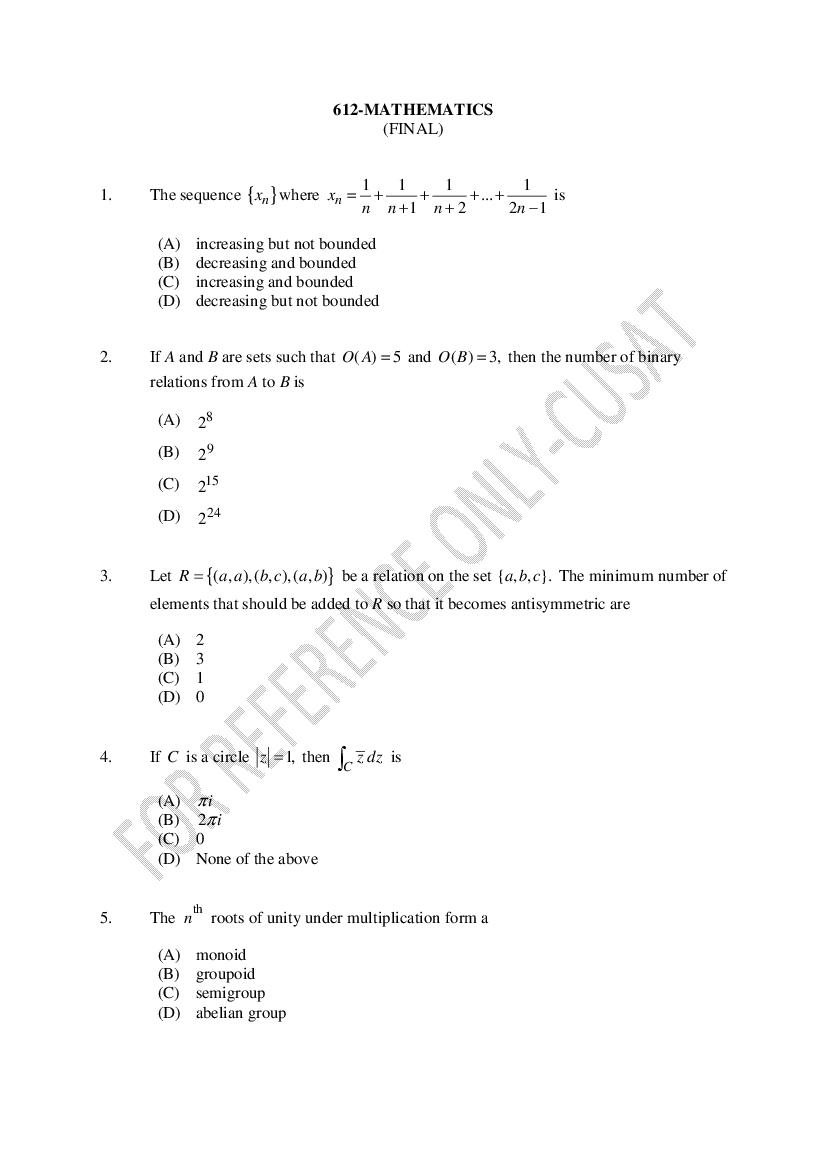
(FINAL)
1 1 1 1
1. The sequence { xn } where xn = + + + ... + is
n n +1 n + 2 2n − 1
(A) increasing but not bounded
(B) decreasing and bounded
(C) increasing and bounded
(D) decreasing but not bounded
2. If A and B are sets such that O ( A) = 5 and O ( B ) = 3, then the number of binary
relations from A to B is
(A) 28
(B) 29
(C) 215
(D) 224
3. Let R = {(a, a), (b, c), (a, b)} be a relation on the set {a, b, c}. The minimum number of
elements that should be added to R so that it becomes antisymmetric are
(A) 2
(B) 3
(C) 1
(D) 0
4. If C is a circle z = 1, then ∫ z dz is
C
(A) π i
(B) 2π i
(C) 0
(D) None of the above
th
5. The n roots of unity under multiplication form a
(A) monoid
(B) groupoid
(C) semigroup
(D) abelian group
Page 2
(A) ( )
x 2 y ''+ xy '+ x 2 − n 2 y = 0
(B) (1 − x2 ) y ''+ 2 xy '− n ( n + 1) y = 0
(C) (1 − x ) y ''− 2 xy '+ n ( n + 1) y = 0
2
(D) (1 − x ) y ''− xy '+ ( x − n ) y = 0
2 2 2
m
7. The set of rational numbers of the form (m, n are integers) is a group under
2n
(A) addition
(B) subtraction
(C) multiplication
(D) division
8. {
The generators of the group G = a, a 2 , a3 , a 4 = e are}
(A) a only
(B) a and a 2
(C) a and a3
(D) a and a 4
dy
9. The solution of = y 2 , y (0) = 1, exists for all
dx
(A) x ∈ (−∞,1)
(B) x ∈ [0, a ] where a > 1
(C) x ∈ (−∞, ∞)
(D) x ∈ [1, a ] where a > 1
r r
10. The value ∫ F .dr , where F = x 2 y 2i + yj and C is y 2 = 4 x from (0, 0) to (4, 4), is
C
(A) 64
(B) −128
(C) 128
(D) 264
Page 3
the direction of the line PQ where Q has the coordinates (5, 0, 4) is
28
(A)
15
13
(B)
21
4
(C)
15
28
(D)
21
12. If {α , β } is an orthonormal set, then the distance between α and β is
(A) 3
(B) 0
(C) 3
(D) 2
13. The function f ( z ) = z 2 is differentiable
(A) nowhere
(B) everywhere
(C) only at 0
(D) only in |z| < 1
14. The equation of the plane passing through the points (−1, 1, 1) and (1, −1, 1) and
perpendicular to the plane x + 2y + 2z = 7 is
(A) 4x + 2y − 3z + 5=0
(B) 4x + 4y − 6z + 5=0
(C) 2x + 2y − 3z + 3=0
(D) 2x + 2y − 6z + 3=0
15. The total number of subgroups of Z contained in 20Z is
(A) 6
(B) 2
(C) infinite
(D) 18
Page 4
(A) (Q, +) is a cyclic group
(B) Every abelian group is cyclic
(C) Every group of order < 4 is cyclic
(D) Every element of a cyclic group generates the group
17. The equation of a right circular cone with vertex at origin 0,
axis the x-axis and semi-vertical angle α is
(A) x 2 + y 2 = x 2 sec h 2α
(B) y 2 + z 2 = x 2 tanh 2 α
(C) y 2 + z 2 = x 2 tan 2 α
(D) x 2 + y 2 = x 2 tanh 2 α
18. Let R be the ring of all real valued functions defined on R, under pointwise addition
and multiplication. Which of the following subsets of R is not a subring?
(A) Set of all continuous functions
(B) Set of all polynomial functions
(C) Set of all functions which are zero at finitely many points together with the
zero function
(D) Set of all functions which are zero at countable number of points
2 2
19. Let T : R → R be a linear transformation such that T(1, 0) = (1, 1) and T(0, 1) = (−1, 2).
Then T maps the square with vertices (0, 0), (1, 0), (1, 1) and (0, 1) into a
(A) rectangle
(B) trapezium
(C) square
(D) parallelogram
z −1 π
20. The locus of the complex number satisfying arg = is a
z +1 3
(A) straight line
(B) circle
(C) parabola
(D) hyperbola
Page 5
then it is necessary that
(A) z1 = z2
(B) z2 = 0
(C) z1 = λ z2 for all real number λ
(D) z1z2 = 0 or z1 = λ z2 for some real number λ
x − sin x, if x is rational
22. Consider the function f ( x) = . Then
0 ,if x is irrational
(A) f ( x) is everywhere discontinuous
(B) f ( x) is continuous at one point
(C) f ( x) is continuous more than one point but at countable points
(D) f ( x) is continuous at exactly two points
23. The function f ( x) = x + x − 1 , x ∈ R is
(A) continuous but not differentiable at x = 0 and x = 1
(B) discontinuous at x = 0 and x = 1
(C) discontinuous at x = 0 and not differentiable at x = 1
(D) differentiable everywhere
2 2 2
24. The plane x + 2y – z = 4 and the sphere x + y + z + x + z – 2 = 0
(A) do not meet each other
(B) intersect at only one point
(C) intersect along a circle of unit radius
(D) intersect along the great circle
25. The number of elements of order 11 in a group of order 33 are
(A) 0
(B) 10
(C) 20
(D) 30
Page 6
(A) (n + 3)r
(B) (n + 3)r −2n
(C) (n + 3)r n
(D) nr −(n+3)
27. Green's theorem applied to ∫ (cos x sin y − xy )dx + sin x cos ydy,
C
2 2
where C is the circle x + y = 1, yields
1
(A)
2
1
(B)
4
(C) 0
2
(D)
3
28. The units of Z6 are
(A) 1, −1
(B) 1, 2, 3, 5
(C) 1, 5
(D) 1, 2, 3, 4
29. The only function among the following that is analytic is
(A) f ( z ) = Re( z )
(B) f ( z ) = Im( z )
(C) f ( z) = z
(D) f ( z ) = sin z
∞ 1
30. The series g ( z ) = ∑ n=1 2 sin n 2π z is
n
(A) not absolutely convergent
(B) uniformly convergent
(C) convergent but not uniformly convergent
(D) not uniformly convergent
Page 7
(A) A does not have 0 as an eigen value
(B) A has at least one positive eigen value
(C) If A−1 exists, then A−1 is real and symmetric
(D) All eigen values of A are complex numbers
32. The largest possible order of elements in S7 is
(A) 7
(B) 12
(C) 8
(D) 6
d4y d2y
33. The set of linearly independent solutions of the differential equation − = 0 is
dx 4 dx 2
(A) {1, x, e x , e− x }
−x −x
(B) {1, x, e , xe }
(C) {1, x, e , xe }
x x
−x
(D) {1, x, e , xe }
x
34. The least natural number a for which x + ax −2 > 2 for all x ∈ R +
(A) 1
(B) 2
(C) 5
(D) 9
Page 8
(A) x 2 + y 2 = C2
(B) xy = C2
(C) y = C2
(D) x = C2
36. Let C be the positively oriented unit circle z = 1. Then the integral
eiπ z sin(π z ) z 5
∫C 1 1 dz is equivalent to
z − z +
2 2
π
(A) −
4
π
(B)
4
π
(C) −
8
π
(D)
8
37. Any three vectors { x1, x2 , x3} in 2
(A) are linearly independent
(B) are linearly dependent
(C) form a basis for 2
(D) generate a non-trivial subspace of 2
38. The number abelian groups of order 8 is
(A) 2
(B) 3
(C) 1
(D) 4
Page 9
39. The integral surface of the partial differential equation x +y = 0 satisfying the
∂x ∂y
condition u (1, y ) = y is given by
y
(A) u ( x, y ) =
x
2y
(B) u ( x, y ) =
x +1
y
(C) u ( x, y ) =
2− x
(D) u ( x, y ) = y + x − 1
40. The probability that a single toss of a die will result in a number less than 4 if the toss
resulted in an odd number is
1
(A)
3
2
(B)
3
(C) 1
1
(D)
2
41. Let T : 2 → 2 be the linear map which maps each point in 2 to its reflection on
the x-axis. Then the determinant and trace of T are given by
(A) determinant = 1, trace = 0
(B) determinant = −1, trace = 1
(C) determinant = −1, trace = 0
(D) determinant = 2, trace = 1
n2
42. The radius of convergence of ∑ n x n is
2
(A) 2
1
(B)
2
(C) 1
(D) ∞
Page 10
43. The inverse Laplace transform of 4 is
s + 4a 4
1
(A) − sin at sinh at
2a
1
(B) − sin at sinh at
2a 2
1
(C) sin at sinh at
2a
1
(D) sin at sinh at
2a 2
44. The number of generators of a cyclic group of order 8 is
(A) 2
(B) 4
(C) 6
(D) 8
45. Let M (n, ) be the vector space of n × n matrices with real entries. Let
U be the subset of M (n, ) consisting {( a ) | a + a + ... + a = 0}.
ij 11 22 nn
Then the dimension of the subspace U is
n(n + 1)
(A)
2
(B) n2
(C) n2 − 1
n(n − 1)
(D)
2
46. The general integral of yzp + zxq = xy is
(A) f ( x + y, y + z ) = 0
(B) f ( x2 + y2 , x2 + z 2 ) = 0
(C) f ( x2 − y 2 , x2 − z 2 ) = 0
(D) f ( x + y + z, x) = 0
Page 11
x sin , x ≠ 0
47. Let f :[−1,1] → be defined by f ( x) = x , where is the
0, x=0
set of all real numbers. Then
(A) f satisfies the condition of Rolles theorem on [1, 1]
(B) f satisfies the condition of Lagranges mean value theorem on [1, 1]
(C) f satisfies the condition of Rolles theorem on [0, 1]
(D) f satisfies the condition of Lagranges mean value theorem on [0, 1]
48. The expectation of a discrete random variable X, whose probability function is given
x
1
by f ( x) = , x = 1, 2,3..., is
2
(A) 1
1
(B)
2
(C) 2
1
(D)
4
49. If G ≠ {e} is a group having no proper subgroup, then G is a
(A) cyclic group of prime order
(B) cyclic group of even order
(C) cyclic group of odd order
(D) group of even order
50. If D is the region defined by 1 ≤ x 2 + y 2 + z 2 ≤ 2 and z ≥ 0, then
32
2 2 2
x + y +z
∫ ∫ ∫D e
dx dy dz is equal to
2π
(A) ( ) 3
e 8 −e
(B) 2π ( e − e )
8
π
(C)
3
(e − e) 8
π
(D)
2
(e − e) 8
Page 12
orthogonally at (1, −1, 2) is
(A) a = −5 2, b = −1
(B) a = 5 2, b = −1
(C) a = −5 2, b = 1
(D) a = 5 2, b = 1
52. {
The interior of the set r ∈ : 0 < r < 2 is }
(A)
(B)
(C) φ
(D) − {0}
∂ 2u ∂ 2u
53. The general solution of 2
+ = 0 is of the form
∂x ∂y 2
(A) u = f ( x + iy ) + g ( x − iy )
(B) u = f ( x + y) + g ( x − y)
(C) u = cf ( x − iy )
(D) u = g ( x + iy )
54. The general integral of the partial differential equation
( y + zx) z x − ( x + yz ) z y = x 2 − y 2 is
(A) ( )
F x 2 + y 2 + z 2 , xy + z = 0
(B) F ( x + y − z , xy + z ) = 0
2 2 2
(C) F ( x − y − z , xy + z ) = 0
2 2 2
(D) F ( x + y + z , xy − z ) = 0
2 2 2
Page 13
The probability that they are both aces if the first card is replaced is
1
(A)
221
1
(B)
169
1
(C)
122
1
(D)
196
th
56. If f ( x) is a polynomial of degree n in x, then n difference of this polynomial is
(A) a constant
(B) n
(C) zero
(D) 1
57. Consider the following:
(i) n 2 + n is divisible by 2
(ii) n3 − n is divisible by 3
(iii) n5 − 5n3 + 4n is divisible by 5
Then
(A) Only (i) is true
(B) Only (i) and (ii) are true
(C) Only (i) and (iii) are true
(D) All the three are true
Page 14
(i) The product of four consecutive integers is divisible by 24
(ii) The product of five consecutive positive integers is a perfect square
n
(iii) There exist infinitely many positive integers n such that n
2 +1
6
(iv) for each positive integer n
n(n + 1)(2n + 1)
Then
(A) (i) is true
(B) (ii) is not true
(C) (iii) is true
(D) (iv) is true
59. ( )
Let A = aij be a 2 × 2 lower triangular matrix with diagonal entries
( )
a11 = 1 and a22 = 3. If A−1 = bij then
(A) b11 = 1, b22 = 1
1
(B) b11 = 1, b22 =
3
(C) b11 = 3, b22 = 2
(D) b11 = 3, b22 = 1
1
60. { }
Consider A = ( x, y ) : ( x + 1)2 + y 2 ≤ 1 ∪ ( x, y ) : y = x sin , x > 0 ⊆ 2 . Then
x
(A) A is compact
(B) A is connected
(C) A is bounded
(D) A is not connected
Page 15
cos 2 x, sin 2x and e− x is
(A) ( D3 + D 2 + 4 D + 4 ) y = 0
(B) ( D − D + 4 D − 4 ) y = 0
3 2
(C) ( D + D − 4 D − 4 ) y = 0
3 2
(D) ( D − D − 4 D + 4 ) y = 0
3 2
62. The smallest integer a > 2 such that 2 | a, 3 | a + 1, 4 | a + 2, 5 | a + 3, 6 | a + 4
( a | b mean a divides b) is
(A) 24
(B) 12
(C) 62
(D) 74
63. In a group of 100 people, each one knows at least 67 other people.
Then the minimum number of people who are mutual friends is
(A) 0
(B) 2
(C) 3
(D) 4
64. ( )
A solution of the equation log 4 2 x 2 + x + 1 − log 2 (2 x − 1) = 1 is
3
(A) −
14
(B) −1
(C) 1
6
(D)
14
Page 16
1
f ( x) = e − x c , 0 ≤ x ≤ ∞, c > 0, is
c
(A) 2c 2
(B) c3
(C) c2
(D) 2c 3
66. Suppose that B is a square matrix such that B 2 = B and that λ = 1 is not an
eigenvalue of B. Then B is
(A) a zero matrix
(B) a symmetric matrix
(C) a diagonal matrix
(D) any arbitrary non zero matrix
67. The set of all points of discontinuity of the function f :[−1,1] → defined by
x, is if x is irrational
f ( x) = is
0, is if x is rational
(A) [−1,1]
(B) (−1,1)
(C) [−1,1] − {0}
(D) φ
68. Consider the statements.
(i) In a tree, every edge is a bridge
(ii) In a tree, every non pendant point is a cut point
(iii) Any connected graph ( p, q ) with p + 1 = q is a tree
(iv) Every tree is a bipartite graph
Then
(A) (i) is not true
(B) (ii) is not true
(C) (iii) is not true
(D) (iv) is not true
Page 17
(A) 8
(B) 10
(C) 2
(D) 4
70. The bilinear transformation has ∞ and one finite point as fixed points, when
(A) c ≠ 0; (d − a) 2 + 4bc ≠ 0
(B) c ≠ 0; (d − a) 2 + 4bc = 0
(C) c = 0; a ≠ d
(D) c = 0; a = d
dy y − x + 1
71. The solution of = is
dx y − x + 5
3
(A) (x − y) + 10y − 5x = C
2
(B) (y − x) + 10y − 2x = C
2
(C) (x + y) − 5y + 10x = C
3
(D) (x + y) − 10y − 2x = C
72. {
The sequence 1 + ( −1)
n
} has
(A) exactly one constant subsequence
(B) exactly two constant subsequences
(C) exactly three constant subsequences
(D) exactly four constant subsequences
73. Which amongst the following expressions is NOT true?
3n + 2
(A) lim =1
n→∞ n + 1
3n + 7 4
(B) lim n − 1 =
n→∞ 3n + 3 3
3+ 2 n
(C) lim =2
n→∞ n
(D) lim n n = 1
n→∞
Page 18
(A) A sequence cannot converge to move than one limit
(B) Every convergent sequence is bounded
(C) Every bounded sequence is convergent
(D) Limit of a sequence is unique
∞ ∞
75. Let {a n }n =1 be a sequence converges to 0 and {bn }n=1 be a bounded sequence.
∞
Then {anbn }n=1
(A) converges to one
(B) converges to zero
(C) is a divergent sequence
(D) converges to two
76. Let ∑ an be a convergent series of positive terms and let ∑ bn be a divergent series
of positive terms. Then
(A) the sequence an is convergent and bn is not convergent
(B) the sequence an converges to 0
(C) the sequence bn does not converges to 0
(D) the sequence bn diverges to ∞
π
77. If we expand sin x by Taylor’s series about , then a2 , a7 , a4 , a3 are
2
1 1
(A) − , 0, ,0
2 24
1 1
(B) − , 0, − , 0
2 24
1 1
(C) , 0, ,0
2 24
1 1
(D) 0, − , 0,
2 24
Page 19
then the difference function f − g is
(A) the zero function on I
(B) a constant function on I
(C) a polynomial of degree one on I
(D) a polynomial of degree two on I
79. The function f ( x) = x + 3 is
(A) continuous as well as differentiable on R
(B) continuous on R but not differentiable anywhere on R
(C) not continuous on R
(D) continuous on R and differentiable at all points on R except zero
80. Let S = {(1, i, 0), (2i, 1, 1), (0, 1 + i, 1 – i)} be a subset of the complex vector space
C 3 and T = {(1, 1, 1), (1, 1, 0), (1, 0, 0)} be the subset of the real vector space R3 .
Which of the following is correct?
(A) S and T are both basis
(B) S is a basis but T is not a basis
(C) S is not a basis but T is a basis
(D) Neither S nor T is a basis
0 1 0 0
0 0 1 0
81. If X = , then the rank of X T X ,
0 0 0 1
0 0 0 0
(where X T denotes the transpose of X ) , is
(A) 0
(B) 2
(C) 3
(D) 4
82. The system of equations x − y + 3 z = 4, x + z = 2 and x + y − z = 0 has
(A) unique solution
(B) finitely many solutions
(C) infinitely many solutions
(D) no solution
Page 20
(A) the matrix A + A ' is anti-symmetric, but the matrix A − A ' is symmetric
(B) the matrix A + A ' is symmetric, but the matrix A − A ' is anti-symmetric
(C) both A + A ' and A − A ' matrices are symmetric
(D) both A + A ' and A − A ' matrices are anti-symmetric
2 3 4
84. Let A = 0 5 6 . Then
0 0 7
2
(A) A is diagonalizable but not A
2
(B) A is diagonalizable but not A
(C) both A and A2 are diagonalizable
2
(D) neither A nor A is diagonalizable
85. Let T1 and T2 be two linear operators on R3 defined
by T1 ( x, y, z ) = ( x, x + y, x − y − z ) and
T2 ( x, y, z ) = ( x + 2 z , y − z , x + y + z ) . Then
(A) T1 is invertible but not T2
(B) T2 is invertible but not T1
(C) both T1 and T2 are invertible
(D) neither T1 nor T2 is invertible
86. The complex numbers z1 = 1 + 2i , z2 = 4 − 2i and z3 = 1 − 6i form the vertices of
(A) a right angled triangle
(B) an isosceles triangle
(C) an equilateral triangle
(D) a scalene triangle
Page 21
87. The radius of convergence of the power series ∑ (n + 2i)n z n is
n =0
(A) 0
(B) 1
(C) ∞
(D) 2
∞
The center of convergence of ∑ (n + 2i ) z
n n
88. is
n =0
(A) 0
(B) 1
(C) 2
(D) 3
89. ( )
The function f ( z ) = log z 2 + z − 2 has branch poles at
(A) z = 1, z = −1
(B) z = 2, z = − 2
(C) z = 1, z = − 2
(D) z = 3, z = −2
90. The bilinear transformation which maps the points z1 = 2, z 2 = i and z3 = −2 into the
points w1 = 1, w2 = i and w3 = −1 respectively, is
3 z + 2i
(A) w=
iz + 6
(B) w=0
(C) w = iz
z2
(D) w=
2
91. Numbers between 5000 and 10000 are formed from the digits 1, 2, 3, 4, 5, 6, 7, 8, 9
each digit not appearing more than once in each number. The number of such
numbers is
(A) 1080
(B) 1680
(C) 336
(D) 1008
Page 22
If gcd ( a, b ) = 1 , then gcd a + b, a 2 − ab + b 2 is
(A) 0 or 1
(B) 1 or 2
(C) 1 or 3
(D) 2 or 3
93. Number of the solutions of the congruence 15x ≡ 6 ( mod 21) is
(A) 1
(B) 2
(C) 3
(D) 4
94. If ac ≡ bc ( mod m ) and d = ( m, c ) , then
m
(A) a ≡ b mod
d
m
(B) a ≡ c mod
d
b
(C) a ≡ m mod
d
(D) a ≡ b(mod c )
95. { }
Let G = ( 0,1, 2,3, 4 ) , +5 . Then the order of 2 in G is
(A) 1
(B) 2
(C) 4
(D) 5
96. Given the permutation c = (1 2 3 4 5 6 7 ) . Then c 3 is
(A) (1 3 5 7 2 4)
(B) (1 4 7 3 6 2 5)
(C) (1 7 6 5 4 3 2)
(D) (1 4 7 6 3 5 2)
Page 23
G
Let F : G → defined by F ( x ) = Nx ∀ x ∈ G. Then
N
G
(A) F is a homomorphism of G into with ker F ≠ N
N
G
(B) F is a homomorphism of G onto with ker F ≠ N
N
G
(C) F is a homomorphism of G into with ker F = N
N
G
(D) F is a homomorphism of G onto with ker F = N
N
98. Which of the following is a compact subspace of R?
(A) {0} ∪{n | n ∈ z+ }
1
(B) The subspace X = {0} ∪ | n ∈ z+ of R
n
(C) [0, 1)
(D) (0, 1)
99. The real part of the complex number (1 + i ) n is
n
nπ
(A) 2 2 cos
4
nπ
(B) 2n cos
2
n
(C)
2 2 cos nπ
nπ
(D) 2− n cos
2
Page 24
(A) Re( z ) = 1
1
(B) Re ( z ) =
2
(C) Im( z ) = 1
1
(D) Im( z ) =
2
ez
101. ∫C z − 2 dz where C : z = 3 is
The value of the integral
(A) 2π ie 2
(B) 2π ie
(C) e2
(D) 2π i
102. The unit digit of 2100 is
(A) 2
(B) 4
(C) 6
(D) 8
103. The number of generators in a cyclic group of order 10 is
(A) 3
(B) 1
(C) 2
(D) 4
Page 25
104. If α and β are the eigenvalues of −1 5 , then
the matrix whose eigenvalues are α 3 and β 3 is
38 −50
(A) −50 138
−50 38
(B) 138 −50
−50 −50
(C) 38 138
−50 −50
(D) 138 38
105. Given that the equations x + y + z = 6, x + 2y + 3z = 10 and x + 2y + λz = µ have an
infinite number of solutions. Then
(A) λ = 10, µ = 3
(B) λ = 5, µ = 5
(C) λ = 3, µ =10
(D) λ = 2, µ = 10
sinh x − sin x
106. lim is equal to
x→0 x3
1
(A)
2
1
(B)
4
1
(C)
3
1
(D)
5
Page 26
107. If = , then θ is equal to
θ 2523
1
(A) radians
28
1
(B) radians
29
1
(C) radians
30
1
(D) radians
25
108. sinh −1 x 2 − 1 =
(A) sinh −1 x
(B) tanh −1 x
(C) cosh −1 x
(D) cot −1 x
109. An equation of the form zz + bz + bz + c = 0 (c is real) represents
(A) a circle
(B) an ellipse
(C) a parabola
(D) a hyperbola
110. The transformation w =cos z makes the line x = a in the z-plane corresponds to
(A) a hyperbola
(B) a parabola
(C) an ellipse
(D) a circle
Page 27
111. The residue of 2 at z = ia is
z + a2
(A) ia
(B) 2ia
1
(C) ia
2
(D) 3ia
112. The standard deviation of a symmetrical distribution is 3. The fourth moment about
mean (assuming that the distribution is mesokurtic) is
(A) 240
(B) 241
(C) 242
(D) 243
113. The coefficients of correlation between two variables x and y is 0.8.
The covariance between x and y is 18 and the standard deviation of x is 3.
The standard deviation of y is
(A) 7
(B) 8
(C) 7.5
(D) 8.5
114. If the two regression coefficients are 0.8 and 0.2,
then the value of correlation coefficient is
(A) r = 0.2
(B) r = 0.3
(C) r = 0.1
(D) r = 0.4
115. If a is constant vector and r is the position vector of any point, then div ( a × r ) is
(A) 0
(B) 1
(C) 2
(D) 3
Page 28
(A) n = −2
(B) n = −3
(C) n = −1
(D) n=1
2
117. The image of x + y = 2 under the transformation w = z is
(A) a hyperbola
(B) a circle
(C) an ellipse
(D) a parabola
1 1 1 1
118. The series + + + + ... is
1.2 2.3 3.4 4.5
(A) divergent
(B) convergent
(C) oscillating
(D) converges to 10
119. If c0 , c1, c2 ,..., cn denote the binomial coefficients in the expansion of (1 + x)n ,
then c1 + 2c2 + 3c3 + ...ncn =
(A) n.2n
(B) n.2n+1
(C) n.2n−1
(D) 2n
Page 29
120. Sum the series to n terms: + + + + ...
1.4 4.9 9.16 16.25
1
(A) 1 +
(n + 1) 2
1
(B) 1−
(n + 1)2
1
(C) 1 −
(n − 1) 2
1
(D) 1 +
(n − 1)2
3 2 2
121. A particle moves along a straight line according to the law s = t – 6t + 9t + 3.
The velocity, at the instant where its acceleration is zero, is
(A) −3 unit/sec
(B) −2 unit/sec
(C) 3 unit/sec
(D) 2 unit/sec
122. The value of (to five places of decimals) cube root of 1003 is
(A) 10.00333
(B) 10.00666
(C) 10.00444
(D) 10.00999
a −b−c 2a 2a
123. 2b b−c−a 2b is a
2c 2c c −a−b
(A) perfect square
(B) quadratic
(C) biquadratic
(D) perfect cube
Page 30
the function f ( x) = 1 − x 2 in 0 ≤ x ≤ 2 is
(A) c=2
(B) c=3
(C) c=0
(D) c =1
2
125. The area of the region bounded by the parabola y = 2 – x and the line y = −x is
9
(A)
4
3
(B)
4
9
(C)
2
5
(D)
2
4 − 16 + x
126. lim is equal to
x→0 x
1
(A)
8
1
(B) −
8
1
(C)
4
1
(D) −
4
127. Ten percent of the tools produced in a certain manufacturing process turn out to be
defective. The probability that in a sample of 10 tools chosen at random, exactly 2
will be defective is
(A) 0.19
(B) 0.16
(C) 0.15
(D) 0.17
Page 31
128. The density function of a random variable x is given by f ( X ) = x , 0 < x < 2.
2
The expected value of x is
3
(A)
4
4
(B)
5
4
(C)
3
5
(D)
3
129. If f : A → B and g : B → C be functions such that the g o f : A → C is surjective,
then the mapping g is
(A) injective
(B) surjective
(C) bijective
(D) not surjective
130. If a, b are elements of a group G such that O(a ) = 3 and aba −1 = b 2 , then O(b) is
(A) 4
(B) 5
(C) 6
(D) 7
131. Let R be a ring such that a 2 = a for all a ∈ R. Then, for any element b in R, 2b equals
(A) 0
(B) 1
(C) 2
(D) 4
3
132. A basis of R which contains (1, 2, 0) and (1, 3, 1) is
(A) {(1, 2, 0), (1, 3, 1), (0, 1, 0), (1, 1, 0)}
(B) {(1, 2, 0), (0, 1, 0), (1, 3, 1)}
(C) {(1, 2, 1), (0, 1, 1), (1, 3, 1)}
(D) {(1, 2, 0), (1, 3, 1), (1, 1, 1), (−1, 1, 0)}
Page 32
(A) real
(B) imaginary
(C) rational
(D) irrational
1 1 1
134. If x + y + z = 1, then the least value + + =
x y z
(A) 9
(B) 8
(C) 6
(D) 4
135. If α is special root of the equation x8 − 1 = 0, then 1 + 3α + 5α 2 + ... + 15α 7 =
15
(A)
α −1
16
(B)
α −1
17
(C)
α −1
18
(D)
α −1
136. If U = L {(1, 2,1), (2,1,3)} and W = L {(1,0, 0), (0,1, 0)} are the subspaces of R3 ,
then dim(U + W ) =
(A) 1
(B) 2
(C) 4
(D) 3
Page 33
137. If ∆ = a 2 b2 c 2 , then
a3 b3 c3
(A) ∆ = (a − b)(b − c)(c − a )(ab − bc − ca )
(B) ∆ = (a − b)(b − c)(c − a )(ab + bc + ca )
(C) ∆ = (a + b)(b + c)(c − a )(ab + bc + ca )
(D) ∆ = (a + b)(b + c)(c + a )(ab + bc + ca )
138. The direction cosines of the line joining the points A(−4,9, 6) and B (−1, 6, 6) are
1 1
(A) ,− ,0
2 2
1 1
(B) , ,0
2 2
1
(C) 1, − ,0
2
1 1 1
(D) ,− ,
2 2 2
139. The equation of a sphere described on the line joining the
points (2, −1, 4) and (−2, 2, −2) as diameter, is
(A) x 2 + y 2 + z 2 + y + 2 z − 14 = 0
(B) x 2 + y 2 + z 2 − y − 2 z − 14 = 0
(C) x 2 + y 2 + z 2 + y − 2 z + 14 = 0
(D) x 2 + y 2 + z 2 + y + 2 z + 14 = 0
Page 34
140. The n order derivative of sin(ax + b) is
π
(A) a n sin ax + b +
2
π
(B) a n−1 sin ax + b +
2
nπ
(C) a n sin ax + b +
2
nπ
(D) a n−1 sin ax + b +
2
a
x7
141. The value of ∫ dx is equal to
0 ( a 2 − x2 )
16
(A)
35a 7
17
(B)
35a 7
19
(C)
35a 7
13
(D)
35a 7
142. A problem in mechanics is given to 3 students A, B and C whose
1 1 1
chances of solving it are , and respectively. Then the
2 3 4
probability that the problem will be solved is
1
(A)
4
1
(B)
2
1
(C)
3
3
(D)
4
Page 35
(A) are linearly dependent
(B) are linearly independent
(C) form a basis for 3
(D) form a basis for 4
144. One of the particular integral of the PDE r − 2 s + t = cos(2 x + 3 y ) is
(A) sin(2 x + 3 y )
(B) cos(3 x + 2 y )
(C) sin(2 x − 3 y )
(D) cos( x + y )
145. The order x7 in a group of order 56 is
(A) 8
(B) 16
(C) 24
(D) 56
146. The characteristic of ( 189 , +, ⋅) is
(A) 1
(B) 17
(C) 189
(D) ∞
147. The number of group homomorphisms from S3 to 6 is
(A) 1
(B) 2
(C) 3
(D) 4
148. The automorphism group of the group ( 10 , +10 ) is a
(A) group of order 3
(B) cyclic group of order 4
(C) non-abelian group
(D) non cyclic group of order 4
Page 36
(A) B ⊂ f −1 ( f ( B ) )
(B) B = f −1 ( f ( B ) )
(C) ( )
B ⊂ f f −1 ( B)
(D) B = f ( f ( B) )
−1
150. If A and B are irrotational vectors, then ( A × B ) is
(A) irrotational
(B) rotational
(C) solenoidal
(D) flux
Page 37
Subject Name: 612 MATHEMATICS
SI No. Key SI No. Key SI No. Key SI No. Key SI No. Key
1 C 31 C 61 A 91 B 121 A
2 C 32 B 62 C 92 C 122 D
3 D 33 A 63 D 93 B 123 D
4 B 34 B 64 C 94 A 124 D
5 D 35 B 65 A 95 D 125 C
6 C 36 C 66 A 96 B 126 B
7 A 37 B 67 C 97 D 127 A
8 C 38 B 68 C 98 B 128 C
9 A 39 A 69 C 99 A 129 B
10 D 40 B 70 C 100 B 130 D
11 D 41 C 71 B 101 A 131 A
12 D 42 A 72 B 102 C 132 B
13 C 43 D 73 A 103 D 133 A
14 C 44 B 74 C 104 A 134 A
15 C 45 C 75 B 105 C 135 B
16 C 46 C 76 B 106 C 136 D
17 C 47 D 77 A 107 B 137 B
18 D 48 C 78 B 108 C 138 A
19 D 49 A 79 D 109 A 139 B
20 B 50 A 80 B 110 A 140 C
21 D 51 D 81 C 111 C 141 A
22 B 52 C 82 C 112 D 142 D
23 A 53 A 83 B 113 C 143 A
24 C 54 B 84 C 114 D 144 A
25 B 55 B 85 A 115 A 145 A
26 C 56 A 86 B 116 B 146 B
27 C 57 D 87 A 117 D 147 C
28 C 58 B 88 A 118 B 148 B
29 D 59 B 89 C 119 C 149 A
30 B 60 B 90 A 120 B 150 C
Document Details
| Board / Org | Cochin University |
| Exam | CUSAT Common Admission Test |
| Type | Question Paper |
| Pages | 37 |
| Updated | 22 Jul 2026 |