CBSE Class 11 Political Science Syllabus 2021-22
Finished viewing? Save it for later —
Download CBSE Class 11 Political Science Syllabus 2021-22 (PDF · 6 pages)About CBSE Class 11 Political Science Syllabus 2021-22
CBSE Class 11 Political Science Syllabus 2021-22 is available here for free download. Published by CBSE for Class 11, this syllabus can be viewed online or downloaded as a PDF (6 pages). Candidates preparing for Class 11 can use CBSE Class 11 Political Science Syllabus 2021-22 to understand the exam pattern, the type of questions asked, and the overall difficulty level.
Frequently Asked Questions
How can I download CBSE Class 11 Political Science Syllabus 2021-22?
Open this page and click the Download button to save CBSE Class 11 Political Science Syllabus 2021-22 as a PDF. It is completely free on AglaSem Docs.
Is CBSE Class 11 Political Science Syllabus 2021-22 free to download?
Yes. CBSE Class 11 Political Science Syllabus 2021-22 can be viewed online and downloaded as a PDF free of cost on AglaSem Docs.
How many pages does CBSE Class 11 Political Science Syllabus 2021-22 have?
CBSE Class 11 Political Science Syllabus 2021-22 contains 6 pages, which you can read online or download together as a single PDF.
Where can I find more Class 11 study material?
You can find more Class 11 question papers, sample papers, syllabus, and answer keys on AglaSem Docs.
CBSE Class 11 Political Science Syllabus 2021-22 – Text
Read the full text of this syllabus below — useful to quickly search, copy and reference the content online without downloading the PDF.
📄 View text version (6 pages)
Page 1
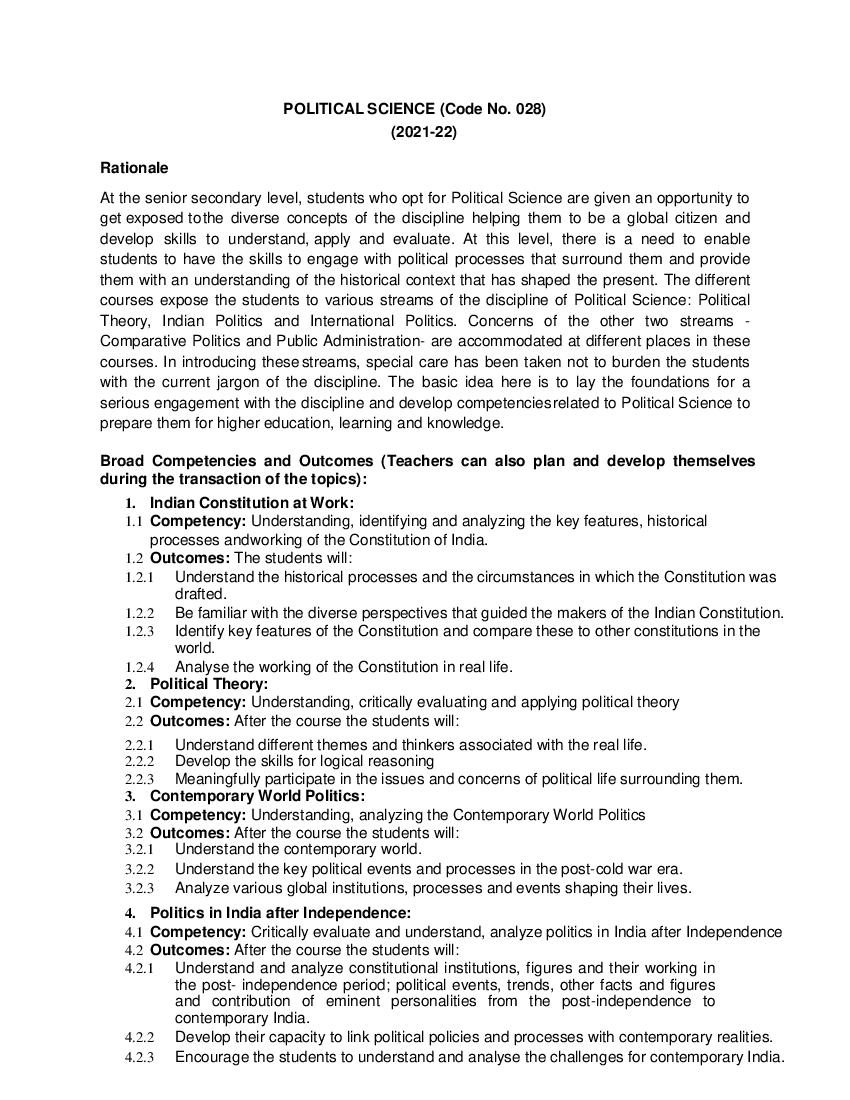
(2021-22)
Rationale
At the senior secondary level, students who opt for Political Science are given an opportunity to
get exposed to the diverse concepts of the discipline helping them to be a global citizen and
develop skills to understand, apply and evaluate. At this level, there is a need to enable
students to have the skills to engage with political processes that surround them and provide
them with an understanding of the historical context that has shaped the present. The different
courses expose the students to various streams of the discipline of Political Science: Political
Theory, Indian Politics and International Politics. Concerns of the other two streams -
Comparative Politics and Public Administration- are accommodated at different places in these
courses. In introducing these streams, special care has been taken not to burden the students
with the current jargon of the discipline. The basic idea here is to lay the foundations for a
serious engagement with the discipline and develop competencies related to Political Science to
prepare them for higher education, learning and knowledge.
Broad Competencies and Outcomes (Teachers can also plan and develop themselves
during the transaction of the topics):
1. Indian Constitution at Work:
1.1 Competency: Understanding, identifying and analyzing the key features, historical
processes and working of the Constitution of India.
1.2 Outcomes: The students will:
1.2.1 Understand the historical processes and the circumstances in which the Constitution was
drafted.
1.2.2 Be familiar with the diverse perspectives that guided the makers of the Indian Constitution.
1.2.3 Identify key features of the Constitution and compare these to other constitutions in the
world.
1.2.4 Analyse the working of the Constitution in real life.
2. Political Theory:
2.1 Competency: Understanding, critically evaluating and applying political theory
2.2 Outcomes: After the course the students will:
2.2.1 Understand different themes and thinkers associated with the real life.
2.2.2 Develop the skills for logical reasoning
2.2.3 Meaningfully participate in the issues and concerns of political life surrounding them.
3. Contemporary World Politics:
3.1 Competency: Understanding, analyzing the Contemporary World Politics
3.2 Outcomes: After the course the students will:
3.2.1 Understand the contemporary world.
3.2.2 Understand the key political events and processes in the post-cold war era.
3.2.3 Analyze various global institutions, processes and events shaping their lives.
4. Politics in India after Independence:
4.1 Competency: Critically evaluate and understand, analyze politics in India after Independence
4.2 Outcomes: After the course the students will:
4.2.1 Understand and analyze constitutional institutions, figures and their working in
the post- independence period; political events, trends, other facts and figures
and contribution of eminent personalities from the post-independence to
contemporary India.
4.2.2 Develop their capacity to link political policies and processes with contemporary realities.
4.2.3 Encourage the students to understand and analyse the challenges for contemporary India.
Page 2
Part A: Indian Constitution at Work
1. Constitution 30 Periods
Constitution: The Philosophy and Making of the Constitution, Fundamental Rights
and Duties, Directive Principles of State Policy, Constitutional Amendments.
2. Election and Representation 14 Periods
Elections and Democracy, Election System in India, Electoral Reforms.
3. Legislature 14 Periods
Why do we need a Parliament? Unicameral/Bicameral Legislature, Functions and
Power of the Parliament, Parliamentary Committees, Parliamentary Officials: Speaker,
Deputy Speaker, Parliamentary Secretary.
4. Executive 12 Periods
Parliamentary Executive in India: the President, the Prime Minister and the Council of
Ministers. Permanent Executive: Bureaucracy.
5. Judiciary 12 Periods
Why do we need an Independent Judiciary? Structure and Jurisdiction of the
Judiciary, Judicial Review, Judicial Activism, Judicial Over-reach.
6. Federalism 14 Periods
Meaning of Federalism, Evolution & Growth of Indian Federalism: Quasi Federalism,
Cooperative Federalism, Competitive Federalism.
7. Local Governments 14 Periods
Why do we need Local Governments? Growth of Local Governments in India, 73rd
and 74th Constitutional Amendments, Working and Challenges of Local Governments.
Page 3
8. Political Theory: An Introduction 12 Periods
What is Politics? Politics vs Political Theory, Importance of Political Theory.
9. Liberty 12 Periods
Liberty vs Freedom, Negative and Positive Liberty.
10. Equality 12 Periods
What is Equality? Significance of Equality, Various Dimensions of Equality, How can
we promote Equality?
11. Justice 12 Periods
What is Justice? Different Dimensions of Justice, Distributive Justice.
12. Rights 12 Periods
What are Rights? History of Rights, Kinds of Rights, Human Rights.
13. Citizenship 13 Periods
Citizen and Citizenship, Citizen and Nation, Global Citizenship.
14. Nationalism 13 Periods
Nation and Nationalism, Variants of Nationalism, Nationalism & Multiculturalism.
15. Secularism 12 Periods
What is Secularism? Western and Indian Perspectives of Secularism, Salient
Features of Indian Secularism.
16. Development 12 Periods
Growth vs. Development, Different Models of Development – Welfare State Model,
Market Model, Developmental Model.
Prescribed Books:
1. Indian Constitution at Work, Class XI, Published by NCERT
2. Political Theory, Class XI, Published by NCERT
3. Uploaded Additional Study Materials
Note: The above textbooks are also available in Hindi and Urdu versions.
Page 4
1. Weightage of Content
Part A: Indian Constitution at Work
Unit Content Marks
s s
1 Constitution 12
2 Election and Representation
10
3 The Legislature
4 The Executive
08
5 The Judiciary
6 Federalism
10
7 Local Governments
Total 40
Part B: Political Theory
Unit Contents Marks
s
8 Political Theory: An Introduction 06
9 Liberty
08
10 Equality
11 Justice
08
12 Rights
13 Citizenship
10
14 Nationalism
15 Secularism
08
16 Development
Total 40
Page 5
POLITICAL SCIENCE(CODE NO. 028)
CLASS XI
TIME: 3 Hours Max. Marks : 80
S.No Competencies Total Marks % Weightage
1 Demonstrative Knowledge + Understanding
(Knowledge based simple recall questions, to know
specific facts, terms, concepts, principles, or theories,
Identify, define, or recite, information) (Comprehension – 29 Upto 37%
to be familiar with meaning and to understand
conceptually, interpret, compare, contrast, explain,
paraphrase information)
2 Knowledge / Conceptual Application (Use abstract
information in concrete situation, to apply knowledge to
new situations; Use given 27 Upto 33%
content to interpret a situation, provide an example, or solve a
problem)
3 Formulation Analysis, Evaluation and Creativity
(Analysis & Synthesis- Classify, compare, contrast, or
differentiate between different pieces of information; 24 Upto 30%
Organize and/or integrate unique pieces of information
from a variety of sources)(includes Map interpretation)
Total 80 100%
Page 6
□ Scheme of Options:
There is an internal choice for long answer questions of 6 marks.
□ In order to assess different mental abilities of learners, question paper is likely to include
questions based on passages, visuals such as maps, cartoons, etc. No factual question will
be asked on the information given in the plus (+) boxes in the textbooks.
Document Details
| Board / Org | CBSE |
| Exam | Class 11 |
| Type | Syllabus |
| Pages | 6 |
| Updated | 22 Jul 2026 |