Telangana Class 12 Syllabus 2024 Physics
Finished viewing? Save it for later —
Download Telangana Class 12 Syllabus 2024 Physics (PDF · 6 pages)About Telangana Class 12 Syllabus 2024 Physics
Telangana Class 12 Syllabus 2024 Physics is available here for free download. Published by Telangana Board for Class 12, this syllabus can be viewed online or downloaded as a PDF (6 pages). Candidates preparing for Class 12 can use Telangana Class 12 Syllabus 2024 Physics to understand the exam pattern, the type of questions asked, and the overall difficulty level.
Frequently Asked Questions
How can I download Telangana Class 12 Syllabus 2024 Physics?
Open this page and click the Download button to save Telangana Class 12 Syllabus 2024 Physics as a PDF. It is completely free on AglaSem Docs.
Is Telangana Class 12 Syllabus 2024 Physics free to download?
Yes. Telangana Class 12 Syllabus 2024 Physics can be viewed online and downloaded as a PDF free of cost on AglaSem Docs.
How many pages does Telangana Class 12 Syllabus 2024 Physics have?
Telangana Class 12 Syllabus 2024 Physics contains 6 pages, which you can read online or download together as a single PDF.
Where can I find more Class 12 study material?
You can find more Class 12 question papers, sample papers, syllabus, and answer keys on AglaSem Docs.
Telangana Class 12 Syllabus 2024 Physics – Text
Read the full text of this syllabus below — useful to quickly search, copy and reference the content online without downloading the PDF.
📄 View text version (7 pages)
Page 1
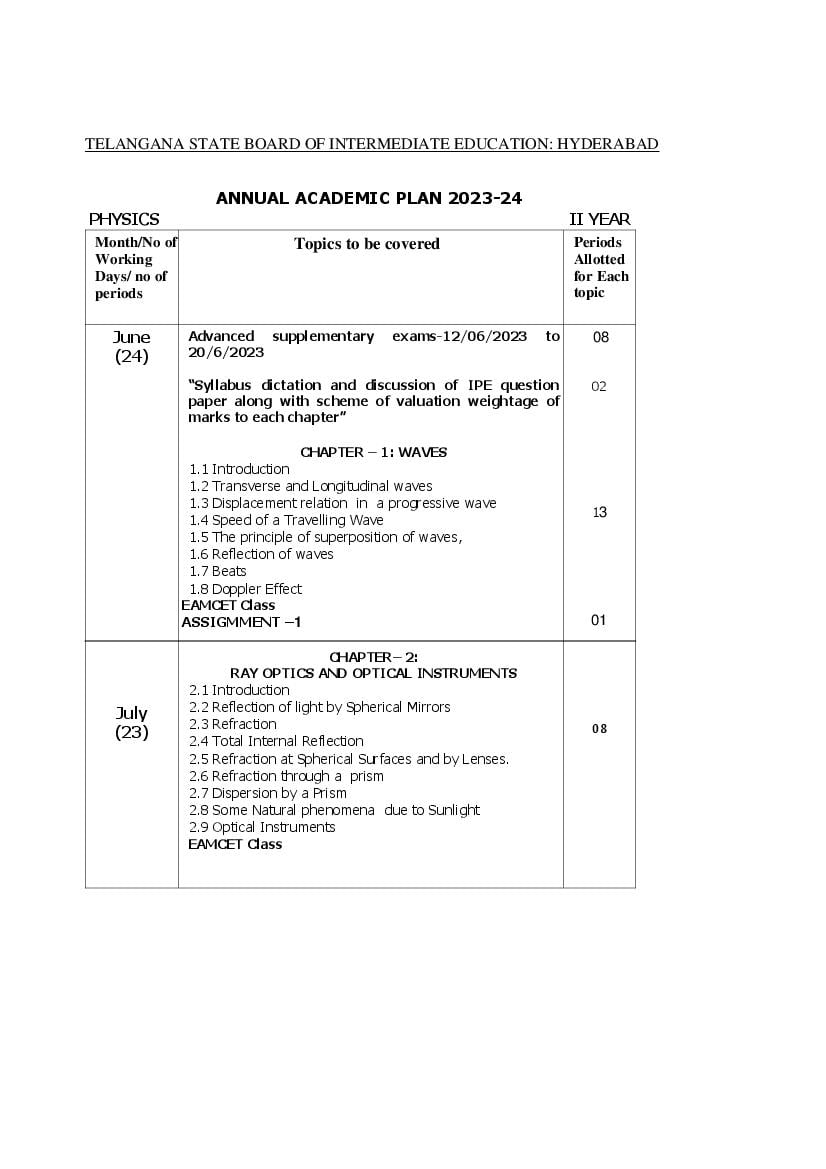
ANNUAL ACADEMIC PLAN 2023-24
PHYSICS II YEAR
Month/No of Topics to be covered Periods
Working Allotted
Days/ no of for Each
periods topic
June Advanced supplementary exams-12/06/2023 to 08
(24) 20/6/2023
“Syllabus dictation and discussion of IPE question 02
paper along with scheme of valuation weightage of
marks to each chapter”
CHAPTER – 1: WAVES
1.1 Introduction
1.2 Transverse and Longitudinal waves
1.3 Displacement relation in a progressive wave
13
1.4 Speed of a Travelling Wave
1.5 The principle of superposition of waves,
1.6 Reflection of waves
1.7 Beats
1.8 Doppler Effect
ASSIGMMENT –1 01
CHAPTER– 2:
RAY OPTICS AND OPTICAL INSTRUMENTS
2.1 Introduction
July 2.2 Reflection of light by Spherical Mirrors
2.3 Refraction 08
(23)
2.4 Total Internal Reflection
2.5 Refraction at Spherical Surfaces and by Lenses.
2.6 Refraction through a prism
2.7 Dispersion by a Prism
2.8 Some Natural phenomena due to Sunlight
2.9 Optical Instruments
Page 2
3.1 Introduction
3.2 Huygens Principle
3.3 Refraction and Reflection of plane waves using Huygens 05
Principle
3.4 Coherent and Incoherent Addition of waves
3.5 Interference of Light waves and Young’s Experiment
3.6 Diffraction
3.7 Polarisation
CHAPTER – 4: ELECTRIC CHARGES AND FIELDS
4.1 Introduction
4.2 Electric Charges 08
4.3 Conductors and Insulators
4.4 Charging by Induction
4.5 Basic Properties of Electric Charge
4.6 Coulomb’s Law
4.7 Forces between Multiple charges
4.8 Electric Field
4.9 Electric Field Lines
4.10 Electric Flux
4.11 Electric Dipole
4.12 Dipole in a uniform external field
4.13 Continuous Charge Distribution
4.14 Gauss’s Law
4.15 Application of Gauss’ Law
ASSIGNMENT-2 01
Unit test 1 01
PRACTICAL:
1. Velocity of sound by Resonance apparatus
2.Determination of focal length of concave mirror
Page 3
(25) ELECTROSTATIC POTENTIAL AND CAPACITANCE
5.1 Introduction
5.2 Electrostatic Potential
5.3 Potential due to a point charge
5.4 Potential due to an Electric Dipole 11
5.5 Potential due to a System of Charges
5.6 Equipotential Surfaces
5.7 Potential Energy of a System of Charges
5.8 Potential Energy in an External field
5.9 Electrostatics of Conductors
5.10 Dielectrics and Polarisation
5.11 Capacitors and Capacitance
5.12 The Parallel Plate Capacitor
5.13 Effect of Dielectric on Capacitance
5.14 Combination of Capacitors
5.15 Energy Stored in a Capacitor
5.16 Van de Graaff Generator
CHAPTER – 6: CURRENT ELECTRICITY
6.1 Introduction
6.2 Electric current
6.3 Electric current in conductors
6.4 Ohm’s Law
6.5 Drift Electrons and Origin of Resistivity
12
6.6 Limitations of Ohms’s Law
6.7 Resistivity of various Materials
6.8 Temperature Dependence of Resistivity
6.9 Electric Energy, Power
6.10 Combination of Resistors – Series and Parallel
6.11 Cells, emf, Internal Resistance
6.12 Cells in Series and in Parallel
6.13 Kirchhoff’s Laws
6.14 Wheatstone Bridge
6.15 Meter Bridge
6.16 Potentiometer
ASSIGNMENT-3 01
Unit test -2 01
Practicals:
3.DETERMINATION OF FOCAL LENGTH OF CONVEX LENS
4.REFRACTIVE INDEX OF PRISM
Page 4
(22)
7.1 Introduction
7.2 Magnetic Force 07
7.3 Motion in a Magnetic field
7.4 Motion in combined Electric and Magnetic Fields
7.5 Magnetic Field due to a Current Element, Biot-Savart
Law
7.6 Magnetic Field on the Axis of a Circular Current Loop
7.7 Ampere’s Circuital Law
7.8 The Solenoid and the Toroid
7.9 Force between two Parallel Currents, The Ampere(Unit)
7.10 Torque on Current Loop, Magnetic Dipole
7.11 The Moving Coil Galvanometer
CHAPTER – 8 MAGNETISM AND MATTER
8.1 Introduction
8.2 The Bar Magnet 05
8.3 Magnetism and Gauss’s Law
8.4 The Earth’s Magnetism
8.5 Magnetisation and Magnetic Intensity
8.6 Magnetic Properties of Materials
8.7 Magnets and Electromagnets
CHAPTER – 9: ELECTROMAGNETIC INDUCTION
9.1 Introduction
9.2 The experiments of Faraday and Henry
08
9.3 Magnetic Flux
9.4 Faraday’s Law of Induction
9.4 Faraday’s Law of Induction
9.5 Lenz’s Law and Conservation of Energy
9.6 Motional Electromotive Force
9.7 Energy consideration : A Quantitative Study
9.8 Eddy Currents
9.9 Inductance
9.10 AC Generator
ASSIGNMENT 4 01
UNIT TEST 3 01
PRACTICALS:
5.meterbridge
Page 5
(18) 10.1 Introduction
10.2 AC voltage applied to a Resistor
10.3 Representation of AC Current and Voltage by
Rotating
Vectors- Phasors 09
10.4 AC voltage applied to an Inductor
10.5 AC voltage applied to a Capacitor
10.6 AC voltage applied to a Series LCR Circuit
10.7 Power in AC Circuit: The Power Factor
10.8 LC Oscillations
,10.9Transformers
CHAPTER – 11: ELECTRO MAGNETIC WAVES
11.1 Introduction 08
11.2 Displacement Current
11.3 Electro Magnetic Waves
11.4 Electromagnetic Spectrum
ASSIGNMENT -5 01
PRACTICALS:
6.magnetic lines of force
7.ohms law
DUSSEHRA HOLIDAYS:19-10-2023 TO 25-10-2023
DATE OF REOPENING: 26-10-2023
November CHAPTER–12:DUAL NATURE OF RADIATION AND
(24) MATTER
12.1 Introduction
12.2 Electron Emission 09
12.3 Photoelectric Effect
12.4 Experimental Study of Photoelectric Effect
12.5 Photoelectric Effect and Wave Theory of Light
12.6 Einstein’s Photoelectric Equation: Energy Quantum of
Radiation
12.7 Particle Nature of Light : The Photon
12.8 Wave Nature of Matter
12.9 Davisson and Germer Experiment
Page 6
13.1 Introduction
13.2 Alpha-particle Scattering and Rutherford’s Nuclear 09
model of Atom13.3 Atomic Spectra
13.4 Bohr Model of the Hydrogen Atom
13.5 The Line Spectra of the Hydrogen Atom
13.6 De Broglie’s Explanation of Bohr’s Second Postulate of
Quantisation
HALF YEARLY EXAMINATIONS:20-11-2023 TO 25-11-2023 06
CHAPTER–14 :NUCLEI
December 14.1 Introduction
(23) 14.2 Atomic Masses and Composition of Nucleus 08
14.3 Size of the Nucleus
14.4 Mass- Energy and Nuclear Binding Energy
14.5 Nuclear Force
14.6 Radioactivity
14.7 Nuclear Energy
CHAPTER–15:SEMICONDUCTOR ELECTRONICS:
MATERIALS, DEVICES AND SIMPLE CIRCUITS
15.1 Introduction
15.2 Classification of Metals, Conductors and Semiconductors
15.3 Intrinsic Semiconductor
15.4 Extrinsic Semiconductor 09
15.5 p – n junction
15.6 Semi conductor diode
15.7 Application of Junction Diode as a Rectifier
15.8 Special Purpose p-n Junction Diodes
15.9 Junction Transistor
15.10 Digital Electronics and Logic Gates
15.11 Integrated Circuits
CHAPTER– 16: COMMUNICATION SYSTEMS
16.1 Introduction
16.2 Elements of communication system 04
16.3 Basic Terminology used in Electronic Communication
Systems
16.4 Bandwidth of Signals
16.5 Bandwidth of Transmission Medium
16.6 Propagation of Electromagnetic Waves
16.7 Modulation and its Necessity
16.8 Amplitude Modulation
16.9 Production of Amplitude Modulated Wave
16.10 Detection of Amplitude Modulated Wave
ASSIGNMENT–6 01
UNITTEST–4 01
PRACTICALS: 8.Tangent Galvanometer
9.P-N Junction diode
10.Transister Characteristics
Page 7
(23)
SANKRANTRI HOLIDAYS FROM13-01-2024 TO 16-01-2024
DATEOFREOPENING:17-01-2024
PREFINAL EXAMINATIONS :
FROM 22.01.2024 TO 29.01.2024 06
February PRACTICALS Revision
(23) 23
IPE PRACTICALS:2nd week of Feb 2024
March I.P. Examinations: Ist week of March 2024
(22)
Last working day: 31-03-2024 22
Summer Vacation: 01-04-2024 to 31-05-2024
Advance Supplementary Exams :
Last week of May 2024
Date of Reopening after summer vacation: 01-06-2024
Prepared by: B.VISHNU VARDHAN, JL in Physics,
Government Junior College, CHANCHAL GUDA, HYDERABAD District
Document Details
| Board / Org | Telangana Board |
| Exam | Class 12 |
| Type | Syllabus |
| Pages | 6 |
| Updated | 22 Jul 2026 |