NIOS Class 12 Syllabus 2023 Accountancy
Finished viewing? Save it for later —
Download NIOS Class 12 Syllabus 2023 Accountancy (PDF · 9 pages)About NIOS Class 12 Syllabus 2023 Accountancy
NIOS Class 12 Syllabus 2023 Accountancy is available here for free download. Published by NIOS for National Institute of Open Schooling Class 12, this syllabus can be viewed online or downloaded as a PDF (9 pages). Candidates preparing for National Institute of Open Schooling Class 12 can use NIOS Class 12 Syllabus 2023 Accountancy to understand the exam pattern, the type of questions asked, and the overall difficulty level.
Frequently Asked Questions
How can I download NIOS Class 12 Syllabus 2023 Accountancy?
Open this page and click the Download button to save NIOS Class 12 Syllabus 2023 Accountancy as a PDF. It is completely free on AglaSem Docs.
Is NIOS Class 12 Syllabus 2023 Accountancy free to download?
Yes. NIOS Class 12 Syllabus 2023 Accountancy can be viewed online and downloaded as a PDF free of cost on AglaSem Docs.
How many pages does NIOS Class 12 Syllabus 2023 Accountancy have?
NIOS Class 12 Syllabus 2023 Accountancy contains 9 pages, which you can read online or download together as a single PDF.
Where can I find more National Institute of Open Schooling Class 12 study material?
You can find more National Institute of Open Schooling Class 12 question papers, sample papers, syllabus, and answer keys on AglaSem Docs.
NIOS Class 12 Syllabus 2023 Accountancy – Text
Read the full text of this syllabus below — useful to quickly search, copy and reference the content online without downloading the PDF.
📄 View text version (9 pages)
Page 1
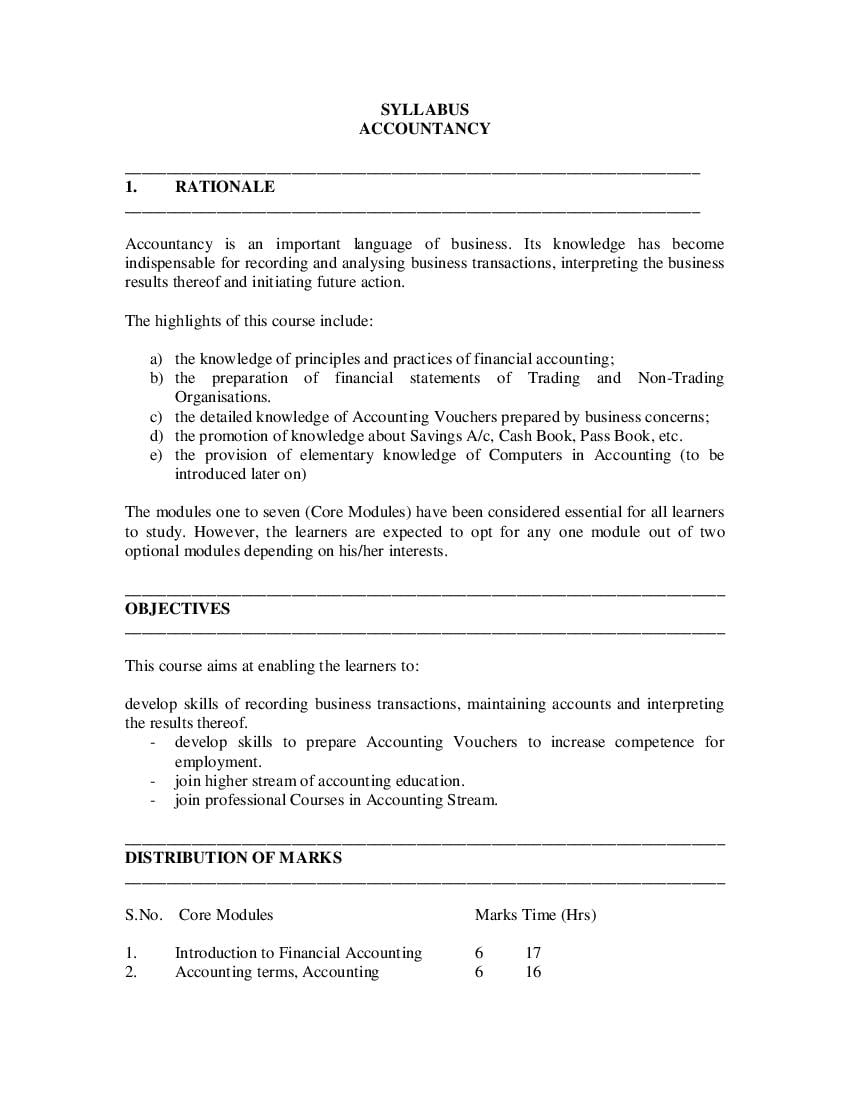
ACCOUNTANCY
_____________________________________________________________________
1. RATIONALE
_____________________________________________________________________
Accountancy is an important language of business. Its knowledge has become
indispensable for recording and analysing business transactions, interpreting the business
results thereof and initiating future action.
The highlights of this course include:
a) the knowledge of principles and practices of financial accounting;
b) the preparation of financial statements of Trading and Non-Trading
Organisations.
c) the detailed knowledge of Accounting Vouchers prepared by business concerns;
d) the promotion of knowledge about Savings A/c, Cash Book, Pass Book, etc.
e) the provision of elementary knowledge of Computers in Accounting (to be
introduced later on)
The modules one to seven (Core Modules) have been considered essential for all learners
to study. However, the learners are expected to opt for any one module out of two
optional modules depending on his/her interests.
________________________________________________________________________
OBJECTIVES
________________________________________________________________________
This course aims at enabling the learners to:
develop skills of recording business transactions, maintaining accounts and interpreting
the results thereof.
- develop skills to prepare Accounting Vouchers to increase competence for
employment.
- join higher stream of accounting education.
- join professional Courses in Accounting Stream.
________________________________________________________________________
DISTRIBUTION OF MARKS
________________________________________________________________________
S.No. Core Modules Marks Time (Hrs)
1. Introduction to Financial Accounting 6 17
2. Accounting terms, Accounting 6 16
Page 2
3. Voucher Approach in Accounting 12 40
4. Bank Reconciliation Statement 6 15
5. Financial Statements 15 30
6. Partnership Accounts 20 45
7. Accounting for Share Capital 15 52
Total 80 195
Choose any one out of two
Modules 8 to 9
8. Analysis of Financial Statements 45
9. Final Accounts of Non-Trading Organisation 20
Total 100 240
IMPORTANT NOTE FOR PAPER SETTERS AND LEARNERS
APPLICATION:
Paper setters may set questions asking journal entries for marks not exceeding 20. Such
questions can be from one topic or combination of topics.
Module 1. Introduction to Financial Accounting 6 Marks
This module has been designed to introduce Accounting to learners. This module will
familiarise the learners with Basic Assumptions, Concepts and Conventions of
Accounting.
Prerequisite Knowledge
General idea of profit or loss, transactions.
Unit 1. Accounting-An Introduction
Business transactions, Book-keeping, Accounting and its branches.
Nature, functions and objectives of Financial Accounting.
Unit 2. Accounting Assumptions:
Page 3
Periodicity.
Unit 3. Accounting Concepts
Meaning, concepts: Matching, Accrual, Realisation and Dual Aspect Concept.
Unit 4. Accounting Conventions
Meaning, Conventions: Consistency, Full disclosure, Materiality, Conservatism.
Module 2: Accounting Terms, Accounting Equation and Journal: 6 Marks
This module had been designed to familiarise the students with different accounting
terms, accounting equation and journal approach to accounting. This will enable them, i)
to prepare Accounting equation. ii) to make journal entires for business transactions.
Familiarity with items of merchandise and Mathematical equation.
Unit 1. Accounting Terms
Meaning and significance of different Accounting terms like Assets, Liabilities, Capital,
Revenues and Expenses.
Unit 2. Accounting Equation
Need of Accounting equation, Meaning and preparation of Accounting equation.
Unit 3. Rules of Accounting
Meaning of Accounts, Type of Accounts: Assets, Liabilities, Capital, Revenue and
Expense, Rules of Debit and Credit on the basis of Accounting Equation.
Unit 4. Journal
Meaning, classification of journal into General journal and special journals (with
examples). Incorporation of journal entries involving different accounts.
Unit 5: Cash Book
Page 4
Book.
Module 3 Voucher Approach in Accounting 12 Marks
This module has been designed to familiarise the learners with different types of
accounting vouchers usually prepared by business concerns. This will enable the learners
to prepare accounts.
Familiarity with cash memos, bills, house, Rent Receipt, Electricity bill, Telephone bill,
etc.
Unit 1: Vouchers and their preparation
Meaning, usefulness and types of vouchers (Accounting Vouchers and Supporting
Vouchers), preparation of Accounting Vouchers: Debit Voucher, Credit Voucher,
Transfer Voucher.
Unit 2 Day Book and Subsidiary Day Books
Meaning Classification of Day Book: Simple Day Book, Day Book with a transfer
column, Day Book with Bank and transfer column, Classification of Subsidiary Day
Books: Purchases Day Book, Sales Day Book, Purchases Returns Day Book, Sales
Returns Day Book.
Unit 3: Recording the vouchers into Day Books
Recording into Simple Day Book, Day Book with Transfer Column, Day-Book with
Bank Column.
Unit 4: Recording the Vouchers into Subsidiary Day Books
Recording into Purchases Day Book, Sales Day Book, Sales Returns Day Book, Puchases
Returns Day-Book..
Unit 5: Ledger Posting of Day Book
Meaning and format of Ledger, Posting the items from Day Book to Ledger A/cs.
Unit 6: Posting of Subsidiary Day Books
Posting the items from Subsidiary Day Books to Ledger A/cs.
Page 5
Meaning, objective and format of Trial Balance, Preparation of Trial Balance from
Ledger balances.
Unit 8: Errors and their Rectification
Meaning of Accounting error, Classification of errors, Rectification of errors through
journal and Accounting vouchers, Need and Preparation of Suspense A/c.
Module 4: Bank Reconciliation Statement 6 Marks
This module has been designed to explain the reasons responsible for the differences
between the balance shown by Cash Book and Pass Book.
Familiarity with Cash Book and Pass Book
Content Unit
Units 1: Bank Reconciliation Statement
Need, Meaning, reasons for difference between the balance of cash book and pass book,
preparation.
Module 5: Financial Statements 15 Marks
This module has been designed to explain to the learners the calculation of profit or loss
during the accounting period. This also enables the learners to explain the financial
position of the business on a particular date.
Familiarity with Accounting terms, Ledger Posting, Trial Balance etc
Unit 1: Capital and Revenue
Classification of expenditure into Capital and Revenue (with examples), Calculation of
Cost of Goods sold, Capital and Revenue receipts.
Page 6
Need, format of Trading and Profit and Loss A/c., items to be recorded on the Debit and
Credit Side of Trading and Profit and Loss A/c, Preparation of Trading and Profit and
Loss A/c. Need, format of Balance Sheet, identification of Accounts to be written on
liabilities and Assets side, Preparation of Balance sheet.
Unit 3: Preparation of Trading and Profit and Loss A/c and Balance Sheet (with
adjustments).
Need for adjustments, adjustments regarding closing stock, Depreciation, Additional bad
debts, Provision for Doubtful Debts, Outstanding expenses, Pre-paid expenses, Accrued
income and unearned income, incorporation of Adjustments in Trading and Profit and
Loss A/c and Balance Sheet.
Module 6 : Partnership Accounts 20 Marks
This module has been designed to explain to the learners the accounting procedure
regarding admission, retirement and death of a partner through journal and accounting
vouchers. This also explains the valuation and recording of Goodwill and revaluation and
realisation of assets and liabilities.
Familiarity with system of accounts
Unit 1: Partnership-General
Meaning, Partnership Deed, Types of Partners, Capital Accounts.
Accounting Treatment of the following in the absence of Partnership Deed.
a) Distribution of Profits
b) Interest on Partner’s Loans
c) Interest on Capital and Drawings
d) Salary and Commission of Partner
Unit 2: Admission of Partner
Concept of Admission of Partner, Calculation of Profit sharing ratio, Revaluation of
assets and liabilities, Goodwill: Meaning, Valuation and its recording, Adjustment
Page 7
Capital A/c and Balance Sheet from the given information.
Unit 3: Retirement and Death of a Partner
Meaning, Calculation of New Profit sharing ratio, calculation of Gaining ratio, Recording
of goodwill, Revaluation of assets and liabilities, Accumulated reserves and profits,
Adjustments regarding partners, Capital Accounts, Calculation of profit upto the date of
death of a partner. Preparation of Relevant A./cs and Balance Sheet.
Unit 4: Dissolution of a Partnership Firm
(Excluding Insolvency of Partners)
Concept of Dissolution of partner and partnership firm, Realisation of asset and making
payment of Liabilities, Treatment of unrecorded Assets and Liabilities, Preparation of
Realisation A/c., Partner’s Capital A/c and Bank A/c.
Module 7: Accounting for Share Capital 15 Marks
This module has been designed to impart to the learners the knowledge of different types
of shares as a source of finance and their accounting treatment through Accounting
Vouchers and journal.
Familiarity with the company a form of business organisation.
Unit 1: Joint Stock Company – An Introduction
Meaning, characteristics and kinds of companies, Shares (as a source of finance) and its
types, kinds of shares capital.
Unit 2: Issue of Shares
At par, At discount (Sec. 79) and At Premium (Sec, 78), Share Application, Share
Allotment and Share Calls, Calls in Arrears and Calls-in-Advance. Journal entries in the
books of company, Preparation of Accounting Vouchers, Preparation of Share Capital
A/c, Share Allotment A/c, Bank A/c and Calls A/c.
Unit 3: Forfeiture and Reissue of Forfeited Shares
Page 8
discount and Premium, Accounting Treatment for reissue of forfeited shares originally
issued at par, discount and premium.
Optional Modules
Module 8: Analysis of Financial Statements 20 Marks
This module has been designed to explain the different accounting ratios to enable the
learners to prepare the statement of sources and uses of funds.
Familiarity with financial statements
Unit 1:Ratio Analysis – An Introduction
Meaning of financial statements, Meaning and need for Analysis of financial statement..
Arithmetical and Accounting Ratio, Concept of Ratio Analysis, parties interested in
Analysis of financial statement, Significance of Accounting Ratios.
Unit 2 : Accounting Ratios – I
Meaning, Significance and calculation of Liquidity and Turnover Ratios.
Unit 3 : Accounting Ratios – II
Meaning, significance and calculation of Gross Profit, Net Profit, Return on Investment
and Debt-Equity Ratios.
Unit 4: Funds Flow Statement – I
Meaning, Need, Increase/decease in working capital by preparing Schedule of Changes in
Working Capital, Funds from operation.
Unit 5: Funds Flow Statement – II
Preparation of Funds Flow Statement in ‘T’ form, Adjustments: Depreciation (including
Provision for Depreciation), Sale and Purchase of fixed Asset.
Module 9: Final Accounts of Non-Trading Organisations 20 Marks
Page 9
Trading Organisations.
Familiarity with
- Educational Institutions, Clubs, Hospitals, etc.
- Concepts of Receipts and Payments.
- Concepts of Income and Expenditures.
Unit 1: Accounts of Non-Trading Organisations-I
Meaning and characteristics, Receipts and Payments A/c; Meaning, Need, Preparation,
Difference between Receipts and Payments A/c and Cash Book.
Unit 2: Accounts of Non-Trading Organisations-II
Income and Expenditure A/c: Meaning, Need, Preparation, Difference between Receipts
and Payments A/c and Income and Expenditure A/c. Adjustments: Outstanding and Pre-
paid expenses, Accrued and unearned Incomes, Subscriptions and Depreciation on Asset
only. Preparation of Balance Sheet.
Document Details
| Board / Org | NIOS |
| Exam | National Institute of Open Schooling Class 12 |
| Type | Syllabus |
| Pages | 9 |
| Updated | 22 Jul 2026 |