NIOS Class 12 Syllabus 2023 Chemistry
Finished viewing? Save it for later —
Download NIOS Class 12 Syllabus 2023 Chemistry (PDF · 6 pages)About NIOS Class 12 Syllabus 2023 Chemistry
NIOS Class 12 Syllabus 2023 Chemistry is available here for free download. Published by NIOS for National Institute of Open Schooling Class 12, this syllabus can be viewed online or downloaded as a PDF (6 pages). Candidates preparing for National Institute of Open Schooling Class 12 can use NIOS Class 12 Syllabus 2023 Chemistry to understand the exam pattern, the type of questions asked, and the overall difficulty level.
Frequently Asked Questions
How can I download NIOS Class 12 Syllabus 2023 Chemistry?
Open this page and click the Download button to save NIOS Class 12 Syllabus 2023 Chemistry as a PDF. It is completely free on AglaSem Docs.
Is NIOS Class 12 Syllabus 2023 Chemistry free to download?
Yes. NIOS Class 12 Syllabus 2023 Chemistry can be viewed online and downloaded as a PDF free of cost on AglaSem Docs.
How many pages does NIOS Class 12 Syllabus 2023 Chemistry have?
NIOS Class 12 Syllabus 2023 Chemistry contains 6 pages, which you can read online or download together as a single PDF.
Where can I find more National Institute of Open Schooling Class 12 study material?
You can find more National Institute of Open Schooling Class 12 question papers, sample papers, syllabus, and answer keys on AglaSem Docs.
NIOS Class 12 Syllabus 2023 Chemistry – Text
Read the full text of this syllabus below — useful to quickly search, copy and reference the content online without downloading the PDF.
📄 View text version (6 pages)
Page 1
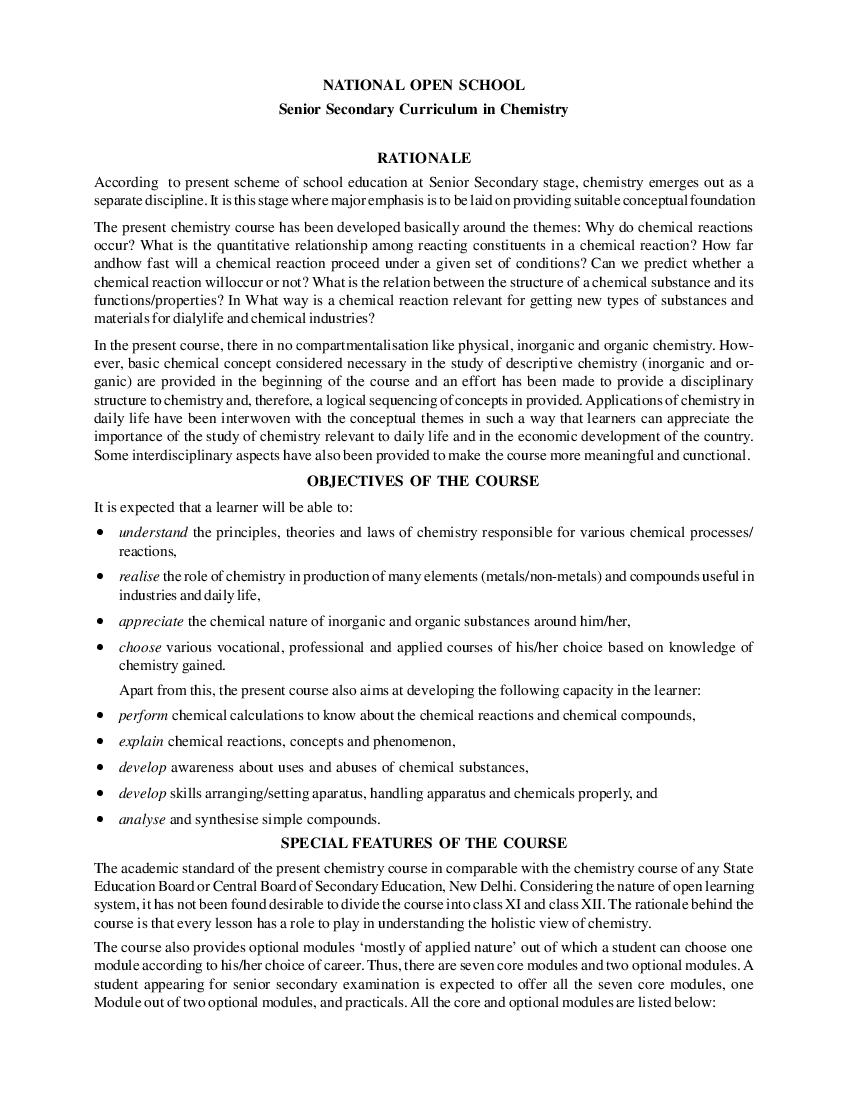
Senior Secondary Curriculum in Chemistry
RATIONALE
According to present scheme of school education at Senior Secondary stage, chemistry emerges out as a
separate discipline. It is this stage where major emphasis is to be laid on providing suitable conceptual foundation
The present chemistry course has been developed basically around the themes: Why do chemical reactions
occur? What is the quantitative relationship among reacting constituents in a chemical reaction? How far
andhow fast will a chemical reaction proceed under a given set of conditions? Can we predict whether a
chemical reaction willoccur or not? What is the relation between the structure of a chemical substance and its
functions/properties? In What way is a chemical reaction relevant for getting new types of substances and
materials for dialylife and chemical industries?
In the present course, there in no compartmentalisation like physical, inorganic and organic chemistry. How-
ever, basic chemical concept considered necessary in the study of descriptive chemistry (inorganic and or-
ganic) are provided in the beginning of the course and an effort has been made to provide a disciplinary
structure to chemistry and, therefore, a logical sequencing of concepts in provided. Applications of chemistry in
daily life have been interwoven with the conceptual themes in such a way that learners can appreciate the
importance of the study of chemistry relevant to daily life and in the economic development of the country.
Some interdisciplinary aspects have also been provided to make the course more meaningful and cunctional.
OBJECTIVES OF THE COURSE
It is expected that a learner will be able to:
understand the principles, theories and laws of chemistry responsible for various chemical processes/
reactions,
realise the role of chemistry in production of many elements (metals/non-metals) and compounds useful in
industries and daily life,
appreciate the chemical nature of inorganic and organic substances around him/her,
choose various vocational, professional and applied courses of his/her choice based on knowledge of
chemistry gained.
Apart from this, the present course also aims at developing the following capacity in the learner:
perform chemical calculations to know about the chemical reactions and chemical compounds,
explain chemical reactions, concepts and phenomenon,
develop awareness about uses and abuses of chemical substances,
develop skills arranging/setting aparatus, handling apparatus and chemicals properly, and
analyse and synthesise simple compounds.
SPECIAL FEATURES OF THE COURSE
The academic standard of the present chemistry course in comparable with the chemistry course of any State
Education Board or Central Board of Secondary Education, New Delhi. Considering the nature of open learning
system, it has not been found desirable to divide the course into class XI and class XII. The rationale behind the
course is that every lesson has a role to play in understanding the holistic view of chemistry.
The course also provides optional modules ‘mostly of applied nature’ out of which a student can choose one
module according to his/her choice of career. Thus, there are seven core modules and two optional modules. A
student appearing for senior secondary examination is expected to offer all the seven core modules, one
Module out of two optional modules, and practicals. All the core and optional modules are listed below:
Page 2
S.No. Module Marks Study
Alloted Hours
1. Atom Molecule and
Chemical Arithmatics 7 14
2. Atomic Structure and Chemical Bonding 12 33
3. States of Matter 12 18
4. Chemical Energetics 8 23
5. Chemical Dynamics 8 19
6. Chemistry of Elements 10 48
7. Chemistry of Organic Compounds 12 48
OPTIONAL MODULES
I. Environmental Chemistry 15
II. Chemistry and Industry 37
Total 80 240
A detailed curriculum is given for your ready reference
348
Page 3
CORE MODULES Types of bonds and their characteristics (logic,
MODULE 1:ATOMS MOLECULES AND Covalent, Coordinate, Metallic)
CHEMICAL ARITHMATICS Shapes of molecules, Introduction to VSEPR
Lesson 1 Mole Concept theory (upto 6 electron pairs only)
A simple idea of basic SI units Hybridization of atomic orbitals
Counting and weighing of atoms and molecules Multiple covalent bonds (,) e.g. C2H4,C2H2
Avogadro constant M.O. Theory, Homonuclear molecule
Molar quantities (H2,N2,O2,F2), Bond Parameters
Hydrogen Bonding
Lesson 2 Chemical Arithmetic
MODULE 3: STATES OF MATTER
Chemical formula and percentage composition Lesson 6 Gaseous State
Empirical and molecular formulae Properties
Mole, Mas, Volume relationships in chemical Boyle’s Law
reactions Charles law-Kelvin Temperature Scale
Limiting reagent concept and percentage yield
Avogadro’s Law
MODULE 2:ATOMS STRUCTURE AND Dalton’s law of partial pressures
CHEMICAL ARITHMATICS Ideal gas equation
Lesson 3 Chemical Arithmaties The kinetic molecular theory of gases (no
Fundamental particles of an atom (electron, derivation)
Proton, Neutron) Graham’s law of diffusion
Rutherford’s nuclear model real gases-deviations from ideal gas behavior,
Electromagnetic spectrum Vansder Waal equation Liquefaction of gases,
Line spectra of H-atom: Bohr model (no critical Constants
derivation) Lesson 7 Liquid State
Wave-particle duality: Heisenberg’s Properties of liquids
uncertainty principle Vapour pressure
The wave mechanical model-orbitals Surface tension
(probability picture may be emphasised), Viscosity
Quantum numbers
Lesson 8 Solid State
Pauli’s exclusion principle
Properties of solids
Aufbau Principle-electronic configuration of
atoms Classification of solids
Types of orbitals (s,p,d,f): shapes of s,p,d Unit cell and their types
orbitals Packing in crystals
Hund’s rule Structure of simple ionic compounds
Imperfections in solids (Frenkel, Schottky
Lesson 4 Periodic Table and Atomic Properties defects)
Long Form of periodic table and IUPAC
nomenclature for elements with Z > 110 (brief Lesson 9 Solutions
mention) Solution, solute and solvent
Variation in atomic properties (size, jonization Concentration of solutions-molarity, molality,
energy, electron affinity, valency and electro mole fraction, percentage and Strength
negativity) Types of solutions
Raoult’s law
Lesson 5 Chemical Bonding
Why do atoms combine? (potential-energy
Ideal and non-ideal solutions
diagram) Colligative properties of solutions
349
Page 4
Lesson 10 Colloids
Acid-base equilibrium
The Colloidal Solution
lonisation constant of lead acids and bases
True solution, colloidal solution and suspension
Ionization of water
Classification of colloids
pH value
Preparation and properties of colloidal solutions
Common Ion effect
Applications of colloids
Buffer solutions, Henderson equation
Solubility equilibrium, solubility product and its
MODULE 4: CHEMICAL ENERGETICS applications
Lesson 11 Chemical Thermodynamics Salt Hydrolysis
System : Isolated, closed and open systems Acid base titration
Processes: cyclic, isothermal, adiabatic, Lesson 15 Electrochemistry
reversible and irreversible Oxidation and Reduction (Electron transfer
Standard state of a substance concept)
Exothermic and endothermic reactions Oxidation number, balancing of Redox reaction
Thermochemical equations by oxidation number method
Concept of internal energy and enthalpy change, Types of cells: Electrolytic and electrochemical
relationship between H and U, Electrolytic conduction (Conductance,
Ist law of thermodynamics conductivity molar conductivity, effect of
Standard enthalpy of reactions dilution, Kohlrausch’s law)
Enthalpy changes during a reaction: enthalpy Standard electrode potential
of formation, enthalpy of combustion, enthalpy Electrochemical series and its applications
of neutralization Effect of concentration of electrode potentials
Hess’s law and its applications (Nernst equation)
Bond enthalpy Relationship between emf and free energy
Lesson 12 Spontaneity of Chemical Reactions change
Concept of entropy, entropy change and Lesson 16 Chemical Kinetics
spontaneity Rate of Reaction: Average and Instantaneous
IInd law of thermodynamics Expressions for reaction rates
Concept of free energy, relationship between Factors affecting rate of reaction
G,H and S Rate law
Free energy change and spontaneity of a Order of a reaction
chemical reaction First order reaction
Standard free energy of formation Half change period
Free energy change and chemical equilibrium Effect of temperature on reaction rate
IIIrd law of thermodynamics and its significance Lesson 17 Adsorption and Catalysis
(illustrative) Adsorption-Physical and Chemical
MODULE 5: CHEMICAL DYNAMICS Adsorption Isotherms (Freundlich and
Lesson 13 Chemical Equilibrium
Langmuir)
Dynamic nature of equilibrium; Factors
Catalysis-Homogenous and Heterogeneous
affecting equilibrium
Activation energy
Reversible and irreversible reactions
Types of equilibrium system: Homogeneous and MODULE 6 Chemistry of Elements
heterogeneous systems Lesson 18 Occurrence And Extraction of Metals
Laws of chemical equilibrium Occurrence of metals
Relationship between Kc and Kp Important ores of some common elements :
Le Chatelier’s Principle and its applications Na,Al, Sn, Pb, Ti, Fe, Cu, Ag and Zn
350
Page 5
metals from their ores (concentration of the ore, ionic radii, catalytic properties, coloured ions,
reduction and refining) complex formation, magnetic properties,
Lesson 19 Hydrogen and s-Block Elements interstitial compounds alloy formation.
Unique position of H2 in Periodic Preparation, properties and applications some
Properties reactions and uses important compounds:
Isotopes of hydrogen KMnO4, K2Cr2O7
Water structure and aggregation of water f-Block elements-configuration, properties and
molecules, Heavy Water lanthanide contraction
Hydrogen peroxide Lesson 24 Coordination Compounds
Alkali Metals and Alkaline earth metals- Werner’s theory
occurrence, electronic configuration trends in Nomenclature
atomic and physical properties, reactivity Bonding-V.B. Approach
electrode potential, Applications (qualitative analysis, extraction of
Reaction with oxygen, hydrogen, halogens and metals and biological systems)
water MODULE 7 CHEMISTRY OF ORGANIC
Solubility and thermal stability of their oxo salts. COMPOUNDS
Lesson 20 General characteristics of The p-block Lesson 25 Nomenclature and General Principles
elements Rules of IUPAC Nomenclature
Occurrence in nature and electronic
Types of bond fission
configuration, (physical and chemical properties)
Types of reactions: substitution, addition,
Inert pair effect
elimination, oxidation/reduction (electrophilic
Anomalous properties of first element and nucle ophillic)
Lesson 21 p-Block elements and Their Electron displacement in a covalent bond:
Compounds-I
inductive effect, electromeric effect,
Boron family-borax, boric acid, boron hydrides,
resonance and hyperconjugation, steric effect
halides.
Isomerism–Structural isomerism,
Carbon family-allotropes (graphite, diamond,
stereoisomerism
elementary idea of fullerens)
Oxides, carbides, halides Lesson 26 Hydrocarbons
Nitrogen family-Ammonia, Nitric acid, fertilizer Definition and types of hydrocarbons (Alkane,
(N,P) and fixation of nitrogen industrial and Alkene, alkyne, Arene)
biological IUPAC nimenclature
Nitrogenous and phosphatic fertilisers Preparation and Properties of Hydrocarbons
Lesson 22 p-Block Elements and their Physical properties of hydrocarbons
compounds-II Chemical properties of hydrocarbons (addition,
Oxygen family-oxxides, acidic, basic and substitution, elimination, oxidation)
amphoteric, Ozone (Oxidizing Properties) Lesson 27 Compounds of Carbon
Halogens- Hydrides, oxides and oxoacids of ContainingHalogens (Haloalkanes and
chlorine. Haloarenes)
Bleaching powder-preparation and properties, IUPAC Nomenclature of halogen compounds
Interhalogen compounds. Preparation of haloalkanes and haloarenes
Noble gases-compounds of xenon: xenon Physical and chemical properties and uses
fluorides, oxides (preparation, structure)
Lesson 23 d-Block and f-Block elements Lesson 28 Alcohol, Phenols and Ethers
Electronic configuration Classification
General trends in the Chemistry of first row IUPAC Nomenclature
transition elements Methods of preparation
351
Page 6
pollution
Lesson 29 Aldehydes, Ketones and Carboxylic
acids. Lesson 35 Heavy Metal Contamination
Carboxylic Acids and acid derivatives Heavy metals
IUPAC Nomenclature Effects of heavy metal contamination
Preparation and Properties Preventive measures
Interconversion of acid derivations Lesson 36 Radioactive Pollution
Lesson 30 Compounds of Carbon Containing Radioactive sources
Nitrogen III effects of radiation
Nitro compounds, amines Preventive measures
Classification of amines Regulation regarding safety
IUPAC nomenclature
MODULE 2: CHEMISTRY AND INDUSTRY
Preparation and properties Lesson 32 Petrochemicals
Lesson 31 Biomolecules Generations of petrochemicals
Difference between DNA and RNA Soaps and detergents
Biomolecules in biological systems. Rocket propellants
Structures of proteins and carbohydrates Pollutants and Indian Space Programs.
OPTIONAL MODULES Lesson 33 Polymers
MODULE 1: ENVIRONMENTAL Classification
CHEMISTRY Teflox, polyester and nylons
Lesson 32 Environment at concerns Biodegradable polymers
Idea of environment Biopolymers
Threats to environment
Lesson 34 Dyes. Paints and Pigments
Pollutants
Composition
Lesson 33 Air Pollution Classification
Composition of air Process of dying
Respiration, photosynthesis and decay cycle Applications
Air pollutants Lesson 35 Drugs and Medicines
Green house effect Distinction between drugs and medicines
Global warming Classification
Depletion of ozone layer Analgesics and antipyretics
Acid rain Antibiotics and anaestheties
Lesson 34 Water Pollution Lesson 36 Building Materials
Water resources Cement and its manufacture
Water pollutants Mortar, Concrete and R.C.C
Biological oxygen demand Manufacture of glass
Prevention of water pollution Ceramics and day products
352
Document Details
| Board / Org | NIOS |
| Exam | National Institute of Open Schooling Class 12 |
| Type | Syllabus |
| Pages | 6 |
| Updated | 22 Jul 2026 |