PU M.Phil & Ph.D Entrance Exam 2019 Question Paper Faculty of Design & Fine Arts, Education, Business Mgt & Commerce
Finished viewing? Save it for later —
Download PU M.Phil & Ph.D Entrance Exam 2019 Question Paper Faculty of Design & Fine Arts, Education, Business Mgt & Commerce (PDF · 37 pages)About PU M.Phil & Ph.D Entrance Exam 2019 Question Paper Faculty of Design & Fine Arts, Education, Business Mgt & Commerce
PU M.Phil & Ph.D Entrance Exam 2019 Question Paper Faculty of Design & Fine Arts, Education, Business Mgt & Commerce is available here for free download. Published by Punjab University for PU PhD, this question paper can be viewed online or downloaded as a PDF (37 pages). Candidates preparing for PU PhD can use PU M.Phil & Ph.D Entrance Exam 2019 Question Paper Faculty of Design & Fine Arts, Education, Business Mgt & Commerce to understand the exam pattern, the type of questions asked, and the overall difficulty level.
Frequently Asked Questions
How can I download PU M.Phil & Ph.D Entrance Exam 2019 Question Paper Faculty of Design & Fine Arts, Education, Business Mgt & Commerce?
Open this page and click the Download button to save PU M.Phil & Ph.D Entrance Exam 2019 Question Paper Faculty of Design & Fine Arts, Education, Business Mgt & Commerce as a PDF. It is completely free on AglaSem Docs.
Is PU M.Phil & Ph.D Entrance Exam 2019 Question Paper Faculty of Design & Fine Arts, Education, Business Mgt & Commerce free to download?
Yes. PU M.Phil & Ph.D Entrance Exam 2019 Question Paper Faculty of Design & Fine Arts, Education, Business Mgt & Commerce can be viewed online and downloaded as a PDF free of cost on AglaSem Docs.
How many pages does PU M.Phil & Ph.D Entrance Exam 2019 Question Paper Faculty of Design & Fine Arts, Education, Business Mgt & Commerce have?
PU M.Phil & Ph.D Entrance Exam 2019 Question Paper Faculty of Design & Fine Arts, Education, Business Mgt & Commerce contains 37 pages, which you can read online or download together as a single PDF.
Where can I find more PU PhD study material?
You can find more PU PhD question papers, sample papers, syllabus, and answer keys on AglaSem Docs.
PU M.Phil & Ph.D Entrance Exam 2019 Question Paper Faculty of Design & Fine Arts, Education, Business Mgt & Commerce – Text
Read the full text of this question paper below — useful to quickly search, copy and reference the content online without downloading the PDF.
📄 View text version (37 pages)
Page 1
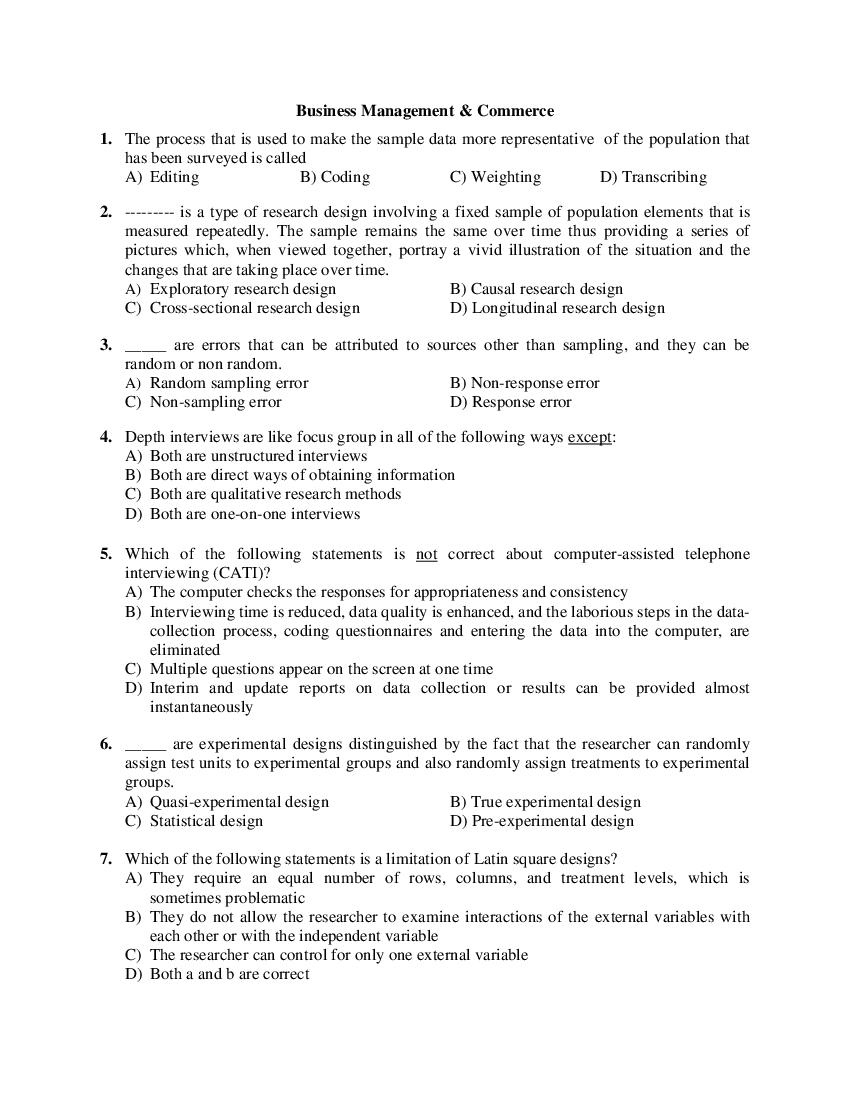
1. The process that is used to make the sample data more representative of the population that
has been surveyed is called
A) Editing B) Coding C) Weighting D) Transcribing
2. --------- is a type of research design involving a fixed sample of population elements that is
measured repeatedly. The sample remains the same over time thus providing a series of
pictures which, when viewed together, portray a vivid illustration of the situation and the
changes that are taking place over time.
A) Exploratory research design B) Causal research design
C) Cross-sectional research design D) Longitudinal research design
3. _____ are errors that can be attributed to sources other than sampling, and they can be
random or non random.
A) Random sampling error B) Non-response error
C) Non-sampling error D) Response error
4. Depth interviews are like focus group in all of the following ways except:
A) Both are unstructured interviews
B) Both are direct ways of obtaining information
C) Both are qualitative research methods
D) Both are one-on-one interviews
5. Which of the following statements is not correct about computer-assisted telephone
interviewing (CATI)?
A) The computer checks the responses for appropriateness and consistency
B) Interviewing time is reduced, data quality is enhanced, and the laborious steps in the data-
collection process, coding questionnaires and entering the data into the computer, are
eliminated
C) Multiple questions appear on the screen at one time
D) Interim and update reports on data collection or results can be provided almost
instantaneously
6. _____ are experimental designs distinguished by the fact that the researcher can randomly
assign test units to experimental groups and also randomly assign treatments to experimental
groups.
A) Quasi-experimental design B) True experimental design
C) Statistical design D) Pre-experimental design
7. Which of the following statements is a limitation of Latin square designs?
A) They require an equal number of rows, columns, and treatment levels, which is
sometimes problematic
B) They do not allow the researcher to examine interactions of the external variables with
each other or with the independent variable
C) The researcher can control for only one external variable
D) Both a and b are correct
Page 2
A) Ratios of scale values can be computed
B) Both the zero point and the units of measurement are arbitrary
C) Any positive linear transformation of the form y = a + bx will preserve the properties of
the scale
D) Both B and C are correct
9. XO = XT + XS + XR.
In the true score model shown above, XT represents:
A) Random error B) The observed score or measurement
C) The true score of the characteristic D) Systematic error
10. Which of the following is not an objective of a questionnaire?
A) A questionnaire must translate the information needed into a set of specific questions that
the respondents can and will answer
B) A questionnaire must be easy to use
C) A questionnaire must uplift, motivate, and encourage the respondent to become involved
in the interview, to cooperate, and to complete the interview
D) A questionnaire should minimize response error
11. “Describe your college experience” and “What is your occupation?” are _____ questions.
A) Dichotomous B) Filter
C) Structured D) Unstructured
12. A _____ is a question that gives the respondent a clue as to what answer is desired or leads
the respondent to answer in a certain way.
A) Structured question B) Leading question
C) Implicit Alternative D) Filter question
13. _____ is the testing of the questionnaire on a small sample of respondents for the purpose of
improving the questionnaire by identifying and eliminating potential problems.
A) Telescoping B) Post testing C) Pretesting D) Funneling
14. A complete enumeration of the elements of a population or study objects is a _____.
A) Population B) Target population C) Element D) Census
15. Which statement is not true about judgmental sampling?
A) It does not allow direct generalizations to a specific population
B) Each population element has a known and equal probability of selection
C) An extension of the technique involves the use of quotas
D) It may be useful if broad population inferences are not required
16. Which of the following activities is not fieldwork?
A) A worker mailing questionnaires from an office
B) An observer counting customers in a particular section of a store
C) A statistician analyzing the results of a survey
D) A telephone interviewer calling from a central location
Page 3
identify illegible, incomplete, inconsistent, or ambiguous responses.
A) Coding B) Data cleaning
C) Questionnaire checking D) Editing
18. Data that are interval or ratio in nature are _____.
A) Metric data B) Independent data C) Nonmetric data D) Paired data
19. Multivariate techniques can be classified based on _____.
A) Whether the data are metric or non metric
B) Whether one, two, or more samples are involved
C) A and B are correct
D) Whether interdependence techniques or dependence techniques are to be used
20. For multivariate statistical techniques, when there is _____, cluster analysis and
multidimensional scaling can be used.
A) Variable interdependence B) One dependent variable
C) More than one dependent variable D) Interobject similarity
21. _____ is also known as across-countries analysis. The data of all the respondents can be
pooled and analyzed.
A) Cross-cultural analysis B) Individual-level analysis
C) Pan cultural analysis D) Intra cultural analysis
22. A statistic that indicates the distribution’s dispersion is a _____.
A) Measure of variability B) Measure of shape
C) Measure of occasion D) Measure of location
23. The square root of the variance is the _____.
A) Standard deviation B) Variance
C) Interquartile range D) Coefficient of variation
24. The _____ is used to test the statistical significance of the observed association in cross-
tabulation.
A) Contingency coefficient B) Cramer’s V
C) Phi coefficient D) Chi-square coefficient
25. Which of the following tests is not a non-parametric one-sample test?
A) Kolmogorov-Smirnov one-sample test
B) Runs test
C) Mann-Whitney U test
D) Binomial test
26. The null hypothesis for ANOVA typically is that all _____.
A) Proportions are equal B) Means are unequal
C) Proportions are unequal D) Means are equal
Page 4
A) The proportion of variation in one variable that is explained by the other
B) The proportion of error variation
C) The proportion of variation in Y related to the variation of the categories of X
D) The proportion of variation in Y due to the variation within each of the categories of X
28. A technique for fitting a straight line to a scattergram by minimizing the square of the
vertical distances of all the points from the line is known as the _____.
A) Scatter diagram plot B) Sum of square errors procedure
C) Maximum residual procedure D) Least-square procedure
29. _____ is a regression procedure in which the predictor variables enter or leave the regression
equation one at a time.
A) Multiple regression B) Bivariate regression
C) Dummy variable regression D) Stepwise regression
30. In discriminant analysis, the criterion or dependent variable is _____ and the predictor or
independent variables are _____ in nature.
A) Interval; categorical B) Ordinal; interval
C) Categorical; interval D) Ordinal; categorical
31. Which statement is not true about the report preparation and presentation process?
A) The findings should be presented in such a way that they can be used directly as input
into decision making
B) Conclusions should be drawn but recommendations should not be made
C) The researcher should assist the client in understanding the report
D) The researcher should evaluate the research process in retrospect
32. Which of the following is not true about e journals?
A) They are distributed through digital methods
B) They also have editors or editorial boards
C) They are publications of serial nature
D) They are always free of cost
33. Assertion (A): A reasonably sized sample drawn randomly from large sized population
contains almost all the characteristics which exist in the population.
Reasoning (R): The theory of sampling is based on the two important laws of statistics, viz.,
Law of statistical Regularity and law of inertia of large numbers.
A) Both (A) and (R) are correct and (R) is the complete explanation of (A)
B) Both (A) and (R) are correct but (R) is not the complete explanation of (A)
C) (A) is not correct while (R) is correct
D) Both (A) and (R) are not correct
Page 5
A) Measure of skewness indicates the direction and extent of skewness in the distribution of
numerical values in the data set
B) In a moderately asymmetrical distribution, the empirical relationship between Mean,
a. Mode and Median suggested by Karl Pearson is
b. Mean – Mode = 3 (Mean – Median)
C) Coefficient of variation is an absolute measure of dispersion
D) Kurtosis refers to the degree of flatness or peakedness in the region around the mode of a
frequency curve
35. Statement – I: When the null hypothesis is true but as per the hypothesis-testing, it is
rejected, it is known as beta type error in hypothesis testing.
Statement – II: Chi-square test is exclusively a non-parametric test.
Codes:
A) Both the statements are true
B) Both the statements are false
C) Statement – I is true while Statement – II is false
D) Statement – I is false while Statement – II is true
36. Spurious non correlation is said to occur when
A) There is no true relationship between X and Y and the researcher concludes there is
B) The researcher concludes there is no relationship between X and Y and in fact there is
C) There is a true relationship between X and Y and the researcher concludes this is so
D) There is no true relationship between X and Y and the researcher concludes this is so
37. The BEST way to handle missing items when analyzing the data is to:
A) Leave the item blank and report the number blank as a separate category
B) Eliminate the case with the missing item in analyses using the variable
C) Substitute values for the missing item
D) There is no single best way for handling missing items but rather their treatment depends
on the purpose of the study, the incidence of missing items, and the methods that will be
used to analyze the data
38. The product manager for a large ice cream company believes that sales of his product in
supermarkets greatly depends upon the amount of space given to the product in the ice cream
section and the amount of in-store promotion given his product. To determine if this is the
case, the manager collected data from 20 supermarkets.
Which of the following statistical procedures is appropriate for use with the above situation?
A) Factor analysis B) Discriminant analysis
C) Multiple regression analysis D) Spearman's Rank Correlation
39. Which of the following is NOT a technique used in the analysis of dependence?
A) Multiple regression B) Multiple discriminant analysis
C) Multivariate analysis of variance D) Multidimensional scaling
Page 6
A) Median B) Mode C) Mean D) None of these
41. Which of the following types of questions are LEAST likely to be pre coded?
A) Open-ended questions B) Multiple choice questions
C) Yes-no questions D) Categorical questions
42. The "foot-in-the-door" technique:
A) Is not used by a company sensitive to its public image
B) Is only useful in conjunction with personal selling
C) Begins with a smaller initial request for data
D) Seldom is used by ethical field-workers
43. A researcher conducts a survey and calculates the confidence interval to be between 400 and
440 at the 95 percent confidence level. This means that:
A) There is a 90 percent probability that the sample mean will fall in this range
B) There is a 100 percent probability that the population mean will fall in this range
C) If 100 samples were conducted, 5 times out of 100 the sample mean would fall within the
confidence interval that was calculated
D) If 100 samples were conducted, 95 times out of 100 the true population mean would fall
[
within the confidence interval that was calculated
44. Which confidence level has become the “traditional” confidence level among business
researchers?
A) 90 percent B) 95 percent C) 99 percent D) 85 percent
45. Using Web site visitors for Internet surveys is an example of a(n):
A) Stratified random sample
B) Multistage area sample
C) Convenience sample
D) Systematic sample
46. When respondents believe that recent events took place longer ago than they actually did,
this is called:
A) Squishing B) Funnel technique
C) Frequency determination D) Telescoping
47. When using the Internet, if you need to click beside either a “Yes” or a “No” response to fill
in the circle that is next to one of these choices to indicate your answer to the question, this
type of prompt is called:
A) A split-ballot prompt
B) A radio button
C) A check list button
D) A complex choice button
Page 7
A) The logical process of establishing a general proposition on the basis of observation of
particular facts.
B) The logical process of inducing individuals to reason.
C) The logical process of linking propositions via the ladder of abstraction.
D) The logical process of deriving a conclusion from a known premise or something known
to be true
49. If the probabilities are 0.25, 0.35, 0.06 and 0.30 that a certain office will receive 0, 1, 2, 3, or
4 complaints about theft on any one day. How many such complaints can be expected per
day?
A) 4.33 B) 3.33 C) 5.34 D) 4.76
50. _____ occurs when the sample results lead to the rejection of a null hypothesis that is in fact
true.
A) Type I error B) Two-tailed error C) Type II error D) One-tailed error
x-x-x
Page 8
1. Which of the following is not one of the features of urban community?
(A) Materialistic (B) Informal ties
(C) Complex life (D) Glamorous life
2. Research is essentially
(A) An intellectual and creative ability (B) A routine process
(C) A cramming process (D) None of the above
3. Projection means
(A) Day dreaming (B) Making excuses
(C) Blaming others (D) Acting childish
4. Cause(s) for the existence of slums:
(A) Rural-urban migration (B) Poverty
(C) Social exclusion (D) All of the above
5. Society is a web of
(A) Homogeneous relations (B) Social relationships
(C) Personal relations (D) Professionalism
6. Personality of an individual can be assessed by
(A) Subjective techniques (B) Objective techniques
(C) Projective techniques (D) All of the above
7. According to M.K. Gandhi, the aim of education is
(A) Self realization (B) Back to nature
(C) Production of commodities (D) None of the above
8. National policy on disaster management focuses on
(A) Prevention (B) Preparedness
(C) Response (D) All of the above
9. Which of the following is not a scale of measurement?
(A) Ordinal (B) Nominal (C) t-test (D) Interval
10. Gap between the highest and the lowest score is called:
(A) Mean (B) Range (C) Data (D) Median
Page 9
(A) Verbal (B) Non verbal
(C) Performance (D) All of the above
12. One of the causes for environmental degradation is
(A) Urbanization (B) Rural area
(C) Inflation (D) None of the above
13. The cumulative percentage curve is also known as
(A) Bar graph (B) Ogive
(C) Polygon (D) Cumulative frequency graph
14. A study of kinship is also known as:
(A) Delocalization (B) Antisocial
(C) Socialization (D) Isolation
15. Stereotypes are _________ frameworks that influence the processing of social
information.
(A) Emotional (B) Neural (C) Cognitive (D) Behavioral
16. The organization of social life within a limited area is known as:
(A) An association (B) A community
(C) An institution (D) A society
17. Leadership style may be
(A) Authoritarian (B) Democratic
(C) Laissez-faire (D) All of the above
18. The term green revolution refers to
(A) Grow more crops (B) Use of green manure
(C) High yield variety programme (D) Green vegetation
19. Dependency groups include
(A) Below 16 years and above 60 years (B) Below 14 years and above 65 years
(C) Below 18 years and above 60 years (D) None of the above
20. Human Development Index includes
(A) Income, health and education indicators
(B) Poverty, human rights and unemployment indicators
(C) Health, education and quality of life indicators
(D) Income, trade and investment indicators
Page 10
(A) Ambiguity (B) Listening
(C) Sharing of activity (D) Politeness
22. If you give money to a stranger to make an urgent phone call, it is known as:
(A) Obligation (B) Compliance (C) Conformity (D) Obedience
23. Which among the following is not a cause of growth of cities?
(A) Development of transport (B) Industrialization
(C) Hygienic outlook of people (D) Trade and commerce
24. Method(s) of conflict resolution
(A) Mediation (B) Arbitration
(C) Negotiation (D) All of the above
25. Eclectic is a
(A) Device (B) Counseling approach
(C) Innovation (D) None of the above
26. Social change may cause:
(A) Social evolution (B) Social disorganization
(C) Social progress (D) All of the above
27. The method of teaching adults is known as:
(A) Pedagogy (B) Andragogy (C) Anthropology (D) Technology
28. Which of the following is not a benefit of training?
(A) Reduced accidents (B) Increased productivity
(C) Reduced supervision (D) None of the above
29. Dependency theory of Marxist school is related to:
(A) Rural development (B) Urbanization
(C) Occupation (D) Health
30. Marketing management includes
(A) Pricing (B) Sale
(C) Advertising (D) All of the above
31. Emotional insulation means
(A) Reaction formation (B) Apathy
(C) Compensation (D) Pretending illness
32. Which of the following is not a characteristic of group?
Page 11
(C) Roles (D) Cohesiveness
33. Benefit(s) of employee training is/are:
(A) Provides a good climate for learning
(B) Improves morale
(C) Helps people identify with organizational goals
(D) None of the above
34. Performance appraisal, assessment centers and psychological testing are methods used to
assess:
(A) Massed learning (B) Staffing needs
(C) Development needs (D) Tactile learning
35. Community Development Organizer should be:
(A) An enabler (B) An expert
(C) A therapist (D) All of the above
36. Limitation of using rating scale is
(A) Structured (B) Unstructured
(C) Halo effect (D) None of the above
37. Suppose mean of weekly pay of four brothers is Rs. 500 and the median is Rs. 600. How
much money do the brothers take home?
(A) 2000 (B) 2400 (C) 800 (D) 600
38. National policy of skill development in India came into force in
(A) 2014 (B) 2015 (C) 2016 (D) 2017
39. Non formal education is
(A) Need based (B) Philosophical viewpoint
(C) Popularly used (D) Information technology based
40. Natural disaster has
(A) Economic impact (B) Social impact
(C) Political impact (D) All of the above
41. In anthropology, the social groups that are ranked and defined by descent marriage and
occupation are called:
(A) Lineage (B) Caste (C) Status (D) Cultural level
42. National Population Policy came into force in
Page 12
43. What is the other name for infectious diseases?
(A) Communicable diseases (B) Non-communicable diseases
(C) Heredity diseases (D) Non-transmissible diseases
44. Which of the following is the most significant feature of Indian population?
(A) Declining birth rate (B) Improvement in literacy level
(C) Improvement in health conditions (D) Size of its adolescent population
45. The main aim of educational guidance is:
(A) Improvement of curriculum (B) To solve the problems
(C) Pupil development (D) None of the above
46. Which of the following approaches is similar to school mapping approach of planning?
(A) Demographic approach (B) Social justice approach
(C) Intra-educational approach (D) Man power approach
47. Micro-teaching is a better teaching technique than traditional teaching. This is a
(A) Null hypothesis (B) Directional hypothesis
(C) Non-directional hypothesis (D) No-a-priori hypothesis
48. Which of the following is promoted by a caste based society?
(A) Open society (B) Regressive society
(C) Progressive society (D) Closed society
49. My experiments with truth is written by:
(A) Durkheim (B) Robert K. Merton
(C) M.K. Gandhi (D) Rousseau
50. Which of the following is a principle of counseling?
(A) Helping all
(B) Understanding of the individual
(C) Flexibility according to community needs
(D) Diagnosis and recognition of individual differences
x-x-x
Page 13
1. The name/term Kuchipudi comes from:
(A) Mahabharat (B) A Village of Andhra Pradesh
(C) Natyasastra (D) Abhinaya Darpan
2. ‘Dasha Roopak’ deals with-
(A) Dance Theory (B) Dramaturgy,
(C) Kootiyattam (D) Kathakali
3. According to Natyasastra Natya means-
(A) Emotions (B) Rasabhinaya (C) Anubhava (D) Imitation
4. Who formed Hindustani music system with 10 Thats?
(A) Tansen (B) V. N. Bhathkande
(C) Meerabhai (D) Sur das
5. How many Melakartha ragas (‘Thaats’) are there in Carnatic Music?
(A) 72 (B) 21 (C) 10 (D) 9
6. Kerala’s Kalarippayattu is a –
(A) Folk art (B) Ritualistic art (C) Religious art (D) Martial art
7. Make-up, costumes and stage decorations are included in –
(A) Satwika (B) Angika (C) Aharya (D) Vachika
8. Kootiyattam is the presentation of –
(A) Malayalam Drama (B) Sanskrit Drama
(C) Dance Drama (D) Semi-classical Drama
9. Natyasastra enumerates –
(A) Eight Rasas (B) Nine Rasas (C) Seven Rasas (D) Eleven Rasas
10. Natyasatra is a work on –
(A) Dance theory (B) Dramaturgy
(C) Indian classical theatre (D) Bharatnatyam
11. In which chapter the theory of Rasa has been discussed in Natyasastra?
(A) 36th chapter (B) 11th chapter (C) 9th chapter (D) 6th chapter
12. Who introduced, the term 'Sadharanikaran' to explain Rasa theory?
(A) Lollata (B) Sri Sankuka
Page 14
13. Pancham Ved and Natyaved are the synonyms of ………………
(A) Abhinayadarpan (B) Natyasastra (C) Natanadhyayi (D) Dasharupak
14. Mudras to be included in the section of –
(A) Vachika (B) Rasabhinaya (C) Satwka (D) Angika
15. The 12th chapter of Natyasastra (Gatiprakara) discusses -----------------.
(A) Parts of stage (B) Modes of movements
(C) Sentiments (D) Bhavas
16. To create Natyasastra, Brahma took the Patthya (Text) from………..
(A) Samaved (B) Adharvaved (C) Rigved (D) Yajurved
17. Chapter number 2 (Mandapa) of Natyasastra dealt with…………..
(A) Theatre construction (B) Stage worship
(C) Movements (D) Preliminary of play
18. The Thandav type of dance deals with –
(A) Light & soft moves (B) Expressions
(C) Feminine dance (D) Masculine & Vigorous dance
19. Which chapter of Natyasastra, named as 'Tandava Lakshanam'?
(A) 9th Chapter (B) 21st Chapter (C) 4th Chapter (D) 11th Chapter
20. Match the items in list – 1 with list - 2
List – 1 List – 2
a) Beebhtsa i) Utsaha
b) Veera ii) Shoka
c) Karuna iii) Krodha
d) Raudra iv) Jugupsa
Codes:
a) b) c) d)
(A) iv i ii iii
(B) i ii iii iv
(C) iii i ii iv
(D) ii iii iv i
21. Thandav is suitable for –
(A) Sringar Ras (B) Shok Ras (C) Raudra Ras (D) Bhayanak Ras
Page 15
(A) 4 Divisions (B) 7 Divisions (C) 9 Divisions (D) 11 Divisions
23. According to UNESCO the oldest living theatre in the word is –
(A) Noe (B) Chinese opera (C) Kabuki (D) Kutiyattam
24. Incidents of Chilappathikaram happens in the ancient city of –
(A) Thanjavur (B) Kancheepuram
(C) Mahabalipuram (D) Madhurai
25. The Sthyeebhav of Raudra Ras is –
(A) Krodh (B) Jugupsa (C) Utsaha (D) Bhaya
26. Kelucharan Mohapatra was an exponent of –
(A) Kuchippudi (B) Odissi
(C) Kathakali (D) Mohiniyattam
27. According to Indian concept Natya means-
(A) Emotions (B) Rasabhinaya (C) Anubhava (D) Imitation
28. To create Natyasastra, Brahma took the Patthya (Text) from………..
(A) Samaved (B) Adharvaved (C) Rigved (D) Yajurved
29. How many Vritties are mentioned in Natyasastra?
(A) 4 (B) 7 (C) 9 (D) 33
30. Kootiyattam is the presentation of –
(A) Malayalam Drama (B) Sanskrit Drama
(C) Dance Drama (D) Semi-classical Drama
31. As per Natyasastra Abhinaya has –
(A) 4 Divisions (B) 7 Divisions (C) 9 Divisions (D) 11 Divisions
32. Natyasastra enumerates –
(A) Eight Rasas (B) Nine Rasas (C) Seven Rasas (D) Eleven Rasas
33. The term Jati is related to –
(A) Mohiniyattam (B) Kathakali (C) Bharatnatyam (D) Manipuri
34. Sitar is a …………. Vadya –
(A) Ghana Vadya (B) Sushira Vadya (C) Thata Vadya (D) Avanatha
35. Mudra as a perfect language to be seen in –
Page 16
(C) Kuchipudi (D) Kathakali
36. The most elaborated make up is seen in –
(A) Kathakali (B) Odissi (C) Maniuri (D) Kuchipudi
37. As per Sangit Ratnakar and Sangit Damodar the term Sangit tands for –
(A) Music (B) Music dance & Instruments
(C) Instruments (D) Instruments & dance
38. Chapter number 2 (Mandapa) of Natyasastra dealt with………….
(A) Theatre construction (B) Stage worship
(C) Movements (D) Preliminary of play
39. Kalakshetra established by –
(A) Vallathole (B) Uday Shankar
(C) Rugminidevi Arundhel (D) Madras Government
40. How many Vritties are mentioned in Natyasastra?
(A) 4 (B) 7 (C) 9 (D) 33
41. How many slokas (stanzas) are there in Natyasastra.
(A) 1001 (B) 6000 (C) 3333 (D) 1111
42. How many Dharmis are mentioned in Natyasastra?
(A) Four (B) Nine (C) Two (D) Seven
43. How many Vyabhicharee Bbhavas are enumerated by Bharat Muni?
(A) 21 (B) 24 (C) 33 (D) 9
44. Abhinaya Darpan written by –
(A) Bharat Muni (B) Nadikeswara
(C) Abhinavagupta (D) Dhananjaya
45. How many Satwikas are described in Natyasastra by Bharat Muni?
(A) 9 (B) 8 (C) 13 (D) 24
46. The main element of Mohiniyattam is –
(A) Lasya (B) Thandav (C) Arabhati Vrutti (D) Natyadharmi
47. Venkatamukhi related to:
(A) Abhinayasangit (B) Hindustani Music
(C) Carnatic Music (D) Dhrupath
Page 17
List – 1 List - 2
a) Rati i) Eight
b) Tribhangi ii) Mohiniyattanm
c) Satwik iii) Odissi
d) Lasya iv) Sringar
Codes:
a) b) c) d)
(A) iii i ii iv
(B) iv iii i ii
(C) iv i ii iii
(D) ii iii iv i
49. Match the items in list – 1 with list - 2
List – 1 List - 2
a) Chilappathikaram i) Shoodraka
b) Swapnavasavadattam ii) Kalidas
c) Mruchakatikam iii) Ilankovatikal
d) Raghuvamsham iv) Bhasa
Codes:
a) b) c) d)
(A) iii iv i ii
(B) iv iii i ii
(C) iv i ii iii
(D) ii iii iv i
50. In which Parva of Mahabharat Gita has been included?
(A) Drona Parva (B) Virata Parva
(C) Udyoga Parva (D) Bhishma Parva
x-x-x
Page 18
1. dqPphiqM+h uke fy;k x;k gS%
(A) egkHkkjr (B) vkU/kzizns’k dk ,d xk¡o
(C) ukV~;’kkL= (D) vfHkuo niZ.k
2. ^n’k :id* o.kZu djrk gS%
(A) u`R; fl)kUr (B) ukV~;’kkL= (C) dqfV;kV~Ve (D) dFkdyh
3. UkkV~;’kkL= ds vuqlkj ukV~; dk vFkZ gS%
(A) laosx (B) jl vfHku; (C) vuqHko (D) udy
4. nl FkkVksa dh fgUnqLrkuh laxhr iz.kkyh fdlus cukbZ\
(A) rkulsu (B) oh-,u-Hkkr[k.Ms+ (C) ehjkckbZ (D) lwjnkl
5. dukZVd laxhr esa fdrus esydrkZ jkx ¼FkkV½ gSa\
(A) 72 (B) 21 (C) 10 (D) 9
6. dsjy dk dykjhi;V~Vw gS%
(A) yksd dyk (B) deZdkaMh dyk (C) /kkfeZd dyk (D) ek'kZy dyk
7. ltkoV ¼lkt lTtk½] os’kHkw"kk vkSj eap ltkoV lHkh 'kkfey gksrs gSa%
(A) lkfRod (B) vafxd (C) vgk;Z (D) ofPpdk
8. dqfV;kiV~Ve izLrqfr gS%
(A) ey;kye ukVd (B) laLd`r UkkVd (C) u`R; ukVd (D) v/kZ 'kkL=h; UkkVd
9. ukV~;’kkL= ,d&,d djds crkrk gS%
(A) vkB jl (B) ukSa jl (C) lkr jl (D) X;kjg jl
10. ukV~;’kkL= fuEu esa ls fdl ij fd;k x;k dk;Z gS\
(A) u`R; fl)kUr (B) ukV~;dyk
(C) Hkkjrh; 'kkL=h; jaxeap (D) HkjrukV~;e
11. ukV~;’kkL= ds dkSu ls v/;k; esa jl fl)kUr dk o.kZu fd;k x;k gS\
(A) 36oka v/;k; (B) 11oka v/;k; (C) 9oka v/;k; (D) 6oka v/;k;
12. jl fl)kUr dh O;k[;k djus ds fy, ^lk/kj.khdj.k* 'kCn fdlus tksM+k\
(A) Yksy~yV (B) Jh ldwdk (C) vfHkuo xqIr (D) HkV~Vuk;d
13. iape osn vkSj ukV~;osn lekukFkhZ 'kCn gS%
(A) vfHkuo niZ.k (B) ukV~;’kkL= (C) uru/;k;h (D) n’kk:id
14. eqæk dks bl [kaM ¼Hkkx½ esa 'kkfey fd;k tkrk gS%
(A) okfpd (B) jl vfHku; (C) lkfRod (D) vafxdk
15. ukV~;’kkL= ¼xfrizdj.k½ dk 12oka v/;k; o.kZu djrk gS%
(A) eap ds Hkkx (B) xfr;ksa dh fof/k;k¡ (C) Hkkouk,a (D) Hkko
16. ukV~;’kkL= dh jpuk ds fy, czã us ikB~; ----------- ls fy;k%
(A) lkeosn (B) vFkZoosn (C) _Xosn (D) ;tqZosn
Page 19
(A) jaxeap lajpuk (B) eap iwtk (C) xfrfof/k;k¡ (D) ukVd dk izkjfEHkd
18. u`R; dk rkaMo :i O;k[;k djrk gS%
(A) gYdh vkSj fouez xfr;ka (B) vfHkO;fDr;ksa (C) ukjh u`R; (D) ejnkuk tksjnkj u`R;
19. ukV~;’kkL= ds dkSu ls v/;k; dk uke ^rkaMo y{k.ke~* gS%
(A) 9oka v/;k; (B) 21oka v/;k; (C) 4oka v/;k; (D) 11oka v/;k;
20. lwph&1 dk lwph&2 ds lkFk feyku dhft,%
lwph&1 lwph&2
a) ohHkRl (i) mRlkg
b) ohj (ii) 'kksd
c) d:.k (iii) Øks/k
d) jkSæ (iv) tqxqIlk
a. b. c. d.
(A) iv i ii iii
(B) i ii iii iv
(C) iii i ii iv
(D) ii iii iv i
21. rkaMo ds fy, mi;qDr gS%
(A) J`axkj jl (B) 'kksd jl (C) jkSæ jl (D) Hk;kud jl
22. ukV~;’kkL= vfHku; ds vuqlkj 'kkfey gS%
(A) 4 foHkkx (B) 7 foHkkx (C) 9 foHkkx (D) 11 foHkkx
23. ;wusLdks ds vuqlkj fo’o esa lcls izkphu ledkfyd jaxeap gS%
(A) uksbZ (B) phuh vksisjk (C) dcqdh (D) dqfV;V~Ve
24. f'kYinohdkjee dh ?kVuk,a@izkphu 'kgj esa gksrh gSa%
f'kYinohdkj
(A) Fkatkowj (B) dkaphiqje~ (C) egkcyhiqje (D) enqjkbZ
25. jkSæ jl dk LFkk;h Hkko gS%
(A) Øks/k (B) tqxqIlk (C) mRlkg (D) Hk;
26. ?kkrk
dsywpju eksgik= ?kk rkad
rka gS%
(A) dqPphiqM+h (B) vksMhlh (C) dRFkddyh (D) eksfguhvV~Ve
27. Hkkjrh; vo/kkj.kk ds vuqlkj ukV~; dk vFkZ gS%
(A) eukslosx (B) jl vfHkuo (C) vuqHko (D) udy
28. ukV~;’kkL= jpus ds fy, czãk us ikB~; -------- fy;k%
(A) Lkkeosn (B) vFkZoosn (C) _Xosn (D) ;tqZosn
29. ukV~;’kkL= esa fdruh o`fŸk;ka crkbZ xbZ gSa\
(A) 4 (B) 7 (C) 9 (D) 33
Page 20
(A) ey;kye ukVd (B) laLd`r UkkVd (C) u`R; ukVd (D) v/kZ&’kkL=h; ukVd
31. UkkV~;’kkL= vfHku; ds vuqlkj 'kkfey gS%
(A) 4 [k.M (B) 7 [k.M (C) 9 [k.M (D) 11 [k.M
32. ukV~;’kkL= ,d&,d dk o.kZu djrk gS%
(A) vkB jlksa dk (B) ukSa jlksa dk (C) Lkkr jlksa dk (D) X;kjg jlksa dk
33. tkfr 'kCn dk lEcU/k gS%
(A) eksfguhvV~Ve (B) dRFkddyh (C) HkjrukV~;e (D) ef.kiqjh
34. flrkj ,d --------------- ok| gS%
(A) ?ku oknu (B) lq'khjk oknu (C) FkkV oknu (D) voUFkk
35. eqæk dks iw.kZ Hkk"kk ds :i esa ns[kk tk ldrk gS%
(A) Hkjr ukV~;e (B) eksfguhvV~Ve (C) dqPphiqM+h (D) dRFkddyh
36. lcls vf/kd lqUnj esdvi ns[kk tkrk gS%
(A) dRFkddyh (B) vksMhlh (C) ef.kiqjh (D) dqPphiqM+h
37. laxhhrr jRukdj vkSj laxhr nkeksnj ds vuqlkj laxhr dk vFkZ gS%
(A) laxhr (B) laxhr u`R; vkSj ok| midj.k
(C) [email protected] (D) ok| midj.k vkSj u`R;
38. ukV~;’kkL= dk v/;k; la[;k 2 ¼eaMi½ O;k[;k djrk gS%
(A) jaxeap jpuk (B) eap iwtk (C) xfrfof/k;ka (D) ukVd dk izkjfEHkd
39. dyk{ks= LFkkfir fd;k x;k Fkk%
(A) oykBksys (B) mn; 'kadj (C) jxfefunsoh v:.k/ksy (D) eækl ljdkj
40. ukV~;’kkL= esa fdruh o`fŸk;ka crkbZ xbZ gSa\
(A) 4 (B) 7 (C) 9 (D) 33
41. ukV~;’kkL= esa fdrus 'yksd gSa\
(A) 1001 (B) 6000 (C) 3333 (D) 1111
42. ukV~;’kkL= esa fdruh /kfeZ;ka crkbZ xbZ gSa\
(A) pkj (B) ukSa (C) nks (D) lkr
43. Hkjr eqfu }kjk fdrus O;fHkpkjhHkko crk, x, gSa\
(A) 21 (B) 24 (C) 33 (D) 9
44. vfHku; niZ.k fy[kk x;k Fkk Fkk%%
(A) Hkjr eqfu (B) ukfnds'oj (C) vfHkuo xqIrk (D) /kuat;
45. Hkjr eqfu }kjk UkkV~;’kkL= esa fdruh lkfRod o.kZu dh xbZ gS\
(A) 9 (B) 8 (C) 13 (D) 24
46. eksfguhvV~Ve ds izeq[k rRo gSa%
(A) ykL; (B) rkaMo (C) vkjHkVh o`fŸk (D) ukV~;/kehZ
Page 21
dVkeq[kh dk lEcU/k gS%
(A) vfHku; laxhr (B) fgUnqLrkuh laxhr (C) dukZVdh laxhr (D) /kzqin
48. lwph&1 dk lwph&2 ds lkFk feyku dhft,%
lwph&1 lwph&2
a) jfr (i) vkB
b) f=Hkaxh (ii) eksfguhvV~Ve
c) lkfRod (iii) vkSMhlh
d) ykL; (iv) J`axkj
a. b. c. d.
(A) iii i ii iv
(B) iv iii i ii
(C) iv i ii iii
(D) ii iii iv i
49. lwph&1 dk lwph&2 ds lkFk feyku dhft,%
lwph&1 lwph&2
a) fpyiFkhdje~ (i) 'kwæd
b) Loiuoklonre~ (ii) dkfynkl
c) e`fPNyhde~ (iii) bykudksofVdy
d) j?kqoa’ke~ (iv) Hkkl
a. b. c. d.
(A) iii iv i ii
(B) iv iii i ii
(C) iv i ii iii
(D) ii iii iv i
50. egkHkkjr ds dkSu ls ioZ esa xhrk dks 'kkfey fd;k x;k gS\
(A) æks.k ioZ (B) fojkV ioZ (C) m|ksx ioZ (D) Hkh"e ioZ
x-x-x
Page 22
1. Non-Probability sample, which truly represents the population characteristics or quality
from which it is taken, is also called
(A) Classified sample (B) Systematic sample
(C) Deliberate sample (D) Cluster sample
2. When the concentration of scores in normal curve is above or below the centre the
distribution is called
(A) UnKurtosis (B) Skewed
(C) Kurtosis (D) Unskewed
3. ……… Research is an example of Population Census
(A) Diagnostic (B) Empirical (C) Survey (D) Clinical
4. In which format this reference is written…Jain, A.K. (2006).Textbook of Physiology
(3rdEd.). Himachal Pradesh: Ambala, AVICHAL PUBLISHING COMPANY.
(A) APA format (B) Chicago format
(C) MLA format (D) Reference /natural format
5. Which of the following two-way purposeful conversation techniques is used in data-
gathering?
(A) Rating scale (B) Attitude Scale
(C) Interview (D) Questionnaire
6. “A set of questions logically arranged in sequence and used when factual information
is needed.” said by
(A) John Best (B) John Deway
(C) Clark & Clarke (D) Johnson and Nelson
7. If a statistical technique to assess when SD is known……
(A) F-test (B) T-test
(C) Z-test (D) ANCOVA
8. Which area under the normal curve distribution in between 95%
(A) -1α to +1α (B) -2α to +2α
(C) -3α to +3α (D) -1α to +3α
9. Which condition null hypothesis is accepted, if the observed effects could reasonably be
attributed to.....?
(A) Experimental study (B) Descriptive study
(C) Observational study (D) Narrative Study
10. Which scale identify it has a true zero point
(A) Nominal Scale (B) Ratio Scale
(C) Ordinal Scale (D) Interval Scale
11. Which is an additional name for the reliability of a test is
Page 23
12. If we take Null Hypothesis in the study, what meant by this hypothesis?
(A) Statistical hypothesis
(B) Alternative hypothesis
(C) Research hypothesis
(D) No-difference hypothesis
13. Which of the AAHPER test is for measuring?
(A) Motor fitness in youth (B) General motor ability in youth
(C) Motor educability in youth (D) Motor learning
14. In Knox basketball test, sequence of items is as follows:
(A) Penny Cup Test, Speed Dribble Test, Wall Bounce Test, Dribble Shoot Test
(B) Speed Dribble Test, Wall Bounce Test, Dribble Shoot Test, Penny Cup Test
(C) Dribble Shoot Test, Penny Cup Test, Wall Bounce Test, Speed Dribble Test,
(D) Wall Bounce Test, Penny Cup Test, Speed Dribble Test, Dribble Shoot Test
15. Which of the following pairs is incorrectly matched?
(A) Piaget - Moral Development
(B) Maslow - Hierarchy of Needs
(C) Thorndike - Theory X and Y
(D) Skinner - Programmed Learning
16. Which of the following hormone is produced by Alpha cells?
(A) Leutenizing hormone (B) Oxytocin
(C) Glucagon (D) Insulin
17. What is the role of Enzymes in the biological functioning?
(A) Biological macromolecules. (B) Biological catalysts.
(C) Diverse in shape size (D) Larger set of molecules
18. The allowed time for a floor exercise in gymnastics for males and females respectively
is:
(A) Up to 80 seconds and up to 90 seconds
(B) Up to 60 seconds and up to 80 seconds
(C) Up to 70 seconds and up to 80 seconds
(D) Up to 70 seconds and up to 90 seconds
19. Which International Federation is related with Swimming?
(A) FINA (B) AAFI (C) FIFA (D) FIDE
20. Total Scoring of Vault Table in 2016 summer Olympics (Rio de Janeiro) by Gymnast
Dipa Karmakar is
(A) 15.966 (B) 15.216 (C) 15.066 (D) 15.253
21. The term Bishop and Gambit are used in which game?
(A) Golf (B) Chess (C) Billiards (D) Base ball
Page 24
and lower thoracic vertebrae, most often develops in
(A) In young children (B) In Infant child
(C) In old age (D) In Mid of the age
23. Find the Correct answer of Rectus Abdominis muscle as follows
Origin Insertion
(A) Pubis Costal cartilages of ribs 5-7, xiphoid
process of sternum
(B) Ribs and the iliac crest Inserts into the public tubercle via
the conjoint tendon
(C) Public symphysis and pubic crest Linea Alba
(D) Iliac crest and iliolumbar ligament Last rib and Transverse processes of
lumbar vertebrae
24. The basic energy required per hour for every kg of body weight is approximately
(A) 1.7 cal. (B) 1.9 cal. (C) 1.3 cal. (D) 1.5 cal.
25. During Metabolism process Lactic acid is the by-product of
(A) Oxidation (B) Aerobic Metabolism
(C) Anaerobic Metabolism (D) Protein Metabolism
26. Another name of Prime mover is also known as
(A) Stabilizer (B) Agonist (C) Neutralizer (D) Antagonist
27. A test represents a useful method of comparing experimentally obtained results with
those to be expected theoretically on some hypothesis
(A) Correlation (B) Z-test
2
(C) X (chi-square) tests (D) t-test
28. The objective means of Judgement of training load consists of
(A) Oxygen consumption, Lactic Acid concentration
(B) Cotton lips, Lactic Acid concentration
(C) Sleeplessness, Cotton lips
(D) Lactic Acid concentration, Sleeplessness
29. Which of the following correlation co-efficient represents the weakest relationship
between two variables?
(A) –1.0 (B) +0.10 (C) –0.69 (D) +0.86
30. The person exercising is converting chemical energy (Foo(D) into:
(A) Electrical energy (B) Nuclear energy
(C) Mechanical energy (D) Thermal energy
31. Which aspect of personality enables the Individual to decide between right and wrong …
Page 25
32. “Hydrophobia” disease is associated with?
(A) Tetanus (B) AIDS (C) Rabies (D) Tuberculosis
33. In a Computer a byte generally consists of
(A) 8 bits (B) 10 bits (C) 16 bits (D) 4 bits
34. Which one of the following is correct?
(A) (19)10 = (19)16 (B) (19)10 = (10001)2
(C) (19)10= (10011)2 (D) (19)10= (19)8
35. MS-Word document of Office 2007 file extension is _____
(A) .pdf (B) .txt (C) .docx (D) .doc
36. Laissez faire curriculum term is usually used in
(A) Child Centered (B) Monetary Centered
(C) Social Values Centered (D) Social Needs Centered
37. In single league competition the number of matches to be played by the formula
( ) ( )
(A) N (B) N (C) N×2 (D) N(N+1)
38. When physical measurements are used to answer a psychological question, experimenters
make use of
(A) Psychoanalysis (B) Psycho-metric
(C) Psychophysics (D) Psychogenesis
39. What is the stagger distance of third lane on 200mtr track?
(A) 4.50 mtr (B) 7.66mtr (C) 3.52 mtr (D) 7.34 mtr
40. Which is a appropriate proportion of essential ingredients of food in a good diet, besides
vitamins and mineral sales in adequate quantity is
Carbohydrates Fats Proteins
(A) 50% 25% 25%
(B) 45% 15% 40%
(C) 63% 20% 17%
(D) 57% 30% 13%
41. The most frequent dietary deficiencies occur in
(A) Vitamin A and sodium chloride (B) Vitamin D and calcium
(C) Vitamin C and phosphorus (D) Vitamin B and potassium
42. In standing position, flexion occurs in the hip joint when the leg is raised forward and
upward approximately
(A) 1800or more (B) 1500 or more
(C) 1200or more (D) 900or more
Page 26
(A) 70 ml. (B) 100ml. (C) 130 ml. (D) 250 ml.
44. Where the resolution of celebrating International Day of Yoga was passed?
(A) UN, General Assembly (B) Parliament of India
(C) World Health Organization (D) World Anti-Doping Agency
45. If we set up level of significance (p < .05) then it is equal to as
(A) 96% (B) 98% (C) 95% (D) 92%
46. In Yoga Nidra,which of the following is sequence of stages in ascending order
(A) Body Rotation, Settling, Intention, Breathe Awareness
(B) Settling, Intention, Body Rotation, Breath Awareness
(C) Breathe Awareness, Body Roation, Intention, Settling
(D) Breathe Awareness, Body Rotation, Settling, Intention
47. The usual ration of systolic to diastolic pulse pressure is approximately
(A) 1:2:3 (B) 3:1:2 (C) 2:3:1 (D) 3:2:1
48. The term Fetal alcohol syndrome is associated with
(A) Brain damage and growth problems
(B) Cancer which starts in blood-forming tissue, usually the bone marrow
(C) To intellectual disability, seizures, behavioral problems, and mental disorders
(D) Inflammation of the liver
49. Which method of research design is demand controlled observation is
(A) Genetic method (B) Descriptive method
(C) Experimental method (D) Statistical method
50. Which Enzyme secreted by the duodenum to helps in the digestion of protein
(A) Trypsin (B) Pepsin (C) Erepsin (D) Coronin
x-x-x
Page 27
1. The term used for Gayan in the Rigveda is
(A) Prabandh (B) Giti (C) Sama (D) Dhrupad
2. Which instrument did not prevail in the vedic period.
(A) Veena (B) Pakhavaj (C) Venu (D) Dundubhi
3. According to Bharta which swara is on ninth shruti.
(A) Gandhar (B) Nishad (C) Madhyam (D) Shadja
4. Sarod is modified form of
(A) Veena (B) Vaan (C) Rabab (D) Sitar
5. Distance between the shrutis of Shadja-Madhyan Samvad is
(A) 7 (B) 13 (C) 12 (D) 09
6. Different Layakris are used in
(A) Thumari (B) Dhrupad (C) Tappa (D) Dadra
7. Wazid Ali Shah is the originator of
(A) Tarana (B) Thumri (C) Tappa (D) Trivat
8. What is the name of the Gharana of Kishori Amonkar?
(A) Patiala (B) Delhi (C) Agra (D) Jaipur
9. The chapters of ragatarangini by Lochan are known as
(A) Adhyay (B) Kandika (C) Tarang (D) Prapathak
10. Which Rasa is not mentioned in eight Rasas of Bharat
(A) Shant (B) Shingar (C) Raudra (D) Adbhut
11. 'Detailed study of the chapter of Sangit Ratnakar' in which research method this topic
related to
(A) Experimental research (B) Historical research
(C) Interdiscipilinary research (D) Phychological research
12. Which is the right situation of Praman Shruti?
(A) 4- 3- 2- 4- 2- 3- 4 (B) 4- 3- 2- 4- 4- 3- 2
(C) 4- 3- 4- 2- 3- 4- 2 (D) 4- 3- 2- 4- 3-4- 2
13. Frequency of Dhaivat in western scale
(A) 405 (B) 400 (C) 430 (D) 450
Page 28
(A) Hafiz Ali Khan (B) Bade Gulam Ali Khan
(C) Yunus Hussain Khan (D) Karim Khan
15. The percussion instrument used as an accompaniment in carnatik music is
(A) Mridangam (B) Tabla (C) Pakhavaj (D) Khol
16. How many Gram Ragas are there in Sangeet Ratnakar
(A) 30 (B) 8 (C) 15 (D) 20
17. In which Chapter of Natyashatra Music has been dealt with
(A) 14 (B) 17 (C) 24 (D) 28
18. How many sansargja Vikrita Jatis are described in Natyashastra?
(A) Seven (B) Elevan (C) Eight (D) Five
19. Four Talis are in
(A) Rupak (B) Teentala (C) Jhaptala (D) Ektala
20. To which Gharana Mushtak ali Khan of Sitar belongs to
(A) Senia (B) Indore (C) Maihar (D) Gwalior
21. Which is parmale praveshak Raga?
(A) Madhuwanti (B) Sarang (C) Todi (D) Rageshri
22. Which is sandhiprakash Raga?
(A) Lalit (B) Megh (C) Bhairav (D) Multani
23. Which is not a seasonal Raga?
(A) Mian- Ki Malhar (B) Sohni
(C) Bhar (D) Basant
24. 'Swar sadharan' is described in
(A) Sangeet Makrand (B) Natyashastra
(C) Sangeet Ratnakar (D) Brihaddeshi
25. In ancient times 'Two Swara' gana was known as
(A) Gathik (B) Archik (C) Swranter (D) Samik
26. Which Swara is anabhyasmulak Alpatva in Raga Bihag?
(A) Re in ascending order (B) Dha in assending order
(C) Re in descending order (D) Ga in descending order
27. Sinhabhupal wrote commentory on
(A) Sangeet Makrand (B) Sangeet Samaysar
Page 29
28. Author of Pranav Bharti is
(A) Pt. Omkar Nath Thakur (B) Pt. V.N Palvardhan
(C) Pt. VD Paluskar (D) Pt VN Bhatkhande
29. University founded to mark the birth centenary of Rabindra Nath Tagore
(A) Shanti Niketan (B) School of Indian Music
(C) Rabindra Bharti (D) Merris college of Hindustani music
30. Ustad Asad ali Khan is related with Instrument
(A) Sitar (B) Veena (C) Sarod (D) Santoor
31. Founder of Rasa theory is
(A) Mammat (B) Abhinavgupta (C) Bharat (D) Dattil
32. This Raga is a mixture of Mian-Malhar and Sarang
(A) Jyant Malhar (B) Nat Malhar
(C) Mian ki Sarang (D) Shuddha Sarang
33. Key signature in western notation is to indicate
(A) Laya (B) Tala (C) Vibhaga (D) Swara
34. Name of the Hindustani Tala alike Karnatka Adi Tala
(A) Teental (B) Sultala (C) Ektala (D) Jhaptala
35. Who is the author of 'Universal History of Music'?
(A) Kshetramohan Goswami (B) S S Paranjape
(C) S M Tagore (D) Rabindra Nath Tagore
36. Which Raga is not a vareity of Kanda?
(A) Suha (B) Nayki (C) Shahana (D) Adana
37. Which is the drone Instrument?
(A) Violin (B) Sarangi (C) Tanpura (D) Veena
38. Ragas classified in Rag-Ragini System for the first time in
(A) Sangeet Makrand (B) Sangeet Darpan
(C) Sangeet Parijat (D) Sangeet Samayasar
39. 'Virud Pada' is in the praise of
(A) God (B) King
(C) Common Public (D) Nature
Page 30
(A) 14 (B) 13 (C) 12 (D) 11
41. 'Tit kat Gadi Gin' Bols used in the tala
(A) Dhmar (B) Deepchandi (C) Jhaptal (D) Chartala
42. 'Lalanpiya' is related to
(A) Thumari (B) Dhrupada (C) Khyal (D) Tappa
43. Which one is the appropriate name of the group of percussion instruments?
(A) Patah (B) Nakkara (C) Dundubhi (D) Pushkar
44. The Journal JIMS is published from
(A) Pune (B) Baroda (C) Madras (D) Delhi
45. Dashvidh Rag Vargikarn was propounded by
(A) Bharat (B) Matang (C) Sharangdeva (D) Lochan
46. 'Adhvadarshak swara' Madhyam is important because it indicates
(A) Swar Samvad of Raga (B) Samya Vibhajan of Raga
(C) Vargikarn of Raga (D) Dhyan of Raga
47. Which pair of Raga has similar swaras?
(A) Puriya-sohni (B) Puriya Dhnashri- Puriyakalyan
(C) Puriya- Poorvi (D) Puriya- Puriya Kalyan
48. Which is ashraya Raga of Bilawal That?
(A) Alhia Bilawal (B) Devgiri Bilawal
(C) Bilawal (D) Yamni Bilawal
49. A swara lower by one semitone in staff rotation in called
(A) Sharp (B) Natural (C) Flat (D) Double flat
50. According to Bharat 'Alankar' is based
(A) Raga (B) Jati (C) Tala (D) Varna
x-x-x
Page 31
1) _Xosn esa xk;u ds fy, 'kCn iz;ksx fd;k tkrk gS% 1) fort/d ftu rk:B bJh Fpd dh tos'_ ehsh iKdh
j?L
(A) izcU/k (A) gqpzX
(B) xhfr (B) rhsh
(C) lke (C) ;kw
(D) /kzqin (D) Xo{gd
2) oSfnd dky esa dkSu ls ok| dk iz;ksx izpfyr ugha Fkk\
Fkk\ 2) t?fde ekb ftu fejV/ ;k} dh tos'_ dk fotk} Bjh_
;h<
(A) oh.kk (A) thDk
(B) i[+kkot (B) gykti
(C) os.kq (C) t/D{
(D) nqaqnqHkh (D) d[zd[Gh
3) Hkjr ds vuqlkj dkSu lk Loj ukSoha Jqfr esa gS\ 3) Gos d/ nB[;ko fejVk ;Po B'_th Fo{sh ftu j?<
(A) xU/kkj (A) rzXko
(B) fu'kkn (B) fBFkd
(C) e/;e (C) wXZw
(D) "kM~t+ (D) yV}
4) ljksn la’kksf/kr :i gS% 4) ;o'd ;F'Xs o{g j?L
(A) oh.kk (A) thDk
(B) Okk.k (B) tkD
(C) jckc (C) opkp
(D) flrkj (D) f;sko
5) "kM~t+&e/;e laokn dh Jqfr;ksa esa nwjh gS% 5) yV}-
yV}-wXZw ;ztkd dh Fo{shnK ftu d{oh j?L
(A) 7 (A) 7
(B) 13 (B) 13
(C) 12 (C) 12
(D) 9 (D) 9
6) fofHkUu y;dkfj;ksa dk iz;ksx fd;k tkrk gS% 6) tZy-tZyoh b:ekohnK dh tos'_ ehsh iKdh j?L
(A) Bqejh (A) m[woh
(B) /kzqin (B) Xo{gd
(C) VIik (C) NgZk
(D) nknjk (D) dkdok
7) okft+n vyh 'kkg ys[kd gSa% 7) tkf}d nbh yK b/ye j?L
(A) rjkuk (A) sokBk
(B) Bqejh (B) m[woh
(C) VIik (C) NgZk
(D) f=or (D) fsots
Page 32
(A) ifV;kyk (A) gfNnkbk
(B) fnYyh (B) fdZbh
(C) vkxjk (C) nkrok
(D) t;iqj (D) i?g[o
9) ykspu ds jtrjaxuh ds v/;k;ksa dks tkuk tkrk gS% 9) b'uB d/ oisozfrDh d/ nfXnkfJnK ~ ikfDnk iKdk
j?L
(A) v/;k; (A) nfXnkfJ
(B) dafMdk (B) ezfvek
(C) rjax (C) sozr
(D) izikBd (D) gqgkme
10) Hkjr
Hkjr ds vkB jlksa esa ls dkSu ls jl dk mYys[k ugha gS\ 10) Gos d/ nZm o;K ftu'_ fejV/ o; dk t/otk Bjh_ j?<
(A) 'kkUr (A) ;Ks
(B) J`axkj (B) fFqzrko
(C) jkSæ (C) o"do
(D) vnHkqr (D) ndG[s
11) ^laxhr jRukdj ds v/;k; dk foLr`r o.kZu* dkSu lh 'kks/k 11) @;zrhs osBkeo d/ nfXnkfJ dk ;- ;-ft;sko toDB#
fof/k ls ;g 'kh"kZd lEcU/k j[krk gS\ f;ob/y fejVh F'X ftXh Bkb ;zpzX oydk j?<
(A) izk;ksfxd 'kks/k (A) gq:'re F'X
(B) ,sfrgkfld 'kks/k (B) fJfsjk;e F'X
(C) var%fo"k;d 'kks/k (C) nzs-ftFk F'X
(D) euksoSKkfud 'kks/k (D) wB'ftfrnkBe F'X
12) izek.k Jqfr esa dkSu lh lgh voLFkk gS\ 12) gqwkD Fo{sh ftu fejVh mhe nt;Ek j?<
(A) 4-3-2-4-2-3-4 (A) 4-3-2-4-2-3-4
(B) 4-3-2-4-4-3-2 (B) 4-3-2-4-4-3-2
(C) 4-3-4-2-3-4-2 (C) 4-3-4-2-3-4-2
(D) 4-3-2-4-3-4-2 (D) 4-3-2-4-3-4-2
13) if'peh iSekus esa /kSor dh ckjackjrk gS% 13) gSZwh g?wkB/ ftu
ftu X?ts dh pkozpkosk j?L
(A) 405 (A) 405
(B) 400 (B) 400
(C) 430 (C) 430
(D) 450 (D) 450
14) vkxjk ?kjkus ls fdldk lEcU/k gS\ 14) nkrok xokD/ Bkb fejdk ;zpzX j?<
(A) gkfQt+ vyh [kk¡ (A) jkf\} nbh yK
(B) cMs+ xqyke vyh [kk¡ (B) tZv/ r[bkw nbh yK
(C) ;wuql gqlSu [kk¡ (C) :{B; j[;?B yK
(D) djhe [kk¡ (D) eohw yK
Page 33
tkrk gS% (skbw/b) bJh ehsh iKdh j?L
(A) e`nax (A) fwodzr
(B) rcyk (B) spbk
(C) i[+kkot (C) gykt}
(D) [kksy (D) y'b
16) laxhr jRukdj esa fdrus xzke jkx gS\ 16) ;zrhs osBkeo ftu fezBQ/ rqkw okr jB<
(A) 30 (A) 30
(B) 8 (B) 8
(C) 15 (C) 15
(D) 20 (D) 20
17) ukV~;’kkL= laxhr dh dkSu ls v/;k; esa ppkZ dh xbZ gS\ 17) BkNFk;so ;zrhs dh fejV/ nfXnkfJ ftu uouk ehsh
rJh j?<
(A) 14 (A) 14
(B) 17 (B) 17
(C) 24 (C) 24
(D) 28 (D) 28
18) ukV~;’kkL= esa fdruh lalxZ o`fŸkdk tkfr;ksa dk o.kZu fd;k 18) BkNFk;so ftu fezBh ;z;or tofsek ikshnK dk
x;k\
x;k\ toDB ehsk frnk j?<
(A) lkr (A) ;Zs
(B) X;kjg (B) frnkojK
(C) vkB (C) nZm
(D) ik¡p (D) gzi
19) pkj rkfy;ka gSa% 19) uko skbhnK j?L
(A) :id (A) o{ge
(B) rhurky (B) fszBskb
(C) >irky (C) Mgskb
(D) ,drky (D) fJeskb
20) flrkj ds eq’rkd vyh [kk¡ dkSu ls ?kjkus esa lEcU/k j[krs gSa\ 20) f;sko d/ w[Fske nbh yK fejV/ xokD/ Bkb ;zpzX
oyd/ jB<
(A) lsfu;k (A) ;/fBnk
(B) bankSj (B) fJzd"o
(C) eSgkj (C) w?jko
(D) Xokfy;j (D) rtkfbno
21) ijesy izos’kd jkx dkSu lk gS\ 21) gow/b got/Fe okr fejVk j?<
(A) e/kqoUrh (A) wX[tzsh
(B) lkjax (B) ;Kor
(C) rksM+h (C) s'Vh
(D) jkxsJh (D) okr/Fqh
Page 34
(A) yfyr (A) bfbs
(B) es?k (B) w/x
(C) HkSjo (C) G?ot
(D) eqYrkuh (D) w[bskBh
23) dkSu lk ekSleh jkx ugha gS\ 23) fejVk w";wh okr Bjh_ j?<
(A) fe;ka&dh&eYgkj (A) whnK dh wbjko
(B) lksguh (B) ;'jBh
(C) cgkj (C) pjko
(D) clUr (D) pz;s
24) ^Loj l/kkj.k* dk o.kZu fd;k x;k gS% 24) @;Po ;XkoD# dh ftnkfynk ehsh rJh j?L
(A) laxhr edjUn (A) ;zrhs weozd
(B) ukV~;’kkL= (B) BkNFk;so
(C) laxhr jRukdj (C) ;zrhs osBkeo
(D) c`gnns’kh (D) ftqjdd/Fh
25) izkphu le; esa ^nks
^nks Loj*
Loj* xku dks tkuk tkrk Fkk% 25) gqkuhB ekb ftu @d' ;Po# rkB ~ ikfDnk iKdk ;hL
(A) xfFkd (A) rfEe
(B) vjfpd (B) nofue
(C) Lojarj (C) ;Pozso
(D) lfed (D) ;fwe
26) jkx fcgkx esa vuH;klewyd vYiRo Loj dkSu lk gS\ 26) okr ftjkr ftu nBfGnk;w[be nbgst ;Po fejVk
j?<
(A) vkjksgh Øe esa ^js* (A) nko'jh eqw ftu @o/#
(B) vkjksgh Øe esa ^/kk* (B) nko'jh eqw ftu @Xk#
(C) vojksgh Øe esa ^js* (C) nto'jh eqw ftu @o/#
(D) vojksgh Øe esa ^xk* (D) nto'jh eqw ftu @rk#
27) flagckgqiy us fVIi.kh fy[kh Fkh% 27) f;zjpkj{gb B/ fNgZDh fbyh ;hL
(A) laxhr edjUn (A) ;zrhs weozd
(B) laxhr le;lkj (B) ;zrhs ;wK;ko
(C) laxhr ikfjtkr (C) ;zrhs gkfoiks
(D) laxhr jRukdj (D) ;zrhs osBkeo
28) ^iz.ko Hkkjrh* ds ys[kd gSa% 28) @goDt Gkosh# d/ b/ye jBL
(A) iafMr vkSadkj ukFk Bkdqj (A) gzvs T[zeko BkE mke[o
(B) iafMr oh-,u- iyo/kZu (B) gzvs thHJ/BH gbtoXB
(C) iafMr oh-Mh- iqyLdj (C) gzvs thHvhH g[b;eo
(D) iafMr oh-,u- Hkkr[k.Ms (D) gzvs thHJ/BH Gksyzv/
Page 35
LFkkiuk dh xbZ Fkh% dh ;EkgBk ehsh rJhL
(A) 'kkfUr fudsru (A) FKsh fBe/sB
(B) Hkkjrh; laxhr Ldwy (B) Gkosh ;zrhs ;e{b
(C) jfcUæ Hkkjrh (C) ofpzdo Gkosh
(D) fgUnqLrkuh laxhr esfjl egkfo|ky; (D) fjzd[;skBh ;zrhs w/fo; wjkftfdnkb:
30) mLrkn vln vyh [kk¡ dk fdl ok| ls lEcU/k gS\ 30) T[;skd n;d nbh yK dk fejV/ ;k} d/ Bkb ;zpzX
j?<
(A) flrkj (A) f;sko
(B) oh.kk (B) thDk
(C) ljksn (C) ;o'd
(D) larwj (D) ;zs{o
31) jl fl)kUr ds laLFkkid gSa% 31) o; f;XKs d/ ;z;Ekge jBL
(A) eEeV (A) wwZN
(B) vfHkuo xqIr (B) nfGBt r[gs
(C) Hkjr (C) Gos
(D) nfVWy (D) dfNZb
32) jkx] fe;ka eYgkj vkSj lkjax dk feJ.k gS% 32) okr @fwnK wbjko ns/ ;kozr# dk fwFoD j?L
(A) t;ar eYgkj (A) i:zs wbjko
(B) uV eYgkj (B) BN wbjko
(C) fe;ka dh lkjax (C) fwnK dh ;kozr
(D) 'kq) lkjax (D) F[X ;kozr
33) if'peh vadu i}fr esa eq[; O;fDr] ladsr djrk gS% 33) gSZwh nzeD gXsh ftu w[Zy ftnesh ;ze/s eodk j?L
(A) y; (A) b:
(B) rky (B) skb
(C) foHkkx (C) ftGkr
(D) Loj (D) ;Po
34) dukZVd vkfn rky dh rjg] fgUnqLrkuh rky dk uke gS% 34) eoBkNe nkfd skb dh soQK, fjzd[;skBh skb dk BK
j?L
(A) rhurky (A) fszBskb
(B) lwyrky (B) ;{bskb
(C) ,drky (C) fJeskb
(D) >irky (D) MZgskb
35) ‘Universal History of Music’ iqLrd ds ys[kd gSa% 35) ‘Universal History of Music’ g[;se d/ b/ye e'D
jB<
(A) [ks=eksgu xksLokeh (A) y/sow'jB r';tkwh
(B) ,l-,l- ijkatis (B) J/;HJ/;H goKig/
(C) ,l-,e- VSxksj (C) J/;HJ/wH N?r'o
(D) jfcUæ ukFk VSxksj (D) ofpzdo BkE N?r'o
Page 36
(A) lwgk@lqgkx (A) ;{jk
(B) ukf;dh (B) BkfJeh
(C) 'kgkuk (C) FkjBk
(D) vnuk (D) ndBk
37) Mªksu lkt dkSu lk gS\ 37) vq'B ;k} fejVk j?<
(A) fpdkjk (A) fuekok
(B) lkjaxh (B) ;kozrh
(C) rkuiqjk (C) skBg[ok
(D) oh.kk (D) thDk
38) jkx&jkfxuh iz.kkyh ds fy, igyh ckj jkxksa dk oxhZdj.k 38) okr-
okr-okfrBh gqDkbh bJh gfjbh tko okrK dk
fd;k x;k gS% torheoD ehsk frnkL
(A) laxhr edjUn (A) ;zrhs weozd
(B) laxhr niZ.k (B) ;zrhs dogD
(C) laxhr ikfjtkr (C) ;zrhs gkfoiks
(D) laxhr le;lkj (D) ;zrhs ;wK;ko
39) ^fo:) in*] iz’kalk esa xk;k tkrk gS% 39) @fto{X gd# dh gqFz;k ftu rkfJnK iKdk j?L
(A) ijekRek (A) oZp
(B) jktk (B) okik
(C) vke yksx (C) nkwb'e
(D) izd`fŸk (D) gqfeqsh
40) elhr[kkuh xr dk eq[kM+k dkSu lh ^ek=k* ls 'kq: gksrk gS% 40) w;hsykBh rs dk w[yVk fejVh wksok s'_ F[o{ j[zdk
j?L
(A) 14 (A) 14
(B) 13 (B) 13
(C) 12 (C) 12
(D) 11 (D) 11
41) ^frr dr xkM+h fxu* cksy] rky esa iz;ksx fd;s tkrs gSa% 41) @fss es rkVh frzB# p'b, skb ftu tos/ iKd/ jBL
(A) /kejk (A) Xwok
(B) nhip.nh (B) dhguzdh
(C) >irky (C) Mgskb
(D) NWMrky (D) SVskb
42) ^yyufiz;k* dk lEcU/k gS% 42) @bbBfgqnk# dk ;zpzX j?L
(A) Bq
e jh (A) m[woh
(B) /kzqin (B) Xo{gd
(C) [;ky (C) fynkb
(D) VIik (D) NgZk
43) vk?kkrh@pksV ekjus okys ;a=ksa ds lewg ds fy, dkSu lk ,d 43) ;ZN wkoD tkb/ :zsoK d/ ;w{j bJh fejVk fJe BK
mfpr uke gS\ T[uZs j?<
(A) iVg (A) gNj
(B) uDdkjk (B) BeZkok
(C) nqanqfHk (C) d[zv[fG
(D) iq"dj (D) g[Feo
Page 37
,e-,l-
,l- izdkf’kr gksrh gS% 44) gfsqek i/HnkJhHJ/wHJ/;H gqekFs j[zdh j?L
(A) iwuk (A) g{Bk
(B) cM+kSnk (B) pV'dk
(C) eækl (C) wdok;
(D) fnYyh (D) fdZbh
45) n'kfo/k jkx oxhZdj.k izfrikfnr fd;k x;k Fkk% 45) d;ftX okr torheoD gqshgkds ehsk frnk ;hL
(A) Hkjr (A) Gos
(B) erax (B) wszr
(C) 'kkjaxnso (C) Fkozrd/t
(D) ykspu (D) b'uB
46) ^v/kon’kZd Loj* e/;e egRoiw.kZ gS D;ksafd ;g ladsr djrk 46) @nXtdoFe ;Po# wXZw wjsZtg{oD j? feT[_fe fJj
gS% ;ze/s eodk j?L
(A) jkx dk Loj laokn (A) okr dk ;Po ;ztkd
(B) jkx dk le; foHkktu (B) okr dh ;wK tzv
(C) jkx dk oxhZdj.k (C) okr dk torheoD
(D) jkx dk /;ku (D) okr dk fXnkB
47) jkx ds dkSu ls ;qXe esa ,d tSls Loj gksrs gSa\ 47) okr d/ fejV/ i'V/ ftu fJe' fij/ ;Po j[zd/ jB<
(A) iqfj;k&lksguh (A) g[ohnk-;'jBh
(B) iqfj;k /kukJh&iqfj;kdY;k.k (B) g[ohnk XBkFqh- g[ohnk efbnkD
(C) iqfj;k&iwohZ (C) g[ohnk - g{oth
(D) iqfj;k&iqfj;k dY;k.k (D) g[ohnk - g[ohnk efbnkD
48) fcykoy FkkV dk vkJ; jkx dkSu lk gS\ 48) fpbktb EkN dk nkFo: okr fejVk j?<
(A) vfYg;k fcykoy (A) nbft:k fpbktb
(B) nsofxjh fcykoy (B) d/tfroh fpbktb
(C) fcykoy (C) fpbktb
(D) ;keuh fcykoy (D) :kfwBh fpbktb
49) LVkQ vadu i}fr esa ,d v)ZLoj dks de djus ij dgk 49) ;Nkc nzeD gXsh ftu fJe noX;Po ~ xZN eoD s/
tkrk gS% fejk iKdk j?L
(A) rst (A) s/i
(B) izkd`frd (B) gqkfeqse
(C) lery (C) ;wsb
(D) nksgjk lery (D) d'jok ;wsb
50) Hkjr ds vuqlkj vaydkj fdl ij vk/kkfjr gS\ 50) Gos d/ nB[;ko nzbeko fe; s/ nXkos j?<
(A) jkx (A) okr
(B) tkfr (B) iksh
(C) rky (C) skb
(D) o.kZ (D) toD
x-x-x
Document Details
| Board / Org | Panjab University |
| Exam | PU PhD |
| Type | Question Paper |
| Pages | 37 |
| Updated | 30 Apr 2026 |