PU M.Phil & Ph.D Entrance Exam 2019 Question Paper Faculty of Arts
Finished viewing? Save it for later —
Download PU M.Phil & Ph.D Entrance Exam 2019 Question Paper Faculty of Arts (PDF · 93 pages)About PU M.Phil & Ph.D Entrance Exam 2019 Question Paper Faculty of Arts
PU M.Phil & Ph.D Entrance Exam 2019 Question Paper Faculty of Arts is available here for free download. Published by Punjab University for PU PhD, this question paper can be viewed online or downloaded as a PDF (93 pages). Candidates preparing for PU PhD can use PU M.Phil & Ph.D Entrance Exam 2019 Question Paper Faculty of Arts to understand the exam pattern, the type of questions asked, and the overall difficulty level.
Frequently Asked Questions
How can I download PU M.Phil & Ph.D Entrance Exam 2019 Question Paper Faculty of Arts?
Open this page and click the Download button to save PU M.Phil & Ph.D Entrance Exam 2019 Question Paper Faculty of Arts as a PDF. It is completely free on AglaSem Docs.
Is PU M.Phil & Ph.D Entrance Exam 2019 Question Paper Faculty of Arts free to download?
Yes. PU M.Phil & Ph.D Entrance Exam 2019 Question Paper Faculty of Arts can be viewed online and downloaded as a PDF free of cost on AglaSem Docs.
How many pages does PU M.Phil & Ph.D Entrance Exam 2019 Question Paper Faculty of Arts have?
PU M.Phil & Ph.D Entrance Exam 2019 Question Paper Faculty of Arts contains 93 pages, which you can read online or download together as a single PDF.
Where can I find more PU PhD study material?
You can find more PU PhD question papers, sample papers, syllabus, and answer keys on AglaSem Docs.
PU M.Phil & Ph.D Entrance Exam 2019 Question Paper Faculty of Arts – Text
Read the full text of this question paper below — useful to quickly search, copy and reference the content online without downloading the PDF.
📄 View text version (93 pages)
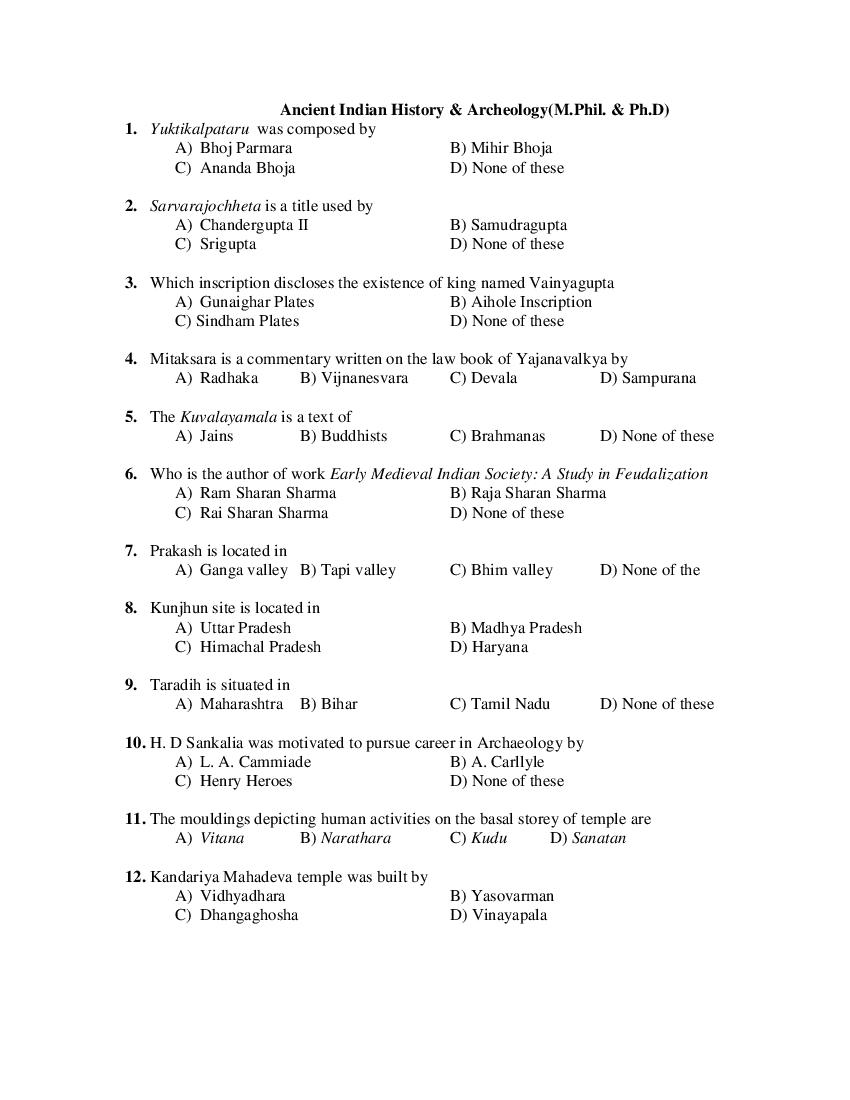
Page 1
1. Yuktikalpataru was composed by
A) Bhoj Parmara B) Mihir Bhoja
C) Ananda Bhoja D) None of these
2. Sarvarajochheta is a title used by
A) Chandergupta II B) Samudragupta
C) Srigupta D) None of these
3. Which inscription discloses the existence of king named Vainyagupta
A) Gunaighar Plates B) Aihole Inscription
C) Sindham Plates D) None of these
4. Mitaksara is a commentary written on the law book of Yajanavalkya by
A) Radhaka B) Vijnanesvara C) Devala D) Sampurana
5. The Kuvalayamala is a text of
A) Jains B) Buddhists C) Brahmanas D) None of these
6. Who is the author of work Early Medieval Indian Society: A Study in Feudalization
A) Ram Sharan Sharma B) Raja Sharan Sharma
C) Rai Sharan Sharma D) None of these
7. Prakash is located in
A) Ganga valley B) Tapi valley C) Bhim valley D) None of the
8. Kunjhun site is located in
A) Uttar Pradesh B) Madhya Pradesh
C) Himachal Pradesh D) Haryana
9. Taradih is situated in
A) Maharashtra B) Bihar C) Tamil Nadu D) None of these
10. H. D Sankalia was motivated to pursue career in Archaeology by
A) L. A. Cammiade B) A. Carllyle
C) Henry Heroes D) None of these
11. The mouldings depicting human activities on the basal storey of temple are
A) Vitana B) Narathara C) Kudu D) Sanatan
12. Kandariya Mahadeva temple was built by
A) Vidhyadhara B) Yasovarman
C) Dhangaghosha D) Vinayapala
Page 2
A) Chahmanas B) Gurjara Pratiharas
C) Chandellas D) Guptas
14. The Bhagadugha is
A) Keeper of dice B) Manager of stables
C) One who apportioned shares D) One who manages army
15. Silappadhikaram was authored by
A) Rano Adhikal B) Ilango Adhikal
C) Rahul Adhi D) None of these
16. Brahmarishidesa corresponds to present was composed by
A) Haryana B) Himachal C) Gujarat D) Karnataka
17. Kaparadaka are
A) Seals B) Sculptures C) Cowery shells D) None of these
18. Pirak is located in
A) Northern Baluchistan B) Southern Baluchistan
C) Kashmir D) Afghanistan
19. The early Indian text on Music is
A) Natyashastra B) Samaveda C) Grihasutras D) None of these
20. The Palaeography of India is written by
A) K. A. Ojha B) Gaurishankara Ojha
C) Garima Ojha D) None of these
21. The term bhumicchidranyaya refers to
A) Process of transplantation
B) Bringing virgin land under cultivation
C) The process of winnowing
D) None of these
22. Hemchandra is an author of
A) Vaijayanti B) Abhidhamachintamani
C) Karpuramanjari D) None of these
23. The capital of Matsya janapada was
A) Mathura B) Pava C) Vairat D) Kampilya
24. The Mahabharata consists of how many Parvas
A) 12 B) 16 C) 17 D) 18
Page 3
A) Jatakas B) Vinay Pitaka C) Dipavamsa D) Abhidhamma Pitaka
26. Who held Chandragupta Maurya as a grandson of Peacock –tamers
A) Hemchandra B) Harisena C) Vishakhadatta D) Somdeva
27. Who suggested the division of Palaeolithic age into lower, middle and upper on the basis
of changes in fauna
A) Edward Cook B) Edouard Lartet
C) Edouard Thames D) Edward Thompson
28. The Sutta Pitaka consists of how many Nikayas
A) 8 B) 6 C) 5 D) 3
29. The Lingaraja temple is a typical example of
A) Triratha and Trianga B) Pancharatha and Panchanga
C) Saptaratha D) None of these
30. Nanadesi was a
A) Commercial body B) Group of slaves
C) Cultural body D) Both (B) and (C)
31. Pentha was a
A) An ornament B) A religious sect
C) A commercial centre D) A Fruit
32. Kile Ghul Mohammad was excavated by
A) W.A. Fairservis B) R.P. Mathur
C) M. Burkitt D) None of these
33. The Pithecanthropus had a cranial capacity of
A) 800cc B) 1000cc C) 750cc D) 1300cc
34. The ninth mandala of Rigveda was dedicated to
A) Craftsmen B) Soma C) Magic D) None of these
35. The Panchajana of Rigveda are
A) Yadu, Kuru, Puru, Turvasa, Anu
B) Yadu, Kuru, Druhyu, Turvasa, Anu
C) Yadu, Puru Turvasa, Anu, Druhyu
D) None of the above
36. Who was Mahishi
A) A Priest B) A prosperous person
C) A chief queen D) A divine creator
Page 4
A) Sibois B) Kshudrakas C) Agras D) Abhiras
38. Who was Vatsaraja
A) A Gurjara –Pratihara king B) A Pala king
C) An architect of Konark temple D) None of these
39. A Putbhedana is a
A) A trade centre B) A craft guild
C) A city dweller D) An archer
40. Who was Akaradhyaksha
A) Director of mines B) Director of salt making
C) Director of foreign office D) Director of brewers
41. Didarganj yakshi was found from
A) Mathura B) Patna C) Bengal D) Orissa
42. Who are called Sungabhrityas
A) Nandas B) Maghas C) Kanavas D) Pahalavs
43. Vakradeva was a successor of
A) Kharavela B) Bhadramagha C) Nagasena D) None of these
44. Who was the founder of Kanava dynasty
A) Vasumitra B) Vasudeva C) Vaimla D) Vachitra
45. Who assumed the title Sarvalogisvara
A) Kujula Kadphises B) Vima Kadphises
C) Both (A) and (B) D) None of these
46. Name the capital of Satavahana rulers
A) Nasik B) Pratishthana C) Kaundinyapur D) Kampilya
47. Who was Balasiri
A) Mother of Gautamiputra Satakarni
B) Grandmother of Gautamiputra Satakarni
C) Mother of Vasisthiputra
D) None of these
48. Angadis were
A) Markets B) Stupas C) Temple rituals D) Herdsmen
49. Who composed Ashtangahridya
A) Chakrapanidatta B) Vagbhatta
C) Krishana D) Bhuvandeva
Page 5
A) Composer of Aihole Inscription
B) Builder of a Meguti temple
C) Father of Mangalesha
D) Both (A) and (B)
x-x-x
Page 6
1. Who authored the famous military work titled, “Principes Generaux de la Guerre?”
A) Jomini B) Clausewitz C) Guibert D) None of these
2. Who coined the term ‘Geopolitics’?
A) Karl Haushofer B) Friedrich Ratzel C) Rudolf Kjellén D) Mackinder
3. ‘Oisivetes’ are related to which of the following thinkers?
A) Jomini B) Jean Errard C) Count de Pagan D) None of these
4. As per the nuclear theorist P. K. Huth, key factors for consideration under rational
deterrence theory are:
i. the military balance;
ii. signaling and bargaining power;
iii. reputations for resolve;
iv. interests at stake
A) i. and ii. only B) i., ii. and iv. only C) i. and iv. only D) i., ii., iii., and iv.
5. Match the following Strategic Thinkers in List – I given below with their respective
domain of doctrines in List – II with the help of code given below:
List – I List – II
(Strategic Thinkers) (Doctrines)
(a) Sir Julian Corbett (i) Nuclear Deterrence
(b) Nichols Spykman (ii) Air power
(c) Herman Kahn (iii) Sea power
(d) Mitchell (iv) Geopolitics
Code :
(a) (b) (c) (d) (a) (b) (c) (d)
A) (iii) (i) (iv) (ii) B) (iii) (iv) (i) (ii)
C) (iv) (ii) (iii) (i) D) (i) (iii) (ii) (iv)
6. Who is author of the book titled, “On Escalation: Metaphors and Scenarios”?
A) Paul K. Davis B) Peter J.E. Stan
C) William W. Kaufmann D) Herman Kahn
7. The book “India’s Wars: A Military History (1947-1971)” has been authored by whom?
A) Shiv Kunal Verma B) T M P Mahadevan
C) Arjun Subramaniam D) Srinath Raghavan
8. The book “India vs Pakistan : Why Can’t we just be friend” has been penned by whom?
A) Arjun Subramaniam B) Husain Haqqani
C) Ayesha Siddiqa D) Kishlay Bhattacharjee
9. Who is the author of the book “The Other Side of Silence: Voices from the Partition of
India”?
A) Khushwant Singh B) Yasmin Khan
C) Sathya Sothanai D) Urvashi Butalia
10. Which of the following are the magazines published by ISIS
i) Rumiyah ii) Dabiq iii) Daesh
Select the correct answer using the codes given below:
A) i) only B) ii) only C) i) and ii) only D) All of them
Page 7
A) Amu B) Hilmand C) Harirud D) Kabul
12. India has Kalapani and Susta territorial dispute with
A) Bangladesh B) Bhutan C) Nepal D) Myanmar
13. The Kaladan transport project by India and Myanmar consists of which of the following
modes of transport?
i) Roads
ii) Railways
iii) Shipping
iv) Inland water transport
Select the correct answer using the codes given below.
A) i), ii) and iii) only B) i), iii) and iv) only
C) ii), iii) and iv) only D) i) , ii), iii) and iv)
14. Which of the following is the first step in starting the research process?
A) Searching sources of information to locate problem
B) Survey of related literature
C) Identification of problem
D) Searching for solutions to the problem
15. Scientific method is committed to ……………….
A) Objectivity B) Ethics C) Proposition D) Neutrality
16. Theory is “ a set of systematically related propositions specifying casual relationship
among variables” is defined by
A) Black James and Champion B) P.V. Young
C) Emory D) Gibbes
17. “Foundations of Behavioral Research” is written by
A) P.V. Young B) Fred Nichols Kerlinger
C) Emory D) Clover Verno
18. Constructivists argue that...
A) Scientific enquiry can uncover absolute truths
B) Material forces are much more important than ideas
C) Individuals are powerless to shape the world as they find it
D) The 'truth' is always socially constructed
19. Which of the following agreements has been signed by India with USA?
i) COMCASA ii) GSOMIA iii) LEMoA iv) BECA
Select the correct answer using the codes given below
A) i. and iii only B) i., ii. and iii. only
C) i., ii. and iv. only D) i., ii., iii., and iv.
Page 8
A) Kingston B) Berlin C) Paris D) New York
21. Which country has agreed to setup a National Crisis Management Centre for India to
handle disaster and other emergency situations?
A) United States B) China C) Russia D) Japan
22. The ‘natural law’ perspective on international law is most associated with which IR
theory?
A) Realism B) Liberalism C) Marxism D) Critical Theory
23. The first India-Myanmar Bilateral Military Exercise 2017 (IMBAX 2017) was held in
which NE state?
A) Nagaland B) Mizoram C) Assam D) Meghalaya
24. With reference to ‘BIMSTEC’, consider the following:
i) It is a regional organization comprising seven Member States lying in the littoral
and adjacent areas of the Bay of Bengal constituting a contiguous regional unity.
ii) It constitutes seven Member States: five deriving from South Asia, including
Bangladesh, Bhutan, India, Nepal, Sri Lanka, and two from Southeast Asia,
including Myanmar and Indonesia.
iii) Recently its 4th summit was held in Nepal.
Which of the above statements is/are correct?
A) i. only B) i and iii only C) i and ii. only D) All of these
25. Exercise Pitch Black 2018 was hosted by
A) South Africa B) Australia C) USA D) Israel
26. According to Kenneth Waltz’s ‘more may be better’ argument which of the following is a
true statement?
A) A large nuclear arsenal is necessary for a state to dominate its region and ensure that
no other state dares attack it
B) The only way for a state to maintain its security is for it to seek an alliance with a
larger and more powerful state
C) A small nuclear arsenal with an appropriate command and control doctrine is
sufficient for nuclear deterrence to operate successfully
D) None of these
27. The ‘SAMADHAN’ doctrine is related to which one of the following problems :
A) To tackle the problem of arms smuggling
B) To tackle the problem of Naxalism
C) To tackle the problem of drugs and narcotics
D) To tackle the problem of Cross-border terrorism
Page 9
Pakistan?
A) Britain B) World Bank
C) USA D) United Nations
29. The ‘Friendship Highway’ is located between
A) Pakistan and China B) India and Bangladesh
C) India and Nepal D) Tibet and Nepal
30. ‘Nine –Dash Line’ relates to which one of the following:
A) Demarcation of China’s Claim in East China Sea
B) Partition of the Korean Peninsula
C) Demarcation of China’s Claim in South China Sea
D) Demarcation of Japanese Claim in East China Sea
31. On which river was the Salal Dam Agreement signed between India and Pakistan?
A) Chenab B) Indus C) Jhelum D) Sutlej
32. Who has propounded the Decision Making Theory?
A) Mortan Kaplan B) Hans J. Margenthau
C) Barry Buzan D) John Burton
33. Identify the correct sequence of N.S.A. in India in a chronological order
A) Brijesh Mishra, M.K. Narayanan, J.N. Dixit, Shiv Shankar Menon, Ajit Doval
B) Brijesh Mishra, J.N. Dixit, M.K. Narayanan, Shiv Shankar Menon, Ajit Doval
C) Shiv Shankar Menon, M.K. Narayanan, Brijesh Mishra, J.N. Dixit, Ajit Doval
D) J.N. Dixit, Brijesh Mishra, M.K. Narayanan, Shiv Shankar Menon, Ajit Doval
34. Who among the following was the mastermind of the massacre at the Holy Artisan
Bakery in July, 2016 in Dhaka?
A) Sheikh Aslam Chowdhury B) Syed Jamal Ali Rehman
C) Tamin Chowdhury D) None of these
35. ‘Geronimo’ was the code name given to which of the following individual by US
administration?
A) Col Gaddafi B) Saddam Hussain
C) Mustafa Abu al-Yazid D) None of these
36. The Headquarters of the International Atomic Energy Agency is located in which one of
the following cities:
A) Vienna B) Paris C) Washington D) Geneva
37. Which one of the following institutions is known as ‘Soft loan window’ of the World
Bank:
A) Indian Development Forum B) International Monetary Fund
C) International Finance Corporation D) International Development Association
38. The term ‘Fat Boy in Space’ refers to which one of the following?
A) Mangalayan B) GSLV Mark - III
C) Cartostat D) IRNSS
Page 10
that has held the Western alliance together”?
A) Henry Kissinger B) James Schlesinger
C) Bill Clinton D) George P. Shultz
40. The Bill HR 6069 introduced in the US Congress in September 2016 is related to which
one of the following?
A) It aims at designating Pakistan a state sponsor of terrorism
B) It aims at checking illegal flow of drug money to terrorist organisations based in Pakistan
C) It aims at eliminating terrorism in the region of South Asia
D) It aims at uniting cooperation in both Afghanistan and Pakistan to eliminate terrorist
groups operating in the region
41. Who among the following thinkers emphasized that “Science is the great antidote to the
poison of enthusiasm and superstition”?
A) A. Hamilton B) Karl Marx C) Adam Smith D) Karl Haushofer
42. Identify the correct code for the Assertion (A) and Reason (R) as given below:
Assertion (A) : The Indian Air strikes on terrorist camps at Balakot in Pakistan was an
action taken in response to Pulwama terrorist attack on CRPF Convoy.
Reason (R): The Indian response under compulsion exhibited the strong political will to
act against terrorism.
Codes :
A) (A) is correct but (R) is not correct B) Both (A) and (R) are correct
C) (A) is not correct, but (R) is correct D) Both (A) and (R) are not correct
43. The Garland Highway in Afghanistan connects which four cities?
A) Herat, Kandhar, Kabul, Mazar-e-Sharif B) Kunduz, Bamiyan, Nimroz, Jalalabad
C) Ghazni, Badakhshan, Khost, Baghlan D) Herat, Bamiyan, Ghazni, Kabul
44. The Younghusband expedition to Tibet to establish diplomatic relations and resolve the
dispute over the border between Tibet and Sikkim occurred in which of the following
years?
A) 1903-04 B) 1904-05 C) 1902-03 D) 1903-05
45. Nine Degree Channel separates ……………..
A) Car Nicobar and Great Nicobar B) Lakshdweep and Minicoy
C) Little Andaman and Car Nicobar D) North Andaman and South Andaman
46. Tibetan Uprising Day commemorates the 1959 Tibetan uprising against the presence of
the People's Republic of China in Tibet. It is observed every year on which of the
following day?
A) 10 February B) 23 February C) 10 March D) 23 March
47. On 15 June 1988, Dalai Lama addressed the members of European Parliament. It is also
called as
A) Strasburg Proposal B) Tibetan Proposal
C) Five point peace plan D) Tibetan Agreement
Page 11
following country?
A) Australia B) United States of America
C) Japan D) UK
49. The Japan- India Association was setup in which year?
A) 1903 B) 1904 C) 1905 D) 1906
50. The fifth India-Japan 2+2 Vice-Ministerial level dialogue was held on June 19, 2018 in
which city?
A) Kyoto B) Tokyo C) New Delhi D) Ahmedabad
x-x-x
Page 12
1. The equilibrium is unstable and indeterminate under:
(A) Edgeworth’s Duopoly Model (B) Chamberlin’s Oligopoly Model
(C) Bertrand’s Model (D) Pareto Model
2. Social welfare function was introduced by:
(A) James Tobin (B) K. Arrow
(C) Lerner (D) Bergson
3. Who is the chairman of 15th Finance Commission:
(A) C.Rangarajan (B) N.K.Singh
(C) Dr. Vijay L. Kelkar (D) Anoop Singh
4. The short run Phillips Curve holds constant:
(A) Wages (B) Taxes
(C) Income (D) Inflationary expectations
5. The value of for Cobb-Douglas Production Function is:
(A) ∞ (B) 0
(C) 1 (D) -1
6. When e< 1, ℎ :
(A) (B)
(C) (D)
7. Laffer Curve measures:
(A) Total tax burden and total payment burden
(B) Total income and total expenditure
(C) Relation between tax rate and tax revenue
(D) Aggregate tax and aggregate non-tax revenue
8. RBI revision of Repo/Reverse Repo Rate by 10 basis points implies which among the
following fractions:
(A) 10% (B) 1% (C) 100% (D) 0.1%
9. The practice of charging each consumer the reservation price is called:
(A) Peak Load Pricing
(B) Third Degree Price Discrimination
(C) First Degree Price Discrimination
(D) Inter-temporal Price Discrimination
Page 13
(A) Goodness of fit of multiple regression model
(B) Heteroscedasticity of multiple regression model
(C) Homoscedasticity of multiple regression model
(D) Multicollinearity of multiple regression model
11. Modern economic growth has been analyzed by:
(A) Maurice Alias (B) W. Leontief
(C) Richard Stone (D) Simon Kuznets
12. GNP at factor cost is equal to:
(A) GNP at factor price – Net Direct Taxes
(B) GNP at factor cost + Net Direct Taxes
(C) GNP at market prices – Net Indirect Taxes
(D) GNP at market prices + Net Indirect Taxes
13. The 2017 Nobel Prize for Economics was awarded to Richard Thaler:
(A) For his analysis of consumption, poverty and welfare
(B) For his analysis of trade patterns and location of economic activity
(C) For integrating climate change into long-run macroeconomic analysis
(D) For his contributions to behavioural economics
14. Keynes Liquidity Preference Theory indicates that the demand for money is:
(A) Negatively related to bond price
(B) Constant
(C) Positively related to interest rates
(D) Negatively related to interest rates
15. If a bank wants to borrow money from RBI which rate of interest is applicable:
(A) Repo Rate
(B) Reverse Repo Rate
(C) Base Rate
(D) Differential rate of interest
16. Devaluation of currency can correct a Balance of Payment deficit because
(A) It raises price of exports and imports in foreign currency
(B) It lowers price of exports in foreign currency and raises price of imports in
home currency
(C) It lowers price of exports and imports in home currency
(D) It raises price of exports in foreign currency and lowers price of imports in
home currency
Page 14
(A) Female Entrepreneur
(B) Large Capital Industries
(C) Micro, Small and Medium Enterprises
(D) Farmers introducing technology in farming
18. What will be the quartile deviation when Q1 = 14.6 and Q3 = 25.2
(A) 5.4
(B) 5.2
(C) 5.3
(D) 5.6
19. Rejecting null hypothesis, when it is true results in which type of error?
(A) Type I error (B) Type II error
(C) Two tailed error (D) One tailed error
20. Financial dualism theory was developed by:
(A) H. Myint (B) M. Porter
(C) A.M. Khan (D) Solow
21. Which type of dispersion is used in sampling theory:
(A) Range (B) Mean Deviation
(C) Standard Deviation (D) None of the above
22. The mean and variance of a Binomial Distribution is:
(A) , (B) √ p,
(C) , (D) ,
23. Foreign trade multiplier is given by:
∆ # ∆ # ∆ # ∆ #
A = (B) = (C) ∆! = #$% (D) = #$&
∆! #$%$& ∆! #$%'& ∆!
24. Core inflation is a measure of inflation :
(A) That is based only of food and energy prices
(B) That includes items that face volatile price movements notably food and
energy
(C) That excludes items that face volatile price movements notably food and
energy
(D) None of the above
25. The ‘ Year of Great Divide’ refers to:
(A) Rapid growth rate in population after 1921
(B) The declining sex ratio after 1921
(C) The slowdown in birth rate after 1921
(D) All of the above
Page 15
(A) IDA (B) IFC (C) IBRD (D) MIGA
27. ‘Reserve Army of Labor’ term was used by who among the following economists:
(A) A. Schumpeter (B) J.R. Hicks
(C) T.R. Malthus (D) Karl Marx
28. The Product Life Cycle Theory was developed by:
(A) Adam Smith (B) David Ricardo
(C) Raymond Vernon (D) Eli Heckscher
29. Which of the following is a measure of market concentration and monopoly power in a
particular industry:
(A) Herfindahl Index (B) Fisher Index
(C) Chamberlin Index (D) Robinson Index
30. By which year the Central Government has planned to double the income of the
farmers?
(A) 2020 (B) 2022 (C) 2023 (D) 2024
31. The regression coefficient is independent of:
(A) Change of origin and scale
(B) Change of origin only
(C) Change of scale only
(D) Neither change of origin nor change of scale
32. Net Profit is equal to total revenue minus:
(A) Explicit costs (B) Implicit costs
(C) Wages and rents (D) Implicit and Explicit costs
33. What does hedging means?
(A) The acceptance of a foreign exchange risk
(B) The covering of a foreign exchange risk
(C) Foreign exchange speculation
(D) Foreign exchange arbitrage
34. Statistic is a numerical quantity which is calculated from:
(A) Population (B) Sample (C) Universe (D) Hypothesis
35. Human Development Index was formulated by:
(A) World Bank (B) International Monetary Fund
(C) UNCTAD (D) UNDP
36. What was the unemployment rate in India for the year 2017-2018 as per the survey
conducted by National Sample Survey Office (NSSO)?
(A) 6.1% (B) 6.2% (C) 6.3% (D) 6.4%
Page 16
(A) Standard deviation (B) Standard normal curve
(C) Standard error (D) Coefficient of determination
38. Money Laundering means:
(A) Money acquired from undisclosed sources
(B) Money acquired from criminal sources
(C) Hiding of income source mainly to avoid Income Tax
(D) Process of conversion of money obtained illegally to appear to have originated
from legitimate sources
39. What is ‘Open Market Operations’?
(A) Activities of SEBI registered brokers
(B) Selling of currency by the RBI
(C) Selling of gilt-edged securities by the Central Bank
(D) Sale of shares by FIIs
40. The number of outcome of rolling three dice is:
(A) 216 (B) 36 (C) 6 (D) 72
41. The mean of 11 numbers is 7, one of the numbers, 13, is deleted. What is the mean of
remaining numbers?
(A) 7.7 (B) 6.4 (C) 6.0 (D) 5.8
42. In Hick’s neutral technical progress , the technical progress is:
(A) Capital augmenting
(B) Labor augmenting
(C) Both labor and capital augmenting
(D) Change in the efficiency and productivity of labor
43. Which state became the first state of India to ratify GST bill?
(A) Bihar (B) Assam
(C) Andhra Pradesh (D) Arunachal Pradesh
44. Which among the following has not been declared as a special category state in India?
(A) Uttrakhand (B) Bihar
(C) Jammu and Kashmir (D) Himachal Pradesh
45. What is e-NAM?
(A) Pan –India online trading platform for agricultural commodities
(B) An initiative to boost industrial growth
(C) A component of Bharat Nirman Programme
(D) A component of Make in India
Page 17
(A) Backwash effects and spread effects
(B) Roundabout effects and direct effects
(C) Spread effects and interlinkage effects
(D) Backwash effects and direct effects
47. Income TOT is:
() (*
(A) . +, (B) . +,
(* ()
(* #
(C) & . , .+, (D) .
() .)
48. When we reject the null hypothesis then our finding is said to be:
(A) 95% probability finding
(B) 5% confidence finding
(C) Not statistically significant
(D) Statistically significant
49. Match the following from List-I and List-II:
List -I List –II
(i) Durbin-Watson‘d’ statistics 1. Stationarity
(ii) R2 2. Qualitative Effects
(iii) Augmented Dickey-Fuller Test 3. Serial Correlation
(iv) Dummy Variable 4. Goodness of fit of regression equation
Codes:
i ii iii iv
(A) 1 2 4 3
(B) 2 1 3 4
(C) 4 3 2 1
(D) 3 4 1 2
50. Intermediate goods are not included to calculate the final output because:
(A) They do not have value
(B) Their value is included in final goods so they are not added to avoid the
problem of double counting
(C) They have unknown value
(D) None of the above
x-x-x
Page 18
1. Gandhi founded his first ashram in South Africa in the year:
A) 1904 B) 1906 C) 1910 D) 1914
2. By Which name is Gandhi ji’s ancestral home known today?
A) Birla House B) Gandhi Nagar C) Bankanair’s House D) Kirti Mandir
3. In which year Gandhi ji passed his matriculation examination in India?
A) 1885 B) 1887 C) 1888 D) 1889
4. Where did Mahatma Gandhi start his struggle against apartheid?
A) Natal B) Cape Colony C) Orange Free State D) Transvaal
5. Bardoli Satyagraha occurred in:
A) 1922 B) 1928 C) 1930 D) 1936
6. In how many parts Mahatma Gandhi’s Autobiography is divided?
A) 6 B) 7 C) 5 D) 4
7. Demand for Pakistan was raised by Mohammed Ali Jinnah in the year:
A) 1938 B) 1939 C) 1940 D) 1942
8. Gandhi ji accorded very high priority to communal harmony in his programme of
actions. At which place did he undertake his last fast for it on January 13, 1948?
A) Nasik B) Delhi C) Navkohli D) Bombay
9. Who called the dropping of Civil Disobedience Movement by Gandhi ji as a
‘National Calamity’?
A) Jawaharlal Nehru B) M. N. Roy
C) Subhas Chandra Bose D) C. R. Das
10. Gandhi ji’s statement “the surplus money should be used for the welfare of the have –
nots”, highlights:
A) Theory of the “greatest good of the greatest number”
B) Theory of “Wantlessness”
C) Theory of “Ends and Means”
D) Theory of “Trusteeship”
11. To refer an International Conflict to third party is called:-
A) Retaliation B) Arbitration C) Mediation D) Meditation
12. According to Gandhi the following is correct:
A) Religion without Politics is a sin
B) Politics bereft of religion is a dirt
C) Spiritualization of politics is impossible
D) Ethics and Economics are separate entities
Page 19
i) Gandhi believed in Caste System
ii) Gandhi did not believe in Caste System
iii) Gandhi believed in Varnashram Dharma
iv) Gandhi did not believe in Varnashram Dharma
A) (i) & (ii) B) (i) & (iii) C) (ii) & (iii) D) (i) & (iv)
14. Who described Gandhi’s long march to Dandi by foot in the following words:
“Like the historic march of Ramachandra to Lanka, the march of Gandhi will be
memorable.”?
A) Motilal Nehru B) Sarojini Naidu
C) Vallabhbhai Patel D) Madan Mohan Malavia
15. Who was the first recipient of Gandhi Peace Prize?
A) Mother Teresa B) Indira Gandhi C) Julius Nyerere D) Rajiv Gandhi
16. Identify the incorrect match:
A) Sunderlal Bahuguna - Chipko Movement
B) Hochi Minh - Gandhi of Vietnam
C) Daisaku Ikeda - Japanese Gandhi
D) Martin Luther King(Jr.) - African Gandhi
17. What was the name of the Educational Inspector who visited the High School
where Gandhi ji was studying and gave spelling exercise of five words?
A) Mr. Kettle B) Mr. Giles C) Mr. Richard D) Mr. Polak
18. Name the Gandhi’s House in Johannesburg, where he lived for 3 years?
A) The Croll B) The Cape Colony C) Smuts Palace D) Prisoners Den
19. Where did Gandhiji address his first speech in South Africa?
A) Cape Town B) Transvaal C) Pretoria D) Orange Free State
20. Gandhi ji writes ‘Sir Pherozeshah had seemed to me like the Himalayas’. To what did
he compare Lokmanya Bal Gangadhar Tilak?
A) Ocean B) Ganga C) River D) Drop of Water
21. What is the subject which was new to Mahatma Gandhi and which he found more
difficult because of English Medium?
A) Geometry B) French C) Sanskrit D) Latin
22. Gandhi participated first in the Boer War or in Zulu Rebellion?
A) Zulu Rebellion
B) Boer War
C) Both Together
D) Never participated in any of the two
Page 20
burst of political activity. This fast was undertaken by him to:
A) Condemn violence of people in the Quit India Movement
B) Prove his innocence before God for violence during the Quit India Movement
C) Register his protest against the violence of state, including the unwarranted
detention of thousands of Congressmen
D) Both: (B) and (C)
24. Which of the following constitutes the primary difference between Western and
Gandhian Socialism?
A) Material progress with violence
B) Equality irrespective of the material wealth
C) State ownership of all means of production without violence
D) First control of the State to be followed by enforcement of equality by law
25. Though at the Round Table Conference in London Gandhi ji could gain nothing, he
was the richer for having secured many friends and the goodwill of the people. Who
of the following eminent persons refused to meet him?
A) Winston Churchill B) Lloyd George
C) Gilbert Murrye D) Lady Astor
26. After how many days of strike was the settlement reached between Ahmedabad
textile mill-owners and workers?
A) Twenty-five B) Twenty-one C) Fifteen D) Twelve
27. Society based on Justice, equality and liberty is also known as:
A) Positive Peace B) Provision of Human Rights
C) Absence of Communal Violence D) Absence of War
28. Where was Gandhi kept as a prisoner during the Salt Satyagraha?
A) Ahmedabad Jail B) Yervada Jail
C) Aga Khan Palace D) Sabarmati Jail
29. Out of the following, who is from the Peace Researchers’ group?
A) Hedley Bull B) Barrack Obama C) John Galtung D) Richard B. Gregg
30. In which year the ‘Universal Declaration of Human Rights’ was adopted by the
General Assembly?
A) 1945 B) 1946 C) 1947 D) 1948
31. Who referred Gandhi ji as ‘One Man Peace Army’ during the partition period?
A) Lord Mountbatten B) Lord Wavell
C) Lord Wellington D) Ramsay McDonald
32. In which year ‘Rio Earth Summit’ related to environment was held?
A) 1972 B) 1973 C) 1992 D) 1993
Page 21
A) 1964 B) 1974 C) 1984 D) 1994
34. Which among the following marks Mahatma Gandhi’s first fast unto death?
A) Kheda Satyagraha B) Champaran Satyagraha
C) Ahmedabad Mill Stike D) Jallianwala Bagh Tragedy
35. Gandhian concept of decentralization is based on:
A) Pyramid B) Oceanic C) Square D) None of these
36. Before his assassination, which document had Gandhi signed?
A) Directive Principles B) Panchyat Raj Institutions
C) Prohibition of intoxicants D) Uniform Civil Code for Citizens
37. Constitution Part IV (Article 36-51) contains the Directive Principles of State Policy.
In the following options bring out those which include the scope of Gandhian
principles?
A) Articles 40, 43, 44 B) Articles 40, 47, 48
C) Articles 50, 50 D) Articles 40, 44, 50
38. Gandhi ji made a distinction between “Passive Resistance” and “Nonviolence”. What
was the distinction?
A) Passive resistance is the resistance offered by the weak because they are unable to
offer armed resistance, whereas nonviolence is the resistance offered by the strong
because they are unwilling to offer armed resistance
B) Passive resistance is the resistance offered by the satyagrahis in the form of fasts
and vows of silence, whereas nonviolence stands for not raising armed resistance
in the fact of state violence
C) Passive resistance means strikes and closing down of work establishment,
whereas nonviolence means demonstrations and other allied activities where work
is not stopped
D) All of the above
39. Having divested himself of the responsibility of leadership of the Congress, Gandhi ji
gave full attention to the revitalization of rural India and the organization of the All-
India Village Industries Association. Which of the following became the headquarters
of training and research in village industries?
A) Sevagram B) Maganwadi C) Sabarmati D) Faizpur
40. Gandhi called himself:
A) An Atheist B) A Arya Smajist C) A Sanatani Hindu D) None of these
41. Identify the correct combination:
i) Gandhi believed in Caste System
ii) Gandhi did not believe in Caste System
iii) Gandhi believed in Varnashram Dharma
iv) Gandhi did not believe in Varnashram Dharma
A) (i) & (ii) B) (i) & (iii) C) (ii) & (iii) D) (i) & (iv)
Page 22
A) To test the Self-Control of the inmates
B) To train the Satyagrahis to retaliate
C) To exercise Self-Control upon Ashram Women
D) To acquire self-discipline and moral perfection
43. What moved Abanindranath Tagore to paint the famous image of Bharat Mata?
A) Civil Disobedience Movement B) Swadeshi Movement
C) Quit India Movement D) All of these
44. Boycott of British Goods is related to which of the following movements?
A) Swadeshi Movement B) Quit India Movement
C) Non Cooperative Movement D) Home Rule Movement
45. Who prepared the Trusteeship formula for Gandhi to consider?
A) Mahadev Desai and Pyarelal
B) J. B. Kripalani and Jayaprakash Narayan
C) Subhash Chander Bose and Jawaharlal Nehru
D) K. G. Mashruwala and N. D. Parikh
46. Quit India Movement is also called as?
A) Khilafat Movement B) Swadeshi Movement
C) Homerule Movement D) August Kranti Movement
47. What led to the Civil Disobedience Movement?
A) Arrival of the Simon Commission
B) Working at the firm without payments
C) Violation of Salt Tax by Gandhi
D) Fall in demand for agricultural goods
48. What was the effect of the Non-cooperation movement on the plantation
workers in Assam?
A) They left the plantations and headed home
B) They went on strike
C) They destroyed the plantations
D) None of the above
49. When Gandhi ji was arrested during the Civil Disobedience Movement and tried
in court, who expressed the wish that if the Government releases Gandhi ji, he
would be the happiest person?
A) Gen. Smuts B) Judge Broom Fields
C) Motilal Nehru D) S. Radhakrishnan
50. The prefix 'Mahatma' was added with the name of Gandhi:
A) During Champaran Satyagraha
B) During the Satyagraha against Rowlatt Act
C) In the Amritsar session of the Indian National Congress 1919
D) At the beginning of Khilafat Movement
x-x-x
Page 23
1. _____ was a gathering at which the booty acquired in a raid was distributed during the
early vedic period.
A) Dana B) Vidatha C) Damaras D) Hadda
2. The Ainnurruvar (five hundred swamis of Aihole) were the most celebrated south Indian:
A) Weavers B) Religious priests C) Ship builders D) Merchant guilds
3. The Jatakas tell us about akasiya and tundiyas:
A) Who were ship builders B) Who were weavers
C) Who were foot soldiers D) Who were oppressive tax collectors
4. The most important leader of the Ajivika sect was:
A) Tapassu B) Bhallika C) Ambattha D) Makkhali Gosala
5. _____ were an important Rajput ruling house of Junagadh.
A) Cudasamas B) Vaghelas C) Jadejas D) Rashtrakutas
6. The ____ refers to a water-based share (Udakabhaga) of produce as tax ranging from one
fifth to one third of the crop.
A) Arthasastra B) Indika C) Dipvamsa D) Girnar inscription
7. The striking ‘Yakshi’ from Didarganj belongs to the ___ .
A) Gupta period B) Nanda period C) Mauryan period D) Vardhan period
8. Maues is the first ___ king whose coins are found mainly in Punjab.
A) Pala B) Sena C) Saka D) Parthian
9. The capital of Kosala was:
A) Shrvasti B) Gonda C) Champa D) Vaishali
10. The Sabha and Samiti are described as twin daughters of:
A) Lord Vishnu B) Lord Shiva C) Goddess Durga D) Lord Prajapati
11. The White Yajurveda contains a special prayer Shatarudriya, addressed to:
A) Lord Vishnu B) Lord Shiva C) Lord Durga D) Lord Krishna
12. _____ was the famous king of Girnar in the 12 century AD.
A) Ra Khengar B) Pulakesin II C) Rudradaman D) Mahendravarman
13. Svapnavasavadatta, was a drama composed by:
A) Bhasa B) Kalidasa C) Patanjali D) Harisena
14. ____ was a kind of cloth woven with gold thread and silk yarn in medieval India.
A) Zardozi B) Phulkari C) Tsar D) Zarbaft
Page 24
Gujarat ranging in time from:
A) 12 to 16 century A.D. B) 9 to 13 century A.D.
C) 4 to 7 century A.D. D) 14 to 18 century A.D.
16. ___ were territories reserved for the King’s treasury.
A) Kharaj B) Imlak C) Khalisa D) Khot
17. Nabud in Mughal period meant:
A) Land where crop had failed B) Land given as reward to warriors
C) Land exempted from land tax D) Land alienated for religious buildings
18. Qutb Minar was built early in the:
A) 11 century B) 12 century C) 13 century D) 14 century
19. The rearing of mulberry silkworm is reported from ___ only in the 15 century.
A) Bengal B) Avadh C) Punjab D) Kashmir
20. Bijak is the most revered collection of:
A) Dadu B) Kabir C) Raidas D) Dhanna
21. Virji Vohra and Abdul Gafur were well known merchants of:
A) Sopara B) Delhi C) Surat D) Ahmadabad
22. Zainul Abidin (1420-1470) was the famous sultan of:
A) Kashmir B) Bengal C) Avadh D) Bijapur
23. A dhadi is:
A) A musician who sings in praise of the Sikh gurus and recounts the heroic deeds of the
Sikhs
B) The keeper of the royal residence in the time of Maharaja Ranjit Singh
C) Literally, a horse rider
D) A person well-versed in the Sikh scriptures
24. Guru Arjan founded Kartarpur in the:
A) Chaj Doab B) Bari Doab C) Bist-Jalandhar Doab D) Rachna Doab
25. PEPSU is:
A) Punjab and East Punjab States Union B) Patiala and East Punjab States Union
C) Punjab and East Princely States Union D) Punjab and North Punjab States Union
26. The tutor of Maharaja Ripudaman Singh of Nabha was the Sikh intellectual:
A) Gaini Ditt Singh B) Bhai Sohan Singh
C) Bhai Gurdit Singh D) Bhai Kahn Singh
Page 25
A) Kard B) Kardar C) Katra D) Marhi
28. Land entirely dependent on rain for cultivation is _____.
A) Barani B) Batai C) Faslana D) Garhi
29. Ghallughara, is used for two carnages in Sikh history, one in 1746 and the other in ___.
A) 1759 B) 1760 C) 1761 D) 1762
30. Rahiras is a composition of ____ recited in the evening in a Gurdwara or at home.
A) Guru Gobind Singh B) Guru Arjan Dev
C) Guru Nanak Dev D) Guru Har Rai
31. The Alienation of Land Act of 1900:
A) Prevented cultivators from transferring their lands or mortgaging them for extended
periods to non-agriculturists
B) Prevented cultivators from transferring their lands or mortgaging them for extended
periods to other cultivators
C) Exempted cultivators from payment of land revenue
D) Forced the cultivators to pay double land revenue in case of delay
32. The Punjab Chiefs College at ____ educated the sons of princes and men of high social
position.
A) Lahore B) Amritsar C) Lyallpur D) Simla
33. The Legislative Council was formed in 1897 in the Punjab consisting of only ____
members.
A) 5 B) 6 C) 9 D) 10
34. The Brahmo Samajist monthly, ____ was launched in 1877 in the Punjab.
A) Panjabee B) Hari Hakikat C) Kohinoor D) Akbar-i-Am
35. The Namdhari movement in the Punjab was started by ____.
A) Hira Singh Dard B) Baba Dayal C) Baba Balak Singh D) Tej Singh
36. The Ministry of Bhim Sen Sachar is known for the ____ formula generally called the
Sachar Formula.
A) Language B) Racial C) Reservation D) Caste
37. The ______ won the largest number of seats in the elections of the Punjab Legislative
Council in 1926.
A) Indian National Congress B) Hindu Mahasabha
C) Shiromani Akali Dal D) Unionist Party
38. Maharaja Hari Singh of _____ acceded to India in October 1947.
A) Junagarh B) Kashmir C) Baroda D) Nabha
Page 26
A) Jai Prakash Narayan B) Morarji Desai
C) Indira Gandhi D) Jawaharlal Nehru
40. A non-Brahmin movement emerged in south India under the leadership of E.V.
Ramaswamy Naicker, ‘Periyar’ called:
A) Self-Respect Movement B) Justice Movement
C) Dravidian Movement D) Low-Caste Movement
41. The Lucknow-Pact (1916) was an important step in achieving:
A) Hindu-Sikh unity B) Hindu-Muslim unity
C) Muslim-Sikh unity D) Hindu-Christian unity
42. ____ was appointed the Chairman of the Boundary Commission in June 1947.
A) Sir Stafford Cripps B) Sir Cyril Radcliffe
C) Sir Campbell Johnson D) None of these
43. A.K. FazlulHuq was the leader of the ____ in Bengal.
A) KrishakPraja Party B) Unionist Party
C) Kirti Kisan Party D) Naujawan Bharat Sabha
44. _____ was chosen as the Direct Action Day during the agitation for Pakistan.
A) 16 August 1945 B) 16 August 1944
C) 16 September 1946 D) 16 August 1946
45. Subhas Chandra Bose resigned as President of the Indian National Congress in Calcutta in:
A) 1938 B) 1939 C) 1940 D) 1941
46. The author of The Idea of History is:
A) E.H. Carr B) R.G. Collingwood
C) John C.B. Webster D) Trevelyan
47. History is a ‘chapter of ____’.
A) Accidents B) Incidents C) Events D) Happenings
48. Study of coins is known as:
A) Anthropology B) Archaeology C) Numismatics D) Architecture
49. Historians must examine primary sources critically to determine their ___ and reliability.
A) Genuineness B) Objectiveness C) Antiquity D) None of these
50. ____ is the author of Discovery of India.
A) Motilal Nehru B) Mahatma Gandhi
C) Subhas Chandra Bose D) Jawaharlal Nehru
x-x-x
Page 27
1. Syādvāda is an epistemic theory of—
A) Nyaya B) Samkhya C) Jainism D) Buddhism
2. The Four Ārya Satyas of Buddhism are—
A) Dukha, The cause of dukha, Ceassation of dukkha , The path to achieve the cessation of
dukkha
B) Ahimsā, Satya, Asteya, Aprigraha
C) Kāma, Krodha, Lobha, Moha
D)Yama, Niyama, Dhyāna, Samādhim
3. Yama, Niyama, Āsana, Prāņāyāma, Pratyāhāy, Dhārņā, Dhyāna, Samādhi are the eight fold
path of –
A) Yoga of Buddha B) Yoga of Patanjali
C) Jainism D) Tantra
4. Which one of the following is a great Mahayan Bhuddhist Philosopher?
A) Nagarjuna B) Gagesha Upddhyaya
C) Ishwar Krishna D) Ramanuja
5. Who is the founder of Vaisheshika school of philosophy ?
A) Jaimini B) Gautama C) Kanada D) Kautilya
6. Ramanuja’s interpretation of Vedanta philosophy is known as –
A) Dwait Vāda B) Adwaita Vāda
C) Viśiştādwaita Vāda D) Śuddhādwaita Vāda
7. Who is the author of Viveka Chudamani?
A) Acarya Shamkara B) Acarya Ramanuja
C) Acarya Vallabha D) Acarya Nimbarka
8. ‘Apurva’ is a very important concept of ______.
A) Nyaya B) Vaishesika C) Vedanta D) Mimansa
9. Which one of the following Upnishadas is a dialogue between Naciketa and Yama---
A) Ishavasya B) Kena C) Mandukya D) Katha
10. How many sutras are there in Narada Bhakti Sutra ?
A) 84 B) 85 C) 90 D) 95
11. Which one of the philosophers of Modern age was also the founder of Co-ordinate Geometry?
A) Immanuel Kant B) Rene Descartes C) Benedict Spinoza D) John Locke
12. Which one of the following thinkers does not belong to the Rationalist school?
A) Descartes B) Spinoza C) Leibniz D) David Hume
Page 28
A) David Hume B) Descartes C) Kant D) John Locke
14. Who equates Nature with God?
A) Kant B) Spinoza C) Leibniz D) Hume
15. ‘Pantheism’ is a philosophical view that means _______.
A) Everything is God B) Everything is in God
C) All gods are one D) Nothing is God
16. Kant’s theory of Knowledge is known as —
A) Transcendentalism B) Pragmatism
C) Utilitarianism D) Henotheism
17. Kant’s Ethical theory is known as _______.
A) Virtue Ethics B) Deontological Ethics
C) Hedonistic Ethics D) Pragmatic Ethics
18. Whose Ethical theory is also popularly known as ‘Rigorism’ ?
A) Spinoza B) Mill C) Moore D) Kant
19. ‘Categorical Imparative’ means _________.
A) Voice of conscience B) Command of Reason
C) Law of the land D) Divine injubction
20. Who has writen ‘Pincipia Ethica’?
A) G. E. Moore B) Spinoza C) Kant D) Aristotle
21. Who has written ‘Ethica’?
A) G. E. Moore B) Spinoza C) Kant D) Aristotle
22. ‘Prescriptivism’ in Ethics is propounded by_______.
A) G. E. Moore B) J.S. Mill C) R. M. Hare D) Immanuel Kant
23. Who held that moral judgements are merely a person’s emotional expressions regarding an
act?
A) J. S. Mill B) A. J. Ayer C) R. M Hare D) G. E. Moore
24. Who is the author of ‘Philosophical Investigations’ ?
A) Wittgenstein B) Husserl C) Sartre D) Heidegger
25. Who is the author of ‘Logical Investigations’?
A) Wittgenstein B) Husserl C) Sartre D) Heidegger
26. ‘Propositions are the pictures of facts’. This is the view of _______.
A) Husserl B) Latter Wittgenstein
C) Sartre D) Early Wittgenstein
27. ‘Use theory of meaning’ emerges in the philosophy of _______.
A) Husserl B) Latter Wittgenstein
C) Sartre D) Early Wittgenstein
Page 29
_________.
A) Sense experience B) Original experience
C) Mystical experience D) Personal experience
29. In Husserl’s Phenomenology ‘Reduction’ means—
A) Reducing the data into sense data
B) Analysing the data into fundamental concepts
C) Going Back to experience
D) Going back to soul
30. ‘Existence precedes essence’ – is the slogan given by ________.
A) Sartre B) Kierkegaard C) Jaspers D) Heidegger
31. Which one of the following novel is written by Sartre?
A) A Tale of Two Cities B) Hard Times
C) Nausea D) War and Peace
32. Who wrote ‘Being and Time’?
A) Sartre B) Heidegger C) Kierkegaard D) Jaspers
33. Who wrote ‘Being and Nothingness’?
A) Sartre B) Heidegger C) Kierkegaard D) Jaspers
34. Which one of the following thinkers has given ‘The Theory of Communicative Action’?
A) Jurgan Habermas B) Heidegger C) Kierkegaard D) Jaspers
35. Who holds that prejudice has a positive role in understanding a phenomenon?
A) Jurgan Habermas B) Heidegger C) H. G. Gadamer D) Jaspers
36. Whose Phenomenology of Perception is based on Gestalt Psychology ?
A) Jurgan Habermas B) Merleay Ponty C) H. G. Gadamer D) Jaspers
37. Who is a contemporary exponent of the ‘ Speech Act Theory of Language’ ?
A) John Searle B) Davidson C) Saul Kripke D) Peter Winch
38. Who has given the idea of Radical Translation?
A) Davidson B) Wittgenstein C) Russell D) Quine
39. Who presented a solution to the traditional paradoxes by the ‘Theory of Types’ ?
A) Moore B) Russell C) Wittgenstein D) Husserl
40. With which one of the following thinkers Russell wrote the ‘Principia Mathematica’?
A) G. E. Moore B) L. Wittgenstein C) A. N. Whitehead D) Husserl
41. The idea of ‘Language Game’ is given by ___________.
A) G. E. Moore B) L. Wittgenstein C) A. N. Whitehead D) Husserl
42. Who envisaged language as a ‘Form of Life’?
A) Wittgenstein B) Davidson C) Quine D) Dummet
43. Who among the following philosophers is an Idealist ?
A) Moore B) Marx C) Bradley D) Russell
Page 30
A) Moore B) Marx C) Bradley D) Russell
45. Who proclaimed that Truth is Subjective ?
A) Jaspers B) Kierkegaard C) Sartre D) Gadamer
46. Which one of the following is not a Tautology ?
A) (P v ~ P) B) ~ ( P . ~P) C) (P . P) D) {(P . P ) v ~ P}
47. Which one of the following is a Tautology?
A) P ( ﬤQ ﬤP)} B) { (P ﬤQ) ﬤP } C) {P . (Q ﬤP)} D) { P( ﬤP . Q )}
48. A condition is called ‘Paradox of Material Implication’ in which—
A) A true proposition implies a false proposition
B) A false proposition implies a false proposition
C) A false proposition implies a true proposition
D) A false proposition is implied by a true proposition
49. A ‘Symmetrical Relation’ could be symbolically stated as--
A) (x) (y) ( Rxy ~ ﬤRyx ) B) (x) (y) ( Rxy ﬤRyx )
C) (x) (y) ( Rxy ~ ﬤRxy ) D) (x) (y) ( Rxy ﬤRxx )
50. Which one of the following propositions does not assert the existence of the members of the
class they represent ?
A) All humans are rational B) Some humans are rational
C) Some Humans are not rational D) Not all humans are rational
x-x-x
Page 31
1. The author of the book “The Wretched of the earth” is written by:
(A) Wilfred Pareto (B) Frantz Fanon
(C) Jean-Paul Sartre (D) Anthony Elliot
2. “No citizen enjoys genuine freedom of religious conviction until the state is indifferent to
every form of religious outlook from Atheism to Zoroastrianism.” Who said it?
(A) Emanual Kant (B) Maciver
(C) Harold J Laski (D) David Easton
3. Attributes of the traditional doctrine of Sovereignty can be summed up as:
(A) Absoluteness, Universality, Inalienability, Permanence and Indivisibility
(B) Comprehensiveness, Inalienability, Perpetuity and Absoluteness
(C) Perpetuity, Absoluteness, Leadership and Superiority
(D) None of the above
4. From the statements given below, select which is not associated with Hobbesian Contract
(A) Hobbes’ contract is irrevocable
(B) It confers no rights to the people against the Sovereign
(C) Every word of the Sovereign is law and Sovereign personifies the will of all
(D) The terms of the contract are not applicable to the generations to come
5. Which articles of the Indian Constitution mention administrative relations between the
Centre and the states?
(A) Article 240-247 (B) Article 256-263
(C) Article 270-280 (D) Articles 281-291
6. The main objective of the rule of law is to ensure:
(A) Independence of Judiciary (B) Liberty and equality for citizens
(C) Freedom of news papers (D) All the above
7. Nationalism means:
(A) Identification with one's own nation and support for its interests
(B) The desire to establish a dominant empire
(C) The desire of a people to start a war
(D) All the above
8. The members of the Senate in USA are elected through
(A) Indirect election (B) The state legislatures
(C) Direct election (D) US Congress
Page 32
(A) Have never enjoyed power of judicial review
(B) Do not enjoy the power of judicial review
(C) Supreme Court may allow them the power of judicial review
(D) Enjoy the power of judicial review
10. An essential condition for the success of Liberal Democracy is that:
(A) People should be religious
(B) People should subscribe to one ideology
(C) There should be freedom of press
(D) Election should be organized by the ruling party
11. The guiding principal of a socialist state is:
(A) From each according to his ability and to each according to his work
(B) Maintain difference in income and wealth between the people
(C) Establish multi party democracy
(D) From each according to his capacity and to each according to his needs
12. In the seminal work ‘The Origins of Totalitarianism’:
(A) Herbert Marcuse laid down the foundation of a totalitarian state
(B) Rousseau built a state based on ‘General Will’
(C) Hannah Arendt examined the roots of Communism and Nazism
(D) None of the above is true
13. Under Article 370 of the Indian Constitution:
(A) Parliament cannot make any law or change any policy without concurrence of
State Legislature
(B) Jammu and Kashmir has its own constitution and flag
(C) National Emergency except on the ground of external aggression cannot have
automatic extension to J&K
(D) All the above are applicable
14. Number of Indian States having bicameral legislature is:
(A) 6 (B) 7 (C) 8 (D) 9
15. Who founded the ‘Servants of India Society’?
(A) Mahatma Gandhi (B) Annie Besant
(C) Gopal Krishna Gokhale (D) Jawaharlal Nehru
16. Number of subjects in the Union list, the State List and Concurrent list respectively is:
(A) 97 - 61 - 47 (B) 100 – 66 - 52
(C) 98 – 63 – 48 (D) 96 – 62 - 47
Page 33
(A) Right to Property deleted from the list of fundamental rights
(B) Defection to another political party after election made illegal
(C) Voting age reduced from 21 to 18 years
(D) Konkani, Manipuri and Nepali added as languages in the Eighth Schedule
18. Extraterritoriality stands for:
(A) Extending a country’s territory
(B) Redefining territorial jurisdiction with the neighbours
(C) Extending country’s laws to the citizens living in outside territories
(D) Privilege of immunity from local law enforcement enjoyed by certain aliens
19. Electoral College to elect Indian President consists of:
(A) All the members of Lok Sabha and Rajya Sabha
(B) Elected members of Lok Sabha and state legislatures
(C) Elected members of Parliament and state legislatures
(D) Elected members of state legislatures and all members of Parliament
20. In a post Industrial Society:
(A) Service sector generates more wealth than the manufacturing sector
(B) Industrialisation is at its peak
(C) Industry and agriculture contribute equally to GDP
(D) Liberal democracy is endangered
21. Elected non-permanent seats in UN Security Council are distributed on which basis:
(A) On the basis of defense preparedness
(B) On the basis of continental representation
(C) On the basis of quantum of GDP
(D) On the basis of seniority in UN membership
22. Which freedom has not been given under article 19 of the constitution?
(A) Freedom of speech and expression
(B) Freedom to assemble peaceably and without arms
(C) Freedom to confess any religion
(D) Freedom to form associations or unions
23. The book ‘The Twenty Years' Crisis’, published in 1939 was authored by:
(A) Benjamin Franklin (B) E. H. Carr
(C) H. J. Morgenthau (D) George F. Kennan
24. Which of the following statements is correct?
(A) The foundation of British Constitution was laid in the 15th century
(B) The foundation of British Constitution was laid in the 16th century by King
George, who issued Magna Carta
Page 34
who issued the first charter of British freedom known as Magna Carta
(D) None of the above
25. Which of the following is true about Fascism?
(A) Fascism is spiritual, ethical, religious and historical in concept
(B) Fascism is ideologically close to Parliamentary Democracy
(C) Fascism respects individualism, liberalism and socialism
(D) All the Above
26. Theory of alienation propounded by Karl Marx is:
(A) Theory of man being alienated from nature
(B) Theory of man being alienated from history
(C) Theory in which the worker is made to feel foreign to the products of his/her
own labour
(D) None of the above
27. _______ was a great supporter of the proportional representation.
(A) Jeremy Bentham (B) Harold J. Laski
(C) John Stuart Mill (D) John Locke
28. Which of the following statements wrong?
(A) Locke does not believe that man is egoistic, quarrelsome and aggressive
(B) Locke viewed man as selfish, power hungry and never satisfied
(C) To Locke men are fundamentally decent, orderly and society loving
(D) None of the above
29. The chief advocate of Patriarchal Theory was:
(A) Sir Henry Maine (B) J. J. Rousseau
(C) Beatrice Webb (D) Pattabhi Sitaramayya
30. Aim of the Khilafat Movement in India was
(A) To pressurise British government to preserve the authority of the Ottoman Sultan
(B) A means of achieve pan-Indian Muslim political Support for freedom movement
(C) To create Hindu Muslim unity
(D) All the above
31. The left–right paradigm is a concept from Political Sciences and Anthropology which
proposes:
(A) All the political systems are confronting the right wing politics
(B) That societies have a tendency to divide themselves into ideological opposites.
(C) Left ideology is fundamentally inward looking
(D) Neither left nor right is sensitive to the aspirations of the people
Page 35
(A) Gandhiji and Lord Irwin (B) Gandhiji and Jinnah
(C) Gandhiji and S.C. Bose (D) Gandhiji and Ambedkar
33. Who among the following Pakistani Nationals was awarded “Bharat Ratna” by the Indian
Government?
(A) Liaquat Ali khan (B) Mohammad Ali Jinnah
(C) Khan Abdul Ghaffar Khan (D) Dr. Mohammad Iqbal
34. The first mass movement started by Mahatma Gandhi was?
(A) Non Co-operation Movement (B) Salt Movement
(C) Quit Indian Movement (D) Indigo Movement
35. Plato defined Justice as:
(A) Justice is the interest of stronger
(B) Injustice is better than justice
(C) Justice is fulfilling one's proper role and principle of non-interference
(D) Justice is weakness of the weaker
36. The Pluralists believe that:
(A) There should be a federal form of government in the state
(B) There should be no government at all in the state
(C) The state should share its sovereignty with a large number of associations
(D) Associations in the state should be deprived of most of their existing powers
37. Finance Commission of India is appointed every:
(A) 5 years or earlier if President desires so
(B) 5 years by the President on recommendation of Lok Sabha
(C) 10 years or earlier if President desires so
(D) 5 years by the Prime Minister if he desires so
38. The Interim Government envisaged under the Cabinet Mission Plan was formed on:
(A) 16 January 1946 (B) 2 September 1946
(C) 3 January 1947 (D) 26 January 1947
39. Most of the Amendments in Indian Constitution can be carried out:
(A) By Lok Sabha with simple or two-third majority
(B) By Lok Sabha with the consent of one half of states
(C) By Lok Sabha and Rajya Sabha with the ratification by all the states
(D) By the Lok Sabha and Rajya Sabha with simple or two-third majority
40. Which of the following is true?
(A) The International Court of Justice comprises of 15 members elected for five
Page 36
(B) The International Court of Justice comprises of 15 members elected for six year
term by the UN General Assembly
(C) The International Court of Justice has 10 members elected for nine year term by
the UN Security Council
(D) The International Court of Justice comprises of 15 members elected for nine year
term by UN General Assembly and the Security Council
41. Democracy is a ‘government in which everyone has a share’ was the opinion of:
(A) Abraham Lincoln (B) George Washington
(C) Albert Einstein (D) Niccolo Machiavelli
42. Which of the statements is correct in defining gender mainstreaming?
(A) Gender mainstreaming is women empowerment
(B) Gender mainstreaming is integrating gender concerns in policy making
(C) Gender mainstreaming is an end in itself rather that means to an end
(D) Gender mainstreaming is a holistic approach to establish complete equality
43. The names of two major parties in USA are:
(A) Labour and Democrat (B) Liberal and Democrat
(C) Republican and Democrat (D) Conservative and Democrat
44. Under the Presidential System of government:
(A) Advice of the Cabinet is binding on the President
(B) Advice of the Cabinet is not binding on the President
(C) The President cannot disregard the advice of the Cabinet
(D) Cabinet can impeach the President
45. Which were allied powers during the Second World War?
(A) Great Britain, France, Soviet Union, United States and China
(B) United States, Italy, Germany, Japan and China
(C) Great Britain, France, Italy, Brazil, Ireland and China
(D) Germany, Great Britain, France and Ottoman Empire
46. Which of the following books was not written by Nehru?
(A) Glimpses of World History (B) The Discovery of India
(C) Selected Works of Nehru (D) An Autobiography
47. Austin’s theory of sovereignty is also known as:
(A) Totalitarian theory of sovereignty (B) Traditional theory of sovereignty
(C) Legal theory of sovereignty (D) Monistic theory of sovereignty
Page 37
(A) Individual (B) Society (C) Community (D) State
49. Which of the following is correct?
(A) Rajya Sabha is only a directly elected house
(B) India has geographical boundaries with 7 countries
(C) India has 29 states and 7 union territories
(D) John Rawls was a great British liberal political thinker
50. Which of the following about Legislative Council is correct?
(A) Governor nominates 1/3rd of its members on the basis of qualification
(B) Legislative Assembly nominates 1/6th of its members on party basis
(C) University Teachers elect 1/12th of its members from themselves
(D) Graduates of the state with three years' standing elect 1/12th of its members
x-x-x
Page 38
1. Which of the following British Lord created Intelligence Bureau during the British Rule in
India?
A) Lord Lytton B) Lord Curzon C) Lord Minto D) Lord Irwin
2. Which Section of Indian Police Act, 1861 required maintenance of a General Diary in Police
Stations?
A) Section 42 B) Section 43 C) Section 44 D) Section 49
3. The Criminal Procedure Code came into force in India from:
A) 15 February, 1863 B) 1 January, 1862
C) 5 September, 1864 D) 1 August, 1861
4. During the Moghul period, who among the following was incharge of the entire police force?
A) Kotwal B) Subedar C) Fauzdar D) None of these
5. Central Industrial Security Force was set up on:
A) September 10, 1961 B) March 10, 1969
C) November 19, 1965 D) October 15, 1960
6. The law relating to Inquest-investigation is contained in which section of the Code of
Criminal Procedure?
A) Section 164 B) Section 471 C) Section 174 D) Section 147
7. The International Criminal Police Organization popularly known as Interpol has its head
quarters at:
A) New York, USA B) Chicago, USA
C) Lyon, France D) London, England
8. The Government of India created Shri Soli Sorabjee Committee to draft a new police act on:
A) September 9, 2006 B) September 20, 2005
C) November 9, 2005 D) October 5, 2006
9. The salary and pension expenditure of the IPS officers posted in a state are met by:
A) The Central Government
B) The State Government
C) Partially by Central Government and partially by State Government
D) None of the above
10. Who among the following characterizes crime as a symptom of social disorganization?
A) Tappan Paul W. B) Lombroso
C) Sutherland D) Cesare Beccaria
11. Who among the following propounded the classical school of criminology?
A) Enrico Ferri B) J.L. Gillin
C) Raffaelo Garofalo D) Cesare Beccaria
12. Who has given conflict theory of criminal behavior?
A) Dr. E.A. Hooton B) Vold G.B.
Page 39
13. Which of the following section of the Information Technology Act, 2000 deals with
unauthorized access to a computer, computer system or computer network?
A) Section 40 B) Section 42 C) Section 43 D) Section 44
14. The Police Officer investigating cyber crime under Section 80 of I.T. Act, 2000 should not be
below the rank of:
A) Sub-Inspector B) Inspector
C) Deputy Superintendent of Police D) Superintendent of Police
15. Which of the following section of the Juvenile Justice (care and protection of children) Act,
2000 makes provision for ‘Special Homes’ for Juveniles?
A) Section 7 B) Section 8 C) Section 9 D) Section 10
16. Which of the following country in the world was the first to legalize euthanasia?
A) England B) USA C) Canada D) Netherlands
17. In India, first women jail was established at:
A) Calcutta B) Pune C) Yarwada D) Patiala
18. Which of the following state was first to establish open jail in India?
A) Madhya Pradesh B) Maharashtra
C) Kerala D) West Bengal
19. The term of office of the Vice-President is:
A) 2 years B) 3 years C) 5 years D) 6 years
20. The greatest resistance to Scientific Management school came from:
A) Human Relationists B) Workers
C) Managers D) Trade Unions
21. The first country in the world to introduce the right to information was:
A) Norway B) USA C) Sweden D) Finland
22. In the House of People (Lok Sabha), number of representatives from the Union Territories
cannot exceed:
A) 10 B) 20 C) 30 D) 40
23. Selection of every nth person, from a list of persons, to be included in a sample is called:
A) Purposive sampling B) Systematic sampling
C) Accidental sampling D) Stratified sampling
24. The experimental study is based on:
A) The manipulation of variables B) Conceptual parameters
C) Replication of research D) Survey of literature
25. Which of the following is not the characteristic of a research?
A) Research is systematic B) Research is not a process
C) Research is problem oriented D) Research is not passive
Page 40
A) Six years of age B) Seven years of age
C) Nine years of age D) Ten years of age
27. Which of the following is correct for the aforesaid:
I. The physical aspect of crime is actus reas.
II. The mental aspect of crime is mens rea.
III. The motive is the desire to commit crime
A) I & II are correct but III is not correct
B) Only II & III
C) Only I & III
D) I, II & III
28. Right to private defence is:
A) Available under all circumstances
B) Available where there is time to have the recourse to the protection of public
authorities
C) Available where there is no time to have recourse to the protection of public
authorities
D) All of the above
29. Which of the following Section of the IPC deals with solitary confinement?
A) Section 71 B) Section 72 C) Section 73 D) Section 74
30. Section 311 of the Code of Criminal Procedure, 1973-
A) Is confined to Court witnesses
B) Does not apply to defence witnesses
C) Cannot be exercised after the accused had closed his defence
D) Does not include “accused” as witness
31. Compounding an offence under section 320 of the Code of Criminal Procedure, 1973-
A) Can only be done after obtaining the permission from the Court
B) Can only be done by the complainant
C) Cannot result in acquittal of the accused
D) None of these
32. If a judge dies after writing his judgement but before delivering it-
A) The judgement will be final as long as the judge has signed it
B) The judgement will be final if his successor comes and delivers it
C) The judgement will be considered merely as an opinion
D) The judgement will be final in criminal proceedings
33. The maximum possible compensation awardable under section 357 of the Code of Criminal
Procedure, 1973:
A) Depends on the Court in which the case is being tried
B) Cannot exceed the maximum fine possible for the offence
Page 41
D) Depends on the discretion of the judge
34. Generally dying declarations are admissible as evidence under-
A) Section 20 of the Indian Evidence Act, 1872
B) Section 25 of the Indian Evidence Act, 1872
C) Section 32 of the Indian Evidence Act, 1872
D) Section 35 of the Indian Evidence Act, 1872
35. Definition of secondary evidence has been given under _________ of the Indian Evidence
Act, 1872?
A) Section 61 B) Section 62 C) Section 63 D) Section 64
36. Under the Protection of Women from Domestic Violence Act, 2005, domestic violence
includes
A) Physical and Sexual abuse B) Verbal and Emotional abuse
C) Economic abuse D) All the above
37. The steps taken by the police for collection of evidence is known as:
A) Enquiry B) Investigation
C) Remand D) None of the above
38. A search warrant is a written authority given to a police officer or any other person for the
search of any place
A) Generally
B) For specified things or documents
C) Generally as well as for specified things or documents
D) None of the above
39. A police officer arresting a person may carry out the personal search of the person arrested,
as provided
A) Section 50 of CrPC B) Section 51 of CrPC
C) Section 54 of CrPC D) Section 56 of CrPC
40. Which of the following statements does NOT hold true for the confessions made to the
Magistrate under the provisions of the Code of Criminal Procedure, 1973?
A) It is the duty of the Magistrate to exclude the presence of the police officer from
the
place where the confession is recorded
B) It is obligatory for the Magistrate to warn the accused, before recording his
confession that he is not bound to make it and that if he does so, it may be used as
evidence against him
C) The accused should be sent back to police custody as soon as the confession is
recorded
D) It is necessary for the confession to be signed by the accused
41. A plea that an accused was somewhere else when the crime was committed:
A) Alibi B) Declaration C) Allegation D) Proof
Page 42
remand under Section 167 of the Code of Criminal Procedure, 1973?
A) If the investigation is not completed within 60 days he has to be released on bail
B) The maximum period of remand in police custody cannot exceed 15 days, after
that
only sending to judicial custody is possible
C) The maximum period of remand in judicial custody cannot exceed 15 days, after
that only sending to police custody is possible
D) If the investigation is not completed within maximum period of 90 days the
accused has to be released
43. Which of the following statements in NOT true regarding the charge sheet made under the
provisions of the Code of Criminal Procedure, 1973?
A) In case of offence of a rape of a child the charge sheet must be submitted within
three months of the FIR
B) After submission of the charge sheet there cannot be any further investigation into
the case by police
C) The right to be released on bail is lost once the charge-sheet is filed
D) Charge sheet against absconding accused can be filed even if the accused is not
arrested
44. Which police force is currently providing security cover to nuclear installations, airport,
seaports, power plants?
A) BSF B) CRPF C) CISF D) Indian Army
45. The Convention for the Prevention and Punishment of Terrorism was adopted in the year:
A) 1919 B) 1937 C) 1948 D) 1958
46. Which one of these is NOT a class characteristic of a fingerprint?
A) Whorl B) Tented Arch C) Loop D) Bifurcation
47. Preservation of footprint on snow can be done by
A) Plaster of Paris Cast B) Sulphur Casting
C) Tracing D) Wax Casting
48. The scales of hair can be preserved with the help of
A) Wax cast B) Nail polish
C) Plaster of Paris cast D) Plasticine
49. The following typing is used to determine the both sex from a biological specimen:
A) Mt. STR typing B) Amelogenin typing
C) PCR typing D) Y-STR typing
50. Teaching of Forensic Science for the first time in India was started in 1959 at the following
place:
A) Delhi B) Hyderabad C) Patiala D) Sagar
Page 43
1) Hkkjr esa vaxzsth 'kklu ds nkSjku] dkSu ls vaxzsth ykMZ us 1) Gkos ftu nzro/}h Fk;B ekb d/ d'okB, fejV/
[kqfQ;k C;wjksa dh LFkkiuk dh Fkh\
Fkh\ nzro/i bkov B/ y[f\nk fpT[o' pDkJh ;h<
(A) ykMZ fyVWu (A) bkov fbNZB
(B) ykMZ dtZu (B) bkov eoiB
(C) ykMZ feUVks (C) bkov fwzN'
(D) ykMZ bjfou (D) bkov fJoftB
2) iqfyl LVs’kuksa esa] Hkkjrh; iqfyl vf/kfu;e] 1861 dh dkSu 2) g[b; ;N/FBK ftu nkw vkfJoh dh ;zGkb bJh, Gkosh
lh /kkjk ds rgr] vke Mk;jh dk j[kj[kko okafNr gS\ g[b; nfXfB;w 1861 dh fejVh Xkok dh b'V j?<
(A) /kkjk 42 (A) Xkok 42
(B) /kkjk 43 (B) Xkok 43
(C) /kkjk 44 (C) Xkok 44
(D) /kkjk 49 (D) Xkok 49
3) Hkkjr esa vijkf/kd izfØ;k dksM dc ls 'kq: fd;k x;k\
x;k\ 3) Gkos ftu ngokXe gqfefonk e'v bkr{ j'fJnk<
(A) 15 Qjojh] 1863 (A) 15 cotoh, 1863
(B) 1 tuojh] 1862 (B) 1 iBtoh, 1862
(C) 5 flrEcj] 1864 (C) 5 f;szpo, 1864
(D) 1 vxLr] 1861 (D) 1 nr;s, 1861
4) eqxyksa ds 'kkludky esa] iwjh iqfyl cy dk babapktZ ¼izHkkjh½ 4) w[rbekb d/ d"okB, j/mK fds/ ftu'_ g{oh g[b; pb dk
dkSu Fkk\
Fkk\ fJzuko} e"D ;h<
(A) dksroky (A) e'stkb
(B) lwcsnkj (B) ;{p/dko
(C) QkStnkj (C) c"idko
(D) buesa ls dksbZ ugha (D) fJBQK ftu' e'Jh Bjh_
5) dsUæh; vkS|ksfxd lqj{kk
j{kk cy LFkkfir fd;k x;k Fkk\
Fkk\ 5) e/zdoh T[d:'re ;[oZfynk pb dh ;EkgBk j'Jh ;h<
(A) flrEcj 10] 1961 (A) f;szpo 10, 1961
(B) ekpZ 10] 1969 (B) wkou 10, 1969
(C) uoEcj 19] 1965 (C) Btzpo 19, 1965
(D) vDVwcj 15] 1960 (D) nes{po 15, 1960
6) vijkf/kd
vijkf/kd izfØ;k dksM+ dh dkSu lh /kkjk esa] rgdhdkr 6) sjeheks iKu Bkb ;zpzXs ek~B, ngokXe gqfefonk
lEcU/kh dkuwu vkrk gS\ e'v dh fejVh Xkok ftu fbfynk frnk j?<
(A) /kkjk 164 (A) Xkok 164
(B) /kkjk 471 (B) Xkok 471
(C) /kkjk 174 (C) Xkok 174
(D) /kkjk 147 (D) Xkok 147
7) vUrjkZ"Vªh; vijk/k iqfyl laxBu tks baVjiksy ds uke ls 7) nzsookFNoh ngokXe g[b; ;zrmB, fijVh fJzNog'b
izfl) gS] dk eq[;ky; fLFkr gSA d/ BK Bkb wFj{o j?, dk w[Zy dcso f;Es j?<
(A) U;w;kdZ ;w-,l-,- (A) fBT[:koe, :{HJ/;HJ/H
(B) f'kdkxks] ;w-,l-,- (B) fFekr', :{HJ/;HJ/H
(C) fy;ksu] Ýkal (C) fb:'B, cqK;
(D) Yaknu] baXyS.M (D) bzdB, fJzrb?zv
Page 44
iqfyl vf/kfu;e dh :ijs[kk ds fy, dh FkhA ;oeko B/ Fqh ;'bh ;'okpih ;fwsh dh ;EkgBk ehsh.
(A) flrEcj 9] 2006 (A) f;szpo 9, 2006
(B) flrEcj 20] 2005 (B) f;szpo 20, 2005
(C) uoEcj 9] 2005 (C) Btzpo 9, 2005
(D) vDVwcj 5] 2006 (D) nes{po 5, 2006
9) jkT;ksa esa fu;qDr vkbZ-ih- ih-,l-
,l- vf/kdkfj;ks
vf/kdkfj;ksa ds osru vkSj isa’ku 9) okiK ftu fB:[es nkJhHghHJ/;H n\
n\;oK dh sBykj
dk Hkqxrku fd;k tkrk gS% ns/ g?B;B d/ you/ dk G[rskB ehsk iKdk j?L
(A) dsUæ ljdkj }kjk (A) e/dz oh ;oeko tb'_
(B) jkT; ljdkj }kjk (B) oki ;oeko tb'_
(C) vkaf'kd dsUæ ljdkj vkSj vkaf'kd jkT; ljdkj }kjk (C) nKFe oki ;oeko ns/ nKFe e/zdo ;oeko tb'_
(D) mijksDr dksbZ ugha (D) T[go fds/ ftu'_ e'Jh Bjh_
10) fuEufyf[kr esa ls dkSu] vijk/k dks lkekftd vO;oLFkk ds 10) ;wkie nftt;Ek d/
j/mK fdshnK ftu'_ fejVk }[ow ~ ;wkie
y{k.k ds :i esa n’kkZrk gS\ bZSD d/ o{g ftu doFkT[dK j?<
(A) rIiu iky MCY;w (A) sgZB gkb vpb:{
(B) ykseczkslks (B) b'wpq';'
(C) lwFkjyS.M (C) ;{Eob?zv
(D) lslkjs csdkfj;k (D) ;/;ko/ p/ekfonk
11) fuEufyf[kr esa ls vijk/k foKku ds 'kkL=h; Ldwy dks 11) j/mK fds/ ftu'_ ngokX (}[ow) ftfrnkB d/ Fk;soh
izfrikfnr
rikfnr fd;k Fkk% ;e{b ~ gqshgkds ehskL
(A) bafjdks QSjh (A) fJzfoe' c?oh
(B) ts-,y- fxfYyu (B) i/HJ/bH frfbZB
(C) jkQsyks xsjhQsyks (C) okc/b' r/o'c/b'
(D) lslkjs csdkfj;k (D) ;/;ko/ p/ekfonk
12) vijkf/kd O;ogkj dk la?k"kZ fl)kUr fdlus fn;k\ fn;k\ 12) ngokfXe fttjko dk ;zxoF f;XKs fe;B/ fdsk<
(A) Mk- bZ - ,- gw Vu (A) vkH JhH J/H j{NB
(B) oksYM th-ch- (B) t'bv ihHphH
(C) MCY;w- ,- cksaxj (C) vpb:{H J/H p'zro
(D) Mk- xyw,d (D) vkH rb{J/e
13) fuEufyf[kr esa ls] lwpuk rduhdh vf/kfu;e 2000 dh dkSu 13) j/mK fds/ ftu'_ ;{uBk seBheh nfXfB:w 2000 dh
lh /kkjk] vukf/kd`r dEI;wVj iz.kkyh ;k dEI;wVj uSVodZ dh fejVh Xkok, nBknfXeqs ezfgT[No gqDkbh iK ezfgT[No
B?Ntoe dh gj[zu (;z
(;zgoe) Bkb ;zpzX oydh j?<
igq¡p rd lEcU/k j[krh gS\
(A) /kkjk 40 (A) Xkok 40
(B) /kkjk 42 (B) Xkok 42
(C) /kkjk 43 (C) Xkok 43
(D) /kkjk 44 (D) Xkok 44
14) vkbZ-Vh-
Vh- vf/kfu;e 2000 ds vUrZxr] lkbcj vijk/k dh 14) nkJhHNhH nfXfB:w 2000 d/ sjs ;kfJpo ngokX dh
tkap iM+rky djus okyk iqfyl vf/kdkjh] fuEufyf[kr inks esa iKu gVskb eoD tkbk g[b; nfXekoh, j/mK fds/
o?zeK s'_ EZb/ tkbk Bjh_ j'Dk ukjhdk<
ls uhps
uhps ds in okyk ugha gksuk pkfg,\pkfg,\
(A) mi&ba L iS
D Vj (A) ;p-fJB;g?eNo
(B) baLiSDVj (B) fJB;g?eNo
(C) iqfyl mi&v/kh{kd (C) g[fb; T[g nXhfyne
(D) iqfyl v/kh{kd (D) g[fb; nXhfyne
Page 45
2000 esa] cky vijk/k U;k;ky; ds vUrZxr] dkSu lh /kkjk nfXfB:w 2000, ftu pkb ngokX fBnK d/ sjs
fejVh Xkok ftu, pkb ngokXK bJh @ftF/F xoK# dk
esa] cky vijkf/k;ksa ds fy, ^fo’ks"k ?kjksa* dk izko/kku gS\ gqktXkB j?<
(A) /kkjk 7 (A) Xkok 7
(B) /kkjk 8 (B) Xkok 8
(C) /kkjk 9 (C) Xkok 9
(D) /kkjk 10 (D) Xkok 10
16) fuEufyf[kr esa ls] fo’o dk igyk ns’k dkSu lk Fkkk ftlus 16) j/mK fds/ ftu'_ ftFt dk gfjbk d/F fejVk ;h fi;B/
e`R;q&bPNk dks oS| ?kksf"kr fd;k\
fd;k\ fJSk w"s ~ t?X x'Fs ehsk<
(A) ba
X yS
. M (A) fJzrb?zv
(B) ;w-,l-,- (B) :{HJ/;HJ/H
(C) dSusM+k (C) e?B/vk
(D) uhnjyS.M (D) Bhdob?zv
17) Hkkjr dh igyh efgyk tsy dgk¡ LFkkfir dh xbZ\ 17) Gkos ftu gfjbh fJ;soh i/b feZE/ ;Ekgs j'Jh ;h<
(A) dydŸkk (A) ebeZsk
(B) iwuk (B) g{Bk
(C) ;jonk (C) :otvk
(D) ifV;kyk (D) gfNnkbk
18) Hkkjr esa [kqyh tsy LFkkfir djus okyk] fuEufyf[kr
fuEufyf[kr esa ls 18) Gkos ftu y[bh i/b ;Ekgs eoD tkbk, j/mK fds/
igyk jkT; dkSu lk Fkk\Fkk\ okiK ftu'_ fejVk oki ;h<
(A) e/; izns’k (A) wZX gqd/F
(B) egkjk"Vª (B) wjkokFNo
(C) dsjy (C) e/ob
(D) if'peh caxky (D) gSZwh pzrkb
19) mi&jk"Vªifr dk dk;Z
dk;Zdky gS% 19) T[g-okFNogsh dk ekoi ekb j?L
(A) 2 o"kZ (A) 2 ;kb
(B) 3 o"kZ (B) 3 ;kb
(C) 5 o"kZ (C) 5 ;kb
(D) 6 o"kZ (D) 6 ;kb
20) fuEufyf[kr esa ls fdlus] oSKkfud izcU/ku Ldwy dk lcls 20) j/mK fds/ ftu'_ fejB/ ftfrnkBe gqpXB
zXB ;e{b dk
vf/kd fojks/k fd;k\
fd;k\ ;ps'_ finkdk fto'X ehsk frnk<
(A) ekuo lEcU/kdkjksa us (A) wkBt ;pzXekoK B/
(B) dk;ZdŸkkvksa us (B) ekfwnK B/
(C) izcU/kdksa us (C) gqpzXeK B/
(D) O;kikj la?kksa us (D) tgkoe ;zxK B/
21) fo'o esa lwpuk ds vf/kdkj dks is’k djus okyk]
okyk] lcls igyk 21) ftFt ftu ;{uBk d/ nfXeko ~ g/F eoD tkbk
ns’k Fkk% gfjbk d/F ;h<
(A) ukosZ (A) Bkot/
(B) ;w-,l-,- (B) :{HJ/;HJ/H
(C) LohMu (C) ;thvB
(D) fQuySaM (D) fcBb?zv
Page 46
blls 22) b'e ;Gk ftu e/zdo gqFk;s y/soK s'_ gqshfBfXnK dh
vf/kd ugha gks ldrh\
ldrh\ ;zfynK s'_ tZX Bjh_ j' ;edh<
(A) 10 (A) 10
(B) 20 (B) 20
(C) 30 (C) 30
(D) 40 (D) 40
23) uewus esa] yksxksa dh lwph esa ls] izR;sd 9osa O;fDr ds p;u dks 23) Bw{B/ ftu, b'eK dh ;{uh ftu'_, jo B"t/ ftnesh dh
dgk tkrk gS% u'D ~ fejk iKdk j?<
(A) iz;kstu uewuk (A) gq:'iB Bw{Bk
(B) Js.khc) uewuk (B) F/qDhpX Bw{Bk
(C) nq?kZVukRed uewuk (C) d[oxNBkswe Bw{Bk
(D) Lrjhdj.k uewuk (D) ;soheoD Bw{Bk
24) iz;ksxkRed v/;;u
v/;;u vk/kkfjr gS% 24) gq:'rkswe nfXn?B nXkos j?L
(A) pjksa ds gsj&Qsj ij (A) uoK d/ j/o-c/o s/
(B) oSpkfjd ekudksa ij (B) ftukoe wkBek s/
(C) 'kks/k esa izfrd`fr ij (C) F'X ftu gqshfeqsh s/
(D) lkfgR; ds losZ{k.k ij (D) ;kfjs d/ ;ot/ s/
25) fuEufyf[kr esa ls dkSu lk vuqla/kku dk y{k.k ugha gS% 25) j/mK fds/ ftu'_ fejVk F'X dk bSZD Bjh_ j?<
(A) 'kks/k Js.khc) gSA (A) F'X Fq/DhpX j?.
(B) 'kks/k ,d fof/k ugha gSA (B) F'X fJe ftXh Bjh_ j?.
(C) 'kks/k leL;k vk/kkfjr gSA (C) F'X ;wZf;nk nXkos j?.
(D) 'kks/k fuf"Ø; ugha gSA (D) F'X ;[Fs Bjh_ j?.
26) vkbZ-ih-
ih-lh-
lh- dh /kkjk] ;g iznku djrh gS fd ------- o"kZ ls de 26) nkJhHghH;hH dh Xkok fJj gqdkB eodh j? HHHHHHHHHH ;kb
mez okys cPpksa }kjk fd;k x;k dk;Z vijk/k ugha gS% s'_ S'Nh T[wo tkb/ pZu/
u/ tb'_ ehsk frnk ezw ngokX
Bjh_ j?L
(A) 6 o"kZ dh vk;q okys (A) 6 ;kb dh T[wo tkb/
(B) 7 o"kZ dh vk;q okys (B) 7 ;kb dh T[wo tkb/
(C) 9 o"kZ dh vk;q okys (C) 9 ;kb dh T[wo tkb/
(D) 10 o"kZ dh vk;q okys (D) 10 ;kb dh T[wo tkb/
27) mijksDr dFku
dFku ds fy, fuEufyf[kr esa ls dkSu lk Bhd gS\ 27) T[go'es eEB bJh j/mK fds/ ftu'_ fejVk mhe j?<
I. vijk/k dk 'kkjhfjd i{k] vijkf/kd d`R; gSA I. }[ow dk Fohoe gZy, ngokXe feqs j?.
II. }[ow dk wkB;e gZy, ngokXe wB';fEsh j?.
II. vijk/k dk ekufld i{k] vijkf/kd eu%fLFkfr gSA III. we;d, ngokX eoD dh fJZSk j?.
III. edln] vijk/k djus dh bPNk gSA
(A) I vkSj II Bhd gSa ijUrq III Bhd ugha gS (A) I ns/ II mhe jB gozs[ III mhe Bjh_ j?
(B) dsoy II vkSj III (B) e/tb II ns/ III
(C) dsoy I vkSj III (C) e/tb I ns/ III
(D) I, II, vkSj III (D) I, II ns/ III
28) futh lqj{kk dk vf/kdkj gS% 28) fBih ;[oZfynk dk nfXeko j?L
(A) izR;sd fLFkfr esa miyC/kA (A) jo soK d/ jkbksK ftu T[gbpX.
(B) tgk¡ yksxksa ds vf/kdkjksa dh lqj{kk ds fy, vkJ; dh (B) fiE/ b'eK d/ nfXekoK dh ;[oZfynk bJh ;jko/
t+:jr gks] ml le; miyC/kA dh b'V j't/, T[; t/b/ T[gbpX.
(C) tgk¡ yksxksa ds vf/kdkjksa dh lqj{kk ds lgkjs ds fy, (C) fiE/ b'eK d/ nfXekoK dh ;[oZfynK ;jko/ dh
le; u gks] miyC/kA b'V bJh ;wK Bk j't/, T[gbpX.
(D) mijksDr lHkhA (D) T[go'es ;ko/.
Page 47
ih-lh-
lh- dh dkSu lh /kkjk O;fDr ds 29) j/mK fds/ ftu', nkJhHghH;hH fejVh Xkok ftnesh d/
,dkar dkjkokl ls lEcU/k j[krh gS\ J/eKs i/b Bkb ;zpzX oydh j?<
(A) /kkjk 71 (A) Xkok 71
(B) /kkjk 72 (B) Xkok 72
(C) /kkjk 73 (C) Xkok 73
(D) /kkjk 74 (D) Xkok 74
30) vijkf/kd izfØ;k 1973 ds dksM+ dh /kkjk 311% 30) ngokXe gqfefonK 1973 d/ e'v dh Xkok 311L
(A) U;kf;d xokfg;ksa rd lhfer gSA (A) ndkbsh rtkjhnK se ;hws j?.
(B) lqj{kkRed xokgksa ls Hkkx ugha ldrhA (B) ;[ofynkswe rtkjK s/ bkr{ Bjh_ j[zdk.
(C) vijk/kh }kjk lqj{kk can djus ds ckn] bldk iz;ksx (C) ngokXh tb'_ ;[oZfynK pzd eoD s'_ pkd, fJ;dh
ugha fd;k tk ldrkA tos'_ Bjh_ ehsh ik ;edh.
(D) ^vijk/kh* dks xokg ds :i esa 'kkfey ugha djrhA (D) @ngokXh# ~ rtkj d/ s"o s/ Fkwb Bjh_
eodh.
31) vijkf/kd izfØ;k ds dksM+ 1973 dh /kkjk 320 ds vUrxZr 31) ngokXe gqfefonk d/ e'v 1973 dh Xkok 320 d/ sjs
vijkf/kd le>kSrk% ngokXe ;wM'skL
(A) dsoy U;k;ky; ls vuqefr izkIr djus ds i’pkr (A) e/tb ndkbs s'_ nB[wsh gqkgs eoD s'_ pkd
fd;k tk ldrk gSA ehsk ik ;edk j?.
(B) dsoy] f’kdk;rdŸkkZ gh dj ldrk gSA (B) e/tb fFekfJs eoD tkbk jh eo ;edk j?.
(C) vijk/kh dh nks"k eqfDr dk ifj.kke ugha gks ldrkA (C) ngokXh ~ d'F w[esh dk gfoDkw Bjh_ j'
;edk.
(D) mijksDr dksbZ ughaA (D) T[go'es e'Jh Bjh_.
32) ;fn dksbZ U;k;k/kh’k QSlyk fy[kus ds ckn] ijUrq lqukus ls 32) i/eo e'Jh iZi c?;bk fbyZD s'_ pkd, gzos[ ;[DkT[D s'_
igys ej tkrk gS% gfjbK wo iKdk j?
(A) fu.kZ; vfUre ekuk tk;sxk] tc rd U;k;k/kh’k ml (A) c?;bk nzsw wfBnk ikt/rk, id se iZi T[;
ij gLrk{kj ugha djrkA s/ d;sys Bjh_ eodk j?.
(B) fu.kZ; ml le; vfUre ekuk tk;sxk] tc mldk (B) c?;bk T[; t/b/ nzsw wzfBnk ikt/rk id' T[;dk
mŸkjkf/kdkjh vkdj] QSlyk lquk,xkA T[sokfXekoh nk e/, c?;bk ;[Dkt/rk.
(C) fu.kZ; dks dsoy ,d jk; ekuk tk;sxkA (C) c?;b/ ~ e/tb fJe okJ/ wzfBnk ikt/rk.
(D) vijkf/kd fof/k ds vuqlkj fu.kZ; dks vfUre ekuk (D) ngokXe ftXh nB[;ko c?;b/ ~ nzsw wzfBnk
tk;sxkA ikt/rk.
33) vijkf/kd izfØ;k 1973 ds dksM dh /kkjk 357 ds vUrZxr 33) ngokXe gqfefonk 1973 d/ e'v dh xkok 357 d/
vf/kd ls vf/kd eqvkotk iznku ku fd;k tk;sxk% sjs tZX s'_ tZX ;zGt w[nktik gqdkB ehsk ikt/rkL
(A) ftl U;k;ky; es
a dsl py jgk gS] ml ij fuHkZj (A) fi; ndkbs ftu e/; ub fojk j?, T[;s/
djrk gSA fBoGo eodk j?.
(B) vijk/k ds fy, vf/kd ls vf/kd laHkkfor tqekZus ls (B) ngokX bJh tZX s'_ tZX ;zGkts }[owkB/ s'_ tZX
vf/kd ugha gks ldrkA Bjh_ j' ;edk.
(C) 1]00]00]000 ls vf/kd ugha gks ldrkA (C) 1,00,00,000 s'_ tZX Bjh_ j' ;edk.
(D) U;k;k/kh’k dh et+hZ ij fuHkZj djrk gSA (D) iZi dh wo}h s/ fBoGo eodk j?.
34) vkerkSj ij e`R;q ?kks"k.kkvksa dks ------- ds vUrZxr izek.kksa ds 34) nkws"o s/ fwqs x'FDktK HHHHHHHH d/ sjs ;p{sK d/ o{g
:i esa eatwj fd;k tkrk gS% ftu wB}{o j[zfdnk jBL
(A) Hkkjrh; izek.k vf/kfu;e 1872 dh /kkjk 20 ds vUrxZr (A) Gkosh gqwkD nfXfB:w 1872 dh Xkok 20 d/ sjs
(B) Hkkjrh; izek.k vf/kfu;e 1872 dh /kkjk 25 ds vUrxZr (B) Gkosh gqwkD nfXfB:w 1872 dh Xkok 25 d/ sjs
(C) Hkkjrh; izek.k vf/kfu;e 1872 dh /kkjk 32 ds vUrxZr (C) Gkosh gqwkD nfXfB:w 1872 dh Xkok 32 d/ sjs
(D) Hkkjrh; izek.k vf/kfu;e 1872 dh /kkjk 35 ds vUrxZr (D) Gkosh gqwkD nfXfB:w 1872 dh Xkok 35 d/ sjs
Page 48
ek/;fed izek.k dh ifjHkk"kk nh xbZ gS% wkXfwe ;p{s dh gfoGkFk
gfoGkFk fdsh rJh j?L
(A) /kkjk 61 (A) Xkok 61
(B) /kkjk 62 (B) Xkok 62
(C) /kkjk 63 (C) Xkok 63
(D) /kkjk 64 (D) Xkok 64
36) ?kjsyw fgalk vf/kfu;e 2005 ds vuqlkj] efgykvksa dh lqj{kk 36) xo'_rh fjz;K nfXfB:w 2005 nB[;ko, fJ;sohnK dh
ds fy, --------- ?kjsyw fgalk,a 'kkfey gSa% ;[oZfynk bJh HHHHHHHHHHHHH xo'_rh fjz;KtK Fkwb jBL
(A) 'kkjhfjd ,oa ;kSu mRihM+u (A) Fohoe ns/ :'B T[sghVB
(B) ekSf[kd ,oa HkkoukRed mRihM+u (B) w"fye ns/ GktBkswe T[sghVB
(C) vkfFkZd mRihM+u (C) nkoEe T[sghVB
(D) mijksDr lHkh (D) T[go'es ;ko/
37) iqfyl }kjk lwpuk,a ,df=r djus ds fy, mBk, x, dneksa dks 37) g[b; tb'_ ;p{sK ~ fJeZmk eoD bJh u[Ze/ rJ/ edwK
dgk tkrk gS% ~ fejk ikdK j?L
(A) iwNrkN (A) g[ZS frS
(B) tkap iM+rky (B) iKu gVskb
(C) fjek.M+ (C) fowKv
(D) mijksDr dksbZ ugha (D) T[go'es e'Jh Bjh_
38) ryk'kh okjaV fdlh iqfyl vf/kdkjh ;k vU; O;fDr dks fdlh 38) ;ou tKoN fe;/ g[b; n\ n\;o iK d{i/ ftnesh ~
LFkku dh tkap iM+rky djus ds fy,] fn;k x;k fyf[kr fe;/ EK dh iKu gVskb eoD bJh,bJh, fdsk frnk
fbys nfXeko j[zdK j?L
vf/kdkj gksrk gS%
(A) lk/kkj.kr;k (A) nkws"o s/
(B) fo'ks"k oLrqvksa ;k nLrkostksa ds fy, (B) yk; d;skt/iK iK t;s[nK bJh
(C) vke vkSj [kkl nLrkostksa ;k oLrqvksa ds fy, (C) nkw ns/ yk; d;skt/iK iK t;s[nK d'jK bJh
(D) mijksDr dksbZ u gksA (D) T[go'es e'Jh Bjh_
39) fdlh O;fDr dks fxj¶rkj djus okyk iqfyl vf/kdkjh ml 39) fe;/ ftnesh ~ fro\ fro\sko eoD tkbk g[b; n\n\;o
O;fDr dh O;fDrxr tkap Hkh dj ldrk gS c’krsZ% T[; ftnesh dh ftneshrs iKu th eo ;edk j?
pFos/L
(A) lh-vkj-ih-lh dh /kkjk 50 ds vuqlkj (A) ;hHnkoHghH;hH dh Xkok 50 nB[;ko
(B) lh-vkj-ih-lh dh /kkjk 51 ds vuqlkj (B) ;hHnkoHghH;hH dh Xkok 51 nB[;ko
(C) lh-vkj-ih-lh dh /kkjk 54 ds vuqlkj (C) ;hHnkoHghH;hH dh Xkok 54 nB[;ko
(D) lh-vkj-ih-lh dh /kkjk 56 ds vuqlkj (D) ;hHnkoHghH;hH dh Xkok 56 nB[;ko
40) vijkf/kd izfØ;k vf/kfu;e 1973 dh dksM+ ds izko/kku ds 40) ngokXe gqfefonk nfXfB:w 1973 dh e'v d/ gqktXkB
vUrxZr] eftLVªsV ds le{k fn, x, c;ku ds fy, d/ sjs, wfi;Nq/N d/ ;kjwD/ fds/
fds/ rJ/ fpnkB bJh,
j/mK fds/ ftu'_ fejVk eEB mhe Bjh_ j?L
fuEufyf[kr esa ls dkSu lk dFku lR; ugha gS%
(A) ;g eftLVªsV dk dŸkZO; gS fd tgk¡ c;ku fjdkMZ (A) fJj wfi;Nq/N dk \o} j? fe fiE/ fpnkB
fd;k x;k gS ogk¡ ij iqfyl vf/kdkjh dks 'kkfey u foekov ehsk frnk j? T[; EK s'_ g[b; n\;o
~ ;kwb Bk eo'.
djsaA
(B) eftLVªsV ds fy, ;g vko’;d gS fd vijk/kh dks (B) wfi;Nq/N bJh fJj jo{oh j? fe ngokXh ~
psrkouh nh tk,] mlds c;kuksa dh fjdkfMZax ls igys fusktBh fedh ikt/, T[;d/ fpnkBK dh
foekofvzr s'_ gfjbk fe T[j fJj fpnkB d/D
fd og c;ku nsus ds fy, etcwj ugha gS vkSj ;fn bJh w}p{o Bjh_ j? ns/ i/eo T[j fpnkB
og c;ku nsrk gS] bls blds fo:) izek.k ds :i esa fdzdk j?, fJ; ~ T[;d/ fynkc ;p{s d/ o{g
iz;ksx fd;k tk;sxkA ftu tofsnk ikt/rk.
(C) c;ku fjdkMZ gksus ds ckn] vijk/kh dks iqfyl fgjklr (C) fpnkB foekov j'D s'_ pkd, ngokXh ~ g[b;
esa Hkst fn;k tkrk gSA fjok;s ftu G/i fdsk ikt/.
(D) vijk/kh }kjk fn, x, c;kuksa ij gLrk{kj djuk (D) ngokXh tb'_ fds/ rJ/ fpnkBK s/ d;sys
vfuok;Z gSA eoBk bk}wh j?.
Page 49
LFkku ij Fkk] dks dgk tkrk gS% fe;/ j'o EK s/ ;h, ~ fejk iKdk j?L
(A) cgkuk (A) pjkBk
(B) ?kks"k.kk (B) x'FDk
(C) nks"k (C) d'F
(D) izek.k (D) gqwkD
42) fuEu dFkuksa esa ls dkSulk dFku] vijkf/kd izfØ;k
Ø;k 1973 ds 42) j/mK fds/ eEBK ftu'_ fejVk eEB, ngokXe gqfefonk
dksM+ dh /kkjk 167 ds vUrxZr] vijk/kh dks iqfyl fjekaM ij 1973 d/ e'v dh Xkok 167 d/ sjs, ngokXh ~ g[b;
fowKv s/ G/iDk, wfi;Nq/N dh FeshnK, s/s/ mhe bkr{
Hkstuk] Bhd eftLVsªV dh 'kfDr;ksa ij ykxw gksrk gS% j[zdK j?L
(A) ;fn 60 fnuksa ds vanj] tkap iM+rky iwjh ugha gksrh] (A) i/eo 60 fdBK d/ nzdo iKu gVskb g{oh Bjh_
mls tekur ij fjgk djuk iMs+xkA j[zdh sK T[; ~ iwkBs s/ fojk eoDk gt/rk.
(B) iqfyl fgjklr esa fjekaM dk le; 15 fnu ls vf/kd (B) g[b; fjok;s ftu fowkv dk ;wK 15 fdBK s'_
ugha gks ldrk] mlds i'pkr mls vnkyrh fgjklr esa tZX Bjh_ j' ;edk, T[; s'_ pkd e/tb fBnkfJe
fjok;s ftu G/iDk ;zGt j?.
Hkstuk laHko gSA
(C) vnkyrh fgjklr esa vf/kd ls vf/kd 15 fnuksa rd (C) fBnKfJe fjok;s ftu tZX s'_ tZX 15 fdBK se
j[kk tk ldrk gS] mlds i'pkr iqfyl fgjklr esa oZfynk ik ;edk j?, T[; s'_ pkd g[b; fjok;s
ftu G/iDk ;zGt j?.
Hkstuk laHko gSA
(D) ;fn tkap iM+rky 90 fnuksa ds vanj iwjh ugha gksrh rks (D) i/eo iKu gVskb tZX s'_ tZX 90 fdBK ftu
vijk/kh dks NksM+uk iMs+xkA g{oh Bjh_ j[zdh sk ngokXh ~ SvDk gt/rk.
43) vijkf/kd izfØ;k 1973 ds dksM+ ds izko/kku ds vUrxZr fuEu 43) ngokXe gqfefonk 1973 d/ e'v d/ gqktXkBK d/ sjs
fn, x;s dFkuksa esa ls] pktZ’khV rS;kj djus lEcU/kh dkSu lk j/mK fds/
fds/ eEBK ftu'_, ukoiFhN fsnko eoD ;zpzXh
fejVk eEB mhe Bjh_ j?L
dFku Bhd ugha gS%
(A) cPps ds lkFk cykRdkj ds vijkf/kd ekeys esa] ,Q- (A) pZu/ Bkb pbkseko d/ ngokXe e/; ftu,
vkbZ-vkj esa rhu eghuksa ds vanj pktZ’khV nkf[ky dj J/cHnkJhHnkoH ftu fszB wjhBhnK d/ nzdo
ukoi FhN dkyb eo d/Dh ukjhdh j?.
nsuh pkfg,A
(B) pktZ’khV nkf[ky djus ds ckn iqfyl }kjk dsl esa (B) ukoi FhN dkyb eoD s'_ pkd g[b; tb'_ e/;
vkSj dksbZ tkap iM+rky ugha dh tk ldrhA ftu j'o e'Jh iKu gVskb Bjh_ ehsh ik
;edh.
(C) ,d ckj pktZ’khV nkf[ky gksus ds ckn] tekur ij (C) fJe tkoh ukoi FhN dkyb j'D s'_ pkd
NksM+us dk vf/kdkj lekIr gks tkrk gSA iwkBs s/ SZvD dk nfXeko ysw j' iKdk j?.
(D) HkxkSMs+ vijk/kh ds f[kykQ pktZ’khV nkf[ky dh tk (D) Gr'V/ ngokXh d/ fynkc ukoi FhN dkfyb
ldrh gS cs’kd vijk/kh fxj¶rkj u gks ldk gksA ehsh ik ;edh j? p/Fe ngokXh frocsko Bjh_
j' ;fenk.
44) ijek.kq laLFkkuksa] gokbZ vM~Mksa] leqæh iŸkuksa] ÅtkZ IykaVksa dh 44) gowkD{ ;z;EkBK, jtkJh nZfvnk, ;w[zdoh pzdorkjK,
lqj{kk rRdkyhu le; esa dkSu lk iqfyl cy iznku dj jgk T{oik gbkNK
gbkNK dh ;[oZfynk, ssekbhB nt;ZEk ftu
fejVk g[fb; pb, gqdkB eo fojk j?<
gS\
(A) ch-,l-,Q- (A) phHJ/;HJ/c
(B) lh-vkj-ih-,Q- (B) ;hHnkoHghHJ/c
(C) lh-vkbZ-,l-,Q- (C) ;hHnkJhHJ/;HJ/c
(D) Hkkjrh; lsuk (D) Gkosh ;?Bk
Page 50
o"kZ gqvk Fkk\
Fkk\ ;kb ftu j'fJnk ;h<
(A) 1919 (A) 1919
(B) 1937 (B) 1937
(C) 1948 (C) 1948
(D) 1958 (D) 1958
46) fuEufyf[kr esa ls dkSu lh ,d fof/k ,d vaxqfy;ksa ds fu’kkuksa 46) j/mK fds/ ftu'_ fejVh fJe ftXh T[zrfbnK d/ fBFkBk
dh oxZ
oxZ fo’ks"krk ugha gS\ dh tor ftF/Fsk Bjh_ j?<
(A) dqaMyh (A) SZbk
(B) VSafVM esgjkc (B) N?zfNv fwjokp
(C) ywi (C) b{g
(D) foHkktu (D) ftGkiB
47) cQZ ij iSjksa ds fu’kkuksa dk j[kj[kko fd;k
fd;k tk ldrk gS% 47) po\
po\ s/ g?oK d/ fBFkBK dh ;zGkb ehsh ik ;edh j?<
(A) IykLVj vkW Q isfjl dkLV (A) gbk;No nkc g/fo; ek;N
(B) lYQj dkfLVax (B) ;bco ek;fNzr
(C) vuq js[k.k (C) ;[okr
(D) ekse dkfLVax (D) w'w ek;fNzr
48) ckyksa ds iSekuksa dks ----------
---------- dh lgk;rk ls lqjf{kr fd;k tk 48) tkbK d/ g?wkfBnK ~ HHHHHHHH dh ;jkfJsk Bkb ;[oZfyns
ldrk gS% ehsk ik ;edk j?L
(A) ekse dkLV (A) w'w ek;N
(B) uk[kwu ikWfy’k (B) Bky{B gkfbF
(C) IykLVj vkWQ isfjl dkLV (C) gbk;No nkc g/fo; ek;N
(D) IykfLVlkbZu (D) gbk;fN;kJhB
49) tSfod uewus ls nksuksa fyaxksa dks fu/kkZj.k djus ds fy, 49) i?fte Bw{B/ s'_ d'jK fbzrK ~ fBoXkos eoD bJh
fuEufyf[kr Vkbfiax dk iz;ksx fd;k tkrk gS% j/mK fdsh NkfJfgzr dh tos'_ ehsh iKdh j?L
(A) ,eVh- ,l-Vh-vkj- VkbZfiax (A) J/wNhH J/wHNhHnkoH NkfJfgzr
(B) ,ehykstsfuu VkbZfiax (B) J/whb'i/BhB NkfJfgzr
(C) ih-lh-vkj- VkbZfiax (C) ghH;hHnkoH NkfJfgzr
(D) okbZ&,l-Vh-vkj- VkbZfiax (D) tkJhH J/;HNhHnkoH NkfJfgzr
50) Hkkjr esa 1959 esa igyh ckj U;kf;d foKku dh i<+kbZ 50) Gkos ftu gfjbh tkoh ndkbsh ftfrnkB dh gVkJh
fuEufyf[kr
fuEufyf[kr esa LFkkuksa esa ls dgk¡ 'kq: gqbZ Fkh\
Fkh\ 1959 ftu, j/mK fdshnK EktK ftu'- feE'_ F[o{ j'Jh ;h<
(A) fnYyh (A) fdZbh
(B) gSnjkckn (B) j?dokpkd
(C) ifV;kyk (C) gfNnkbk
(D) Lkkxj (D) ;kro
x-x-x
Page 51
1. Factor analysis was invented by:
(A) Ferguson
(B) Spearman
(C) Pearson
(D) Fruchter
2. The effect of the independent variable on the dependent variable for each level of the
other variable is called:
(A) Simple effect
(B) Main effect
(C) Interaction effect
(D) Partial regression coefficient
3. Semantic differential method was invented by:
(A) Spearman
(B) Osgood
(C) Strong
(D) Havighurst
4. Power of a test is to:
(A) Correctly accept the null hypothesis
(B) Correctly reject the null hypothesis
(C) Correctly reject the alternative hypothesis
(D) None of the above
5. Resting potential of the neuron is:
(A) -70mV
(B) 70mV
(C) 40mV
(D) -40mV
6. Which part of the human nervous system is also called “thermostat” of the body:
(A) Thalamus
(B) Autonomic nervous system
(C) Hypothalamus
(D) Limbic system
7. Fovea has:
(A) Both rods and cones
(B) Only rods
(C) Only cones
(D) Neither rods nor cones
Page 52
(A) Sclerotic coat
(B) Choroid coat
(C) Retina
(D) Fundus
9. Which of the following is the symbol for reaction potential:
(A) SHR
(B) D
(C) SER
(D) SOR
10. “Learning by contiguity” was proposed by:
(A) Skinner
(B) Tolman
(C) Hull
(D) Guthrie
11. Which school of psychology analyzes consciousness into basic elements:
(A) Associationism
(B) Structuralism
(C) Functionalism
(D) Behaviourism
12. Which of the following concepts have been proposed in Lewin’s theory:
(A) Communication
(B) Locomotion
(C) Hodological space
(D) All the above
13. Who proposed the classification of claustral and urethral complexes in his theory:
(A) Freud
(B) Sullivan
(C) Murray
(D) Allport
14. The concept of erg and meta-erg has been proposed in the theory by:
(A) Sullivan
(B) Cattell
(C) Murray
(D) Allport
Page 53
intelligence:
(A) Jensen
(B) Cattell
(C) Goleman
(D) Sternberg
16. Who belongs to the school of associationism:
(A) Ebbinghaus
(B) Pavlov
(C) None of the above
(D) Both (A) and (B)
17. Who proposed the “tridimensional theory of feeling”:
(A) Titchener
(B) William James
(C) Wundt
(D) Lange
18. _____ refers to inherited disposition to perceive or act in a certain way:
(A) Persona
(B) Archetype
(C) Complex
(D) Shadow
19. Which of the following is a non-parametric equivalent of t-test:
(A) Mann Whitney test
(B) Friedman’s test
(C) Z- test
(D) Wilcoxon test
20. When scores in a distribution cluster on the right side of the curve, it is called:
(A) Positive skewness
(B) Positive kurtosis
(C) Negative skewness
(D) Negative kurtosis
21. The fact that the Normal Probability Curve can be divided into two equal halves is
depicted by the statement that the “curve is ____”:
(A) Symmetric
(B) Asymptotic
(C) Unimodal
(D) Bimodal
Page 54
(A) Test-retest reliability
(B) Alternate form reliability
(C) Both (A) and (B)
(D) None of the above
23. When we want to construct an achievement test, which type of validity is typically
assessed:
(A) Content validity
(B) Construct validity
(C) Criterion validity
(D) Face validity
24. Which of the following scales has a “true” zero point:
(A) Nominal scale
(B) Ordinal scale
(C) Ratio scale
(D) Interval scale
25. The proportion of true variance in total variance is called:
(A) Sum of squares
(B) Reliability
(C) Validity
(D) Mean sum of squares
26. S.D=________
(A) Variance
(B) Under root of variance
(C) (Variance)2
(D) Cube root of variance
27. Who has classified traits as cardinal, central, and secondary traits:
(A) Cattell
(B) Allport
(C) Sullivan
(D) Murray
28. “Dwarfism” is caused due to malfunctioning of the:
(A) Thyroid gland
(B) Adrenal gland
(C) Pituitary gland
(D) Pineal gland
Page 55
(A) Lewin
(B) Witkin
(C) Fiedler
(D) Atkinson
30. The term “Eureka experience” was coined by:
(A) Wallas
(B) Witkin
(C) Guilford
(D) Kohler
31. Army Alpha test is a:
(A) Verbal test
(B) Non-verbal test
(C) Performance test
(D) None of the above
32. The technique of sociometry helps in assessing:
(A) An individual’s likeability
(B) Group cohesion
(C) Both (A) and (B)
(D) Neither (A) nor (B)
33. Sphygmomanometer is used to check:
(A) Heart rate
(B) Blood pressure
(C) Respiration
(D) G.S.R
34. Which of the following are types of concepts:
(A) Conjunctive
(B) Disjunctive
(C) Relational
(D) All the above
35. Theory of cognitive dissonance has been given by:
(A) Ferguson
(B) Friedman
(C) Festinger
(D) Fiedler
Page 56
(A) Self-actualization
(B) Cognitive needs
(C) Aesthetic needs
(D) Transcendence
37. Who gave the “tip-of-the-tongue” phenomenon:
(A) Hilgard & Atkinson
(B) Brown & McNeill
(C) Tulving
(D) Broadbent
38. The “information processing model” of memory has been proposed by:
(A) Atkinson & Shiffrin
(B) Atkinson & Tulving
(C) Shiffrin & Tulving
(D) Hilgard & Atkinson
39. Who gave the term “null hypothesis”:
(A) Spearman
(B) Pearson
(C) Guilford
(D) Fisher
40. Which of the following are types of memory:
(A) Sensory memory
(B) Short-term and long-term memory
(C) Declarative and procedural memory
(D) All the above
41. Who gave the concept of “episodic memory”:
(A) Quillian
(B) Tulving
(C) Broadbent
(D) Atkinson
42. Who has worked in the area of aggression:
(A) Brad J Bushman
(B) Craig A Anderson
(C) K. Björkqvist
(D) All the above
43. High “need for affiliation” denotes the need to:
(A) Seek company of others
(B) Stay away from others
(C) Exert influence over others
(D) Be non-adjusting
Page 57
(A) Intensity, distance, and rehearsal
(B) Intensity, time interval, and rehearsal
(C) Distance, time interval, and rehearsal
(D) Intensity, distance, and time interval
45. Attribution theory includes the attribution of success/failure outcomes to which type of causes:
(A) Internal versus external causes
(B) Global versus specific causes
(C) Stable versus unstable causes
(D) All the above
46. “Glass ceiling effect” is an indicator of:
(A) Harmony
(B) Alienation
(C) Hopelessness
(D) Discrimination
47. The different types of leadership include:
(A) Transformational leadership
(B) Transactional leadership
(C) Laissez-faire leadership
(D) All the above
48. Which of the following are types of triangulation:
(A) Investigator triangulation
(B) Data triangulation
(C) Both (A) and (B)
(D) None of the above
49. Which of the following attitude scales include monotone items:
(A) Guttman’s scale
(B) Thurstone’s scale
(C) Both (A) and (B)
(D) None of the above
50. A well-known theory of genetic epistemology in psychology has been proposed by:
(A) Kohlberg
(B) Piaget
(C) Chomsky
(D) Bandura
x-x-x
Page 58
1. Which of the following thinkers does not belong to classical school of thought?
(A) Fayol (B) Gullick (C) Simon (D) Urwick
2. "Public Administration is the art and science of management as applied to the affairs of
State", who said it?
(A) Waldo (B) White (C) Wilson (D) Walker
3. Whose name is associated with combining Span of Control with Span of Attention?
(A) Merton (B) Simon (C) Blau (D) Graicunus
4. Which one falls in the category of a Staff Agency?
(A) Agriculture Dept. (B) NITI Aayog
(C) Labour Union (D) LIC of India
5. Which is generally not a unit of Revenue Administration?
(A) Block (B) Village (C) District (D) Tehsil
6. Which of these includes mainly the proposals for taxation?
(A) Appropriation Bill (B) Finance Bill
(C) Supplementary Bill (D) Economy Bill
7. Which of the following is not a basic feature of New Public Administration?
(A) Phenomenology (B) Social Equity
(C) Development Orientation (D) Client Orientation
8. Whose name is associated with "Mass Interviewing Programme" in 1928-31?
(A) Mayo (B) Wilson (C) Goodnow (D) White
9. Which of these countries adopted the system based on 'Separation of Powers'?
(A) India (B) U.K. (C) Germany (D) USA
10. Which of the following was not given by Weber as a feature of bureaucracy?
(A) Rules (B) Morale (C) Career (D) Efficiency
11. The modified system of Competitive Exams for Civil Services started in 1979 was on the
recommendation of:
(A) Gorwala Report (B) ARC-I
(C) Appleby Report (D) Kothari Commission
12. When the Government is given authority by the legislature to withdraw funds for about a
month, it is called --
(A) Vote on Credit (B) Supplementary Grants
Page 59
13. Theory "X'' and theory "Y" were given by --
(A) McGregor (B) Herzberg (C) Alderfer (D) Vroom
14. Whitley Councils are basically meant for which of the following?
(A) Training (B) Higher Management
(C) Financial Management (D) Employer-Employee Relations
15. Which of the following taxes is levied and collected by the Union and the proceed is
divided between Union and States?
(A) Custom Duty (B) Stamp Duty
(C) Income Tax (D) Corporation Tax
16. Action under which of the Art. of the Constitution has never been taken
(A) 352 (B) 356 (C) 360 (D) 368
17. Whose name is associated with 'Public Choice Theory'?
(A) Dror (B) Buchanan (C) Goodnow (D) Fredrick
18. Which was not primarily advocated by Woodrow Wilson?
(A) Science of Administration (B) Delegation of Powers
(C) Comparative Approach (D) Politics-Administration Dichotomy
19. Which of the following categories of PSUs enjoys the autonomy of investing upto Rs.
1000 crore without government nod?
(A) Navratnas (B) Maharatna (C) Miniratna-I (D) Miniratna-II
20. The Civil Service was defined as “professional body of officials, permanent, paid and
skilled by
(A) Herman Finer (B) O. Glen Stahl
(C) E.N. Gladden (D) Max Weber
21. Any aggrieved consumer may file a case in the consumer forum against the company
within __________time of the rise of cause.
(A) Three months (B) Six Months (C) One Year (D) Two Years
22. In the Arthashastra, Kautilya identified ______modes of corruption.
(A) 32 (B) 40 (C) 24 (D) 36
23. Which of the following is not specifically a type of sampling?
(A) Cluster (B) Variate (C) Probability (D) Multi stage
Page 60
(A) Focus Group Discussion (B) Interview
(C) Questionnaire (D) Observation
25. Who differentiated five categories of bureaucrats, namely climbers, conservers, zealots,
advocates and statesman?
(A) Vincert Genrney (B) Max Weber
(C) Anthony Downs (D) Mechel Crozier
26. Match List-I with List-II and select correct answer by using the code given below the
lists:
List-I List -II
a) Decentralization 1. Based on Political and legal action
b) Devolution 2. Based on administrative action
c) De-concentration 3. Based on functional imperative
d) Delegation 4. Based on political, legal and administrative action
a. b. c. d.
(A) 4 1 2 3
(B) 4 2 3 1
(C) 1 2 4 3
(D) 1 3 4 2
27. List-I List-II
a) Incremental Approach 1. Y. Dror
b) Rational Approach 2. David Easton
c) Systems Approach 3. H. Simon
d) Normative-Optimum Model 4. H. Lasswell
5. C. Lindblom
a. b. c. d.
(A) 4 5 1 2
(B) 5 3 4 1
(C) 4 2 1 5
(D) 5 3 2 1
28. Split system in Indian administration is generally referred to......
(A) Policy making and Executing agencies
(B) Generalists and Specialists
(C) Political and Permanent executives
(D) Audit and Accounts
Page 61
(A) New Public Management (B) Neo Taylorism
(C) Marxism (D) Postmodernism
30. National Commission on SC is a:
(A) Constitutional body (B) Statutory Body
(C) Body created by executive (D) A Society
31. According to Robert A. Dahl the attempt to create a science of public administration was
handicapped by three basic problems. Which are those three?
1. Values 2. Norms 3. Individual personality 4. Social framework
(A) 1,2,3 (B) 2,3,4 (C) 1,3,4 (D) 1,2,4
32. Which one is not a type of hypothesis?
(A) Directional (B) Complex
(C) Unrelated (D) Statistical
33. Which of the following kind of Public Enterprises is created by a special Act of
Legislature?
(A) Public Company (B) Departmental Undertaking
(C) Joint Stock Company (D) Public Corporation
34. Which one is closely associated with 'Input-Output Model'?
(A) Easton (B) Simon (C) Taylor (D) Mooney
35. Which of the following committees recommended the 'organically linked' panchayatiraj
system?
(A) G.V.K. Rao Committee (B) Ashok Mehta Committee
(C) Santhanam Committee (D) Balwantrai Mehta Committee
36. As per 'principal-agent theory' which one of the following is Principal?
(A) Citizens (B) Administration
(C) President (D) Cabinet
37. Which one was not associated with 'Public Policy Approach'?
(A) Lasswell (B) Dror (C) Lindbloom (D) Buchanan
38. Which of these is not primarily for urban areas?
(A) HRIDAY (B) AMRUT
(C) Ajeevika (D) Swatchh Bharat
Page 62
(A) HRD (B) Home
(C) Laws (D) Cultural Affairs
40. Who used the concept of 'Development Administration' in the first time?
(A) F.W. Riggs (B) Donald Stone (C) U.L. Goswami (D) B.B Misra
41. Which one is odd among the following?
(A) Lokpal (B) Ombudsman
(C) Parliamentary Commissioner (D) C & AG
42. Who holds the disciplinary authority in case of an IAS officer posted in Punjab?
(A) President of India (B) The PM of India
(C) The CM of India (D) The Governor of Punjab
43. Which of the following is generally not a primary source of data?
(A) Interviews (B) Field Observations
(C) Experiments (D) Annual Reports
44. Which of the following is the Central Financial Agency in Britain?
(A) Ministry of Finance (B) Chancellor of Exchequer
(C) Office of Management & Budget (D) Treasury
45. Which of the following Articles of the Constitution of India carries some elements of
Rules of Natural Justice?
(A) 348 (B) 309 (C) 342 (D) 311
46. A Joint Secretary in GOI in generally the in-charge of:
(A) Branch (B) Department (C) Wing (D) Division
47. Which of the following is the Parliamentary Committee for control over Delegated
Legislation?
(A) Committee on Executive Legislation
(B) Committee on Delegated Legislation
(C) Committee on Subordinate Legislation
(D) Committee on Administrative Legislation
48. Who was the first Chairman of Comparative Administrative Group?
(A) Ferrel Heady (B) Fred Riggs
(C) Donald Stone (D) Dwight Waldo
Page 63
(A) Robert Merton (B) R.A. Rhodes
(C) David Osborne (D) Vincent Ostrom
50. According to the Contingency Model of leadership effectiveness, the effectiveness of the
leader is contingent upon which of the following factors?
1. Characteristics of the subordinates
2. The task structure
3. The leader-member relations
4. Environmental pressures
5. The leader's position power
(A) 1, 2, and 5 (B) 2,3 and 4
(C) 3,4 and 5 (D) 2,3, and 5
x-x-x
Page 64
1) fuEufyf[kr esa ls dkSu lk fopkjd] 'kkL=h; ckSf)d ijEijk 1) j/mK fds/ ftu'_ fejVk ftukoe, Fk;soh p'fXe gozgok
Ldwy ls lEcU/k ugha j[krk\
j[krk\ ;e{b Bkb ;zpzX Bjh_ oydk<
(A) Qs;ksy (A) c/:'b
(B) xqfYyd (B) r[fbZe
(C) lkbeu (C) ;kfJwB
(D) mfoZd (D) T[ofte
2) ^yksd iz’kklu] jkT; ds ekeyksa esa iz;ksx gksus okyh dyk vkSj 2) @b'e gqFk;B, okiK d/ w;fbnK ftu tosh ikD tkbh
oSKkfud izcU/ku gSA* ;g dFku fdldk gS\ ebk ns/ ftfrnkBe gqpzXB j?.# fJj eEB fejdk
j?<
(A) okYM+ks (A) tkbv'
(B) OgkbV (B) tjkJhN
(C) foYlu (C) ftb;B
(D) okWdj (D) tkZeo
3) ^fu;a=.k dh vof/k* ds lkFk ^/;ku dh vof/k* feykus esa 3) @fB:zsoD dh ntXh# d/ Bkb @fXnkB dh ntXh#
fdldk uke tqM+k gqvk gS\ fwbkT[D ftu fejdk BK i[fVnk j'fJnk j?<
(A) eVZu (A) woNB
(B) lkbeu (B) ;kfJwB
(C) Cyw (C) pb{
(D) xzkbZdwul (D) rqkfJe{B;
4) fuEufyf[kr esa ls dkSu lk] ,d LVkQ ,atsUlh dh Js.kh esa 4) j/mK fds/ ftu'_ fejVk fJe, ;Nkc J/i/z;h dh Fq/Dh ftu
vkrk gS\ nkT[dK j?<
(A) d`f"k foKku (A) y/sh ftGkr
(B) uhfr vk;ksx (B) Bhsh nk:'r
(C) et+nwj la?k (C) wid{o ;zx
(D) Hkkjrh; thou chek (D) Gkosh ihtB phwk
5) vDlj
vDlj ;g jktLo iz’kklu dh bdkbZ ugha gSA 5) nkws"o s/ fJj wkbhnk gqFk;B dh fJekJh Bjh_ j?L
(A) [k.M+ (A) yzv
(B) xk¡o (B) fgzv
(C) ftyk (C) f}bk
(D) rglhy (D) sfj;hb
6) fuEufyf[kr dkSu ls fcy esa vf/kdrj djksa ds fy, izLrko 6) j/mK fds/ fejV/ fpb ftu nkws"o s/ N?e;K bJh
fn, tkrs gSa\ gq;skt fds/ iKd/ jB<
(A) fofu;ksx fo/ks;d (A) ftfB:'r fpZb
(B) foŸk fo/ks;d (B) fts fpZb
(C) vuqiwjd fcy (C) nB[g{oe fpZb
(D) vFkZO;oLFkk fo/ks;d (D) noEftt;Ek fpZb
Page 65
uo yksd iz’kklu dk ewy y{k.k 7) j/mK fds/ ftu'_ fejVK Bt/_ b'e gqFk;B dk w{b bSZD
ugha gS\ Bjh_ j?<
(A) n`’; ?kVuk foKku (A) fdqF xNBk ftfrnkB
(B) lkekftd lekurk (B) ;wkie ;wkBsk
(C) fodkl mUeq[khdj.k (C) ftek; T[Bw[yheoD
(D) xzkgd mUeq[khdj.k (D) rqkje T[Bw[yheoD
8) 1928&31 ds e/; fuEu esa ls fdl dk uke ^lkewfgd 8) 1928-
1928-31 d/ ftueko j/mK fds/ ftu'_ fe; dk BK
lk{kkRdkj dk;ZØe* ls tqM+k gS\ @;kw[fje w[bkeks gq'rqkw# Bkb i[fVnk j?<
(A) Ekk;ks (A) wk:'
(B) foYlu (B) ftb;B
(C) xqMukso (C) r[vB't
(D) OgkbV (D) tjkfJN
9) fuEufyf[kr esa ls fdl ns’k us ^'kfDr foHkktu* ij vk/kkfjr 9) j/mK fds/ ftu'_ fejV/ d/F B/ @Fesh tzv# s/ nXkos
iz.kkyh dks viuk;k\
viuk;k\ gqDkbh ~ ngDkfJnk<
(A) Hkkjr (A) Gkos
(B) ;w-ds- (B) :{He/H
(C) teZuh (C) iowBh
(D) ;w-,l-,- (D) :{HJ/;HJ/H
10) fuEufyf[kr esa oScj }kjk dkSu lk vQlj’kkgh dk y{k.k ugha 10) j/mK fds/ ftu'_ t?po tb'_ fejVk n\
n\;oFkjh dk bSZD
crk;k x;k\
x;k\ Bjh_ df;nk frnk j?<
(A) fu;e (A) fB:w
(B) eukscy (B) wB'pb
(C) O;olk; (C) g/Fk
(D) n{krk (D) fywsk
11) 1979 esa Li/kkZRed flfoy lsok,a ijh{kkvksa esa la’kksf/kr 11) 1979 ftu w[ekpbk f;ftb ;/tktK gqhfynK ftu ;zF'Xs
iz.kkyh fdldh flQkfj’k ij 'kq: dh xbZ\ gqDkbh fejdh f;\
f;\koF s/ F[o{ ehsh rJh<
(A) xksjoky fjiksVZ (A) r'otkb fog'oN
(B) ,-vkj-lh-&1 (B) J/HnkoH;hH-1
(C) ,iysch fjiksVZ (C) J/gb/ph fog'oN
(D) dksBkjh vk;ksx (D) e'mkoh nk:'r
12) tc fo/kku eaMy }kjk] ljdkj dks] yxHkx ,d eghus ds fy, 12) id'_ ftXkB wzvb tb'_, ;oeko ~, fJe wjhB/ bJh czv
QaM fudkyus dk vf/kdkj fn;k tkrk gS rks mls -------- dgrs eYkT[D dk nfXeko fdsk iKdk j? sK T[; ~ HHHHHHHHHH
efjzd/ jB<
gSa\
(A) lk[k vuqnku (A) ;ky nB[dkB
(B) iwjd vuqnku (B) g{oe nB[dkB
(C) ys[kk vuqnku (C) b/yk nB[dkB
(D) fo'ks"k vuqnku (D) ftF/F nB[dkB
13) fl)kUr
fl)kUr X vkSj Y fl)kUr fdlds }kjk cuk;s x;s Fks\ 13) f;XKs X ns/ Y f;XKs fe; tb'_ pDkJ/ rJ/<
(A) eSdxzsxj (A) w?e rq/ro
(B) gt+ZcxZ (B) jo}por
Page 66
(D) o:e (D) to{w
14) fOgVyh ifj"knsa ewy :i ls fuEufyf[kr esa ls fdlds fy, gSa\ 14) ftjNbh gfoFdK w{b o{g ftu, j/mK fds/ ftu'- fe;
bJh jB<
(A) izf'k{k.k (A) f;yZbkJh
(B) mPprj izca/ku (B) T[uZso gqpXB
(C) foŸkh; izca/ku (C) ftsh gqpzXB
(D) fu;ksDrk&deZpkjh lEcU/kksa (D) fB:'esk-eowukoh gqpzXB
15) fuEufyf[kr esa ls dkSu ls dj dsUæ }kjk olwys ;k ,df=r fd, 15) j/mK fds/ ftu' fejV/ N?e;, e/d
z o tb'_ fJZem/ ehs/ iKd/
tkrs gSa vkSj fQj dsUæ vkSj jkT;ksa esa vkxs ckaV fn, tkrs gSa\ jB ns/ pkd ftu e/d z o ns/ okiK ftu tzv/ iKd/ jB<
(A) lhek 'kqYd (A) ;hwk F[be
(B) LVkEi 'kqYd (B) ;NKg F[be
(C) vk;dj (C) nkwdB eo
(D) fuxe dj (D) fBrw eo
16) lafo/kku ds vuqPNsn ds rgr vHkh rd dHkh Hkh dk;Zokgh 16) ;zftXkB d/ nB[S/d d/ sjs nZi se ed/ th ekotkJh
ugha dh xbZ% Bjh_ ehsh rJh<
(A) 352 (A) 352
(B) 356 (B) 356
(C) 360 (C) 360
(D) 368 (D) 368
17) ^yksd p;u fl)kUr* ds lkFk fdldk uke tqM+k gqvk gS\ 17) @b'e u'D f;XKs# d/ Bkb fejdk BK i[fVnk j'fJnk
j?<
(A) Mªksj (A) v'qo
(B) cqdkuu (B) p[ekBB
(C) xqMukso (C) r[vB't
(D) ÝsMfjd (D) cq/vfoe
18) oqMjksjks foYlu }kjk eq[; :i ls leFkZu ugha fd;k x;k Fkk ---- 18) t[vo' ftb;B tb'_ w[Zy o{g ftu, ;woEB Bjh_ ehsk
frnk ;h HHHHHHHHHHHHHHH
(A) iz'kklu foKku (A) gqFk;B ftfrnkB
(B) 'kfDr;ksa dk izfrfuf/kRo (B) FeshnK dk gqshfBXZst
(C) rqyukRed n`f"Vdks.k (C) s[bBkswe fdqFNhe'D
(D) jktuhfr&iz’kklu fojks/kkHkkl (D) okiBhfse gqFk;B fto'XkGk;
19) fuEufyf[kr esa ih-
ih-,l-
,l-;w- dh Jsf.k;ksa esa ls fdls] ljdkj dh 19) j/mK fds/ ftu'_ ghHJ/;H:{H dh Fq/DhnK ftu'_ fe; ~,
fcuk vuqefr ds 1000 djksM+ :i;s fuos’k djus dk vf/kdkj ;oeko dh pr?o fJikis s' 1000 eo'V o[gJ/ d/
fBt/F eoD dk gqkgs j?<
izkIr gS\
(A) uojRu (A) Btosb
(B) egkjRu (B) wjkosB
(C) feuhjRu&izFke (C) fwzBh osB-1
(D) feuhjRu&f}rh; (D) fwzBh osB-2
20) ukxfjd lsok dh ifjHkk"kk ^LFkk;h] osruHkks
uHkksxh vkSj dkS’ky izkIr 20) @;EkJh, t/sBG'rh ns/ e"Fb gqkgs nfXekfonK dh
vf/kdkfj;ksa dh laLFkk gS* ds }kjk nh xbZ Fkh ---------- fJj ;z;Ek j?# Bkrfoe ;/tk dh fJj gqhGkFk fejB/
fdsh ;h<
(A) gjeu fQuj (A) jowB fcBo
Page 67
(C) bZ-,u- XySMu (C) JhHJ/BH rb?vB
(D) eSDl oScj (D) w?e; t?po
21) ihfM+r xzkgd fdlh dEiuh ds fo:) miHkksDrk Qksje esa] 21) ghVs rqkje fe;/ ezgBh d/ fybkc T[gG'rsk c'ow
?kVuk ?kfVr gksus ls ysdj --------- ds vanj dsl ntZ djk ftu xNBk d/ j'D s' pkd HHHHHHH fdBQK d/ nzdo e/;
do} eok ;edk j?L
ldrk gS%
(A) rhu eghus (A) fszB wjhB/
(B) N% eghus (B) S/ wjhB/
(C) ,d o"kZ (C) fJe ;kb
(D) nks o"kZ (D) d' ;kb
22) vFkZ'kkL= esa dkSfVY; us -------- Hkz"Vkpkj fof/k;ksa dks mtkxj 22) noEFk;so
noEFk;so ftu e"fNb: B/ HHHHHHHHH GqFNkuko ftXhnK
fd;k% ~ T[ukro ehskL
(A) 32 (A) 32
(B) 40 (B) 40
(C) 24 (C) 24
(D) 36 (D) 36
23) fuEufyf[kr esa ls fo’ks"kr;k dkSu lk uewus dk izdkj ugha gS\ 23) j/mK fds/ ftu'_ yk; s"o s/ fejVk Bw{B/ dk gqeko
Bjh_ j?<
(A) lewg (A) ;w{j
(B) fopj (B) ftuo
(C) lEHkkouk (C) ;zGktBk
(D) eYVh LVst (D) wbNh ;N/i
24) fuEufyf[kr esa ls dkSu lk xq.kkRed 'kks/k dk midj.k ugha gS\ 24) j/mK fds/ ftu'_ fejVk r[Dkswe F'X dk T[geoD Bjh_
j?<
(A) dsUæ lewg okrkZyki (A) e/zdo ;w{j tkoskbkg
(B) lk{kkRdkj (B) w[bkeks
(C) iz'ukoyh (C) gqFBktbh
(D) voyksdu (D) ntb'eB
25) vQlj’kkgksa dh ik¡p Jsf.k;ka] tSls ioZrkjksgh] laj{kd] 25) nc;oFkjh dh gzi Fq/DhnK fit/_, gotsko'jh,
h, ;zofyne,
vfrmRlkgh] odhy vkSj jktusrk fdlus cukbZ\ nsh T[s;kjh, tehb ns/ okiB/sk fejB/ pDkfJnK<
(A) foUlsaV tsUuh (A) ftz;/_N i/zBh
(B) eSDl oScj (B) w?e; t?po
(C) ,aFkksuh Mkat (C) J/zE'Bh vK}
(D) esdsy ØkWft;j (D) w/e/b e'qf}no
26) lwph&1 vkSj lwph&2 dk feyku dhft, vkSj uhps nh xbZ 26) ;{uh-
h-1 ns/ ;{uh-
h-2 dk fwbkB eo' ns/ j/mK fdsh rJh
lwph;ksa esa dksM+ dk iz;ksx djrs gq, lgh mŸkj nhft,% ;{uhnK ftu e'v dh tos'_ eofdnK j'J/ mhe T[sZo dh
u'D eo'L
a) fodsUæhdj.k 1) jktuhfrd vkSj dkuwuh dk;Zokgh ij vk/kkfjr a) fte/zdoheoD 1) okiBhfse
okiBhfse ns/ ek~Bh ekotkJh s/
nXkos
b) gLrkarj.k 2) iz’kklfud dk;Zokgh ij vk/kkfjr b) gfotosB 2) gqFk;Be ekotkJh s/ nXkos
c) foladsUæ.k 3) fØ;kRed vkns’kksa ij vk/kkfjr c) ft;ze/zdoD 3) fefonkswe nkd/Fk s/ nXkos
d) Ikzfrfuf/k eaMy 4) jktuhfrd] dkuwuh vkSj iz’kklfud dk;ksZa ij d) gqshfBX wzvb 4) okiBhfse, ek~Bh ns/ gqFk;Be ekoiK
vk/kkfjr s/ nXkos
Page 68
(A) 4 1 2 3 (A) 4 1 2 3
(B) 4 2 3 1 (B) 4 2 3 1
(C) 1 2 4 3 (C) 1 2 4 3
(D) 1 3 4 2 (D) 1 3 4 2
27) lwph&1 lwph&2 27) ;{uh-1 ;{uh-
h-2
a) o`f)’khy n`f"Vdks.k 1) okbZ- Mªksj a) ftekFFhb fdQFNhe'D 1) tkJhH vq'o
b) rdZlaxr n`f"Vdks.k 2) MsfoM+ bZLVu b) soeFhb fdQFNhe'D 2) v/ftv Jh;NB
c) iz.kkfy;ka n`f"Vdks.k 3) ,p-
,p- lkbeu c) gqDkbhnK fdQFNhe'D 3) J/uH ;kfJwB
d) izkekf.kd
ekf.kd b"Vre ekWMy 4) ,p-
,p- ykloSy d) gqwkDe fJFnsw wkvb 4) J/uH bZkwt?b
5) lh-
lh- fyaMCykse 5) ;hH fbzvpb'w
a b c d a b c d
(A) 4 5 1 2 (A) 4 5 1 2
(B) 5 3 4 1 (B) 5 3 4 1
(C) 4 2 1 5 (C) 4 2 1 5
(D) 5 3 2 1 (D) 5 3 2 1
28) Hkkjrh; iz’kklu esa foHkktu iz.kkyh izk;% lanfHkZr dh tkrh gS% 28) Gkosh gqFk;B ftu tzv gqDkbh ne;o ;zdoGs ehsh
iKdh j?L
(A) uhfr cukuk vkSj dk;Zdkjh ,atsfUl;ka (A) Bhsh pDkT[Dk ns/ ekoiekoh J/i/zf;nK
(B) i=dkj vkSj fo’ks"kK (B) gsoeko ns/ ftF/;r
(C) jktuhfrd vkSj LFkk;h dk;Zdkjh (C) okiBhfse ns/ ;EkJh ekoiekoh
(D) ys[kk ijh{kk vkSj ys[kk lsok (D) b/yk gqhyhnk ns/ b/yk ;/tk
29) ^esVk dFkk ds vfo’okl* dks ,d fo’ks"krk ds :i esa le>k 29) @w/Nk eEk d/ nftFtk;# ~ fJe ftF/Fsk d/ o{g ftu
tkrk gS% ;wfMnk iKdk j?L
(A) uo&yksd&izca/ku (A) Bt-b'e-gqpzXB
(B) uo&Vsyksfjt+e (B) Bt-N?fboh}w
(C) ekDlZokn (C) wkoe;tkd
(D) mŸkj vk/kqfudokn (D) T[sZo nkX[fBetkd
30) ,l-
,l-lh-
lh- ij jk"Vªh; vk;ksx -------- gS% 30) J/;H;h_ s/ okFNoh nk:'r HHHHHHH j?L
(A) laoS/kkfud laLFkk (A) ;zftXkBe ;z;EK
(B) oS/kkfud fudk; (B) ftXkBe fBek:
(C) dk;Zdkjh }kjk fufeZr laLFkk (C) ekoiekoh tb'_ fBows ;z;EK
(D) ,d lekt (D) fJe ;wki
31) jkcVZ ,-
,- Mkgy ds vuqlkj yksd iz’kklu ds foKku dk fuekZ.k 31) okpoN J/H vkjb d/ nB[;ko b'e gqFk;B d/ ftfrnkB
rhu ekSfyd leL;kvksa }kjk vleFkZrk crkbZcrkbZ xbZA os rhu d/ fBowkD dh e'fFFk ftu, fszB w[Ybh ;wZf;nktK
tb'_ ngkjisk gqeN ehsh rJh j?< T[j fszB
leL;k,a dkSu lh gSa\ ;wZf;nktK
;nktK fejVhnK jB<
1. uSfrd ewY; 2. ekunaM 1. B?fse w[b 2. wkBdzv
3. futh O;fDrRo 4. lkekftd <+k¡pk 3. fBih ftneshsZt 4. ;wkie YKuk
(A) 1,2,3 (A) 1,2,3
(B) 2,3,4 (B) 2,3,4
(C) 1,3,4 (C) 1,3,4
(D) 1,2,4 (D) 1,2,4
Page 69
(A) fn'kkRed (A) fdFkswe
(B) fefJr (B) fwFos
(C) vlEcf/kr (C) n;zpzXs
(D) lkaf[;dh; (D) nKeVh
33) fuEufyf[kr esa dkSu lh yksd m|e dh izdkj] fo/kkueaMy ds 33) j/mK fds/ ftu'_ fejV/ b'e T[geqw dh gqeko, ftXkB
fo’ks"k vf/kfu;e }kjk cukbZ tkrh gS\ wzvb d/ ftF/F nfXfB:w okjh_ pDkJh iKdh j?<
(A) ifCyd dEiuh (A) gpfbe ezgBh
(B) foHkkxh; miØe (B) ftGkrh T[geqw
(C) feJ LVkd dEiuh (C) fwFso ;Nke ezgBh
(D) yksd fuxe (D) b'e fBrw
34) fuEufyf[kr esa ls fdldk ^bu iqV&vkÅV iqV ekWMy* ds lkFk 34) j/mK fds/ ftu'_ fejVk @fJB g[N-nkT[N g[N wkZvb# d/
?kfu"B lEcU/k gS\ Bkb r{Y ;zpzX oydk j?<
(A) bZLVu (A) Jh;NB
(B) lkbeu (B) ;kfJwB
(C) Vsyj (C) N/bo
(D) ewuh (D) w{Bh
35) fuEufyf[kr esa ls dkSu lh lfefr us iaiapk;rh jkt dks 35) j/mK fds/ ftu'_ fejVh ;fwsh B/ gzukfJsh oki ~
^laxBukRed :i esa tqM+k* gksus dh flQkfj’k dh\
dh\ @;zrmBkswe o{g Bkb i[fVnk# j'D dh f;ckoF ehsh<
(A) th-oh-ds- jko lfefr (A) ihHthHe/H okT[ ;fwsh
(B) v'kksd esgrk lfefr (B) nF'e w/jsk ;fwsh
(C) laFkkue lfefr (C) ;zEkBw ;fwsh
(D) cyoarjk; esgrk lfefr (D) pbtzs okJ/ w/jsk ;fwsh
36) ^iz/kku&,tsUlh&fl)kUr* ds vuqlkj] fuEufyf[kr esa ls 36) @gqXkB-
kB-J/i/z;h-
h-f;XKs# d/ nB[;ko j/mK fds/ ftu'_ @gqXKB#
^iz/kku* dkSu gS\ e'D j?<
(A) ukxfjd (A) Bkrfoe
(B) iz'kklu (B) gqFk;B
(C) jk"Vªifr (C) okFNogsh
(D) dScusV (D) e?pB/N
37) fuEufyf[kr esa ls dkSu lk ,d ^yksd uhfr n`f"Vdks.k* ls 37) j/mK fds/ ftu'_ fejVk fJe @b'e Bhsh fdqFNhe'D# Bkb
lEcU/k ugha j[krk\
j[krk\ ;zpzX Bjh_ oydk<
(A) ykWlosy (A) bZk;t/b
(B) Mªkj (B) vq'o
(C) fyUMcywe (C) fbzvpb{w
(D) cqdkuu (D) p{ekBB
38) fuEufyf[kr esa ls eq[; :i ls 'kgjh {ks=ksa ls ugha gS% 38) j/mK fds/ ftu'_, w[Zy s"o s/, Ffjoh y/soK ftu FkFb
Bjh_ j?L
(A) ,p-vkj-vkbZ-Mh-,-okbZ- (A) J/uHnkoHnkJhHvhHJ/HtkJhH
(B) ,-,e-vkj-;w-Vh- (B) J/HJ/wHnkoH:{HNhH
Page 70
(D) LoPN Hkkjr (D) ;tZS Gkos
39) ljdkjh dkedkt Hkk"kk foHkkx] dkSu ls ea=ky; dk fgLlk gS\ 39) ;oekoh ezwekih GkFk ftGkr fejV/ wzsqkb/ dk fjZ;k
j?<
(A) ,p-vkj-Mh- (A) J/uHnkoHvhH
(B) x`g ea=ky; (B) rqfj wzsqkb/
(C) dkuwu ea=ky; (C) ek~B wzsqkb/
(D) lkaLd`frd ekeysa (D) ;K;feqse w;b/
40) igyh ckj ^fodkl iz’kklu* dh vo/kkj.kk dk iz;ksx fdlus 40) gfjbh tkoh @ftek; gqFkFB# dh ntXkoDk dh tos'_
fd;k\
fd;k\ fe;B/ ehsh<
(A) ,Q-MCY;w- fjxWl (A) J/cHvpb:{H forZ;
(B) MksukYM LVksu (B) v'Bkbv ;N'B
(C) ;w-,y-xksLokeh (C) :{HJ/bHr';tkwh
(D) ch-ch- feJk (D) phHphH fwFok
41) fuEufyf[kr esa ls dkSu lk ,d fo"ke gS\ 41) j/mK fds/ ftu'_ fejVk ftFw j?<
(A) yks
d iky (A) b'egkb
(B) yksdk;qDr (B) b'enk:[es
(C) lalnh; vk;qDr (C) ;z;dh nk:[es
(D) lh vkSj ,-th- (D) ;hHJ/v J/HihH
42) iatkc esa fu;qDr vkbZ-,-,l- ,l- vf/kdkjh ds dsl esa 42) gzikp ftu fB:[es nkJhHJ/HJ/;H nfXekoh d/ e/; ftu
vuq’kklukRed dk;Zokgh djus okys vf/kdkjh dkSu gS\ nB[Fk;Bkswe ekotkJh eoD dk nfXekoh e'D j?<
(A) Hkkjr ds jk"Vªifr (A) Gkos d/ okFNogsh
(B) Hkkjr ds iz/kkuea=h (B) Gkos d/ gqXkB wzsoh
(C) Hkkjr ds lh-,e- (C) Gkos d/ ;hHJ/wH
(D) iatkc ds jkT;iky (D) gzikp d/ okigkb
43) fuEufyf[kr esa ls dkSu lk eq[;r;k vkadM+ksa dk] lzksr ugha gS\ 43) j/mK fds/ ftu'_ fejVk w[Zy s"o s/, nzeVhnK dk ;'wK
Bjh_ j?<
(A) lk{kkRdkj (A) w[bkeks
(B) {ks= voyksdu (B) y/so ntb'eB
(C) iz;ksx (C) gq:'r
(D) okf"kZd fjiksVZ (D) ;kbkBk fog'oN
44) fuEufyf[kr esa ls dkSu lh fczVsu dh dsUæh; foŸk ,tsUlh gS\ 44) j/mK fds/ ftu'_ fejVh, fpqN/B dh e/zdoh fts J/iz;h j?<
(A) foŸk ea=ky; (A) fts wzsqkb/
(B) jktdks"k ds pkalyj (B) oki;h yikB/ d/ uK;bo
(C) izca/ku vkSj ctV dk;kZy; (C) gqpzXB ns/ piN dcso
(D) jktdks"k (D) yikBk$okie'F
45) fuEufyf[kr esa ls Hkkjrh; lafo/kku ds dkSu ls vuqPNsn esa] 45) j/mK fds/ ftu' Gkosh ;zftXkB s/ fejV/ nB[S/d ftu
LokHkkfod U;k; ds fu;eksa ds dqN rRo fn, x;s gSa\ ;[Gkte fBnK d/ fB:wK d/, e[M sZs fds/ rJ/ jB<
(A) 348 (A) 348
Page 71
(C) 342 (C) 342
(D) 311 (D) 311
46) Hkkjr ljdkj esa la;qDr lfpo izk;% izHkkjh gksrk gS% 46) Gkos ;oeko ftu ;z:[es ;fut ne;o gqGkoh jz[dk
j?L
(A) 'kk[kk (A) Fkyk
(B) foHkkx (B) ftGkr
(C) [k.M (C) yzv
(D) eaMy (D) wzvb
47) f}fr;d@izR;k;ksftr fo/kku ij fu;a=.k ds fy,] fuEufyf[kr 47) gqshfBX ek~B s/ fB:zsoD bJh j/mK fds/ ftu'_ fejVh
esa ls dkSu lh lalnh; lfefr gksrh gS\ ;z;dh ;fwsh jz[dh j?<
(A) dk;Zdkjh fo/kku lfefr (A) ekoiekoh ek~B ;fwsh
(B) izR;k;ksftr fo/kku lfefr (B) gqshfBX ek~B ;fwsh
(C) v/khuLFk fo/kku lfefr (C) nXhB;E ek~B ;fwsh
(D) iz'kklfud fo/kku lfefr (D) gqFk;Be ek~B ;fwsh
48) rqyukRed iz’kklfud lewg dk igyk ps;jeSu dkSu Fkk\
Fkk\ 48) s[bBkswe gqFk;Be ;w{j dk gfjbk u/now?B e'D ;h<
(A) Qs
j y
s gS
M h (A) c/o/b j?vh
(B) ÝsM fjXxl (B) cq/v for;
(C) MksukYM LVksu (C) v'Bkbv ;N'B
(D) M~okbV okYMks (D) vtkfJN tkbv'
49) ‘Intellectual crisis in American Public 49) ‘Intellectual crisis in American Public
Administration 'kh"kZd iqLrd ds ys[kd dk uke
uke Administration f;ob/y g[;se d/ b/ye dk BK d;'L
crkvksA
(A) jkcVZ eVZu (A) okpoN woNB
(B) vkj-,- jksM~l (B) nkoHJ/H o'v;
(C) MsfoM vkslcksuZ (C) v/ftv T[;p'oB
(D) foUlsaV vkLVªke (D) ftB;?_N nk;Nqkw
50) usr`Ro izHkko’khyrk ds vkdfLed ekWMy ds vuqlkj] usrk dh 50) nr[tkJh gqGktFhbsk d/ nke;we wkZvb d/ nB[;ko
izHkko’khyrk] fuEufyf[kr dkjdksa esa ls fdu dkjdksa ij B/sk dh gqGktFhbsk, j/mK fds/ ekoek ftu'_ fejV/
ekoeK ftu gqkFkfre j[zdh j?<
izklkafxd gksrh gS\
1. v/khuLFkksa dh fo’ks"krkvksa 1HnXhB;EK d/ bSZDK
2. dk;Z lajpuk 2Hekoi ;zouBk
3. usrk lnL; lEcU/k 3HB/sk-
k-w?zpo-
o-;zpzXK
4HtksktoD dpkT[
4. i;kZoj.kh; ncko
5H B/sk dh f;Esh Fesh ns/
5. usrk dh voLFkk 'kfDr
(A) 1, 2 vkSj 5 (A) 1, 2 ns/ 5
(B) 2, 3 vkSj 4 (B) 2, 3 ns/ 4
(C) 3, 4 vkSj 5 (C) 3, 4 ns/ 5
(D) 2, 3 vkSj 5 (D) 2, 3 ns/ 5
Page 72
1. Which option is correct
A) Vedas - 05
B) Puranas - 08
C) Upanishads - 108
D) Samrities - 24
2. Which is correct
A) Ragas in Guru Granth Sahib - 31
B) Banikars in Guru Granth Sahib - 32
C) Ashatpadies of ‘Sukhmani’ Sahib - 28
D) Pauries of Japuji are - 36
3. Identify the incorrect
A) ‘Dakhni Onkar’ bani - Guru Nanak
B) ‘Funeh’ bani - Guru Arjan Dev
C) ‘Akal Ustat’ - Guru Amardas
D) ‘Bachitar Natak’ - Guru Gobind Singh
4. ‘Digamber’ sect is related to
A) Buddhism B) Jainism C) Judaism D) Hinduism
5. Which is not the school of Indian Religious Philosophy
A) Nyaya B) Vaishnva C) Sankhya D) Vaiseshika
6. Suttapitaka is related with
A) Islam B) Jainism C) Christanity D) Buddhism
7. Hymns are not included is Guru Granth Sahib
A) Tulsidas B) Baini C) Sain D) Tarlochan
8. The holy quran consist of Chapters
A) 114 B) 118 C) 110 D) 124
9. Polytheism is
A) Dualism B) One God C) Many gods D) Self
10. What is the Sikh flag called
A) Khanda B) Tegh C) Nishan Sahib D) Gurdwara
11. Which is correct
A) Sri Gurpartap Suraj Granth is written by Bhai Chapa Singh
B) Bansawali Name ‘Dasan Patshahian Ka’ (Ten Guru’s) is written by Kesar Singh
Chhibar
C) Guru Sobha is written by Rattan Singh Bhangoo
D) Guru Shabad Ratnakar Mahan Kosh written by Bhai Vir Singh
Page 73
A) 1782 at Pishawar B) 1784 at Kabul
C) 1780 at Gujranwala D) 1772 at Multan
13. Which is correct :
A) Guru Nanak and the Sikh Religion (book) – J.S. Grewal
B) Guru Nanak in History (book) - W.H. Mcleod
C) Hum Hindu Nahi (book) - Bhai Kahn Singh Nabha
D) Pracheen Panth Parkash (book) - Bhai Sukha Singh
14. Identify which saying is incorrect according to Sikhism
A) Chardi Kala B) Deg Tegh Fateh
C) Sarbat da Bhalla D) Fear and Frighten
15. Name of 8th Guru in Sikh Guru Tradition
A) Guru Har Gobind B) Guru Har Rai C) Guru Harkrishan D) Guru Arjan Dev Ji
16. Guru Nanak’s Baramah is written in
A) Aasa Rag B) Majh Rag C) Soohi Rag D) Tukhari Rag
17. Which is the right option :
A) Panjab Journal of Sikh Studies is published by Panjab University Chandigarh
B) Nanak Parkash Patarika is published by Guru Nanak Dev University Amritsar
C) Khoj Darpan is published by Punjabi University Patiala
D) Abstract of Sikh Studies journal is written by Delhi University Delhi
18. ‘Zaffarnama’ written by Guru Gobind Singh was addressed to which emperor
A) Akbar B) Jahagir C) Aurangjeb D) Farukhsiar
19. Which Bani is Rag mukat (not written in Rag)
A) Japuji B) Sukhman C) Anand Sahib D) Aasa Di Var
20. Primary source of Chandi di Var is
A) Garur Puran B) Markande Puran C) Katha Puran D) Mahabharat
21. Which source of the Sikh History is not correct
A) Vaarn Bhai Gurdas B) Guru Granth Sahib
C) Panth Parkash D) Anand Parkash
22. The following Sikh Piaras were from :
A) Bhai Daya Singh was from Lahore
B) Bhai Himat Singh from Delhi
C) Bhai Mohkam Singh was from Jagannath puri
D) Bhai Sahib Singh was from Dwaraka Puri
Page 74
A) Bhagat Namdev was from Banaras
B) Bhagat Kabir was from Maharastra
C) Bhagat Ravi Das was from Lucknow
D) Bhagat Dhana was from Rajasthan
24. What was the name of the Father of Guru Tegh Bahadur Ji.
A) Guru Hargobind B) Guru Har Rai C) Baba Gurdita D) Ram Rai
25. Which option is correct :
A) Guru Amardas has established ‘22 preching centres’ (Manjias)
B) Guru Hargobind Singh introduced ‘Sant Sipahi’
C) Guru Arjan Dev Ji gave the honour of ‘Sapreme Guru’ to Adi Granth
D) Guru Gobind Singh Ji introduced ‘Miri Piri’
26. Which saying is incorrect :
A) ‘Kita Pasao, Aako Kavao’ - Guru Nanak Dev Ji
B) ‘Bhai Kahu Kau deit mahi nah bhai manat’ - Guru Tegh Bhahadur
C) ‘Tati Vau n lagai Parabrahan Sarnai’ - Guru Arjan Dev Ji
D) ‘Soora so Pehchaniye jo larey deen ke hait’ - Guru Gobind Singh
27. Who was Dhirmal
A) Son of Guru Har Rai B) Brother of Guru Hargobind
C) Father of Guru Harkrishan D) Brother of Guru Har Rai
28. Find out correct answer
A) Sahib Singh- Sachi Sakhi B) Puran Singh- The Spirit Born people
C) Kapur Singh- Gurbani Viyakaran D) Bhai Jodh Singh- Gurmat Martand
29. Guru Tegh Bahadur’s martyrdom took place in
A) 1656 B) 1669 C) 1670 D) 1675
30. Which is the fourth Khand in Japuji
A) Dharam Khand B) Karam Khand C) Sach Khand D) Gyan Khand
31. Which is incorrect
A) The name of Guru Nanak Dev Ji’s wife was ‘Sulkhani’
B) The name of the daughter of Guru Amardas Ji was Bhani
C) The name of Guru Angad Dev Ji’s wife was Khivi
D) The name of Guru Arjan Dev Ji’s mother was Ganga
32. The man who knows one religion knows none is said by
A) Max Mullar B) E B Taylor C) Mircea Eliade D) Max Weber
33. Who was the exponent of phenomenology of Religion
A) E B Taylor B) Paul Tillich C) G. Van der leeuw D) Max Muller
Page 75
A) The Author of book ‘The Golden Bough’ - James Frazer
B) The Author of book ‘Idea of Holy’ - Rudolf Otto
C) The Author of book ‘The Varieties of Religious experiences’ - William James
D) The Author of book ‘Primitive Cultures’ - Emile Durkheim
35. Meaning of the Concept of Trinity is
A) Cities of God B) Prophet of God
C) Three Roads towards God D) Father, Son and Holy Spirit
36. Which is correct
A) The last raga of Guru Granth Sahib is Bahiro Rag
B) The first Raga of Guru Granth Sahib is Siri Rag
C) The last Raga of Guru Granth Sahib is Rag Sorth
D) Anand Sahib is not written in Ramkali Rag
37. Prophet of the Old Testament
A) St. Paul B) St. Thomas C) Jesus Christ D) Jermuah Jeremiah
38. Identify the incorrect
A) Guru Nanak Dev Ji has established city – Kartarpur
B) Guru Amardas ji has established city - Goindwal Sahib
C) Guru Arjan Dev Ji has established city - Amritsar
D) Guru Hargobind Ji has established city - Kiratpur
39. Who is the writer of Pracheen Panth Parkash
A) Rattan Singh Bhangoo B) Giani Gian Singh
C) Bhai Santokh Singh D) Kesar Singh Chhiber
40. Who has edited Shabadarth Guru Granth Sahib
A) Principal Teja Singh B) Professor Sahib Singh
C) Bhai Vir Singh D) Giani Dit Singh
41. Which is incorrect
A) Five Khands - Sikhism
B) Five Pillars - Islam
C) Five Nobel Truth - Budhism
D) Five Mahavratas - Jainism
42. Which is the correct statement
A) Primitive man was very logical
B) Primitive man was very analytical
C) Primitive man was very intellectual
D) Primitive man was afraid of natural forces
Page 76
A) Religious understanding B) Religious Tolerance
C) Religious indifference D) Religious Politics
44. In today’s life style religion is facing challenges from
A) Materialism B) Communalism C) Fanaticism D) All of these
45. Which institution was founded by Guru Hargobind Ji
A) Guru Granth Sahib- Guru Panth
B) Gur matta
C) Akal Takhat
D) Sarbat Khalsa
46. The word ‘Religion’ has its roots in the language :
A) Greek B) Hebrew C) Spanish D) Latin
47. Religious experience concerns with
A) Agnosticism B) Materialism C) Spiritualism D) Structuralism
48. Which is correct order of Vedas
A) Rigvad, Yajurved, Samved, Atharved
B) Rigved, Samved, Atharv veda, Yajur veda
C) Samved, Rigved, Yajur veda, Athar veda
D) Rigved, Yajur ved, Athurved, Sam ved
49. The 550th Celebration of Guru Nanak’s parkash utsav falls in
A) 2018 B) 2019 C) 2020 D) 2021
50. Which Dhram rejects idol worship
A) Hinduism B) Jainism C) Buddhism D) Sikhism
x-x-x
Page 77
1. Who wrote the book ‘Social change in Modern India’?
(A) Yogendra Singh (B) Karl Marx
(C) Andre Beteille (D) M.N. Srinivas
2. Who gave the concept of “Looking Glass Self”?
(A) G.H. Mead (B) Robert Park
(C) W. I Thomas (D) C.H. Cooley
3. Who coined the concept of ‘collective effervescence’?
(A) Auguste Comte (B) Emile Durkheim
(C) Max Weber (D) Georg Simmel
4. Who developed Social physics?
(A) Auguste Comte (B) P. Sorokin
(C) Max Weber (D) Robert Merton
5. _______________ is a variety of ethnomethodology
(A) Pragmatism (B) Behaviourism
(C) Frame Analysis (D) Conversation Analysis
6. Who among the following does not belong to Chicago school of Sociology?
(A) R. Dahrendorf (B) C.H .Cooley
(C) G.H . Mead (D) Robert Park
7. Which is a type of non- probability sampling?
(A) Stratified Random Sampling (B) Simple Random Sampling
(C) Quota Sampling (D) Cluster sampling
8. Which of the following is a measure of Central Tendency?
(A) Standard Deviation (B) The Median
(C) Variable (D) Sample
9. Which state in India has the highest sex ratio?
(A) Haryana (B) Uttar Pradesh
(C) Tamil Naidu (D) Kerala
10. Which of the following is an NGO working in the field of women empowerment?
(A) Green Peace (B) AMUL
Page 78
11. Who among the following analysed caste on the basis of ‘purity – pollution’?
(A) S.C. Dubey (B) Louis Dumont
(C) Herbert Spencer (D) A.R. Desai
12. Who gave the concept of ‘preventive checks’ in population?
(A) Karl Marx (B) Paul Ehrlich
(C) Thomas Malthus (D) Simon Hopkins
13. Who wrote the book “The Remembered Village”?
(A) Radcliffe Brown (B) M.N.Srinivas
(C) S.C. Dubey (D) Malnowski
14. Who of the following is a Subaltern theorist?
(A) G.S.Ghurye (B) Louis Dumont
(C) N.K . Bose (D) B. R . Ambedkar
15. Which of the following is correctly matched?
(A) Suicide – Max Weber
(B) The Rules of sociological Method – Karl Marx
(C) The Elementary Forms of Religious Life – Emile Durkheim
(D) The Division of Labour – Georg Simmel
16. Who among the following is a neo- functionalist?
(A) Rousseau (B) Ivan Illich
(C) Talcot Parsons (D) J. C. Alexander
17. ‘Risk Society: Toward a New Modernity’ was authored by
(A) Anthony Giddens (B) Amartya Sen
(C) Ulrich Beck (D) J. Habermas
18. Where was the International Conference on Population and Development (ICPD), 1994
held?
(A) Bucharest (B) London
(C) New York (D) Cairo
19. Which book was written by G.H. Mead?
(A) Suicide (B) Mind, Self and Society
(C) Presentation of self in Everyday Life (D) Economy and Society
Page 79
(A) Max Weber (B) Blumer (C) T. Parsons (D) A. Baldwin
21. Essay on the Principle of Population was written in which year by Malthus?
(A) 1790 (B) 1744 (C) 1798 (D) 1778
22. Which commissions report defined sustainable development?
(A) Kothari commission (B) Brundtland Commission
(C) Mandal Commission (D) None of these
23. What is the full form of EAS?
(A) Employment Ability scheme (B) Education Area scheme
(C) Employment Assurance scheme (D) English Arithmetic Subjects
24. Who gave the concept of deconstruction?
(A) M. Foucalt (B) J. Derrida (C) A. Giddens (D) G. Ritzer
25. Sanskritization given by Srinivas is a kind of ___________
(A) Social control (B) Social authority
(C) Social ability (D) Social mobility
26. Who is the author of ‘The Philosophy of money’?
(A) Georg Simmel (B) Max Weber
(C) A. Baldwin (D) Randall Collins
27. Which feminist theory highlights gender inequality?
(A) Cultural feminism (B) Radical Feminism
(C) Liberal Feminism (D) Socialist Feminism
28. Who authored ‘Deschooling Society’?
(A) Bowles and Gintis (B) Louis Althusser
(C) H.H. Hyman (D) Ivan Illich
29. Which of the following is not a functional pre- requisite given by Parsons?
(A) Adaptation (B) Goal Conflict
(C) Integration (D) Pattern Maintenance
30. Who gave a pessimistic view of the family in an industrial society?
(A) Talcott Parsons (B) Edmund Leach
(C) George P. Murdock (D) Vogel and Bell
Page 80
(A) Egoistic Suicide (B) Altruistic Suicide
(C) Psychiatric Suicide (D) Anomic Suicide
32. ‘Involuntary Resettlement’ is related to construction of ----------------
(A) Roads (B) Buildings (C) Dams (D) Houses
33. Who was the one who used the term ‘Post – Industrial Society’?
(A) Daniel Bell (B) Vilfred Pareto (C) Karl Marx (D) Max Weber
34. Which article of Indian Constitution provides for protection of Environment?
(A) Article 13 (B) Article 48B (C) Article 15 (1) (D) Article 16(4)
35. Juvenile Delinquency refers to the criminal acts of ----------------
(A) Elderly (B) Women (C) Children (D) Transgenders
36. Who is the author of ‘The Functions of Social Conflict’?
(A) Paul Colomy (B) Auguste Comte
(C) Randall Collins (D) Lewis Coser
37. Breaching Experiment is a term used in ----------------
(A) Ethnomethodology (B) Symbolic Interactionism
(C) Post- Modernism (D) Systems Theory
38. Role Distance is a term given by --------
(A) Garfinkel (B) E. Goffman (C) E. Durkheim (D) G.H. Mead
39. Which of the following is a parametric test?
(A) R- Test (B) C- Test (C) G-test (D) F-test
40. Which is not a practice of sustainable development?
(A) Use of solar energy (B) Use of thermal energy
(C) Use of hydro electric energy (D) Use of wind energy
41. The National Population Policy (NPP) came out in the year
(A) 1999 (B) 1991 (C) 2002 (D) 2000
42. Which state has the largest number of Slum Enumeration Blocks (SEBs)
(A) Maharashtra (B) Uttar Pradesh
(C) Karnataka (D) Gujarat
Page 81
(A) Case Study (B) Oral history
(C) Interview schedule (D) Ethnography
44. Which is not a feature of a rural society?
(A) Rigid caste system (B) Nuclear family
(C) Village exogamy (D) All of these
45. Who of the following is a dependency theorist?
(A) Daniel Lerner (B) Gunnar Myrdal
(C) A. G Frank (D) N.J. Smelser
46. Which of the following is not a principle of Globalization?
(A) Free market (B) Privatization
(C) Economic Barriers (D) Sustained Economic Growth
47. World Environment Day is celebrated on ------
(A) 4th June (B) 5th March (C) 24th September (D) 5th June
48. What kind of economy is present in India?
(A) Capitalist (B) Socialist (C) Mixed (D) Global
49. Who gave the Five stages of growth in Economic development?
(A) Gunnar Myrdal (B) W. W. Rostow
(C) Adam Smith (D) Samir Amin
50. When is International Women’s Day celebrated?
(A) 9th June (B) 19th December
th
(C) 15 April (D) 8th March
x-x-x
Page 82
;se d/
fdlus fy[kh\
fy[kh\ fbykoh e'D jB<
(A) ;ksxsUæ flag (A) :'frzdo f;zx
(B) dkyZ ekDlZ (B) ekob wkoe;
(C) vkUæs csfV;sys (C) nkBdq/ p/fN:/b/
(D) ,e-,u- Jhfuokl (D) J/wHJ/BHFqhfBtk;
2) “Looking Glass Self” vo/kkj.kk fdlus nh\
nh\ 2) “Looking Glass Self” ntXkoDk fejB/ fdsh<
(A) th-,p- ehM (A) ihH J/uH whv
(B) jkcVZ ikdZ (B) okpoN gkoe
(C) MCY;w-vkbZ-FkkWel (C) vpb:{HnkJhH E'w;
(D) lh-,p- dwyh (D) ;hHJ/uH e{bh
3) ^lkeqfgd cqncqnkgV* dh vo/kkj.kk dk ukjk fdlus fn;k\
fn;k\ 3) @;kw[fje GVk;# dh ntXkoDk dk Bknok fejB/ fdsk<
(A) vkxLV dkEVs (A) nkr;N ekwN/
(B) ,fey nq[khZe (B) J/fwb d[oyhw
(C) eSDl oScj (C) w?e; t?po
(D) tktZ flesy (D) ikoi f;w/b
4) Lkkekftd
Lkkekftd HkkSfrdh fdlus fodflr dh\dh\ 4) ;wkie G'fseh fe;B/ fte;s ehsh<
(A) vkxLV dkEVs (A) nkr;N ekwN/
(B) ih- lksjksfdu (B) ghH ;'o'feB
(C) eSDl oScj (C) w?e; t?po
(D) jkcVZ eVZu (D) okpoN woNB
5) ------------- ujtkfr foKku dh ,d fdLe gSA 5) HHHHHHHHHHHHHH
HHHHHHHHHHHHHH Bo iksh ftfrnkB dh fJe fe;w j?.
(A) O;ogkjokn (A) fttjkotkd
(B) vkpj.kokn (B) nkuoDtkd
(C) vkdkj fo’ys"k.k (C) nkeko ftFb/FD
(D) ckrphr fo’ys"k.k (D) ;ztkd ftFb/FD
6) fuEufyf[kr esa ls fdldk] lekt’kkL= ds f’kdkxks Ldwy ls 6) j/mK fds/ ftu'_ fe;dk ;wkiFkFso d/ fFekr' ;e{b
lEcU/k ugha
ugha gS\ Bkb ;zpzX Bjh_ j?<
(A) vkj- MkgjMkQZ (A) nkoH Gkjovkoc
(B) lh-,p- dwyh (B) ;hHJ/uHe{bh
(C) th-,p- ehM (C) ihHJ/uH whv
(D) jkcVZ ikdZ (D) okpoN gkoe
7) fuEufyf[kr esa ls dkSu lk xSj&laHkkO;rk
kkO;rk uewus dk izdkj gS\ 7) j/mK fds/ ftu'_ fejVk r?o-wGktBk Bw{B/ dk gqeko j?<
(A) Lrjh; vfu;fer uewus (A) ;soh nfB:fws Bw{Bk
(B) ljy ;kn`fPNd uewus (B) ;ob o?zvw Bw{Bk
(C) dksVk uewuk (C) e'Nk Bw{Bk
(D) dYLVj uewuk (D) eb;No Bw{Bk
8) fuEufyf[kr
fuEufyf[kr esa ls dkSu lk dsUæh; izo`fŸk dk mik; gS\ 8) j/mK fds ftu'_ fejVk e/zdoh gqftosh dk ;kXB j?<
(A) ekud fopyu (A) wkBe ftubB
(B) ekf/;dk (B) wfXek
(C) pj (C) uo
(D) uewuk (D) Bw{Bk
9) Hkkjr esa dkSu ls jkT; dk fyax vuqikr mPpre gS\ 9) Gkos d/ fejV/ oki dk fbzr nB[gks ;ps'_ tZX j?<
(A) gfj;k.kk (A) jfonkDk
(B) mŸkj izns’k (B) T[sZo gqd/F
(C) rfeyukMq (C) sfwbBkv[
(D) dsjy (D) e/ob
Page 83
,u-th-
th-vks- efgyk l’kfDrdj.k 10) j/mK fds/
fds/ ftu'_ fejVh J/BHihHT[H fJ;soh ;FesheoD
{ks= esa dk;Zjr gS\ d/ y/so ftu ezw eo ojh j?<
(A) xzhu ihl (A) rqhB gh;
(B) vewy (B) nw{b
(C) lsok (C) ;/tk
(D) mijksDr esa ls dksbZ ughaA (D) T[go fds/ rJ/ ftu'_ e'Jh Bjh_.
11) fuEufyf[kr esa ls fdlus tkfr dk fo’ys"k.k
"k.k ^’kq)rk iznw"k.k* 11) j/mK fds/ ftu'_ fejB,/ iksh dk ftFb/FD @F[Xsk-
sk-
ds vk/kkj ij fd;k\
fd;k\ gqd{FD# d/ nXko s/ ehsk<
(A) ,l-lh- nqcs (A) J/;H;hH d[p/
(B) yqbZl M;weUV (B) b[fJ; v:{wzN
(C) gjcVZ Lisulj (C) jopoN ;g/B;o
(D) ,-vkj- nslkbZ (D) J/HnkoH d/;kJh
12) tula[;k esa ^fuokjd fu;a=.k* dh vo/kkj.kk fdlus nh\
nh\ 12) iB;zfynk ftu @fBtkoe fB:zsoD# dh ntXkoDk fejB/
fdsh<
(A) dkyZ ekDlZ (A) ekob wkoe;
(B) ikWy ,gjfyp (B) gkb J/jofbZu
(C) FkkWel ekYFkl (C) Ekw; wkbE;
(D) lkbeu gksfIdalu (D) ;kJhwB j'gfez;
13) “The Remembered Village” iqLrd ds ys[kd dkSu 13) “The Remembered Village” feskp d/ b/ye e'D
gSa\ jB<
(A) jSMfDYQ czkmu (A) o?vfebc pqkT[B
(B) ,e-,u- Jhfuokl (B) J/wHJ/BH FqhfBtk;
(C) ,l-lh- nqcs (C) J/;H;hH d[p/
(D) ekyuksoLdh (D) wkfbB't;eh
14) fuEufyf[kr esa ls v/khuLFk fopkjd dkSu gaS\ 14) j/mK fds/ ftu'_ nXhB;E ftukoe e"D j?<
(A) th-,l- ?kqj;S (A) ihHJ/;H x[o?
(B) yqbZl M;weUV (B) b[fJ; fv:{wzN
(C) ,u-ds-cksl (C) J/BHe/H p';
(D) ch-vkj- vEcsMdj (D) phHnkoH nzp/veo
15) fuEufyf[kr esa ls dkSu lk feyku Bhd gS\ 15) j/mK fds/ ftu'_ fejVk fwbkB mhe j?<
(A) vkRegR;k & eSDl oScj (A) nksw jZfsnk - w?e; t?po
(B) lkekftd fof/k ds fu;e & dkyZ ekDlZ (B) ;wkie ftXh d/ fB:w - ekob wkoe;
(C) /kkfeZd thou ds izkFkfed :i & ,fey nq[khZe (C) Xkowe ihtB d/ w[Yb/ o{g - J/fwb d[oyhw
(D) Je foHkktu & tktZ lhesy (D) wid{oh tzv - ikoi ;hw/b
16) fuEufyf[kr esa ls uo&izdk;Zoknh dkSu gS\ 16) j/mK fds/ ftu'_ fejVk BtK fefonkswetkdh j?<
(A) :lks (A) o{;'
(B) boku ,fyp (B) JhtkB J/fbu
(C) VSydkWV iklZUl (C) N?bekZN gko;z;
(D) ts-lh-vYdtS+UMj (D) i/H;hH nbei?zvo
17) ‘Risk Society: Toward a New Modernity’ 17) ‘Risk Society: Toward a New Modernity’ f;ob/y
'kh"kZd iqLrd fdlds }kjk jfpr dh xbZ\ feskp
fesk p d/ ouBkeko e'D jB<
(A) ,aFkksuh fxMsUl (A) J/zEBh frv/z;
(B) veR;Z lsu (B) nwos: ;?B
(C) myfjp csd (C) T[bfou p/e
(D) ts- gscjekl (D) i/H j/powk;
Page 84
¼vkbZ-lh-
lh-ih-
ih-Mh½ dgk¡ gqvk Fkk\
Fkk\ (nkJhH;hHghHvhH) feZE' j'fJnk ;h<
(A) cq[ kkjs
L V (A) p[yko/;N
(B) yanu (B) bzdB
(C) U;w;kdZ (C) fBT[:koe
(D) dSjks (D) e?o'
19) th-
th-,p-
,p- ehm }kjk dkSu lh iqLrd fy[kh xbZ Fkh\
Fkh\ 19) ihHJ/uH whv tb'
tb'_ fejVh feskp fbyh rJh ;h<
(A) vkRe gR;k (A) nksw jZfsnk
(B) eu&Lo] vkSj lekt (B) wB -;t? ns/ ;wki
(C) nSfud thou esa Lo;a dk izLrqfrdj.k (C) d?fBe ihtB ftu ;t? dk gq;s[sheoD
(D) vFkZO;oLFkk vkSj lekt (D) noEftt;Ek ns/ ;wki
20) dkfYouokn vkSvkSj iwathokn dh Hkkouk dk lEcU/k -----gS
-----gSA 20) ekbftBtkd ns/ g{zihtkd dh GktBk dk ;zpzX HHHHHH
Bkb j?<
(A) eSDl oScj (A) w?e; t?po
(B) Cywej (B) pb{wo
(C) Vh-ikjlal (C) NhH gko;z;
(D) ,- ckYMfou (D) J/H pkbvftB
21) ekYFkl }kjk dkSu ls o"kZ esa tula[;k ds fl)kUrksa ij fucU/k 21) wkbE; tb'_ fejV/ ;kb ftu iB;zfynk d/ f;XKs s/
fy[kk x;k Fkk\
Fkk\ b/y fbfynk frnk<
(A) 1790 (A) 1790
(B) 1744 (B) 1744
(C) 1798 (C) 1798
(D) 1778 (D) 1778
22) dkSu ls vk;ksx dh fjiksVZ] lEizs"k.kh; fodkl dks ifjHkkf"kr
ifjHkkf"kr 22) fejV/ nk:'r dh fog'oN, g[FNh:'r ftek; ~ gfoGkFs
djrh gS\ eodh j?<
(A) dksBkjh vk;ksx (A) e'mkoh nk:'r
(B) czVyS.M vk;ksx (B) pqzNb?zv nk:'r
(C) eaMy vk;ksx (C) wzvb nk:'r
(D) mijksDr dksbZ ughaA (D) T[go fds/ rJ/ ftu'_ e'Jh Bjh_
23) EAS dk iw.kZ :Ik D;k gS\ 23) EAS dk g{ok o{g j?<
(A) Employment Ability scheme (A) Employment Ability scheme
(B) Education Area scheme (B) Education Area scheme
(C) Employment Assurance scheme (C) Employment Assurance scheme
(D) English Arithmetic Subjects (D) English Arithmetic Subjects
24) fo[kaMu dh vo/kkj.kk fdlus nh\
nh\ 24) ftyzvB dh ntXkoDk fejB/ fdsh<
(A) ,e- Qwdks (A) J/w c{e'
(B) ts- MsfjMk (B) i/H v/fovk
(C) ,- fxMsUl (C) J/H frv/z;
(D) th- fjVt+j (D) ihH foN}o
25) Jhfuokl
Jhfuokl }kjk of.kZr laLd`frdj.k ----------dk
----------dk ,d izdkj gSA 25) FqhfBtk; tb'_ toDs ;z;feqsheoD HHHHHHHHHH dk fJe
gqeko j?<
(A) lkekftd fu;a=.k (A) ;wkie fB:zsoD
(B) lkekftd vkf/kiR; (B) ;wkie nfXeko
(C) lkekftd ;ksX;rk (C) ;wkie :'rsk
(D) lkekftd xfr’khyrk (D) ;wkie rshFhbsk
Page 85
dkSu gSa\ e'D jB<
(A) tktZ lhesy (A) ikoi ;hw/b
(B) eSDl oScj (B) w?e; t?po
(C) ,- ckYMfou (C) J/H pkbvftB
(D) jsuMkWy dqfyul (D) o/Bvkb e[fbz;
27) dkSu lk ukjhoknh fl)kUr fyax vlekurk ij izdk’k Mkyrk 27) fejVk Bkohtkd f;XKs fbzr n;wkBsk s/ ukBDk
gS\ gkT[dK j?<
(A) lkaLd`frd ukjhokn (A) ;z;feqse Bkohtkd
(B) :f<+oknh ukjhokn (B) eNZotkdh Bkohtkd
(C) mnkjoknh ukjhokn (C) T[dkotkdh Bkohtkd
(D) lektoknh ukjhokn (D) ;wkitkdh Bkohtkd
28) ‘Deschooling Society’ 'kh"kZd iqLrd ds jpf;rk dkSu 28) ‘Deschooling Society’ f;ob/y g[;se d/ ouBkeko
gS\ e'D jB<
(A) ckmYl vkSj ftfuVl (A) pkT[b; ns/ fifBN;
(B) yqbZl ,yFklj (B) b[fJ; J/bE;o
(C) ,p-,p- gseu (C) J/uHJ/uH j/wB
(D) boku ,sfyp (D) JhtkB J/fbu
29) fuEufyf[kr esa ls ikjlal }kjk crkbZ xbZ dk;kZRed 'krZ ugha 29) j/mK fds/ ftu'_ gko;z; tb'_ d;h rJh fefonkswe
gS\ Fos Bjh_ j?<
(A) vuqdqyu (A) nB[e{bB
(B) y{; la?k"kZ (B) Nhuk ;zxoF
(C) ,dhdj.k (C) J/eheoD
(D) iSVuZ j[k j[kko (D) g?NoB ;zGkb
30) vkS|ksfxd lekt esa ifjokj ij fujk’kkoknh n`f"Vdks.k fdlus 30) T[d:'re ;wki ftu gfotko s/ fBokFktkdh fdqFNhe'D
fn;k\
fn;k\ fejB/ fdsk<
(A) VkydkWV ikjlal (A) NkbekN gko;z;
(B) ,Me.M yhp (B) J/vwzv bhu
(C) tktZ ih- eqjMksd (C) ikoi gh w[ov'e
(D) oksxsy vkSj csy (D) t'r/b ns/ p/b
31) fuEufyf[kr esa ls dkSu lk vkRegR;k dk izdkj ugha gS\ 31) j/mK fds/ ftu'_ fejVk nksw jZfsnk dk o{g Bjh_ j?<
(A) vagdkjh vkRegR;k (A) nzjekoh nksw jZfsnk
(B) ijksidkjh vkRegR;k (B) goT[gekoh nksw jZfsnk
(C) euksjksxh vkRegR;k (C) wB'o'rh nksw jZfsnk
(D) ukeu fodkjh vkRegR;k (D) BkwB ftekoh nksw jZfsnk
32) ^vuSfPNd iquZokl* dk lEcU/k ------
------ ds fuekZ.k ls gSA 32) @nBfJZSs g[Botk;# dk ;zpzX HHHHH d/ fBowkD Bkb j?<
(A) lM+dksa (A) ;VeK
(B) bekjrksa (B) fJwkosK
(C) cka/kksa (C) pzBK
(D) ?kjksa (D) xoK
33) fuEufyf[kr esa ls og ,d dkSu Fkk ftlus 'kCnkoyh 33) j/mK fds/ ftu'_ T[j fJe e'D ;h, fi;B/ @T[so- o-
^mŸkj&vkS|ksfxd lekt* dk iz;ksx fd;k\
fd;k\ T[d:'re ;wki# ;pdktbh dh tos'_ ehsh<
(A) Msfu;y cSy (A) v/fB:b p?b
(B) foyÝsM isfjVks (B) ftbc?qv g/foN'
(C) dkyZ ekDlZ (C) ekob wkoe;
(D) eSDl oScj (D) w?e; t?po
Page 86
j{kk ds fy,] Hkkjrh; lafo/kku esa] dkSu ls vuqPNsn 34) tksktoD ;[Zofynk bJh, Gkosh ;zftXkB ftu, fejV/
esa izko/kku fn, x;s gSa\ nB[S/d ftu gqktXkB fds/ rJ/ jB<
(A) vuqPNsn 13 (A) nB[S/d 13
(B) vuqPNsn 48ch (B) nB[S/d 48 ph
(C) vuqPNsn 15 ¼1½ (C) nB[S/d 15 (1)
(D) vuqPNsn 16 ¼4½ (D) nB[S/d 16 (4)
35) cky vijk/k] vijkf/kd d`R; dks] yf{kr djrk gS------- ------- 35) pkb ngokX, ngokXe ekoBkw/ ~ ;zdofGs eodk j?<
(A) cq
t x
q ks
Z a (A) pi[orK
(B) efgykvksa (B) fJ;sohnK
(C) cPpksa (C) pZfunK
(D) Vªkalts.MlZ (D) NqK;i?zvo
36) ‘The Functions of Social Conflict’ 'kh"kZd iqLrd 36) ‘The Functions of Social Conflict’ f;ob/y feskp d/
ds ys[kd dkSu gSa\ fbykoh e'D jB<
(A) ikWy dksykseh (A) gZkb e'b'wh
(B) vkxLV dkEVs (B) nkr;N ekwN/
(C) jsuMky dqfyul (C) o/zvkb e[fbz;
(D) yqbZl dkst+j (D) b[fJ; e'}o
37) ^mYya?ku iz;ksx* ,d 'kCnkoyh gS ftldk iz;ksx ------- esa 37) @T[bzxDk gq:'r# fJe Fpdktbh fi;dh tos'_ HHHHHH ftu
fd;k tkrk gSA ehsh iKdh j?<
(A) ujtkfr iz.kkyh foKku (A) Bo iksh gqDkbh
(B) lkadsfrd vknku&iznku (B) ;Ke/se b?D-d/D
(C) mŸkj vk/kqfudrkokn (C) T[sZo nkX[fBesktkd
(D) ra= fl)kUr (D) szso f;XKs
38) ^Hkwfedk nwjh* 'kCnkoyh ----------- ds }kjk nh xbZA 38) @G[fwek d{oh# Fpdktbh HHHHHHH tb'_ fdsh rJh.
(A) xsjfQUdsy (A) r/ofcBe/b
(B) xkWQeSu (B) rZkcw?B
(C) nq[khZe (C) d[oyhw
(D) th-,p- ehM (D) ihHJ/uH whv
39) fuEufyf[kr esa ls dkSu lk iSjkehfVªd ijh{k.k gS\ 39) j/mK fds/ ftu'_ fejVk g?okwhfNqe gohyD j?<
(A) vkj&ijh{k.k (A) nko-gohyD
(B) lh&ijh{k.k (B) ;h-gohyD
(C) th&ijh{k.k (C) ih-gohyD
(D) ,Q&ijh{k.k (D) J/c-gohyD
40) fuEufyf[kr esa ls dkSu lk lEizs"k.kh; fodkl vH;kl esa ugha 40) j/mK fds/ ftu'_ fejVk g[FNh:'r ftek; nfGnk; ftu
gS\ Bjh_ j?<
(A) lkSj ÅtkZ dk iz;ksx (A) ;{oih T{oik dh tos'_
(B) Å"ek ÅtkZ dk iz;ksx (B) rowh T{oik dh tos'_
(C) ty fo|qr ÅtkZ dk iz;ksx (C) gkDh fpibh T{oik dh tos'_
(D) ok;q ÅtkZ dk iz;ksx (D) jtk T{oik dh tos'_
41) jk"Vªh; tula[;k uhfr ¼,u-¼,u-ih-
ih-ih½ fdl o"kZ 'kq: gqbZ\ 41) okFNoh iB;zfynk Bhsh (J/BHghHghH) fejV/
fejV/ ;kb F[o{
j'Jh<
(A) 1999 (A) 1999
(B) 1991 (B) 1991
(C) 2002 (C) 2002
(D) 2000 (D) 2000
Page 87
¼,l-bZ-ch-
ch-½ dh vf/kdre la[;k 42) M[Zrh M"_gDh rDB yzvK (J/;HJhHth) dh tZX s' tZX
dkSu ls jkT; esa gS\ ;zfynK fejV/ oki ftu j?<
(A) egkjk"Vª (A) wjkokFNo
(B) mŸkj izns’k (B) T[so gqd/F
(C) dukZVd (C) eoBkNe
(D) xqtjkr (D) r[ioks
43) fuEufyf[kr esa ls dkSu ls vkadMs laxzg.k dh xq.kkRed fof/k 43) j/mK fdsh ftXhnK ftu'_ fejVh nzeV/ ;zfrqjD dh
gS\ r[Dkswe ftXh j?<
(A) dsl v/;;u (A) e/; nfXn?B
(B) ekSf[kd bfrgkl (B) w"fye fJfsjk;
(C) lk{kkRdkj lwph (C) w[bkeks ;{uh
(D) uLy foKku (D) B;b ftfrnkB
44) fuEufyf[kr esa ls dkSu lk xzkeh.k lekt dk y{k.k ugha gS\ 44) j/mK fds/ ftu'_ fejVk g?zv{ ;wki dk bZSD Bjh_ j?<
(A) dBksj tkfr iz.kkyh (A) em'o iksh gqDkbh
(B) ,dkdh ifjokj (B) J/ekeh gfotko
(C) xzkeh.k vlo.kZ fookg (C) g?zv{ n;toD FkdhnK
(D) mijksDr lHkh (D) T[go fds/ rJ/ ;ko/
45) fuEufyf[kr esa ls dkSu lk fuHkZjrk fl)kUrdkj gS\ 45) j/mK fds/ ftu'_ fejVk fBoGosk f;XKseko j?<
(A) Msfu;y yuZj (A) v/fB:b boBo
(B) xqUukj enZ;y (B) r[BZko fwodnb
(C) ,-th- ÝSad (C) J/HihH cq?_e
(D) ,u-ts- lesylj (D) J/BHi/H ;w/b;o
46) fuEufyf[kr esa ls dkSu lk oS’ohdj.k dk fl)kUr ugha gS\ 46) j/mK fds/ ftu'_ fejVk t?FtheoD dk f;XKs Bjh_ j?<
(A) Lora= foi.ku (A) ;[szso wkofeN
(B) futhdj.k (B) fBiheoD
(C) vkfFkZd ck/kk,a (C) nkoEe o[ektNK
(D) lEizs"k.kh; vkfFkZd o`f) (D) g[FNhg{oD nkoEe ftek;
47) fo'o i;kZoj.k fnol euk;k tkrk gSA 47) ftFt tksktoD fdjkVk wBKfJnk iKdk j?<
(A) 4 twu (A) 4 i[B
(B) 5 ekpZ (B) 5 wkou
(C) 24 flrEcj (C) 24 f;szpo
(D) 5 twu (D) 5 i[B
48) Hkkjr esa fdl izdkj dh vFkZO;oLFkk gS\ 48) Gkos ftu fe; soQK dh noEftt;Ek j?<
(A) iwathoknh (A) g{zihtkdh
(B) lektoknh (B) ;wkitkdh
(C) fefJr (C) fwFos
(D) oSf’od (D) t?Ffte
49) vkfFkZd fodkl o`f) dh ik¡p voLFkk,a fdlus crkbZ\ 49) nkoEe ftek; tkX/ dh gzi ntFEktK fejB/ df;nK<
(A) xqUukj enZ;ky (A) r[BZko fwod:kb
(B) MCY;w- MCY;w- jksLVkso (B) vpb:{H vpb:{H o';N't
(C) ,Me fLeFk (C) J?vw ;whE
(D) lehj vkehu (D) ;who nkwhB
50) vUrjkZ"Vªh; efgyk fnol dc euk;k tkrk gS\ 50) nzsookFNoh fJ;soh fdjkVk ed'_ wBkfJnk iKdk j?<
(A) 9 twu (A) 9 i{B
(B) 19 fnlEcj (B) 19 fd;zpo
(C) 15 vizSy (C) 15 ng?qb
(D) 8 ekpZ (D) 8 wkou
Page 88
1. Which one of the following is credited with having started the ‘Congress Radio’ an
underground radio station during the freedom movement?
A) Tara Ali Baig B) Usha Mehta C) Sarojini Naidu D) Annie Besant
2. ‘Turner’s Syndrome is:
A) A condition that affects only females, when one of the X chromosomes is missing
or partially missing
B) A condition that affects only males, when the Y Chromosome is missing
C) A condition that can affect anyone, when they have three x chromosomes
D) A condition that makes a person who has it, think that he or she is from the
opposite gender
3. Which one of the following is incorrectly matched?
A) Margaret Atwood - A Handmaid’s Tale
B) Roxanne Gay - Bad Feminist
C) Susan Faludi - Stiffed
D) Audre Lorde - Insider Outsider
4. Match the following thinkers with the stream of feminism:
List A List B
a. Nancy Chodorow i. Feminist psychoanalysis
b. Bell Hooks ii. Black feminism
c. Charlotte Perkins Gilman iii. Cultural feminism
d. Helene Cixous iv. Post structural feminism
A) a-iv, b-iii, c-ii,d-i B) a-i, b-ii, c-iii, d-iv
C) a-ii, b-iii,c-iv, d-i D) a-i, b-iii, c-ii, d-iv
5. Which one of the following wrote about rape that it "is nothing more or less than a
conscious process of intimidation by which all men keep all women in a state of fear."
A) Susan Brownmiller B) Shulamith Firestone
C) Catherine Mackinnon D) Susan Faludi
6. Match the books with their authors:
List I List II
a. A Cyborg Manifesto i. Lindsey German
b. Theories of Patriarchy ii. Donna Haraway
c. Beyond God the Father iii. Andrea Dworkin
d. Women Hating iv. Mary Daly
A) a-ii, b- iii, c-iv, d-i B) a-iv, b- iii, c-ii, d-i
C) a-ii, b-i, c-iv, d-ii D) a-iii, b-ii, c-i, d-iv
7. Who said this, “Just as the end goal of socialist revolution was not only the elimination of
the economic class privilege but of the economic class distinction itself, so the end goal
of feminist revolution must be… not just the elimination of male privilege but of the sex
distinction itself: genital differences between human beings would no longer matter
culturally.”
A) Simone de Beauvoir B) Shulamith Firestone
C) Kate Millett D) Juliet Mitchell
Page 89
conception:
A) Six B) Eight C) Ten D) Sixteen
9. Which one of the following programmes does not focus on education of girl child?
A) Mahila Samakhya Programme
B) Rashtriya Madhyamik Shiksha Abhiyan
C) Sarva Shiksha Abhiyan
D) Indira Gandhi Swarnjyanti Yojana
10. Match the Following Programmes/ Policies/Acts with the year in which they were
launched:
List I List II
a. National Policy for Empowerment of Women i. 2010
b. National Mission for Empowerment of Women ii. 2009
c. Right to Education Act iii. 2001
d. National Skill Development Mission iv. 2015
A) a-iii, b-i, c-ii, d-iv B) a-i, b-ii, c-iii, d-iv
C) a-ii, b-iii, c-iv, d-i D) a-iv,b-iii,c-ii,d-i
11. The first woman to receive the Nobel Prize in Physics in 1903 was:
A) Isabelle Stone B) Chika Kuroda C) Marie Curie D) Emmy Noether
12. Ada Lovelace was:
A) One of the first computer programmers and the first to recognize that Charles
Babbage’s analytical engine had applications beyond pure calculation
B) Invented a dynamic engine which later was used for jet aircraft
C) Was a simple housewife who became famous because of her connection with
Charles Babbage
D) Was a revolutionary feminist who stood for women’s voting rights in the early
years of the twentieth century
13. Which of the following are barriers to career advancement for women:
a) Sticky floors b) Glass ceiling
c) Gender stereotyping d) Flexible working conditions
A) a, c, & d B) Only b C) a, b, & c D) All of these
14. Arrange the following states in terms of Female Work Participation Rate from highest to
lowest:
a) Himachal Pradesh
b) Nagaland
c) Sikkim
d) Manipur
A) a, b, c, d B) d,c,b,a C) a,c,b,d D) a,d,c,b
Page 90
A) Estimates of women's relative income
B) Participation in high-paying positions with economic power
C) Access to professional and parliamentary positions
D) Sex ratio and life expectancy
16. India’s first all woman bank is known as:
A) Rashtriya Mahila Kosh B) Bharatiya Mahila Bank
C) Hindustani Mahila Bank D) State Bank for Women
17. Which one of the following was one of the founder members of Confederation of Indian
Entrepreneurs(COWE)?
A) Smt. Shylaja Reddy B) Smt. Chanda Kochar
C) Mrs. Shahnaz Husain D) Mrs. Dorothy Jinardasa
18. One Billion Rising is:
A) A movement to end violence against women
B) A movement to ensure women rise high in leadership positions
C) A movement to ensure women’s participation in decision-making
D) A movement to counter women’s liberation
19. Goal 5 of the Sustainable Development Goals deals with:
A) End poverty in all its forms
B) End hunger, achieve food security, and improved nutrition and promote
sustainable agriculture
C) Ensure healthy lives and promote the well-being of all at all ages
D) Achieve gender equality and empower all women and girls
20. GAD approach was influenced by:
A) Liberal feminism B) Radical feminism
C) Socialist feminism D) Post-modern feminism
21. Human Development Index (HDI) was developed by _____________ and first used in
the year_______ by UNDP
A) Mahbub-ul-Haq, 1990 B) Ban-ji-Moon, 1990
C) Eleanor Roosevelt, 1946 D) Barack Obama, 2012
22. The number of women elected to the Lok Sabha in 2019 is:
A) 62 B) 68 C) 75 D) 78
23. A Woman’s Component Plan was adopted in the:
A) 6th five year Plan B) 8th Five Year Plan
th
C) 9 Five Year Plan D) 12th Five Year Plan
24. Name the woman who first unfurled the flag of Indian freedom in 1907 in Stuttgart:
A) Kamla Nehru B) Bikaji Cama C) Aruna Asaf Ali D) Sarojini Naidu
Page 91
A) The abused child is mentally ill or when the abuse is committed by a person in a
position of trust or authority vis-à-vis the child, like a family member, police
officer, teacher, or doctor
B) All sexual assault under POCSO is regarded as aggravated sexual assault
C) POCSO does not refer to aggravated sexual assault
D) Only when the abused child becomes pregnant after sexual assault or dies due to
sexual assault
26. The programme launched in 2014 by the Government of India to eradicate open
defecation among other things is known as:
A) Total Sanitation Campaign B) Nirmal Bharat Abhiyan
C) Swachh Gram Abhiyan D) Swachh Bharat Abhiyan
27. The Maternity Benefits Act as amended in 2017 allows maternity leave upto:
A) 12 weeks B) 16 weeks C) 22 weeks D) 26 weeks
28. Which among the following is the method of sterilization used for males?
A) Depo-Provera B) IUD C) Vasectomy D) Tubectomy
29. Census 2011 identifies 262 districts across India as Gender Critical Districts. Of these
how many are in Punjab?
A) 18 B) 16 C) 14 D) 12
30. Fear/hatred of sexual minorities is known as:
A) Homophobia B) Monophobia C) Sexophobia D) Claustrophobia
31. Which of the following pairs is incorrectly matched?
A) First woman judge of the Supreme Court - Fatima Beevi
B) First woman Defence Minister - Nirmala Sitharaman
C) First woman Governor - Aruna Asaf Ali
D) First Woman Railway Minister - Mamata Bannerjee
32. Match the following:
List I List II
a. Article 15(3) i. Prohibits traffic in human beings and beggar
b. Article 16 ii. Equality of opportunity
c. Article 23 iii. Equal pay for equal work
d. Article 39(d) iv. State can make special provisions for women
A) a-iv,b-ii,c-i,d-iii B) a-i,b-ii,c-iv,d-iii
C) a-i,b-ii,c-iii,d-iv D) a-iv,b-i,c-ii,d-iii
33. Which of the following UN Security Council Resolutions recognizes the importance of
women in the prevention and resolution of conflicts:
A) 1010 B) 1325 C) 1527 D) 1698
Page 92
Rights?
A) Prohibition of slavery and slave trade
B) No one shall be subjected to arbitrary interference with his privacy, family, home
or correspondence
C) Right to marry and found a family
D) Right to reproductive choices including abortion
35. Which General Recommendation of the CEDAW Committee first focused upon violence
against women as a violation of women’s human rights:
A) 15 B) 19 C) 23 D) 27
36. Which one of the following put forth the concept of feminist environmentalism:
A) Bina Agarwal B) Vandana Shiva
C) Arundhati Roy D) Srilatha Batliwala
37. The elements trilogy- Fire, Earth and Water was produced by:
A) Kalpana Lajmi B) Gurinder Chadha
C) Deepa Mehta D) Mira Nair
38. Which Act prohibits indecent representation of women through advertisements or in
publications, writings, paintings, figures?
A) The Indecent Representation of Women (Prohibition) Act, 1986
B) Representation of women in Media Act, 1979
C) Prohibition of Pronography and Indecent Represention of Women, 1986
D) Suppression of Indecent Representation of Women in Media Act, 1991
39. Which of the following statements is not true with regard to feminist research?
A) It is interdisciplinary and begins from the standpoint of women
B) It is grounded in feminist values and beliefs
C) It documents women’s experiences, concerns and issues
D) It is quantitative and absolutely value free
40. Which of the following is a method of data collection:
A) Random sampling B) Experimental research design
C) Focus group discussion D) Feminist standpoint
41. A question composed of more than two separate issues or topics, but which can only
have one answer is known as:
A) Double barreled question B) Twin question
C) Irregular question D) Double dimension question
42. When a sample is selected in various stages, but only the last stage sample is studied, it is
known as:
A) Selective sampling B) Multi-stage sampling
C) Multi-random sampling D) Snowball sampling
Page 93
A) Very cold temperatures in a region
B) Boycotting and cold behavior towards a person in the workplace or in the private
sphere
C) Subtle sexist environment towards females
D) Equal and positive treatment of all genders
44. India’s HDI rank in 2017 was:
A) 125 B) 130 C) 135 D) 140
45. Which one of the following is a characteristic of formal equality:
A) Treats men and women as same
B) Equality of results
C) Recognizes differences among groups
D) All of these
46. Which convention is regarded as the first women’s rights convention and when was it
organized?
A) Vienna Convention, 1993 B) CEDAW, 1979
C) Seneca Falls Convention, 1848 D) Niagara Falls Convention, 1848
47. ‘Istri Purush Tulana’ was written by:
A) Rokeya Sakhawat Husain B) Sarla Devi Chaudharani
C) Chandra Kanta D) Tara Bai Shinde
48. Which one of the following said, “You can tell the condition of a nation by looking at the
status of its women”?
A) Pt. Jawaharlal Nehru B) Dr. B.R. Ambedkar
C) Mahatma Gandhi D) Indira Gandhi
49. Which one of the following ancient Indian texts have the quote, ‘Dhol, ganwar, shudra,
pashu, nari, yeh sab tadan ke adhikari’?
A) Manusmriti B) Mahabharat C) Ramcharitmanas D) Arthsastra
50. Which one of the following is a post-structural feminist?
A) Luce Irigaray B) Nancy Chodorow C) Nancy Hartsock D) Susan Faludi
x-x-x
Document Details
| Board / Org | Panjab University |
| Exam | PU PhD |
| Type | Question Paper |
| Pages | 93 |
| Updated | 30 Apr 2026 |