JNUEE 2021 Question Paper M.Sc Mathematics
Finished viewing? Save it for later —
Download JNUEE 2021 Question Paper M.Sc Mathematics (PDF · 21 pages)About JNUEE 2021 Question Paper M.Sc Mathematics
JNUEE 2021 Question Paper M.Sc Mathematics is available here for free download. Published by NTA for Jawaharlal Nehru University Entrance Examination, this question paper can be viewed online or downloaded as a PDF (21 pages). Candidates preparing for Jawaharlal Nehru University Entrance Examination can use JNUEE 2021 Question Paper M.Sc Mathematics to understand the exam pattern, the type of questions asked, and the overall difficulty level.
Frequently Asked Questions
How can I download JNUEE 2021 Question Paper M.Sc Mathematics?
Open this page and click the Download button to save JNUEE 2021 Question Paper M.Sc Mathematics as a PDF. It is completely free on AglaSem Docs.
Is JNUEE 2021 Question Paper M.Sc Mathematics free to download?
Yes. JNUEE 2021 Question Paper M.Sc Mathematics can be viewed online and downloaded as a PDF free of cost on AglaSem Docs.
How many pages does JNUEE 2021 Question Paper M.Sc Mathematics have?
JNUEE 2021 Question Paper M.Sc Mathematics contains 21 pages, which you can read online or download together as a single PDF.
Where can I find more Jawaharlal Nehru University Entrance Examination study material?
You can find more Jawaharlal Nehru University Entrance Examination question papers, sample papers, syllabus, and answer keys on AglaSem Docs.
JNUEE 2021 Question Paper M.Sc Mathematics – Text
Read the full text of this question paper below — useful to quickly search, copy and reference the content online without downloading the PDF.
📄 View text version (21 pages)
Page 1
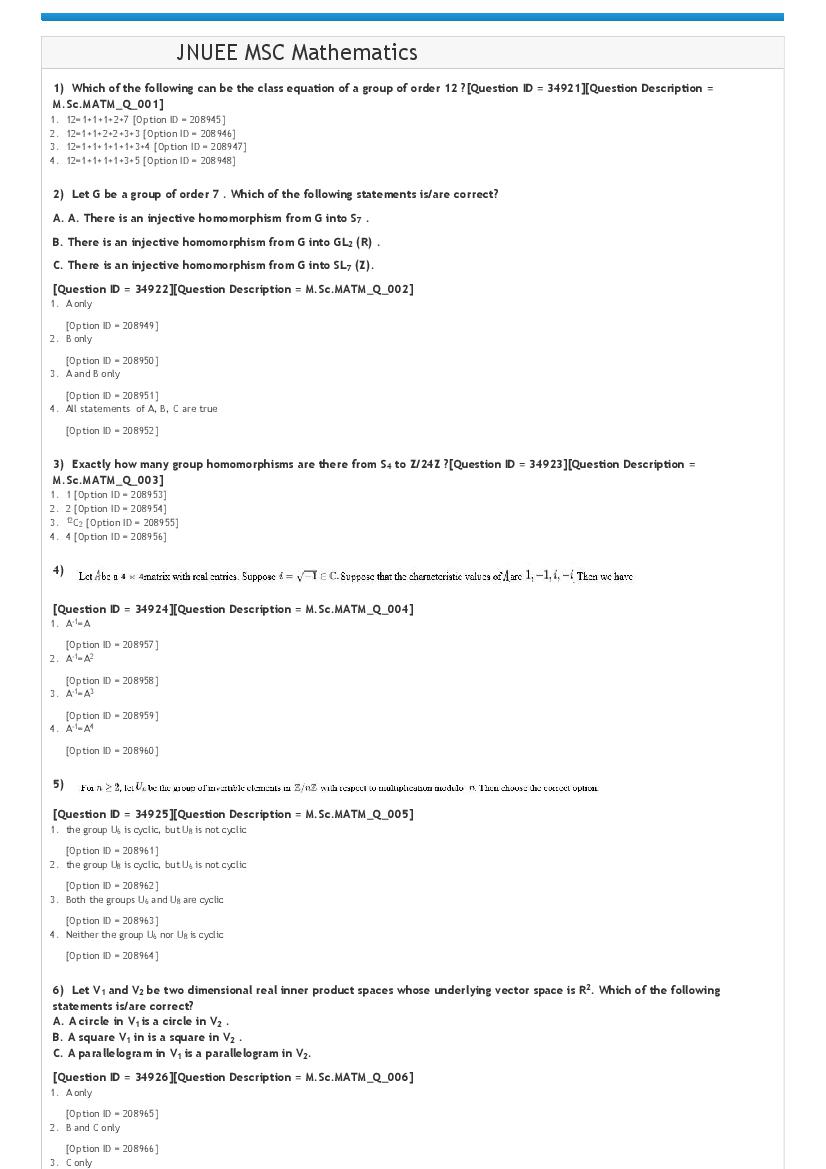
1) Which of the following can be the class equation of a group of order 12 ?[Question ID = 34921][Question Description =
M.Sc.MATM_Q_001]
1. 12=1+1+1+2+7 [Option ID = 208945]
2. 12=1+1+2+2+3+3 [Option ID = 208946]
3. 12=1+1+1+1+1+3+4 [Option ID = 208947]
4. 12=1+1+1+1+3+5 [Option ID = 208948]
2) Let G be a group of order 7 . Which of the following statements is/are correct?
A. A. There is an injective homomorphism from G into S7 .
B. There is an injective homomorphism from G into GL2 (R) .
C. There is an injective homomorphism from G into SL7 (Z).
[Question ID = 34922][Question Description = M.Sc.MATM_Q_002]
1. A only
[Option ID = 208949]
2. B only
[Option ID = 208950]
3. A and B only
[Option ID = 208951]
4. All statements of A, B, C are true
[Option ID = 208952]
3) Exactly how many group homomorphisms are there from S4 to Z/24Z ?[Question ID = 34923][Question Description =
M.Sc.MATM_Q_003]
1. 1 [Option ID = 208953]
2. 2 [Option ID = 208954]
3. 12C2 [Option ID = 208955]
4. 4 [Option ID = 208956]
4)
[Question ID = 34924][Question Description = M.Sc.MATM_Q_004]
1. A‐1=A
[Option ID = 208957]
2. A‐1=A2
[Option ID = 208958]
3. A‐1=A3
[Option ID = 208959]
4. A‐1=A4
[Option ID = 208960]
5)
[Question ID = 34925][Question Description = M.Sc.MATM_Q_005]
1. the group U6 is cyclic, but U8 is not cyclic
[Option ID = 208961]
2. the group U8 is cyclic, but U6 is not cyclic
[Option ID = 208962]
3. Both the groups U6 and U8 are cyclic
[Option ID = 208963]
4. Neither the group U6 nor U8 is cyclic
[Option ID = 208964]
6) Let V1 and V2 be two dimensional real inner product spaces whose underlying vector space is R2. Which of the following
statements is/are correct?
A. A circle in V1 is a circle in V2 .
B. A square V1 in is a square in V2 .
C. A parallelogram in V1 is a parallelogram in V2.
[Question ID = 34926][Question Description = M.Sc.MATM_Q_006]
1. A only
[Option ID = 208965]
2. B and C only
[Option ID = 208966]
3. C only
Page 2
4. All of A, B and C
[Option ID = 208968]
7)
[Question ID = 34927][Question Description = M.Sc.MATM_Q_007]
1. 1
[Option ID = 208969]
2. 2
[Option ID = 208970]
3. n
[Option ID = 208971]
4. infinite
[Option ID = 208972]
8)
[Question ID = 34928][Question Description = M.Sc.MATM_Q_008]
1. None of f,g and h
[Option ID = 208973]
2. f and g only
[Option ID = 208974]
3. h only
[Option ID = 208975]
4. g only
[Option ID = 208976]
9) Which of the following sets has/have the same cardinality as ℝ?
A. The set of all real sequences
B. The set of all continuous functions from ℝ to ℝ
C. The set of all functions from ℝ to the two‐element set {0, 1}
Choose the correct answer from the options given below: [Question ID = 34929][Question Description = M.Sc.MATM_Q_009]
1. A only [Option ID = 208977]
2. B only [Option ID = 208978]
3. A and B only [Option ID = 208979]
4. C only [Option ID = 208980]
10)
[Question ID = 34930][Question Description = M.Sc.MATM_Q_010]
1. 0 [Option ID = 208981]
2. ‐1 [Option ID = 208982]
3. ‐e [Option ID = 208983]
4. ‐∞ [Option ID = 208984]
11) In how many ways can we choose the sets A, B, C so that A ∪ B ∪ C = {1, 2, 3, 4}?[Question ID = 34519][Question Description
= M.Sc.MATM_Q_011]
1. 74 [Option ID = 208985]
2. 34 [Option ID = 208986]
3. 43 [Option ID = 208987]
4. 3!4! [Option ID = 208988]
12) What is the highest power of 2 dividing the product (2020)(2021)(2022)...(4040)?[Question ID = 34520][Question Description
= M.Sc.MATM_Q_012]
1. 22022 [Option ID = 208989]
2. 22020 [Option ID = 208990]
3. 21011 [Option ID = 208991]
4. 21518 [Option ID = 208992]
13) Three numbers are chosen randomly from the set {1, 2, 3, 4, 5, 6, 7, 8, 9, 10}. What is the probability that their product is
divisible by 10?[Question ID = 34521][Question Description = M.Sc.MATM_Q_013]
Page 3
2. 29/60 [Option ID = 208994]
3. 31/60 [Option ID = 208995]
4. 1/2 [Option ID = 208996]
14)
[Question ID = 34522][Question Description = M.Sc.MATM_Q_014]
1. between 17 and 18 [Option ID = 208997]
2. between 18 and 19 [Option ID = 208998]
3. between 19 and 20 [Option ID = 208999]
4. between 20 and 21 [Option ID = 209000]
15) 100 women participate in a knockout tournament. (In a knockout tournament a player is out of the tournament as soon as she
loses one match. Some players might get byes in the first round.) How many matches will be held in the tournament?[Question ID =
34523][Question Description = M.Sc.MATM_Q_015]
1.
[Option ID = 209001]
2. 98 [Option ID = 209002]
3. 99 [Option ID = 209003]
4. 100 [Option ID = 209004]
16) How many subsets of {1, 2, 3, ..., 50} have 20 elements but contain no two consecutive natural numbers in them?[Question
ID = 34524][Question Description = M.Sc.MATM_Q_016]
1.
[Option ID = 209005]
2.
[Option ID = 209006]
3.
[Option ID = 209007]
4.
[Option ID = 209008]
17)
[Question ID = 34525][Question Description = M.Sc.MATM_Q_017]
1. A is true but B is false.
[Option ID = 209009]
2. B is true but A is false.
[Option ID = 209010]
3. Both A and B are true.
[Option ID = 209011]
4. Both A and B are false.
[Option ID = 209012]
18)
[Question ID = 34526][Question Description = M.Sc.MATM_Q_018]
Page 4
[Option ID = 209013]
2. B is true but A is false.
[Option ID = 209014]
3. Both A and B are true.
[Option ID = 209015]
4. Both A and B are false.
[Option ID = 209016]
19)
[Question ID = 34527][Question Description = M.Sc.MATM_Q_019]
1. A is true but B is false. [Option ID = 209017]
2. B is true but A is false. [Option ID = 209018]
3. Both A and B are true. [Option ID = 209019]
4. Both A and B are false. [Option ID = 209020]
20)
[Question ID = 34528][Question Description = M.Sc.MATM_Q_020]
1.
[Option ID = 209021]
2.
[Option ID = 209022]
3.
[Option ID = 209023]
4.
[Option ID = 209024]
21)
[Question ID = 34529][Question Description = M.Sc.MATM_Q_021]
1. 1
[Option ID = 209025]
2. 0
[Option ID = 209026]
3. ∞
[Option ID = 209027]
4. π
[Option ID = 209028]
22)
[Question ID = 34530][Question Description = M.Sc.MATM_Q_022]
Page 5
[Option ID = 209029]
2. B is true but A is false.
[Option ID = 209030]
3. Both A and B are true.
[Option ID = 209031]
4. Both A and B are false.
[Option ID = 209032]
23) Sports Class: Please answer the question based on the information given below.
In a class of 60 students,35 students enrolled for football, 45 students enrolled for basketball 55 and students enrolled for hockey.
What is minimum number of students who must have enrolled for at least two sports?
[Question ID = 34607][Question Description = M.Sc.MATM_Q_023]
1. 0
[Option ID = 209337]
2. 20
[Option ID = 209338]
3. 40
[Option ID = 209339]
4. 45
[Option ID = 209340]
24) Sports Class: Please answer the question based on the information given below.
In a class of 60 students,35 students enrolled for football, 45 students enrolled for basketball 55 and students enrolled for hockey.
What is the minimum number of students who must have enrolled for all three sports?
[Question ID = 34608][Question Description = M.Sc.MATM_Q_024]
1. 0
[Option ID = 209341]
2. 15
[Option ID = 209342]
3. 25
[Option ID = 209343]
4. 35
[Option ID = 209344]
25)
[Question ID = 34531][Question Description = M.Sc.MATM_Q_025]
1. A only [Option ID = 209033]
2. A and D only [Option ID = 209034]
3. A and C only [Option ID = 209035]
4. A and B only [Option ID = 209036]
26)
[Question ID = 34532][Question Description = M.Sc.MATM_Q_026]
1.
[Option ID = 209037]
2. There exists a surjective map from S onto R 2/Z2 [Option ID = 209038]
3. There exists an injective map from R/Q into S. [Option ID = 209039]
4.
Page 6
27)
[Question ID = 34533][Question Description = M.Sc.MATM_Q_027]
1. B and C only [Option ID = 209041]
2. C only [Option ID = 209042]
3. All of A, B and C are correct. [Option ID = 209043]
4. A and C only [Option ID = 209044]
28)
[Question ID = 34534][Question Description = M.Sc.MATM_Q_028]
1. All of A, B and C are true. [Option ID = 209045]
2. A and C only [Option ID = 209046]
3. B and C only [Option ID = 209047]
4. A and B only [Option ID = 209048]
29)
[Question ID = 34535][Question Description = M.Sc.MATM_Q_029]
1. 0
[Option ID = 209049]
2. 1/3
[Option ID = 209050]
3. 2/3
[Option ID = 209051]
4. 4/3
[Option ID = 209052]
30)
[Question ID = 34536][Question Description = M.Sc.MATM_Q_030]
1. A and D only
[Option ID = 209053]
2. B and D only
[Option ID = 209054]
3. B and C only
[Option ID = 209055]
4. B only
[Option ID = 209056]
31)
Page 7
1. A is true and B is false. [Option ID = 209057]
2. B is true and A is false. [Option ID = 209058]
3. both A and B are true. [Option ID = 209059]
4. both A and B are false. [Option ID = 209060]
32)
[Question ID = 34538][Question Description = M.Sc.MATM_Q_032]
1. both A and B are true. [Option ID = 209061]
2. B is true and A is false. [Option ID = 209062]
3. both A and B are false. [Option ID = 209063]
4. A is true and B is false. [Option ID = 209064]
33)
[Question ID = 34539][Question Description = M.Sc.MATM_Q_033]
1.
[Option ID = 209065]
2.
[Option ID = 209066]
3.
[Option ID = 209067]
4. f is an onto function [Option ID = 209068]
34)
[Question ID = 34540][Question Description = M.Sc.MATM_Q_034]
1. A is true and B is false.
[Option ID = 209069]
2. both A and B are false.
[Option ID = 209070]
3. both A and B are true.
[Option ID = 209071]
4. B is true and A is false.
[Option ID = 209072]
35)
Page 8
1. 0 [Option ID = 209073]
2. 4 [Option ID = 209074]
3. 5 [Option ID = 209075]
4. ∞ [Option ID = 209076]
36)
[Question ID = 34542][Question Description = M.Sc.MATM_Q_036]
1. 0 [Option ID = 209077]
2. 1/8 [Option ID = 209078]
3. 1/10 [Option ID = 209079]
4. 1/40 [Option ID = 209080]
37)
[Question ID = 34543][Question Description = M.Sc.MATM_Q_037]
1. ‐1/9 [Option ID = 209081]
2. ‐1/6 [Option ID = 209082]
3. ‐1/3 [Option ID = 209083]
4. 0 [Option ID = 209084]
38) Consider the following statements:
A. Union of any collection of open sets in Rn is open.
B. Intersection of any collection of open sets in Rn is open. Then [Question ID = 34544][Question Description = M.Sc.MATM_Q_038]
1. B is true and A is false. [Option ID = 209085]
2. A is true and B is false. [Option ID = 209086]
3. both A and B are true. [Option ID = 209087]
4. both A and B are false. [Option ID = 209088]
39)
[Question ID = 34545][Question Description = M.Sc.MATM_Q_039]
1. 1 [Option ID = 209089]
2. 2 [Option ID = 209090]
3. 3 [Option ID = 209091]
4. 0 [Option ID = 209092]
40)
[Question ID = 34546][Question Description = M.Sc.MATM_Q_040]
1. 0 [Option ID = 209093]
2. 1 [Option ID = 209094]
3. 3 [Option ID = 209095]
4. 21 [Option ID = 209096]
Page 9
[Question ID = 34547][Question Description = M.Sc.MATM_Q_041]
1. 0 [Option ID = 209097]
2. 1 [Option ID = 209098]
3. 2 [Option ID = 209099]
4. 4 [Option ID = 209100]
42) Given that 100003 is a prime, the remainder when 100001! is divided by 100003 , is[Question ID = 34548][Question
Description = M.Sc.MATM_Q_042]
1. 100002 [Option ID = 209101]
2. 0 [Option ID = 209102]
3. 1 [Option ID = 209103]
4. 2 [Option ID = 209104]
43)
[Question ID = 34549][Question Description = M.Sc.MATM_Q_043]
1. is equal to 0 [Option ID = 209105]
2. is equal to 1 [Option ID = 209106]
3. does not exist. [Option ID = 209107]
4. is equal to ∞ [Option ID = 209108]
44)
[Question ID = 34550][Question Description = M.Sc.MATM_Q_044]
1. f is continuous everywhere on the Euclidean plane R2 apart from (0,0) .
[Option ID = 209109]
2. f is continuous everywhere on the Euclidean plane R2 apart from (0,0) but differentiable nowhere.
[Option ID = 209110]
3. f is differentiable everywhere on the Euclidean plane R2 .
[Option ID = 209111]
4. f is continuous everywhere on the Euclidean plane R2 and also differentiable everywhere apart from (0,0) .
[Option ID = 209112]
45)
[Question ID = 34551][Question Description = M.Sc.MATM_Q_045]
1.
[Option ID = 209113]
2.
[Option ID = 209114]
3.
[Option ID = 209115]
4.
[Option ID = 209116]
46)
[Question ID = 34552][Question Description = M.Sc.MATM_Q_046]
Page 10
2.
[Option ID = 209118]
3.
[Option ID = 209119]
4.
[Option ID = 209120]
47)
[Question ID = 34553][Question Description = M.Sc.MATM_Q_047]
1. Absolute maximum is 2, absolute minimum is 0 . [Option ID = 209121]
2. Absolute maximum is 1 , absolute minimum is 0. [Option ID = 209122]
3. Absolute maximum is 1/5 , absolute minimum is 0 . [Option ID = 209123]
4. Absolute maximum is 1 , absolute minimum does not exist. [Option ID = 209124]
48)
[Question ID = 34554][Question Description = M.Sc.MATM_Q_048]
1.
[Option ID = 209125]
2.
[Option ID = 209126]
3.
[Option ID = 209127]
4.
[Option ID = 209128]
49)
[Question ID = 34555][Question Description = M.Sc.MATM_Q_049]
1.
[Option ID = 209129]
2.
[Option ID = 209130]
3.
[Option ID = 209131]
4. 0 [Option ID = 209132]
50)
[Question ID = 34556][Question Description = M.Sc.MATM_Q_050]
1. 1/2 [Option ID = 209133]
2. 1/8 [Option ID = 209134]
3. 1/16 [Option ID = 209135]
4. 1 [Option ID = 209136]
Page 11
[Question ID = 34557][Question Description = M.Sc.MATM_Q_051]
1.
[Option ID = 209137]
2.
[Option ID = 209138]
3.
[Option ID = 209139]
4.
[Option ID = 209140]
52)
[Question ID = 34558][Question Description = M.Sc.MATM_Q_052]
1. 1 [Option ID = 209141]
2.
[Option ID = 209142]
3.
[Option ID = 209143]
4.
[Option ID = 209144]
53)
[Question ID = 34559][Question Description = M.Sc.MATM_Q_053]
1. S is a linearly independent set. [Option ID = 209145]
2. S is a basis for V. [Option ID = 209146]
3.
[Option ID = 209147]
4.
[Option ID = 209148]
54)
[Question ID = 34560][Question Description = M.Sc.MATM_Q_054]
1.
[Option ID = 209149]
2.
[Option ID = 209150]
3.
Page 12
4.
[Option ID = 209152]
55) Let G be a group such that all quotient groups of G are cyclic. Then, which of the following is true for G? [Question ID = 34561]
[Question Description = M.Sc.MATM_Q_055]
1. G must be a cyclic group. [Option ID = 209153]
2. G must be an abelian group, but not necessarily cyclic. [Option ID = 209154]
3. G must be a finite group. [Option ID = 209155]
4. G must be an infinite group. [Option ID = 209156]
56) Let π be a homomorphism from a group G to group H. Then, which of the following statements is correct?
[Question ID = 34562][Question Description = M.Sc.MATM_Q_056]
1. img(π) is a subgroup of G.
[Option ID = 209157]
2. img(π) is not a subgroup of H.
[Option ID = 209158]
3. ker(π) is a subgroup of G.
[Option ID = 209159]
4. ker(π) is a subgroup of H.
[Option ID = 209160]
57) Suppose G is a group and π: G ↦ G is an injective homomorphism. Then, which of the following statements is necessarily true?
[Question ID = 34563][Question Description = M.Sc.MATM_Q_057]
1. G is an abelian group. [Option ID = 209161]
2. π is surjective, if |G| is finite. [Option ID = 209162]
3. π is surjective, if |G| is infinite. [Option ID = 209163]
4. G is a non‐abelian group. [Option ID = 209164]
58) The multiplicative group of roots of unity in ℂ* is isomorphic to the group[Question ID = 34564][Question Description =
M.Sc.MATM_Q_058]
1.
[Option ID = 209165]
2.
[Option ID = 209166]
3.
[Option ID = 209167]
4.
[Option ID = 209168]
59)
[Question ID = 34565][Question Description = M.Sc.MATM_Q_059]
1.
[Option ID = 209169]
2.
[Option ID = 209170]
3. S is not a subspace of V.
[Option ID = 209171]
4.
[Option ID = 209172]
60) Let U={(a,b,c,d) ∈ ℝ4|a‐b+c=0} and V={(a,b,c,d) ∈ ℝ4|a=d, b=‐c}. Then, the dimension of U∩V over ℝ is[Question ID =
34566][Question Description = M.Sc.MATM_Q_060]
1. 1 [Option ID = 209173]
2. 2 [Option ID = 209174]
3. 3 [Option ID = 209175]
Page 13
61)
[Question ID = 34567][Question Description = M.Sc.MATM_Q_061]
1. (−7, −11, −22, 30). [Option ID = 209177]
2. (−7, 11, −21, 30). [Option ID = 209178]
3. ( 7, 11, −21, 31). [Option ID = 209179]
4. ( 7, −11, −21, 31) . [Option ID = 209180]
62)
[Question ID = 34568][Question Description = M.Sc.MATM_Q_062]
1.
[Option ID = 209181]
2.
[Option ID = 209182]
3.
[Option ID = 209183]
4.
[Option ID = 209184]
63)
[Question ID = 34569][Question Description = M.Sc.MATM_Q_063]
1.
[Option ID = 209185]
2.
[Option ID = 209186]
3.
[Option ID = 209187]
4.
[Option ID = 209188]
64)
[Question ID = 34570][Question Description = M.Sc.MATM_Q_064]
1. The vectors u,v are linearly dependent. [Option ID = 209189]
2. The vectors u,v,w are linearly dependent. [Option ID = 209190]
3.
[Option ID = 209191]
4. The vectors u,v,w are linearly independent. [Option ID = 209192]
65) Let Sn denote the symmetric group of permutations on n symbols. Then the least n such that Sn has an abelian subgroup of
order 30 is [Question ID = 34571][Question Description = M.Sc.MATM_Q_065]
1. 7 [Option ID = 209193]
2. 9 [Option ID = 209194]
3. 10 [Option ID = 209195]
4. 11 [Option ID = 209196]
66) For which of the following group G, G has a subgroup of order d, whenever d divides O(G)?[Question ID = 34572][Question
Description = M.Sc.MATM_Q_066]
Page 14
2. S 4 [Option ID = 209198]
3. A5 [Option ID = 209199]
4. A6 [Option ID = 209200]
67) Which of the following statements are correct?
A. A finite group cannot be written as union of two of its proper subgroups.
B. There is a finite group which can be written as union of three of its proper subgroups.[Question ID = 34573][Question Description
= M.Sc.MATM_Q_067]
1. Only A [Option ID = 209201]
2. Only B [Option ID = 209202]
3. None of A and B [Option ID = 209203]
4. Both A and B [Option ID = 209204]
68) Let G be a non‐abelian group of order pq, where p and q are distinct primes.Then the number of normal subgroups of G are
[Question ID = 34574][Question Description = M.Sc.MATM_Q_068]
1. 1 [Option ID = 209205]
2. max {p,q} [Option ID = 209206]
3. min{p,q} [Option ID = 209207]
4. 2 [Option ID = 209208]
69) Let G be a group of order 45. Then which of the following option is not necessarily true?[Question ID = 34575][Question
Description = M.Sc.MATM_Q_069]
1. G has an element of order 9 [Option ID = 209209]
2. G has a subgroup of order 9 [Option ID = 209210]
3. G has a normal subgroup of order 9 [Option ID = 209211]
4. G has a normal subgroup of order 5 [Option ID = 209212]
70) In which of the following group every element is of finite order but group is of infinite order?
[Question ID = 34576][Question Description = M.Sc.MATM_Q_070]
1. The group of non‐singular 2x2 matrices with integer entries
[Option ID = 209213]
2.
[Option ID = 209214]
3.
[Option ID = 209215]
4.
[Option ID = 209216]
71)
[Question ID = 34577][Question Description = M.Sc.MATM_Q_071]
1.
[Option ID = 209217]
2.
[Option ID = 209218]
3.
[Option ID = 209219]
4.
[Option ID = 209220]
72) Let A be a 3×4 real matrix and AX=b be an inconsistent system of equations. Then maximum possible rank of A is
Page 15
1. 1
[Option ID = 209221]
2. 2
[Option ID = 209222]
3. 3
[Option ID = 209223]
4. 4
[Option ID = 209224]
73)
[Question ID = 34579][Question Description = M.Sc.MATM_Q_073]
1.
[Option ID = 209225]
2.
[Option ID = 209226]
3.
[Option ID = 209227]
4.
[Option ID = 209228]
74)
[Question ID = 34580][Question Description = M.Sc.MATM_Q_074]
1.
[Option ID = 209229]
2.
[Option ID = 209230]
3.
[Option ID = 209231]
4.
[Option ID = 209232]
75)
Page 16
1. 3 [Option ID = 209233]
2. 4 [Option ID = 209234]
3. 5 [Option ID = 209235]
4. 6 [Option ID = 209236]
76)
[Question ID = 34582][Question Description = M.Sc.MATM_Q_076]
1. a=4, b=5, c=6
[Option ID = 209237]
2. a=6, b=5, c=4
[Option ID = 209238]
3. a=‐4, b=‐5, c=‐6
[Option ID = 209239]
4. a=‐6, b=‐5, c=‐4
[Option ID = 209240]
77)
[Question ID = 34583][Question Description = M.Sc.MATM_Q_077]
1. Both A and B are true [Option ID = 209241]
2. Only A is true [Option ID = 209242]
3. Only B is true [Option ID = 209243]
4. Neither A nor B is true [Option ID = 209244]
78) Which of the following series is convergent: [Question ID = 34584][Question Description = M.Sc.MATM_Q_078]
1.
[Option ID = 209245]
2.
[Option ID = 209246]
3.
[Option ID = 209247]
4.
[Option ID = 209248]
79)
[Question ID = 34585][Question Description = M.Sc.MATM_Q_079]
1. unbounded [Option ID = 209249]
2. bounded and convergent to a positive real number [Option ID = 209250]
3. bounded but does not converge [Option ID = 209251]
Page 17
80)
Which of the following statements is not true:
[Question ID = 34586][Question Description = M.Sc.MATM_Q_080]
1. Every bounded sequence of real numbers has a monotone subsequence. [Option ID = 209253]
2.
[Option ID = 209254]
3. Every unbounded sequence of real numbers has a monotone subsequence. [Option ID = 209255]
4. Every monotonic sequence of real numbers has a convergent subsequence. [Option ID = 209256]
81)
[Question ID = 34587][Question Description = M.Sc.MATM_Q_081]
1. A, B and C [Option ID = 209257]
2. Only B [Option ID = 209258]
3. Only B and C [Option ID = 209259]
4. Only A and C [Option ID = 209260]
82)
[Question ID = 34588][Question Description = M.Sc.MATM_Q_082]
1.
[Option ID = 209261]
2.
[Option ID = 209262]
3.
[Option ID = 209263]
4.
[Option ID = 209264]
83)
[Question ID = 34589][Question Description = M.Sc.MATM_Q_083]
1. A, B and D only [Option ID = 209265]
2. A, B and C only [Option ID = 209266]
3. B and D only [Option ID = 209267]
4. A and B only [Option ID = 209268]
84)
Page 18
1. A and B only [Option ID = 209269]
2. A and C only [Option ID = 209270]
3. B and C only [Option ID = 209271]
4. All of A, B and C [Option ID = 209272]
85)
[Question ID = 34591][Question Description = M.Sc.MATM_Q_085]
1.
[Option ID = 209273]
2.
[Option ID = 209274]
3.
[Option ID = 209275]
4.
[Option ID = 209276]
86)
[Question ID = 34592][Question Description = M.Sc.MATM_Q_086]
1.
[Option ID = 209277]
2.
[Option ID = 209278]
3.
[Option ID = 209279]
4.
[Option ID = 209280]
87)
[Question ID = 34593][Question Description = M.Sc.MATM_Q_087]
1. A and B only [Option ID = 209281]
2. A and C only [Option ID = 209282]
3. Only A [Option ID = 209283]
4. B and C only [Option ID = 209284]
88)
[Question ID = 34594][Question Description = M.Sc.MATM_Q_088]
1.
[Option ID = 209285]
2.
[Option ID = 209286]
3.
[Option ID = 209287]
Page 19
[Option ID = 209288]
89)
[Question ID = 34595][Question Description = M.Sc.MATM_Q_089]
1.
[Option ID = 209289]
2.
[Option ID = 209290]
3.
[Option ID = 209291]
4.
[Option ID = 209292]
90)
[Question ID = 34596][Question Description = M.Sc.MATM_Q_090]
1. Statement (a) is true, statement (b) is false. [Option ID = 209293]
2. Statement (b) is true, statement (a) is false. [Option ID = 209294]
3. Both statements (a) and (b) are true. [Option ID = 209295]
4. Both statements (a) and (b) are false. [Option ID = 209296]
91) Which one of the following is a finitely generated infinite group?[Question ID = 34597][Question Description =
M.Sc.MATM_Q_091]
1.
[Option ID = 209297]
2.
[Option ID = 209298]
3.
[Option ID = 209299]
4.
[Option ID = 209300]
92)
[Question ID = 34598][Question Description = M.Sc.MATM_Q_092]
1. Statement (a) is true, statement (b) is false. [Option ID = 209301]
2. Statement (b) is true, statement (a) is false. [Option ID = 209302]
3. Both statements (a) and (b) are true. [Option ID = 209303]
4. Both statements (a) and (b) are false. [Option ID = 209304]
93)
Page 20
1. Statement (a) is true, statement (b) is false. [Option ID = 209305]
2. Statement (b) is true, statement (a) is false. [Option ID = 209306]
3. Both statements (a) and (b) are true. [Option ID = 209307]
4. Both statements (a) and (b) are false. [Option ID = 209308]
94)
[Question ID = 34600][Question Description = M.Sc.MATM_Q_094]
1. 2 and 3 respectively. [Option ID = 209309]
2. 3 and 4 respectively. [Option ID = 209310]
3. 2 and 4 respectively. [Option ID = 209311]
4. 1 and 3 respectively. [Option ID = 209312]
95)
[Question ID = 34601][Question Description = M.Sc.MATM_Q_095]
1. Statement (a) is true, statement (b) is false. [Option ID = 209313]
2. Statement (b) is true, statement (a) is false. [Option ID = 209314]
3. Both statements (a) and (b) are true. [Option ID = 209315]
4. Both statements (a) and (b) are false. [Option ID = 209316]
96)
[Question ID = 34602][Question Description = M.Sc.MATM_Q_096]
1. Statement (a) is true, statement (b) is false. [Option ID = 209317]
2. Statement (b) is true, statement (a) is false. [Option ID = 209318]
3. Both statements (a) and (b) are true. [Option ID = 209319]
4. Both statements (a) and (b) are false. [Option ID = 209320]
97)
[Question ID = 34603][Question Description = M.Sc.MATM_Q_097]
1. is injective but not surjective.
[Option ID = 209321]
2. is surjective but not injective.
[Option ID = 209322]
3. is both injective and surjective.
[Option ID = 209323]
4. is neither injective nor surjective.
[Option ID = 209324]
98)
[Question ID = 34604][Question Description = M.Sc.MATM_Q_098]
1. All of them. [Option ID = 209325]
2.
Page 21
3.
[Option ID = 209327]
4.
[Option ID = 209328]
99)
[Question ID = 34605][Question Description = M.Sc.MATM_Q_099]
1. Only (a) is true. [Option ID = 209329]
2. Only (b) is true. [Option ID = 209330]
3. Only (a) and (b) are true. [Option ID = 209331]
4. All of them are true. [Option ID = 209332]
100)
[Question ID = 34606][Question Description = M.Sc.MATM_Q_100]
1. 26 [Option ID = 209333]
2. 13 [Option ID = 209334]
3. 3 [Option ID = 209335]
4. 9 [Option ID = 209336]
Document Details
| Board / Org | NTA |
| Exam | Jawaharlal Nehru University Entrance Examination |
| Type | Question Paper |
| Pages | 21 |
| Updated | 22 Jul 2026 |