HBSE Class 10 Sample Paper 2026 Answers Agriculture
Finished viewing? Save it for later —
Download HBSE Class 10 Sample Paper 2026 Answers Agriculture (PDF · 6 pages)About HBSE Class 10 Sample Paper 2026 Answers Agriculture
HBSE Class 10 Sample Paper 2026 Answers Agriculture is available here for free download. Published by Haryana Board for Class 10, this answer key can be viewed online or downloaded as a PDF (6 pages). Candidates preparing for Class 10 can use HBSE Class 10 Sample Paper 2026 Answers Agriculture to understand the exam pattern, the type of questions asked, and the overall difficulty level.
Frequently Asked Questions
How can I download HBSE Class 10 Sample Paper 2026 Answers Agriculture?
Open this page and click the Download button to save HBSE Class 10 Sample Paper 2026 Answers Agriculture as a PDF. It is completely free on AglaSem Docs.
Is HBSE Class 10 Sample Paper 2026 Answers Agriculture free to download?
Yes. HBSE Class 10 Sample Paper 2026 Answers Agriculture can be viewed online and downloaded as a PDF free of cost on AglaSem Docs.
How many pages does HBSE Class 10 Sample Paper 2026 Answers Agriculture have?
HBSE Class 10 Sample Paper 2026 Answers Agriculture contains 6 pages, which you can read online or download together as a single PDF.
Where can I find more Class 10 study material?
You can find more Class 10 question papers, sample papers, syllabus, and answer keys on AglaSem Docs.
HBSE Class 10 Sample Paper 2026 Answers Agriculture – Text
Read the full text of this answer key below — useful to quickly search, copy and reference the content online without downloading the PDF.
📄 View text version (6 pages)
Page 1
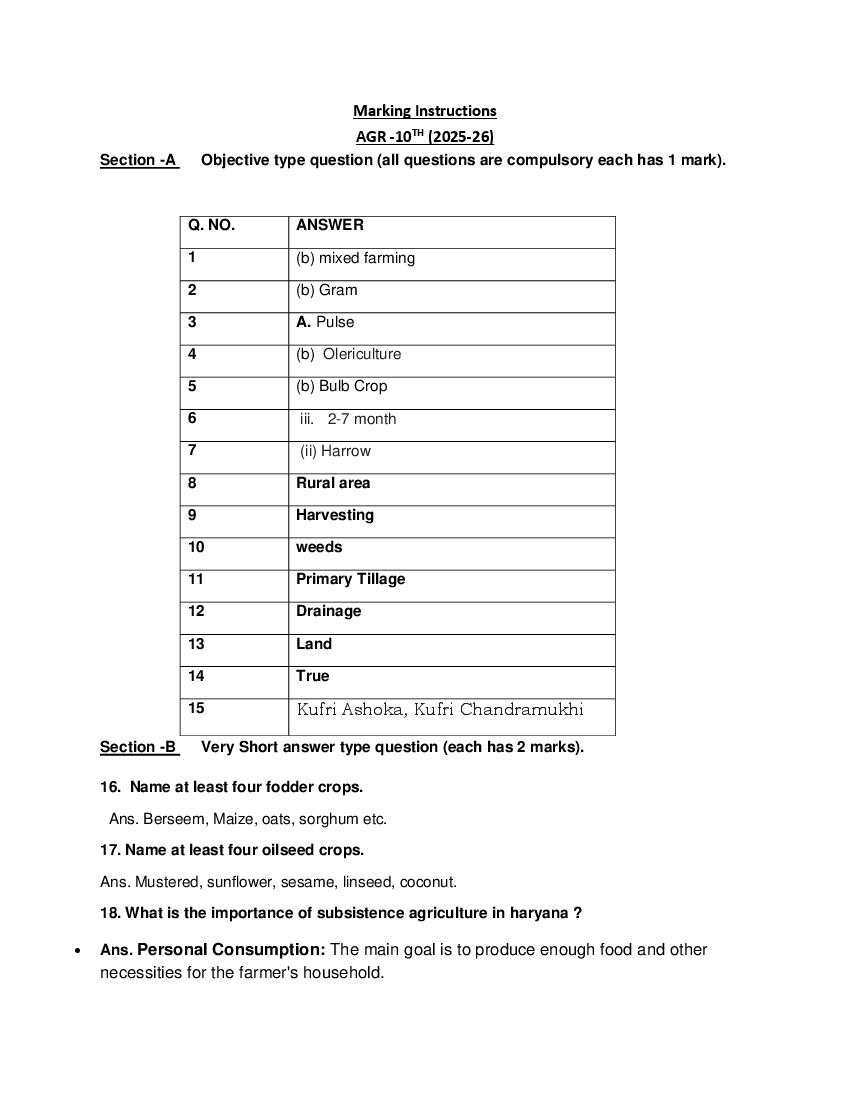
AGR -10TH (2025-26)
Section -A Objective type question (all questions are compulsory each has 1 mark).
Q. NO. ANSWER
1 (b) mixed farming
2 (b) Gram
3 A. Pulse
4 (b) Olericulture
5 (b) Bulb Crop
6 iii. 2-7 month
7 (ii) Harrow
8 Rural area
9 Harvesting
10 weeds
11 Primary Tillage
12 Drainage
13 Land
14 True
15 Kufri Ashoka, Kufri Chandramukhi
Section -B Very Short answer type question (each has 2 marks).
16. Name at least four fodder crops.
Ans. Berseem, Maize, oats, sorghum etc.
17. Name at least four oilseed crops.
Ans. Mustered, sunflower, sesame, linseed, coconut.
18. What is the importance of subsistence agriculture in haryana ?
Ans. Personal Consumption: The main goal is to produce enough food and other
necessities for the farmer's household.
Page 2
family. Manual Labor & Family Work, Polyculture.
19. Define dryland farming?
Ans. Dryland farming, or dry farming, is a technique for growing crops in arid or semi-
arid regions with limited rainfall, without artificial irrigation
OR
Name two critical stage of irrigation in tomato crop.
Ans. flowering and fruit development (fruit sizing and ripening)
20. Define crop rotation.
practice of planting different types of crops in the same field in a planned sequence
over several growing seasons, rather than growing the same crop repeatedly.
21. Write atleast 4 harvesting & threshing equipment.
Ans. common tools are mowers for cutting grass, reapers and reaper-binders for
cereal crops, various types of threshers that separate grain from stalks and chaff,
and chaff cutters for processing crop residues.
OR
Name one staple crop of India and the regions where it is produced.
Ans. Rice, rice can be grown in haryana, punjab, UP etc.
Section -C Short answer type question (each has 3 marks).
22. What is subsistence farming, Write their merits ?
Ans. Subsistence cultivation, or subsistence farming, is a form of agriculture where
farmers grow food on small plots of land primarily to feed themselves and their
families, with little or no surplus for sale or trade. This practice is often characterized
by manual labor, small landholdings, traditional methods, and a focus on local needs
rather than commercial profit
23. Name at least four main food grain crops of India.
ANS. WHEAT, RICE, PEARL MILLET, MAIZE
24. What is a nursery bed? How is it prepared?
OR
Define nursery bed, classify them.
Ans. A nursery bed is a small area where necessary soil and environmental
conditions, such as germinating media, plant nutrients, water, temperature,
Page 3
seeds into healthy seedlings.
Preparation:The nursery bed is thoroughly mixed with 10–15 kg of
decomposed farmyard manure per square metre. All weeds, stones, stumps,
clots, etc., are removed from the field and the bed should be leveled.
Classification: Leveled/flat Bed, Sunken Bed, Raised Bed.
25. Describe Sprinkler Irrigation.
Ans. In the sprinkler system, water is sprinkled over the crop and the soil in a
circular manner similar to rain. With the help of revolving sprinkler nozzles,
water is forced out with pressure through pipes fitted with a stand.
OR
Define Drip Irrigation, how much water can save from this particular irrigation.
Ans. This is also known as trickle irrigation or micro irrigation, which supplies water in
the form of discrete, continuous drops at a slow rate through emitters, either onto the
soil surface or directly to the root zone. There is direct and continuous wetting of the
root region. Fertilisers and chemical amendments can also be applied using this method.
It is a highly water use efficient system with little irrigation water requirement. Thus, it is
suitable for water scarce areas. It saves 40-60% of water over the other conventional
methods.
26. How much type of sprayer used for farming, Write their name ?
Ans. Agricultural sprayers vary from small, manual knapsack sprayers for gardens to
large, tractor-mounted boom sprayers and advanced self-propelled sprayers for
extensive fields. Other types include air-assisted sprayers, airplanes, and drones for
large-scale or remote applications, while mist blowers and foggers are used for
specialized applications like controlling pests in greenhouses.
27. Define tillage, describe primary and secondary tillage with suitable examples.
Ans. Tillage is the manipulation of the soil into a desired condition by mechanical
means; tools are employed to achieve some desired effect (such as pulverization,
cutting, or movement).
Primary tillage: plough indigenious, MB Plough, sub soiler etc,
Page 4
Section -D Essay answer type question (each has 5 marks).
28. Define kharif crop? Describe climatic & soil requirement for kharif crop, Enlist
important kharif crops growing in Haryana state.
Ans. Kharif crops, also known as monsoon crops, are planted at the beginning of the
rainy season (June-July) and are harvested in the autumn (October-November).
Important kharif crops growing in Haryana state are rice, cotton, maize, and bajra etc.
Climate and soil requirements: require significant rainfall and warm conditions for their
growth. They need ample water and warm, humid conditions to thrive.
A soil pH between 6 and 7 is often ideal for kharif crops.
General Requirements for Kharif Crops
High Moisture Content:
Kharif crops depend on the monsoon for water, so the soil must be able to retain
moisture for their growth and germination.
Good Drainage:
Despite needing moisture, the soil must also be well-drained to prevent waterlogging
and root rot, which are common in high-rainfall areas.
Rich in Organic Matter:
Soils that are rich in organic matter and nutrients provide the best foundation for the
rapid growth characteristic of kharif crops.
29. What is irrigation? Describe sources of irrigation.
IRRIGATION: the artificial application of water to the soil in order to maintain a proper
soil moisture regime for plant growth is called irrigation.
Sources of Irrigation Water
1. Surface water sources are found on the surface of the land. These sources are
rivers, canals, ponds, lakes, dams, etc. Generally the quality of water from
these sources is quite good and fit for irrigation.
2. Groundwater is underground water lifted through dug wells, tube wells and bore
wells. This water quality varies from poor to good.
Page 5
growing of any kind of vegetable crop and also gives a high yield and better quality of
vegetable crops.
30. Describe advantage and disadvantages of farm mechanization
Ans. Advantages:
Increased Productivity and Efficiency: Machines can perform tasks much faster and
cover large areas, significantly increasing agricultural output and efficiency.
Reduced Labor Needs: Machines replace human effort, reducing the required
workforce and freeing up manpower for other tasks.
Lower Production Costs:Efficient resource use, reduced post-harvest losses, and
timely operations contribute to lower overall production costs.
Improved Quality and Yields:Mechanized farming can lead to higher yields per unit
of land and better quality produce.
Timely Operations:Mechanization ensures that crucial tasks like planting and
harvesting are completed promptly,
Disadvantages:
High Capital Costs:The purchase of farm machinery is expensive, presenting a
significant barrier for smaller or low-income farmers.
Environmental Impact:Heavy machinery can lead to soil compaction, while the
burning of fuel for machines contributes to pollution.
Technical Limitations:Mechanized systems require technical knowledge and skilled
operators, creating a need for training and infrastructure.
Unsuitable for Small Farms:Mechanization may not be cost-effective or practical for
very small farm holdings.
OR
Describe climatic, water & soil Requirment in rabi crops and enlist rabi crops
growing in india.
Page 6
Temperature: Rabi crops thrive in cool weather conditions, with optimal growth
occurring between 10-20°C. Warm temperatures are needed for the crops to mature
and for harvesting.
Rainfall: They require less water than Kharif crops and are well-suited for areas with
limited irrigation, as they rely on the stored moisture from the monsoon.
Soil Requirements
Texture: Ideal soils are well-drained, such as loamy or sandy-loam soils. Some crops,
like gram, also do well in clay loams and black cotton soils.
Drainage: Good drainage is crucial because Rabi crops are sensitive to waterlogging.
Fertility: While general requirements are fertile, well-drained soil, specific nutrient
needs depend on soil testing and the chosen crop.
Examples of Rabi Crops : Wheat & Barley, Gram (Chickpea), Mustard, Lentil.
Document Details
| Board / Org | Haryana Board |
| Exam | Class 10 |
| Type | Sample Paper |
| Pages | 6 |
| Updated | 24 Sep 2026 |