CBSE Class 10 Sample Paper 2027 for Science
Finished viewing? Save it for later —
Download CBSE Class 10 Sample Paper 2027 for Science (PDF · 15 pages)About CBSE Class 10 Sample Paper 2027 for Science
CBSE Class 10 Sample Paper 2027 for Science is available here for free download. Published by CBSE for Class 10, this sample paper can be viewed online or downloaded as a PDF (15 pages). Candidates preparing for Class 10 can use CBSE Class 10 Sample Paper 2027 for Science to understand the exam pattern, the type of questions asked, and the overall difficulty level.
Frequently Asked Questions
How can I download CBSE Class 10 Sample Paper 2027 for Science?
Open this page and click the Download button to save CBSE Class 10 Sample Paper 2027 for Science as a PDF. It is completely free on AglaSem Docs.
Is CBSE Class 10 Sample Paper 2027 for Science free to download?
Yes. CBSE Class 10 Sample Paper 2027 for Science can be viewed online and downloaded as a PDF free of cost on AglaSem Docs.
How many pages does CBSE Class 10 Sample Paper 2027 for Science have?
CBSE Class 10 Sample Paper 2027 for Science contains 15 pages, which you can read online or download together as a single PDF.
Where can I find more Class 10 study material?
You can find more Class 10 question papers, sample papers, syllabus, and answer keys on AglaSem Docs.
CBSE Class 10 Sample Paper 2027 for Science – Text
Read the full text of this sample paper below — useful to quickly search, copy and reference the content online without downloading the PDF.
📄 View text version (16 pages)
Page 1
CBSE Class 10 Sample
Paper 2027 for Science
EXAM YEAR TYPE SUBJECT
CBSE Class 10 2027 Sample Paper Science
Notes · Sample Papers · Previous Year Papers · Mock Tests
Page 2
m .co
m .co s e m
se g
SCIENCE – CODE NO. 086l a
a
SAMPLE QUESTION PAPER*
CLASS – X (2026-27)
Max. Marks: 80 Time Allowed: 3 hours
General Instructions:
(i) This question paper consists of 39 questions in 3 sections. Section A is
Biology, Section B is Chemistry and Section C is Physics.
m
.co
(ii) All questions are compulsory. However, an internal choice is provided in some
m
.co m
questions. A student is expected to attempt only one of the alternatives in
s e
em
these questions.
s l a
g la Section – A ag
1
a
During photosynthesis, what happens to carbon dioxide and water as glucose is 1
formed?
A. Carbon dioxide gains hydrogen, while water loses electrons.
B. Carbon dioxide loses oxygen, while water gains oxygen.
C. Carbon dioxide is oxidised, while water is reduced.
D. Both carbon dioxide and water undergo reduction.
m
.co
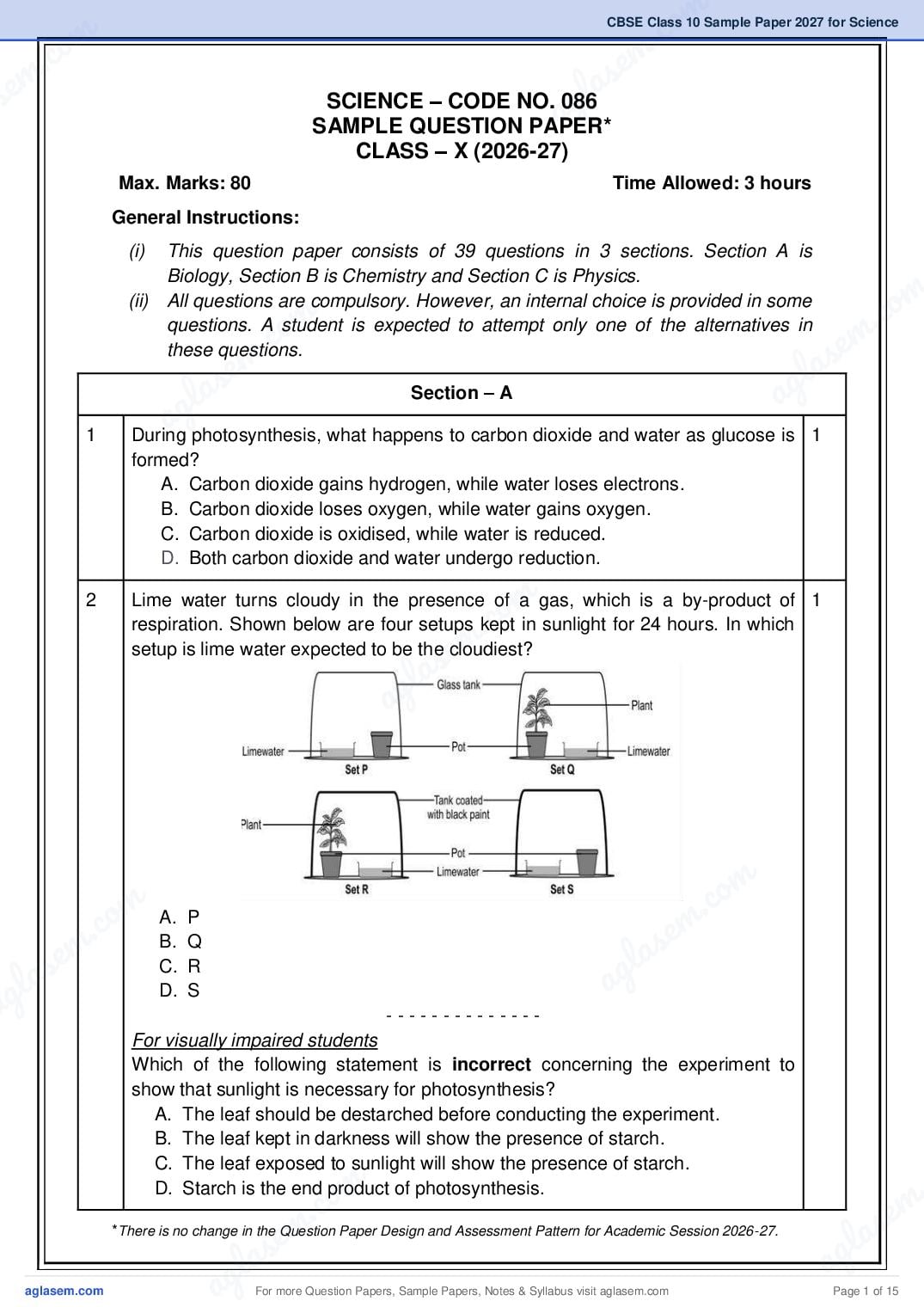
2 Lime water turns cloudy in the presence of a gas, which is a by-product of 1
respiration. Shown below are four setups kept in sunlight for 24 hours. In which
e m
s
setup is lime water expected to be the cloudiest?
la
ag
m
m A. P .co
m .co s e m
s e
B. Q
g l a
la
C. R
g a
a
D. S
Which of the following statement is incorrect concerning the experiment to
show that sunlight is necessary for photosynthesis?
A. The leaf should be destarched before conducting the experiment.
B. The leaf kept in darkness will show the presence of starch.
C. The leaf exposed to sunlight will show the presence of starch.
m .
.co
D. Starch is the end product of photosynthesis.
e m
em
l as
las ag
ag For more Question Papers, Sample Papers, Notes & Syllabus visit Page 1 of 15
Page 3
kidneys. Which of the following sets correctly indicates both the substances that
are reabsorbed in the kidneys?
A. Glucose and salts
B. Glucose and starch
C. Glycogen and salts
D. Glycogen and starch
4 In a controlled experiment, the anthers of a mustard plant's flowers were 1
carefully removed in the bud stage before they matured. The bud was covered
with a paper bag.
What will be the most likely result for these flowers?
A. They will still produce seeds and fruit through self-pollination.
B. They will attract more insects and produce larger flowers but no fruit.
C. They will not produce any seeds or fruits.
D. They will produce seeds and fruits that are genetically identical to the
parent.
5 The Vas deferens and the Oviduct are both targets for surgical contraception 1
(Vasectomy and Tubectomy respectively). Analysing the process of
reproduction, what common biological event is prevented by blocking both these
structures?
A. The production of gametes (sperm and egg).
B. The implantation of the fertilized egg into the uterine wall.
C. The successful meeting and fusion of the male and the female gametes.
D. The release of hormones - testosterone and estrogen.
6 The male gamete of an apple plant has seventeen chromosomes. What is the 1
number of chromosomes in the female gamete and in the cells of the adult plant
respectively?
A. 17,17
B. 17,34
C. 34,34
D. 34,51
7 A fish living in a pond ecosystem feeds on small aquatic insects (larvae). These 1
insect larvae, in turn, feed on green algae and small photosynthetic bacteria.
In this specific food chain, what is the trophic level classification of fish?
A. Producer
B. Primary Consumer
C. Secondary Consumer
D. Tertiary Consumer
The following two questions consist of two statements – Assertion (A) and Reason (R).
Answer these questions by selecting the appropriate option given below:
A. Both A and R are true, and R is the correct explanation of A.
B. Both A and R are true, and R is not the correct explanation of A.
For more Question Papers, Sample Papers, Notes & Syllabus visit Page 2 of 15
Page 4
m .co
m .co s e m
se g l a
C. A is true but R is false.
D. A is false but R is true.
a
8 Assertion (A): The rate of breathing in aquatic organisms is much lower than in 1
the terrestrial organisms.
Reason (R): The amount of oxygen dissolved in water is less as compared to
the amount of oxygen in air.
9 Assertion (A): In an ecosystem, 1% of energy is available for transfer from one 1
m
trophic level to the next.
m .co
.co
Reason (R): An average of 10% of the food eaten by organisms is available for
s e m
em
flow in the form of chemical energy.
s g2l a
10 A. Dueltoa
g was obstructed. How will the process of digestion be affected? a
narrowing of the bile duct, the bile secretion from the liver to the small
a
intestine
B. How does the length of the intestine depend on the nature of food habit in
different animals?
11 Students to attempt either option A or B. 2
A. Which parts of the brain perform certain actions for which we do not have
any thinking control? What are such actions called, give two examples.
OR
m
.co
B. How is the information of touch in the ‘sensitive plant' controlled and
coordinated?
e m
12
las
What changes are observed in the uterus subsequent to implantation of the 2
young embryo in a human female?
ag
13 How do muscles move at the cellular level and respond when processed 3
messages are received from the brain?
14 Study the food chain given below: 3
o m
m . c
A. In the given food chain, the amount of energy available at the fourth trophic
c. o B. Islevelit possible m
is 10 kJ, what will be the energy available at the producer level?
s e food chain?
e m to have three more trophic levels in the above
l a
l as C.
Justify.
Which of these trophic levels will have the maximum
a g
amount of pesticide, if
ag it had washed down in the water body from agricultural fields. Why?
15 In order to study patterns of inheritance, Neha had performed typical Mendelian 4
experiments with pea plants in the field. In experiment one, she crossed a pea
plant having white flowers (vv) with another pea plant bearing violet flowers
(VV). In another experiment, in addition to the colour of the flower she also
focussed on the height of the pea plant. This time she crossed a pea plant
having violet flowers and tall height (VVTT) with another pea plant having white
m .
.co
flowers and short height (vvtt).
e m
em
l as
las ag
ag For more Question Papers, Sample Papers, Notes & Syllabus visit Page 3 of 15
Page 5
experiments? Give a reason.
A. Violet flowers in F1 and F2 generation in experiment one? (1)
B. Tall height plants with white flowers in F2 generation in experiment two?
(1)
Attempt either sub-part C or D.
C. Percentage of medium height plants with light violet flowers in F1 and F2
generations in experiment two? Give a reason.
OR
D. Percentage of short height plants with white flowers in F1 and F2
generations in experiment two? (2)
16 Attempt either option A or B 5
A. Observe the structure of hearts A, B and C shown above and answer the
following questions
I. Which of the hearts depicted above is present in both birds and Mammals
and how are they able to maintain their body temperature? Give reason
for your answer.
II. Which of the hearts depicted above is present in fishes, how does
circulation of blood take place in them?
OR
B.
I. Observe both the diagrams A and B. Which diagram indicates inhalation?
Describe how it occurs.
II. If diffusion were to move oxygen in our body, it is estimated that it would
take 3 years for a molecule of oxygen to get to our toes from our lungs.
Then, how is oxygen delivered to all parts of our body?
A.
I. How many chambers are present in the hearts of birds and mammals and
how are they able to maintain their body temperature? Give reason for
your answer
For more Question Papers, Sample Papers, Notes & Syllabus visit Page 4 of 15
Page 6
m .co
m .co s em
se g la of fishes, how does
a
II. How many chambers are present in the heart
circulation of blood take place in them?
OR
B.
I. Describe the process of inhalation and also mention how are the lungs
designed in human beings to maximise the area for exchange of gases?
II. If diffusion were to move oxygen in our body, it is estimated that it would
take 3 years for a molecule of oxygen to get to our toes from our lungs
m
m .co
then, how is oxygen delivered to all parts of our body?
m .co Section – B
s e m
s e contain crystals that reflect light and produce colour. Adjusting theg
l a
l
17 Chameleons
g a a
a
spacing between these crystals, they can alter the wavelengths of light reflected, 1
thus changing their skin colour. Based on the above information, we can infer
that the change in colour by chameleons is a:
A. chemical change because change in colour takes place.
B. chemical change because wavelength of reflected light changes.
C. physical change because the space between crystals is adjusted.
D. physical change because light is reflected by crystals.
o m
c
18 Rishita summarizes the chlor-alkali process in the following table.
m . 1
Option Product
e
Formed
sAt cathode
Use
I Hydrogen
g l a Used as a fuel
II Chlorine a At anode Used to make margarines
III Sodium Hydroxide Near cathode To make soap
IV Sodium Hydroxide Near anode To make bleaching
powder
Identify the options that are correctly matched.
A. I, II and III
m
.co
B. I and III
m
.co
C. II and IV
e m
D. I, II, III and IV
em19 Manjeet wants to wash clothes, but the water available is hard.
l as
l as ag He compares the
ag action of soap and detergent in hard water, to decide which one to use for 1
washing his clothes. He observes:
Soap forms scum in hard water.
Detergent produces lather easily in hard water.
Which of the following inferences is correct?
A. Ca²⁺ and Mg²⁺ ions react with soap, forming insoluble compounds,
whereas detergents do not form such insoluble salts.
m
B. Soap is acidic, and detergents are basic.
.
.co s e m
em
s l a
g la ag
a For more Question Papers, Sample Papers, Notes & Syllabus visit Page 5 of 15
Page 7
not react with Na+ ions.
D. Detergents form lather easily because they are ionic compounds and
react with Ca²⁺ and Mg²⁺ ions while soaps do not react with hard water.
20 Which of the following salts contain water of crystallisation:
1
(i) Plaster of Paris, (ii) Washing soda,
(iii) Baking soda and (iv) Gypsum.
A. (i), (ii) and (iii)
B. (i), (iii) and (iv)
C. (ii), (iii) and (iv)
D. (i), (ii) and (iv)
21 Which of the following pair of compounds are isomers?
A. 1
B.
C.
D.
The unsaturated hydrocarbon with three carbon atoms is:
A. propene
B. propane
C. pentane
D. pentene
For more Question Papers, Sample Papers, Notes & Syllabus visit Page 6 of 15
Page 8
m .co
m .co s em
se g a
ladded
biscuits.
a
22 A food label is given below. E304 and E307b are to the flavoured
1
m
m .co
m .co s e m
s e l a
g l a ag
a
Which of the following is added to food packets for the same reason?
A. salt
B. vinegar
C. nitrogen
D. vanilla
o m
. c
em
In the food industry nitrogen is used as a/an
s
la
A. preservative.
B. oxidising agent.
C. antioxidant. ag
D. colouring agent.
23 Electrical wires made of aluminum 1
A. corrode easily as aluminium is a very reactive metal.
B. corrode easily because porous flaky aluminium oxide is formed.
C. do not corrode easily as aluminium oxide forms a protective layer.
D. do not corrode easily as aluminium is less reactive than metals like
m
.co
sodium, magnesium and zinc.
m
m .co
The following question consists of two statements – Assertion (A) and Reason (R).
s e m
s e Answer this question by selecting the appropriate option given below:
g l a
g la A. Both A and R are true, and R is the correct explanation of A. a
a B. Both A and R are true, and R is not the correct explanation of A.
C. A is true but R is false.
D. A is false but R is true.
24 Assertion (A): Onion extract loses its smell, when it is added to baking soda 1
solution whereas it retains its smell when added to lemon juice.
Reason (R): Onion acts as an olfactory indicator.
m .
.co s e m
em
s l a
g la ag
a For more Question Papers, Sample Papers, Notes & Syllabus visit Page 7 of 15
Page 9
the Periodic Table, forms a few compounds. Explain the reason for the
difference in their ability to form compounds.
26 Attempt either option A or B.
3
A. An organic compound “X” with formula C2H6O is used to blend with petrol in
order to reduce the dependence on fossil fuels and lower down the harmful
emissions from the cars. It is also used as a solvent in medicines such as
tincture iodine, cough syrups and many tonics.
(i) Draw the electron dot structure of “X”.
(ii) Write the name and formula of the next homologue of “X”.
(iii) Write the reaction of “X” with acetic acid to form a sweet smelling
substance.
OR
B. Ramya performs an experiment in the following two steps:
Step 1: Heats ethanol with conc. H₂SO₄ at 170°C to get product A.
Step 2: Passes hydrogen gas over product A, using Ni as a catalyst and gets
product B.
(i) Name the products A and B.
(ii) Write the reactions involved in both the steps.
Attempt either option A or B.
A. An organic compound “X” with formula C2H6O is used to blend with petrol in
order to reduce the dependence on fossil fuels and lower down the harmful
emissions from the cars. It is also used as a solvent in medicines such as
tincture iodine, cough syrups and many tonics.
(i) Name the compound “X”.
(ii) Write the formula of the next homologue of “X”.
(iii) Write the reaction of “X” with acetic acid to form a sweet smelling
substance.
OR
B. Ramya performs an experiment in the following two steps:
Step 1: Heats ethanol with conc. H₂SO₄ at 170°C to get product A.
Step 2: Passes hydrogen gas over product A, using Ni as a catalyst and gets
product B.
(i) Name the products A and B.
(ii) Write the reactions involved in both the steps.
27 Give reason for the following : 3
A. A solution of sports electrolyte drink conducts electricity, but coconut oil does
not.
For more Question Papers, Sample Papers, Notes & Syllabus visit Page 8 of 15
Page 10
m .co
m .co s em
se g lais passed through lime
a
B. Milkiness disappears when excess of carbon dioxide
water.
C. An iron bridge near the sea rusts much faster than an iron bridge located in a
dry hilly region.
28 Aavya and Vihan are studying the properties of metals in school. They decide to 4
design and conduct an experiment to test the relative conduction of heat by
metals. They use the apparatus (Figure) with rods of five different metals
aluminium, silver, copper, iron and zinc attached to a central point. This central
m
m
point is heated using a burner. The metal rods are of equal length and thickness.
.co
.co
They observe that the candles at the end of the rods fall at different times.
m s e m
e
(Study the graph)
s l a
g l a ag
a
m
m .co
s e
g la
a
m
m .co
A. On the basis of the graph obtained, which metal is the best conductor of
.co e m
heat?
e m B. Gold is a better conductor of heat than aluminium but it is not as good as
l as
las copper. The time taken for the candle to drop if one of the rods were made
ag
ag of gold would have been:
(i) 15 s
(ii) 20 s
(iii) 35 s
(iv) 10 s
Attempt either sub-part C or D.
C. The length of all the metal rods is increased by 20% without any change in
the thickness. Will the time required for the candles to drop be affected?
m .
.co
How and why?
e m
em
l as
las ag
ag For more Question Papers, Sample Papers, Notes & Syllabus visit Page 9 of 15
Page 11
D. Mayank tries the experiment with an apparatus similar to figure (1). He
ensures the length of all metal rods is the same. However, the thickness of
rods is not the same in his apparatus. Will the inference he draws on the
basis of his experiment be correct? Justify your answer.
Aavya and Vihan are studying the properties of metals in school. They decide to
design and conduct an experiment to test the relative conduction of heat by
metals. They use rods of equal length and thickness made of five different
metals – A, B, C, D and E. A heat sensor is attached at one end of each rod.
The other end of the rod is heated and time required for the heat sensor to beep
is noted for all metal rods. The heat sensor at the end of B rod beeps in 10
seconds, C rod in 15 seconds, A a 30 seconds, E in 50 seconds and D sensor
beeps in 60 seconds.
A. On the basis of the experimental result, which metal is the best conductor of
heat?
B. Metal G is a better conductor of heat than metal A but it is not as good as
metal C. The time taken for the sensor to beep if one of the rods were made
of G would have been:
(i) 15 s
(ii) 20 s
(iii) 35 s
(iv) 10 s
Attempt either sub-part C or D.
C. The length of all the metal rods is increased by 20% without any change in
the thickness. Will the time required for the sensor to beep be affected?
How and why?
OR
D. Mayank tries the experiment with little variation. He keeps the length of all
the rods of the same length, but, the thickness of rods is not the same. Will
the inference he draws on the basis of his experiment be correct? Justify
your answer.
29 Attempt either option A or B. 5
A.
I. Refer to the dialogue between Alisha, Drishti and Bhushan in the chemistry
lab. They are discussing rusting of iron and formation of ammonia gas. Who
all do you agree with and why?
Alisha: The formation of ammonia by reaction of nitrogen with hydrogen is a
reduction reaction.
Dristhti: Both rusting of iron and formation of ammonia are redox reactions.
Bhushan: Rusting of iron is an oxidation reaction.
For more Question Papers, Sample Papers, Notes & Syllabus visit Page 10 of 15
Page 12
m .co
m .co s em
se g lathe error(s) and rewrite
a
II. Assess the following chemical equations. Identify
the equation after correction.
(i) MgCl2 + AgNO3 → AgCl2 + MgNO3
(ii) Al + H2SO4 → Al2SO4 + H2O
OR
B.
I. Refer to the dialogue between Daljeet and Avik in the chemistry lab. They
m
.co
have learnt about decomposition reactions. Who has understood
m
.co
decomposition reactions correctly? Justify your answer.
e m
Daljeet: During a decomposition reaction, a substance decomposes to give
e m l as
s
two simpler compounds. MgCO3 decomposes on heating to magnesium
l a ag
g
oxide and carbon dioxide.
aAvik: No, during a decomposition reaction, a substance decomposes to give
two elements. Water on electrolysis gives hydrogen and oxygen, both are
elements.
II. Analyse the observations given in following two cases. Are these
observations correct? Give reasons to support your answer.
(i) Iron fillings are added to an aqueous solution of magnesium sulphate.
Observation: The colourless solution turns greenish due to formation of
iron sulphate.
m
(ii) Aluminium metal is added to dilute sulphuric acid
.co
em
Observation: Brisk effervescence are seen due to evolution of a gas.
s
g la – C
Section
a
A student wants to determine the focal length of a convex lens using sunlight. 1
30
Which of the following practical procedures will give the most accurate result?
A. Move the lens close to a wall and measure the blurred circle.
B. Hold the lens above a sheet of paper and adjust until the smallest, brightest
spot is formed.
C. Measure the thickness of the lens with a scale.
D. Look through the lens at a distant object.
o m
31 om c
. does it
c. An m
electrical appliance rated 1000 W is operated at 250 V. What current
e
1
e m draw? l as
l as A. 0.25 A
a g
ag B. 2.5 A
C. 4.0 A
D. 10 A
The following one question consists of two statements – Assertion (A) and Reason (R).
Answer these questions by selecting the appropriate option given below:
A. Both A and R are true, and R is the correct explanation of A.
m
B. Both A and R are true, and R is not the correct explanation of A.
.
.co s e m
em
s l a
g la ag
a For more Question Papers, Sample Papers, Notes & Syllabus visit Page 11 of 15
Page 13
D. A is false but R is true.
32 Assertion (A): The apparent depth of a coin in water is less than its real depth. 1
Reason (R): Light bends away from the normal when it travels from water to air.
33 A. State Snell’s Law of refraction. 2
B. Define the refractive index of a material with respect to another material
giving the mathematical expression.
34 Attempt either option A or B. 2
A.
I. State Joule’s Law of heating.
II. What happens to the heat produced in a conductor if the resistance is
doubled while keeping other variables constant?
Or
B.
I. Define resistivity.
II. Justify with an example why resistivity is an intrinsic property of a material.
35 3
A concave lens forms an image that is 1/3rd the size of the object, as shown in
the diagram. If the object is placed 24 cm in front of the lens, determine:
A. the type of lens.
B. the image distance
C. the focal length of the lens
A student places an object 24 cm from a convex lens of focal length 12 cm.
Calculate the image position and determine whether the image is real or virtual.
36 A. State the Right-Hand Thumb Rule and describe how it helps determine the 3
direction of magnetic field around a current-carrying conductor.
B. Explain how the magnetic field changes with distance from the conductor.
For more Question Papers, Sample Papers, Notes & Syllabus visit Page 12 of 15
Page 14
m .co
m .co s e m
se g l a
37
a 3
m
m .co
.co e m
em a circuit with a 15 V battery connected to several resistors.glas
The figuresshows
g lagiven circuit diagram:
Using the a
A. aFind the total current supplied by the battery.
B. Calculate the potential difference between points A and B.
A 15 V battery is connected in series with three resistors of 2 Ω, 3 Ω, and 5 Ω.
Calculate:
m
A. The total resistance in the circuit.
B. The total current supplied by the battery.
.co
em
C. The voltage drop across the 3Ω resistor.
s
g laelectromagnetic door-locking system at the 4
a
38 A school has installed an automatic
main entrance. The locking mechanism uses a solenoid controlled by a switch at
the security desk. When electricity flows through the solenoid, it creates a
magnetic field strong enough to pull an iron bolt, unlocking the door.
As soon as the switch is turned off, the magnetic field disappears, and a spring
pushes the bolt back, locking the door.
m
m .co
m .co s e m
s e g l a
g la a
a
A. Why is an iron core kept inside the solenoid in this locking mechanism?
B. How can we determine the magnetic poles in this solenoid?
m .
.co s e m
em
s l a
g la ag
a For more Question Papers, Sample Papers, Notes & Syllabus visit Page 13 of 15
Page 15
C. If the current in the solenoid is increased from 1 A to 2 A, explain how the
magnetic effect changes and its effect on unlocking the door.
OR
D. If the source of the current is fixed, how can we increase the magnetic field
in the solenoid?
A student places a small magnetic compass on a wooden table and aligns it so
that the compass needle points naturally toward North–South. She then
stretches a straight charging cable above the compass so that the wire is
parallel to the compass needle. When the phone charger is switched on and
current begins to flow through the wire, the compass needle deflects away from
its North–South position.
A. What causes the compass needle to deflect when current flows through the
wire?
B. What happens to the compass needle when the current in the wire is
switched off?
C. Explain how the amount of current in the wire affects the magnitude of
deflection of the compass needle?
OR
D. When the direction of current is reversed, the compass deflects in the
opposite direction. Explain how the Right-Hand Thumb Rule accounts for
this change.
39 Attempt either option A or B. 5
A.
I. What is meant by accommodation of the human eye?
II. What is the near point of a normal eye and what does it signify?
III.Name which type of lens is used to correct the defect in which a person
cannot see distant objects clearly.
IV. Draw a diagram to show how the choice of your lens in (d) helps to see
distant objects clearly?
OR
B.
I. What is dispersion of light?
II. Which colour of light deviates the least during dispersion through a
prism?
III. State why the sky appears dark to an astronaut in outer space.
IV. Draw a simple labelled diagram to show how white light splits into
different colours while passing through a glass prism.
For more Question Papers, Sample Papers, Notes & Syllabus visit Page 14 of 15
Page 16
m .co
m .co s e m
se l a
-------------- g
a
A.
I. What is meant by hypermetropia (long-sightedness)?
II. What is the far point of a normal human eye and what does it signify?
III. Name the type of lens used to correct hypermetropia.
IV. Explain why a hypermetropic eye is unable to focus nearby objects on
the retina.
m
m .co
.co
OR
e m
B.
e m l as
s
I. Why does Earth’s atmosphere exhibit Tyndall’s effect?
l a ag
ag
II. Which colour of light has the shortest wavelength?
III. Why do danger/stop signs use red colour?
IV. State why the sky appears blue even though sunlight is white.
***********
m
m .co
s e
g la
a
m
m .co
m .co s e m
s e g l a
g la a
a
m .
.co s e m
em
s l a
g la ag
a For more Question Papers, Sample Papers, Notes & Syllabus visit Page 15 of 15
Document Details
| Board / Org | CBSE |
| Exam | Class 10 |
| Type | Sample Paper |
| Pages | 15 |
| Updated | 29 Oct 2026 |