JEMAS PG 2023 Question Paper FCCT
Finished viewing? Save it for later —
Download JEMAS PG 2023 Question Paper FCCT (PDF · 17 pages)About JEMAS PG 2023 Question Paper FCCT
JEMAS PG 2023 Question Paper FCCT is available here for free download. Published by WBJEEB for JEMAS PG, this question paper can be viewed online or downloaded as a PDF (17 pages). Candidates preparing for JEMAS PG can use JEMAS PG 2023 Question Paper FCCT to understand the exam pattern, the type of questions asked, and the overall difficulty level.
Frequently Asked Questions
How can I download JEMAS PG 2023 Question Paper FCCT?
Open this page and click the Download button to save JEMAS PG 2023 Question Paper FCCT as a PDF. It is completely free on AglaSem Docs.
Is JEMAS PG 2023 Question Paper FCCT free to download?
Yes. JEMAS PG 2023 Question Paper FCCT can be viewed online and downloaded as a PDF free of cost on AglaSem Docs.
How many pages does JEMAS PG 2023 Question Paper FCCT have?
JEMAS PG 2023 Question Paper FCCT contains 17 pages, which you can read online or download together as a single PDF.
Where can I find more JEMAS PG study material?
You can find more JEMAS PG question papers, sample papers, syllabus, and answer keys on AglaSem Docs.
JEMAS PG 2023 Question Paper FCCT – Text
Read the full text of this question paper below — useful to quickly search, copy and reference the content online without downloading the PDF.
📄 View text version (16 pages)
Page 1
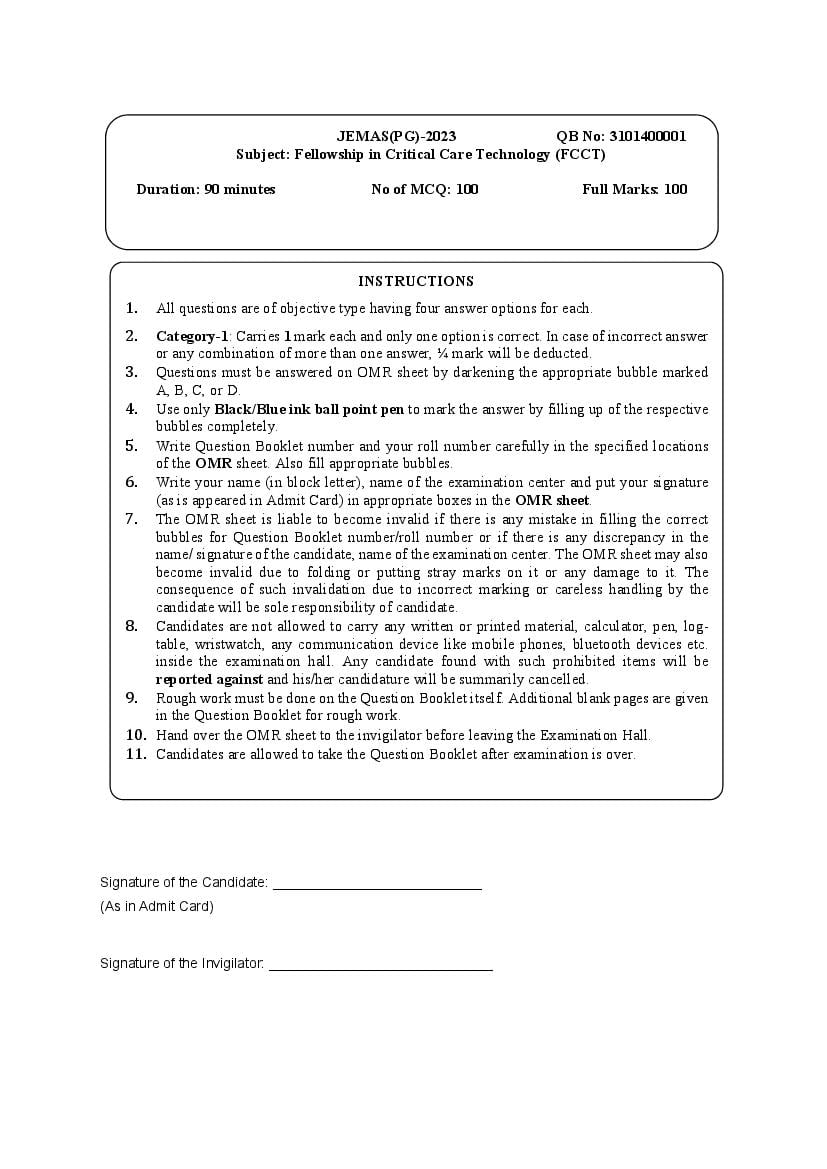
Subject: Fellowship in Critical Care Technology (FCCT)
Duration: 90 minutes No of MCQ: 100 Full Marks: 100
INSTRUCTIONS
1. All questions are of objective type having four answer options for each.
2. Category-1: Carries 1 mark each and only one option is correct. In case of incorrect answer
or any combination of more than one answer, ¼ mark will be deducted.
3. Questions must be answered on OMR sheet by darkening the appropriate bubble marked
A, B, C, or D.
4. Use only Black/Blue ink ball point pen to mark the answer by filling up of the respective
bubbles completely.
5. Write Question Booklet number and your roll number carefully in the specified locations
of the OMR sheet. Also fill appropriate bubbles.
6. Write your name (in block letter), name of the examination center and put your signature
(as is appeared in Admit Card) in appropriate boxes in the OMR sheet.
7. The OMR sheet is liable to become invalid if there is any mistake in filling the correct
bubbles for Question Booklet number/roll number or if there is any discrepancy in the
name/ signature of the candidate, name of the examination center. The OMR sheet may also
become invalid due to folding or putting stray marks on it or any damage to it. The
consequence of such invalidation due to incorrect marking or careless handling by the
candidate will be sole responsibility of candidate.
8. Candidates are not allowed to carry any written or printed material, calculator, pen, log-
table, wristwatch, any communication device like mobile phones, bluetooth devices etc.
inside the examination hall. Any candidate found with such prohibited items will be
reported against and his/her candidature will be summarily cancelled.
9. Rough work must be done on the Question Booklet itself. Additional blank pages are given
in the Question Booklet for rough work.
10. Hand over the OMR sheet to the invigilator before leaving the Examination Hall.
11. Candidates are allowed to take the Question Booklet after examination is over.
Signature of the Candidate: ___________________________
(As in Admit Card)
Signature of the Invigilator: _____________________________
Page 2
(A) Trachycardia
(B) Nystagmus
(C) Lactic acidemia
(D) Mental clouding
2. Severe carbon dioxide retention can cause all of the following EXCEPT:
(A) Mental clouding
(B) Acidosis
(C) Reduced cerebral blood flow
(D) Papilledema
3. Features of ARDS typically include the following EXCEPT:
(A) Severe Hypoxemia
(B) Ventilation- perfusion inequality without a shunt.
(C) Reduced lung compliances.
(D) Reduced FRC
4. Features of infant respiratory distress syndrome typically include all of the following
EXCEPT:
(A) Patchy heamorrhagic edema and atelectasis.
(B) Production of abnormal form of pulmonary surfactant.
(C) Severe hypoxemia
(D) Large shunt.
5. The laboratory reports arterial blood gas in a patient with severe lung disease as: PO2 60
mmHg, PCO2 110mmHg, and pH 7.20. all of the following are true EXCEPT :
(A) There is hypoxemia.
(B) There is CO2 retention.
(C) There is respiratory acidosis.
(D) The patient is breathing air.
6. Following statements about pulmonary surfactant is true EXCEPT :
(A) It is glycoprotein molecule.
(B) Acts by lowering surface tension of alveolar lining fluid.
(C) Surface tension of alveolar lining fluid gets progressive higher during inspiration.
(D) Surfactant prevents alveolar collapse during expiration.
7. Following statements about leptospirosis are true EXCEPT:
(A) It is a zoonotic disease
(B) It can involve multiple organs including lungs.
(C) Can be diagnosed early by blood culture.
(D) May result in ARDS
P a g e 1 | 15
Page 3
(A) ABG will show evidence of type I respiratory failure.
(B) It is an example of anemic hypoxia.
(C) Symptoms include headache, vomiting and confusion.
(D) Oxygen dissociation curve is shifted to the left.
9. Partial pressure of Oxygen in room air at sea level is:
(A) Approx. 760mm/Hg.
(B) Approx. 160mm/ Hg.
(C) Nearly 100 mm/Hg.
(D) Nearly 40mm/Hg.
10. A low PaO2 may be seen in all EXCEPT:
(A) Sedative overdose.
(B) Cirrhosis of liver.
(C) Pulmonary embolism.
(D) Methemoglobinemia.
11. Bed Side Index of Severity Score in acute pancreatitis includes all EXCEPT:
(A) Impaired mental status.
(B) Peritonitis.
(C) BUN.
(D) Age.
12. Identify wrong statement about management of acute pancreatitis.
(A) Currently gut resting is the key in initial management.
(B) Ringer Lactate is preferred IV fluid for resuscitation.
(C) Hypocalcemia is largely asymptomatic and requires no specific therapy.
(D) ARDS usually presents after 24 hours.
13. A 63 year old man present with a triad of angina, syncope and congestive heart failure.
Which of the following valvular heart lesion can be suspected:
(A) Mitral stenosis.
(B) Tricuspid regurgitation.
(C) Aortic stenosis.
(D) Aortic regurgitation.
14. Which of the following is not present in cardiac tamponade?
(A) Pulsus paradoxus.
(B) Kussmaul’s sign.
(C) Pulmonary edema.
(D) Hypertension.
P a g e 2 | 15
Page 4
pulmonary edema, except:
(A) Digoxin.
(B) Morphine.
(C) Furosemide.
(D) Positive Pressure Ventilation.
16. A person with mitral regurgitation and atrial fibrillation presents with syncope. On
examination the person has a heart rate of 55. What is the most probable cause?
(A) Digitalis toxicity.
(B) Incomplete heart block.
(C) Stroke.
(D) Subarachnoid Haemorrhage.
17. Acronym AMBU stands for?
(A) Automated manual breathing unit.
(B) Artificial manual breathing unit.
(C) Artificial mechanical breathing unit.
(D) Automated mechanical breathing unit.
18. ST elevation may be seen in all of the following conditions EXCEPT:
(A) Myocardial infarction.
(B) Coronary artery spasm.
(C) Constrictive pericarditis.
(D) Ventricular aneurysm.
19. In MI, which enzyme is raised in 4 to 6 hrs and decreases in 3 to 4 days:
(A) SGOT
(B) LDH
(C) CPK
(D) SGPT
20. Enlarged pulsatile liver with ascites is typically seen in:
(A) Tricuspid Regurgitation.
(B) Mitral Regurgitation.
(C) Mitral stenosis.
(D) Pulmonary stenosis.
21. In stable angina:
(A) CK-MB is elevated.
(B) Troponin I is elevated.
(C) Myoglobin is elevated.
(D) The levels of cardiac markers remain unchanged.
P a g e 3 | 15
Page 5
(A) TOF.
(B) PDA.
(C) Tricuspid Atresia.
(D) Eisenmenger’s complex.
23. Whole blood is stored at:
(A) 0 degree centigrade.
(B) 4 degree centigrade.
(C) 20 degree centigrade.
(D) 37 degree centigrade.
24. Dengue shock syndrome occurs due to:
(A) Super-imposed bacterial infection.
(B) Capillary leak.
(C) Addison’s crisis.
(D) Myocarditis.
25. Clinical criteria of brain death is all except:
(A) Coma.
(B) Absent brain stem reflex.
(C) Absent spinal cord reflex.
(D) Absent motor activity.
26. Which of the following is not a cardiovascular monitoring technique:
(A) Transesophageal echocardiography.
(B) Central venous pressure monitoring.
(C) Pulmonary artery catheterization.
(D) Capnography.
27. Which of the following statement is false for pulmonary embolism:
(A) Fat embolism can cause seizures.
(B) Amniotic fluid embolism is a rare but catastrophic complication during labour.
(C) Sickle cell anemia can cause fat embolism.
(D) Presents with type II respiratory failure.
28. Hyponatremia may be found in all, EXCEPT:
(A) Addison’s disease.
(B) Congenital adrenal hyperplasia.
(C) Lithium toxicity when used in bipolar disorder.
(D) Lung cancer.
P a g e 4 | 15
Page 6
(A) Is defined as a serum creatinine >133µmol/L (1.5mg/dL) in a patient with advanced liver
disease in the absence of an identifiable cause of renal failure.
(B) Portal hypertension is the initiating factor.
(C) Renal replacement therapy may improve short-term survival.
(D) Liver transplantation offers little benefit.
30. Which statement is true regarding Electrocardiography?
(A) The PR interval is usually ≤0.2 seconds.
(B) A normal QTc is >0.44 seconds.
(C) The QT interval is measured from the start of the Q-wave to the start of the T-wave.
(D) A normal QRS duration is 0.2 seconds.
31. Which statement is false in a case of Intestinal obstruction :
(A) Large bowel obstruction typically presents with vomiting.
(B) Fluid and electrolyte replacement with nasogastric tube decompression may be effective
at treating adhesional obstruction.
(C) A history of appendicectomy may be associated with severe and extensive adhesions.
(D) Neostigmine may be beneficial in pseudo-obstruction.
32. In Gastroparesis all are true except :
(A) Is characterised by delayed gastric emptying in the presence of mechanical obstruction.
(B) Vomiting may cause hyponatraemia.
(C) Secondary gastroparesis may present in Type I diabetes mellitus.
(D) Management is often ineffective.
33. Which one is true Critical care and haematological malignancies?
(A) Patients with neutropenic sepsis have similar rates of acute respiratory distress syndrome
(ARDS) to other critically ill patients.
(B) A temperature greater than 38°C is necessary for the diagnosis of neutropenic sepsis.
(C) Catheter-related bacteraemia always necessitates removal of the indwelling intravenous
catheter.
(D) Steroids are an appropriate initial therapy for graft versus host disease (GVHD).
34. Which one is false about Anti-neutrophil cytoplasmic antibody (ANCA)?
(A) If ANCA is positive, two target antigens should be checked (myeloperoxidase [MPO]
and serine proteinase-3 [PR3]).
(B) A positive perinuclear-ANCA (p-ANCA) may be seen in cystic fibrosis.
(C) Microscopic polyarteritis is not associated with positive cytoplasmic- ANCA (c-ANCA).
(D) Minocycline use may cause positive ANCA vasculitis.
35. Diagnostic criteria for sepsis, severe sepsis and septic shock which one is false?
(A) Decreased plasma procalcitonin levels.
(B) Normal white cell count with >10% immature forms.
(C) Elevated mixed venous oxygen saturations (>70%).
(D) Severe sepsis is sepsis plus organ dysfunction.
P a g e 5 | 15
Page 7
(A) Hemoptysis.
(B) Rigor
(C) Pleuritic pain.
(D) Dyspnea.
37. Factors that increases the likelihood of formation of peripheral venous thrombi include all of
the following EXCEPT:
(A) Polycythemia.
(B) Use of oral contraceptives.
(C) Medication with aspirin.
(D) Immobilization of a limb.
38. Some newborn infants lack pulmonary surfactant. The consequences includes all of the
following EXCEPT:
(A) Edema fluid in the alveoli.
(B) Areas of atelectasis.
(C) The lungs are difficult to inflate.
(D) Atrophy of the respiratory muscles.
39. Regarding cerebrospinal fluid all are true EXCEPT:
(A) Formation is largely independent of intracranial pressure.
(B) Circulates from lateral ventricle to the third ventricle via the aqueduct of Sylvius.
(C) Has a higher level of chloride and lower level of potassium than plasma.
(D) Will display a low glucose relative to plasma value in bacterial meningitis.
40. In relation to sodium which statement is true:-
(A) Sodium is the principal cation of the intracellular fluid.
(B) Criteria for diagnosis of the SIADH include finding a urinary sodium less than
20mmol/L.
(C) One liter of 3% sodium chloride contains approximately 500mmol of sodium.
(D) Hypernatraemia is not associated with hyperosmolality.
41. Indication for hyperbaric oxygen therapy include the following:-
(A) Carbon monoxide poisoning.
(B) Decompression sickness.
(C) Clostridial myositis.
(D) All of the above.
42. Respiratory failure in a patient with rheumatoid arthritis may be caused by :
(A) Bronchiolitis obliterans with organizing pneumonia.
(B) Methotrexate.
(C) Cricoarytenoid dysfunction.
(D) All of the above.
P a g e 6 | 15
Page 8
(A) Is the highest work rate that an individual can attain.
(B) Is the highest O2 uptake attained when the work rate is incrementally increased.
(C) Is the O2 uptake when the blood lactate suddenly rises during a test when the work rate is
incrementally increased.
(D) Is the O2 uptake when the total ventilation reaches a ceiling that cannot be exceeded.
44. Which of the following statements is true about O2 carriage.
(A) A 1gm of hemoglobin carries 1.34ml of O2 when fully saturated.
(B) 100ml of blood carries 3ml of O2 in solution.
(C) A 1gm of hemoglobin carries 6 ml of O2 when fully saturated.
(D) 100 ml of blood carries 10ml of O2 in solution.
45. A raised hemoglobin value may be seen in all of the following EXCEPT:
(A) Renal cell carcinoma.
(B) Polycystic kidney.
(C) Patient having COPD.
(D) Meningioma.
46. Obstructive sleep apnea may present with the following symptoms EXCEPT:
(A) Tiredness.
(B) Insomnia.
(C) Restlessness.
(D) Early morning headache.
47. Clinical features of pulmonary edema typically include all of the following EXCEPT:
(A) Dyspnea.
(B) Pleuritic pain.
(C) Cough.
(D) Radiographic changes.
48. The following statements are true about high altitude pulmonary edema EXCEPT:
(A) Pulmonary wedge pressure is normal.
(B) Pulmonary artery pressure is high.
(C) Hypoxic pulmonary vasoconstriction may be uneven.
(D) The best immediate treatment is to give diuretic.
49. The normal barometric pressure in the passenger cabin of an aircraft is maintained at:-
(A) Sea level barometric pressure.
(B) Pressure at 40,000 ft.
(C) Pressure at 8,000 ft.
(D) Pressure at 10,000 ft.
P a g e 7 | 15
Page 9
(A) PaCO2 rises in hypoventilation.
(B) PaO2 may rise in hyperventilation.
(C) Hyperventilation causes alkalosis.
(D) Hypoventilation causes acidosis.
51. Differential diagnoses for delayed waking post-general anaesthesia include all EXCEPT:
(A) Hypoglycaemia.
(B) Residual neuromuscular blockade.
(C) Central cholinergic syndrome.
(D) Anemia.
52. In severe necrotising pancreatitis which of the following is true:
(A) In the first 7-10 days pancreatic necrosis develops a surrounding fibrous wall.
(B) Infected necrosis requires urgent debridement in stable patients.
(C) Sterile necrosis is associated with less severe systemic involvement than infected
necrosis.
(D) Endoscopic debridement of necrotic tissue is preferred to open surgical management.
53. The common pathological changes following brainstem death is:
(A) Severe hypertension.
(B) Hyponatraemia.
(C) Pulmonary oedema.
(D) Thromboembolic events.
54. When inserting a chest drain which of the following statement is false:
(A) The anatomical triangle considered ‘safe’ is bordered by the latissimus dorsi, pectoralis
major and a line superior to the horizontal level of the nipple.
(B) A small-bore chest tube, inserted with a Seldinger technique, is inappropriate for the
management of a pneumothorax.
(C) The administration of prophylactic antibiotics should be considered in trauma patients
undergoing chest drain insertion.
(D) If suction is required, following chest drain insertion, this may be performed via an
underwater seal at a level of 10-20cmH2O.
55. The following statements are true for drugs in pregnancy EXCEPT:
(A) Ketamine should be avoided in early pregnancy.
(B) Suxamethonium readily crosses the placenta.
(C) Suxamethonium may have a prolonged action in pregnancy.
(D) The risk of antiepileptic drugs affecting the fetus are greatest in the first trimester.
56. Which of the below statement is true in abnormalities of coagulation?
(A) A prolonged prothrombin time (PT) is seen in heamophilia.
(B) In von Willebrand’s disease (VWD) the platelet count is unaffected.
(C) Aspirin prolongs PT and activated partial thromboplastin time (APTT).
(D) Uraemia prolongs the APTT.
P a g e 8 | 15
Page 10
Airway Pressure [BiPAP]) is contraindicated in:
(A) Mechanical bowel obstruction.
(B) Recent upper GI surgery.
(C) Cardiogenic pulmonary oedema.
(D) Chest wall trauma.
58. Which of the statement is true for Phaeochromocytoma:
(A) Is classically associated with multiple endocrine neoplasia (MEN) Type 1.
(B) 24-hour urinary collection for catecholamines and metanephrines has a high sensitivity
but a low specificity for diagnosis.
(C) Hyperglycaemia, hypercalcaemia and erythrocytosis are laboratory features.
(D) In relation to pre-operative preparation for surgical resection of phaeochromocytoma,
β-blockade should be instigated prior to α-blockade.
59. For antimicrobial resistance (AMR) Which of the following statement is false:
(A) AMR is resistance to an antimicrobial where the organism in question was initially
sensitive.
(B) Resistant organisms can include fungi, viruses and parasites in addition to bacteria.
(C) Misprescribing of antimicrobials can accelerate this natural phenomenon.
(D) Extended-spectrum β-lactamases (ESBLs) are responsible for a minority of resistant
Gram-negative bacteria.
60. In the management of acute ST-elevation myocardial infarction (STEMI) which of the
following statement is false:
(A) Ticagrelor and aspirin should be given once the diagnosis is made.
(B) Primary percutaneous coronary intervention (PCI) is recommended within 90 minutes
of first medical contact, if the patient initially arrives at a non-PCI-capable hospital.
(C) An injectable anticoagulant should be used (e.g. bivalirudin).
(D) Fibrinolytic therapy is recommended within 12 hours of symptom onset if primary PCI
cannot be performed.
61. Which of the following are recognized causes of hypocalcaemia EXCEPT:
(A) Hypermagnesaemia.
(B) Acute Hypophosphataemia.
(C) Vitamin D deficiency.
(D) Tumour lysis syndrome.
62. Regarding severe acute adult meningitis which of the following is false:
(A) Bacterial seeding of the meninges commonly occurs via haematogenous spread.
(B) Fever, headache and neck stiffness form the classic triad of presenting symptoms.
(C) Adjuvant dexamethasone therapy reduces mortality and hearing loss, and improves
neurological sequelae in acute bacterial meningitis.
(D) The use of corticosteroids may predispose to delayed cerebral thrombosis.
P a g e 9 | 15
Page 11
(A) Most deaths due to malaria are caused by P. falciparum.
(B) The initial development of the parasite after transmission occurs in the spleen.
(C) The incubation period is typically <7 days.
(D) Monotherapy is recommended by the World Health Organization (WHO) for treatment.
64. In Pathophysiology of sepsis which of the statement is false:
(A) The pathophysiology of bacterial sepsis initiated by Gram-positive organisms involves
lipopolysaccharides.
(B) Interleukin 1, 2 and 6 have pro-inflammatory properties.
(C) Cytokines increase the expression of enzyme-inducible nitric oxide synthase in
endothelial cells.
(D) Tumour necrosis factor causes cardiovascular insufficiency through a direct myocardial
depressant effect.
65. Which of the statement is false in Haematological malignancies and critical care:
(A) Granulocyte Colony-Stimulating Factor (GCSF) may be used to promote lymphocyte
recovery following bone marrow transplant (BMT).
(B) The incidence of graft versus host disease (GVHD) increases with increasing age of
donor and recipient.
(C) Acute GVHD is graded from I to IV.
(D) Respiratory failure is the commonest cause of death in patients undergoing bone
marrow transplant.
66. Which of the following is false regarding Clostridium difficile:
(A) Risk factors include age >60 years and previous use of broad spectrum antibiotics.
(B) Diagnosis is confirmed by stool culture.
(C) There is evidence for the use of probiotics to prevent Clostridium difficile-associated
diarrhoea.
(D) Is a Gram-positive, spore-forming, anaerobic, toxin-producing bacteria.
67. In relation to extracorporeal membrane oxygenation (ECMO) which of the following is false:
(A) Veno-venous ECMO (VV ECMO) is preferred to VA ECMO in the treatment of
respiratory failure as normal pulmonary blood flow is maintained.
(B) An ECMO circuit consists of a drainage cannula, pump, oxygenator, and an arterial-
return cannula.
(C) Haematology support is vital for the running of an ECMO service.
(D) The well-publicized CESAR trial showed no benefit of ECMO in adults.
68. Which of the statement is false regarding management of poisoning:
(A) Selective serotonin reuptake inhibitor (SSRI) overdose — benzodiazepines.
(B) Iron overdose — multiple-dose activated charcoal.
(C) Lithium overdose — haemodialysis.
(D) Organophosphate overdose — atropine.
P a g e 10 | 15
Page 12
EXCEPT:
(A) Chronic alcohol excess.
(B) Methotrexate therapy.
(C) Phenytoin therapy.
(D) Hyperthyroidism.
70. Regarding Human albumin solution (HAS) which of the following is true:
(A) Is derived from plasma from one donor.
(B) 4.5% HAS is hyperoncotic.
(C) Improved outcomes in critical care have been found with the use of HAS compared to
saline.
(D) May have an outcome benefit when used post-ascitic drainage.
71. Which of the following is true in relation to an empyema:
(A) An empyema tends to form 7 to 14 days after the onset of pneumonia.
(B) An empyema with a pH of less than 7.4 requires urgent drainage.
(C) Organized and loculated collections are best treated with intercostal drainage and
antibiotics.
(D) An empyema will often have a reduced lactate dehydrogenase (LDH) level
(<1000IU/L) on fluid analysis.
72. Which of the following is false regarding Macrophage Activation Syndrome (MAS):
(A) Pancytopenia, liver failure, coagulopathy and multi-organ failure may be seen.
(B) High serum ferritin levels are often seen.
(C) MAS often causes a cytokine storm.
(D) High-dose steroid therapy is contraindicated.
73. Which of the following is true in liver function test abnormalities?
(A) Albumin is a useful marker of synthetic liver function in the critically ill.
(B) Aspartate aminotransferase (AST) is more specific for liver injury than alanine
aminotransferase (ALT).
(C) AST is the primary enzyme raised in cholestatic liver disease.
(D) The normal range for serum ammonia is 15-45µg/dl.
74. Regarding the cranial nerves (CN) all the statements are false EXCEPT:
(A) The trochlear nerve provides motor supply to the superior rectus muscle.
(B) Sensory nerve supply to the face, nose and mouth is supplied by the trigeminal nerve.
(C) Pathology associated with the internal carotid artery may present with a third cranial
nerve (III) palsy.
(D) Sensation to the anterior one third of the tongue is supplied by the glossopharyngeal
nerve.
P a g e 11 | 15
Page 13
EXCEPT:
(A) Aspirin.
(B) Lithium.
(C) Diltiazem.
(D) Metformin.
76. Which statement is true regarding Acute Ischaemic Stroke (AIS):
(A) Aspirin and clopidogrel in combination following minor AIS or transient ischaemic
attack is not superior to aspirin treatment alone.
(B) Statin therapy should be started immediately following AIS.
(C) Patients presenting within 4.5 hours of onset of AIS should be considered for
thrombolysis with intravenous tissue-type plasminogen activator (tPA).
(D) Tight glycaemic control (glucose of 4-8mmol/L) is recommended post-AIS.
77. Regarding hepatic encephalopathy all are true EXCEPT:
(A) The West Haven system divides hepatic encephalopathy into five grades.
(B) Only complicates acute liver failure.
(C) Hyperammonaemia plays a critical role in pathogenesis.
(D) Lactulose 30-60ml orally or via a nasogastric tube is recommended.
78. In a pneumothorax all are true EXCEPT:
(A) Is more common in males than in females.
(B) When under tension will cause tracheal deviation towards the affected side.
(C) May occur as a complication of tracheostomy insertion.
(D) Is more common in smokers than non-smokers.
79. In relation to tracheostomy which statement is true?
(A) Haemorrhage from the innominate vessels is an early complication of insertion.
(B) It is recommended that the first routine tracheostomy change be performed at day 3 after
percutaneous tracheostomy.
(C) Early tracheostomy improves long-term outcomes and reduces length of ICU stay.
(D) Percutaneous tracheostomies are more cost-effective and result in fewer complications,
when compared to the surgical tracheostomies route in ICU patients.
80. Causes of DIC include:
(A) Leukemia.
(B) Massive transfusion.
(C) Abruptio placentae.
(D) All of the above.
81. The most sensitive test for DIC is?
(A) Serum fibrinogen levels.
(B) Serum levels of fibrin degradation products.
(C) Prolonged PT and PTT.
(D) Thrombocytopenia.
P a g e 12 | 15
Page 14
(A) Useful in ITP.
(B) Used in DIC.
(C) Effective for 9-10 days.
(D) Effect decreases with repeated usage.
83. Causes of Deep venous thrombosis include all of the following, EXCEPT:
(A) Diabetes Mellitus.
(B) Oral contraceptives.
(C) Paroxysmal Nocturnal Hemoglobinuria (PNH).
(D) Prolonged surgery.
84. Which one of the following is not a component of airway maintenance:
(A) Head tilt.
(B) Jaw thrust.
(C) Chin lift.
(D) Tongue pull.
85. Which of the following investigations should be done immediately to best confirm a non-
matched blood transfusion reaction?
(A) Indirect Coomb’s test.
(B) Direct Coomb’s test.
(C) Antibody in patient’s serum.
(D) Antibody in donor serum.
86. Urgent management in a case of open pneumothorax is :
(A) Urgent thoracotomy
(B) Immediate insertion of a chest drain
(C) Stuffing the wound with sterile gauze
(D) Administration of intravenous Normal Saline
87. Most common type of ECG rhythm at the time of cardiac arrest in adults is:
(A) Ventricular tachycardia without pulse
(B) Ventricular fibrillation
(C) Asystole
(D) Pulseless electrical activity
88. C.V.P (Central Venous Pressure) and pulmonary wedge pressure give an accurate assessment
of all the following EXCEPT:
(A) Tissue perfusion.
(B) Volume depletion.
(C) Volume overload.
(D) Myocardial function.
P a g e 13 | 15
Page 15
(A) Upper third of sternum
(B) Mid third of sternum
(C) Lower third of sternum
(D) Precordium overall
90. First step in CPR (Cardio Pulmonary Resuscitation) should be:
(A) IV adrenaline.
(B) Intracardic atropine.
(C) Airway maintenance.
(D) None of the above.
91. Post-spinal headache is due to
(A) Injury to spinal cord.
(B) CSF leak from dura.
(C) Meningitis.
(D) Raised intracranial pressure.
92. All of the following are seen in cardiac tamponade EXCEPT:
(A) Electrical alternans.
(B) Pulsus paradoxus.
(C) Increased JVP.
(D) Bradycardia.
93. Early complications of tracheostomy are:
(A) Hemorrhage
(B) Displacement of tube or obstruction
(C) Surgical emphysema
(D) Tracheal stenosis
94. Most common complication of central venous catheter is:
(A) Local bleeding
(B) Thrombosis
(C) Catheter related infection
(D) Pneumothorax
95. Low QRS voltage on ECG indicates:
(A) Pulmonary embolism
(B) Pericardial effusion
(C) Cor pulmonale
(D) Infective endocarditis
96. Why is a patient kept fasting before surgery?
(A) To maintain a clear G.I.T in abdominal surgeries
(B) To reduce the risk of aspiration
(C) To decrease pressure on abdominal aorta
(D) To prevent hyperglycemia
P a g e 14 | 15
Page 16
treatment EXCEPT:
(A) Atropine.
(B) Pacing.
(C) Isoproterenol.
(D) Diltiazem.
98. 100% oxygen improves cyanosis in all EXCEPT:
(A) Tetralogy of Fallot.
(B) Bronchial asthma.
(C) Eosinophilic pneumonia.
(D) Interstitial lung disease.
99. Infective endocarditis is least likely to occur in:
(A) Atrial septal defect.
(B) Small ventricular septal defect.
(C) Mitral valve prolapse.
(D) Tetralogy of Fallot.
100. Which of the following ECG findings is associated with acute myocardial Infarction:
(A) Elevation of S wave.
(B) Prolonged QT interval.
(C) ST segment elevation.
(D) Prolonged PR interval.
P a g e 15 | 15
Document Details
| Board / Org | WBJEEB |
| Exam | JEMAS PG |
| Type | Question Paper |
| Pages | 17 |
| Updated | 24 Sep 2026 |