Uttarakhand Board Class 10 Syllabus 2024
Finished viewing? Save it for later —
Download Uttarakhand Board Class 10 Syllabus 2024 (PDF · 51 pages)About Uttarakhand Board Class 10 Syllabus 2024
Uttarakhand Board Class 10 Syllabus 2024 is available here for free download. Published by Uttarakhand Board for Class 10, this syllabus can be viewed online or downloaded as a PDF (51 pages). Candidates preparing for Class 10 can use Uttarakhand Board Class 10 Syllabus 2024 to understand the exam pattern, the type of questions asked, and the overall difficulty level.
Frequently Asked Questions
How can I download Uttarakhand Board Class 10 Syllabus 2024?
Open this page and click the Download button to save Uttarakhand Board Class 10 Syllabus 2024 as a PDF. It is completely free on AglaSem Docs.
Is Uttarakhand Board Class 10 Syllabus 2024 free to download?
Yes. Uttarakhand Board Class 10 Syllabus 2024 can be viewed online and downloaded as a PDF free of cost on AglaSem Docs.
How many pages does Uttarakhand Board Class 10 Syllabus 2024 have?
Uttarakhand Board Class 10 Syllabus 2024 contains 51 pages, which you can read online or download together as a single PDF.
Where can I find more Class 10 study material?
You can find more Class 10 question papers, sample papers, syllabus, and answer keys on AglaSem Docs.
Uttarakhand Board Class 10 Syllabus 2024 – Text
Read the full text of this syllabus below — useful to quickly search, copy and reference the content online without downloading the PDF.
📄 View text version (51 pages)
Page 1
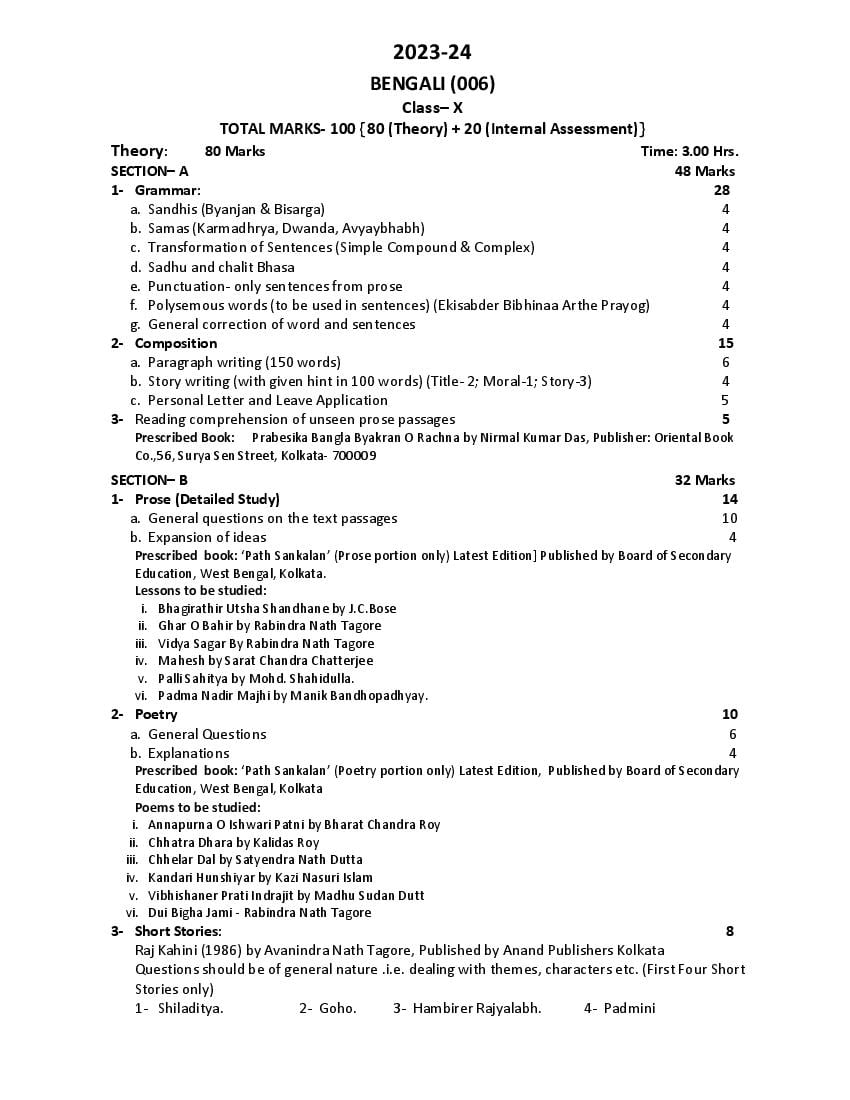
BENGALI (006)
Class– X
TOTAL MARKS- 100 ¿ 80 (Theory) + 20 (Internal Assessment)À
Theory: 80 Marks Time: 3.00 Hrs.
SECTION– A 48 Marks
1- Grammar: 28
a. Sandhis (Byanjan & Bisarga) 4
b. Samas (Karmadhrya, Dwanda, Avyaybhabh) 4
c. Transformation of Sentences (Simple Compound & Complex) 4
d. Sadhu and chalit Bhasa 4
e. Punctuation- only sentences from prose 4
f. Polysemous words (to be used in sentences) (Ekisabder Bibhinaa Arthe Prayog) 4
g. General correction of word and sentences 4
2- Composition 15
a. Paragraph writing (150 words) 6
b. Story writing (with given hint in 100 words) (Title- 2; Moral-1; Story-3) 4
c. Personal Letter and Leave Application 5
3- Reading comprehension of unseen prose passages 5
Prescribed Book: Prabesika Bangla Byakran O Rachna by Nirmal Kumar Das, Publisher: Oriental Book
Co.,56, Surya Sen Street, Kolkata- 700009
SECTION– B 32 Marks
1- Prose (Detailed Study) 14
a. General questions on the text passages 10
b. Expansion of ideas 4
Prescribed book: ‘Path Sankalan’ (Prose portion only) Latest Edition] Published by Board of Secondary
Education, West Bengal, Kolkata.
Lessons to be studied:
i. Bhagirathir Utsha Shandhane by J.C.Bose
ii. Ghar O Bahir by Rabindra Nath Tagore
iii. Vidya Sagar By Rabindra Nath Tagore
iv. Mahesh by Sarat Chandra Chatterjee
v. Palli Sahitya by Mohd. Shahidulla.
vi. Padma Nadir Majhi by Manik Bandhopadhyay.
2- Poetry 10
a. General Questions 6
b. Explanations 4
Prescribed book: ‘Path Sankalan’ (Poetry portion only) Latest Edition, Published by Board of Secondary
Education, West Bengal, Kolkata
Poems to be studied:
i. Annapurna O Ishwari Patni by Bharat Chandra Roy
ii. Chhatra Dhara by Kalidas Roy
iii. Chhelar Dal by Satyendra Nath Dutta
iv. Kandari Hunshiyar by Kazi Nasuri Islam
v. Vibhishaner Prati Indrajit by Madhu Sudan Dutt
vi. Dui Bigha Jami - Rabindra Nath Tagore
3- Short Stories: 8
Raj Kahini (1986) by Avanindra Nath Tagore, Published by Anand Publishers Kolkata
Questions should be of general nature .i.e. dealing with themes, characters etc. (First Four Short
Stories only)
1- Shiladitya. 2- Goho. 3- Hambirer Rajyalabh. 4- Padmini
Page 2
fo’k; esa vkUrfjd ewY;kadu fuEuor~ fd;k tk;sxk&
Ø0la0 vkUrfjd ewY;kadu gsrq ewY;kadu fcUnq fu/kkZfjr vad
1 Jo.k dkS”ky (LISTENING SKILL) 4
2 Okkpu dkS”ky (SPEAKING SKILL) 4
ifj;kstuk dk;Z&
3 v½ fo"k;oLrq] Hkk"kk ,oa izLrqqfr] ekSfydrk 4
c½ ifj;kstuk dk;Z ij vk/kkfjr ekSf[kdh 3
4 lrr ewY;kadu ¼bdkbZ ijh{kk½ 5
dqy ;ksx 20
1- Jo.k dkS”ky (LISTENING SKILL)- lquuk (LISTENING)
of.kZr ;k ifBr lkexzh dks lqudj vFkZxzg.k djuk] okrkZyki] okn fookn] Hkk’k.k] dfork ikB vkfn dks lqudj le>uk]
ewY;kadu djuk vkSj vfHkO;fDr ds <ax dks tkuukA
Jo.k ¼lquuk½ dk ewY;kadu (ASSESSMENT OF LISTENING)
Ikjh{kd fdlh izklafxd fo’k; ij ,d vuqPNsn dk Li’V okpu djsxkA vuqPNsn rF;kRed ;k lq>kokRed gks ldrk gSA
vuqPNsn yxHkx 200 “kCnksa dk gksxkA ijh{kd dks lqurs&lqurs ijh{kkFkhZ vyx dkxt ij fn;s gq, Jo.k cks/k ds vH;klksa dks
gy dj ldsaxsA vH;kl fjDr LFkku iwfrZ] cgqfodYih; iz”u vFkok lR;@vlR; dk pquko vkfn fo/kkvksa esa gks ldrs gSaA
2- Okkpu dkS”ky (SPEAKING SKILL)- cksyuk (SPEAKING)
Hkk’k.k] okn&fookn
Xkfr] y;] vkjksg&vojksg lfgr lLoj dfork&okpu
okrkZyki vkSj mldh vkSipkfjdrk,¡
dk;ZØe&izLrqfr
dFkk&dgkuh vFkok ?kVuk lquuk
ifjp; nsuk] ifjp; izkIr djuk
Hkkokuqdwy laokn&okpu
okrkZyki dh n{krk,¡
fVIi.kh& okrkZyki dh n{krkvksa dk ewY;kadu fujarjrk ds vk/kkj ij ijh{kk ds le; gksxkA
okpu ¼cksyuk½ dk ewY;kadu (ASSESSMENT OF SPEAKING)
fp=ksa ds Øe ij vk/kkfjr o.kZu% bl Hkkx esa vis{kk dh tk,xh fd ijh{kkFkhZ fooj.kkRed Hkk’kk dk iz;ksx djsaA
fdlh fp= dk o.kZu% ¼fp= yksxksa ds ;k LFkkuksa ds gks ldrs gSaA½
fdlh fu/kkZfjr fo’k; ij cksyuk ftlls og vius O;fDrxr vuqHko dk izR;kLej.k dj ldsaA
dksbZ dgkuh lquuk ;k fdlh ?kVuk dk o.kZu djukA
fVIi.kh&
1- ijh{k.k ls iwoZ ijh{kkFkhZ dks rS;kjh ds fy, dqN le; fn;k tk;A
2- fooj.kkRed Hkk’kk esa orZeku dky dk iz;ksx visf{kr gSA
3- fu/kkZfjr fo’k; ijh{kkFkhZ ds vuqHko lalkj ds gksa tSls& dksbZ pqVdqyk ;k gkL;&izlax lqukuk] gky esa i<+h iqLrd ;k ns[ks
x;s flusek dh dgkuh lqukukA
4- tc ijh{kkFkhZ iz”u i= izkjEHk dj nsa rks ijh{kd de ls de gLr{ksi djsaA
3- ifj;kstuk dk;Z (PROJECT WORK)
fo|kFkhZ dks “kSf{kd l= esa fo’k; ls lEcfU/kr ,d izkstsDV dk;Z djuk gksxkA fo|kFkhZ izkstsDV dk;Z gsrq fo’k; ls lEcfU/kr
fdlh Hkh VkWfid dk fo’k;k/;kid ls ijke”kZ dj p;u dj ldrk gSA
4- lrr ewY;kadu&bdkbZ ijh{kk (CONTINUOUS ASSESSMENT- UNIT TEST)
d{kk 9& l= esa dqy 04 bdkbZ ijh{kk;sa gksaxh ¼02 bdkbZ ijh{kk;sa v)Zokf’kZd ijh{kk ls iwoZ rFkk 02 v)Zokf’kZd ijh{kk ds mijkUr½A
v)Zokf’kZd ijh{kk ds ijh{kkQy fuekZ.k gsrq izFke nks bdkbZ ijh{kkvksa ¼izFke o f}rh;½ esa ls vf/kd izkIrkad okyh bdkbZ ijh{kk
ds vad fy;s tk;saxs rFkk bu vadksa dks 05 ds Hkkjkad esa ifjofrZr fd;k tk;sxkA blh izdkj okf’kZd ijh{kk ds ijh{kkQy fuekZ.k
gsrq vfUre nks bdkbZ ijh{kkvksa ¼r`rh; o prqFkZ½ esa ls vf/kd izkIrkad okyh bdkbZ ijh{kk ds vad ysdj bu vadksa dks 05 ds
Hkkjkad esa ifjofrZr fd;k tk;sxkA
d{kk 10& l= esa dqy 03 bdkbZ ijh{kk;sa ¼02 bdkbZ ijh{kk;sa v)Zokf’kZd ijh{kk ls iwoZ rFkk 01 v)Zokf’kZd ijh{kk ds mijkUr½ rFkk 01
izh&cksMZ ijh{kk gksxhA v)Zokf’kZd ijh{kk ds ijh{kkQy fuekZ.k gsrq izFke nks bdkbZ ijh{kkvksa ¼izFke o f}rh;½ esa ls vf/kd
izkIrkad okyh bdkbZ ijh{kk ds vad fy;s tk;saxs rFkk bu vadksa dks 05 ds Hkkjkad esa ifjofrZr fd;k tk;sxkA ifj’knh;~ ijh{kk ds
vkUrfjd ewY;kadu gsrq rhu bdkbZ ijh{kkvksa esa ls lokZf/kd izkIrkad okyh bdkbZ ijh{kk ds vad ysdj bu vadksa dks 05 ds
Hkkjkad esa ifjofrZr fd;k tk;sxkA
********
Page 3
Class– X
Theory : 80 Marks Time: 3.00 Hrs.
SECTION A : READING 15 Marks
1 & 2- Two unseen passages of total 500 words with a variety of questions including 4 marks for
vocabulary. Only prose passages will be used. One will be factual and the other will be
literary.
Passage 1 - 200 words (6 marks)– Three or Four comprehension questions. 06 Marks
Passage 2 - 300 words (9 marks)-Three or Four comprehension questions and One or two
questions on vocabulary. 09 Marks
SECTION B : WRITING 15 Marks
3- Letter Writing - One letter based on provided verbal stimulus and context. Type of letter:
Informal: Personal such as to family and friends.
Formal: Letter of complaints, enquiries, requests, applications 06 Marks
4- Writing a short paragraph on a given outline / topic in about 60 words 04 Marks
5. Composition : A short writing task based on a verbal and/or visual stimulus (diagram,
Picture, graph, map, chart, table, flow chart etc.) Maximum words 80. 05 Marks
SECTION C : GRAMMAR 15 Marks
Question No. 6-11
A variety of short questions involving the use of particular structures within a context. Test
types used will include clause, gap-filling, sentence-completion, sentence-reordering,
Page 4
Grammar syllabus will include the following areas for teaching:
1. Use of non-finites.
2. Sentence connectors (as, since, while, then, just because, just, until)
3. Clauses with what, where and how.
4. Past Tense.
5. Modals (can, could, may, must, might)
Note: All other areas covered in Class IX will also be tested in Class X as this is an integrated course for
this area of learning. No separate marks allotted for any of grammatical items listed above.
SECTION D : TEXT BOOKS 35 Marks
First Flight - NCERT Text Book for class X (Latest Edition)
Prose 16 Marks
12 & 13- Two extracts from different prose lessons included in Text book (Approximately 100 words
each) 4x2 = 08 Marks
These extracts chosen from different lessons will be literary and discursive in nature. Each
extract will be of 4 marks. 01 mark in each extract will be for vocabulary. 3 Marks in each
passage will be used for testing local and global comprehension besides a question on
interpretation.
14- One out of two questions extrapolative in nature based on any one of the prose lessons from
Textbook to be answered in about 80 words. 05 Marks
15- One out of two questions on Drama Text (local and global comprehension question) (30-40
words) 03 Mark
Poetry 07 Marks
16. One extract from a poem from the prescribed reader followed by two or three questions to
test the local and global comprehension of the set text. The extract will carry three marks.
03 Marks
17. Two out of three short answer type questions on interpretation of themes and ideas
contained in the poems to be answered in 30-40 words each. 04 Marks
Foot Prints without Feet - Supplementary Reader for Class X 12 Marks
18- One out of two questions from Supplementary Reader to interpret, evaluate and analyze
character, plot or situations occurring in the lessons to be answered in about 100 words.
07 Marks
19- One out of two short answer type questions of interpretative and evaluative nature based on
lessons to be answered in 30-40 words. 03 Marks
20- One out of two short answer type questions based on factual aspects of the lessons to be
answered in 20-30 words. 02 Marks
INTERNAL ASSESSMENT- 20 MARKS
S. No. Assessment Points Marks
1 Listening Skill 4
2 Speaking Skill 4
Project Work
3 a) Script, Presentation, Originality 4
b) Viva based on Project 3
4 Continuous Assessment (Unit Test) 5
TOTAL 20
Page 5
1- LISTENING AND SPEAKING SKILLS
Guidelines for Assessment of Listening and Speaking Skills (ALS)
ALS is a component of the Subject Enrichment Activity under Internal Assessment. ALS must be seen as an
integrated component of all four language skills rather than a compartment of two. Suggested activities,
therefore, take into consideration an integration of the four language skills but during assessment,
emphasis will be given to speaking and listening, since reading and writing are already being assessed in the
written exam.
Assessment of Listening and Speaking Skills:
i. Activities:
● Subject teachers must refer to books prescribed in the syllabus.
● In addition to the above, teachers may plan their own activities and create their own material for
assessing the listening and speaking skills.
ii. Parameters for Assessment: The listening and speaking skills are to be assessed on the following
parameters:
Interactive competence (Initiation & turn taking, relevance to the topic)
Fluency (cohesion, coherence and speed of delivery)
Pronunciation
Language (grammar and vocabulary)
iii. Schedule: The practice of listening and speaking skills should be done throughout the academic year.
2- PROJECT WORK- Student should complete a project work, related to subject, in the session. The student
has to select the topic under the guidance of subject teacher.
3- CONTINUOUS ASSESSMENT (UNIT TEST)-
CLASS 9th
There will be total 4 Unit Tests to be conducted throughout the year (two Unit Tests before half yearly
examination and two after half yearly examination). At the time of half yearly result preparation best of
two Unit Tests (I & II) marks will be taken and converted to the weightage of 05 marks. Likewise best of
two Unit Tests (III & IV) marks will be taken and converted to the weightage of 05 marks for the annual
result preparation.
CLASS 10th
There will be total 3 Unit Tests (two Unit Tests before half yearly examination and one after half yearly
examination) and a pre-board examination to be conducted throughout the year. At the time of half
yearly result preparation best of two Unit Tests (I & II) marks will be taken and converted to the
weightage of 05 marks. In Board examination, marks of the best out of 3 Unit Tests will be taken and
converted to the weightage of 05 marks for the result preparation.
PRESCRIBED BOOKS:
1. Beehive- Textbook for class IX, NCERT Publication
2. Moments– Supplementary Reader for class IX, NCERT Publication
3. First Flight- Textbook for class X, NCERT Publication
4. Foot Prints without Feet– Supplementary Reader for class X, NCERT Publication.
******
Page 6
1 Jo.k dkS”ky (LISTENING SKILL) 4
2 Okkpu dkS”ky (SPEAKING SKILL) 4
ifj;kstuk dk;Z&
3 v½ fo"k;oLrq] Hkk"kk ,oa izLrqqfr] ekSfydrk 4
c½ ifj;kstuk dk;Z ij vk/kkfjr ekSf[kdh 3
4 lrr ewY;kadu ¼bdkbZ ijh{kk½ 5
dqy ;ksx 20
2023-24
fgUnh ¼001½
d{kk&10
iw.kkZad& 100 ¼lS)kfUrd& 80 vad + vkUrfjd ewY;kadu& 20 vad½
lS)kfUrd Hkkx% le;& 3 ?kaVk iw.kkZad&80 ¼56+24½
fgUnh 56
[k.M d& vifBr x|ka”k 07
[k.M [k& jpuk 12
[k.M x& O;kogkfjd&O;kdj.k 10
[k.M ?k& ikB~;&iqLrdsa
f{kfrt Hkkx& 2 21
d`frdk Hkkx& 2 06
laLd`r 24
[k.M ³& laLd`r ikB~;iqLrd 18
[k.M p& laLd`r O;kdj.k 04
[k.M N& okD; jpuk 02
[k.M d& vifBr x|ka”k 07 vad
1- ,d lkfgfR;d x|ka”k ¼450 ls 600 “kCn½
x|ka”k esa “kh’kZd dk pquko] fo’k; oLrq dk cks/k] Hkkf’kd fo”ks’krkvksa vkfn ij vfr y?kwÙkjkRed ikWap iz”u
iwNs tk;saxsA 2$2$1$1$1 07
[k.M [k& jpuk 12 vad
2- fdlh vk/kqfud fo’k; ij ladsr fcUnqvksa ij vk/kkfjr fuca/k ys[ku 08
3- i= ys[ku ¼vkSipkfjd@vukSipkfjd i=½ 04
[k.M x& O;kogkfjd O;kdj.k 10 vad
4- fØ;k&Hksn % vdeZd@ldeZd 02
Page 7
6- okD; Hksn % Lo:i ifjorZu 02
7- okP;& dr`ZokP;] vdrZ̀okP; 02
8- vusdkFkhZ “kCn 02
[k.M ?k& ikB~; iqLrdsa
f{kfrt Hkkx& 2 21 vad
9- nks esa ls fdlh ,d dkO;ka”k ij vFkZ&xzg.k laca/kh rhu esa ls nks iz”u 2$2 04
10- dforkvksa ij vk/kkfjr fo’k;&oLrq laca/kh rhu esa ls nks iz”u 2$2 04
11- dforkvksa ds lans”k@thou ewY;ksa ij nks y?kwÙkjkRed iz”u 1$1 02
12- nks esa ls ,d x|ka”k ij vFkZxzg.k laca/kh nks iz”u 2$2 04
13- x| ikBksa ds fopkj@lans”k ls laca/kh rhu esa ls nks iz”u 2$2 04
14- x| ikBksa ds fopkj@lans”k ls lEcfU/kr nks y?kwÙkjkRed iz”u 2$1 03
d`frdk Hkkx& 2 06 vad
15- ikBksa ij vk/kkfjr pkj esa ls rhu y?kwÙkjkRed iz”u 2$2$2 06
[k.M ³& ikB~;iqLrd laLd`r fouksfnuh ¼Hkkx&2½ 18 vad
16- x| vuqPNsn ij vk/kkfjr pkj esa ls rhu iz”uksa ds mÙkj 2$2$2 06
17- i| vuqPNsn ij vk/kkfjr rhu esa ls nks iz”uksa ds mÙkj 2$2 04
18- ikB~;&iqLrd ij vk/kkfjr pkj esa ls rhu iz”uksa ds mÙkj 2$2$2 06
19- fn, x;s “kCnksa dh lgk;rk ls okD; iwjk djuk 4X½ 02
¼N% iz”uksa esa ls pkj okD; cukuk½
[k.M p& laLd`r O;kdj.k 04 vad
20- laf/k] Loj laf/k ¼;.k] v;kfn] iwoZ:i] ij:i½ lekl] dkjd] milxZ
¼ik¡p iz”uksa esa ls pkj iz”uksa ds mÙkj½ 4X1 04
[k.M N&
21- okD; jpuk 02 vad
fn, x;s N% Lora= inksa esa ls pkj dh laLd`r okD;ksa esa jpuk 4X½ 02
vFkok
fn, x;s rhu okD;ksa esa ls nks dk laLd`r esa vuqokn djuk 1$1 02
vkUrfjd ewY;kadu& 20 vad
Ø0la0 ewY;kadu fcUnq fu/kkZfjr vad
1 Jo.k dkS”ky (LISTENING SKILL) 4
2 Okkpu dkS”ky (SPEAKING SKILL) 4
ifj;kstuk dk;Z&
3 v½ fo"k;oLrq] Hkk"kk ,oa izLrqqfr] ekSfydrk 4
c½ ifj;kstuk dk;Z ij vk/kkfjr ekSf[kdh 3
4 lrr ewY;kadu ¼bdkbZ ijh{kk½ 5
dqy ;ksx 20
----------------------------------------------------------------------------------------------------------------------------------------------------------------------------------------------------------------
d{kk 9 o 10 esa fgUnh fo’k; esa vkUrfjd ewY;kadu fuEuor~ fd;k tk;sxk&
vkUrfjd ewY;kadu gsrq ewY;kadu fcUnq&
1- Jo.k dkS”ky (LISTENING SKILL)- lquuk (LISTENING)
of.kZr ;k ifBr lkexzh dks lqudj vFkZxzg.k djuk] okrkZyki] okn fookn] Hkk’k.k] dfork ikB vkfn dks lqudj le>uk]
ewY;kadu djuk vkSj vfHkO;fDr ds <ax dks tkuukA
Jo.k ¼lquuk½ dk ewY;kadu (ASSESSMENT OF LISTENING)
Ikjh{kd fdlh izklafxd fo’k; ij ,d vuqPNsn dk Li’V okpu djsxkA vuqPNsn rF;kRed ;k lq>kokRed gks ldrk gSA
vuqPNsn yxHkx 200 “kCnksa dk gksxkA ijh{kd dks lqurs&lqurs ijh{kkFkhZ vyx dkxt ij fn;s gq, Jo.k cks/k ds vH;klksa dks
gy dj ldsaxsA vH;kl fjDr LFkku iwfrZ] cgqfodYih; iz”u vFkok lR;@vlR; dk pquko vkfn fo/kkvksa esa gks ldrs gSaA
Page 8
Hkk’k.k] okn&fookn
Xkfr] y;] vkjksg&vojksg lfgr lLoj dfork&okpu
okrkZyki vkSj mldh vkSipkfjdrk,¡
dk;ZØe&izLrqfr
dFkk&dgkuh vFkok ?kVuk lquuk
ifjp; nsuk] ifjp; izkIr djuk
Hkkokuqdwy laokn&okpu
okrkZyki dh n{krk,¡
fVIi.kh& okrkZyki dh n{krkvksa dk ewY;kadu fujarjrk ds vk/kkj ij ijh{kk ds le; gksxkA
okpu ¼cksyuk½ dk ewY;kadu (ASSESSMENT OF SPEAKING)
fp=ksa ds Øe ij vk/kkfjr o.kZu% bl Hkkx esa vis{kk dh tk,xh fd ijh{kkFkhZ fooj.kkRed Hkk’kk dk iz;ksx djsaA
fdlh fp= dk o.kZu% ¼fp= yksxksa ds ;k LFkkuksa ds gks ldrs gSaA½
fdlh fu/kkZfjr fo’k; ij cksyuk ftlls og vius O;fDrxr vuqHko dk izR;kLej.k dj ldsaA
dksbZ dgkuh lquuk ;k fdlh ?kVuk dk o.kZu djukA
fVIi.kh&
1- ijh{k.k ls iwoZ ijh{kkFkhZ dks rS;kjh ds fy, dqN le; fn;k tk;A
2- fooj.kkRed Hkk’kk esa orZeku dky dk iz;ksx visf{kr gSA
3- fu/kkZfjr fo’k; ijh{kkFkhZ ds vuqHko lalkj ds gksa tSls& dksbZ pqVdqyk ;k gkL;&izlax lqukuk] gky esa i<+h iqLrd ;k ns[ks
x;s flusek dh dgkuh lqukukA
4- tc ijh{kkFkhZ iz”u i= izkjEHk dj nsa rks ijh{kd de ls de gLr{ksi djsaA
3- ifj;kstuk dk;Z (PROJECT WORK)
fo|kFkhZ dks “kSf{kd l= esa fo’k; ls lEcfU/kr ,d izkstsDV dk;Z djuk gksxkA fo|kFkhZ izkstsDV dk;Z gsrq fo’k; ls lEcfU/kr
fdlh Hkh VkWfid dk fo’k;k/;kid ls ijke”kZ dj p;u dj ldrk gSA
4- lrr ewY;kadu&bdkbZ ijh{kk (CONTINUOUS ASSESSMENT- UNIT TEST)
d{kk 9&
l= esa dqy 04 bdkbZ ijh{kk;sa gksaxh ¼02 bdkbZ ijh{kk;sa v)Zokf’kZd ijh{kk ls iwoZ rFkk 02 v)Zokf’kZd ijh{kk ds mijkUr½A
v)Zokf’kZd ijh{kk ds ijh{kkQy fuekZ.k gsrq izFke nks bdkbZ ijh{kkvksa ¼izFke o f}rh;½ esa ls vf/kd izkIrkad okyh bdkbZ ijh{kk
ds vad fy;s tk;saxs rFkk bu vadksa dks 05 ds Hkkjkad esa ifjofrZr fd;k tk;sxkA blh izdkj okf’kZd ijh{kk ds ijh{kkQy
fuekZ.k gsrq vfUre nks bdkbZ ijh{kkvksa ¼r`rh; o prqFkZ½ esa ls vf/kd izkIrkad okyh bdkbZ ijh{kk ds vad ysdj bu vadksa dks
05 ds Hkkjkad esa ifjofrZr fd;k tk;sxkA
d{kk 10&
l= esa dqy 03 bdkbZ ijh{kk;sa ¼02 bdkbZ ijh{kk;sa v)Zokf’kZd ijh{kk ls iwoZ rFkk 01 v)Zokf’kZd ijh{kk ds mijkUr½ rFkk
01 izh&cksMZ ijh{kk gksxhA v)Zokf’kZd ijh{kk ds ijh{kkQy fuekZ.k gsrq izFke nks bdkbZ ijh{kkvksa ¼izFke o f}rh;½ esa ls vf/kd
izkIrkad okyh bdkbZ ijh{kk ds vad fy;s tk;saxs rFkk bu vadksa dks 05 ds Hkkjkad esa ifjofrZr fd;k tk;sxkA ifj’knh;~ ijh{kk
ds vkUrfjd ewY;kadu gsrq rhu bdkbZ ijh{kkvksa esa ls lokZf/kd izkIrkad okyh bdkbZ ijh{kk ds vad ysdj bu vadksa dks 05 ds
Hkkjkad esa ifjofrZr fd;k tk;sxkA
------------------------------------------------------------------------------------------------------------------------------------------------------------------------------------------------------------------------------------------------------
fu/kkZfjr ikB~;iqLrdsa&
1- f{kfrt] Hkkx&1] ¼d{kk 9½ ,u0lh0bZ0vkj0Vh0] ubZ fnYyh }kjk izdkf”kr uohure laLdj.kA
2- d`frdk] Hkkx&1] ¼d{kk 9½ ,u0lh0bZ0vkj0Vh0] ubZ fnYyh }kjk izdkf”kr uohure laLdj.kA
3- laLd`r fouksfnuh ¼d{kk 9½A
4- f{kfrt] Hkkx&2] ¼d{kk 10½ ,u0lh0bZ0vkj0Vh0] ubZ fnYyh }kjk izdkf”kr uohure laLdj.kA
5- d`frdk] Hkkx&2] ¼d{kk 10½ ,u0lh0bZ0vkj0Vh0] ubZ fnYyh }kjk izdkf”kr uohure laLdj.kA
6- laLd`r fouksfnuh ¼d{kk 10½A
********
Page 9
Class- X
Theory : 70 Marks Time: 3.00 Hrs.
UNIT I: Growth and development of children between birth to 3 years. Principles of growth and
development of child; Important milestones in physical, motor, social, emotional and language
development of children; physical, social and emotional needs of children. 10
UNIT II: Role of books, music rhymes, games, radio, TV & Video, in the life of a child up to 3 years of age.
04
UNIT III: Play : Meaning, need and types of play in children between birth & 3 yrs; Characteristics of play-
active, passive, natural, serious and exploratory Play materials for children-Characteristics
of play material. 05
UNIT IV: Nutrients : Functions, sources and deficiency of Carbo hydrates, proteins, Fats Minerals-Iron,
Calcium and Iodine and Vitamins- Vitamin A, B, B2, Vitamin C and Vitamin D. Loss of nutrients
during cooking, conservation and enhancement of nutrients. 05
UNIT V: Meal Planning : Concept, need and factors affecting meal planning-age, sex, climate,
occupation, physical needs, number of family members, economic status of family, availability of
food, family traditions, likes and dislike and occasion; Food Groups (Basic : 5 suggested by ICMR); Use
of food groups in planning balanced diet, food allowances suggested by ICMR. 06
UNIT VI: Food hygiene & methods of storage of food : Rules of hygienic handling of food, Method of
storage of perishable, semi-perishable and non-perishable foods. 05
UNIT VII: Resources available to family : Types of resources-Human (Energy, time, knowledge and skill)
Non-Human (money, material goods and community resources); general characteristics of
resources, wise use of resources; personal & shared: 06
UNIT VIII: Money Management : Family income and expenditure and importance of saving &
Investment. 06
UNIT IX: Consumer Education : Consumer rights and responsibilities, consumer problems, malpractices
of traders-price variation, poor quality, adulteration, faulty weights and measures, non-
availability of goods, misleading information, lack of standardized products, misleading
advertisement, aids to help consumers-standardization marks, labels, packages, advertisement,
Pamphlets & Leaflets. 06
UNIT X: Care of clothes :Cleaning and finishing agents used in everyday care of clothes in the homes:
stain removal (precautions and methods); laundering and storage of cotton, silk, wool and
synthetics. 12
UNIT XI: Quality check of apparel : Workmanship of readymade, tailor made garment, reading of labels
on clothes. 05
PRACTICAL : 30 Marks
Ø0la0 iz;ksxkRed Hkkx gsrq ewY;kadu fcUnq Dqy vad
0&3 o’kZ rd ds cPpksa ds “kkjhfjd o fØ;kRed y{k.kksa ds lEcU/k esa isz{k.k] 1&3 o’kZ rd ds cPpksa esa [ksyksa ds fØ;k
1 dyki] mudk [ksyksa ls yxko vkSj [ksy lkexzh dk isz{k.k rFkk cPpksa ds fy, mi;qDr [ksy lkexzh dk fuekZ.k gsrq ,d 10
izkstsDV dk fuekZ.kA
2 ikd fØ;k o flykbZ ds ,d&,d iz;ksx ¼dqy nks iz;ksx½A 10
3 l=h; dk;Z 05
4 lrr ewY;kadu ¼bdkbZ ijh{kk½* 05
dqy ;ksx 30
Page 10
d{kk 9& l= esa dqy 04 bdkbZ ijh{kk;sa gksaxh ¼02 bdkbZ ijh{kk;sa v)Zokf’kZd ijh{kk ls iwoZ rFkk 02 v)Zokf’kZd
ijh{kk ds mijkUr½A v)Zokf’kZd ijh{kk ds ijh{kkQy fuekZ.k gsrq izFke nks bdkbZ ijh{kkvksa ¼izFke o f}rh;½ esa
ls vf/kd izkIrkad okyh bdkbZ ijh{kk ds vad fy;s tk;saxs rFkk bu vadksa dks 05 ds Hkkjkad esa ifjofrZr fd;k
tk;sxkA blh izdkj okf’kZd ijh{kk ds ijh{kkQy fuekZ.k gsrq vfUre nks bdkbZ ijh{kkvksa ¼r`rh; o prqFkZ½ esa ls
vf/kd izkIrkad okyh bdkbZ ijh{kk ds vad ysdj bu vadksa dks 05 ds Hkkjkad esa ifjofrZr fd;k tk;sxkA
d{kk 10& l= esa dqy 03 bdkbZ ijh{kk;sa ¼02 bdkbZ ijh{kk;sa v)Zokf’kZd ijh{kk ls iwoZ rFkk 01 v)Zokf’kZd ijh{kk ds
mijkUr½ rFkk 01 izh&cksMZ ijh{kk gksxhA v)Zokf’kZd ijh{kk ds ijh{kkQy fuekZ.k gsrq izFke nks bdkbZ ijh{kkvksa
¼izFke o f}rh;½ esa ls vf/kd izkIrkad okyh bdkbZ ijh{kk ds vad fy;s tk;saxs rFkk bu vadksa dks 05 ds
Hkkjkad esa ifjofrZr fd;k tk;sxkA ifj’knh;~ ijh{kk ds vkUrfjd ewY;kadu gsrq rhu bdkbZ ijh{kkvksa esa ls
lokZf/kd izkIrkad okyh bdkbZ ijh{kk ds vad ysdj bu vadksa dks 05 ds Hkkjkad esa ifjofrZr fd;k tk;sxkA
********
Page 11
Class – X
TOTAL MARKS-- 100 ¿ 80 (Theory) + 20 (Internal Assessment)À
THEORY: 80 Marks Time: 3:00 Hrs.
Units Unit Name Marks
I NUMBER SYSTEMS 06
II ALGEBRA 20
III COORDINATE GEOMETRY 06
IV GEOMETRY 15
V TRIGONOMETRY 12
VI MENSURATION 10
VII STATISTICS & PROBABILTY 11
Total 80
UNIT I: NUMBER SYSTEMS
REAL NUMBER
Fundamental Theorem of Arithmetic- statements after reviewing work done earlier and after
illustrating and motivating through examples, Proofs of irrationality of
UNIT II: ALGEBRA
1. POLYNOMIALS
Zeros of a polynomial. Relationship between zeros and coefficients of quadratic polynomials.
2. PAIR OF LINEAR EQUATIONS IN TWO VARIABLES
Pair of linear equations in two variables and graphical method of their solution,
consistency/inconsistency.
Algebraic conditions for number of solutions. Solution of a pair of linear equations in two variables
algebraically- by substitution, by elimination. Simple situational problems.
Page 12
Standard form of a quadratic equation ax2 + bx + c = 0, (a ≠ 0). Solutions of quadratic equations
(only real roots) by factorization, and by using quadratic formula. Relationship between
discriminant and nature of roots.
Situational problems based on quadratic equations related to day to day activities to be
incorporated.
4. ARITHMETIC PROGRESSIONS
Motivation for studying Arithmetic Progression Derivation of the nth term and sum of the first n
terms of A.P. and their application in solving daily life problems.
UNIT III: COORDINATE GEOMETRY
Coordinate Geometry
Review: Concepts of coordinate geometry, graphs of linear equations. Distance formula. Section
formula (internal division).
UNIT IV: GEOMETRY
1. TRIANGLES
Definitions, examples, counter examples of similar triangles.
a. (Prove) If a line is drawn parallel to one side of a triangle to intersect the other two sides in
distinct points, the other two sides are divided in the same ratio.
b. (Motivate) If a line divides two sides of a triangle in the same ratio, the line is parallel to the third
side.
c. (Motivate) If in two triangles, the corresponding angles are equal, their corresponding sides are
proportional and the triangles are similar.
d. (Motivate) If the corresponding sides of two triangles are proportional, their corresponding
angles are equal and the two triangles are similar.
e. (Motivate) If one angle of a triangle is equal to one angle of another triangle and the sides
including these angles are proportional, the two triangles are similar.
2. CIRCLES
Tangent to a circle at, point of contact
a. (Prove) The tangent at any point of a circle is perpendicular to the radius through the point of
contact.
b. (Prove) The lengths of tangents drawn from an external point to a circle are equal.
UNIT V: TRIGONOMETRY
1. INTRODUCTION TO TRIGONOMETRY
Trigonometric ratios of an acute angle of a right-angled triangle. Proof of their existence (well
defined); motivate the ratios whichever are defined at 0 o and 90o. Values of the trigonometric
ratios of 300, 450 and 600. Relationships between the ratios.
2. TRIGONOMETRIC IDENTITIES
Proof and applications of the identity sin2A + cos2A = 1. Only simple identities to be given.
3. HEIGHTS AND DISTANCES: Angle of elevation, Angle of Depression.
Simple problems on heights and distances. Problems should not involve more than two right
triangles. Angles of elevation / depression should be only 30°, 45°, and 60°.
UNIT VI: MENSURATION
1. AREAS RELATED TO CIRCLES
Area of sectors and segments of a circle. Problems based on areas and perimeter/circumference of
the above said plane figures. (In calculating area of segment of a circle, problems should be
restricted to central angle of 60°, 90° and 120° only.
2. SURFACE AREAS AND VOLUMES
Surface areas and volumes of combinations of any two of the following: cubes, cuboids, spheres,
hemispheres and right circular cylinders/cones.
Page 13
1. STATISTICS
Mean, median and mode of grouped data (bimodal situation to be avoided).
2. PROBABILITY
Classical definition of probability. Simple problems on finding the probability of an event.
INTERNAL ASSESSMENT Max. Marks: 20
(i) Activities (02)- 2X5 10 Marks
(ii) Project Work (01) 05 Marks
(iii) Continuous Assessment (Unit Test) 05 Marks
(There will be total 3 Unit Tests (two Unit Tests before half yearly examination and one after half yearly
examination) and a pre-board examination to be conducted throughout the year. At the time of half
yearly result preparation best of two Unit Tests (I & II) marks will be taken and converted to the
weightage of 05 marks. In annual board examination, marks of the best out of 3 Unit Tests will be taken
and converted to the weightage of 05 marks for the result preparation.)
--------------------------------------------------------------------------------------------------------------------------------------------------
PRESCRIBED BOOKS:
1. Mathematics - Textbook for class IX - NCERT Publication
2. Mathematics - Textbook for class X - NCERT Publication
3. Laboratory Manual - Mathematics, secondary stage - NCERT Publication
4. Mathematics exemplar problems for class IX, NCERT publication.
5. Mathematics exemplar problems for class X, NCERT publication.
******
Page 14
PUNJABI (005)
Class– X
TOTAL MARKS- 100 ¿ 80 (Theory) + 20 (Internal Assessment)À
Theory: 80 Marks Time: 3.00 Hrs.
SECTION–A
40 Marks
1- Grammar: 12
A variety of questions as listed below will be included based on the application of grammar items:
(i) Word Building (Shabad Rachna): Aggetar , Pichhetar and samasi Shabad 3
(ii) Parsing (Pad Vand) 2
(iii) Correction of words and sentences 3
(iv) Transformation of sentences (Vak-Vatandra) 2
(iv) Punctuation (Visram- Chinh) 2
2- Idioms and Proverbs (2+1)= 3
3- Essay Writing (Reflective) 10
4- Letter Writing (Business and Official) 8
5- Precise writing with a heading. (5+2)= 7
SECTION–B
40 Marks
1- Text Books
(1) Prose 8
(i) One very short answer type question 1
(ii) Two short answer type questions (2x2)= 4
(iii) Long question to test factual comprehension and interpretation 3
(2) Poetry 12
(i) Two very short answer questions (2x1)= 2
(ii) One short answer question to test factual comprehension (1x2)= 2
(iii) Two reference to the context followed by short questions (2x4)= 8
(3) One Act Plays
A long question to test theme, character, heading, plot etc. on the basis
of one act play. 4
(4) Short Stories 8
(i) Reference to the context followed by the short questions. 3
(ii) Two short questions to test factual comprehension. (2x2)= 4
(iii) Very short answer type question to test facts (1x1)= 1
(5) Biographies 8
(i) Two very short answer questions based on the text (2 x1)= 2
(ii) Three short answer type questions to test factual comprehension (3x2)= 6
Prescribed books:
1- Sahit Deepika, Part-II, Revised edition 2004, published by C.B.S.E, Delhi
2- Sahitak Vannagian Part-II, Revised edition 2004, published by C.B.S.E, Delhi.
Internal Assessment- 20 Marks
Page 15
Ø0la0 vkUrfjd ewY;kadu gsrq ewY;kadu fcUnq fu/kkZfjr vad
1 Jo.k dkS”ky (LISTENING SKILL) 4
2 Okkpu dkS”ky (SPEAKING SKILL) 4
ifj;kstuk dk;Z&
3 v½ fo"k;oLrq] Hkk"kk ,oa izLrqqfr] ekSfydrk 4
c½ ifj;kstuk dk;Z ij vk/kkfjr ekSf[kdh 3
4 lrr ewY;kadu ¼bdkbZ ijh{kk½ 5
dqy ;ksx 20
1- Jo.k dkS”ky (LISTENING SKILL)- lquuk (LISTENING)
of.kZr ;k ifBr lkexzh dks lqudj vFkZxzg.k djuk] okrkZyki] okn fookn] Hkk’k.k] dfork ikB vkfn dks lqudj le>uk]
ewY;kadu djuk vkSj vfHkO;fDr ds <ax dks tkuukA
Jo.k ¼lquuk½ dk ewY;kadu (ASSESSMENT OF LISTENING)
Ikjh{kd fdlh izklafxd fo’k; ij ,d vuqPNsn dk Li’V okpu djsxkA vuqPNsn rF;kRed ;k lq>kokRed gks ldrk gSA
vuqPNsn yxHkx 200 “kCnksa dk gksxkA ijh{kd dks lqurs&lqurs ijh{kkFkhZ vyx dkxt ij fn;s gq, Jo.k cks/k ds vH;klksa dks
gy dj ldsaxsA vH;kl fjDr LFkku iwfrZ] cgqfodYih; iz”u vFkok lR;@vlR; dk pquko vkfn fo/kkvksa esa gks ldrs gSaA
2- Okkpu dkS”ky (SPEAKING SKILL)- cksyuk (SPEAKING)
Hkk’k.k] okn&fookn
Xkfr] y;] vkjksg&vojksg lfgr lLoj dfork&okpu
okrkZyki vkSj mldh vkSipkfjdrk,¡
dk;ZØe&izLrqfr
dFkk&dgkuh vFkok ?kVuk lquuk
ifjp; nsuk] ifjp; izkIr djuk
Hkkokuqdwy laokn&okpu
okrkZyki dh n{krk,¡
fVIi.kh& okrkZyki dh n{krkvksa dk ewY;kadu fujarjrk ds vk/kkj ij ijh{kk ds le; gksxkA
okpu ¼cksyuk½ dk ewY;kadu (ASSESSMENT OF SPEAKING)
fp=ksa ds Øe ij vk/kkfjr o.kZu% bl Hkkx esa vis{kk dh tk,xh fd ijh{kkFkhZ fooj.kkRed Hkk’kk dk iz;ksx djsaA
fdlh fp= dk o.kZu% ¼fp= yksxksa ds ;k LFkkuksa ds gks ldrs gSaA½
fdlh fu/kkZfjr fo’k; ij cksyuk ftlls og vius O;fDrxr vuqHko dk izR;kLej.k dj ldsaA
dksbZ dgkuh lquuk ;k fdlh ?kVuk dk o.kZu djukA
fVIi.kh&
1- ijh{k.k ls iwoZ ijh{kkFkhZ dks rS;kjh ds fy, dqN le; fn;k tk;A
2- fooj.kkRed Hkk’kk esa orZeku dky dk iz;ksx visf{kr gSA
3- fu/kkZfjr fo’k; ijh{kkFkhZ ds vuqHko lalkj ds gksa tSls& dksbZ pqVdqyk ;k gkL;&izlax lqukuk] gky esa i<+h iqLrd ;k ns[ks
x;s flusek dh dgkuh lqukukA
4- tc ijh{kkFkhZ iz”u i= izkjEHk dj nsa rks ijh{kd de ls de gLr{ksi djsaA
3- ifj;kstuk dk;Z (PROJECT WORK)
fo|kFkhZ dks “kSf{kd l= esa fo’k; ls lEcfU/kr ,d izkstsDV dk;Z djuk gksxkA fo|kFkhZ izkstsDV dk;Z gsrq fo’k; ls lEcfU/kr
fdlh Hkh VkWfid dk fo’k;k/;kid ls ijke”kZ dj p;u dj ldrk gSA
4- lrr ewY;kadu&bdkbZ ijh{kk (CONTINUOUS ASSESSMENT- UNIT TEST)
d{kk 9& l= esa dqy 04 bdkbZ ijh{kk;sa gksaxh ¼02 bdkbZ ijh{kk;sa v)Zokf’kZd ijh{kk ls iwoZ rFkk 02 v)Zokf’kZd ijh{kk ds mijkUr½A
v)Zokf’kZd ijh{kk ds ijh{kkQy fuekZ.k gsrq izFke nks bdkbZ ijh{kkvksa ¼izFke o f}rh;½ esa ls vf/kd izkIrkad okyh bdkbZ ijh{kk
ds vad fy;s tk;saxs rFkk bu vadksa dks 05 ds Hkkjkad esa ifjofrZr fd;k tk;sxkA blh izdkj okf’kZd ijh{kk ds ijh{kkQy fuekZ.k
gsrq vfUre nks bdkbZ ijh{kkvksa ¼r`rh; o prqFkZ½ esa ls vf/kd izkIrkad okyh bdkbZ ijh{kk ds vad ysdj bu vadksa dks 05 ds
Hkkjkad esa ifjofrZr fd;k tk;sxkA
d{kk 10& l= esa dqy 03 bdkbZ ijh{kk;sa ¼02 bdkbZ ijh{kk;sa v)Zokf’kZd ijh{kk ls iwoZ rFkk 01 v)Zokf’kZd ijh{kk ds mijkUr½ rFkk 01
izh&cksMZ ijh{kk gksxhA v)Zokf’kZd ijh{kk ds ijh{kkQy fuekZ.k gsrq izFke nks bdkbZ ijh{kkvksa ¼izFke o f}rh;½ esa ls vf/kd
izkIrkad okyh bdkbZ ijh{kk ds vad fy;s tk;saxs rFkk bu vadksa dks 05 ds Hkkjkad esa ifjofrZr fd;k tk;sxkA ifj’knh;~ ijh{kk ds
vkUrfjd ewY;kadu gsrq rhu bdkbZ ijh{kkvksa esa ls lokZf/kd izkIrkad okyh bdkbZ ijh{kk ds vad ysdj bu vadksa dks 05 ds
Hkkjkad esa ifjofrZr fd;k tk;sxkA
********
Page 16
n”keh d{kk
lS)kfUrd iw.kkZdk% 80 vof/k ?k.Vk=;e~
d [k.M% vifBr&vocks/kue~ 12 vadk%
[k [k.M% jpukReda dk;Ze~ 16 vadk%
x [k.M% vuqç;qDr&O;kdj.ke~ 24 vadk%
?k [k.M% ifBr&vocks/kue~~ 28 vadk%
*d* [k.M% vifBr&vocks/kue~ 12 vadk%
¼ljyx|ka”ke~ vk/kkfjra dk;Ze~& x|ka”k};e~½
1- 40&50 “kCnifjfer% x|ka”k% ¼,d% ljyx|ka”k%½ 05 vadk%
,dinsu iw.kZokD;su p ç”uksÙkjkf.k ¼3½
Hkkf’kddk;Ze ¼2½
2- 80&100 “kCnifjfer% x|ka”k%] ,d% ljyx|ka”k% 07 vadk%
¼ljydFkk&?kVuko.kZue~ ok½
,dinus iw.kZokD;su p ç”uksÙkjkf.k ¼2+2½
leqfpr “kh’kZdçnkue~ ¼1½
Hkkf’kddk;Ze~ ¼2½
(i) okD;sdÙk`ZfØ;kinp;ue`
(ii) d`rfØ;k & vfUofr%
(iii) fo”ks’k.kfo”ks’;& vfUofr%
(iv) laKkLFkkus loZukeç;ksx% vFkok loZukeLFkkus laKkç;ksx%
(v) i;kZ;a foyksea ok ina nÙok vuqPNsns nÙka inp;ue~A
*[k* [k.M% jpukReda dk;Ze~ 16 vadk%
¼vH;kliqLrd&vk/kkfjre~½
3- ladsrk/kkfjre vukSipkfjdi=e~ 04 vadk%
4- ladrs k/kkfjra laoknys[kue~ 04 vadk%
5- fp=k/kkfjre o.kZue vFkok ladsrk/kkfjre vuqPnsn&ys[kue~ 08 vadk%
*x* [k.M% vuqç;qDr O;kdj.ke~ 24 vadk%
¼vH;kliqLrde~ vk/kkfjre~½
6- lfU/kdk;Ze~ 03 vadk%
LojlfU/k% & nh?kZ] xq.k] o`f)] ;.k~] v;kfn] iwoZ:ie~ ¼1½
O;atulfU/k% & ijlo.kaZ] NRoa] rqd&vkxe%]eks·uqLokj%] oxhZ;çFkek{kjk.kka ¼1½
r`rh;o.kZifjorZue~] çFkeo.kZL;] iapeo.ksZ ifjorZue`A
folxZlfU/k% & folxZL; mRoa] jRoa] yksi% folxZLFkkus l~] “k~] ‘kA ¼1½
7- lekl% ¼okD;s’kq leLrinkuka foxzg% foxzginkuka p lekl%½ ¼3X1½ 03 vadk%
rRiq:’k% ¼foHkfDr%] u´~] miin%½
deZ/kkj;% ¼fo”ks’k.k&fo”ks’;e~] miuke&mies;e~½
f}xq%
}U)%
Ckgqozhfg% lekukf/kdj.ke~
vO;;hHkko% ¼vuq] mi] lg] fuj~] çfr] ;Fkk½
8- çR;;k% ¼3X1½ 03 vadk%
v/kksfyf[kr& çR;;;ksXkS% okD;la;kstue] fjDrLFkkuiwfrZ%
d`nUrk% rO;r~] vuh;j] “kr`] “kkup~A
rf)rk% erqi~] bu~] Bd~] Ro] ry~A
L=hçR;;kS Vki~] Mhi~A
9- vO;;inkfu ¼dFkk;ke~ vuqPNsns laokns ok vO;;kuka ç;ksx½ 03 vadk%
vfi] vfr] bo] mPpS%] ,o] dnk] dqr%] uwue~] iqjk] ek] brLrr%] ;r] v=&r=] ;=&dq=]
Page 17
o`Fkk] dnkfi] ”kuS%] fdeFkZe~A
10- okP;ifjorZue ¼dsoya yVy~dkjs½ 03 vadk%
11- ?kfVdkfp=lkgk¸;su vM~d~kuka LFkkus “kCns’kq le;&ys[kue~ 04 vadk%
lkekU;&likn&lk/kZ&iknksu
12- l³~[;k ,dr% iapi;ZUra okD;ç;ksx%A ,dr% “kri;ZUra la[;kKkue~ 02 vadk%
13- opu&fy³x&iq:’k&ydkj&n`’V~;k la”kks/kue~ 03 vadk%
*?k* [k.M ¼ifBr vocks/kue~½ 28 vadk%
14- ifBr&lkexzhe~ vk/k`R; vocks/kudk;Ze~ 15 vadk%
,d% x|ka”k% ¼1+2+2) ¼5½
,d% i|ka”k% ¼1+2+2) ¼5½
,d% ukV~;ka”k% ¼1+2+2) ¼5½
çfr&v”kae vk/kkfjre~ vocks/kudk;Ze~ ,dinsu iw.kZokD;su p ç”uksÙkjkf.k] fjDrLFkkuiwfrZ%¼1++2½
Hkkf’kddk;Ze~ ¼2½
i. okD;s drZ̀fØ;kinp;ue~~
ii. d`rZfØ;k&vfUofr%
iii. fo”ks’k.kfo”ks’;&vfUofr%
iv. laKkLFkkus loZukeç;ksx% vFkok loZukeLFkkus laKkç;ksx%
v. i;kZ;a foyksea ok ina nÙok vuqPNsns nÙka inp;ue~A
vi. fo”ks’k.k& fo”ks’;p;ue~] dr`ZfØ;kp;ue~
15- Hkkokocks/kue~ ¼va”k};e½ ¼2+2) 04 vadk%
¼fjDrLFkkuiwfrZ}kjk] fodYip;usu] “kq)&v”kq)ek/;esu] leHkkolwfDrek/;esu ok½
16- vUo;s fjDrLFkkuiwfrZ% ¼1++1½ 02 vadk%
17- ç”ufuekZ.ke~ ¼pRokj%½ 02 vadk%
18- Øejfgr&’k’BokD;kuka dFkkØela;kstue~ dFkkiwfrZ% ok 03 vadk%
19- lUnHkZ&“kCnkuka ç;ksx% “kCnkFkZ& esyue~ ok 02 vadk%
vkUrfjd ewY;kadu& 20 vad
Ø0la0 ewY;kadu fcUnq fu/kkZfjr vad
1 Jo.k dkS”ky (LISTENING SKILL) 4
2 Okkpu dkS”ky (SPEAKING SKILL) 4
ifj;kstuk dk;Z&
3 v½ fo"k;oLrq] Hkk"kk ,oa izLrqqfr] ekSfydrk 4
c½ ifj;kstuk dk;Z ij vk/kkfjr ekSf[kdh 3
4 lrr ewY;kadu ¼bdkbZ ijh{kk½ 5
dqy ;ksx 20
----------------------------------------------------------------------------------------------------------------------------------------------------------------------------------------------------------------
d{kk 9 o 10 esa laLd`r fo’k; esa vkUrfjd ewY;kadu fuEuor~ fd;k tk;sxk&
vkUrfjd ewY;kadu gsrq ewY;kadu fcUnq&
1- Jo.k dkS”ky (LISTENING SKILL)- lquuk (LISTENING)
of.kZr ;k ifBr lkexzh dks lqudj vFkZxzg.k djuk] okrkZyki] okn fookn] Hkk’k.k] dfork ikB vkfn dks lqudj le>uk]
ewY;kadu djuk vkSj vfHkO;fDr ds <ax dks tkuukA
Jo.k ¼lquuk½ dk ewY;kadu (ASSESSMENT OF LISTENING)
Ikjh{kd fdlh izklafxd fo’k; ij ,d vuqPNsn dk Li’V okpu djsxkA vuqPNsn rF;kRed ;k lq>kokRed gks ldrk gSA
vuqPNsn yxHkx 200 “kCnksa dk gksxkA ijh{kd dks lqurs&lqurs ijh{kkFkhZ vyx dkxt ij fn;s gq, Jo.k cks/k ds vH;klksa dks
gy dj ldsaxsA vH;kl fjDr LFkku iwfrZ] cgqfodYih; iz”u vFkok lR;@vlR; dk pquko vkfn fo/kkvksa esa gks ldrs gSaA
2- Okkpu dkS”ky (SPEAKING SKILL)- cksyuk (SPEAKING)
Hkk’k.k] okn&fookn
Xkfr] y;] vkjksg&vojksg lfgr lLoj dfork&okpu
Page 18
dk;ZØe&izLrqfr
dFkk&dgkuh vFkok ?kVuk lquuk
ifjp; nsuk] ifjp; izkIr djuk
Hkkokuqdwy laokn&okpu
okrkZyki dh n{krk,¡
fVIi.kh& okrkZyki dh n{krkvksa dk ewY;kadu fujarjrk ds vk/kkj ij ijh{kk ds le; gksxkA
okpu ¼cksyuk½ dk ewY;kadu (ASSESSMENT OF SPEAKING)
fp=ksa ds Øe ij vk/kkfjr o.kZu% bl Hkkx esa vis{kk dh tk,xh fd ijh{kkFkhZ fooj.kkRed Hkk’kk dk iz;ksx djsaA
fdlh fp= dk o.kZu% ¼fp= yksxksa ds ;k LFkkuksa ds gks ldrs gSaA½
fdlh fu/kkZfjr fo’k; ij cksyuk ftlls og vius O;fDrxr vuqHko dk izR;kLej.k dj ldsaA
dksbZ dgkuh lquuk ;k fdlh ?kVuk dk o.kZu djukA
fVIi.kh&
1- ijh{k.k ls iwoZ ijh{kkFkhZ dks rS;kjh ds fy, dqN le; fn;k tk;A
2- fooj.kkRed Hkk’kk esa orZeku dky dk iz;ksx visf{kr gSA
3- fu/kkZfjr fo’k; ijh{kkFkhZ ds vuqHko lalkj ds gksa tSls& dksbZ pqVdqyk ;k gkL;&izlax lqukuk] gky esa i<+h iqLrd ;k ns[ks
x;s flusek dh dgkuh lqukukA
4- tc ijh{kkFkhZ iz”u i= izkjEHk dj nsa rks ijh{kd de ls de gLr{ksi djsaA
3- ifj;kstuk dk;Z (PROJECT WORK)
fo|kFkhZ dks “kSf{kd l= esa fo’k; ls lEcfU/kr ,d izkstsDV dk;Z djuk gksxkA fo|kFkhZ izkstsDV dk;Z gsrq fo’k; ls lEcfU/kr
fdlh Hkh VkWfid dk fo’k;k/;kid ls ijke”kZ dj p;u dj ldrk gSA
4- lrr ewY;kadu&bdkbZ ijh{kk (CONTINUOUS ASSESSMENT- UNIT TEST)
d{kk 9&
l= esa dqy 04 bdkbZ ijh{kk;sa gksaxh ¼02 bdkbZ ijh{kk;sa v)Zokf’kZd ijh{kk ls iwoZ rFkk 02 v)Zokf’kZd ijh{kk ds mijkUr½A
v)Zokf’kZd ijh{kk ds ijh{kkQy fuekZ.k gsrq izFke nks bdkbZ ijh{kkvksa ¼izFke o f}rh;½ esa ls vf/kd izkIrkad okyh bdkbZ ijh{kk
ds vad fy;s tk;saxs rFkk bu vadksa dks 05 ds Hkkjkad esa ifjofrZr fd;k tk;sxkA blh izdkj okf’kZd ijh{kk ds ijh{kkQy
fuekZ.k gsrq vfUre nks bdkbZ ijh{kkvksa ¼r`rh; o prqFkZ½ esa ls vf/kd izkIrkad okyh bdkbZ ijh{kk ds vad ysdj bu vadksa dks
05 ds Hkkjkad esa ifjofrZr fd;k tk;sxkA
d{kk 10&
l= esa dqy 03 bdkbZ ijh{kk;sa ¼02 bdkbZ ijh{kk;sa v)Zokf’kZd ijh{kk ls iwoZ rFkk 01 v)Zokf’kZd ijh{kk ds mijkUr½ rFkk
01 izh&cksMZ ijh{kk gksxhA v)Zokf’kZd ijh{kk ds ijh{kkQy fuekZ.k gsrq izFke nks bdkbZ ijh{kkvksa ¼izFke o f}rh;½ esa ls vf/kd
izkIrkad okyh bdkbZ ijh{kk ds vad fy;s tk;saxs rFkk bu vadksa dks 05 ds Hkkjkad esa ifjofrZr fd;k tk;sxkA ifj’knh;~ ijh{kk
ds vkUrfjd ewY;kadu gsrq rhu bdkbZ ijh{kkvksa esa ls lokZf/kd izkIrkad okyh bdkbZ ijh{kk ds vad ysdj bu vadksa dks 05 ds
Hkkjkad esa ifjofrZr fd;k tk;sxkA
------------------------------------------------------------------------------------------------------------------------------------------------------------------------------------------------------------------------------------------------------
fu/kkZfjr ikB~;iqLrdsa&
1- “kseq’kh izFkeks Hkkx] ¼d{kk 9½ ,u0lh0bZ0vkj0Vh0] ubZ fnYyh }kjk izdkf”kr uohure laLdj.kA
2- “kseq’kh f}rh;k Hkkx] ¼d{kk 10½ ,u0lh0bZ0vkj0Vh0] ubZ fnYyh }kjk izdkf”kr uohure laLdj.kA
********
Page 19
CLASS- X
TOTAL MARKS- 100 ¿ 80 (Theory) + 20 (Internal Assessment)À
THEORY: 80 Marks Time: 3:00 Hrs.
Unit No. Unit Marks
I Chemical Substances-Nature and Behaviour 25
II World of Living 25
III Natural Phenomena 12
IV Effects of Current 13
V Natural Resources 05
Total 80
Theme: Materials
Unit I: Chemical Substances- Nature and Behaviour
Chemical reactions: Chemical equation, Balanced chemical equation, implications of a balanced
chemical equation, types of chemical reactions: combination, decomposition, displacement, double
displacement, precipitation, endothermic exothermic reactions, oxidation and reduction.
Acids, bases and salts: Their definitions in terms of furnishing of H+ and OH– ions, General
properties, examples and uses, neutralization, concept of pH scale (Definition relating to logarithm
not required), importance of pH in everyday life; preparation and uses of Sodium Hydroxide,
Bleachingpowder, Baking soda, Washing soda and Plaster of Paris.
Metals and Non-metals: Properties of metals and non-metals; Reactivity series; Formation and
properties of ionic compounds; Basic metallurgical processes; Corrosion and its prevention.
Carbon and its compounds: Covalent bonding in carbon compounds. Versatile nature of carbon.
Homologous series. Nomenclature of carbon compounds containing functional groups (halogens,
alcohol, ketones, aldehydes, alkanes and alkynes), difference between saturated hydro carbons and
unsaturated hydrocarbons. Chemical properties of carbon compounds (combustion, oxidation,
addition and substitution reaction). Ethanol and Ethanoic acid (only properties and uses), soaps and
detergents.
Theme: The World of the Living
Unit II: World of Living
Life processes: ‘Living Being’. Basic concept of nutrition, respiration, transport and excretion in plants
and animals.
Control and Coordination: Tropic movements in plants; Introduction of plant hormones; Control and
co-ordination in animals: Nervous system; Voluntary, involuntary and reflex action; Chemical co-
ordination: animal hormones.
Reproduction: Reproduction in animals and plants (asexual and sexual) reproductive health- need
and methods of family planning. Safe sex vs HIV/AIDS. Child bearing and women’s health.
Heredity: Heredity; Mendel’s contribution- Laws for inheritance of traits: Sex determination: brief
introduction:
Theme: Natural Phenomena
Unit III: Natural Phenomena
Reflection of light by curved surfaces; Images formed by spherical mirrors, centre of curvature,
principal axis, principal focus, focal length, mirror formula (Derivation not required), magnification.
Refraction; Laws of refraction, refractive index.
Refraction of light by spherical lens; Image formed by spherical lenses; Lens formula (Derivation
not required); Magnification. Power of a lens.
Functioning of a lens in human eye, defects of vision and their corrections, applications of spherical
mirrors and lenses.
Page 20
life.
Theme: How Things Work
Unit IV: Effects of Current
Electric current, potential difference and electric current. Ohm’s law; Resistance, Resistivity, Factors
on which the resistance of a conductor depends. Series combination of resistors, parallel
combination of resistors and its applications in daily life. Heating effect of electric current and its
applications in daily life. Electric power, Interrelation between P, V, I and R.
Magnetic effects of current: Magnetic field, field lines, field due to a current carrying conductor, field
due to current carrying coil or solenoid; Force on current carrying conductor, Fleming’s Left Hand
Rule, Direct current. Alternating current: frequency of AC. Advantage of AC over DC. Domestic
electric circuits.
Theme: Natural Resources
Unit V: Natural Resources
Our environment: Eco-system, Environmental problems, Ozone depletion, waste production and
their solutions. Biodegradable and non-biodegradable substances.
INTERNAL ASSESSMENT : 20 Marks
1- Physics Practical 03 Marks
2- Chemistry Practical 03 Marks
3- Biology Practical 03 Marks
4- Session Work 03 Marks
5- Viva Voce 03 Marks
6- Continuous Assessment (Unit Test) 05 Marks
(There will be total 3 Unit Tests (two Unit Tests before half yearly examination and one after half yearly
examination) and a pre-board examination to be conducted throughout the year. At the time of half
yearly result preparation best of two Unit Tests (I & II) marks will be taken and converted to the
weightage of 05 marks. In annual board examination, marks of the best out of 3 Unit Tests will be taken
and converted to the weightage of 05 marks for the result preparation.)
PRACTICALS
Practical should be conducted alongside the concepts taught in theory classes.
LIST OF EXPERIMENTS
1. A. Finding the pH of the following samples by using pH paper/universal indicator: Unit-I
(i) Dilute Hydrochloric Acid
(ii) Dilute NaOH solution
(iii) Dilute Ethanoic Acid solution
(iv) Lemon juice
(v) Water
(vi) Dilute Hydrogen Carbonate solution
B. Studying the properties of acids and bases (HCl & NaOH) on the basis of their reaction with: Unit-I
a) Litmus solution (Blue/Red)
b) Zinc metal
c) Solid sodium carbonate
2. Performing and observing the following reactions and classifying them into: Unit-I
A. Combination reaction
B. Decomposition reaction
C. Displacement reaction
D. Double displacement reaction
(i) Action of water on quicklime
(ii) Action of heat on ferrous sulphate crystals
(iii) Iron nails kept in copper sulphate solution
Page 21
3. Observing the action of Zn, Fe, Cu and Al metals on the following salt solutions: Unit-I
i) ZnSO4(aq)
ii) FeSO4(aq)
iii) CuSO4(aq)
iv) Al2 (SO4)3(aq)
Arranging Zn, Fe, Cu and Al (metals) in the decreasing order of reactivity based on theabove result.
4. Studying the dependence of potential difference (V) across a resistor on the current (I) passing through it and
determine its resistance. Also plotting a graph between V and I. Unit-IV
5. Determination of the equivalent resistance of two resistors when connected in series and parallel.Unit-IV
6. Preparing a temporary mount of a leaf peel to show stomata. Unit- II
7. Experimentally show that carbon dioxide is given out during respiration. Unit-II
8. Study of the following properties of acetic acid (ethanoic acid): Unit- I
i) Odour
ii) solubility in water
iii) effect on litmus
iv) reaction with Sodium Hydrogen Carbonate
9. Study of the comparative cleaning capacity of a sample of soap in soft and hard water. Unit- I
10. Determination of the focal length of: Unit-III
i) Concave mirror
ii) Convex lens
by obtaining the image of a distant object.
11. Tracing the path of a ray of light passing through a rectangular glass slab for different angles of incidence. Measure
the angle of incidence, angle of refraction, angle of emergence and interpret the result. Unit - III
12. Studying (a) binary fission in Amoeba, and (b) budding in yeast and Hydra with the help of prepared slides.Unit-II
13. Tracing the path of the rays of light through a glass prism. Unit-III
14. Identification of the different parts of an embryo of a dicot seed (Pea, gram or red kidney bean). Unit-II
---------------------------------------------------------------------------------------------------------------------------------------------------
PRESCRIBED BOOKS:
Science-Textbook for class IX-NCERT Publication
Science-Text book for class X- NCERT Publication
Laboratory Manual-Science-Class IX, NCERT Publication
Laboratory Manual-Science-Class X, NCERT Publication
Exemplar Problems Class IX – NCERT Publication
Exemplar Problems Class X – NCERT Publication
******
Page 22
CLASS- X
TOTAL MARKS- 100 ¿ 80 (Theory) + 20 (Internal Assessment)À
THEORY: 80 Marks Time: 3:00 Hrs.
Unit No. Unit Marks
I INDIA AND THE CONTEMPORARY WORLD-II 20
II CONTEMPORARY INDIA-II 18
III DEMOCRATIC POLITICS-II 18
IV UNDERSTANDING ECONOMIC DEVELOPMENT 16
V DISASTER MANAGEMENT 08
Total 80
Unit I: INDIA AND THE CONTEMPORARY WORLD-II
Section 1: Events and Processes: Rebuilding a World Economy: ThePost-
1- The Rise of Nationalism in Europe: War Era
The French Revolution and the Idea of 4- The Age of Industrialization:
the Nation Before the Industrial Revolution
The Making of Nationalism in Europe Hand Labour and Steam Power
The Age of Revolutions: 1830-1848 Industrialization in the Colonies
The Making of Germany and Italy Factories Come Up
Visualizing the Nation The Peculiarities of Industrial Growth
Nationalism and Imperialism Market for Goods
2- Nationalism in India: Section 3: Everyday Life, Culture and Politics:
The First World War, Khilafat and Non - 5- Print Culture and the Modern World:
Cooperation The First Printed Books
Differing Strands within the Movement Print Comes to Europe
Towards Civil Disobedience The Print Revolution and its Impact
The Sense of Collective Belonging The Reading Mania
Section 2: Livelihoods, Economies and Societies: The Nineteenth Century
3- The Making of a Global World: India and the World of Print
The Pre-modern world Religious Reform and Public Debates
The Nineteenth Century (1815-1914) New Forms of Publication
The Inter war Economy Print and Censorship
Map Work- 02 Marks
Unit II: CONTEMPORARY INDIA-II
1- Resources and Development: 2- Forest and Wildlife
Concept Conservation of forest and wildlife in
Development of Resources India
Resource Planning - Resource Planning in Types and distribution of forests and
India, Conservation ofResources wildlife resources
Land Resources and Land Utilization Community and Conservation
Land Use Pattern in India 3- Water Resources:
Land Degradation and Conservation Water Scarcity and The Need for Water
Measures Conservation and Management
Soil as a Resource - Classification of Soils, Multi-Purpose River Projects and
Soil Erosion and Soil Conservation Integrated Water ResourcesManagement
(excluding Box Information on State of Rainwater Harvesting
India’s Environment).
Page 23
Types of Farming– Primitive Subsistence, Importance of Manufacturing - Industrial
Intensive Subsistence,Commercial Location (excluding Industry Market
Cropping Pattern – Major Crops, Food Linkage), Agro based Industry (excluding
Crops other than Grains, Non Food Crops, Cotton Textiles, Jute Textiles, Sugar
Technological and InstitutionalReforms Industry), Mineral based Industries
Food Security (excluding impact of (excluding Iron Steel Industry, Cement
globalization on agriculture) Industry), Industrial Pollution and
5- Minerals and Energy Resources Environmental Degradation, Control of
What is a mineral? Environmental Degradation
Mode of occurrence of Minerals - Where 7- Life Lines of National Economy:
are these minerals found?, Ferrous Roadways
Minerals, Non-Ferrous Minerals, Non- Railways
Metallic Minerals, Rock Minerals Pipelines
Conservation of Minerals Waterways
Energy Resources - Conventional Sources Major Seaports
of Energy, Non-Conventional Sources of Airways
Energy Communication
Conservation of Energy Resources International Trade
Tourism as a Trade
Map Work- 04 Marks
Unit III: DEMOCRATIC POLITICS-II
1- Power-sharing: 4- Political Parties:
Belgium and Sri Lanka Why do we need Political Parties?–
Majoritarianism in Sri Lanka Meaning, Functions, Necessity
Accommodation in Belgium How many parties should we have?
Why power sharing is desirable? National Parties
Forms of Power Sharing State Parties
2- Federalism: Challenges to Political Parties
What is Federalism? How can Parties be reformed?
What make India a Federal Country?
How is Federalism practiced? 5- Outcomes of Democracy:
Decentralization in India How do we assess democracy’s outcomes?
3- Gender, Religion and Caste: Accountable, responsive and legitimate
Gender and Politics- Public/Private government
division, Women’s political Economic growth and development
representation Reduction of inequality and poverty
Religion, Communalism and Politics– Accommodation of social diversity
Communalism, Secular State Dignity and freedom of the citizens
Caste and Politics- Caste inequalities,
Caste in politics, Politics in caste
Page 24
1- Development: Modern forms of Money
What Development Promises - Different Loan activities of Banks
People, Different Goals Two different Credit situations
Income and Other Goals Terms of Credit
National Development Formal Sector Credit in India
How to compare different countries or Self Help Groups for the Poor
states? 4- Globalization and the Indian Economy:
Income and other criteria Production across countries
Public Facilities Interlinking production across countries
Sustainability of Development Foreign Trade and integration of markets
2- Sectors of the Indian Economy: What is Globalization?
Sectors of Economic Activities Factors that have enabled Globalization
Comparing the three sectors World Trade Organization
Primary, Secondary and Tertiary Sectors in Impact of Globalization in India
India The Struggle for a fair Globalization
Division of sectors as organized and 5- Consumer Rights:
unorganized The consumer in the marketplace
Sectors in terms of ownership: Public and Consumer Movement
Private Sectors Consumer Rights
3- Money and Credit: Taking the consumer movement forward
Money as a medium of exchange
Unit V: DISASTER MANAGEMENT
1- Tsunami
2- Safer Construction Practices
3- Survival Skills
4- Alternate Communication system during Disasters
5- Sharing Responsibility
INTERNAL ASSESSMENT: 20 Marks
1- Assignments- 05 (02 marks for each) - 10 Marks
2- Project Work (01 Project)- 05 Marks
3- Continuous Assessment (Unit Test)- 05 Marks
(There will be total 3 Unit Tests (two Unit Tests before half yearly examination and one after half yearly
examination) and a pre-board examination to be conducted throughout the year. At the time of half
yearly result preparation best of two Unit Tests (I & II) marks will be taken and converted to the
weightage of 05 marks. In annual board examination, marks of the best out of 3 Unit Tests will be taken
and converted to the weightage of 05 marks for the result preparation.)
------------------------------------------------------------------------------------------------------------------------------------------------
PRESCRIBED TEXT BOOKS:
India and the Contemporary World- I for class IX- NCERT Publication
Contemporary India- I for class IX- NCERT Publication
Democratic Politics- I for class IX- NCERT Publication
Economics for class IX- NCERT Publication
India and the Contemporary World- II for class X- NCERT Publication
Contemporary India for class X- NCERT Publication
Democratic Politics for class X- NCERT Publication
Understanding Economic Development for class X- NCERT Publication
******
Page 25
URDU (004)
Class– X
Theory: 80 Marks Time: 3.00 Hrs.
SECTION– A 32 Marks
1- Reading Skills: 08
Comprehension of an unseen prose passage followed by five questions.
2- Writing Skills: 08
Composition (Essay Writing)
3- Applied Grammar: 16
The following elements of grammar are to be studied:
a. Fael Ki Qismein 04
Lazim, Mutaddi, Naqis,Ma’roof, Majhool
b. Figures of speech: 08
Husn- e- Ta’ leel, Miratunnazeer , Tazad
Tajnees, Laff-o- Nashr, Talmih, Tashbeeh
Istiare
c. Idioms and Proverbs 04
SECTION –B 48 Marks
Prescribed Text- books:
(i) Nawa- E- Urdu (Daswin Jamaat Ke Liya) published by the NCERT, New Delhi
(ii) Supplementary Reader, (Gulzar-E-Urdu) published by the NCERT New Delhi
1- Prose: 16
All the lessons from the above book (NAWA-E-URDU) are to be studied:
(i) One out of two extracts from the prescribed lessons followed by
short answer type questions for comprehension. 7
(ii) One essay type question in about 80 words on context/ theme. 3
(iii) Two short answer type questions on the prescribed lesson.
(Knowledge about the life and literary contributions of the prose
writers as given from the prescribed text.) 6
2- Poetry: 16
All the poets and their works from the above book (Nawa-E-Urdu) are to be studied:
(i) One out of two for reference to the context from the poetry section. 6
(ii) One essay type question in about 100 words on content/ theme. 4
(iii) Two short answer type questions on the prescribed lessons. (Knowledge 6
about the life and literary contributions of the prescribed text.)
3- Supplementary Reader: 8
(i) One out of two essay type questions 3
(ii) Two out of four short answer type questions 5
4- Literary genres of the prescribed book 4
5- Origin and Development of Urdu Literature (as covered by the prescribed prose & poetry) 4
Recommended books:
(i) Nawa-E-Urdu published by the NCERT, New Delhi.
(ii) Gulzar-E-Urdu published by the NCERT, New Delhi.
(iii) Urdu Adab ki Tareekh published by the NCERT, New Delhi.
(iv) Urdu Qawaid publilshed by the NCERT, New Delhi.
Page 26
fo’k; esa vkUrfjd ewY;kadu fuEuor~ fd;k tk;sxk&
Ø0la0 ewY;kadu fcUnq fu/kkZfjr vad
1Jo.k dkS”ky (LISTENING SKILL) 4
2Okkpu dkS”ky (SPEAKING SKILL) 4
ifj;kstuk dk;Z&
3 v½ fo"k;oLrq] Hkk"kk ,oa izLrqqfr] ekSfydrk 4
c½ ifj;kstuk dk;Z ij vk/kkfjr ekSf[kdh 3
4 lrr ewY;kadu ¼bdkbZ ijh{kk½ 5
dqy ;ksx 20
1- Jo.k dkS”ky (LISTENING SKILL)- lquuk (LISTENING)
of.kZr ;k ifBr lkexzh dks lqudj vFkZxzg.k djuk] okrkZyki] okn fookn] Hkk’k.k] dfork ikB vkfn dks lqudj le>uk]
ewY;kadu djuk vkSj vfHkO;fDr ds <ax dks tkuukA
Jo.k ¼lquuk½ dk ewY;kadu (ASSESSMENT OF LISTENING)
Ikjh{kd fdlh izklafxd fo’k; ij ,d vuqPNsn dk Li’V okpu djsxkA vuqPNsn rF;kRed ;k lq>kokRed gks ldrk gSA
vuqPNsn yxHkx 200 “kCnksa dk gksxkA ijh{kd dks lqurs&lqurs ijh{kkFkhZ vyx dkxt ij fn;s gq, Jo.k cks/k ds vH;klksa dks
gy dj ldsaxsA vH;kl fjDr LFkku iwfrZ] cgqfodYih; iz”u vFkok lR;@vlR; dk pquko vkfn fo/kkvksa esa gks ldrs gSaA
2- Okkpu dkS”ky (SPEAKING SKILL)- cksyuk (SPEAKING)
Hkk’k.k] okn&fookn
Xkfr] y;] vkjksg&vojksg lfgr lLoj dfork&okpu
okrkZyki vkSj mldh vkSipkfjdrk,¡
dk;ZØe&izLrqfr
dFkk&dgkuh vFkok ?kVuk lquuk
ifjp; nsuk] ifjp; izkIr djuk
Hkkokuqdwy laokn&okpu
okrkZyki dh n{krk,¡
fVIi.kh& okrkZyki dh n{krkvksa dk ewY;kadu fujarjrk ds vk/kkj ij ijh{kk ds le; gksxkA
okpu ¼cksyuk½ dk ewY;kadu (ASSESSMENT OF SPEAKING)
fp=ksa ds Øe ij vk/kkfjr o.kZu% bl Hkkx esa vis{kk dh tk,xh fd ijh{kkFkhZ fooj.kkRed Hkk’kk dk iz;ksx djsaA
fdlh fp= dk o.kZu% ¼fp= yksxksa ds ;k LFkkuksa ds gks ldrs gSaA½
fdlh fu/kkZfjr fo’k; ij cksyuk ftlls og vius O;fDrxr vuqHko dk izR;kLej.k dj ldsaA
dksbZ dgkuh lquuk ;k fdlh ?kVuk dk o.kZu djukA
fVIi.kh&
1- ijh{k.k ls iwoZ ijh{kkFkhZ dks rS;kjh ds fy, dqN le; fn;k tk;A
2- fooj.kkRed Hkk’kk esa orZeku dky dk iz;ksx visf{kr gSA
3- fu/kkZfjr fo’k; ijh{kkFkhZ ds vuqHko lalkj ds gksa tSls& dksbZ pqVdqyk ;k gkL;&izlax lqukuk] gky esa i<+h iqLrd ;k ns[ks
x;s flusek dh dgkuh lqukukA
4- tc ijh{kkFkhZ iz”u i= izkjEHk dj nsa rks ijh{kd de ls de gLr{ksi djsaA
3- ifj;kstuk dk;Z (PROJECT WORK)
fo|kFkhZ dks “kSf{kd l= esa fo’k; ls lEcfU/kr ,d izkstsDV dk;Z djuk gksxkA fo|kFkhZ izkstsDV dk;Z gsrq fo’k; ls lEcfU/kr
fdlh Hkh VkWfid dk fo’k;k/;kid ls ijke”kZ dj p;u dj ldrk gSA
4- lrr ewY;kadu&bdkbZ ijh{kk (CONTINUOUS ASSESSMENT- UNIT TEST)
d{kk 9& l= esa dqy 04 bdkbZ ijh{kk;sa gksaxh ¼02 bdkbZ ijh{kk;sa v)Zokf’kZd ijh{kk ls iwoZ rFkk 02 v)Zokf’kZd ijh{kk ds mijkUr½A v)Zokf’kZd ijh{kk
ds ijh{kkQy fuekZ.k gsrq izFke nks bdkbZ ijh{kkvksa ¼izFke o f}rh;½ esa ls vf/kd izkIrkad okyh bdkbZ ijh{kk ds vad fy;s tk;saxs rFkk bu
vadksa dks 05 ds Hkkjkad esa ifjofrZr fd;k tk;sxkA blh izdkj okf’kZd ijh{kk ds ijh{kkQy fuekZ.k gsrq vfUre nks bdkbZ ijh{kkvksa ¼r`rh; o
prqFkZ½ esa ls vf/kd izkIrkad okyh bdkbZ ijh{kk ds vad ysdj bu vadksa dks 05 ds Hkkjkad esa ifjofrZr fd;k tk;sxkA
d{kk 10& l= esa dqy 03 bdkbZ ijh{kk;sa ¼02 bdkbZ ijh{kk;sa v)Zokf’kZd ijh{kk ls iwoZ rFkk 01 v)Zokf’kZd ijh{kk ds mijkUr½ rFkk 01 izh&cksMZ ijh{kk
gksxhA v)Zokf’kZd ijh{kk ds ijh{kkQy fuekZ.k gsrq izFke nks bdkbZ ijh{kkvksa ¼izFke o f}rh;½ esa ls vf/kd izkIrkad okyh bdkbZ ijh{kk ds vad
fy;s tk;saxs rFkk bu vadksa dks 05 ds Hkkjkad esa ifjofrZr fd;k tk;sxkA ifj’knh;~ ijh{kk ds vkUrfjd ewY;kadu gsrq rhu bdkbZ ijh{kkvksa esa
ls lokZf/kd izkIrkad okyh bdkbZ ijh{kk ds vad ysdj bu vadksa dks 05 ds Hkkjkad esa ifjofrZr fd;k tk;sxkA
********
Page 27
2023-2024
IT-ITeS (052)
TOTAL MARKS- 100 ¿ 30 (Theory) + 50 (Practical) + 20 (Internal Assessment)À
Class- 9
THEORY: 2 Hrs. 30 Marks
Part A Employability Skills
Unit 1: Communication Skills
Unit 2: Self-management Skills
08 Marks
Unit 3: Basic ICT Skills
Unit 4: Entrepreneurial Skills
Unit 5: Green Skills
Part B Vocational Skills
Unit 1 : Introduction to IT–ITeS Industry
Unit 2 : Data Entry and Keyboarding Skills
22 Marks
Unit 3 : Digital Documentation (Elementary)
Unit 4 : Electronic Spreadsheet (Elementary)
Unit 5 : Digital Presentation
PRACTICAL 50 Marks
INTERNAL ASSESSMENT 20 Marks
TOTAL 100 Marks
Class- 10
THEORY: 2 Hrs. 30 Marks
Part A Employability Skills
Unit 1: Communication Skills
Unit 2: Self-management Skills
08 Marks
Unit 3: Basic ICT Skills
Unit 4: Entrepreneurial Skills
Unit 5: Green Skills
Part B Vocational Skills
Unit 1: Digital Documentation (Advanced)
Unit 2: Electronic Spreadsheet (Advanced) 22 Marks
Unit 3: Database Management System
Unit 4: Maintain Health, Safety and Secure WorkingEnvironment
PRACTICAL 50 Marks
INTERNAL ASSESSMENT 20 Marks
TOTAL 100 Marks
uksV& ikB~;Øe dh foLr`r tkudkjh gsrq PSS CENTRAL INSTITUTE OF VOCATIONAL EDUCATION (PSSCIVE) BHOPAL
(M.P.) dh osclkbV www.psscive.ac.in dk voyksdu djsaA
1
Page 28
TOTAL MARKS- 100 ¿ 30 (Theory) + 50 (Practical) + 20 (Internal Assessment)À
Class- 9
THEORY: 2 Hrs. 30 Marks
Part A Employability Skills
Unit 1: Communication Skills-I
Unit 2: Self-management Skills-I
Unit 3: Information and Communication Technology (ICT) Skills-I 08 Marks
Unit 4: Entrepreneurial Skills-I
Unit 5: Green Skills-I
Part B Vocational Skills
Unit 1: History and Evolution ofAutomobiles
Unit 2: Various types of Automobiles
Unit 3: Major Systems & Components ofan Automobile
Unit 4: Road Safety 22 Marks
Unit 5: Health, Hygiene and Environment
Unit 6: Introduction to Vehicle Maintenance & Servicing
Unit 7: Innovations & Developments in Automobiles
PRACTICAL 50 Marks
INTERNAL ASSESSMENT 20 Marks
TOTAL 100 Marks
Class- 10
THEORY: 2 Hrs. 30 Marks
Part A Employability Skills
Unit 1: Communication Skills-II
Unit 2: Self-management Skills-II
08 Marks
Unit 3: Information and Communication Technology (ICT) Skills-II
Unit 4: Entrepreneurial Skills-II
Unit 5: Green Skills-II
Part B Vocational Skills
Unit 1 : Automobile and its components
Unit 2 : Automobile Service Tools
Unit 3 : Vehicle Servicing 22 Marks
Unit 4 : Customer sales care
Unit 5 : Innovation and Development
PRACTICAL 50 Marks
INTERNAL ASSESSMENT 20 Marks
TOTAL 100 Marks
uksV& ikB~;Øe dh foLr`r tkudkjh gsrq PSS CENTRAL INSTITUTE OF VOCATIONAL EDUCATION (PSSCIVE) BHOPAL (M.P.) dh
osclkbV www.psscive.ac.in dk voyksdu djsaA
2
Page 29
RETAIL (054)
TOTAL MARKS- 100 ¿ 30 (Theory) + 50 (Practical) + 20 (Internal Assessment)À
Class- 9
THEORY: 2 Hrs. 30 Marks
Part A Employability Skills
Unit 1: Communication Skills-I
Unit 2: Self-management Skills-I
Unit 3: Information and Communication Technology (ICT) Skills-I 08 Marks
Unit 4: Entrepreneurial Skills-I
Unit 5: Green Skills-I
Part B Vocational Skills
Unit 1: Introduction to Retailing
Unit 2: Receiving and Storage of Goods 22 Marks
Unit 3: Stock Levels in Storage
Unit 4: Customer Service
PRACTICAL 50 Marks
INTERNAL ASSESSMENT 20 Marks
TOTAL 100 Marks
Class- 10
THEORY: 2 Hrs. 30 Marks
Part A Employability Skills
Unit 1: Communication Skills-II
Unit 2: Self-management Skills-II
08 Marks
Unit 3: Information and Communication Technology (ICT) Skills-II
Unit 4: Entrepreneurial Skills-II
Unit 5: Green Skills-II
Part B Vocational Skills
Unit 1: Retail Store Operations
Unit 2: Delivery of Goods 22 Marks
Unit 3: Health and Safety Practices
Unit 4: Work in Team & Organization
PRACTICAL 50 Marks
INTERNAL ASSESSMENT 20 Marks
TOTAL 100 Marks
uksV& ikB~;Øe dh foLr`r tkudkjh gsrq PSS CENTRAL INSTITUTE OF VOCATIONAL EDUCATION (PSSCIVE) BHOPAL
(M.P.) dh osclkbV www.psscive.ac.in dk voyksdu djsaA
3
Page 30
TOTAL MARKS- 100 ¿ 30 (Theory) + 50 (Practical) + 20 (Internal Assessment)À
Class- 9
THEORY: 2 Hrs. 30 Marks
Part A Employability Skills
Unit 1: Communication Skills-I
Unit 2: Self-management Skills-I
Unit 3: Information and Communication Technology (ICT) Skills-I 08 Marks
Unit 4: Entrepreneurial Skills-I
Unit 5: Green Skills-I
Part B Vocational Skills
Unit 1: Introduction of Tourism and Hospitality Industry
Unit 2: Classification of Various Areas InHospitality Industry
Unit 3: Prepare for ManualHousekeeping
22 Marks
Unit 4: Manually Clean Floors, Wash-andRest Rooms
Unit 5: Manually Clean Furniture andSurfaces
Unit 6: Maintain Area Neat and Tidy
Unit 7: Collect and Dispose WasteProperly
PRACTICAL 50 Marks
INTERNAL ASSESSMENT 20 Marks
TOTAL 100 Marks
Class- 10 THEORY: 2 Hrs. 30 Marks
Part A Employability Skills
Unit 1: Communication Skills-II
Unit 2: Self-management Skills-II
08 Marks
Unit 3: Information and Communication Technology (ICT) Skills-II
Unit 4: Entrepreneurial Skills-II
Unit 5: Green Skills-II
Part B Vocational Skills
Unit 1: Clean Pantry and Canteen Area
Unit 2: Report, Record and PrepareDocumentation
Unit 3: Communicate with Customersand Colleagues
22 Marks
Unit 4: Maintain Standard of Etiquetteand Hospital Conduct
Unit 5: Follow Gender and Age SensitiveService Practices
Unit 6: Maintain Health and Hygiene
Unit 7: Maintain Safety at Workplace
PRACTICAL 50 Marks
INTERNAL ASSESSMENT 20 Marks
TOTAL 100 Marks
4
Page 31
TOTAL MARKS- 100 ¿ 30 (Theory) + 50 (Practical) + 20 (Internal Assessment)À
Class- 9
THEORY: 2 Hrs. 30 Marks
Part A Employability Skills
Unit 1: Communication Skills-I
Unit 2: Self-management Skills-I
Unit 3: Information and Communication Technology (ICT) Skills-I 08 Marks
Unit 4: Entrepreneurial Skills-I
Unit 5: Green Skills-I
Part B Vocational Skills
Unit 1: Introduction to Tourism and Hospitality Industry
Unit 2: Classification of Catering Industry
Unit 3: Preparation for Food and Beverage Service Operations 22 Marks
Unit 4: Food and beverage serviceoperation
Unit 5: After - dining activities
Unit 6: Communication with customersand colleagues
PRACTICAL 50 Marks
INTERNAL ASSESSMENT 20 Marks
TOTAL 100 Marks
Class- 10 THEORY: 2 Hrs. 30 Marks
Part A Employability Skills
Unit 1: Communication Skills-II
Unit 2: Self-management Skills-II
08 Marks
Unit 3: Information and Communication Technology (ICT) Skills-II
Unit 4: Entrepreneurial Skills-II
Unit 5: Green Skills-II
Part B Vocational Skills
Unit 1: Customer - Centric Service
Unit 2: Etiquette And HospitableConduct
Unit 3: Gender and Age SensitiveService Practices
Unit 4: IPR of organization and customer 22 Marks
Unit 5: Health and Hygiene
Unit 6: Safety at Workplace
Unit 7: Learn a foreign or local language(s) including English
PRACTICAL 50 Marks
INTERNAL ASSESSMENT 20 Marks
TOTAL 100 Marks
uksV& ikB~;Øe dh foLr`r tkudkjh gsrq PSS CENTRAL INSTITUTE OF VOCATIONAL EDUCATION (PSSCIVE) BHOPAL
(M.P.) dh osclkbV www.psscive.ac.in dk voyksdu djsaA
5
Page 32
BEAUTY & WELLNESS (058)
TOTAL MARKS- 100 ¿ 30 (Theory) + 50 (Practical) + 20 (Internal Assessment)À
Class- 9
THEORY: 2 Hrs. 30 Marks
Part A Employability Skills
Unit 1: Communication Skills-I
Unit 2: Self-management Skills-I
Unit 3: Information and Communication Technology (ICT) Skills-I 08 Marks
Unit 4: Entrepreneurial Skills-I
Unit 5: Green Skills-I
Part B Vocational Skills
Unit 1: Introduction to Beauty and Wellness Industry and BeautyTherapy
22 Marks
Unit 2: Manicure, Pedicure and Mehendi
Unit 3: Hair Care
PRACTICAL 50 Marks
INTERNAL ASSESSMENT 20 Marks
TOTAL 100 Marks
Class- 10
THEORY: 2 Hrs. 30 Marks
Part A Employability Skills
Unit 1: Communication Skills-II
Unit 2: Self-management Skills-II
08 Marks
Unit 3: Information and Communication Technology (ICT) Skills-II
Unit 4: Entrepreneurial Skills-II
Unit 5: Green Skills-II
Part B Vocational Skills
Unit 1: Basic Skin Care Services
Unit 2: Basic Depilation Services 22 Marks
Unit 3: Make Up Service
Unit 4: Creating Positive Impression at the Workplace
PRACTICAL 50 Marks
INTERNAL ASSESSMENT 20 Marks
TOTAL 100 Marks
uksV& ikB~;Øe dh foLr`r tkudkjh gsrq PSS CENTRAL INSTITUTE OF VOCATIONAL EDUCATION (PSSCIVE) BHOPAL
(M.P.) dh osclkbV www.psscive.ac.in dk voyksdu djsaA
6
Page 33
AGRICULTURE (060)
TOTAL MARKS- 100 ¿ 30 (Theory) + 50 (Practical) + 20 (Internal Assessment)À
Class- 9
THEORY: 2 Hrs. 30 Marks
Part A Employability Skills
Unit 1: Communication Skills-I
Unit 2: Self-management Skills-I
Unit 3: Information and Communication Technology (ICT) Skills-I 08 Marks
Unit 4: Entrepreneurial Skills-I
Unit 5: Green Skills-I
Part B Vocational Skills
Unit 1: Introduction to Horticulture
Unit 2: Seed selection and seedling production 22 Marks
Unit 3: Soil preparation and transplanting
Unit 4: Nutrient management in vegetable crops
PRACTICAL 50 Marks
INTERNAL ASSESSMENT 20 Marks
TOTAL 100 Marks
Class- 10
THEORY: 2 Hrs. 30 Marks
Part A Employability Skills
Unit 1: Communication Skills-II
Unit 2: Self-management Skills-II
08 Marks
Unit 3: Information and Communication Technology (ICT) Skills-II
Unit 4: Entrepreneurial Skills-II
Unit 5: Green Skills-II
Part B Vocational Skills
Unit 1: Irrigation management in vegetable crops
Unit 2: Weed control and managementin vegetable crops
22 Marks
Unit 3: Integrated pest and disease management in vegetable crops
Unit 4: Harvest and post harvest management in Solanaceouscrop
Unit 5: Occupational Health, Hygieneand First Aid Practices
PRACTICAL 50 Marks
INTERNAL ASSESSMENT 20 Marks
TOTAL 100 Marks
uksV& ikB~;Øe dh foLr`r tkudkjh gsrq PSS CENTRAL INSTITUTE OF VOCATIONAL EDUCATION (PSSCIVE) BHOPAL
(M.P.) dh osclkbV www.psscive.ac.in dk voyksdu djsaA
7
Page 34
ELECTRONIC & HARDWARE (061)
TOTAL MARKS- 100 ¿ 30 (Theory) + 50 (Practical) + 20 (Internal Assessment)À
Class- 9
THEORY: 2 Hrs. 30 Marks
Part A Employability Skills
Unit 1: Communication Skills-I
Unit 2: Self-management Skills-I
Unit 3: Information and Communication Technology (ICT) Skills-I 08 Marks
Unit 4: Entrepreneurial Skills-I
Unit 5: Green Skills-I
Part B Vocational Skills
Unit 1: Basics of Electrical and Electronics
Unit 2: Electronic Components
Unit 3: Tools and Equipment 22 Marks
Unit 4: Installation of Water purifier
Unit 5: Repair and Maintenance of Water purifier
Unit 6: Maintain Health and Safety
PRACTICAL 50 Marks
INTERNAL ASSESSMENT 20 Marks
TOTAL 100 Marks
Class- 10
THEORY: 2 Hrs. 30 Marks
Part A Employability Skills
Unit 1: Communication Skills-II
Unit 2: Self-management Skills-II
08 Marks
Unit 3: Information and Communication Technology (ICT) Skills-II
Unit 4: Entrepreneurial Skills-II
Unit 5: Green Skills-II
Part B Vocational Skills
Unit 1: Electrical Components and Motor
Unit 2: Repair and Maintenance of Mixer/ Juicer/ Grinder 22 Marks
Unit 3: Repair and Maintenance of Microwave Oven
Unit 4: Workplace Health and Safety Measures
PRACTICAL 50 Marks
INTERNAL ASSESSMENT 20 Marks
TOTAL 100 Marks
uksV& ikB~;Øe dh foLr`r tkudkjh gsrq PSS CENTRAL INSTITUTE OF VOCATIONAL EDUCATION (PSSCIVE) BHOPAL
(M.P.) dh osclkbV www.psscive.ac.in dk voyksdu djsaA
8
Page 35
PLUMBER (063)
TOTAL MARKS- 100 ¿ 30 (Theory) + 50 (Practical) + 20 (Internal Assessment)À
Class- 9
THEORY: 2 Hrs. 30 Marks
Part A Employability Skills
Unit 1: Communication Skills-I
Unit 2: Self-management Skills-I
Unit 3: Information and Communication Technology (ICT) Skills-I 08 Marks
Unit 4: Entrepreneurial Skills-I
Unit 5: Green Skills-I
Part B Vocational Skills
Unit 1:Introduction to plumbing
Unit 2:Tools for plumbing
Unit 3:Plumbing material and pipe 22 Marks
Unit 4:Measurements and symbols used in Plumbing
Unit 5:Plumbing fittings, Joints and valves
PRACTICAL 50 Marks
INTERNAL ASSESSMENT 20 Marks
TOTAL 100 Marks
Class- 10
THEORY: 2 Hrs. 30 Marks
Part A Employability Skills
Unit 1: Communication Skills-II
Unit 2: Self-management Skills-II
08 Marks
Unit 3: Information and Communication Technology (ICT) Skills-II
Unit 4: Entrepreneurial Skills-II
Unit 5: Green Skills-II
Part B Vocational Skills
Unit 1:Pipes–Cutting, Threading, Joining, and Testing of Pipelines
Unit 2:Plumbing and sanitary fixtures
Unit 3:Basic building construction 22 Marks
Unit 4:Pumps and their installation
Unit 5:Performing various plumbing related operations and procedure
Unit 6:Maintaining healthy safe and secure work environment
PRACTICAL 50 Marks
INTERNAL ASSESSMENT 20 Marks
TOTAL 100 Marks
uksV& ikB~;Øe dh foLr`r tkudkjh gsrq PSS CENTRAL INSTITUTE OF VOCATIONAL EDUCATION (PSSCIVE) BHOPAL
(M.P.) dh osclkbV www.psscive.ac.in dk voyksdu djsaA
9
Page 36
MULTISKILLING (062)
TOTAL MARKS- 100 ¿ 30 (Theory) + 50 (Practical) + 20 (Internal Assessment)À
Class- 9
THEORY: 2 Hrs. 30 Marks
Part A Employability Skills
Unit 1: Communication Skills-I
Unit 2: Self-management Skills-I
Unit 3: Information and Communication Technology (ICT) Skills-I 08 Marks
Unit 4: Entrepreneurial Skills-I
Unit 5: Green Skills-I
Part B Vocational Skills
Section 1: Gardening, Nursing and Agriculture Technique (10 Units)
Section 2: Energy & Environment (15 units) 22 Marks
Section 3: Workshop & Engineering Technique(8 units)
Section 4: Food Processing Technique(7 units)
PRACTICAL 50 Marks
INTERNAL ASSESSMENT 20 Marks
TOTAL 100 Marks
Class- 10
THEORY: 2 Hrs. 30 Marks
Part A Employability Skills
Unit 1: Communication Skills-II
Unit 2: Self-management Skills-II
08 Marks
Unit 3: Information and Communication Technology (ICT) Skills-II
Unit 4: Entrepreneurial Skills-II
Unit 5: Green Skills-II
Part B Vocational Skills
Section 1: Workshop & Engineering Techniques(10 units)
Section 2: Energy & Environment (8Units) 22 Marks
Section 3: Gardening, Nursery and Agriculture Techniques (5 Units)
Section 4: Personal Health & Hygiene (7 Units)
PRACTICAL 50 Marks
INTERNAL ASSESSMENT 20 Marks
TOTAL 100 Marks
10
Page 37
ADDITIONAL SUBJECTS (IX & X)
HINDUSTANI MUSIC (VOCAL) (Code- 035)
Class– IX
TOTAL MARKS- 100 ¿ 30 (Theory) + 50 (Practical) + 20 (Internal Assessment)À
THEORY: Max. Marks: 30 Marks Time: 2.00 Hrs.
1- An outline history of Indian Music
2- Definition of the folllowing:
Sangeet, Nada, Swara, Shuddha, Vikrit (Komal, Teevra) Sthana (Mandra, Madhya, Tara), Aaroha,
Avaroha, Raga, Laya, Tala, Sam, Tali, Khali, Matra, Avartana
PRACTICAL : 50 Marks
S.No. Assessment Points Marks Allotted
Two Experiments, 20 Marks each
1 40
(The internal marks distribution will be decided by the examiner.)
2 Viva voce 10
Total 50
1. (a) National AnthemFour folk or tribal songs
(b) Four devotional songs
(c) Three patriotic songs
(d) Community singing (two songs)
2. Aaroha, Avaroha, Pakad and Drut Khayal in the following Ragas: Yaman, Bhairav, Bhopali with
few Tanas.
3. Recitation of the Thekas of Teentala, Kaharwa, Dadra and Jhaptal; keeping tala with hand
beats.
4. Eight Tala-Baddha, Alankars set to different Talas.
INTERNAL ASSESSMENT : 20 Marks
S.No. Assessment Points Marks Allotted
1 Project Work & File 10
2 Sessional Work 05
3 Continuous Assessment (Unit Tests)* 05
Total 20
*There will be total 4 Unit Tests to be conducted throughout the year (two Unit Tests before half yearly
examination and two after half yearly examination). At the time of half yearly result preparation best of two
Unit Tests (I & II) marks will be taken and converted to the weightage of 05 marks. Likewise best of two Unit
Tests (III & IV) marks will be taken and converted to the weightage of 05 marks for the annual result
preparation.
1
Page 38
HINDUSTANI MUSIC (VOCAL) (Code- 035)
Class– X
TOTAL MARKS- 100 ¿ 30 (Theory) + 50 (Practical) + 20 (Internal Assessment)À
THEORY: Max. Marks: 30 Marks Time: 2.00 Hrs.
1- Basic knowledge of the structure and tuning of Taanpura.
2- Knowledge of the notation systems laid down by Pt. Vishnu Digamber Paluskar and Pt. V.N.
Bhatkhande.
3- Definition of Vadi, Samvadi, Anuvadi, Vivadi, Alap
4- Brief description of Natya shastra, Sangeet Ratnakar.
PRACTICAL : 50 Marks
S.No. Assessment Points Marks Allotted
Two Experiments, 20 Marks each
1 40
(The internal marks distribution will be decided by the examiner.)
2 Viva voce 10
Total 50
1- Community Singing:
a) Two songs in different regional languages.
b) One Tagore song
2- Aaroha, Avaroha, Pakad and Drut Khyal in the following Ragas: Kafi, Khamaj, Sarang and Desh
with simple elaborations and few tanas.
INTERNAL ASSESSMENT : 20 Marks
S.No. Assessment Points Marks Allotted
1 Project Work & File 10
2 Sessional Work 05
3 Continuous Assessment (Unit Tests)* 05
Total 20
*There will be total 3 Unit Tests (two Unit Tests before half yearly examination and one after half yearly
examination) and a pre-board examination to be conducted throughout the year. At the time of half yearly
result preparation best of two Unit Tests (I & II) marks will be taken and converted to the weightage of 05
marks. In annual board examination, marks of the best out of 3 Unit Tests will be taken and converted to the
weightage of 05 marks for the result preparation.
2
Page 39
HINDUSTANI MUSIC (MELODIC INSTRUMENTS) (036)
Class– IX
TOTAL MARKS- 100 ¿ 30 (Theory) + 50 (Practical) + 20 (Internal Assessment)À
THEORY: Max. Marks: 30 Marks Time: 2.00 Hrs.
1- An outline history of Indian Music
2- Definition of the following:
Sangeet, Nada, Swara, Shuddha, Vikrit (Komal, Teevra) Sthana (Mandra, Madhya, Tara), Aaroha,
Avaroha, Raga, Laya, Tala, Sama, Tali, Khali, Matras, Avartana.
PRACTICAL : 50 Marks
S.No. Assessment Points Marks Allotted
Two Experiments, 20 Marks each
1 40
(The internal marks distribution will be decided by the examiner.)
2 Viva voce 10
Total 50
1. Proficiency in any one of the following instruments :
(i) Sitar (ii) Sarod (iii) Violin (iv) Dilruba or Esraj (v) Flute (vi) Mandolin (vii) Guitar
2. (a) The tune of National Anthem.
(b) Four light Dhuns and four folk dhuns of different regions.
3. Aaroha, Avaroha, Pakad and Drut gat in the following Ragas; Yaman, Bhairav, Bhopali with
few Todas.
4. The recitation of Thekas of Teen Taal, Keharwa, Dadra and Jhaptal, taal keeping with hand
beats.
INTERNAL ASSESSMENT : 20 Marks
S.No. Assessment Points Marks Allotted
1 Project Work & File 10
2 Sessional Work 05
3 Continuous Assessment (Unit Tests)* 05
Total 20
*There will be total 4 Unit Tests to be conducted throughout the year (two Unit Tests before half yearly
examination and two after half yearly examination). At the time of half yearly result preparation best of two
Unit Tests (I & II) marks will be taken and converted to the weightage of 05 marks. Likewise best of two Unit
Tests (III & IV) marks will be taken and converted to the weightage of 05 marks for the annual result
preparation.
3
Page 40
HINDUSTANI MUSIC (MELODIC INSTRUMENTS) (036)
Class– X
TOTAL MARKS- 100 ¿ 30 (Theory) + 50 (Practical) + 20 (Internal Assessment)À
THEORY: Max. Marks: 30 Marks Time: 2.00 Hrs.
1- Basic knowledge of the structure and tuning of any one of the following insruments:
(i) Sitar, (ii) Sarod, (iii) Violin, (iv) Dilruba or Esraj, (v) Flute, (vi) Mandolin, (vii) Guitar.
2- Knowledge of the notation systems laid down by Pt Vishnu Digambar Palukar and Pt. V.N
Bhatkhande.
3- Vadi, Samvadi, Anuvadi, Vivdi, Alap
4- Brief description of Natya Shastra, Sangeet Ratnakar.
PRACTICAL : 50 Marks
S.No. Assessment Points Marks Allotted
Two Experiments, 20 Marks each
1 40
(The internal marks distribution will be decided by the examiner.)
2 Viva voce 10
Total 50
1- Eight Tala-babbha Alankaras set to different Talas.
2- Aaroha, Avaroha, Pakad and Drut Gat in the following Ragas: Kafi, Khamaj, Sarang and Desh
with simple elaborations and few Todas
INTERNAL ASSESSMENT : 20 Marks
S.No. Assessment Points Marks Allotted
1 Project Work & File 10
2 Sessional Work 05
3 Continuous Assessment (Unit Tests)* 05
Total 20
*There will be total 3 Unit Tests (two Unit Tests before half yearly examination and one after half yearly
examination) and a pre-board examination to be conducted throughout the year. At the time of half yearly
result preparation best of two Unit Tests (I & II) marks will be taken and converted to the weightage of 05
marks. In annual board examination, marks of the best out of 3 Unit Tests will be taken and converted to the
weightage of 05 marks for the result preparation.
4
Page 41
HINDUSTANI MUSIC (PERCUSSION-INSTRUMENTS) (037)
Class– IX
TOTAL MARKS- 100 ¿ 30 (Theory) + 50 (Practical) + 20 (Internal Assessment)À
THEORY: Max. Marks: 30 Marks Time: 2.00 Hrs.
1- An outline history of Indian Music
2- Definition of the following:
Sangeet, Nada, Swara, Shuddha, Vikrit (Komal, Teevra) Raga, Laya, Tala, Matra, Vibhag, Sama, Tali
Avartana, Dugun, Tigun, Chaugun.
PRACTICAL : 50 Marks
S.No. Assessment Points Marks Allotted
Three Experiments, 15 Marks each
1 45
(The internal marks distribution will be decided by the examiner.)
2 Viva voce 05
Total 50
To acquire efficiency in playing on the opted percussion instrument (Tabla or Pakhawaj) with
special reference to accompaniment.
1- Ability to recite with hand beats and to play on the instruments the Theka of Teen Taal,
Kaharwa, Dadra, with simple elaborations.
2- Accompaniment with solo performance.
INTERNAL ASSESSMENT : 20 Marks
S.No. Assessment Points Marks Allotted
1 Project Work & File 10
2 Sessional Work 05
3 Continuous Assessment (Unit Tests)* 05
Total 20
*There will be total 4 Unit Tests to be conducted throughout the year (two Unit Tests before half yearly
examination and two after half yearly examination). At the time of half yearly result preparation best of two
Unit Tests (I & II) marks will be taken and converted to the weightage of 05 marks. Likewise best of two Unit
Tests (III & IV) marks will be taken and converted to the weightage of 05 marks for the annual result
preparation.
5
Page 42
HINDUSTANI MUSIC (PERCUSSION-INSTRUMENTS) (037)
Class– X
TOTAL MARKS- 100 ¿ 30 (Theory) + 50 (Practical) + 20 (Internal Assessment)À
THEORY: Max. Marks: 30 Marks Time: 2.00 Hrs.
1- Basic knowledge of the structure and tuning of the instruments (Tabla or Pakhawaj).
2- Knowledge of the notation systems laid down by Pt. Vishnu Digamber Paluskar and Pt. V.N.
Bhatkhande.
3- Definition of Avartan, Theka, Lahera, Amad, Mohra, Tihai.
4- Brief description of Natya Shastra, Sangeet Ratnakar.
PRACTICAL : 50 Marks
S.No. Assessment Points Marks Allotted
Three Experiments, 15 Marks each
1 45
(The internal marks distribution will be decided by the examiner.)
2 Viva voce 05
Total 50
1- To produce correctly the basic Bolas-Ta, Dha, Tin and Dhin, Dha, Ki, Na, Ti, Dhi, Na and Ti; Ti,
Na, Dhi, Dhi, Ga, Tir, Kit, Tu, Na, Katta, etc.
2- Ability to recongise the tala of the composition being sung or played on a melodic instrument.
3- To recite the tala with hand beats and to play on the instrument the Theka of Jhaptala, Rupak
and Ektala with elaborations.
INTERNAL ASSESSMENT : 20 Marks
S.No. Assessment Points Marks Allotted
1 Project Work & File 10
2 Sessional Work 05
3 Continuous Assessment (Unit Tests)* 05
Total 20
*There will be total 3 Unit Tests (two Unit Tests before half yearly examination and one after half yearly
examination) and a pre-board examination to be conducted throughout the year. At the time of half yearly
result preparation best of two Unit Tests (I & II) marks will be taken and converted to the weightage of 05
marks. In annual board examination, marks of the best out of 3 Unit Tests will be taken and converted to the
weightage of 05 marks for the result preparation.
6
Page 43
PAINTING (041)
Class – IX
TOTAL MARKS- 100 ¿ 30 (Theory) + 50 (Practical) + 20 (Internal Assessment)À
THEORY Max. Marks: 30 Time: 3:00 Hrs.
UNIT- I : Fundamentals of Visual Arts (The Elements) 10 Marks
UNIT-II : Methods and Materials of Painting 10 Marks
Understanding and appropriate use of:
(i) Tools,
(ii) Painting Materials - Poster Colours, Water Colours, Oil Pastels and Pencils.
UNIT-III: Story of Indian Art 10 Marks
A. Appreciation of Indian Art covering selected paintings, sculptures and
architectural glimpses-
a) Paintings:
(i) Ulizard’s Dance (Bhimbethaka)
b) Sculptures:
(i) Yaksha–Yakshi at R.B.I. New Delhi (done by Ramkinker Vaij)
c) Architecture:
(i) Sun Temple (Konark, Odisha)
B. Indian Folk Art- Paintings
(Floor decoration) Alpana, Rangoli and Mandana.
PRACTICAL: Max. Marks: 50 Time: 3:00 Hrs.
Still Life
(a) Accurate drawing with proper composition of objects. 15 Marks
(b) Compositional arrangement with due emphasis on the subject-matter. 15 Marks
(c) Treatment of medium with an appropriate colour scheme in still life. 10 Marks
(d) Originality, creativity and overall expression. 10 Marks
INTERNAL ASSESSMENT : Max. Marks: 20
(i) Portfolio- Portfolio will consist of 10 best works of sketches, still life and painting
compositions done during the year. 15 Marks
(ii) Continuous Assessment (Unit Test) 05 Marks
(There will be total 4 Unit Tests to be conducted throughout the year (two Unit Tests before half
yearly examination and two after half yearly examination). At the time of half yearly result
preparation best of two Unit Tests (I & II) marks will be taken and converted to the weightage of 05
marks. Likewise best of two Unit Tests (III & IV) marks will be taken and converted to the weightage of
05 marks for the annual result preparation.)
7
Page 44
Class – X
TOTAL MARKS- 100 ¿ 30 (Theory) + 50 (Practical) + 20 (Internal Assessment)À
THEORY Max. Marks: 30 Time: 3:00 Hrs.
UNIT- I : Fundamentals of Visual Arts (The Elements and Principles) 10 Marks
UNIT-II : Methods and Materials of Painting 10 Marks
Understanding and appropriate use of:
(i) Tools,
(ii) Painting Materials - Poster Colours, Water Colours, Oil Pastels and Pencils.
UNIT-III: Story of Indian Art 10 Marks
A. Appreciation of Indian Art covering selected paintings, sculptures and
architectural glimpses-
a) Paintings:
(i) Bodhisattava Padmapani (Ajanta)
b) Sculpture:
(i) Ashokan Lion capital (Mauryan Period)
c) Architecture:
(i) Kailashnatha Temple, (Ellora, Maharashtra)
B. Indian Folk Art- Paintings: Madhubani and Warli
PRACTICAL: Max. Marks: 50 Time: 3:00 Hrs.
Painting-Composition
Painting from Memory– Simple composition in water/poster/pastel colours on given
subjects based on sketching from life and nature. It may also be in abstract/semi-
abstract/folk art forms.
a) Compositional-arrangement including emphasis on the subject. 15 Marks
b) Treatment of media with an appropriate colour scheme. 15 Marks
c) Originality and creativity 10 Marks
d) Overall impression 10 Marks
INTERNAL ASSESSMENT: Max. Marks: 20
(i) Project work/Portfolio- Portfolio will consist of 10 best work of colour sketches,
Painting compositions in water colors, poster colors, oil pastels and in pencil colors
done during the year. 15 Marks
(ii) Continuous Assessment (Unit Test) 05 Marks
(There will be total 3 Unit Tests (two Unit Tests before half yearly examination and one after half
yearly examination) and a pre-board examination to be conducted throughout the year. At the time of
half yearly result preparation best of two Unit Tests (I & II) marks will be taken and converted to the
weightage of 05 marks. In annual board examination, marks of the best out of 3 Unit Tests will be
taken and converted to the weightage of 05 marks for the result preparation.)
8
Page 45
ELEMENTS OF BUSINESS (042)
TOTAL MARKS- 100 ¿ 70 (Theory) + 30 (Practical)À
Class – IX
THEORY: Max. Marks- 70 Marks Time: 3:00 Hrs.
I. Introductory : Meaning scope of business 10 Marks
ii. Channels of distribution: Type and functions of wholesaler and retailer 10 Marks
III Course of Business Transaction: Buying and selling of goods. methods of approaching customer
enquiries and quotations price list tenders estimates and firm offers general terms of sale quality
price packing delivery transfer of ownership and payments preparing of invoice Debit note and
credit note. 14 Marks
IV. Mercantile Agents: Kinds of agents and their function. Commission agents factor and broker. Del
Credere agents . bought note and sold note preparation of Accounts Sales. 10 Marks
V. Warehousing and storekeeping : Meaning purpose functions and kinds 08 Marks
VI. Transportation of goods: rail road sea and air transport comparative merits 10 Marks
VII. Insurance: General Principles of Insurance Elementary exposure 08 Marks
PRACTICAL: 30 Marks
S.No. Assessment Points Marks Allotted
1 One subject-related Project/Chart 20
2 Viva voce 05
3 Continuous Assessment (Unit Tests) 05
Total 30
9
Page 46
THEORY: Max. Marks- 70 Marks Time: 3:00 Hrs.
I. Office Routine: Different departments of Business Establishments. Handing in ward and outward
mail. Filing and indexing methods, Copying and duplicating methods. 14 Marks
II. Business correspondence Essential from of good business letter. Writing of simple business
letters of enquiry quotations order reference advice and complaints. 14 Marks
III. Banks Functions of a Bank Kinds of accounts and their operation bank drafts traveler’s cheques.
Post office Saving Bank. 14 Marks
IV. Negotiable instruments: Nature, Kinds of cheques endorsement, crossing, dishonoring of a
cheque. 14 Marks
V. Bills of Exchange: Kinds, parties, negotiation, endorsing, dishonoring, Promissory notes and
Hundies. 14 Marks
PRACTICAL: 30 Marks
S.No. Assessment Points Marks Allotted
1 One subject-related Project/Chart 20
2 Viva voce 05
3 Continuous Assessment (Unit Tests) 05
Total 30
10
Page 47
ELEMENTS OF BOOK–KEEPING AND ACCOUNTANCY (043)
TOTAL MARKS- 100 ¿ 70 (Theory) + 30 (Project)À
Class – IX
THEORY: 70 Marks Time: 3:00 Hrs.
I. Introduction: Need for Book-keeping objectives and advantages of books-keeping. 08 Marks
II. Basic concepts: Dual aspect of transactions and the accounting equation, Effect of transaction on
Accounting equations, Business entity concept. 09 Marks
III. Nature of Accounts and Rules for debit and credit : classifications of accounts. Rules for debit and
credit, Preparation of vouchers and supporting documents. 09 Marks
IV. Journal: Need for journal; journal entries; subsidiary books. 10 Marks
V. Ledger: Definition and importance; relation between journal and ledger; Meaning of posting,
guiding rules for posting transactions, balancing of accounts. 12 Marks
VI. Recording and posting of cash transactions; Necessity of cash book, types of cash books, petty
cash books and imprest system, journal proper. 10 Marks
VII Trial balance: Purpose, methods and limitations. 12 Marks
PROJECT: 30 Marks
S.No. PROJECT WORK MARKS
Project-I
Prepare a pictorial/verbal dictionary of accounting terms OR
1 Prepare subsidiary books OR 15
Diagrammatic presentation of principles of accounting (OR any other topic
related to the course content)
Project –II
Preparation of a Cash Book of;
2 i. Your pocket money 10
ii. Help your parent to maintain one month cash statement (OR any other topic
related to the course content)
Continuous Assessment (Unit Test)
(There will be total 4 Unit Tests to be conducted throughout the year (two Unit Tests
before half yearly examination and two after half yearly examination). At the time of
3 half yearly result preparation best of two Unit Tests (I & II) marks will be taken and 05
converted to the weightage of 05 marks. Likewise best of two Unit Tests (III & IV)
marks will be taken and converted to the weightage of 05 marks for the annual result
preparation.)
Total 30
11
Page 48
ELEMENTS OF BOOK–KEEPING AND ACCOUNTANCY (043)
TOTAL MARKS- 100 ¿ 70 (Theory) + 30 (Project)À
Class – X
THEORY: 70 Marks Time: 3:00 Hrs.
I. Final Accounts: Preparation of Trading and Profit and Loss Account and Balance sheet of sole
trader with simple adjustments. 14 Marks
II. Bank Reconciliation Statement: Utility and preparation; preparation of Cash Book with discount
and Bank columns. 14 Marks
III. Bills of Exchange: Nature and use of bills of exchange and promissory notes; Recording
transactions pertaining to drawing, discounting, retiring, dishonoring and renewing of bills of
exchange. 14 Marks
IV. Errors and their Rectification: Types of errors and entries for their rectification. 14 Marks
V. Depreciation: Objects and methods- Straight line and Diminishing balance methods. 14Marks
PROJECT: 30 Marks
S.No. PROJECT WORK MARKS
Project – I
Identify 20 items and classify them as capital and revenue receipts, capital and
1 15
revenue expenditure and deferred revenue expenditure OR
any other topic related to the course content.
Project –II
2 Make a statement of affairs for incomplete records of a small shop. OR 10
any other topic related to the course content.
Continuous Assessment (Unit Test)
There will be total 3 Unit Tests (two Unit Tests before half yearly examination and one
after half yearly examination) and a pre-board examination to be conducted
3 throughout the year. At the time of half yearly result preparation best of two Unit 05
Tests (I & II) marks will be taken and converted to the weightage of 05 marks. In
annual board examination, marks of the best out of 3 Unit Tests will be taken and
converted to the weightage of 05 marks for the result preparation.
Total 30
12
Page 49
TYPEWRITING ENGLISH OR HINDI (044)
TOTAL MARKS- 100 ¿ 25 (Theory) + 75 (Practical)À
Class – IX
THEORY: 25 Marks Time: 2:00 Hrs.
Knowledge of Key Board.
Methods and Principles of Typewriting.
Touch system of Typewriting.
Knowledge about mechanization of the Typewriter- Its different parts
Maintenance of Typewriter.
PRACTICAL: 75 Marks Time : 1:00 Hrs.
1- Speed Test (15 words per minute) Marks: 30, Time: 10 Minutes
(A simple passage of about 150 words in English or 120 words in Hindi. The same passage to be
repeated if finished before time)
2- Accuracy Test Marks: 40, Time: 40 Minutes
(A simple passage of about 400 words in English or Hindi @ 10 w.p.m.)
3- Continuous Assessment (Unit Test) Marks: 05
Class – X
THEORY: 25 Marks Time: 2:00 Hrs.
Functions of important parts of typewriter.
Elementary knowledge about display of letters and tabulation- margin setting, centering,
headings, Subheadings.
Knowledge of cutting stencils and use of correcting fluid.
Simple proof correction symbols
Standard abbreviations
Speed development exercises.
PRACTICAL: 75 Marks Time : 1:00 Hrs.
1- Running Matter- A speed and Accuracy Test Marks: 30, Time 10 minutes
(A passage of 300 words @ 30 w.p.m. in English and 250 words @ 25 w.p.m. in Hindi. The same
passage to be repeated if finished before time)
2- Tabulation Test Marks: 40, Time 40 minutes
(A Tabular statements having not more than 3-4 rows columns horizontally and vertically. The
same is applicable for Hindi Typewriting also) OR
Letter Typing Marks: 40, Time 40 minutes
(Typing a simple latter in English or in Hindi of around 200 words)
3- Continuous Assessment (Unit Test) Marks: 05
Note- 10 minutes time is allowed in between for adjustments of typewriters and starting of the
above job (s).
13
Page 50
INFORMATION TECHNOLOGY (046)
TOTAL MARKS- 100 ¿ 50 (Theory) + 50 (Practical)À
Class – IX
THEORY: 50 Marks Time: 2:30 Hrs.
1- IT Basic 15 Marks
2- IT Tools 35 Marks
Windows
MS-Office
MS-Word
MS-Power Point
MS-Excel
PRACTICAL: 50 Marks
S.No. PRACTICAL WORK MARKS
Hands on Experience (4 Exercise)
1- Windows operating System 07 Marks
1 2- MS Word 06 Marks 25
3- MS Excel 06 Marks
4- MS PowerPoint 06 Marks
2 IT Application Report File 15
3 Viva Voce 05
4 Continuous Assessment (Unit Test) 05
TOTAL 50
Class – X
THEORY: 50 Marks Time: 2:30 Hrs.
1- IT Basics 15 Marks
2- IT Tools 35 Marks
MS-Office
MS-Access
HTML
PRACTICAL: 50 Marks
S.No. PRACTICAL WORK MARKS
Hands on Experience (2 Exercise)
1 1- MS Access 10 Marks 25
2- HTML 06 Marks
2 IT Application Report File 15
3 Viva Voce 05
4 Continuous Assessment (Unit Test) 05
TOTAL 50
14
Page 51
d`f’k foKku (050)
TOTAL MARKS- 100 ¿ 50 (Theory) + 50 (Practical)À
Class – IX
THEORY: 50 Marks Time: 3:00 Hrs.
bdkbZ 1& tyok;q foKku 10 vad
bdkbZ 2& e`nk;sa 12 vad
bdkbZ 3& flapkbZ ,oa ty fudkl 10 vad
bdkbZ 4& [kkn rFkk moZjd 12 vad
bdkbZ 5& d’kZ.k 06 vad
PRACTICAL: 50 Marks
Ø0la0 Ikz;ksxkRed dk;Z@ewY;kadu fcUnq vad
1 fofHkUUk izdkj dh tSfod ,oa vtSfod [kknksa dh igpku ,oa iz;ksx fof/k 08
2 moZjd feJ.k cukus d fy;s ifjdyu dh lkekU; tkudkjh 06
3 fofHkUUk izdkj ds d`f"k ;U=ksa dh igpku ,oa lkekU; mi;ksx 06
4 ekSleh [kjirokj] moZjdksa] Qly lqj{kk lEcU/kh jlk;uksa] e`nk lq/kkjdksa dh igpku ,oa iz;ksx 10
5 Nk=ksa }kjk o"kZHkj ds izk;ksfxd dk;ksZa dk vfHkys[k rS;kj djuk ¼fjdkMZ Qkby½ 10
6 ekSf[kd ijh{kk 05
7 lrr ewY;kadu ¼bdkbZ ijh{kk½ 05
dqy ;ksx 50
Class – X
THEORY: 50 Marks Time: 3:00 Hrs.
bdkbZ 1& Qly pØ ,oa [ksrh ds çdkj 05 vad
bdkbZ 2& QlyksRiknu 12 vad
bdkbZ 3& ckxokuh 05 vad
bdkbZ 4& QyksRiknu 08 vad
bdkbZ 5& iq’iksRiknu 08 vad
bdkbZ 6& i”kqikyu ,oa nqX/kksRiknu 12 vad
PRACTICAL: 50 Marks
Ø0la0 Ikz;ksxkRed dk;Z@ewY;kadu fcUnq vad
1 Igpku 06
2 cht 'kS¸;k fuekZ.k 12
3 Qy ifjj{k.k 05
4 Ik'kq vkgkj dh x.kuk djuk 12
5 l=h; dk;Z 05
6 ekSf[kd ijh{kk 05
7 lrr ewY;kadu ¼bdkbZ ijh{kk½ 05
dqy ;ksx 50
15
Document Details
| Board / Org | Uttarakhand Board |
| Exam | Class 10 |
| Type | Syllabus |
| Pages | 51 |
| Updated | 22 Jul 2026 |