Uttrakhand Board Class 10 Syllabus 2020-21 (Deleted)
Finished viewing? Save it for later —
Download Uttrakhand Board Class 10 Syllabus 2020-21 (Deleted) (PDF · 17 pages)About Uttrakhand Board Class 10 Syllabus 2020-21 (Deleted)
Uttrakhand Board Class 10 Syllabus 2020-21 (Deleted) is available here for free download. Published by Uttarakhand Board for Class 10, this syllabus can be viewed online or downloaded as a PDF (17 pages). Candidates preparing for Class 10 can use Uttrakhand Board Class 10 Syllabus 2020-21 (Deleted) to understand the exam pattern, the type of questions asked, and the overall difficulty level.
Frequently Asked Questions
How can I download Uttrakhand Board Class 10 Syllabus 2020-21 (Deleted)?
Open this page and click the Download button to save Uttrakhand Board Class 10 Syllabus 2020-21 (Deleted) as a PDF. It is completely free on AglaSem Docs.
Is Uttrakhand Board Class 10 Syllabus 2020-21 (Deleted) free to download?
Yes. Uttrakhand Board Class 10 Syllabus 2020-21 (Deleted) can be viewed online and downloaded as a PDF free of cost on AglaSem Docs.
How many pages does Uttrakhand Board Class 10 Syllabus 2020-21 (Deleted) have?
Uttrakhand Board Class 10 Syllabus 2020-21 (Deleted) contains 17 pages, which you can read online or download together as a single PDF.
Where can I find more Class 10 study material?
You can find more Class 10 question papers, sample papers, syllabus, and answer keys on AglaSem Docs.
Uttrakhand Board Class 10 Syllabus 2020-21 (Deleted) – Text
Read the full text of this syllabus below — useful to quickly search, copy and reference the content online without downloading the PDF.
📄 View text version (17 pages)
Page 1
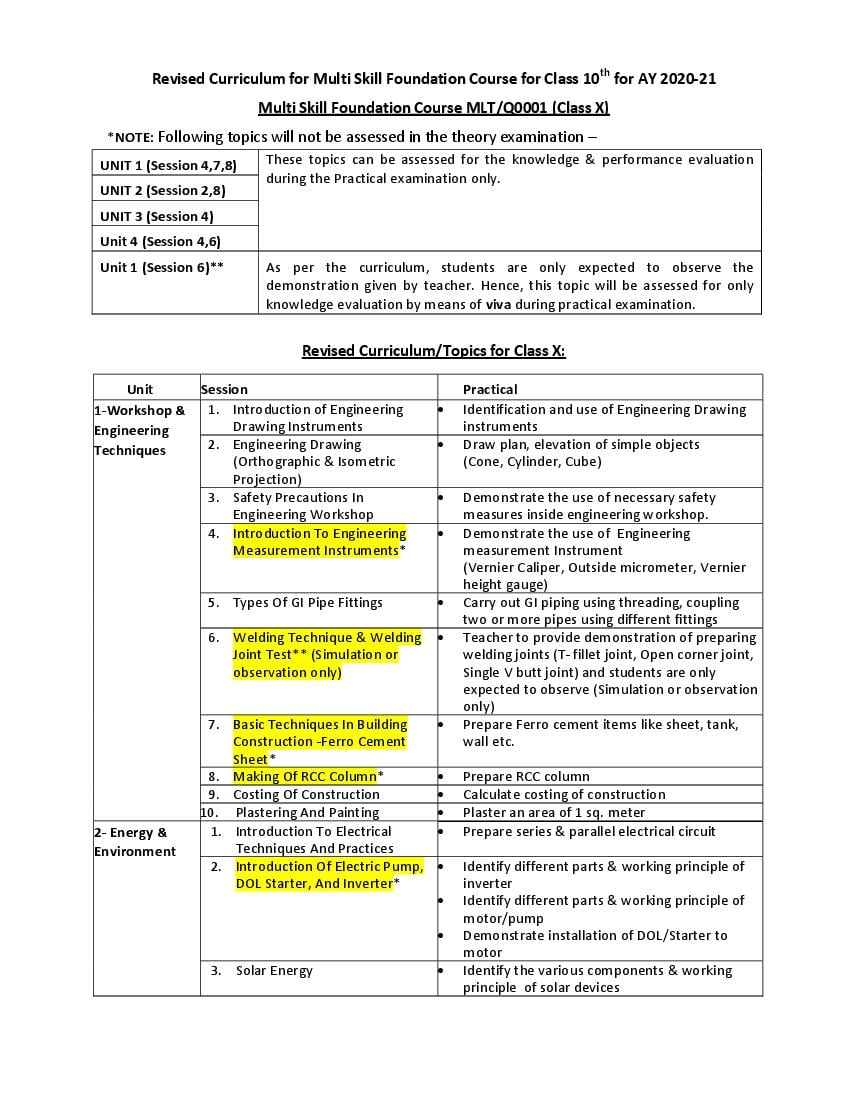
Multi Skill Foundation Course MLT/Q0001 (Class X)
*NOTE: Following topics will not be assessed in the theory examination –
UNIT 1 (Session 4,7,8) These topics can be assessed for the knowledge & performance evaluation
during the Practical examination only.
UNIT 2 (Session 2,8)
UNIT 3 (Session 4)
Unit 4 (Session 4,6)
Unit 1 (Session 6)** As per the curriculum, students are only expected to observe the
demonstration given by teacher. Hence, this topic will be assessed for only
knowledge evaluation by means of viva during practical examination.
Revised Curriculum/Topics for Class X:
Unit Session Practical
1-Workshop & 1. Introduction of Engineering Identification and use of Engineering Drawing
Engineering Drawing Instruments instruments
Techniques 2. Engineering Drawing Draw plan, elevation of simple objects
(Orthographic & Isometric (Cone, Cylinder, Cube)
Projection)
3. Safety Precautions In Demonstrate the use of necessary safety
Engineering Workshop measures inside engineering workshop.
4. Introduction To Engineering Demonstrate the use of Engineering
Measurement Instruments* measurement Instrument
(Vernier Caliper, Outside micrometer, Vernier
height gauge)
5. Types Of GI Pipe Fittings Carry out GI piping using threading, coupling
two or more pipes using different fittings
6. Welding Technique & Welding Teacher to provide demonstration of preparing
Joint Test** (Simulation or welding joints (T- fillet joint, Open corner joint,
observation only) Single V butt joint) and students are only
expected to observe (Simulation or observation
only)
7. Basic Techniques In Building Prepare Ferro cement items like sheet, tank,
Construction -Ferro Cement wall etc.
Sheet*
8. Making Of RCC Column* Prepare RCC column
9. Costing Of Construction Calculate costing of construction
10. Plastering And Painting Plaster an area of 1 sq. meter
2- Energy & 1. Introduction To Electrical Prepare series & parallel electrical circuit
Environment Techniques And Practices
2. Introduction Of Electric Pump, Identify different parts & working principle of
DOL Starter, And Inverter* inverter
Identify different parts & working principle of
motor/pump
Demonstrate installation of DOL/Starter to
motor
3. Solar Energy Identify the various components & working
principle of solar devices
Page 2
And Operation Of A Petrol Or principle of Petrol & Diesel Engine
Diesel Engine
5. Bio Gas Concept And Use Identify the various components of biogas plant
and prepare biogas from biomass
Making of charcoal using biomass
6. Water Conservation Concept Identify & study the different components of
rain water harvesting system
7. Rainfall Measurement Method Make a rain gauge using plastic bottle & funnel
8. Land Survey Method* Use plain table /dumpy level to mark contours
3-Gardening, 1. Nursery Technique Prepare seed bed
Nursery and Demonstrate different grafting methods
Agriculture 2. Irrigation & Water Conservation Demonstrate the knowledge and application of
Techniques Methods different irrigation & water conservation
methods (surface irrigation, Furrow , basin,
sprinkler & drip irrigation)
Demonstrate installation & maintenance of
drip/sprinkler irrigation system
3. Interpreting Result Of Soil Demonstrate the procedure for collecting soil
Testing sample & interpret the results of soil test
4. Artificial Insemination* Identify breeds used for artificial insemination
5. Prepare Fodder For Animals Prepare fodder for animals
4-Personal 1. Balanced Diet Identify different nutrition deficiency diseases
Health & 2. Personal Health & Hygiene And NA
Hygiene Community Health & Mental
Health
3. Communicable & Non- Prepare O.R.S solution
Communicable Diseases, Prepare Emergency FIRST AID kit & learn to use
Vaccination, Dehydration And FIRST AID kit
Emergency First Aid
4. Blood & Blood Group-Basic Teacher to provide demonstration of blood
Information And Blood Pressure group testing and students are expected to only
And Measuring Hemoglobin observe (Simulation or observation only)
(Simulation or observation Teacher to provide demonstration of Blood
only)* Hemoglobin testing and students are expected
to only observe (Simulation or observation only)
Determine blood pressure using blood pressure
machine
5. Community Health & Calculate medical health expenses of a family
Environment Care
(Awareness Programs For
People With Special Needs And
Family Health And Health
Planning)
6. Pollution-Sources, Effects And Perform water quality test using H2O strip
Solutions And Water Quality testing kit
Testing*
7. Food Products (Handling Of Identify Perishable & Non Perishable food
Food Products, Identify the hygienic practices adopted for
Perishable & Non-Perishable handling of food.
Food, Packed & Loose Food And Develop & administer a questionnaire on food
Fresh & Stale Food Product habits & hygienic practices
Page 3
iqLrd dk uke & lkfgfR;d nhfidk
1- “kkg gqlSu & [kkdw fop leko.kk] uky lTtu ns jfg,A
2- cqYys “kkg & b”d nh uohvksa uoha cgkjA
3- gtkjk flag xqjnkl iqjh & fla/k ekrk nh okjA
4- lqjthr ikrj & gusjk tjs xk fdosaA
5- o.ktkjk csnh & VqWVh Hk¡th ukSdjhA
6- rkjk flag v.ktk.k & lHku ds fljekSjA
iqLrd dk uke & lkfgfR;d ouxh;k¡
1- x”kr & txnh”k dkS”ky
2- dksš u fucfgvks lkFk & ika/kh uudk.koh
3- ckck xqjfnr flag dkekxkVk ek: & v”kksd “kekZ
Page 4
1. Final Accounts : with simple adjustments
2. Bank Reconciliation Statement : with discount and Bank colums
3. Bills of Exchange : retiring,dishonouring and renewing of bills of exchange
5- Depreciation : Diminishing balance methods
Page 5
1. Office Routine : Handling inward and outward mail, indexing methods, duplicating
methods.
2. Business Correspondence : Quotations, Reference, Advice and Complaints
3. Banks : Bank drafts, Post Office Saving Bank
4. Negotiable Instruments : Endorsement
5. Bills of Exchange : Negotiation, Endorsing, Dishonouring
Page 6
1. Grammar
a. Punctuation – only sentences from prose
b. General Correction of words and sentences
2. Composition
a) Leave Application
Section B
1. Prose (Detailed Study)
Lessons to be studied :
Vidya Sagar By Rabindra Nath Tagore
Palli Sahitya by Mohd. Shahidulla
2. Poetry
Poems to be studied:
(i) Chhatra Dhara by Kalidas Roy
(ii) Vibhishaner Prati Indrajit by Madhu Sudan Dutt
3. Short Stories
(First Four Short Stories only)
(i) Goho
(ii) Hambirer Rajyalabh
Page 7
Theory
UNIT 1: IT BASICS
Internet : Web address, Emailaddress, URL, HTTP.
Services available on Internet: Information Retrieval, Electronic Mails, Locating sites using search
enginesand finding people on the net.
UNIT 2: IT TOOLS
MS Access:
Data Validation: Field Size, Default Value Validation Rule, Validation Text, Required, Allow Zero
Length.
Page 8
Section – A
Applied Grammer
1- Fael ki Qismein : Lazim, Mutaddi, Naqis.
2- Figures of Speech : Husn-e-taleel, Miratunnazeer, Tazad.
Section – B
Prose
Book : Nawa-e-Urdu
Afsana : (i) Bheek – Hayatullah Ansari.
Mukhtasar Mazmoon : (i) Makhloot zaban – Maulvi Abdul Haq.
(ii) Ishtaharat ‘Zaroori nahi hai’ ke – Ibn-e
Insha.
Book : Gulzar-e-Urdu
Afsana : (i) Sakhi – Kalam-e-Haidari.
(ii) Man ka tauta – Ratan Singh
(iii) Doshala – Jeelani Bano.
Khaka : (i) Mirza Chapati – Ashraf Subuhi.
Poetry
Book : Nawa-e-Urdu
Ghazal : (i) Asghar Gondvi – Alaam-e-rozgar ko asan bana diya.
(ii) Yas Yagana Changezi – Adab ne dil ke taqaze uthaye hein kya
kya?
Nazm : (i) Akhtar Sheerani – O des se aane wale bata.
Rnbai : (i) Tilok Chand Mehroom – Fitrat ki di hui musarrat kho kar.
Mazhab ki zuban par hai nikoi ka
payam.
Page 9
1- bdkbZ&Qly pØ ,oa [ksrh ds izdkj%&
¼?k½ fn;kjk [ksrhA
¼M-½ fefJr [ksrhA
2- bdkbZ&QlyksRiknu %&
¼d½ vukt dh Qlysa & tkS dh [ksrhA
¼[k½ nyguh Qlysa & mM+n ,oa lks;kchu [ksrhA
¼x½ fryguh Qlysa & lwjteq[kh [ksrhA
¼?k½lCth dh Qlysa & QwyxksHkh ,oa cSaxu dh [ksrhA
¼p½ pkjs dh Qlysa & Tokj dh [ksrhA
3- bdkbZ&ckxokuh %&
¼[k½ ckx yxkus ds fy, Hkwfe dk pquko djrs le; /;ku nsus ;ksX; ckrsaA
¼?k½ ckx yxkus dh fof/k;k¡A
4- bdkbZ&QyksRiknu%&
¼d½ ve:n dh [ksrhA
5- bdkbZ&iq’iksRiknu %&
¼[k½ mÙkjk[k.M esa iq’iksRiknu & Mgsfy;k dh oSKkfud [ksrhA
6- bdkbZ&i”kqikyu ,oa nqX/kksRiknu %&
¼[k½ HksM+ ikyuA
¼x½ nqX/kksRiknu lEcU/kh lkekU; tkudkjhA
Page 10
Unit 1 : Principles of growth and development of Child : Physical, Social and Emotional
needs of children.
Unit 3 : Play : Characteristics of Play active-passive-natural-serious and exploratory.
Unit 4 : Nutrients : Loss of nutrients during cooking conversation and enhancement of
nutrients.
Unit 5 : Meal Planning : Food allowances suggested by ICMR
Unit 7 : Resources available to family : General Characteristics of wise use of resources
personal and shared
Unit 9 : Consumer Education : Lacs of standardized products, misleading advertisement, aids
to help consumers, standardization marks, labels, packages, advertisement, pamphlets &
Leaflets
Unit 10 : Care of Clothes : Stain removal (Precaution & Method)
Unit 11 : Quality Check of Apparrel : Reading of labels on Clothes
Page 11
UNIT I : NUMBER SYSTEMS
1. REAL NUMBERS
Euclid's division lemma.
UNIT II : ALGEBRA
1. POLYNOMIALS
Statement and simple problems on division algorithm for polynomials with real
coefficients.
2. PAIR OF LINEAR EQUATIONS IN TWO VARIABLES
Cross multiplication.
UNIT III : TRIGONOMETRY
1. INTRODUCTION TO TRIGONOMETRY
○ ○
Motivate the ratios, whichever are defined at 0 & 90
2. TRIGONOMETRIC IDENTITIES
Trigonometric ratios of complementary angles.
UNIT IV : COORDINATE GEOMETRY
1. LINES (In two-dimensions)
Area of a triangle.
UNIT V : GEOMETRY
1. TRIANGLES
(Prove) The ratio of the areas of two similar triangles is equal to the ratio of the
squares on their corresponding sides.
(Prove) In a triangle, if the square on one side is equal to sum of the squares on
the other two sides, the angles opposite to the first side is a right traingle.
3. CONSTRUCTIONS
Construction of a triangle similar to a given triangle.
UNIT VI : MENSURATION
1. AREAS RELATED TO CIRCLES
1200
2. SURFACE AREAS AND VOLUMES
(i) Frustum of a cone.
UNIT VII : STATISTICS AND PROBABILITY
1. STATISTICS
Cumulative frequency graph.
Page 12
Theme : Materials
Unit 1 : Chemical Substances - Nature and Behaviour
Metals and non metals : Basic Metallurgical processes, corrosion and its prevention.
Carbon Compounds : Nomenclature of carbon compounds, Functional groups, difference
between saturated hydrocarbons and unsaturated hydrocarbons, Ethanol and Ethanoic acid (only
properties and uses), soaps and detergents.
Theme : The world of the living
Unit 2 : World of Living
Control and Co-ordination in animals and plants : Tropic movements in plants; Introduction
to plant hormones; control and co-ordination in animals : voluntary, involuntary and reflex
action, nervous system; chemical co-ordination : animal hormones.
Heridity and evolution : Basic concepts of evolution.
Theme : How things work.
Unit 3 : Effects of Current
Magnets : Direct current. Alternating current; frequency of AC. Advantage of AC over DC.
Domestic electric circuits.
Theme : Natural Phenomena
Unit 4 :
Functioning of a lens in human eye, problems of vision and remedies, applications of spherical
mirrors and lenses.
Theme : Natural Resources
Unit 5 :
Sources of energy : Different forms of energy, conventional and non-conventional sources of
energy:fossil fuels, solar energy; biogas; wind, water and tidal energy; nuclear. Renewable
versus non-renewable sources.
Page 13
Unit 2 : India – Resources and their Development
Chapter Number & Chapter Name Deleted Portion
3. Forest and Wild life resources :types and
distribution, depletion of flora and fauna; Complete Chapter Deleted
conservation and protection of forest and wild life.
5. Water resources : sources, distribution, utilization,
multi-purpose projects, water scarcity, need for Complete Chapter Deleted
conservation and management, rainwater harvesting
(one case study to be introduced)
6. Mineral Resources :types of minerals, distribution,
use and economic importance of minerals, Complete Chapter Deleted
conservation.
Unit 3 :Democratic Politics II
Chapter Number & Chapter Name Deleted Portion
4. Outcomes of democracy :Can or should democracy
be judged by its outcomes? What outcomes can one Complete Chapter Deleted
reasonably expect of democracies? Does democracy in
India meet these expectations? Had democracy led to
development, security and dignity of the people?
What sustains democracy in India?
5. Challenges of democracy :Is the idea of democracy
shrinking? What are the major challenges to Complete Chapter Deleted
democracy in India? How can democracy be reformed
and deepened? What role can an ordinary citizen play
in deepening democracy?
Page 14
Unit 2 : India – Resources and their Development
Chapter Number & Chapter Name Deleted Portion
3. Forest and Wild life resources :types and
distribution, depletion of flora and fauna; Complete Chapter Deleted
conservation and protection of forest and wild life.
5. Water resources : sources, distribution, utilization,
multi-purpose projects, water scarcity, need for Complete Chapter Deleted
conservation and management, rainwater harvesting
(one case study to be introduced)
6. Mineral Resources :types of minerals, distribution,
use and economic importance of minerals, Complete Chapter Deleted
conservation.
Unit 3 :Democratic Politics II
Chapter Number & Chapter Name Deleted Portion
4. Outcomes of democracy :Can or should democracy
be judged by its outcomes? What outcomes can one Complete Chapter Deleted
reasonably expect of democracies? Does democracy in
India meet these expectations? Had democracy led to
development, security and dignity of the people?
What sustains democracy in India?
5. Challenges of democracy :Is the idea of democracy
shrinking? What are the major challenges to Complete Chapter Deleted
democracy in India? How can democracy be reformed
and deepened? What role can an ordinary citizen play
in deepening democracy?
Page 15
l= 2020&21 gsrq ikB~;Øe ls fuEufyf[kr v/;k; gVk fn, x, gS %&
d{kk&10 ikB~;iqLrd&”kseq’kh v/;k;&¼1½ fofp=% lk{kh
¼2½ lwDr;%
¼3½ HkwdEifoHkhf’kdk
¼4½ izk.ksH;ks∙fi fiz;% lqân~
Page 16
Literature
FIRST FLIGHT
1. How to Tell Wild Animals
2. Trees
3. Fog
4. Mijbil the Otter
5. For Anne Gregory
FOOTPRINTS WITHOUT FEET
1. The Midnight Visitor
2. A Question of Trust
3. The Book That Saved The Earth
Page 17
l= 2020&21 gsrq ikB~;Øe ls fuEufyf[kr ikB gVk fn, x, gS %&
dkO; [k.M nso
t;”kadj izlkn & vkRedF;
ukxktqZu & ;g nUrqfjr eqldku] Qly
f{kfrt Hkkx& 2 fxfjtk dqekj ekFkqj & Nk;k er Nwuk
x| [k.M
eaxys”k Mcjky & laxrdkj
eUuw HkaMkjh & ,d dgkuh ;g Hkh
egkohj izlkn f}osnh & L=h f”k{kk ds fojks/kh dqrdksZa dk
[kaMu
;rhUnz feJ & ukScr [kkus esa bcknr
Hknar vkuan dkSlY;k;u & laLd`fr
d`frdk Hkkx& 2 ,ghBS;k¡>qyuhgsjkuhgksjkekA
eSa D;ksa fy[krk gw¡+\
laLd`r fouksfnuh lwfDrekSfDrdkfu
vU;ksfDrfoykl%
Lokeh foosdkuUn%
Document Details
| Board / Org | Uttarakhand Board |
| Exam | Class 10 |
| Type | Syllabus |
| Pages | 17 |
| Updated | 22 Jul 2026 |