Uttrakhand Board Class 10 Syllabus 2020-21
Finished viewing? Save it for later —
Download Uttrakhand Board Class 10 Syllabus 2020-21 (PDF · 39 pages)About Uttrakhand Board Class 10 Syllabus 2020-21
Uttrakhand Board Class 10 Syllabus 2020-21 is available here for free download. Published by Uttarakhand Board for Class 10, this syllabus can be viewed online or downloaded as a PDF (39 pages). Candidates preparing for Class 10 can use Uttrakhand Board Class 10 Syllabus 2020-21 to understand the exam pattern, the type of questions asked, and the overall difficulty level.
Frequently Asked Questions
How can I download Uttrakhand Board Class 10 Syllabus 2020-21?
Open this page and click the Download button to save Uttrakhand Board Class 10 Syllabus 2020-21 as a PDF. It is completely free on AglaSem Docs.
Is Uttrakhand Board Class 10 Syllabus 2020-21 free to download?
Yes. Uttrakhand Board Class 10 Syllabus 2020-21 can be viewed online and downloaded as a PDF free of cost on AglaSem Docs.
How many pages does Uttrakhand Board Class 10 Syllabus 2020-21 have?
Uttrakhand Board Class 10 Syllabus 2020-21 contains 39 pages, which you can read online or download together as a single PDF.
Where can I find more Class 10 study material?
You can find more Class 10 question papers, sample papers, syllabus, and answer keys on AglaSem Docs.
Uttrakhand Board Class 10 Syllabus 2020-21 – Text
Read the full text of this syllabus below — useful to quickly search, copy and reference the content online without downloading the PDF.
📄 View text version (39 pages)
Page 1
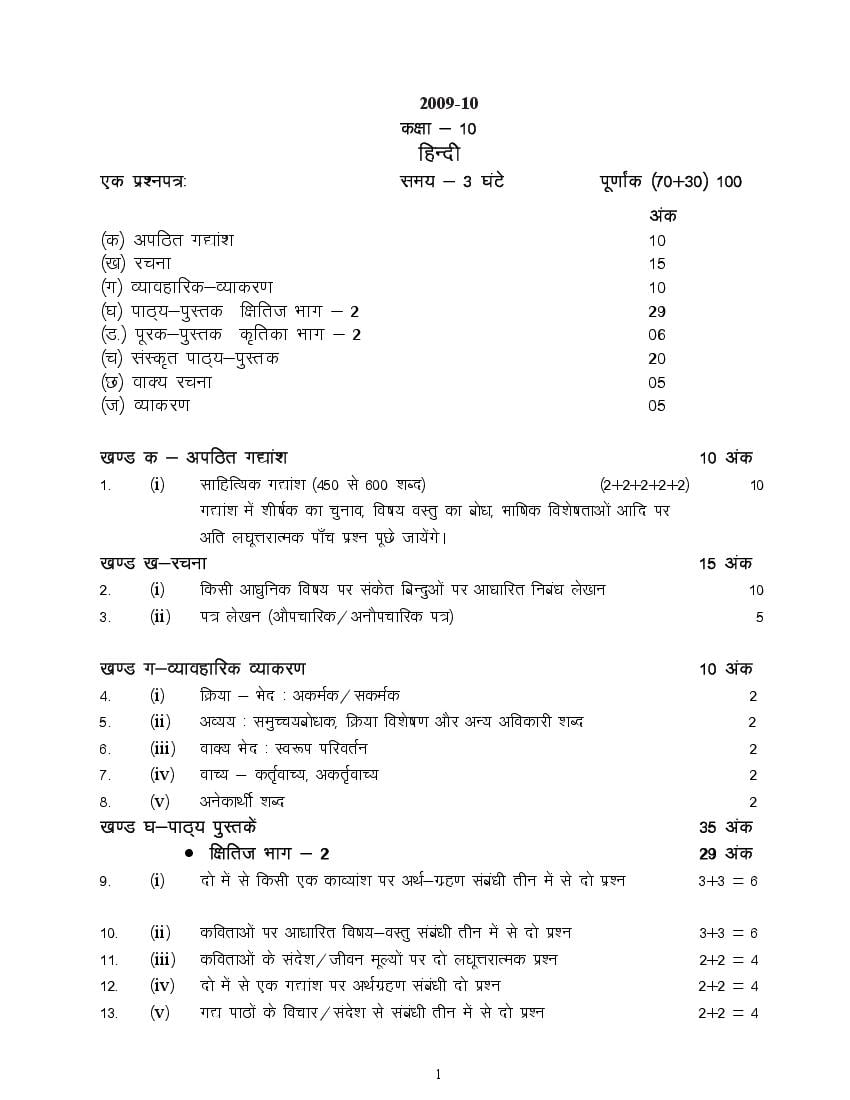
d{kk & 10
fgUnh
,d iz”ui=% le; & 3 ?kaVs iw.kkZad ¼70$30½ 100
vad
¼d½ vifBr x|ka”k 10
¼[k½ jpuk 15
¼x½ O;kogkfjd&O;kdj.k 10
¼?k½ ikB~;&iqLrd f{kfrt Hkkx & 2 29
¼M-½ iwjd&iqLrd d`frdk Hkkx & 2 06
¼p½ laLd`r ikB~;&iqLrd 20
¼N½ okD; jpuk 05
¼t½ O;kdj.k 05
[k.M d & vifBr x|ka”k 10 vad
1- ¼i½ lkfgfR;d x|ka”k ¼450 ls 600 “kCn½ ¼2$2$2$2$2½ 10
x|ka”k esa “kh’kZd dk pquko] fo’k; oLrq dk cks/k] Hkkf’kd fo”ks’krkvksa vkfn ij
vfr y?kwÙkjkRed ik¡p iz”u iwNs tk;saxsA
[k.M [k&jpuk 15 vad
2- ¼i½ fdlh vk/kqfud fo’k; ij ladsr fcUnqvksa ij vk/kkfjr fuca/k ys[ku 10
3- ¼ii½ i= ys[ku ¼vkSipkfjd@vukSipkfjd i=½ 5
[k.M x&O;kogkfjd O;kdj.k 10 vad
4- ¼i½ fØ;k & Hksn % vdeZd@ldeZd 2
5- ¼ii½ vO;; % leqPp;cks/kd] fØ;k fo”ks’k.k vkSj vU; vfodkjh “kCn 2
6- ¼iii½ okD; Hksn % Lo:i ifjorZu 2
7- ¼iv½ okP; & drZ̀okP;] vdrZ̀okP; 2
8- ¼v½ vusdkFkhZ “kCn 2
[k.M ?k&ikB~; iqLrdsa 35 vad
f{kfrt Hkkx & 2 29 vad
9- ¼i½ nks esa ls fdlh ,d dkO;ka”k ij vFkZ&xzg.k laca/kh rhu esa ls nks iz”u 3$3 ¾ 6
10- ¼ii½ dforkvksa ij vk/kkfjr fo’k;&oLrq laca/kh rhu esa ls nks iz”u 3$3 ¾ 6
11- ¼iii½ dforkvksa ds lans”k@thou ewY;ksa ij nks y?kwÙkjkRed iz”u 2$2 ¾ 4
12- ¼iv½ nks esa ls ,d x|ka”k ij vFkZxzg.k laca/kh nks iz”u 2$2 ¾ 4
13- ¼v½ x| ikBksa ds fopkj@lans”k ls laca/kh rhu esa ls nks iz”u 2$2 ¾ 4
1
Page 2
d`frdk Hkkx & 2 06 vad
15- ¼i½ ikBksa ij vk/kkfjr pkj esa ls rhu y?kwÙkjkRed iz”u 2$2$2 ¾ 6
[k.M p&ikB~; iqLrd laLd`r ¼fouksfnuh Hkkx & 2½ 20 vad
¼i½ x| vuqPNsn ij vk/kkfjr pkj esa ls rhu iz”uksa ds mÙkj 2$2$2 ¾ 6
¼ii½ i| vuqPNsn ij vk/kkfjr rhu esa ls nks iz”uksa ds mÙkj 2$2 ¾ 4
¼iii½ ikB~;&iqLrd ij vk/kkfjr pkj esa ls rhu iz”uksa ds mÙkj 2$2$2 ¾ 6
¼iv½ fn, x;s “kCnksa dh lgk;rk ls okD; iwjk djuk 1$1$1$1 ¾ 4
¼N% iz”uksa esa ls pkj okD; cukuk½
[k.M N&laLd`r O;kdj.k vkSj vuqokn 10 vad
¼i½ laf/k] Loj laf/k ¼;.k] v;kfn] iwoZ:i] ij:i½ lekl] dkjd] milxZ
¼ik¡p iz”uksa esa ls rhu iz”uksa ds mÙkj½ 2$2$2 ¾ 6
¼ii½ fn, x;s N% Lora= inksa esa ls pkj dh laLd`r okD;ksa esa jpuk 1$1$1$1 ¾ 4
vFkok
fn, x;s rhu okD;ksa esa ls nks dk laLd`r esa vuqokn djuk 2$2 ¾ 4
fu/kkZfjr iqLrdsa %
1- f{kfrt&Hkkx & 2
2- iwjd iqLrd & Hkkx & 2
3- laLd`r ikB~;iqLrd & fouksfnuh Hkkx & 2
fuEufyf[kr ikBksa dk ewY;kadu ugha fd;k tk;sxk %&
1& f{kfrt&Hkkx 2& 1- Þnsoß
2- ÞukScr [kkus esa bcknrß
3- Þy[kuoh vUnktß
2& d`frdk Hkkx 2& 1- Þ,gh BS;k¡ >qyuh gsjkuh gks jkek!ß
2
Page 3
ikB~;Øe ls 30 izfr”kr dh dVkSrh fuEuor~ dh tkrh gS%&
Class – X
DELETED SYLLABUS
(For the Session of 2020-21 Only)
HINDI
(THEORY)
nso
dkO; [k.M
t;”kadj izlkn & vkRedF;
ukxktqZu & ;g nUrqfjr eqldku] Qly
fxfjtk dqekj ekFkqj & Nk;k er Nwuk
eaxys”k Mcjky & laxrdkj
f{kfrt Hkkx& 2
x| [k.M eUuw HkaMkjh & ,d dgkuh ;g Hkh
egkohj izlkn f}osnh & L=h f”k{kk ds fojks/kh dqrdksZa dk
[kaMu
;rhUnz feJ & ukScr [kkus esa bcknr
Hknar vkuan dkSlY;k;u & laLd`fr
d`frdk Hkkx& 2 ,ghBS;k¡>qyuhgsjkuhgksjkekA
eSa D;ksa fy[krk gw¡+\
laLd`r fouksfnuh lwfDrekSfDrdkfu
vU;ksfDrfoykl%
Lokeh foosdkuUn%
3
Page 4
Class X
ENGLISH - LANGUAGE AND LITERATURE
Time : 3 Hours
One Paper Marks : 100
SECTION A : READING 20 Marks
1 & 2 two unseen passages of total 500 words with a variety of questions including 4 marks
forvocabulary. Only prose passages will be used. One will be factual and the other will be literary.
Passage 1 - 200 words (8 marks) - Four or five comprehension questions
Passage 2 - 300 words (12 marks)-Four or five comprehension questions and two questions on
vocabulary.
Marks for vocabulary will not exceed 4 marks.
SECTION B : WRITING 20 Marks
3. Letter Writing - One letter based on provided verbal stimulus and context. 8 Marks
Type of letter : Informal: Personal such as to family and friends. Formal : Letter of
complaints, enquiries,requests, applications
4. Writing a short paragraph on a given outline / topic in about 60 words 4 Marks
5. Composition : A short writing task based on a verbal and / or visual stimulus. (diagram,
picture, graph, map, chart, table, flow chart etc.) Maximum words 80 8 Marks
SECTION C : READING 15 Marks
Question No. 6-11
A variety of short questions involving the use of particular structures within a context. Test
types used will include cloze, gap-filling, sentence-completion, sentence-reordering, dialogue-
completion and sentence-transformation (including combining sentences). The Grammar syllabus
will include the following areas for teaching:
1. Use of non-finites.
2. Sentence connectors : as, since, while, then, just because, just, until.
3. Clauses with what, where and how.
4. Past Tense.
5. Modals : can, could, may, must, might.
Note : All other areas covered in Class IX will also be tested in Class X as this is an integrated
coursefor this area of learning.
SECTION D : TEXT BOOKS 45 Marks
First Flight - Textbook for Class X
Prose 20 Marks
12 & 13 Two extracts from different prose lessons included in Textbook (Approximately 100
words each) 5x2 = 10 Marks
These extracts chosen from different lessons will be literary and discursive in nature
Each extract will be of 5 marks. One mark in each extract will be for vocabulary. Four
4
Page 5
question on interpretation.
14. One out of two questions extrapolative in nature based on any one of the prose lessons
from Textbook to be answered in about 80 words. 6 Marks
15. One out of two questions on Drama Text (local and global comprehension question)
(30-40 words) 4 Marks
Poetry 10 Marks
16. One extract from a poem from the prescribed reader followed by two or three questions
to test the local and global comprehension of the set text. The extract will carry four
marks. 4 Marks
17. Two out of three short answer type questions on interpretation of themes and ideas
contained in the poems to be answered in 30-40 words each. 6 Marks
Foot Prints without Feet - Supplementary Reader for Class X 15 Marks
18. One out of two questions from Supplementary Reader to interpret, evaluate and analyse
character, plot or situations occurring in the lessons to be answered in about 100 words.
8 Marks
19. One out of two short answer type questions of interpretative and evaluative nature
based on lessons to be answered in 30-40 words 4 Marks
20. One out of two short answer type questions based on factual aspects of the lessons to be
answered in20-30 words. 3 Marks
Prescribed Books
1. First Flight
2. Foot Prints without Feet
5
Page 6
ikB~;Øe ls 30 izfr”kr dh dVkSrh fuEuor~ dh tkrh gS%&
Class – X
DELETED SYLLABUS
(For the Session of 2020-21 Only)
ENGLISH
(THEORY)
Grammer
FIRST FLIGHT – Text for Class X
Literature
FIRST FLIGHT
1. How to Tell Wild Animals
2. Trees
3. Fog
4. Mijbil the Otter
6
Page 7
FOOTPRINTS WITHOUT FEET
1. The Midnight Visitor
2. A Question of Trust
3. The Book That Saved The Earth
7
Page 8
n”keh d{kk
laLd`r
,da iz”ui=e~ vof/k & ?k.Vk=;e~ iw.kkZadk% & 100
vadk%
d [k.M% ¼vifBr&vocks/kue~½ 15 vadk%
[k [k.M% ¼jpukReda dk;Ze~½ 20 vadk%
x [k.M% ¼vuqiz;qDr&O;kdj.ke~½ 30 vadk%
?k [k.M% ¼ifBr&vocks/kue~½ 35 vadk%
Þdß [k.M% ¼vifBr& vocks/kue~½ 15 vadk%
¼ljyx|ka”ke~ vk/kkfjra dk;eZ~&x|ka”k};e~½
1- 40&50 “kCnifjfer% x|ka”k% ¼,d% ljyx|ka”k%½ 5 vadk%
,dinsu iw.kZokD;su p iz”uksÙkjkf.k ¼3½
Hkkf’kddk;Ze~ ¼2½
2- 80&100 “kCnifjfer% x|ka”k% ¼,d% ljyx|ka”k%½ 10 vadk%
¼ljydFkk&?kVuko.kZue~ ok½
,dinsu iw.kZokD;su p iz”uksÙkjkf.k ¼6½
leqfpr “kh’kZdiznkue~ ¼2½
Hkkf’kddk;Ze~ ¼2½
¼i½ okD;sdÙk`sfØ;kinp;ue~
¼ii½ drZ`fØ;k & vfUofr%
¼iii½ fo”ks’k.kfo”ks’; & vfUofr%
¼iv½ laKkLFkkus loZukeiz;ksx% vFkok loZukeLFkkus laKkiz;ksx%
¼v½ i;kZ;a foyksea ok ina nÙok vuqPNsns nÙka in~p;ue~
Þ[kß [k.M% ¼jpukRedadk;Ze~½ 20 vadk%
¼vH;kliqLrde~ vk/kkfjre~½
3- ladsrk/kkfjre~ vukSipkfjdi=e~ 5 vadk%
4- ladsrk/kkfjre~ laoknys[kue~ 5 vadk%
5- fp=k/kkfjre~ o.kuZe~ vFkok ladsrk/kkfjre~ vuqPNsn&ys[kue~ 10 vadk%
8
Page 9
¼vH;kliqLrde~ vk/kkfjre~½
6- lfU/kdk;Ze~ 3 vadk%
LojlfU/k% & nh?kZ] xq.k] o`f)] ;.k~] v;kfn] iwoZ:ie~A ¼1½
O;atulfU/k% & ijlo.kZa] NRoa] rqd~&vkxe%] eks·uqLokj%] oxhZ;izFkek{kjk.kka] r`rh;o.kZifjorZue~]
izFkeo.kZL; iapeo.ksZ ifjorZue~A ¼1½
folxZlfU/k% & folxZL; mRoa] jRoa] yksi% folxZLFkkus l~] “k~] ‘k~A ¼1½
7- lekl% ¼okD;s’kq leLrinkuka foxzg% foxzginkuka p lekl%½ 4 vadk%
rRiq:’k% ¼foHkfDr% u¥~] miin%½ ¼1½
deZ/kkj;% ¼fo”ks’k.k&fo”ks’;e~] mieku&mies;e~½
f}xq%
}U}% ¼1½
cgqozhfg% lekukf/kdj.ke~ ¼1½
vO;;hHkko% ¼vuq] mi] lg] fuj~] izfr] ;Fkk½ ¼1½
8- izR;;k% 5 vadk%
v/kksfyf[kr & izR;;;ksxS% okD;la;kstue~] fjDrLFkkukiwfrZ%&
d`nUrk% & rO;r~] vuh;j] “kr`] “kkupA ¼2½
rf)rk% & erqi~] bu~] Bd~] Ro] ry~A ¼2½
L=hizR;;kS & Vki~] MhiA ¼1½
9- vO;;inkfu ¼dFkk;ke~ vuqPNsns laokns ok vO;;kuka iz;ksx½ 5 vadk%
vfi] bfr] bo] mPpS%] ,o] dnk] dqr%] uwue~] iqjk] ek] brLrr%] ;r~] v=&r=] ;=&dq=] bnkuhe~] lEizfr]
;nk&dnk] ;Fkk&rFkk] ;kor~&rkor~] fouk] lglk] “o%] g~;%] v/kquk] cfg%] o`Fkk] dnkfi] “kuS%] fdeFkZe~A
10- okP;ifjorZue~ ¼dsoya yVy~dkjs½ 3 vadk%
11- ?kfVdkfp=lkgk¸;su vM~dkuka LFkkus “kCns’kq le;&ys[kue~ 4 vadk%
lkekU;&likn&lk/kZ&iknksu
12- l³~[;k ,dr% iapi;ZUra okD;iz;ksx%A ,dr% “kri;ZUra la[;kKkue~ 2 vadk%
13- opu&fy³x&iq:’k&ydkj&n`’V~;k la”kks/kue~ 4 vadk%
9
Page 10
14- ifBr&lkexzhe~ vk/k`R; vocks/kudk;Ze~ 15 vadk%
¼v½ ,d% x|ka”k% ¼1$2$2½ ¼5 vadk%½
¼c½ ,d% i|ka”k% ¼1$2$2½ ¼5 vadk%½
¼l½ ,d% ukV~;ka”k% ¼1$2$2½ ¼5 vadk%½
izfr&va”ke~ vk/kkfjre~ vocks/kudk;Ze~
,dinsu iw.kZokD;su p iz”uksÙkjkf.k] fjDrLFkkuiwfrZ% ¼1$2½ ¼3 vadk%½
Hkkf’kddk;Ze~ ¼2 vadk%½
¼i½ okD;s dr`ZfØ;kinp;ue~
¼ii½ dr`ZfØ;k&vfUofr%
¼iii½ fo”ks’k.kfo”ks’;&vfUofr%
¼iv½ laKkLFkkus loZukeiz;ksx% vFkok loZukeLFkkus laKkiz;ksx%
¼v½ i;kZ;a foyksea ok ina nRok vuqPNsns nÙka inp;ue~
¼v½ fo”ks’k.k & fo”ks’;p;ue~] drZ`fØ;kp;ue~
15- Hkkokocks/kue~ ¼va”k};e½ 3$3 vadk%
¼fjDrLFkkuiwfrZ}kjk] fodYip;usu] “kq)&v”kq)ek/;esu] leHkkolwfDrek/;esu ok½
16- vUo;s fjDrLFkkuiwfrZ% 𝟏𝟏𝟐 $𝟏𝟏𝟐 ¾ 3 vadk%
17- iz”ufuekZ.ke~ ¼pRokj%½ 4 vadk%
18- Øejfgr&v’VokD;kuka dFkkØela;kstue~ dFkkiwfrZ% ok 4 vadk%
19- lUnHkZ&”kCnkuka iz;ksx% “kCnkFkZ & esyue~ ok 3 vadk%
10
Page 11
ikB~;Øe ls 30 izfr”kr dh dVkSrh fuEuor~ dh tkrh gS%&
Class – X
DELETED SYLLABUS
(For the Session of 2020-21 Only)
Sanskrit
(THEORY)
d{kk&10 ikB~;iqLrd&”kseq’kh v/;k;&¼1½ fofp=% lk{kh
¼2½ lwDr;%
¼3½ HkwdEifoHkhf’kdk
¼4½ izk.ksH;ks·fi fiz;% lqân~
11
Page 12
REVISED SYLLABUS
(For the Session of 2020-21 Only)
SOCIAL SCIENCE
(THEORY)
Unit 1 : India and the Contemporary world - II
Themes Objectives
Students are required to choose any two themes The theme will discuss the forms in which
each from the first two sub units and one from the nationalism developed along with the
third sub-unit. In sub-unit 1.1, theme 3 is formation of nation states in Europe in the
compulsory. For second theme in that subunit, post-1830 period.
students are required to choose any one from the
first two themes. Discuss the relationship/difference etween
Thus all students are required to study five European nationalism and anti-colonial
themes in all. nationalisms.
Sub-unit 1.1 : Events and processes :
1. Nationalism in Europe : Point to the way the idea of the nation
(a) The growth of nationalism in Europe after states became generalized in Europe and
the 1830s. (b) The ideas of Giuseppe elsewhere.
Mazzini etc. (c) General characteristics of
the movements in Poland, Hungary, Italy,
Germany and Greece.
2. Nationalism in India : Civil Disobedience Discuss the characteristics of Indian
nationalism through a case study of Civil
Movement (a) First world war, Khilafat Disobedience Movement.
and Non-Cooperation. (b) Salt Satyagraha.
(c) Movements of peasants, workers, Analyze the nature of the diverse social
tribals. movements of the time.
(d) Activities of different political groups.
Familiarize students with the writings and
Sub-unit 1.2 : Economies and livelihoods : ideals of different political groups and
3. Industrialization 1850s - 1950s : (a) individuals, notably Mahatama Gandhi.
Contrast between the form of discuss two different patterns of
industrialization in Britain and India. (b) industrialization, one in the imperial country
Relationship between handicrafts and and another within a colony.
industrial production, formal and informal Show the relationship between different
sectors. (c) Livelihood of workers. Case sectors of production.
studies : Britain and India.
12
Page 13
and integration of the world market in the and point to the shifts within the process.
nineteenth and early twentieth century. (b) Analyze the implication of globalization
Trade and economy between the two Wars. for local economies.
(c) Shifts after the 1950s. (d) Implications of Discuss how globalization is experienced
globalization for livelihood patterns. differently by different social groups.
Case study : The post War International Discuss the link between print culture and
Economic order, 1945 to 1960s. the circulation of ideas.
Familiarize students with pictures,
Sub-unit 1.3 : Culture, Identity and Society
cartoons, extracts from propaganda
5. Print culture and nationalism. (a) The literature and newspaper debates on
history of print in Europe. (b) The growth important events and issues in the past.
of press in nineteenth century India. (c) Show that forms of writing have a specific
Relationship between print culture, public history, and that they reflect historical
debate and politics. changes within society and shape the
forces of change.
Sub-unit 1.4 : Map Work (2 Marks)
13
Page 14
Themes Objectives
1. Resources : Types - natural and human; Need Understand the value of resources and the need
for resource planning. for their judicious utilisation and conservation;
2. Natural Resources : land as a resource, Identify various types of farming and discuss the
soil types and distribution; changing land-use various farming methods; To describe the spatial
pattern; land degradation and conservation distribution of major crops as well as understand
measures. the relationship between rainfall regimes and
cropping pattern;
Explainvarious government policies for
institutional as well as technological reforms
since independence;
4. Agriculture : types of farming, major crops,
cropping pattern, technological and institutional
reforms; their impact; contribution of Agriculture Understand the importance of agriculture in
to national economy - employment and output. national economy;
Discuss various types of conventional and
nonconventional resources and their utilization
Discuss the importance of industries in the
7. Power Resources : types of power resources :
national economy as well as understand the
conventional and non-conventional, distribution regional disparities which resulted due to
and utilization, and conservation. concentration of industries in some areas;
8. Manufacturing Industries : Types, spatial Discuss the need for a planned industrial
distribution, contribution of industries to the development and debate over the role of
national economy, industrial pollution and government towards sustainable development;
degradation of environment, measures to control To explain the importance of transport and
degradation. (One case study to be introduced) communication in the ever shrinking world;
To understand the role of trade in the economic
9. Transport, communication and trade
development of a country,
10. Map Work (4 marks)
Project / Activity
Learners may collect photographs of typical rural houses, and clothing of people from
different regions of India and examine whether they reflect any relationship with climatic
conditions and relief of the area.
Learners may write a brief report on various irrigation practices in the village and the
change in cropping pattern in the last decade.
Posters
Pollution of water in the locality.
Depletion of forests and the greenhouse effect.
14
Page 15
Unit 3 : Democratic Politics II
Themes Objectives
Analyse the relationship between social
1. Power sharing mechanisms in democracy cleavages and political competition with
Why and how is power shared in democracies? reference to Indian situation.
How has federal division of power in India Understand and analyse the challenges
helped national unity? To what extent has posed by communalism to Indian
decentralisation achieved this objective? How democracy.
does democracy accommodate different social Understand the enabling and disabling
groups? effects of caste and ethnicity in politics.
Develop a gender perspective on politics.
2. Working of Democracy
Are divisions inherent to the working of Introduce students to the centrality of
democracy? What has been the effect of caste power sharing in a democracy.
on politics and of politics on caste? How has Understand the working of spatial and
the gender division shaped politics? How do social power sharing mechanisms.
communal divisions affect democracy? Analyse federal provisions and
institutions.
3. Competition and contestations in Understand the new Panchayati Raj
democracy institutions in rural and urban areas.
How do struggles shape democracy in favour Understand the vital role of struggle in the
of ordinary people? What role do political expansion of democracy.
parties play in competition and contestation? Analyse party systems in democracies.
Which are the major national and regional Introduction to major political parties in
Parties in India? Why have social movements the country.
come to occupy large role in politics? Analyse the role of social movements and
nonparty political formations
15
Page 16
Themes Learning Objectives
1. The Story of Development : The traditional Familiarisation of some macroeconomic
notion of development; National Income and Per- concepts.
capita Income. Growth of NI – critical appraisal
of existing development indicators (PCI, IMR, SR Sensitizing the child about the rationale
and other income and health indicators) The need for overall human development in our
for health and educational development; Human country, which include the rise of income,
Development Indicators (in simple and brief as a improvements in health and education
holistic measure of development.The approach to rather than income.
this theme : Use case study of three states
(Kerala, Punjab and Bihar) or take a few countries It is necessary to raise question in minds
(India, China, Sri Lanka and one developed of the children whether the increase in
country)
2. The Role of Service Sector in Indian income alone is sufficient for a nation.
Economy : What is service sector (through
examples)
: Importance of Service Sector in generating How and why people should be healthy
employment and income to the nation (with the and provided with education.
help of a few case studies); Growth of Service
Sector in India; India as a major service provider Familiarize the concept of money as an
to the world; The need for public investment ; economic concept;
The role of important infrastructure, education
and health Create awareness of the role of financial
3. Money and Financial System : Role of institutions from the point of view of day-
money in an economy : Historical origin; Formal to-day life.
and Informal financial institutions for Savings
and Credit - General Introduction; Select one To make aware of a major employment
formal institution such as a nationalized generating sector.
commercial bank and a few
informal institutions; Local money lenders, Sensitise the learner of how and why
landlords, self help groups, chit funds and private governments invest in such an important
finance companies. sector.
4. Globalisation : What is Globalisation
(through some simple examples); How India is Provide children with some idea about
being globalised and why ; Development Strategy how a particular economic phenomenon is
prior to 1991. State Control of Industries : Textile influencing their surroundings and day-to-
goods as an example for elaboration; Economic day life.
Reforms 1991; Strategies adoped in Reform
measures (easing of capital flows; migration, Making the child aware of his or her rights
investment flows); Different perspectives on and duties as a consumer;
globalisation and its impact on different sectors;
Political Impact of globalisation. Familiarizing the legal measures available
5. Consumer Awareness : How consumer is to protect from being exploited in markets.
exploited (one or two simple case studies) factors
causing exploitation of consumers; Rise of
consumer awareness; how a consumer should be
in a market; role of government in
consumer protection
16
Page 17
Theme 2 :
Visit to banks and money lenders / pawnbrokers and discuss various activities that you have observed
in banks in the classroom;
Participate in the meetings of self help groups, which engaged in micro credit schemes in the locality
of learners and observe issues discussed.
Theme 4 :
Provide many examples of service sector activities. Use numerical examples, charts and photographs.
Theme 5 : Collect logos of standards available for various goods and services. Visit a consumer court
nearby and discuss in the class the proceedings; Collect stories of consumer exploitation and
grievances from news papers and consumer courts.
Unit 5 : Disaster Management
Tsunami
Safer Construction
Practices.
Survival Skills.
Alternate Communication systems during disasters.
Sharing Responsibility
17
Page 18
REVISED SYLLABUS
(For the Session of 2020-21 Only)
SCIENCE
(THEORY)
Theme : Materials
Unit 1 : Chemical Substances - Nature and Behaviour
Acids, bases and salts : General properties, examples and uses, concept of pH scale, importance of
pH in everyday life; preparation and uses of sodium hydroxide, Bleaching powder, Baking soda,
washing soda and Plaster of Paris.
Chemical reactions : Chemical Equation, Types of chemical reactions : combination,
decomposition,displacement, double displacement, precipitation, neutralization, oxidation and
reduction in terms of gain and loss of oxygen and hydrogen.
Metals and non metals : General properties of Metals and Non-metals, reactivity series,
Formationand properties of ionic compounds,
Carbon Compounds : Covalent bonding in carbon compounds. Versatile nature of carbon,
Periodic classification of elements : Modern Periodic table, Gradation in Properties.
Theme : The world of the living
Unit 2 : World of Living
Life Processes : "living" things; Basic concept of nutrition, respiration, transport and excretion
inplants and animals.
Reproduction : Reproduction in animal and plants (asexual and sexual). Need for and methods
offamily planning. Safe sex vs HIV/AIDS. Child bearing and women's health.
Heridity and evolution : Heridity; Origin of life : brief introduction;
Theme : How things work.
Unit 3 : Effects of Current
Potential difference and electric current. Ohm's law; Resistance, Factors on which the resistance of a
conductor depends. Series combination of resistors, parallel combination of resistors; Heating effect of
Electric current; Electric Power, Inter relation between P, V, I and R.
Magnets : Magnetic field, field lines, field due to a current carrying wire, field due to current carryingcoil
or solenoid; Force on current carrying conductor, Fleming's left hand rule. Electro magnetic induction.
Induced potential difference, Induced current. Fleming's Right Hand Rule
Theme : Natural Phenomena
Unit 4 : Reflection of light at curved surfaces, Images formed by spherical mirrors, centre ofcurvature,
principal axis, principal focus, focal length. Mirror Formula (Derivation not required), Magnification.
18
Page 19
Refraction of light by spherical lens, Image formed by spherical lenses, Lens formula (Derivation not
required),
Magnification. Power of a lens; Refraction of light through a prism, dispersion of light, scattering of
light, applications in daily life.
Theme : Natural Resources
Unit 5 : Conservation of natural resources :Management of natural resources. Conservation
andjudicious use of natural resources. Forest and wild life, coal and petroleum conservation. Examples of
People's participation for conservation of natural resources.
The Regional environment : Big dams : advantages and limitations; alternatives if any.
Waterharvesting. Sustainability of natural resources.
Our Environment : Eco-system, Environmental problems, their solutions. Biodegradable and non-
biodegradable, substances ozone depletion.
19
Page 20
REVISED SYLLABUS
(For the Session of 2020-21 Only)
MATHEMATICS
(THEORY)
UNIT I : NUMBER SYSTEMS
1. REAL NUMBERS
Fundamental Theorem of Arithmetic - statements after reviewing work done earlier and after
illustrating and motivating through examples, Proofs of results - irrationality of √2, √3, √5,
decimal expansions of rational numbers in terms of terminating/non-terminating recurring
decimals.
UNIT II : ALGEBRA
1. POLYNOMIALS
Zeros of a polynomial. Relationship between zeros and coefficients of a polynomial with
particular reference to quadratic polynomials.
2. PAIR OF LINEAR EQUATIONS IN TWO VARIABLES
Pair of linear equations in two variables. Geometric representation of different possibilities of
solutions/inconsistency.
Algebraic conditions for number of solutions. Solution of pair of linear equations in two
variables algebraically- by substitution, by elimination. Simple situational problems must be
included. Simple problems on equations reducible to linear equations may be included.
3. QUADRATIC EQUATIONS
2
Standard form of a quadratic equation ax + bx + c = 0, (a ≠ 0) Solution of the quadratic
equations(only real roots) by factorization and by completing the square, i.e. by using
quadratic formula. Relationship between discriminant and nature of roots.
Problems related to day to day activities to be incorporated.
4. ARITHMETIC PROGRESSIONS
th
Motivation for studying AP. Derivation of standard results of finding the n term and sum of
first n terms.
UNIT III : TRIGONOMETRY
1. INTRODUCTION TO TRIGONOMETRY
Trigonometric ratios of an acute angle of a right-angled triangle. Proof of their existence (well
○ ○ ○
defined); Values (with proofs) of the trigonometric ratios of 30 , 45 & 60 . Relationships
between the ratios.
2. TRIGONOMETRIC IDENTITIES
2 2
Proof and applications of the identity sin A + cos A = 1. Only simple identities to be given.
3. HEIGHTS AND DISTANCES
Simple and believable problems on heights and distances. Problems should not involve more
○ ○ ○
than two right triangles. Angles of elevation / depression should be only 30 , 45 , 60 .
20
Page 21
1. LINES (In two-dimensions)
Review the concepts of coordinate geometry done earlier including graphs of linear
equations. Awareness of geometrical representation of quadratic polynomials. Distance
between two points and section formula(internal).
UNIT V : GEOMETRY
1. TRIANGLES
Definitions, examples, counter examples of similar triangles.
1. (Prove) If a line is drawn parallel to one side of a triangle to intersect the other two
sides in distinct points, the other two sides are divided in the same ratio.
2. (Motivate) If a line divides two sides of a triangle in the same ratio, the line is parallel
to the third side.
3. (Motivate) If in two triangles, the corresponding angles are equal, their corresponding
sides are proportional and the triangles are similar.
4. (Motivate) If the corresponding sides of two triangles are proportional, their
corresponding angles are equal and the two triangles are similar.
5. (Motivate) If one angle of a triangle is equal to one angle of another triangle and the
sides including these angles are proportional, the two triangles are similar.
6. (Motivate) If a perpendicular is drawn from the vertex of the right angle of a right
triangle to the hypotenuse, the triangles on each side of the perpendicular are similar
to the whole triangle and to each other.
8- (Prove) In a right triangle, the square on the hypotenuse is equal to the sum of the
squares on the other two sides.
2. CIRCLES
Tangents to a circle motivated by chords drawn from points coming closer and closer
to the point.
1. (Prove) The tangent at any point of a circle is perpendicular to the radius through the
point of contact.
2. (Prove) The lengths of tangents drawn from an external point to circle are equal.
3. CONSTRUCTIONS
1. Division of a line segment in a given ratio (internally)
2. Tangent to a circle from a point outside it.
UNIT VI : MENSURATION
1. AREAS RELATED TO CIRCLES
Motivate the area of a circle; area of sectors and segments of a circle. Problems based on areas
and perimeter / circumference of the above said plane figures. (In calculating area of segment
○ ○
of a circle, problems should be restricted to central angle of 60 , 90 only. Plane figures
involving triangles, simple quadrilaterals and circle should be taken.)
21
Page 22
(i) Problems on finding surface areas and volumes of combinations of any two of the
following: cubes, cuboids, spheres, hemispheres and right circular cylinders/cones.
(ii) Problems involving converting one type of metallic solid into another and other mixed
problems. (Problems with combination of not more than two different solids be taken.)
UNIT VII : STATISTICS AND PROBABILITY
1. STATISTICS
Mean, median and mode of grouped data (bimodal situation to be avoided).
2. PROBABILITY
Classical definition of probability. Connection with probability as given in Class IX. Simple
problems on single events, not using set notation.
22
Page 23
REVISED SYLLABUS
(For the Session of 2020-21 Only)
Home Science
(THEORY)
Unit I : Principles of growth and development of child; growth and development of children between
birth to 3 years. Important milestones in physical, motor, social, emotional and language
development of children;
Unit II : Role of books, music rhymes, games, radio, TV & Video, in the life of a child upto 3 years of
age.
Unit III : Play : Meaning, need and types of play in children between birth & 3 yrs; Play materials for
Children, Characteristics of play material
Unit IV : Nutrients : Functions, sources and deficiency of Carbo hydrates, proteins, Fats Minerals-Iron,
Calcium and Iodine and Vitamins- Vitamin A, B, B2, Vitamin C and Vitamin D.
Unit V: Meal Planning : Concept, need and factors affecting meal planning-age, sex, climate,
occupation, physical needs, number of family members, economic status of family, availability
of food, family traditions, likes and dislike and occassion; Food Groups (Basic : 5 suggested by
ICMR); Use of food groups in planning balanced diet,
Unit VI : Food hygiene & methods of storage of food : Rules of hygienic handling of food, Method of
storage of perishable, semi-perishable and non-perishable foods.
Unit VII : Resources available to family :
Types of resources-Human (Energy, time, knowledge and skill) Non-Human (money, material
goods and community resources);
Unit VIII: Money Management : Family income and expenditure and importance of saving &
Investment
Unit IX : Consumer Education : Consumer rights and responsbilities, consumer problems, malpractces
of traders-price variation, poor quality, adulteration, faulty weights and measures, non-
availability of goods, misleading information
Unit X: Care of clothes :
Cleaning and finishing agents used in everyday care of clothes in the homes:
laundering and storage of cotton, silk, wool and synthetics.
Unit XI : Quality check of apparrel : Workmanship of readymade, tailor made garment,
23
Page 24
Page 25
REVISED SYLLABUS
(For the Session of 2020-21 Only)
Elements of Business
(THEORY)
I. Office Routine : Different departments of Business establishment, Filing methods, copying methods.
II. Business Correspondence: Essential forms of a good business letter, writing of simple business letters
of enquiry, order.
III. Banks : Functions of a Bank, Kinds of account and their operation; traveller’s cheques.
IV. Negotiable Instruments : Nature, kinds of cheques, crossing, dishonouring of a cheque.
V. Bills of Exchange : Kinds, parties, Promissory notes and Hundies
25
Page 26
REVISED SYLLABUS
(For the Session of 2020-21 Only)
Elements of Book-Keeping & Accountancy
(THEORY)
I. Final Accounts : Preparation of Trading and Profit and Loss Account and Balance Sheet of a sole trader
II. Bank Reconciliation Statement : Utility and preparation; preparation of Cash Book
III. Bills of Exchange : Nature and use of bills of exchange and promissory notes; Recording transactions
pertaining to drawing, discounting.
IV. Errors and their Rectification : Types of errors and entries for their rectification
V. Depreciation : Objects and methods-Straight line
26
Page 27
REVISED SYLLABUS
(For the Session of 2020-21 Only)
Agriculture
(THEORY)
1- bdkbZ &Qly pØ ,oa [ksrh ds izdkj%&
¼d½ Qlyksa dk oxhZdj.kA
¼[k½ Qly pØA
¼x½ “kq’d [ksrhA
¼M-½ cgqQlyh [ksrhA
2- bdkbZ & QlyksRiknu %&
¼d½ vukt dh Qlysa & /kku eDdk] eaMqvk] xsgw¡ dh [ksrhA
¼[k½ nyguh Qlysa & vjgj] xgr ,oa eVj dh [ksrhA
¼x½ fryguh Qlysa & fry] ljlksa ,oa ykgh dh [ksrhA
¼?k½ lCth dh Qlysa & vkyw] VekVj] f”keyk fepZ ,oa Qjklchu dh [ksrhA
¼M-½ udnh Qly & xUuk dh [ksrhA
¼p½ pkjs dh Qlysa & cjlhe dh [ksrhA
3- bdkbZ & ckxokuh %&
¼d½ ckxokuh dk egRoA
¼x½ Hkwfe dh rS;kjhA
¼M-½ x`gokfVdk ,oa ikS/kksa dk izo/kZuA
4- bdkbZ & QyksRiknu %&
¼d½ vke] yhph] lUrjk ,oa lsc dh [ksrhA
¼[k½ Qy ifjj{k.k vFkZ] vko”;drk ,oa egRo Qy ifjj{k.k dh fof/k;k¡A
5- bdkbZ &iq’iksRiknu %&
¼d½ mÙkjk[k.M esa iq’iksRiknu dh vko”;drk ,oa egRoA
¼[k½ mÙkjk[k.M esa iq’iksRiknu& xsank] xqykc] XySMqyl dh oSKkfud [ksrhA
6- bdkbZ & i”kqikyu ,oa nqX/kksRiknu %&
¼d½ i”kq/ku fodkl dh vko”;drk ,oa egRoA
¼[k½ i”kqvksa dh lkekU; ns[kjs[k ,oa izcU/k] i”kqvksa dh lkekU; chekfj;k¡ ,oa mipkj@xk;] HkSal]
cdjh o mudh mUur uLysaA
¼x½ LoPN ,oa lqjf{kr nqX/k mRiknu] nqX/k nksgu dh fofHkUu fof/k;k¡A
27
Page 28
REVISED SYLLABUS
(For the Session of 2020-21 Only)
Information Technology
(THEORY)
UNIT 1: IT BASICS
Internet : World Wide Web, Web Servers, Web sites, Web Pages, Web Browsers, HTML.
Services available on Internet: Chat, Video Conferencing, FTP, Downloading and Uploading files from or to
remote site, Newsgroup.
UNIT 2: IT TOOLS
MS-Office
MS Access:
Basic Concepts and need for a database, Creating a database, Setting the Primary Key, Entering data into a
database, Inserting and deleting fields, Inserting and deleting Records,
HYPER TEXT MARKUPLANGUAGE
Basic Concept of Web Browsers with emphasis on popular browsers Internet Explorer and Netscape Navigator.
HTML Fundamentals:
Introduction to Web Page Designing using HTML, Creating and saving an HTML document, Elements in
HTML Container and Empty elements, Designing web pages using the following elements:
HTML, HEAD, TITLE, BODY (Attributes: BACKGROUND, BGCOLOUR, TEXT, LINK, ALINK, VLINK,
LEFTMARGIN, TOPMARGIN), FONT (Attributes: COLOUR, SIZE, FACE),
BASEFONT (Attributes :COLOUR, SIZE, FACE), CENTER, BR (Break), HR (Horizontal Rule, Attributes:
SIZE, WIDTH, ALIGH, NOSHADE, COLOUR), COMMENTS, ! for comments, H1..H6 (Heading), P
(Paragraph), B(Bold), I (Italics), U (Underline), UL & OL (Unorder List & OrderedList Attributes: TYPE,
START, LI (List Item), Insertion of images using the element IMG (Attributes : SRC, WIDTH, HEIGHT,
ALT, ALIGN)
Internal and External Linking between Web Pages: Signficance of linking, A-Anchor Element
(Attributes: NAME HREF, TITLE, ALT)
28
Page 29
Students are suggested to work on the following areas using Access and HTML on topics implementing the
tools covered in the course.
Domains :
Database
* Personal Data Management System
* Employee Payroll
* Stock Inventory
* Travel and Tourism
* Rural India
* Environment and Pollution
NOTE
I. Sample documents/presentations on the above are made available on CBSE CD-ROM
II. Teachers are requested to domonstrate some other popular software for word processing.Presentation,
Spreadsheet, Database Management, system which support Hindi and/or some other Indian language (s)
(Leap Office is an example of Office suite with Indian Language support)
III. Students are suggested to prepare some document/presentations of their IT Application report file in
Indian Language(s).
29
Page 30
URDU (Course A) Code No. 004
CLASS X
One Paper 3 Hours Marks: 100
Section – A
Marks : 40
1. Reading Skills :
(i) Comprehension of an unseen prose passage followed by five
questions. 10
2. Writing Skills :
(i) Composition (Essay Writing) 10
3. Applied Grammar : 20
The following elements of grammar are to be studied :
a. Fael Ki Qismein 05
Lazim, Mutaddi, Nargis, Maroof, Majhool
b. Figures of speech 10
Husn-e-Taileel, Miratunnazeer, Tazad, Tajnees, Laff-o-Nashr,
Talmih, Tashbeeh, Istiara
c. Idioms and Proverbs 05
Section – B
Marks : 60
1. Prescribed Text-Books :
(i) Nawa-e-Urdu (Daswin Jamaat Ke Liye) Published by the NCERT, New
Delhi
(ii) Supplementary Reader (Gulzar-E-Urdu) Published by the NCERT,
New Delhi
1. Prose : Marks : 20
All the lessons from the above book (Nawa-E-Urdu) are to be studied.
(i) One out of two extracts from the prescribed lessons followed by short
answer type questions for comprehension 07
(ii) One essay type question about 100 words on content/theme. 05
(iii) Two short answer type questions on the prescribed lessons. 08
(knowledge about life and literary contribution of the prose writers
of the prescribed text).
30
Page 31
All the poets and their works from the above book (Nawa-e-Urdu) are to be
studied.
(i) One out of two for reference to the context from the poetry section 07
(ii) One essay type question about 100 words on content/theme 05
(iii) Two short answer type questions on the prescribed lessons 08
(knowledge about life and literary contribution of the poets
of the prescribed text)
3. Supplementary Reader : Marks : 10
(i) One out of two essay type questions 04
(ii) Two out of four short answer type questions 06
4. Literary genres of the prescribed book 05
5. Origin and Development of Urdu Literature 05
(as covered by the prescribed prose & poetry)
Recommended books :
(i) Urdu Adab Ki Tareekh, Published by the NCERT, New Delhi
(ii) Urdu Qawaid, Published by the NCERT, New Delhi
31
Page 32
ikB~;Øe ls 30 izfr”kr dh dVkSrh fuEuor~ dh tkrh gS%&
Class – X
DELETED SYLLABUS
(For the Session of 2020-21 Only)
Urdu (Sub. Code 004)
(THEORY)
Section – A
Applied Grammer
1- Fael ki Qismein : Lazim, Mutaddi, Naqis.
2- Figures of Speech : Husn-e-taleel, Miratunnazeer, Tazad.
Section – B
Prose
Book : Nawa-e-Urdu
Afsana : (i) Bheek – Hayatullah Ansari.
Mukhtasar Mazmoon : (i) Makhloot zaban – Maulvi Abdul Haq.
(ii) Ishtaharat ‘Zaroori nahi hai’ ke – Ibn-e Insha.
Book : Gulzar-e-Urdu
Afsana : (i) Sakhi – Kalam-e-Haidari.
(ii) Man ka tauta – Ratan Singh
(iii) Doshala – Jeelani Bano.
Khaka : (i) Mirza Chapati – Ashraf Subuhi.
Poetry
Book : Nawa-e-Urdu
Ghazal : (i) Asghar Gondvi – Alaam-e-rozgar ko asan bana diya.
(ii) Yas Yagana Changezi – Adab ne dil ke taqaze uthaye hein
kya kya?
Nazm : (i) Akhtar Sheerani – O des se aane wale bata.
Rnbai : (i) Tilok Chand Mehroom – Fitrat ki di hui musarrat kho kar.
Mazhab ki zuban par hai nikoi ka payam.
32
Page 33
BENGALI
CLASS X
One Paper Time: 3 Hours Marks: 100
Section A Marks : 60
1. Grammar 35
a. Sandhis (Byanjan & Bisarga) 05
b. Samas (Karmadhrya, Dwanda, Avyayibhabh) 05
c. Transformation of Sentences (Simple, Compound & Complex) 05
d. Sadhu and Chalit Bhasa 05
e. Punctuation – only sentences from prose 05
f. Polysemous words (to be used in sentences)
(Ekisabder Bibhinaa Arthe Prayog) 05
g. General Correction of words and sentences 05
2. Composition 19
a) Paragraph Writing (150 words) 08
b) Story Writing (with given hint in 100 words) 05
(Title – 2; Moral – 1; Story – 3)
c) Personal Letter and Leave Application 06
3. Reading comprehension of unseen prose passage 06
Prescribed Book :
Prabesika Bangla Byakran O Rachna by Nirmal Kumar Das
Publisher : Oriental Book Co., 56, Surya Sen Street, Kolkata – 700 009
Section B Marks : 40
1. Prose (Detailed Study) 18
1. General Questions on the text passages 13
2. Expansion of ideas 05
Prescribed book :
‘Path Sankalan’ (Prose portion only) Latest Edition
Published by Board of Secondary Education West Bengal, Kolkata
Lessons to be studied :
Bhagirathir Utsha Shandhane by J.C. Bose
Ghar O Bahir by Rabindra Nath Tagore
Vidya Sagar By Rabindra Nath Tagore
Mahesh by Sarat Chandra Chatterjee
Palli Sahitya by Mohd. Shahidulla
Padma Nadir Majhi by Manik Bandhopadhyay
33
Page 34
(i) General Questions 07
(ii) Explanations 05
Path Sankalan (Latest Edition), (Poetry portion only)
Published by Board of Secondary Education West Bengal, Kolkata
Poems to be studied:
(i) Annapurna O Ishwari Patni by Bharat Chandra Roy
(ii) Chhatra Dhara by Kalidas Roy
(iii) Chhelar Dal by Satyendra Nath Dutta
(iv) Kandari Hunshiyar by Kazi Nasurl Islam
(v) Vibhishaner Prati Indrajit by Madhu Sudan Dutt
(vi) Dui Bigha Jami - Rabindra Nath Tagore
3. Short Stories 10
Raj Kahini (1986) by Avanindra Nath Tagore
Published by Anand Publishers, Kolkata
Questions should be of general nature, i.e. dealing with themes, characters etc.
(First Four Short Stories only)
(i) Shiladitya
(ii) Goho
(iii) Hambirer Rajyalabh
(iv) Padmini
34
Page 35
ikB~;Øe ls 30 izfr”kr dh dVkSrh fuEuor~ dh tkrh gS%&
Class – X
DELETED SYLLABUS
(For the Session of 2020-21 Only)
Bengali
(THEORY)
4. Grammar
h. Punctuation – only sentences from prose
i. General Correction of words and sentences
5. Composition
d) Leave Application
Section B
2. Prose (Detailed Study)
Lessons to be studied :
Vidya Sagar By Rabindra Nath Tagore
Palli Sahitya by Mohd. Shahidulla
2. Poetry
Poems to be studied:
(vii) Chhatra Dhara by Kalidas Roy
(viii) Vibhishaner Prati Indrajit by Madhu Sudan Dutt
3. Short Stories
(First Four Short Stories only)
(v) Goho
(vi) Hambirer Rajyalabh
35
Page 36
PUNJABI (005)
Class X
One Paper 3 Hours Marks: 100
Section – A Marks : 50
1. Grammer 15
A Variety of questions as listed below will be included based on the application of grammer
items:
(i) Word Building (Shabad Rachna) : Aggetar, Pichhetar and Samasi Shabad 3
(ii) Parsing (Pad Vand) 3
(iii) Correction of words and sentences 3
(iv) Transformation of Sentences (Vak-Vatandra) 3
(v) Punctuation (Visram – Chinh) 3
2. Idioms and Proverbs (3+2) 5
3. Essay Writing (Reflective) 12
4. Letter Writing (Business and Official) 8
5. Precis Writing with a heading (8+2) 10
Section – B Marks : 50
1. Text Books
(1) Prose 10
(i) One Very short answer type questions 1
(ii) Two short answer type questions (2x2) 4
(iii) Long question to test factual comprehension and interpretation 5
(2) Poetry 15
(i) Three very short answer type question (3x1) 3
(ii) One Short answer question to test factual comprehension (1x2) 2
(iii) Two reference to the context followed by short questions (2x5) 10
(3) One Act Plays 05
A long question to test theme, character, heading, plot etc. on the basis
of one act play 05
(4) Short Stories 10
(i) Reference to the context followed by short questions 4
(ii) Two short questions to test factual comprehension (2x2) 4
(iii) Very short answer type questions to test facts (2x1) 2
(5) Biographies 10
(i) Two vert short answer questions based on the text (2x1) 2
(ii) Four short answer type questions to text factual comprehension (4x2) 8
36
Page 37
1. Sahit Deepika, Part – II, Revised edition 2004, published by C.B.S.E., Delhi
2. Sahitak Vannagian, Part – II, Revised edition 2004, published by C.B.S.E., Delhi
dksfoM 19 egkekjh ds dkj.k “kSf{kd l= 2020&21 gsrq fo’k;& iatkch ¼d{kk&10½ esa mijksDr
ikB~;Øe ls 30 izfr”kr dh dVkSrh fuEuor~ dh tkrh gS%&
Class – X
DELETED SYLLABUS
(For the Session of 2020-21 Only)
Punjabi
(THEORY)
iqLrd dk uke & lkfgfR;d nhfidk
1- “kkg gqlSu & [kkdw fop leko.kk] uky lTtu ns jfg,A
2- cqYys “kkg & b”d nh uohvksa uoha cgkjA
3- gtkjk flag xqjnkl iqjh & fla/k ekrk nh okjA
4- lqjthr ikrj & gusjk tjs xk fdosaA
5- o.ktkjk csnh & VqWVh Hk¡th ukSdjhA
6- rkjk flag v.ktk.k & lHku ds fljekSjA
iqLrd dk uke & lkfgfR;d ouxh;k¡
1- x”kr & txnh”k dkS”ky
2- dksš u fucfgvks lkFk & ika/kh uudk.koh
3- ckck xqjfnr flag dkekxkVk ek: & v”kksd “kekZ
37
Page 38
Multi Skill Foundation Course MLT/Q0001 (Class X)
*NOTE: Following topics will not be assessed in the theory examination –
UNIT 1 (Session 4,7,8) These topics can be assessed for the knowledge & performance evaluation
during the Practical examination only.
UNIT 2 (Session 2,8)
UNIT 3 (Session 4)
Unit 4 (Session 4,6)
Unit 1 (Session 6)** As per the curriculum, students are only expected to observe the
demonstration given by teacher. Hence, this topic will be assessed for only
knowledge evaluation by means of viva during practical examination.
Revised Curriculum/Topics for Class X:
Unit Session Practical
1-Workshop & 1. Introduction of Engineering Identification and use of Engineering Drawing
Engineering Drawing Instruments instruments
Techniques 2. Engineering Drawing Draw plan, elevation of simple objects
(Orthographic & Isometric (Cone, Cylinder, Cube)
Projection)
3. Safety Precautions In Demonstrate the use of necessary safety
Engineering Workshop measures inside engineering workshop.
4. Introduction To Engineering Demonstrate the use of Engineering
Measurement Instruments* measurement Instrument
(Vernier Caliper, Outside micrometer, Vernier
height gauge)
5. Types Of GI Pipe Fittings Carry out GI piping using threading, coupling
two or more pipes using different fittings
6. Welding Technique & Welding Teacher to provide demonstration of preparing
Joint Test** (Simulation or welding joints (T- fillet joint, Open corner joint,
observation only) Single V butt joint) and students are only
expected to observe (Simulation or observation
only)
7. Basic Techniques In Building Prepare Ferro cement items like sheet, tank,
Construction -Ferro Cement wall etc.
Sheet*
8. Making Of RCC Column* Prepare RCC column
9. Costing Of Construction Calculate costing of construction
10. Plastering And Painting Plaster an area of 1 sq. meter
2- Energy & 1. Introduction To Electrical Prepare series & parallel electrical circuit
Environment Techniques And Practices
2. Introduction Of Electric Pump, Identify different parts & working principle of
DOL Starter, And Inverter* inverter
Identify different parts & working principle of
motor/pump
Demonstrate installation of DOL/Starter to
motor
3. Solar Energy Identify the various components & working
principle of solar devices
4. Demonstrate The Functioning Identify the various components & working
And Operation Of A Petrol Or principle of Petrol & Diesel Engine
Diesel Engine
38
Page 39
and prepare biogas from biomass
Making of charcoal using biomass
6. Water Conservation Concept Identify & study the different components of
rain water harvesting system
7. Rainfall Measurement Method Make a rain gauge using plastic bottle & funnel
8. Land Survey Method* Use plain table /dumpy level to mark contours
3-Gardening, 1. Nursery Technique Prepare seed bed
Nursery and Demonstrate different grafting methods
Agriculture 2. Irrigation & Water Conservation Demonstrate the knowledge and application of
Techniques Methods different irrigation & water conservation
methods (surface irrigation, Furrow , basin,
sprinkler & drip irrigation)
Demonstrate installation & maintenance of
drip/sprinkler irrigation system
3. Interpreting Result Of Soil Demonstrate the procedure for collecting soil
Testing sample & interpret the results of soil test
4. Artificial Insemination* Identify breeds used for artificial insemination
5. Prepare Fodder For Animals Prepare fodder for animals
4-Personal 1. Balanced Diet Identify different nutrition deficiency diseases
Health & 2. Personal Health & Hygiene And NA
Hygiene Community Health & Mental
Health
3. Communicable & Non- Prepare O.R.S solution
Communicable Diseases, Prepare Emergency FIRST AID kit & learn to use
Vaccination, Dehydration And FIRST AID kit
Emergency First Aid
4. Blood & Blood Group-Basic Teacher to provide demonstration of blood
Information And Blood Pressure group testing and students are expected to only
And Measuring Hemoglobin observe (Simulation or observation only)
(Simulation or observation Teacher to provide demonstration of Blood
only)* Hemoglobin testing and students are expected
to only observe (Simulation or observation only)
Determine blood pressure using blood pressure
machine
5. Community Health & Calculate medical health expenses of a family
Environment Care
(Awareness Programs For
People With Special Needs And
Family Health And Health
Planning)
6. Pollution-Sources, Effects And Perform water quality test using H2O strip
Solutions And Water Quality testing kit
Testing*
7. Food Products (Handling Of Identify Perishable & Non Perishable food
Food Products, Identify the hygienic practices adopted for
Perishable & Non-Perishable handling of food.
Food, Packed & Loose Food And Develop & administer a questionnaire on food
Fresh & Stale Food Product habits & hygienic practices
39
Document Details
| Board / Org | Uttarakhand Board |
| Exam | Class 10 |
| Type | Syllabus |
| Pages | 39 |
| Updated | 22 Jul 2026 |