CMI Entrance Exam 2016 Question Paper Solution M.Sc Computer
Finished viewing? Save it for later —
Download CMI Entrance Exam 2016 Question Paper Solution M.Sc Computer (PDF · 10 pages)About CMI Entrance Exam 2016 Question Paper Solution M.Sc Computer
CMI Entrance Exam 2016 Question Paper Solution M.Sc Computer is available here for free download. Published by Default for CMI Entrance Exam, this solution can be viewed online or downloaded as a PDF (10 pages). Candidates preparing for CMI Entrance Exam can use CMI Entrance Exam 2016 Question Paper Solution M.Sc Computer to understand the exam pattern, the type of questions asked, and the overall difficulty level.
Frequently Asked Questions
How can I download CMI Entrance Exam 2016 Question Paper Solution M.Sc Computer?
Open this page and click the Download button to save CMI Entrance Exam 2016 Question Paper Solution M.Sc Computer as a PDF. It is completely free on AglaSem Docs.
Is CMI Entrance Exam 2016 Question Paper Solution M.Sc Computer free to download?
Yes. CMI Entrance Exam 2016 Question Paper Solution M.Sc Computer can be viewed online and downloaded as a PDF free of cost on AglaSem Docs.
How many pages does CMI Entrance Exam 2016 Question Paper Solution M.Sc Computer have?
CMI Entrance Exam 2016 Question Paper Solution M.Sc Computer contains 10 pages, which you can read online or download together as a single PDF.
Where can I find more CMI Entrance Exam study material?
You can find more CMI Entrance Exam question papers, sample papers, syllabus, and answer keys on AglaSem Docs.
CMI Entrance Exam 2016 Question Paper Solution M.Sc Computer – Text
Read the full text of this solution below — useful to quickly search, copy and reference the content online without downloading the PDF.
📄 View text version (10 pages)
Page 1
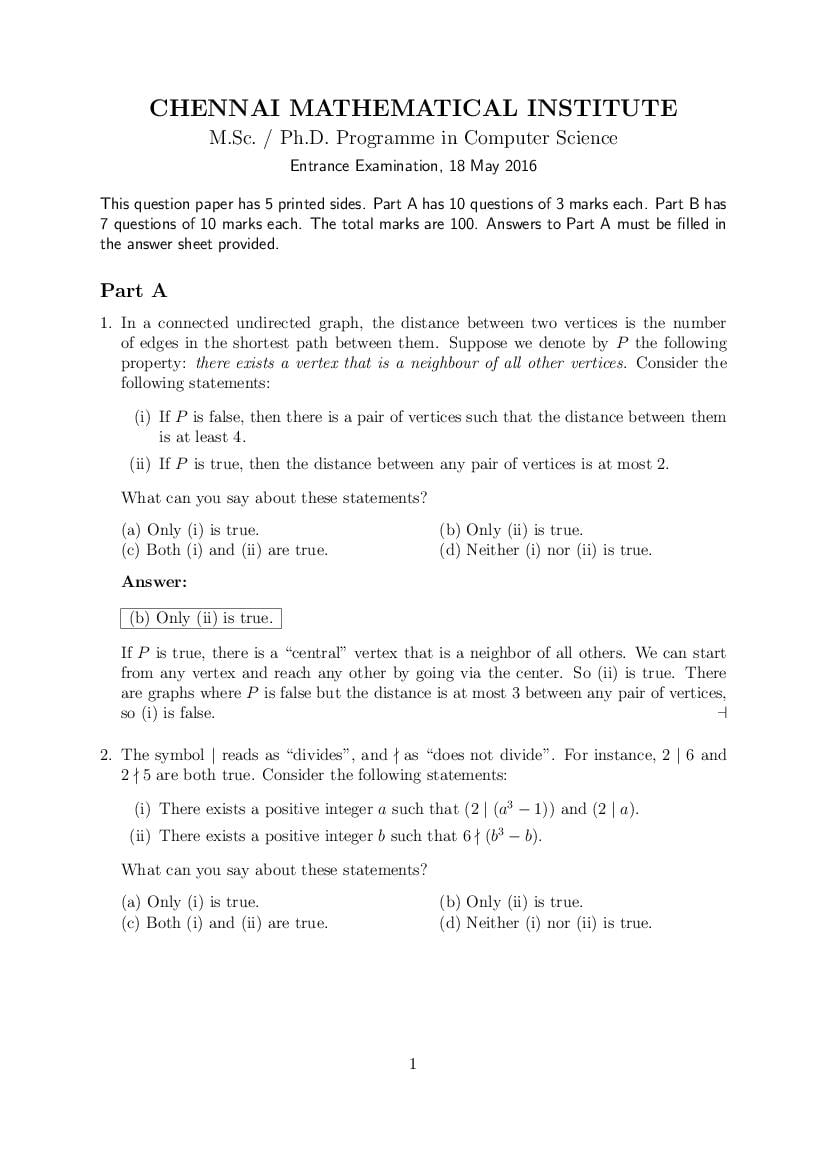
M.Sc. / Ph.D. Programme in Computer Science
Entrance Examination, 18 May 2016
This question paper has 5 printed sides. Part A has 10 questions of 3 marks each. Part B has
7 questions of 10 marks each. The total marks are 100. Answers to Part A must be filled in
the answer sheet provided.
Part A
1. In a connected undirected graph, the distance between two vertices is the number
of edges in the shortest path between them. Suppose we denote by P the following
property: there exists a vertex that is a neighbour of all other vertices. Consider the
following statements:
(i) If P is false, then there is a pair of vertices such that the distance between them
is at least 4.
(ii) If P is true, then the distance between any pair of vertices is at most 2.
What can you say about these statements?
(a) Only (i) is true. (b) Only (ii) is true.
(c) Both (i) and (ii) are true. (d) Neither (i) nor (ii) is true.
(b) Only (ii) is true.
If P is true, there is a “central” vertex that is a neighbor of all others. We can start
from any vertex and reach any other by going via the center. So (ii) is true. There
are graphs where P is false but the distance is at most 3 between any pair of vertices,
so (i) is false. a
2. The symbol | reads as “divides”, and - as “does not divide”. For instance, 2 | 6 and
2 - 5 are both true. Consider the following statements:
(i) There exists a positive integer a such that (2 | (a3 − 1)) and (2 | a).
(ii) There exists a positive integer b such that 6 - (b3 − b).
What can you say about these statements?
(a) Only (i) is true. (b) Only (ii) is true.
(c) Both (i) and (ii) are true. (d) Neither (i) nor (ii) is true.
1
Page 2
(i) is false. Note that (a3 − 1) = (a − 1)(a2 + a + 1), and hence 2 | a implies that both
a − 1 and a2 + a + 1 are odd, and hence so is their product. Thus 2 - (a3 − 1).
(ii) is false too. Note that (b3 − b) = (b − 1)b(b + 1), and at least one of these factors
is even and one is divisible by 3. Hence 6 | (b3 − b). a
3. For a regular expression e, let L(e) be the language generated by e. If e is an expression
that has no Kleene star ∗ occurring in it, which of the following is true about e in
general?
(a) L(e) is empty.
(b) L(e) is finite.
(c) Complement of L(e) is empty.
(d) Both L(e) and its complement are infinite.
(b) L(e) is finite.
This is proved by a simple induction on the structure of the regular expression, using
the fact that L(a) is finite for each letter a, and that unions and concatenations of
finite languages are also finite. a
4. Consider a weighted undirected graph G with positive edge weights. Let (u, v) be an
edge in the graph. It is known that the shortest path from a vertex s to u has weight
53 and the shortest path from s to v has weight 65. Which of the statements is always
true?
(a) Weight of (u, v) ≤ 12.
(b) Weight of (u, v) = 12.
(c) Weight of (u, v) ≥ 12.
(d) Nothing can be said about the weight of (u, v).
(c) Weight of (u, v) ≥ 12.
If the weight of (u, v) is strictly less than 12, then there is a path from s to v of weight
at most 53 + 11 = 64 (which goes from s to u and then takes the edge (u, v)). This
contradicts the fact that the shortest path from s to v has weight 65. Thus the weight
of (u, v) is at least 12. a
2
Page 3
How many edges are there? And how many vertices?
(a) 60 edges and 20 vertices. (b) 30 edges and 20 vertices.
(c) 60 edges and 50 vertices. (d) 30 edges and 50 vertices.
(b) 30 edges and 20 vertices.
Each face has five edges, and there are 12 faces. But each edge is shared between two
faces. Thus the number of edges is (12 × 5)/2 = 30. The number of vertices is given
by Euler’s formula to be |E| − |F | + 2 = 30 − 12 + 2 = 20. a
6. In the code fragment to the right, start and
end are integer values and prime(x) is a i := 0; j := 0; k := 0;
function that returns true if x is a prime for (m := start;
number and false otherwise. m <= end;
m := m+1){
At the end of the loop: if (prime(m)){
i := i + m;
(a) k == i-j. k := k - m;
}else{
(b) k == j-i.
j := j - m;
(c) k == -j-i. k := k + m;
}
(d) Depends on start and end. }
(c) k == -j-i.
The value of i + j + k is 0 initially, and also at the end of each iteration of the loop.
Thus k = −j − i at the end of the loop. a
7. Varsha lives alone and dislikes cooking, so she goes out for dinner every evening. She
has two favourite restaurants, Dosa Paradise and Kababs Unlimited, to which she
travels by local train. The train to Dosa Paradise runs every 10 minutes, at 0, 10, 20,
30, 40 and 50 minutes past the hour. The train to Kababs Unlimited runs every 20
minutes, at 8, 28 and 48 minutes past the hour. She reaches the station at a random
time between 7:15 pm and 8:15 pm and chooses between the two restaurants based on
the next available train. What is the probability that she ends up eating in Kababs
Unlimited ?
1 1 2 1
(a) (b) (c) (d)
5 3 5 2
3
Page 4
If she arrives in the intervals 7:20–7:28, 7:40–7:48, or 8:00–8:08, the next train goes
to Kababs Unlimited. This adds up to 24 minutes, out of a total of 60 minutes, so
24 2
= . a
60 5
8. An advertisement for a tennis magazine states, “If I’m not playing tennis, I’m watching
tennis. And if I’m not watching tennis, I’m reading about tennis.” We can assume
that the speaker can do at most one of these activities at a time. What is the speaker
doing?
(a) Playing tennis. (b) Watching tennis.
(c) Reading about tennis. (d) None of the above.
(b) Watching tennis.
If he is not watching tennis, then he is reading about tennis. Which means he is not
playing tennis, which implies that he is watching tennis. Thus, the assumption that
he is not watching tennis leads to a contradiction. Therefore he is watching tennis. a
9. ScamTel has won a state government contract to connect 17 cities by high-speed
fibre optic links. Each link will connect a pair of cities so that the entire network is
connected—there is a path from each city to every other city. The contract requires
the network to remain connected if any single link fails. What is the minimum number
of links that ScamTel needs to set up?
(a) 34 (b) 32 (c) 17 (d) 16
(c) 17
If we connect the cities in a loop with 17 links, then even if any single link fails, we
can connect the cities by traversing the loop the other way. If we only had 16 links
connecting 16 cities, that would constitute a tree which would have only a single path
between any pair of cities (and thus get disconnected by a single link failure). a
10. Which of the following relationships holds in general between the scope of a variable
and the lifetime of a variable (in a language like C or Java)?
(a) The scope of a variable is contained in the lifetime of the variable.
(b) The scope of a variable is the same as the lifetime of the variable.
(c) The lifetime of a variable is disjoint from the scope of the variable.
(d) None of the above.
4
Page 5
Part B
1. A group of war prisoners are trying to escape from a prison. They have thoroughly
planned the escape from the prison itself, and after that they hope to find shelter
in a nearby village. However, the village (marked as B, see picture below) and the
prison (marked as A) are separated by a canyon which is also guarded by soldiers
(marked as S). These soldiers sit in their pickets and rarely walk; the range of view
of each soldier is limited to exactly 100 meters. Thus, depending on the locations
of soldiers, it may be possible to pass the canyon safely, keeping the distance to the
closest soldier strictly larger than 100 meters at any moment. The situation is depicted
in the following picture, where the circles around S indicate range of view.
S
S
A S B
S S
S
Provide an algorithm to determine if the prisoners can pass the canyon unnoticed,
given the width and the length of the canyon and the coordinates of every soldier in
the canyon, and assuming that soldiers do not change their locations. (Hint: Model
this as a graph, with soldiers represented by the vertices.)
Consider a graph G = (V ∪ {N, S}, E) where V = {vs | s is a soldier}. N and S
are two special vertices representing the north and south boundary of the canyon,
respectively. For two soldiers s and s0 , (vs , vs0 ) ∈ E iff s and s0 are at most 200 meters
apart. For a soldier s, (vs , N ) ∈ E iff s is at most 100 meters from the north boundary,
and similarly (vs , S) ∈ E iff s is at most 100 meters from the south boundary. It is
clear that the prisoners cannot pass the canyon unnoticed iff there is a path between N
and S. Thus it suffices to test reachability of S from N using any standard algorithm
(for instance, one based on breadth-first search). a
2. A simple path (respectively cycle) in a graph is a path (respectively cycle) in which
no edge or vertex is repeated. The length of such a path (respectively cycle) is the
number of edges in the path (respectively cycle).
Let G be an undirected graph with minimum degree k ≥ 2.
(a) Show that G contains a simple path of length at least k.
(b) Show that G contains a simple cycle of length at least k + 1.
5
Page 6
Pick an arbitrary vertex v1 in the first step. At each subsequent step, let vt
be the vertex picked last. If all neighbours of vt have already been picked,
stop. Otherwise vt+1 is chosen to be an arbitrary neighbour of vt hitherto
unpicked.
Since the graph is finite, the above procedure terminates eventually. Let π = v1 · · · vt
be the path produced at the end. By construction, it is a simple path. It follows that
all neighbours of vt have already been picked and they occur among {v1 , . . . , vt−1 }.
Since the minimum degree of the graph is k, it follows that k ≤ t − 1. Thus there are
at least k + 1 vertices and hence at least k edges in π.
Let i be the least index such that vi is adjacent to vt . It is clear that the path from vi
to vt is of length at least k. Adding the edge (vi , vt ) yields a simple cycle of length at
least k + 1. a
3. An undirected graph can be converted into a directed graph by choosing a direction
for every edge. Here is an example:
Show that for every undirected graph, there is a way of choosing directions for its
edges so that the resulting directed graph has no directed cycles.
Assign a distinct natural number N (v) to each vertex v of the graph. For an edge
between v and w, choose the direction v → w provided N (v) < N (w). It is easy to
prove that if there is a directed path from v to w in this scheme, then N (v) < N (w).
Suppose there is a directed cycle involving v. This means that there is a directed path
from v to itself, whence N (v) < N (v), which is a contradiction. a
4. Let Σ = {0, 1}. Let A, B be arbitrary subsets of Σ∗ . We define the following operations
on such sets:
A + B := { w ∈ Σ∗ | w ∈ A or w ∈ B }
A · B := { uv ∈ Σ∗ | u ∈ A and v ∈ B }
2A := { ww ∈ Σ∗ | w ∈ A }
Is it true that (A + B) · (A + B) = A · A + B · B + 2(A · B) for all choices of A and
B? If yes, give a proof. If not, provide suitable A and B for which this equation fails.
6
Page 7
{00, 01, 10, 11}, whereas A · A + B · B + 2(A · B) = {00, 11, 0101}. a
5. For a string x = a0 a1 · · · an−1 over the alphabet {0, 1, 2}, define val(x) to be the value
of x interpreted as a ternary number, where a0 is the most significant digit. More
formally, val(x) is given by X
3n−1−i · ai .
0≤i<n
Design a finite automaton that accepts exactly the set of strings x ∈ {0, 1, 2}∗ such
that val (x) is divisible by 4.
Let L = {x ∈ {0, 1, 2}∗ | val (x) is divisible by 4}. For any string x and b ∈ {0, 1, 2}:
(a) x ∈ L iff val (x) mod 4 = 0.
(b) if val (x) = i mod 4, val (xb) ≡ (3i + b) mod 4, for b = 0, 1, 2.
So to construct a DFA for L, it suffices to take 4 states q0 , q1 , q2 , q3 , with qi recording
the fact that the value of the string read so far is i mod 4. Under this interpretation,
q0 will be the initial and (only) final state, and the automaton will transition from
state qi to qj on reading letter b ∈ {0, 1, 2}, where j = (3i + b) mod 4.
2
q1
1 0
q0 1 0 q3
start 2
2 1
2 1
0
q2
0
Figure 1: Automaton for strings whose value is divisible by 4.
a
6. An automatic spelling checker works as follows. Given a word w, first check if w is
found in the dictionary. If w is not in the dictionary, compute a dictionary entry that
is close to w. For instance if the user types ocurrance, the spelling checker should
7
Page 8
as occurrence and occurance is quantified in terms of alignment.
An alignment between two strings w1 and w2 (over the alphabet {a, b, c, . . . , z}) is
obtained by inserting hyphens in the two strings such that the modified strings align
(i.e., the modified strings are of equal length, and at each position, either both strings
have the same letter or one of the strings has a hyphen).
Here are three examples of alignments. The first is between ocurrance and occurrence
and the second and third are between ctatg and ttaagc.
(1) oc-urr-ance (2) ct-at-g- (3) ctat---g-
occurre-nce -tta-agc ---ttaagc
A mismatch in an alignment is a position where one of modified strings has a hyphen
and the other does not. There are three mismatches in the first alignment given above,
five mismatches in the second, and seven mismatches in the third.
Use dynamic programming to give an efficient algorithm that takes two strings x and
y (over the alphabet {a, b, c, . . . , z}) as its input, and computes the minimum number
of mismatches among all alignments of x and y. What is the running time of your
algorithm (in terms of the lengths of x and y)?
Let x = a1 a2 · · · am and y = b1 b2 · · · bn . For any string w and any i ∈ {0, . . . , |w|}, we
let w[. . . i] denote the prefix of w of length i. For i ∈ {0, . . . , m} and j ∈ {0, . . . , n},
we let opt(i, j) denote the minimum number of mismatches among all alignments of
x[. . . i] and y[. . . j]. It is easy to see that opt(0, j) = j and opt(i, 0) = i. When
i, j > 0, an optimal alignment of x[. . . i] and y[. . . j] either aligns x[. . . i − 1] with
y[. . . j − 1] and tries to match ai and bj (if possible), or aligns y[. . . j] with x[. . . i − 1],
leaving ai unmatched, or aligns x[. . . i] with y[. . . j − 1], leaving bj unmatched.
This is reflected by the following recurrence :
opt(i, j) = min{opt(i − 1, j − 1) + cij , opt(i − 1, j) + 1, opt(i, j − 1) + 1}.
where cij denotes the cost of aligning ai (the string containing just the one letter) with
bj . It is easy to see that (
0 if ai = bj
cij =
2 otherwise
The following algorithm (which runs in O(mn) time) computes the minimum number
of mismatches among alignments of x and y.
array A[0...m, 0...n]
array c[0...m, 0...n]
initialize A[i,0] = i for each i
initialize A[0,j] = j for each j
for j = 1,...,n
8
Page 9
if a[i] == b[j] then c[i,j] = 0 else c[i,j] = 2
endfor
endfor
for j = 1,...,n
for i = 1,...,m
A[i,j] = min(A[i-1,j-1]+c[i,j], A[i-1,j]+1, A[i,j-1]+1)
endfor
endfor
return A[m,n]
a
7. Consider the function M defined as follows:
(
n − 10 if n > 100
M (n) =
M (M (n + 11)) if n ≤ 100
(a) Compute the following.
i. M (101)
ii. M (99)
iii. M (87)
(b) Give a constant-time algorithm that computes M (n) on input n. (A constant-
time algorithm is one whose running time is independent of the input n.)
(a) M (101) = M (99) = M (87) = 91
(b) The following is a simple algorithm for computing M . It just compares n with 100,
and either subtracts 10 from n or returns a constant, all of which are constant-
time operations.
if (n> 100) return (n-10) else return 91
To prove that the algorithm is correct, we need to show that M (n) = 91 for
n < 101. Notice first that M (101) = 91. From the following claim, it follows
that M (n) = 91 for all n ≤ 100
Claim: For all k ≥ 1 and all n such that 101 − 11k ≤ n < 101 − 11(k − 1),
M (n) = 91.
The proof of the claim is by induction on k.
Suppose k = 1 and 90 ≤ n < 101.
M (n) = M (M (n + 11))
= M (n + 11 − 10) ( since n + 11 ≥ 101)
= M (n + 1)
9
Page 10
Assume the claim holds for k ≤ m. Consider n such that 101 − 11k ≤
n < 101 − 11(k − 1) for k = m + 1.
M (n) = M (M (n + 11))
= M (91) (M (n + 11) = 91, by IH )
= 91 by base case
Thus the claim holds for all k, and hence M (n) = 91 for all n < 101.
a
10
Document Details
| Board / Org | Default |
| Exam | CMI Entrance Exam |
| Type | Solution |
| Pages | 10 |
| Updated | 22 Jul 2026 |