CMI Entrance Exam 2025 Question Paper Solution M.Sc PhD Computer Science
Finished viewing? Save it for later —
Download CMI Entrance Exam 2025 Question Paper Solution M.Sc PhD Computer Science (PDF · 13 pages)About CMI Entrance Exam 2025 Question Paper Solution M.Sc PhD Computer Science
CMI Entrance Exam 2025 Question Paper Solution M.Sc PhD Computer Science is available here for free download. Published by CMI for CMI Entrance Exam, this solution can be viewed online or downloaded as a PDF (13 pages). Candidates preparing for CMI Entrance Exam can use CMI Entrance Exam 2025 Question Paper Solution M.Sc PhD Computer Science to understand the exam pattern, the type of questions asked, and the overall difficulty level.
Frequently Asked Questions
How can I download CMI Entrance Exam 2025 Question Paper Solution M.Sc PhD Computer Science?
Open this page and click the Download button to save CMI Entrance Exam 2025 Question Paper Solution M.Sc PhD Computer Science as a PDF. It is completely free on AglaSem Docs.
Is CMI Entrance Exam 2025 Question Paper Solution M.Sc PhD Computer Science free to download?
Yes. CMI Entrance Exam 2025 Question Paper Solution M.Sc PhD Computer Science can be viewed online and downloaded as a PDF free of cost on AglaSem Docs.
How many pages does CMI Entrance Exam 2025 Question Paper Solution M.Sc PhD Computer Science have?
CMI Entrance Exam 2025 Question Paper Solution M.Sc PhD Computer Science contains 13 pages, which you can read online or download together as a single PDF.
Where can I find more CMI Entrance Exam study material?
You can find more CMI Entrance Exam question papers, sample papers, syllabus, and answer keys on AglaSem Docs.
CMI Entrance Exam 2025 Question Paper Solution M.Sc PhD Computer Science – Text
Read the full text of this solution below — useful to quickly search, copy and reference the content online without downloading the PDF.
📄 View text version (13 pages)
Page 1
M.Sc. / Ph.D. Programme in Computer Science
Entrance Examination, 24 May 2025
Instructions
• This question paper consists of two parts. There are 10 Part A questions worth 3
marks each, and 7 Part B questions worth 10 marks each. The total marks are 100.
• Part A consists of multiple choice questions. There may be multiple correct choices.
You have to select all the correct options and no incorrect option to get full marks.
There is no partial credit, and no negative marking.
• For questions in Part A, you have to provide the answers on the computer. You only
have to choose the appropriate answer(s) from the choices provided. For example,
if the answer to a question is options (a) and (c), choose only (a) and (c) to score
full marks for that question.
• For questions in Part B, you have to write your answer with a short explanation in
the space provided for the question.
• In all questions related to graphs, unless otherwise specified, we use the word
“graph” to mean a finite undirected graph with no self-loops, and at most one
edge between any pair of vertices.
Part A
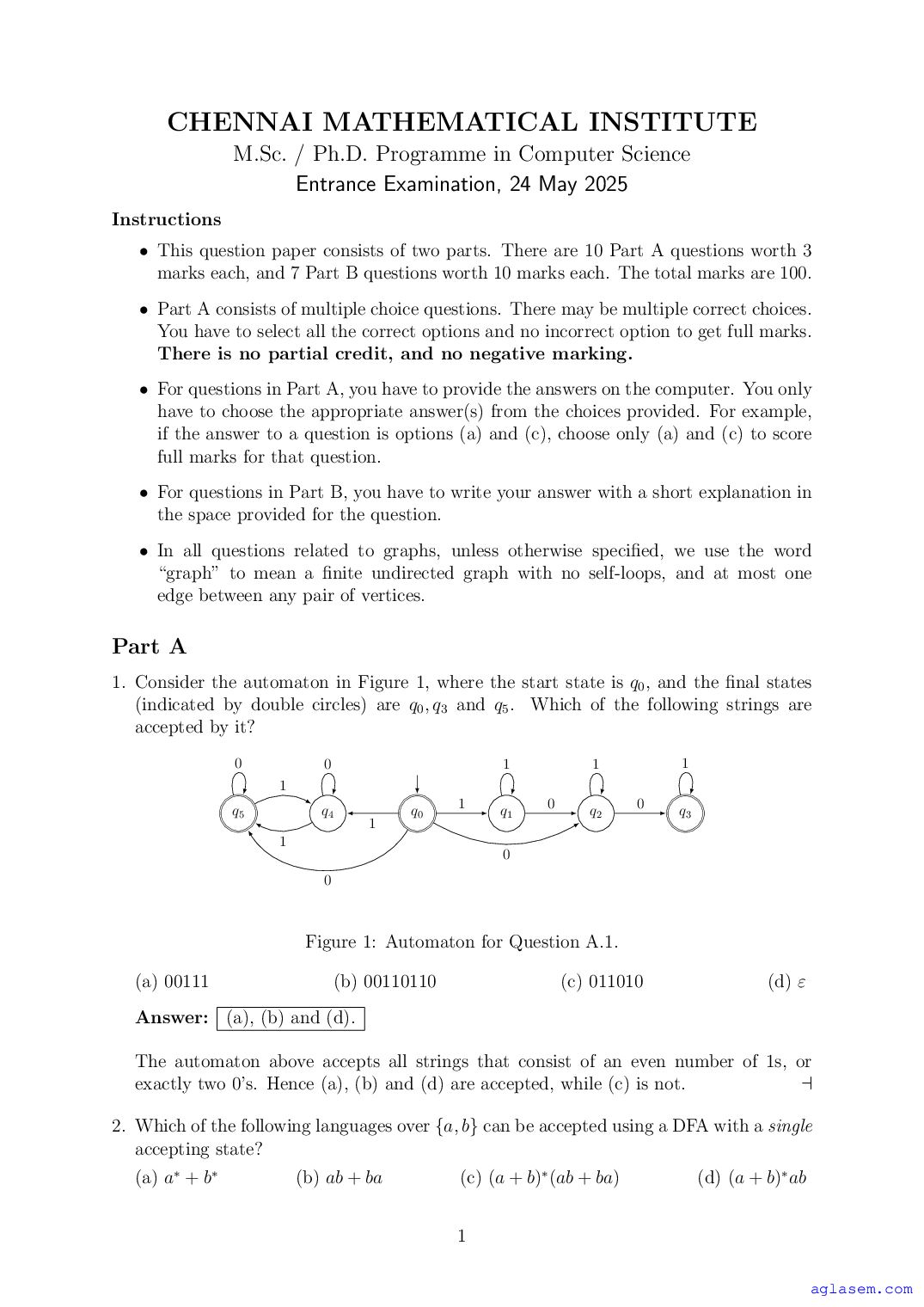
1. Consider the automaton in Figure 1, where the start state is q0 , and the final states
(indicated by double circles) are q0 , q3 and q5 . Which of the following strings are
accepted by it?
0 0 1 1 1
1
q5 q4 q0 1 q1 0 q2 0 q3
1
1
0
0
Figure 1: Automaton for Question A.1.
(a) 00111 (b) 00110110 (c) 011010 (d) ε
Answer: (a), (b) and (d).
The automaton above accepts all strings that consist of an even number of 1s, or
exactly two 0’s. Hence (a), (b) and (d) are accepted, while (c) is not. ⊣
2. Which of the following languages over {a, b} can be accepted using a DFA with a single
accepting state?
(a) a∗ + b∗ (b) ab + ba (c) (a + b)∗ (ab + ba) (d) (a + b)∗ ab
1
Page 2
(a) cannot be accepted by an automaton with a single final state. For if that were the
a
case, then a and b would end up in the same final state (call it qf ). Let qf −→ q. If
qf = q, then both aa and ba are both accepted. If qf ̸= q, then neither aa nor ba is
accepted. But then the language accepted is not a∗ + b∗ .
If (c) were accepted by an automaton with a single final state, then ab and ba go to
same final state. Similar to the reasoning in the above paragraph, consider the strings
aba and baa. ⊣
3. Aruna always eats paranthas or curd rice at lunch if pizza is not available. She eats
curd rice only if pickles are available. Yesterday, Aruna’s mother had fresh pickles
ready at lunch time, and also banned pizza delivery at home. What can you say about
Aruna’s lunch yesterday?
(a) Aruna ate curd rice.
(b) Aruna did not eat curd rice.
(c) Aruna ate paranthas.
(d) Aruna ate both curd rice and paranthas.
Answer: (a), (b), (c) and (d).
Suppose the following letters stand for the accompanying statements.
• P : Aruna eats paranthas.
• C: Aruna eats curd rice.
• Z: Pizza is available.
• K: Pickles are available.
Then Aruna’s approach to life is represented by the formulas ¬Z → (P ∨ C) and
C → K. Her mother’s actions led to the formulas K and ¬Z being true yesterday. It
can be seen that ¬P ∧ C, P ∧ ¬C and P ∧ C are all consistent with the four formulas
above. Thus all four choices are possible. ⊣
4. Consider a biased coin which has probability p of turning up heads (and 1−p of turning
up tails), and consider an experiment where we toss the coin repeatedly. What is the
expected number of tosses before seeing a head ? (Recall that this is given by the
X∞
formula kpk , where pk is the probability that the coin turns up heads for the first
k=1
time on the k-th toss.)
(a) 1/p2 (b) 1/(1 − p)2 (c) 1/p (d) 1/(1 − p)
2
Page 3
If the coin ends up heads for the first time on the k-th toss, it means that there are
∞
X
k−1
k − 1 tails followed by a head. Thus pk = (1 − p) p. Now letting S = kpk , we
k=1
∞
X
have that S = p (1 − p)k−1 . The summation is standard, and evaluates to 1/p2 . So
k=1
S = 1/p. ⊣
5. In a finite directed graph, every vertex has exactly three incoming edges. Which of
the following statements is guaranteed to be true?
(a) Some vertex has at least three edges leaving it.
(b) Exactly three edges leave every vertex.
(c) Some vertex has exactly three edges leaving it.
(d) None of the above is true.
Answer: (a).
Suppose the number of vertices is n. Since every vertex has exactly three incoming
edges, the number of edges is 3n. If each vertex had at most two outgoing vertices,
then the number of edges would have to be ⩽ 2n. Thus at least one vertex has three
edges leaving it.
(b) and (c) are not always true. Consider the graph G = ({a, b, c, d}, E) with
E = {(a, a), (a, b), (a, c), (a, d), (b, a), (b, b), (b, c), (b, d), (c, a), (c, d), (d, b), (d, c)}.
All vertices have exactly three incoming edges, but no vertex has exactly three outgoing
edges. ⊣
6. Let X be a set of size n. What is the size of the set {(A, B) | A, B ⊆ X, A ∩ B = ∅}?
(a) 3n − 2n (b) 3n (c) 4n (d) 2n+1
Answer: (b).
Let P = {(A, B) | A, B ⊆ X and A ∩ B = ∅}. For each (A, B) ∈ P, we can associate
a function fAB : X → {0, 1, 2} defined as follows:
0 if x ∈
/ A∪B
fAB (x) = 1 if x ∈ A \ B
2 if x ∈ B \ A
Conversely, given any function f : X → {0, 1, 2}, we see that (Af , Bf ) ∈ P, where
Af = {x ∈ X | f (x) = 1} and Bf = {x ∈ X | f (x) = 2}.
Thus the set P is in one-to-one correspondence with the set of all functions from X
to {0, 1, 2}. Therefore its size is 3n . ⊣
3
Page 4
eries to Rohit are good length balls, 40% are short pitched, and 20% are overpitched.
Rohit hits a boundary 40% of the time off good length balls, and 80% of the time off
short pitched and overpitched balls. Given that Rohit has hit a boundary off Shardul’s
last ball, what is the probability that it was short-pitched?
(a) 1/4 (b) 1/3 (c) 1/5 (d) 1/2
Answer: (d).
If Shardul bowls 100 balls to Rohit, 40 are length balls, 40 are short-pitched and 20 are
overpitched. Rohit hits 16 boundaries off the length balls, 32 boundaries off the short-
pitched balls, and 16 boundaries off the overpitched balls. Thus he hits 64 boundaries
off the 100 balls, and 32 of these are off short-pitched balls. So Pr(short-pitched |
boundary) = 32/64 = 1/2. ⊣
The next two questions pertain to the following code which takes a non-negative integer
as input.
function foo(n)
if (n = 0) then
return 0
else if (n = 1) then
return 1
else if (n = 2) then
return 3
else
return n + foo(n − 1) + foo(n − 2)
end if
end function
8. What is the value returned by foo(5)?
(a) 10 (b) 14 (c) 26 (d) 35
Answer: (c).
From the code we get: foo(0) = 0, foo(1) = 1, foo(2) = 3. Using these we get:
foo(3) = 3 + 3 + 1 = 7, foo(4) = 4 + 7 + 3 = 14, and foo(5) = 5 + 14 + 7 = 26. ⊣
9. Which of the following best describes the running time of foo(m)?
(a) Linear in m.
(b) Quadratic in m.
(c) Cubic in m.
(d) Exponential in m.
4
Page 5
Recall that the Fibonacci numbers are defined as: F0 = 0, F1 = 1 and Fn = Fn−1 +Fn−2
for n ⩾ 2. Now let Gn be the number of recursive calls (including the top-level call)
made to foo(2) in the computation of foo(n). Then we see that G0 = G1 = 0 =
F0 , G2 = 1 = F1 , and for n ⩾ 3, Gn = Gn−1 + Gn−2 = Fn−2 + Fn−3 = Fn−1 . Thus the
running time of foo(m) is at least the value of Fm−1 , which is exponential in m. ⊣
10. Consider the following two procedures proc1 and proc2, which run in parallel after
initialising x to 0. Running in parallel means that between any two lines of code
in one process, any number of lines of the other process may run. Note that x is a
shared variable which both processes can read/modify, while temp1 and temp2 are
local variables that only the corresponding processes can access.
int x = 0;
proc1 { proc2 {
int temp1 = x; int temp2 = x;
x = temp1 + 1; x = temp2 + 1;
temp1 = x; }
x = temp1 + 1;
}
Which of the following values are possible for x after both processes have come to a
halt?
(a) 0 (b) 1 (c) 2 (d) 3
Answer: (b), (c) and (d).
Clearly the final value cannot be 0 since at least one of the processes will add at least
1 to x.
Use L.1, L.2, L.3, L.4 to number the statements of proc1, and R.1, R.2 to number
the statements of proc2. Here are the execution traces that achieve the final values
specified by (b), (c) and (d).
(b) R.1, L.1, L.2, L.3, L.4, R.2.
(c) L.1, R.1, R.2, L.2, L.3, L.4.
(d) L.1, L.2, L.3, L.4, R.1, R.2.
⊣
5
Page 6
1. Consider the language
L = {x ∈ {a, b}∗ | x ends with a palindrome of length at least 2}.
Is L regular or not? Justify your answer by either constructing a finite automaton, or
by giving a proof for the non-regularity of L.
Answer: L is regular. Let Σ = {a, b}. Any nonempty string x ∈ Σ∗ either ends with
an a or ends with a b. In the former case, it is in L iff it is of the form yabn a for
some y ∈ Σ∗ and n ⩾ 0, and in the latter case, it is in L iff it is of the form yban b
for some y ∈ Σ∗ and n ⩾ 0. Presented in Figure 2 is a nondeterministic automaton
whose initial state is q0 and accepting states are q2 and q4 . It stays in the initial state
till the point where it guesses that it has read the prefix y, and then guesses if it is in
the first or the second case discussed above, according to which it moves left or right,
respectively.
b a
q2 a q1 a q0 b q3 b q4
a, b
Figure 2: Automaton for L.
⊣
6
Page 7
with equal number of occurrences of 01 and 10.
(b) Consider the language L = {1x 0y 1z | x > 0, y ⩾ 0, z > 0} over the alphabet
Σ = {0, 1}. Construct a 3-state NFA for L and prove that it is correct.
Answer:
(a) Any string x over {0, 1} is of the form 0n1 1n2 · · · 0n2k−1 1n2k , with k > 0, ni > 0
for 0 < i < 2k, and n1 , n2k ⩾ 0 (with the convention that 00 and 10 represent the
empty string ε). x has equal number of occurrences of 01 and 10 iff one of the
following three cases holds:
i. k = 1, n1 = 0 and n2 = 0, in which case x = ε, and there are zero occurrences
of 01 and 10.
ii. n1 > 0 and n2k = 0, in which case x starts and ends with 0, and there are
k − 1 occurrences of 01 and 10.
iii. n1 = 0 and n2k > 0, in which case x starts and ends with 1, and there are
k − 1 occurrences of 01 and 10.
So L = (ε + 0(0 + 1)∗ 0 + 1(0 + 1)∗ 1), and is hence regular.
(b) Presented in Figure 3 is a nondeterministic automaton whose initial state is q0
and accepting state is q2 .
1 0 1
q0 1 q1 1 q2
Figure 3: Automaton for {1x 0y 1z | x > 0, y ⩾ 0, z > 0}.
Letting δ be the (nondeterministic) transition function, we prove by induction on
length of strings the following facts, in order.
(a) δ ∗ (q0 , u) = {q0 , q1 } iff u = 1x for some x > 0.
(b) δ ∗ (q1 , v) = {q1 } iff v = 0y for some y ⩾ 0.
(c) δ ∗ (q1 , w) = {q2 } iff w = 0y 1z for some y ⩾ 0 and z > 0.
Combining (a) and (c) above, along with the fact that δ(q0 , 0) = ∅, it follows
that δ ∗ (q0 , s) = {q0 , q2 } iff s = 1x 0y 1z for some x, z > 0 and y = 0, while
δ ∗ (q0 , s) = {q2 } iff s = 1x 0y 1z for some x, y, z > 0. In any case, q2 ∈ δ ∗ (q0 , s) iff
s = 1x 0y 1z , for some x, z > 0 and y ⩾ 0.
⊣
7
Page 8
only if f (X \ A) = Y \ f (A) for every subset A of X.
(b) Let S be a nonempty set and P the set of all subsets of S. Let f : P → P be a
function satisfying the following property: if X ⊆ Y , then f (X) ⊆ f (Y ). Show
that there exists some subset T of S such that f (T ) = T .
Answer:
(a) (⇒): Suppose f is a bijection and A ⊆ X. Since f is one-to-one, f (a) ̸= f (b) for
any a ∈ A and b ∈ / A. Thus f (A) ∩ f (X \ A) = ∅ (†). Since f is onto, for any
y ∈ Y , there is x such that f (x) = y. If x ∈ A then y ∈ f (A), and if x ∈ /A
then y ∈ f (X \ A). Thus f (A) ∪ f (X \ A) = Y (‡). Combining (†) and (‡),
we have that f (A) = Y \ f (X \ A), or in other words, f (X \ A) = Y \ f (A).
(⇐): Suppose f is not a bijection, which means that it is either not one-to-
one, or not onto. If f is not one-to-one, let u, v ∈ X such that u ̸= v and
f (u) = f (v). Consider the set A = {u} ⊆ X. Now f (u) ∈ f (A), but also
f (u) = f (v) ∈ f (X \ A). Thus f (A) ̸= Y \ f (X \ A). If, on the other
hand, f is not onto, let u′ ∈
/ f (X). Taking A = X, we have u′ ∈ / f (A) but
′
u ∈ Y = Y \ ∅ = Y \ f (∅) = Y \ f (X \ A). Thus, once again, we have that
f (A) ̸= Y \ f (X \ A).
In sum, if f (X \ A) = Y \ f (A) for every subset A of X, then f is bijective.
(b) A function f is called monotone if it satisfies the property that f (X) ⊆ f (Y )
whenever X ⊆ Y .
• Here is an argument that works when S is finite.
Define a sequence S0 , S1 , . . . as follows:
S0 = ∅
Si+1 = f (Si ), for i ⩾ 0.
Clearly S0 = ∅ ⊆ S1 . If we assume that Si ⊆ Si+1 for some i, then, by mono-
tonicity of f , Si+1 = f (Si ) ⊆ f (Si+1 ) = Si+2 . Thus we see that S0 , S1 , . . . is a
non-decreasing sequence of subsets of S. Let S have n elements. Then there
cannot be more than n + 1 distinct Si -s. This means that Sk = Sk+1 = f (Sk )
for some k ⩾ 0. We take that Sk to be our T .
• Here is a different argument which is much slicker, and which works for all
sets S, whether finite or infinite.
Consider the collection C = {T ⊆ S | f (T ) ⊆ T }. This \ collection is
nonempty – since f (S) ⊆ S, we have S ∈ C . Letting T0 = T , we have
T ∈C
T0 ⊆ T for all T ∈ C . By monotonicity of f , it follows
\ that f (T0 ) ⊆ f (T ) ⊆ T
for each T ∈ C . We therefore have that f (T0 ) ⊆ T = T0 . By monotonic-
T ∈C
ity of f again, f (f (T0 )) ⊆ f (T0 ), and thus f (T0 ) ∈ C . Thus, by definition
of T0 , we have T0 ⊆ f (T0 ). We conclude that there is a T ⊆ S such that
f (T ) = T .
⊣
8
Page 9
other student exactly once. In each contest, the pair of students can choose to play one
of three games – Chess, Go or Hex. Prove that there are three students that play the
same game among themselves (i.e., each of the three contests involving these players
is a game of Chess, or each is a game of Go, or each is a game of Hex).
Hint: Use the pigeonhole principle.
Answer: We say that a solution group is a subset of three students who all play the
same game against each other, which we call their solution game.
Consider an arbitrary student A. She plays all the 16 others, so there is at least one
game, say Chess, she plays against 6 others (for otherwise, she would play each game
against at most 5 people, which only adds up to 15 opponents at most).
Suppose now that these six students play only Go and Hex against each other. Pick an
arbitrary member of this group, say B. Now B has played five games against members
of this group, so must have played the same game, say Go, against three others (let
us name them C1 , C2 , C3 ). If C1 , C2 and C3 only play Hex against each other, then
{C1 , C2 , C3 } is a solution group with Hex as the solution game. Otherwise, two of
these, say C1 and C2 , play Go against each other. But now we have {B, C1 , C2 } as a
solution group, with Go as the solution game.
Otherwise at least two students out of the six, say B1 and B2 , play Chess against each
other. In this case {A, B1 , B2 } is a solution group, with Chess as the solution game.
⊣
9
Page 10
deg(v) denote the degree of vertex v in G. Let s, t be two vertices in G, let P be a
shortest path from s to t in G, and let V (P ) be the set of vertices in the path P .
Prove that
X
deg(v) ⩽ 3n.
v∈V (P )
Answer: If P has at most three vertices then the claim is easily seen to be true, since
each vertex has degree at most (n − 1). So let us consider the case when P has four or
more vertices, and let these vertices be {v1 , v2 , . . . , vt }. Consider the partition of V (P )
into the three sets X = {v1 , v4 , v7 , . . . }, Y = {v2 , v5 , v8 , . . . }, Z = {v3 , v6 , v9 , . . . }. No
two vertices in X can have a common neighbour in G, since this would imply a strictly
shorter s-t path than P . So the neighbourhoods of the vertices in X form a partition
of some subset of the vertex set of G. It follows that the sum of the degrees in G of
all the vertices in X is at most n. Repeating this argument for Y and Z completes
the proof. ⊣
10
Page 11
We build a full binary tree on top of the array A. The elements of the array are leaves
of the tree, numbered 1, 2, . . . , n, from left to right. At each internal node of the tree,
we store the sum of the values of the array elements in the subtree rooted under it.
We wish to use this data structure to support operations psum(i), 1 ⩽ i ⩽ n, and
add(y, i), 1 ⩽ i ⩽ n, defined below.
j=i
X
psum(i) : return the value of A[j]
j=1
add(y, i) : update A[i] to A[i] + y
(a) Draw the data structure built on top of the array A = [−2, 1, 4, −3, 6, 7, 9, −5].
(b) How will you update the data structure when you perform add(y, i)? Assuming
arithmetic operations are free, what is the time complexity of this update, as a
function of n?
(c) Give an algorithm to implement psum(i), 1 ⩽ i ⩽ n−1 using this data structure?
Assuming arithmetic operations take unit time, what is the time complexity of
psum(i)? What is the complexity of psum(n)?
Answer:
(a) The data structure is given in Figure 4.
17
0 17
−1 1 13 4
−2 1 4 −3 6 7 9 −5
Figure 4: Data structure for the array A = [−2, 1, 4, −3, 6, 7, 9, −5].
(b) We assume that each node of the tree (including each leaf) has three pointer
fields: par, lchild and rchild, that point respectively to the parent node, left child
and right child. We also assume that there is a special nil node, and that the par
field of the root, and the lchild and rchild fields of each leaf, point to nil. Each
node also has a field val, which stores the value at that node. Further we assume
that A itself is now an array of leaf nodes.
11
Page 12
procedure add(y, i)
v ← A[i];
while (v ̸= nil) do
v.val ← v.val + y;
v ← v.par
end while
end procedure
Since the procedure touches each node on the path from leaf i to root, and since
the length of each such path in a full binary tree with n nodes is O(log n), the
time taken for the procedure is O(log n).
(c) We assume the same fields as in the previous part of the question. We also assume
that there is a variable root, that points to the root of the tree. The following
pseudocode implements psum′ (r, s, i), which computes the sum of the leftmost i
values of a tree with root r, and with s leaves.
function psum′ (r, s, i)
if (i = s) then
return r.val
else if (i ⩽ s/2) then
return psum′ (r.lchild, s/2, i)
else
return psum′ (r.lchild, s/2, s/2) + psum′ (r.rchild, s/2, i − s/2)
end if
end function
function psum(i)
return psum′ (root, n, i)
end function
Note that we adjust the third argument, i, when we make recursive calls to
psum′ . One can prove that when r is a leaf, then the call would be of the form
psum′ (r, 1, 1). The time complexity of psum′ (r, s, i) in general is O(s), as can be
proved by induction on s. So the time complexity of psum(i) is O(n) in general.
But for the special case of psum(n) = psum′ (root, n, n), the time complexity is
O(1).
⊣
12
Page 13
100. There are some ladders and some snakes. Each ladder stands on some square
and leads to a higher square. Each snake has its head on some square and tail on a
lower square. It is possible that there are squares which neither contain the head of a
snake, or the foot of a ladder. There are no squares which contain both the head of a
snake and the foot of a ladder.
The game starts by placing a token on square 1, and the aim of the game is to make
the token reach square 100. We do this over a number of rounds. At each round, we
choose a number between 1 and 10 and advance the token by so many squares. If the
token lands on the head of a snake, it automatically goes to the tail. If it lands at the
foot of a ladder, it automatically goes to its top.
(a) Is it possible to have boards where one can never reach square 100?
(b) Model the snakes and ladders board as a graph.
(c) Devise an algorithm to find the smallest number of rounds required to go from
square 1 to square 100.
Answer:
(a) It is possible to have such a board. If all squares from 90 to 99 have the head
of a snake on them, and 100 does not have the top of a ladder, then there is no
way to reach square 100. Since we start at 1 and since the maximum number we
can choose is 10, and since 100 cannot be reached by a ladder, we cannot reach
100 without reaching a square from 90 to 99. But each such square contains the
head of a snake, so one would fall below.
(b) We can model a board as a directed graph. Each square as a vertex, and each
possible transition from square x to square y in one move (either by choosing a
number, or by following a snake or a ladder) is an edge between x and y. Further,
we attach a weight to each edge, 0 is it is by following a ladder or a snake, and n
if y = x + n. We also retain the edge with least weight, in case there are multiple
edges between two vertices. This models the fact that if a square x is at the
bottom of a ladder or at the head of a snake, the player does not have option to
choose a number n and go to x + n. They must necessarily follow the snake or
ladder.
(c) We can apply Dijkstra’s algorithm to find the path with the least total weight
from 1 to 100, if any path exists at all.
⊣
13
Document Details
| Board / Org | CMI |
| Exam | CMI Entrance Exam |
| Type | Solution |
| Pages | 13 |
| Updated | 23 Oct 2026 |