CMI Entrance Exam 2025 Question Paper Solution M.Sc PhD Mathematics
Finished viewing? Save it for later —
Download CMI Entrance Exam 2025 Question Paper Solution M.Sc PhD Mathematics (PDF · 4 pages)About CMI Entrance Exam 2025 Question Paper Solution M.Sc PhD Mathematics
CMI Entrance Exam 2025 Question Paper Solution M.Sc PhD Mathematics is available here for free download. Published by CMI for CMI Entrance Exam, this solution can be viewed online or downloaded as a PDF (4 pages). Candidates preparing for CMI Entrance Exam can use CMI Entrance Exam 2025 Question Paper Solution M.Sc PhD Mathematics to understand the exam pattern, the type of questions asked, and the overall difficulty level.
Frequently Asked Questions
How can I download CMI Entrance Exam 2025 Question Paper Solution M.Sc PhD Mathematics?
Open this page and click the Download button to save CMI Entrance Exam 2025 Question Paper Solution M.Sc PhD Mathematics as a PDF. It is completely free on AglaSem Docs.
Is CMI Entrance Exam 2025 Question Paper Solution M.Sc PhD Mathematics free to download?
Yes. CMI Entrance Exam 2025 Question Paper Solution M.Sc PhD Mathematics can be viewed online and downloaded as a PDF free of cost on AglaSem Docs.
How many pages does CMI Entrance Exam 2025 Question Paper Solution M.Sc PhD Mathematics have?
CMI Entrance Exam 2025 Question Paper Solution M.Sc PhD Mathematics contains 4 pages, which you can read online or download together as a single PDF.
Where can I find more CMI Entrance Exam study material?
You can find more CMI Entrance Exam question papers, sample papers, syllabus, and answer keys on AglaSem Docs.
CMI Entrance Exam 2025 Question Paper Solution M.Sc PhD Mathematics – Text
Read the full text of this solution below — useful to quickly search, copy and reference the content online without downloading the PDF.
📄 View text version (4 pages)
Page 1
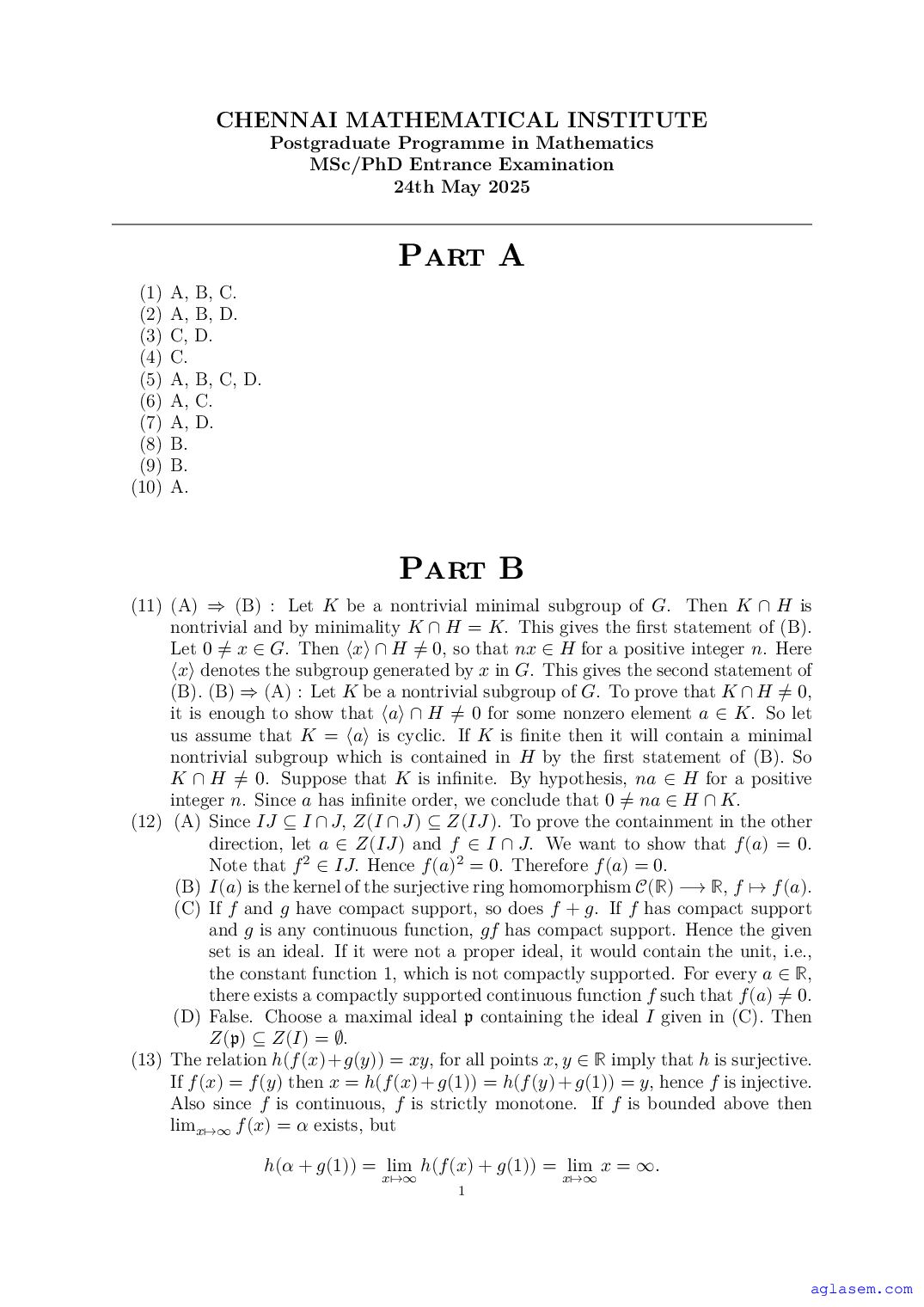
Postgraduate Programme in Mathematics
MSc/PhD Entrance Examination
24th May 2025
PART A
(1) A, B, C.
(2) A, B, D.
(3) C, D.
(4) C.
(5) A, B, C, D.
(6) A, C.
(7) A, D.
(8) B.
(9) B.
(10) A.
PART B
(11) (A) ⇒ (B) : Let 𝐾 be a nontrivial minimal subgroup of 𝐺. Then 𝐾 ∩ 𝐻 is
nontrivial and by minimality 𝐾 ∩ 𝐻 = 𝐾. This gives the first statement of (B).
Let 0 ≠ 𝑥 ∈ 𝐺. Then ⟨𝑥⟩ ∩ 𝐻 ≠ 0, so that 𝑛𝑥 ∈ 𝐻 for a positive integer 𝑛. Here
⟨𝑥⟩ denotes the subgroup generated by 𝑥 in 𝐺. This gives the second statement of
(B). (B) ⇒ (A) : Let 𝐾 be a nontrivial subgroup of 𝐺. To prove that 𝐾 ∩ 𝐻 ≠ 0,
it is enough to show that ⟨𝑎⟩ ∩ 𝐻 ≠ 0 for some nonzero element 𝑎 ∈ 𝐾. So let
us assume that 𝐾 = ⟨𝑎⟩ is cyclic. If 𝐾 is finite then it will contain a minimal
nontrivial subgroup which is contained in 𝐻 by the first statement of (B). So
𝐾 ∩ 𝐻 ≠ 0. Suppose that 𝐾 is infinite. By hypothesis, 𝑛𝑎 ∈ 𝐻 for a positive
integer 𝑛. Since 𝑎 has infinite order, we conclude that 0 ≠ 𝑛𝑎 ∈ 𝐻 ∩ 𝐾.
(12) (A) Since 𝐼𝐽 ⊆ 𝐼 ∩ 𝐽, 𝑍(𝐼 ∩ 𝐽 ) ⊆ 𝑍(𝐼𝐽 ). To prove the containment in the other
direction, let 𝑎 ∈ 𝑍(𝐼𝐽 ) and 𝑓 ∈ 𝐼 ∩ 𝐽. We want to show that 𝑓(𝑎) = 0.
Note that 𝑓 2 ∈ 𝐼𝐽. Hence 𝑓(𝑎)2 = 0. Therefore 𝑓(𝑎) = 0.
(B) 𝐼(𝑎) is the kernel of the surjective ring homomorphism 𝒞(ℝ) ⟶ ℝ, 𝑓 ↦ 𝑓(𝑎).
(C) If 𝑓 and 𝑔 have compact support, so does 𝑓 + 𝑔. If 𝑓 has compact support
and 𝑔 is any continuous function, 𝑔𝑓 has compact support. Hence the given
set is an ideal. If it were not a proper ideal, it would contain the unit, i.e.,
the constant function 1, which is not compactly supported. For every 𝑎 ∈ ℝ,
there exists a compactly supported continuous function 𝑓 such that 𝑓(𝑎) ≠ 0.
(D) False. Choose a maximal ideal 𝔭 containing the ideal 𝐼 given in (C). Then
𝑍(𝔭) ⊆ 𝑍(𝐼) = ∅.
(13) The relation ℎ(𝑓(𝑥)+𝑔(𝑦)) = 𝑥𝑦, for all points 𝑥, 𝑦 ∈ ℝ imply that ℎ is surjective.
If 𝑓(𝑥) = 𝑓(𝑦) then 𝑥 = ℎ(𝑓(𝑥) + 𝑔(1)) = ℎ(𝑓(𝑦) + 𝑔(1)) = 𝑦, hence 𝑓 is injective.
Also since 𝑓 is continuous, 𝑓 is strictly monotone. If 𝑓 is bounded above then
lim𝑥↦∞ 𝑓(𝑥) = 𝛼 exists, but
ℎ(𝛼 + 𝑔(1)) = lim ℎ(𝑓(𝑥) + 𝑔(1)) = lim 𝑥 = ∞.
𝑥↦∞ 𝑥↦∞
1
Page 2
𝑓 maps onto ℝ. So 𝑓 is a bijection. So 𝑓(𝑥) + 𝑔(0) takes all values in ℝ. But
ℎ(𝑓(𝑥) + 𝑔(0)) = 0 for all 𝑥, which is a contradiction.
(14) ∫ 𝑓(𝑥)𝑔(𝑛𝑥)𝑑𝑥 = 𝑛1 ∫ 𝑓 ( 𝑛𝑦 ) 𝑔(𝑦)𝑑𝑦 = 𝑛1 ∑𝑛𝑘=1 ∫
1 𝑛 𝑘+1 1
𝑓 ( 𝑛𝑦 ) 𝑔(𝑦)𝑑𝑦 = 𝑛1 ∑𝑛𝑘=1 ∫ 𝑓 ( 𝑘+𝑧
𝑛 ) 𝑔(𝑧)𝑑𝑧,
0 0 𝑘 0
by periodicity of 𝑔. By replacing 𝑔 by 𝑔 + 𝑐 for some constant 𝑐, we can assume
𝑔 is non-negative. Using continuity and mean value theorem for integrals, we
can write the above sum as 𝑛1 ∑𝑛𝑘=1 𝑓 ( 𝑘+𝑧 𝑛 ) ∫ 𝑔(𝑧)𝑑𝑧 for 𝑧𝑘 ∈ (0, 1). Now
𝑘 1
0
converges to the Riemann integral
1 𝑛 𝑘+𝑧𝑘 1
𝑛 ∑ 𝑘=1
𝑓 ( 𝑛 ) ∫ 𝑓(𝑥)𝑑𝑥.
0
(15) (A) True. Let 𝑎 ∈ ℝ be such that 𝑓(𝑎) > 0 and 𝑏 ∈ ℝ be such that 𝑓(𝑏) < 0.
2 2
Let ℓ be the line perpendicular to the segment joining 𝑎 and 𝑏 passing through
the midpoint of the segment. For each 𝑝 ∈ ℓ, there is a straight-line path
joining 𝑎 with 𝑝 and then 𝑝 with 𝑏. On each such path there is a point 𝑞 such
that 𝑓(𝑞) = 0.
(B) True. Let 𝑈 = (𝑎, 𝑏). Suppose that 𝑓(𝑈 ) is open. Note that 𝑓(𝑈 ) is bounded.
Then 𝜕𝑓(𝑈 ) is uncountable. On the other hand, since 𝜕𝑈 has exactly two
elements, 𝜕𝑓(𝑈 ) is finite.
(16) (A) False. The point 𝑧 = 0 is an essential singularity. To see this, suppose
that for some 𝑛 ≥ 1, 𝑔(𝑧) = 𝑧 −𝑛 𝑓(𝑧) is such that lim𝑧→0 𝑔(𝑧) = ∞, then
𝑧 = 0 is a pole of 𝑔(𝑧). Let 𝑘 be the order of the pole of 𝑔(𝑧) at 𝑧 = 0
and write 𝑔(𝑧) = 𝑧 −𝑘 ℎ(𝑧) where ℎ(𝑧) is analytic in |𝑧| < 𝑟 for some 𝑟 ≤ 1
with ℎ(𝑧) ≠ 0. Then 𝑓(𝑧) = 𝑧 𝑛−𝑘 ℎ(𝑧). If 𝑛 ≥ 𝑘, then 𝑓(𝑧) is analytic at
𝑧 = 0 and hence continuous at 𝑧 = 0, contrary to our assumption on 𝑓(𝑧).
If 𝑛 < 𝑘, then 𝑛 − 𝑘 < 0. As ℎ(0) ≠ 0, we have lim𝑧→0 𝑓(𝑧) = ∞, again a
contradiction.
(B) False. Write 𝑎𝑛 for the fractional part of 𝑒𝑛!. Note that 𝑎𝑛 ⟶ 0. Hence
𝑓(𝑒2𝜋𝑖𝑎𝑛 ) = 0.
(17 ) (A) Write 𝛾(𝑡) = 𝐼𝑛 + 𝑡𝐴 + 𝑂(𝑡2 ) where 𝐴 = 𝛾 ′ (0) ∈ 𝑀𝑛 . Now consider 𝛾𝐴 .
∗
(B) Every tangent vector of 𝐺 is also a tangent vector of GL2 , so there exists
𝐴 ∈ 𝑀2 such that 𝛾𝐴 ′
(0) = 𝐴 is the tangent vector. 𝐼2 = (𝐼2 + 𝑡𝐴 +
𝑂(𝑡 )) (𝐼2 + 𝑡𝐴 + 𝑂(𝑡 )) = 𝐼2 + 𝑡(𝐴∗ + 𝐴) + 𝑂(𝑡2 ), so 𝐴∗ = −𝐴. Since
2 ∗ 2
det 𝛾𝐴 (𝑡) = 1 for all 𝑡, Tr 𝐴 = 0.
𝑖𝑎 𝑧
(C) Φ(𝐼2 ) = (1, 0, 0, 0) and the tangent space there is ℝ3 . Let 𝐴 = [ ]∈
−𝑧 ̄ −𝑖𝑎
𝑉. Then
1 + 𝑖𝑎𝑡 + 𝑂(𝑡2 ) 𝑧𝑡 + 𝑂(𝑡2 )
Φ(𝛾𝐴 (𝑡)) = Φ ([ ])
−𝑧𝑡̄ + 𝑂(𝑡2 ) 1 + 𝑖𝑎𝑡 + 𝑂(𝑡2 )
= (1 + 𝑂(𝑡2 ), 𝑎𝑡 + 𝑂(𝑡2 ), ℜ(𝑧)𝑡 + 𝑂(𝑡2 ), ℑ(𝑧)𝑡 + 𝑂(𝑡2 )).
Therefore (𝐷Φ)𝐼2 (𝐴) = (𝑎, ℜ(𝑧), ℑ(𝑧)). Note that the map (𝐴, 𝐵) ⟶ [𝐴, 𝐵]
is ℝ-bilinear. An ℝ-basis for 𝑉 is
𝑖 0 0 1 0 𝑖
{[ ],[ ],[ ]} .
0 −𝑖 −1 0 𝑖 0
Call these 𝐴1 , 𝐴2 , 𝐴3 respectively. (𝐷Φ)𝐼2 (𝐴𝑖 ) is the 𝑖th standard basis
vector 𝑒𝑖 of ℝ3 . Moreover, [𝐴1 , 𝐴2 ] = 𝐴3 , [𝐴2 , 𝐴3 ] = 𝐴1 , [𝐴3 , 𝐴1 ] = 𝐴2 .
Hence the induced multiplication on ℝ2 is the vector cross product.
(18 ) Since 𝑃 is irreducible, 𝔽𝑞 (𝛼) = 𝔽𝑞2𝑑 for each root 𝛼 of 𝑃. Thus the splitting field
∗
of 𝑃 over 𝔽𝑞 is 𝔽𝑞2𝑑 . One has that Gal(𝔽𝑞2𝑑 /𝔽𝑞 ) ≃ ℤ/(2𝑑), generated by the
2
Page 3
of the form 𝜎𝑖 (𝛼), where 𝛼 is a chosen root. Then we set
𝑄1 ∶= ∏ (𝑥 − 𝜎𝑖 (𝛼))
𝑖even
and
𝑄2 ∶= ∏ (𝑥 − 𝜎𝑖 (𝛼)),
𝑖odd
we have that 𝑃 = 𝑄1 𝑄2 . Each of the polynomials 𝑄𝑖 have coefficients which are
symmetric polynomials in their roots, and it is easy to see that these coefficients
are fixed by 𝜎2 . The fixed field of ⟨𝜎2 ⟩ is 𝔽𝑞2 and thus 𝑄𝑖 has coefficients in 𝔽𝑞2 .
Since all roots of 𝑄𝑖 lie in a single Galois orbit for ⟨𝜎2 ⟩, 𝑄𝑖 is irreducible in 𝔽𝑞2 [𝑥].
(19∗ ) If 0 < 𝛼 < 1 is rational 𝜔 ∶= 𝑒2𝜋𝑖𝛼 is a root of unity. So (𝑟𝜔)𝑚! = 𝑟𝑚! for
all 𝑚 ≥ 𝑛 for 𝑛 ∶= 𝑜(𝜔). Summing from the the first 𝑁 th terms we obtain
𝑠 = ∑𝑚≥𝑛 𝑟𝑚! and it suffices to show this sum diverges to ∞. Consider the sum
up to 𝑚 + 1 terms of the above series: 𝑠𝑚 = 𝑟𝑛! + ⋯ + 𝑟𝑚! .
Let 𝑁 ≥ 1. Choose 𝑟 so that 𝑟𝑁! ≥ 1/2. This is possible since 𝑡 ↦ 𝑡𝑁! is
continuous at 1 and so lim𝑟→1− 𝑟𝑁! = 1. For this choice of 𝑟, we have 𝑠𝑁 ≥
(𝑁 − 𝑛 + 1)/2. As 𝑛 = 𝑜(𝜔) is fixed, we see that 𝑠𝑁 → ∞ as 𝑁 → ∞.
(20 ) (A) Cover ℝ2 by unit squares 𝑅𝑚,𝑛 with sides parallel to the coordinate axes
∗
and centres at (𝑚 + 1/2, 𝑛 + 1/2) with (𝑚, 𝑛) ∈ ℤ2 . It is easily seen that
the rectangles {𝑅𝑚,𝑛 ∣ (𝑚, 𝑛) ∈ ℤ2 } can be arranged in a sequence 𝑆0 =
𝑅0,0 , 𝑆1 , 𝑆2 , … , 𝑆𝑛 , … so that (i) 𝑆𝑘 ≠ 𝑆𝑙 if 𝑘 ≠ 𝑙, (ii) 𝑆𝑖 ∩ 𝑆𝑖+1 is a common
edge of both 𝑆𝑖 , 𝑆𝑖+1 .
Suppose that 𝑓0 ∶ 𝐼 → 𝐼 2 is a surjective continuous map. We may arrange so
that 𝑓0 (0) = (0, 0) = 𝑓(1). (Otherwise let 𝛼 ∶ 𝐼 → 𝐼 2 describe the straight-
line segment from 𝑓(0) to 0 and 𝛽 ∶ 𝐼 → 𝐼 2 , the straight-line segment joining
𝑓(1) to (0, 0) and consider the concatenation 𝑓 ∶= 𝛼 ⋅ 𝑓0 ⋅ 𝛽 ∶ 𝐼 → 𝐼 2 , which
describes 𝛼, 𝑓0 , 𝛽 with thrice the speed in succession. Then 𝑓 maps 0, 1 ∈ 𝐼
to (0, 0).)
Consider 𝜙 ∶ ℝ → ℝ2 is defined as follows: 𝜙(𝑡) = (0, 0) if 𝑡 ≤ 0, 𝜙(𝑡) =
𝑓0 (𝑡), 0 ≤ 𝑡 ≤ 1, and , inductively, having defined 𝜙 on [𝑗 − 1, 𝑗] such that
𝜙([𝑗 − 1, 𝑗]) = 𝑆𝑗−1 = 𝑅𝑚,𝑛 , with 𝜙(𝑗 − 1) = (𝑚, 𝑛), we proceed to define
𝜙 on [𝑗, 𝑗 + 1] as follows. By our hypothesis, 𝑆𝑗 = 𝑅𝑘,𝑙 where (𝑘, 𝑙) ∈
{(𝑚, 𝑛 + 1), (𝑚, 𝑛 − 1), (𝑚 + 1, 𝑛), (𝑚 − 1, 𝑛)}. Let 𝜎 ∶ 𝐼 → 𝑅𝑚,𝑛 ∪ 𝑅𝑘,𝑙 be
the straight line segment that joins (𝑚, 𝑛) to (𝑘, 𝑙). Then define
𝜎(2𝑡), if 0 ≤ 𝑡 ≤ 1/2
𝜙(𝑗 + 𝑡) = {
(𝑘, 𝑙) + 𝑓0 (2𝑡 − 1), if 1/2 ≤ 𝑡 ≤ 1
Then 𝜙 ∶ ℝ → ℝ2 is a continuous surjection. (Continuity follows from pasting
lemma and surjectivity follows from the fact that ⋃ 𝑅𝑚,𝑛 = ℝ2 .)
(B) The complement of the graph of 𝜙 is path connected. Suppose that both
𝑝0 = (𝑥0 , 𝑦0 , 𝑧0 ) , 𝑝1 = (𝑥1 , 𝑦1 , 𝑧1 ) are not in Γ. If 𝑥0 = 𝑥1 , then 𝑝0 , 𝑝1
belong the plane 𝑃 with equation 𝑥 = 𝑥0 and Γ ∩ 𝑃 is a singleton. So 𝑃 \Γ
is a punctured plane, which is path connected.
Suppose that 𝑥0 < 𝑥1 . Then Γ ∩ {(𝑡, 𝑦, 𝑥) ∣ 𝑥0 ≤ 𝑡 ≤ 𝑥1 } is compact. So
we can choose a 𝑐 > 0 large such that Γ is contained in the half space
{(𝑥, 𝑦, 𝑧) ∣ 𝑧 < 𝑐}. Now the straight-line segment joining 𝑞0 = (𝑥0 , 0, 𝑐) and
3
Page 4
from 𝑝0 to 𝑞0 to 𝑞1 to 𝑝1 not meeting Γ.
4
Document Details
| Board / Org | CMI |
| Exam | CMI Entrance Exam |
| Type | Solution |
| Pages | 4 |
| Updated | 23 Oct 2026 |