Finished viewing? Save it for later —
Download NCERT Book Class 11 Sociology (Understanding Society) Chapter 2 Social Change and Social Order in Rural and Urban Society (PDF · 29 pages)About NCERT Book Class 11 Sociology (Understanding Society) Chapter 2 Social Change and Social Order in Rural and Urban Society
NCERT Book Class 11 Sociology (Understanding Society) Chapter 2 Social Change and Social Order in Rural and Urban Society is available here for free download. Published by NCERT for Class 11, this books can be viewed online or downloaded as a PDF (29 pages). Candidates preparing for Class 11 can use NCERT Book Class 11 Sociology (Understanding Society) Chapter 2 Social Change and Social Order in Rural and Urban Society to understand the exam pattern, the type of questions asked, and the overall difficulty level.
Frequently Asked Questions
How can I download NCERT Book Class 11 Sociology (Understanding Society) Chapter 2 Social Change and Social Order in Rural and Urban Society?
Open this page and click the Download button to save NCERT Book Class 11 Sociology (Understanding Society) Chapter 2 Social Change and Social Order in Rural and Urban Society as a PDF. It is completely free on AglaSem Docs.
Is NCERT Book Class 11 Sociology (Understanding Society) Chapter 2 Social Change and Social Order in Rural and Urban Society free to download?
Yes. NCERT Book Class 11 Sociology (Understanding Society) Chapter 2 Social Change and Social Order in Rural and Urban Society can be viewed online and downloaded as a PDF free of cost on AglaSem Docs.
How many pages does NCERT Book Class 11 Sociology (Understanding Society) Chapter 2 Social Change and Social Order in Rural and Urban Society have?
NCERT Book Class 11 Sociology (Understanding Society) Chapter 2 Social Change and Social Order in Rural and Urban Society contains 29 pages, which you can read online or download together as a single PDF.
Where can I find more Class 11 study material?
You can find more Class 11 question papers, sample papers, syllabus, and answer keys on AglaSem Docs.
NCERT Book Class 11 Sociology (Understanding Society) Chapter 2 Social Change and Social Order in Rural and Urban Society – Text
Read the full text of this books below — useful to quickly search, copy and reference the content online without downloading the PDF.
📄 View text version (1 page)
Page 1
CHAPTER 2
SOCIAL CHANGE AND SOCIAL ORDER IN RURAL AND
URBAN SOCIETY
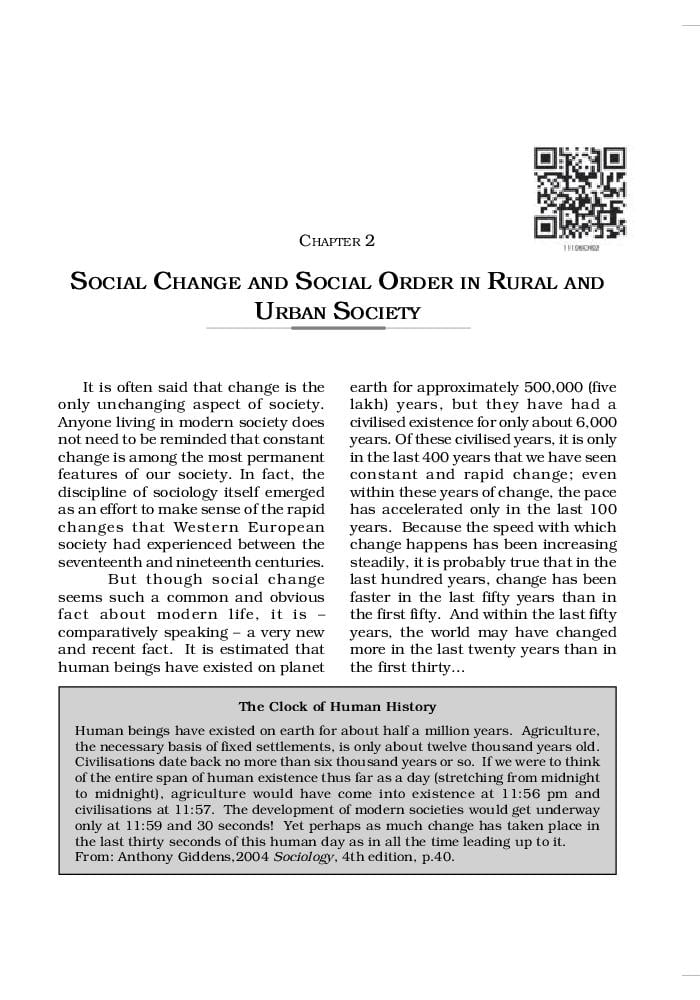
It is often said that change is the earth for approximately 500,000 (five
only unchanging aspect of society. lakh) years, but they have had a
Anyone living in modern society does civilised existence for only about 6,000
not need to be reminded that constant years. Of these civilised years, it is only
change is among the most permanent in the last 400 years that we have seen
features of our society. In fact, the constant and rapid change; even
discipline of sociology itself emerged within these years of change, the pace
as an effort to make sense of the rapid has accelerated only in the last 100
changes that Wester n European years. Because the speed with which
society had experienced between the change happens has been increasing
seventeenth and nineteenth centuries. steadily, it is probably true that in the
But though social change last hundred years, change has been
seems such a common and obvious faster in the last fifty years than in
fact about moder n life, it is – the first fifty. And within the last fifty
comparatively speaking – a very new years, the world may have changed
and recent fact. It is estimated that more in the last twenty years than in
human beings have existed on planet the first thirty…
The Clock of Human History
Human beings have existed on earth for about half a million years. Agriculture,
the necessary basis of fixed settlements, is only about twelve thousand years old.
Civilisations date back no more than six thousand years or so. If we were to think
of the entire span of human existence thus far as a day (stretching from midnight
to midnight), agriculture would have come into existence at 11:56 pm and
civilisations at 11:57. The development of modern societies would get underway
only at 11:59 and 30 seconds! Yet perhaps as much change has taken place in
the last thirty seconds of this human day as in all the time leading up to it.
From: Anthony Giddens,2004 Sociology, 4th edition, p.40.
Showing the first page only. Download the PDF above for the complete document.
Document Details
| Board / Org | NCERT |
| Exam | Class 11 |
| Type | Books |
| Pages | 29 |
| Updated | 29 Aug 2026 |