JEMAS PG 2023 Question Paper M.Sc MB
Finished viewing? Save it for later —
Download JEMAS PG 2023 Question Paper M.Sc MB (PDF · 14 pages)About JEMAS PG 2023 Question Paper M.Sc MB
JEMAS PG 2023 Question Paper M.Sc MB is available here for free download. Published by WBJEEB for JEMAS PG, this question paper can be viewed online or downloaded as a PDF (14 pages). Candidates preparing for JEMAS PG can use JEMAS PG 2023 Question Paper M.Sc MB to understand the exam pattern, the type of questions asked, and the overall difficulty level.
Frequently Asked Questions
How can I download JEMAS PG 2023 Question Paper M.Sc MB?
Open this page and click the Download button to save JEMAS PG 2023 Question Paper M.Sc MB as a PDF. It is completely free on AglaSem Docs.
Is JEMAS PG 2023 Question Paper M.Sc MB free to download?
Yes. JEMAS PG 2023 Question Paper M.Sc MB can be viewed online and downloaded as a PDF free of cost on AglaSem Docs.
How many pages does JEMAS PG 2023 Question Paper M.Sc MB have?
JEMAS PG 2023 Question Paper M.Sc MB contains 14 pages, which you can read online or download together as a single PDF.
Where can I find more JEMAS PG study material?
You can find more JEMAS PG question papers, sample papers, syllabus, and answer keys on AglaSem Docs.
JEMAS PG 2023 Question Paper M.Sc MB – Text
Read the full text of this question paper below — useful to quickly search, copy and reference the content online without downloading the PDF.
📄 View text version (13 pages)
Page 1
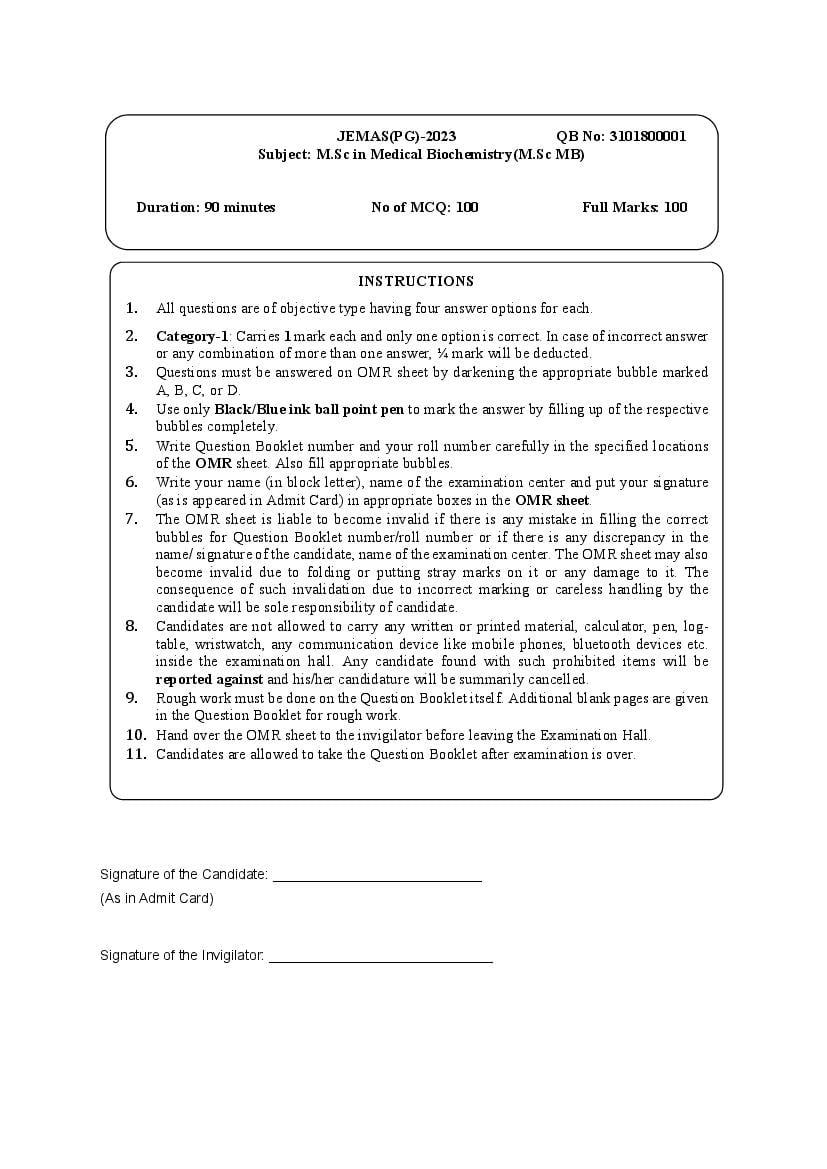
Subject: M.Sc in Medical Biochemistry(M.Sc MB)
Duration: 90 minutes No of MCQ: 100 Full Marks: 100
INSTRUCTIONS
1. All questions are of objective type having four answer options for each.
2. Category-1: Carries 1 mark each and only one option is correct. In case of incorrect answer
or any combination of more than one answer, ¼ mark will be deducted.
3. Questions must be answered on OMR sheet by darkening the appropriate bubble marked
A, B, C, or D.
4. Use only Black/Blue ink ball point pen to mark the answer by filling up of the respective
bubbles completely.
5. Write Question Booklet number and your roll number carefully in the specified locations
of the OMR sheet. Also fill appropriate bubbles.
6. Write your name (in block letter), name of the examination center and put your signature
(as is appeared in Admit Card) in appropriate boxes in the OMR sheet.
7. The OMR sheet is liable to become invalid if there is any mistake in filling the correct
bubbles for Question Booklet number/roll number or if there is any discrepancy in the
name/ signature of the candidate, name of the examination center. The OMR sheet may also
become invalid due to folding or putting stray marks on it or any damage to it. The
consequence of such invalidation due to incorrect marking or careless handling by the
candidate will be sole responsibility of candidate.
8. Candidates are not allowed to carry any written or printed material, calculator, pen, log-
table, wristwatch, any communication device like mobile phones, bluetooth devices etc.
inside the examination hall. Any candidate found with such prohibited items will be
reported against and his/her candidature will be summarily cancelled.
9. Rough work must be done on the Question Booklet itself. Additional blank pages are given
in the Question Booklet for rough work.
10. Hand over the OMR sheet to the invigilator before leaving the Examination Hall.
11. Candidates are allowed to take the Question Booklet after examination is over.
Signature of the Candidate: ___________________________
(As in Admit Card)
Signature of the Invigilator: _____________________________
Page 2
(A) Hydrolase.
(B) Oxidoreductase.
(C) Isomerase.
(D) Ligase.
2. Who deduced the double-helical structure of DNA?
(A) Watson and Francis Crick.
(B) Frederick Sanger.
(C) Anton van Leeuwenhoek.
(D) Mendel.
3. Which of the following enzyme is used in PCR?
(A) EcoRII.
(B) EcoRI.
(C) Taq DNA polymerase.
(D) HRP.
4. Recombinant DNA construction involves ____________.
(A) Cleaving DNA with a restriction endonuclease and joining with polymerase.
(B) Cleaving and joining DNA with restriction endonuclease.
(C) Cleaving DNA with a restriction endonuclease and joining with ligase.
(D) Cleaving DNA with ligase and joining with endonuclease.
5. Which of the following membranes contain low cholesterol and high cardiolipin?
(A) Cell wall.
(B) Inner mitochondrial membrane of the hepatocyte.
(C) Myelin sheath.
(D) Plasma membrane.
6. Anabolism and catabolism are chemically linked in the form of __________.
(A) ASP.
(B) ADP.
(C) ATP.
(D) Phosphodiester linkage.
7. Complex 4 is also known as _________.
(A) Cytochrome c oxidase.
(B) NADH dehydrogenase.
(C) Succinate dehydrogenase.
(D) Cytochrome bc1 complex.
8. Which of the following is a hypertonic solution?
(A) 0.45% sodium chloride.
(B) Oceans.
(C) Red blood cells placed in freshwater.
(D) Freshwater habitats.
9. Which of the following protein is rich in cysteine?
(A) Collagen.
(B) Keratin.
(C) Elastin.
(D) Fibrin.
P a g e 1 | 12
Page 3
(A) Heat.
(B) pH change.
(C) Charge.
(D) Organic solvents.
11. Which of the following is responsible for specifying the 3D shape of a protein?
(A) The peptide bond.
(B) The amino acid sequence.
(C) Interaction with other polypeptides.
(D) Interaction with molecular chaperons.
12. What is the average molecular weight of an amino acid residue in a protein?
(A) 120.
(B) 140.
(C) 130.
(D) 110.
13. Which of the following proteins was first sequenced by Frederick Sanger?
(A) Insulin.
(B) Myosin
(C) Myoglobin.
(D) Haemoglobin.
14. Which of the following amino acids is not necessary to be taken in the diet?
(A) Tyrosine.
(B) Histidine.
(C) Lysine.
(D) Methionine.
15. Which of the following statements is true about the (primary) 1° structure of proteins?
(A) The helical structure of the protein.
(B) Subunit structure of the protein.
(C) Three-dimensional structure of the protein.
(D) The sequence of amino acids joined by a peptide bond.
16. Beta-oxidation of fatty acids occurs in:
(A) Peroxisome.
(B) Peroxisome and Mitochondria.
(C) Mitochondria.
(D) Peroxisome, Mitochindria and ER.
17. The specific gravity of lipid is:
(A) 1.5.
(B) 1.0.
(C) 0.8.
(D) 0.2.
18. Amino acids with aromatic side chains are:
(A) Tryptophan, asparagine, tyrosine.
(B) Tryptophan, threonine, tyrosine.
(C) Phenylalanine, tryptophan, serine.
(D) Phenylalanine, tryptophan, tyrosine.
P a g e 2 | 12
Page 4
(A) D-amino acids.
(B) L-amino acids.
(C) Both (A) and (B).
(D) None of these.
20. An amino acid yielding acetyl CoA during catabolism is:
(A) Ketogenic.
(B) Glucogenic.
(C) Essential.
(D) Both glucogenic and ketogenic.
21. Enzymes that are involved in feedback inhibition are known as:
(A) Apoenzymes.
(B) Holoenzymes
(C) Allosteric enzymes.
(D) Coenzymes.
22. Oasthouse syndrome is due to malabsorption of:
(A) Glycine.
(B) Serine.
(C) Cysteine.
(D) Methionine.
23. Cystathionine beta synthase deficiency is caused due to:
(A) Increased level of methionine and homocysteine.
(B) Increased level of cysteine and serine.
(C) Decreased levels of methionine and homocysteine.
(D) Increased level of serine and threonine.
24. Difluro methyl ornithine (DFMO) is a powerful inhibitor of polyamine synthesis. It is
an example of:
(A) Suicide Inhibition.
(B) Allosteric inhibition.
(C) Non-competitive inhibition.
(D) Competitive inhibition.
25. In Gilbert’s disease the bilirubin level is usually around:
(A) 2μg/dl.
(B) 3g/dl.
(C) 3mg/dl.
(D) 4g/dl.
26. All the following are appetite decreasing factors except:
(A) Leptin.
(B) Melanocyte stimulating hormone.
(C) Glucagon related peptide-1 (GLP1).
(D) Tryptophan.
P a g e 3 | 12
Page 5
(A) Hyperuricemia.
(B) Increased excretion of hypoxanthine and Xanthine.
(C) Hypouricemia.
(D) Liver damage.
28. Sometimes histones are fixed to small ubiquitin related modifier and the process is
called sumoylation. This process is observed in:
(A) Mutation.
(B) Replication.
(C) Transcription.
(D) Translation.
29. Which of the following cellular organelle can cause auto digestion?
(A) Golgi bodies.
(B) Lysosomes.
(C) Microsomes.
(D) Peroxisomes.
30. Glucose-6-phosphatase is a marker enzyme present in:
(A) Cytoplasm.
(B) Mitochondria.
(C) Lysosomes.
(D) Microsomes.
31. Digestive enzymes belong to the class of:
(A) Hydrolases.
(B) Ligases.
(C) Lysates.
(D) Oxidoreductases.
32. The sugar found in milk is:
(A) Galactose.
(B) Glucose.
(C) Fructose.
(D) Lactose.
33. Which contains a beta-glycosidic linkage?
(A) Heparin.
(B) Glycogen.
(C) Cellulose.
(D) Starch.
34. The major fat in adipose tissue is:
(A) Phospholipid.
(B) Cholesterol.
(C) Sphingolipids.
(D) Triacylglycerol.
P a g e 4 | 12
Page 6
(A) Sphingosine.
(B) Inositol.
(C) Mannitol.
(D) Glycerol.
36. Which of the following lipids gives 2 fatty acids, one molecule of glycerol and one
molecule of phosphoric acid on complete hydrolysis?
(A) Diacyl glycerol.
(B) Phosphatidic acid.
(C) Lecithin.
(D) Cephalin.
37. TCA cycle is the final common oxidative pathway because:
(A) It provides large a fraction of energy.
(B) Acetyl-CoA derived from all sources can be oxidized.
(C) Operates in the mitochondria close to ETC.
(D) It is a cyclical process.
38. Which amino acid can enter the TCA cycle as fumarate and oxaloacetate?
(A) Aspartate.
(B) Glutamate.
(C) Arginine.
(D) Serine.
39. All contain high energy bond, except:
(A) ATP.
(B) Glucose-6-phosphate.
(C) Acetyl-CoA.
(D) Phosphoenolpyruvate.
40. Glucokinase is more active after a meal because:
(A) It has a higher Km for glucose than hexokinase.
(B) It has more affinity to glucose than hexokinase.
(C) It is present in all tissues.
(D) Can act on all monosaccharides.
41. The normal fasting plasma glucose level is:
(A) 40–60 mg/100 mL.
(B) 70–100 mg/100 mL.
(C) 120–150 mg/100 mL.
(D) 60–180 mg/100 mL.
42. Features of galactosemia include the following, except:
(A) Cataract.
(B) Hepatosplenomegaly.
(C) Mental retardation.
(D) Hemolytic anaemia.
P a g e 5 | 12
Page 7
(A) It is due to the absence of aldolase-B.
(B) Severe mental retardation is seen.
(C) Urine is positive for Benedict’s test.
(D) Glycolysis is inhibited.
44. Excess ingestion of alcohol may produce hypoglycemia, because ethanol:
(A) Inhibits gluconeogenesis.
(B) Favors glycogen synthesis.
(C) Increases secretion of insulin.
(D) Inhibits absorption of glucose.
45. The net gain of ATP per molecule of palmitic acid on complete oxidation is:
(A) 12.
(B) 38.
(C) 106.
(D) 135.
46. HMG-CoA is directly converted to all the following, except:
(A) Acetoacetyl-CoA.
(B) Mevalonate.
(C) Acetoacetate.
(D) Acetyl-CoA.
47. All are useful substances produced from cholesterol, except:
(A) Vitamin D.
(B) Bile salts.
(C) Bile pigments.
(D) Cortisol.
48. The ring system of cholesterol is called:
(A) Cholanthrene ring.
(B) Cyclopentanoperhydrophenanthrene.
(C) Naphthoquinone.
(D) Corrin ring.
49. During cholesterol biosynthesis, the first sterol ring synthesizes is:
(A) Squalene.
(B) Zymosterol.
(C) Lanosterol.
(D) Desmosterol.
50. An obese person may have all the following biochemical abnormalities, except:
(A) Increased glucose tolerance.
(B) Hypertriglyceridemia.
(C) Chronic respiratory acidosis.
(D) High plasma insulin levels.
51. Which amino acid is oxidatively deaminated in liver?
(A) Aspartic acid.
(B) Alanine.
(C) Glutamic acid.
(D) Valine.
P a g e 6 | 12
Page 8
(A) Ammonia and arginine.
(B) Ammonia and aspartic acid.
(C) Both from ammonia.
(D) Ammonia and ornithine.
53. Glycine is used for synthesis of all the following compounds, except:
(A) Serine.
(B) Cytosine.
(C) Pyrimidine ring.
(D) Heme.
54. Normal serum creatinine level is:
(A) 0.2–0.4 mg/dL.
(B) 0.3–0.6 mg/dL
(C) 0.7–1.4 mg/dL.
(D) 1.4–2.8 mg/dL.
55. The urine of a patient with homocystinuria will be positive for:
(A) Benedict’s test.
(B) Ferric chloride test.
(C) Rothera’s test.
(D) Cyanide-nitroprusside test.
56. Which amino acid will give rise to a vitamin?
(A) Tyrosine.
(B) Tryptophan.
(C) Glutamic acid.
(D) Histidine.
57. Which of the following is a storage form of energy?
(A) Glycogen.
(B) Glycerol.
(C) AMP.
(D) Lactate.
58. Which of the tissues uses glucose as the major fuel?
(A) Liver.
(B) Muscle.
(C) Brain.
(D) Adipose tissue.
59. Bilirubin in serum can be measured by:
(A) Van den Bergh reaction.
(B) Ehrlich’s reaction.
(C) Schlesinger’s reaction.
(D) Fouchet’s reaction.
60. Which compound is not derived from purine nucleotides?
(A) Uric acid.
(B) Beta aminoisobutyric acid.
(C) Allantoin.
(D) Xanthic acid.
P a g e 7 | 12
Page 9
(A) DNA ligase.
(B) Topoisomerase.
(C) Helicase.
(D) Reverse transcriptase.
62. The most important epimer of glucose is:
(A) Galactose.
(B) Fructose.
(C) Arabinose.
(D) Xylose.
63. Which of the following is a reducing sugar?
(A) Sucrose.
(B) Trehalose.
(C) Isomaltose.
(D) Agar.
64. The polysaccharide used in assessing the glomerular fittration rate (GFR) is:
(A) Glycogen.
(B) Agar.
(C) Inulin.
(D) Hyaluronic acid.
65. Glucose on oxidation does not give:
(A) Glycoside.
(B) Glucosaccharic acid.
(C) Gluconic acid.
(D) Glucuronic acid.
66. Hyaluronic acid is found in:
(A) Joints.
(B) Brain.
(C) Abdomen.
(D) Mouth.
67. Cori’s cycle transfers:
(A) Glucose from muscles to liver.
(B) Lactate from muscles to liver.
(C) Lactate from liver to muscles.
(D) Pyruvate from liver to muscle.
68. Two important byproducts of HMP shunt are:
(A) NADH and pentose sugars.
(B) NADPH and pentose sugars.
(C) Pentose sugars and 4 membered.
(D) Pentose sugars and sedoheptulose.
69. The following is an enzyme required for glycolysis:
(A) Pyruvate kinase.
(B) Pyruvate carboxylase.
(C) Glucose-6-phosphatase.
(D) Glycerokinase.
P a g e 8 | 12
Page 10
(A) Amino acids.
(B) Peptides.
(C) Peptones.
(D) All of the above.
71. A person with phenylketonuria cannot convert:
(A) Phenylalanine to tyrosine.
(B) Phenylalanine to isoleucine.
(C) Phenol into ketones.
(D) Phenylalanine to lysine.
72. The optically inactive amino acid is:
(A) Glycine.
(B) Serine.
(C) Threonine.
(D) Valine.
73. Sulphur containing amino acid is:
(A) Methionine.
(B) Leucine.
(C) Valine.
(D) Asparagine.
74. The functions of plasma albumin are:
(A) Osmosis.
(B) Transport.
(C) Immunity.
(D) Both (A) and (B).
75. An amino acid that does not form an α-helix is:
(A) Valine.
(B) Proline.
(C) Tyrosine.
(D) Tryptophan.
76. An essential amino acid in man is:
(A) Aspartate.
(B) Tyrosine.
(C) Serine.
(D) Methionine.
77. A ketogenic amino acid is:
(A) Valine.
(B) Cysteine.
(C) Threonine.
(D) Leucine.
78. Which of the following is a tripeptide?
(A) Anserine.
(B) Oxytocin.
(C) Kallidin.
(D) Glutathione.
P a g e 9 | 12
Page 11
(A) Lipoprotein.
(B) Phosphoprotein.
(C) Chromoprotein.
(D) Metalloprotein.
80. The lipoprotein associated with activation of LCAT is:
(A) LDL.
(B) IDL.
(C) VLDL.
(D) HDL.
81. Control of urea cycle involves the enzyme:
(A) Arginase.
(B) Argininosuccinase.
(C) Ornithine transcarbamoylase.
(D) Carbamoyl phosphate synthetase.
82. During denaturation of proteins, all of the following are disrupted except:
(A) Secondary structure.
(B) Tertiary structure.
(C) Quaternary structure.
(D) Primary structure.
83. DOPA is an intermediate in the synthesis of:
(A) Thyroid hormones.
(B) Melanin.
(C) Catecholamines and melanin.
(D) Catecholamines.
84. Allergic reactions are mediated by:
(A) IgG.
(B) IgA.
(C) IgD.
(D) IgE.
85. Cell-mediated immunity is the function of:
(A) B lymphocytes.
(B) Plasma cells.
(C) Basophils.
(D) T lymphocytes.
86. Lipoproteins can be separated by :
(A) Chromatography.
(B) Salting out with (NH4)2SO4.
(C) Immuno electrophoresis.
(D) Ultracentrifugation.
87. In humans, a dietary essential fatty acid is:
(A) Palmitic acid.
(B) Stearic acid.
(C) Oleic acid.
(D) Linoleic acid.
P a g e 10 | 12
Page 12
possess:
(A) Fatty acids.
(B) Phosphoric acid.
(C) Glycerol.
(D) Both polar and nonpolar groups.
89. Phospholipid acting as surfactant is:
(A) Cephalin.
(B) Phosphatidyl inosito.
(C) Phosphatidyl serine.
(D) Lecithin.
90. The cholesterol molecule is:
(A) Benzene derivative.
(B) Quinoline derivative.
(C) Straight chain acid.
(D) Steroid.
91. The nitrogenous base in lecithin is:
(A) Ethanolamine.
(B) Betaine.
(C) Serine.
(D) Choline.
92. The lipoprotein richest in cholesterol is
(A) Chylomicrons.
(B) VLDL.
(C) HDL.
(D) LDL.
93. Which of the following is required as a reductant in fatty acid synthesis?
(A) NADH.
(B) FMNH2.
(C) FADH2.
(D) NADPH.
94. Propionyl CoA is formed on oxidation of:
(A) Monounsaturated fatty acids.
(B) Polyunsaturated fatty acids.
(C) Fatty acids with odd number of carbon atoms.
(D) None of these.
95. Ketone bodies are synthesized in:
(A) Adipose tissue.
(B) Muscles.
(C) Brain.
(D) Liver.
P a g e 11 | 12
Page 13
(A) Prostacyclins.
(B) Thromboxanes.
(C) Leukotrienes.
(D) Prostaglandins.
97. Methyl malonic aciduria is seen in a deficiency of:
(A) Folic acid.
(B) Thiamine.
(C) Vitamin B6.
(D) Vitamin B12.
98. Metal in Vitamin B12 is:
(A) Copper.
(B) Iron.
(C) Zinc.
(D) Cobalt.
99. Megaloblastic anaemia is caused by the deficiency of:
(A) Vitamin B6.
(B) Protein.
(C) Iron.
(D) Folic acid.
100. In adults a severe deficiency of vitamin D causes:
(A) Night blindness.
(B) Skin cancer.
(C) Rickets.
(D) Osteomalacia.
P a g e 12 | 12
Document Details
| Board / Org | WBJEEB |
| Exam | JEMAS PG |
| Type | Question Paper |
| Pages | 14 |
| Updated | 24 Sep 2026 |