UGC NET Syllabus for Arab Culture and Islamic Studies 2020
Finished viewing? Save it for later —
Download UGC NET Syllabus for Arab Culture and Islamic Studies 2020 (PDF · 12 pages)About UGC NET Syllabus for Arab Culture and Islamic Studies 2020
UGC NET Syllabus for Arab Culture and Islamic Studies 2020 is available here for free download. Published by NTA for UGC National Eligibility Test, this syllabus can be viewed online or downloaded as a PDF (12 pages). Candidates preparing for UGC National Eligibility Test can use UGC NET Syllabus for Arab Culture and Islamic Studies 2020 to understand the exam pattern, the type of questions asked, and the overall difficulty level.
Frequently Asked Questions
How can I download UGC NET Syllabus for Arab Culture and Islamic Studies 2020?
Open this page and click the Download button to save UGC NET Syllabus for Arab Culture and Islamic Studies 2020 as a PDF. It is completely free on AglaSem Docs.
Is UGC NET Syllabus for Arab Culture and Islamic Studies 2020 free to download?
Yes. UGC NET Syllabus for Arab Culture and Islamic Studies 2020 can be viewed online and downloaded as a PDF free of cost on AglaSem Docs.
How many pages does UGC NET Syllabus for Arab Culture and Islamic Studies 2020 have?
UGC NET Syllabus for Arab Culture and Islamic Studies 2020 contains 12 pages, which you can read online or download together as a single PDF.
Where can I find more UGC National Eligibility Test study material?
You can find more UGC National Eligibility Test question papers, sample papers, syllabus, and answer keys on AglaSem Docs.
UGC NET Syllabus for Arab Culture and Islamic Studies 2020 – Text
Read the full text of this syllabus below — useful to quickly search, copy and reference the content online without downloading the PDF.
📄 View text version (12 pages)
Page 1
UGC NET
Syllabus · Arab Culture
Islamic Studies
EXAM YEAR TYPE SUBJECT
UGC NET — Syllabus Arab Culture Islamic Studies
Notes · Sample Papers · Previous Year Papers · Mock Tests
Page 2
. s e
em l a
as a g
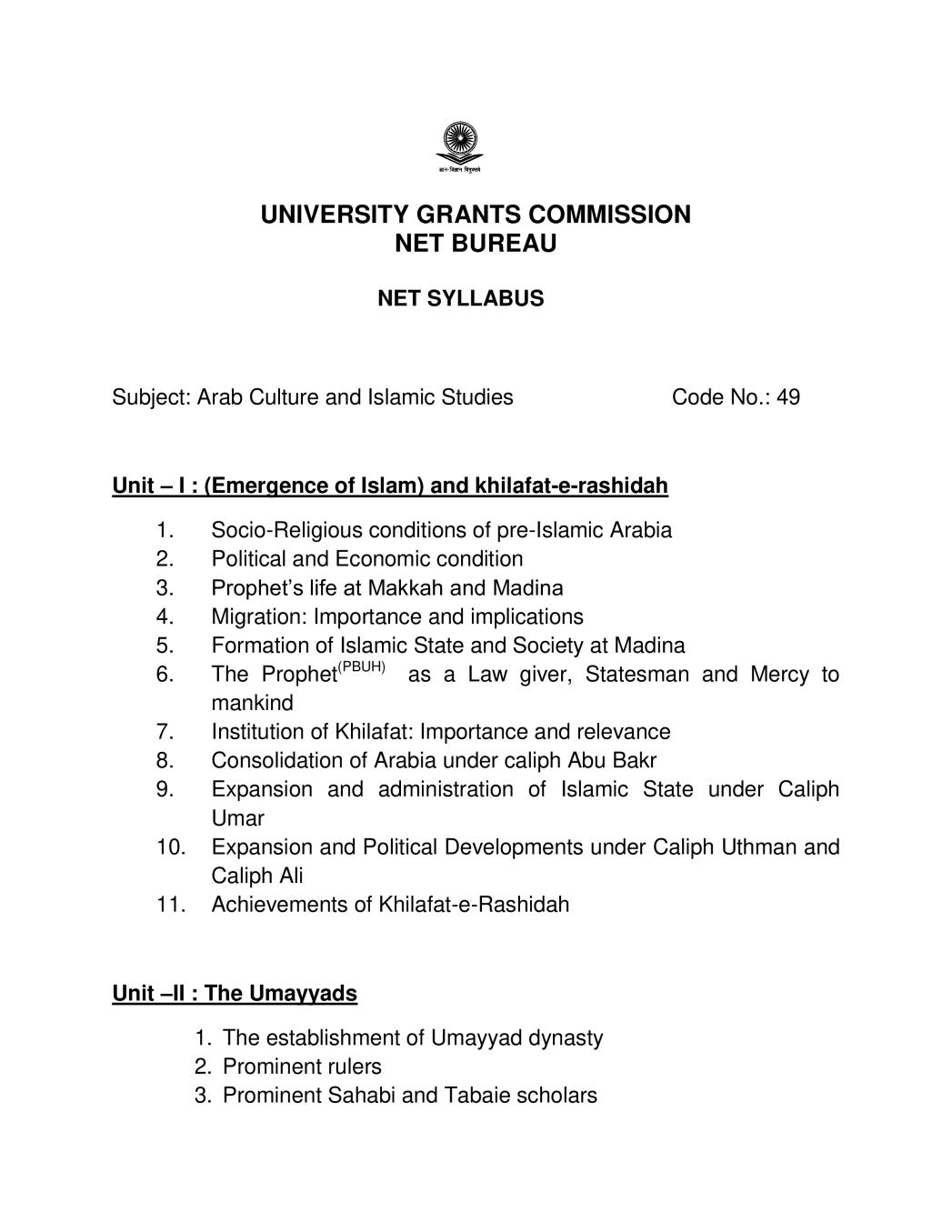
UNIVERSITY GRANTS COMMISSION
m
co
NET BUREAU
.c om e m .
m s
NET SYLLABUS
s e g l a
g l a a
a
Subject: Arab Culture and Islamic Studies Code No.: 49
Unit – I : (Emergence of Islam) and khilafat-e-rashidah
1. Socio-Religious conditions of pre-Islamic Arabia
m
co
2. Political and Economic condition
.
em
3. Prophet’s life at Makkah and Madina
4.
l a
Migration: Importance and implications
s
5.
6. a g
Formation of Islamic State and Society at Madina
The Prophet(PBUH) as a Law giver, Statesman and Mercy to
mankind
7. Institution of Khilafat: Importance and relevance
8. Consolidation of Arabia under caliph Abu Bakr
9. Expansion and administration of Islamic State under Caliph
m
Umar
m c. o
10. Expansion and Political Developments under Caliph Uthman and
c. o 11. Caliph Ali
s e m
s em la
Achievements of Khilafat-e-Rashidah
gla ag
a
Unit –II : The Umayyads
1. The establishment of Umayyad dynasty
2. Prominent rulers
3. Prominent Sahabi and Tabaie scholars
m . c
c. o s e m
m a
se
For more Question Papers, Sample Papers, Notes & Syllabus visit
g lPage 1 of 11
Page 3
5. Social and Economic conditions
6. Administration
7. Education
8. Development of Arabic Language and Literature
9. Art and Architecture
10. Causes of Decline
Unit –III : The Abbasids
1. The establishment of the Abbasid rule
2. Prominent rulers
3. Prominent Scholars
4. Administration
5. Socio-Cultural Developments
6. Development of Religious sciences
7. Education and Educational Institutions
8. Development of Arabic Language and Literature
9. Art and Architecture
10. Trade and Commerce
11. Relations with neighbouring States
12. Causes of decline
Unit –IV : The Arabs in Spain and Sicily
1. The establishment of Umayyad rule in Spain
2. The conquest of Sicily
3. Prominent rulers
4. Prominent Scholars and their impact on the west
5. Socio-Cultural developments
6. Contribution to Science and Literature
7. Development of Libraries and Educational Institutions
8. Agriculture, Trade and Commerce
For more Question Papers, Sample Papers, Notes & Syllabus visit Page 2 of 11
Page 4
. s e
em l a
as a g
9. Art and Architecture
10. Disintegration of the Empire: Emergence of Small City-State
11. Muwahhidin and Murabitin: Emergence and decline
12. Fall of Granada and Spanish Inquisition
m
m . co
c. o of East and West
Unit –V : Dynasties
se m
s em g l a
a
2.l Saljuqs
g
1. Ghaznavids
a
a3. Samanids
4. Fatimids
5. Khwarizmshahs
6. Mamluks
7. Aghlabids
m
co
8. Hamadanids
9. Idrisids
.
10. Tulunids
s em
11. Ikhshidids
g l a
12. Ayyubids a
13. Qachars
Unit VI : The Ottoman and Safavid Empire
1. Origin and Development of Ottoman Empire
m
c. o
2. Prominent Ottoman Rulers
m
c. o m
3. The Ottoman administration and army
s e
em la
4. Socio-Religious and Educational conditions
las 5. The Ottoman Society
ag
ag 6. The Ottomans and the west
7. Art and Architecture
8. The Ottoman decline: causes
9. Origin and Development of Safavid Empire
10. Shah Ismail and the promotion of Shi´ism
m . c
c. o s e m
m a
se
For more Question Papers, Sample Papers, Notes & Syllabus visit
g lPage 3 of 11
Page 5
12. Art and Architecture
13. Trade and Commerce
Unit VII : Islam in India
1. Advent of Islam in India (Kerala)
2. Islam in Sindh: Muhammad bin Qasim’s Administration and
Religious Policy
3. Establishment of Delhi Sultanate
4. Administration during the sultanate period
5. Socio-Religious and Educational conditions
6. Madaris and their syllabii
7. Contribution to Fiqh and Hadith Literature
8. The Mughal rule and administration
9. Socio-Religious and Educational scenario during the Mughal
Rule
10. Contribution to Fiqh and Hadith Literature (Sheikh Ahmad
Sirhindi, Shah Waliullah, Sheikh Abdul Haq Muhaddith Dehlvi
and others)
11. Mughal art and architecture
12. Industry, Trade and Commerce
13. 1757: British Colonialism and its expansion
14. 1857: First war of independence and its consequences
15. Role of Muslims in the freedom struggle: Khilafat and
non-cooperation movements
Unit – VIII : Islamic Sciences – Tafsir, Hadith and Fiqh
1. Collection and compilation of Quran
2. Ethical, Social, Political and Economic teachings of the Quran
3. Origin and development of Tafsir Literature
4. Classical Tafsir: Al-Tabari, Al-Razi and Zamakhshari
For more Question Papers, Sample Papers, Notes & Syllabus visit Page 4 of 11
Page 6
. s e
em l a
as a g
5. Tafsir in the modern age: Tafsir al-Manar, Fi-zilal al-Quran,
Bayan al-Quran, Tarjuman al-Quran, Tafhim al-Quran,
Tadabbur al-Quran and Tafsir al-Quran
6. Origin and development of Hadith Literature
m
co
7. Compilation of Hadith Literature
om .
8. Riwayah and Dirayah
.c e m
m s
9. Muwatta, Musnad,Sihahe-Sitta and their compilers (authors)
se g l a
a
10. Origin and development of Fiqh Literature
l a
ag
11. Sources of Islamic Fiqh
Unit – IX : Muslim Philosophy, Sufism and Muslim Contribution to
Knowledge
1. Origin and development of Muslim philosophy
m
co
2. Classical Muslim Philosophers: Al-Kindi, Farabi, Ibn-Sina,
.
em
Al-Ghazzali, Ibne Rushd.
l a s
3. Qadariyya, Murjiyya, Khawarij, Mutazalites and Asharites
4. Origin and development of Sufism
a g
5. Prominent Sufis: Hassan al- Basri, Junaid Baghdadi, Ibne-Arabi and
Sheikh Ali Hujwiri
6. Major Sufi orders: Chishtiyya, Suhrawardiyya, Qadiriyya,
Naqshabandiyya
7. Muslim contribution to Natural and Social Sciences: Medicine,
m
Mathematics, Astronomy, Historiography, Geography, chemistry and
m c. o
Botany
c. o e m
8. Prominent classical thinkers and scientists Al-Mawardi, Al-Biruni,
s
s em l a
Ibn-Tayimiyya, Ibn-Khaldun, Ibn al-Baytar, Ibn al-Haytham etc.
la a g
ag
Unit – X : Modern Trends, Movements in Islam
1. Advent of Western Modernity and Technology in Egypt and
India
2. Muhammad Ali Pasha and his reforms
m . c
c. o s e m
m a
se
For more Question Papers, Sample Papers, Notes & Syllabus visit
g lPage 5 of 11
Page 7
4. Sir Syed and his educational movement
5. Modern religious movements: The Wahabiyya, the Sokoto and
Faraizi movement
6. Shah Waliullah and his movement
7. Syed Ahmad Shaheed and his movement
8. Ikhwan al-Muslimun and Jamaate-Islami
9. Young Turk Movement, Nursi Movement
10. Arab Nationalism: Abdul Rehman al-Kawakibi
11. Western Modernity in Turkey and Iran:Mustafa Kemal and Reza
Shah
12. Muslim Modernist thinkers: Ali-Abdul Raziq, Qasim Amin, Fazlur
Rahman
13. Contemporary Muslim Organisations and Schools of Thought:
Deoband, Nadwa, the Salfis and Barelvis
14. Modern Islamic Thinkers: Jamalud-din-Afghani, Muhammad
Abduh, Rashid Rida, Hasan al- Banna, Syed Qutb, Shibli
Nomani, Allama Iqbal, Abul-A´la Maududi, Ayatullah Khomeini,
Ali Shariati and Ahmed Kasravi Tabrezi.
15. The Iranian Revolution
16. The Palestine Problem – Liberation Organisation: PLO, Hamas,
and Hezbollah
17. The Arab Spring
18. Egypt: Democracy on Trial
19. Conflicts in West Asia: Iraq, Libya, Syria and Yeman
20. Indo-Arab Relations
For more Question Papers, Sample Papers, Notes & Syllabus visit Page 6 of 11
Page 8
m .co
c. o
e m
em l a s
s a g
m
m c. o
.co s e m
em la
l a s a g
ag
m
. co
s em
g l a
a
m
m .co
c. o se
m
s em g la
gla a
a
m .
.co s e m
e m l a
l a s a g
ag For more Question Papers, Sample Papers, Notes & Syllabus visit Page 7 of 11
Page 9
Page 10
m .co
c. o
e m
em l a s
s a g
m
m c. o
.co s e m
em la
l a s a g
ag
m
. co
s em
g l a
a
m
m .co
c. o se
m
s em g la
gla a
a
m .
.co s e m
e m l a
l a s a g
ag For more Question Papers, Sample Papers, Notes & Syllabus visit Page 9 of 11
Page 11
Page 12
m .co
c. o
e m
em l a s
s a g
m
m c. o
.co s e m
em la
l a s a g
ag
m
. co
s em
g l a
a
m
m .co
c. o se
m
s em g la
gla a
a
m .
.co s e m
e m l a
l a s a g
ag For more Question Papers, Sample Papers, Notes & Syllabus visit Page 11 of 11
Document Details
| Board / Org | NTA |
| Exam | UGC National Eligibility Test |
| Type | Syllabus |
| Pages | 12 |
| Updated | 15 Jul 2026 |