UGC NET Syllabus for Comparative Study of Religions 2020
Finished viewing? Save it for later —
Download UGC NET Syllabus for Comparative Study of Religions 2020 (PDF · 8 pages)About UGC NET Syllabus for Comparative Study of Religions 2020
UGC NET Syllabus for Comparative Study of Religions 2020 is available here for free download. Published by NTA for UGC National Eligibility Test, this syllabus can be viewed online or downloaded as a PDF (8 pages). Candidates preparing for UGC National Eligibility Test can use UGC NET Syllabus for Comparative Study of Religions 2020 to understand the exam pattern, the type of questions asked, and the overall difficulty level.
Frequently Asked Questions
How can I download UGC NET Syllabus for Comparative Study of Religions 2020?
Open this page and click the Download button to save UGC NET Syllabus for Comparative Study of Religions 2020 as a PDF. It is completely free on AglaSem Docs.
Is UGC NET Syllabus for Comparative Study of Religions 2020 free to download?
Yes. UGC NET Syllabus for Comparative Study of Religions 2020 can be viewed online and downloaded as a PDF free of cost on AglaSem Docs.
How many pages does UGC NET Syllabus for Comparative Study of Religions 2020 have?
UGC NET Syllabus for Comparative Study of Religions 2020 contains 8 pages, which you can read online or download together as a single PDF.
Where can I find more UGC National Eligibility Test study material?
You can find more UGC National Eligibility Test question papers, sample papers, syllabus, and answer keys on AglaSem Docs.
UGC NET Syllabus for Comparative Study of Religions 2020 – Text
Read the full text of this syllabus below — useful to quickly search, copy and reference the content online without downloading the PDF.
📄 View text version (8 pages)
Page 1
UGC NET
Syllabus · Comparative
Study of Religions
EXAM YEAR TYPE SUBJECT
UGC NET — Syllabus Comparative Study of Religions
Notes · Sample Papers · Previous Year Papers · Mock Tests
Page 2
. s e
em l a
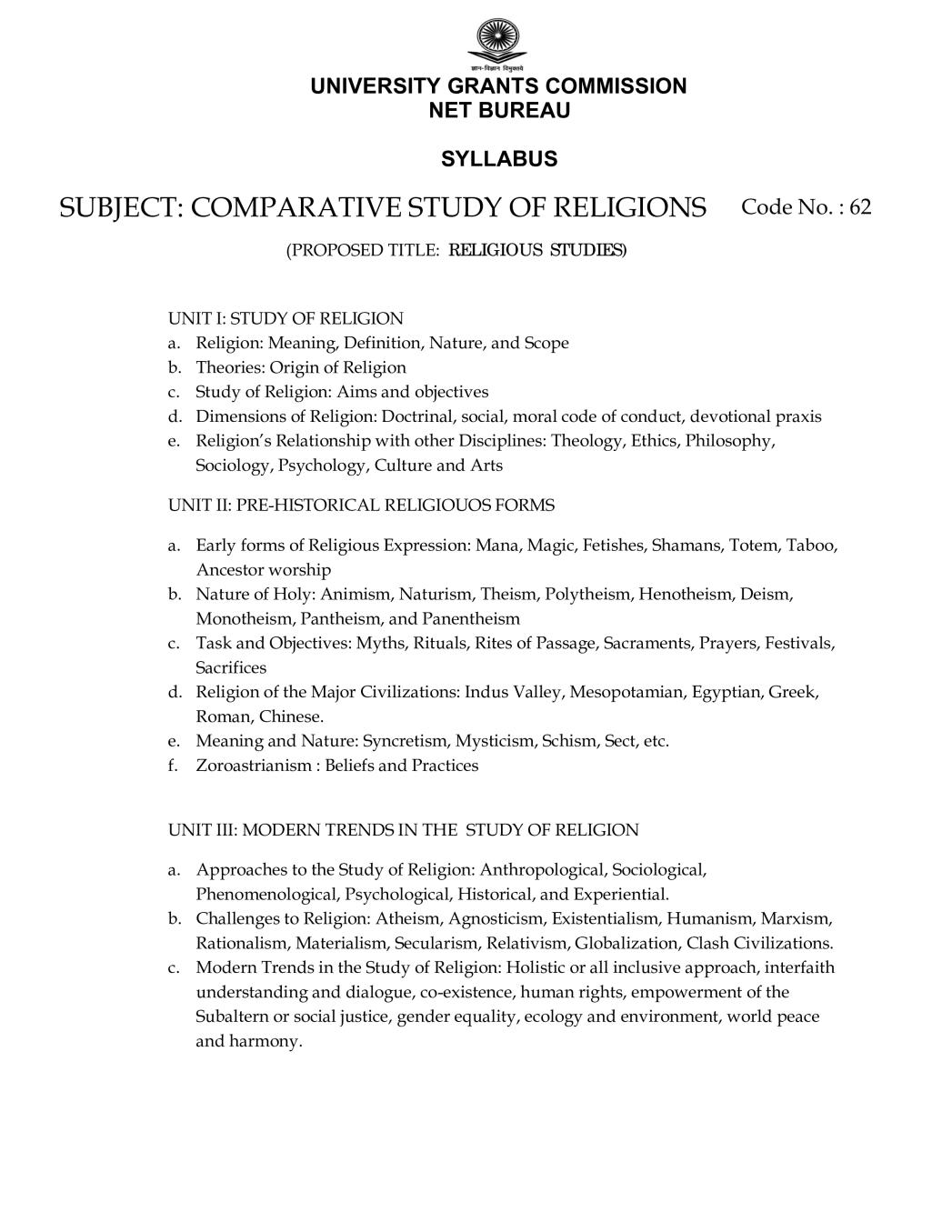
as UNIVERSITY GRANTS COMMISSION a g
NET BUREAU
SYLLABUS
SUBJECT: COMPARATIVE STUDY OF RELIGIONS Code No. : 62
m
co
(PROPOSED TITLE: RELIGIOUS STUDIES)
.c om e m .
e m l a s
s g
UNIT I: STUDY OF RELIGION
l a a
ag
a. Religion: Meaning, Definition, Nature, and Scope
b. Theories: Origin of Religion
c. Study of Religion: Aims and objectives
d. Dimensions of Religion: Doctrinal, social, moral code of conduct, devotional praxis
e. Religion’s Relationship with other Disciplines: Theology, Ethics, Philosophy,
Sociology, Psychology, Culture and Arts
UNIT II: PRE-HISTORICAL RELIGIOUOS FORMS
m
co
a. Early forms of Religious Expression: Mana, Magic, Fetishes, Shamans, Totem, Taboo,
.
Ancestor worship
s em
b. Nature of Holy: Animism, Naturism, Theism, Polytheism, Henotheism, Deism,
l a
Monotheism, Pantheism, and Panentheism
a g
c. Task and Objectives: Myths, Rituals, Rites of Passage, Sacraments, Prayers, Festivals,
Sacrifices
d. Religion of the Major Civilizations: Indus Valley, Mesopotamian, Egyptian, Greek,
Roman, Chinese.
e. Meaning and Nature: Syncretism, Mysticism, Schism, Sect, etc.
f. Zoroastrianism : Beliefs and Practices
m
c. o
UNIT III: MODERN TRENDS IN THE STUDY OF RELIGION
m
c. o e m
a. Approaches to the Study of Religion: Anthropological, Sociological,
em
Phenomenological, Psychological, Historical, and Experiential.
la s
las ag
b. Challenges to Religion: Atheism, Agnosticism, Existentialism, Humanism, Marxism,
ag
Rationalism, Materialism, Secularism, Relativism, Globalization, Clash Civilizations.
c. Modern Trends in the Study of Religion: Holistic or all inclusive approach, interfaith
understanding and dialogue, co-existence, human rights, empowerment of the
Subaltern or social justice, gender equality, ecology and environment, world peace
and harmony.
se
g lPage 1 of 7
Page 3
founder, prophet
UNIT IV: HINDUISM
a. Nature of Vedic Religion and Culture
b. Vedic Literature – Samhita-s, Aranyak-s, Upanisad-s
c. Shaivism, Vaishnavism, Shaktism, Tantraism, etc.
d. Six Systems of Hindu Philosophy – Sankhya, Yoga, Nyaya, Vaisheshika, Mimamsa,
and Vedanta
e. Epics (Ramayana, Mahabharata) and Purana-s
f. Bhakti and Reform Movements of the Medieval Period
g. Modern Reform Movements (Brahmosamaja, Aryasamaja, Ramakrishna Mission, etc.)
UNIT V: JAINISM
a. Sramana Culture and Tirthankara Tradition (Rsabhadeva to Mahavira)
b. Main Sects of Jainism – Digambara and Svethambara
c. Prakrit Agama Literature and Prominent Acaryas
d. Basic Doctrines, Principles and Philosophy
e. Contribution to Arts and Arhitecture
f. Social Aspects of Jainism
g. Contemporary Developments of Jainism
h. Jain Pilgrimage and Jain Festivals
UNIT VI: BUDDHISM
a. Background, Life and Teaching of Gautama Buddha
b. Pali Tipitaka Literature and Mahayana Sutra-s
c. Main Sects – Hinayana, Mahayana, etc.
d. Basic Doctrines, Principles and Philosophy
e. Contribution to Arts and Architecture
f. Expansion of Buddhism Outside India
g. Social Aspects and Revival of Buddhism
For more Question Papers, Sample Papers, Notes & Syllabus visit Page 2 of 7
Page 4
. s e
em l a
as a g
UNIT VII: JUDAISM
m
co
a. Origin and Development: Creation, the Call of Abraham, the Call of Moses, the
om .
Exodus, the Covenant on Mount Sinai
.c e m
s
b. Hebrew Scripture: Pentateuch (Torah), Prophets (Nibium), Writings (Ketubium)
em l a
s g
c. Jewish Beliefs: Ten Commandments, Talmud, Midrash, Passover, Messiah, etc.
l a a
ag
d. Jewish Celebration: Sabbath, Synagogue Assembly, Passover, Feast of Weeks, Feast
of Tabernacles
e. Jewish Ethics: Covenant consciousness, Mosaic Laws, Jubilee stipulations, marriage
and family
f. Importance of Jerusalem
g. Major Denomination of Judaism
m
co
UNIT VIII : CHRISTIANITY
.
em
a. The Life and Message of Jesus Christ
a s
b. The beginning of Christianity and the Sermon on the Mount
c.
g l
Old Testament and New Testament Scriptures
d.
e.
a
Main Christian Churches (Catholic, Orthodox, and Protestant)
Important Beliefs and Teachings of Christianity
f. Christian Life: Worship, Rituals, and Mysticism
g. History of Christianity in India
h. Contemporary Trends in Christian Theology
m
m UNIT IX: ISLAM c. o
c. o s e m
s em g l aQuran, the
la
a. The social, religious condition of Arabia before the advent of Islam
g
b. Life of the Prophet Mohammad and the basic teachings
a
of the
a establishment of the Islamic community and the Madina state.
c. Introduction of Hadith and Fiqh and some important Muhaddith (Imam Bukhari,
Imam Muslim) and Faqi (Imam Abu Hanifa, Imam Shafi, Imam Malki Imam Hanbal)
d. Some important Muslim thinkers: Ali ibn e Hazam, Abu Hamid al-Ghazali, ibn-e-
Taimiyah and Shah Waliullah
se
g lPage 3 of 7
Page 5
Suharwardiyah, Naqsbandiyah, and their impact on society
f. Challenges of modernity and the reform movements among Muslim in India
g. Origin and development of sects: ithna Ashari, Mutazilites and Asharits
h. The contribution of Medieval Islam to Rational sciences, philosophy and fine arts.
UNIT X: SIKHISM
a. Socio-religious milieu and life and mission of Guru Nanak
b. Development of the Sikh Panth (1539-1708)
c. The Sikh Scripture (Sri Guru Granth Sahib) and the Sikh Literature
d. The Sikh beliefs and the code of conduct
e. The Sikh institutions, ceremonies and festivals
f. The Sikh sects and Modern socio-religious movements
g. The Sikh diaspora and Modern Issues
For more Question Papers, Sample Papers, Notes & Syllabus visit Page 4 of 7
Page 6
. s e
em l a
as a g
m
om . co
.c e m
e m l a s
l a s a g
ag
m
. co
s em
g l a
a
m
m c. o
c. o s e m
s em la
gla ag
a
se
g lPage 5 of 7
Page 7
Page 8
. s e
em l a
as a g
m
om . co
.c e m
e m l a s
l a s a g
ag
m
. co
s em
g l a
a
m
m c. o
c. o s e m
s em la
gla ag
a
se
g lPage 7 of 7
Document Details
| Board / Org | NTA |
| Exam | UGC National Eligibility Test |
| Type | Syllabus |
| Pages | 8 |
| Updated | 15 Jul 2026 |