UGC NET Syllabus for Buddhist, Jaina, Gandhian and Peace Studies 2020
Finished viewing? Save it for later —
Download UGC NET Syllabus for Buddhist, Jaina, Gandhian and Peace Studies 2020 (PDF · 11 pages)About UGC NET Syllabus for Buddhist, Jaina, Gandhian and Peace Studies 2020
UGC NET Syllabus for Buddhist, Jaina, Gandhian and Peace Studies 2020 is available here for free download. Published by NTA for UGC NET, this syllabus can be viewed online or downloaded as a PDF (11 pages). Candidates preparing for UGC NET can use UGC NET Syllabus for Buddhist, Jaina, Gandhian and Peace Studies 2020 to understand the exam pattern, the type of questions asked, and the overall difficulty level.
Frequently Asked Questions
How can I download UGC NET Syllabus for Buddhist, Jaina, Gandhian and Peace Studies 2020?
Open this page and click the Download button to save UGC NET Syllabus for Buddhist, Jaina, Gandhian and Peace Studies 2020 as a PDF. It is completely free on AglaSem Docs.
Is UGC NET Syllabus for Buddhist, Jaina, Gandhian and Peace Studies 2020 free to download?
Yes. UGC NET Syllabus for Buddhist, Jaina, Gandhian and Peace Studies 2020 can be viewed online and downloaded as a PDF free of cost on AglaSem Docs.
How many pages does UGC NET Syllabus for Buddhist, Jaina, Gandhian and Peace Studies 2020 have?
UGC NET Syllabus for Buddhist, Jaina, Gandhian and Peace Studies 2020 contains 11 pages, which you can read online or download together as a single PDF.
Where can I find more UGC NET study material?
You can find more UGC NET question papers, sample papers, syllabus, and answer keys on AglaSem Docs.
UGC NET Syllabus for Buddhist, Jaina, Gandhian and Peace Studies 2020 – Text
Read the full text of this syllabus below — useful to quickly search, copy and reference the content online without downloading the PDF.
📄 View text version (11 pages)
Page 1
UGC NET
Syllabus · Buddhist
Jaina Gandhian Peace
Studies
EXAM YEAR TYPE SUBJECT
UGC NET — Syllabus Buddhist Jaina Gandhian Peace Studies
Notes · Sample Papers · Previous Year Papers · Mock Tests
Page 2
. s e
em l a
as a g
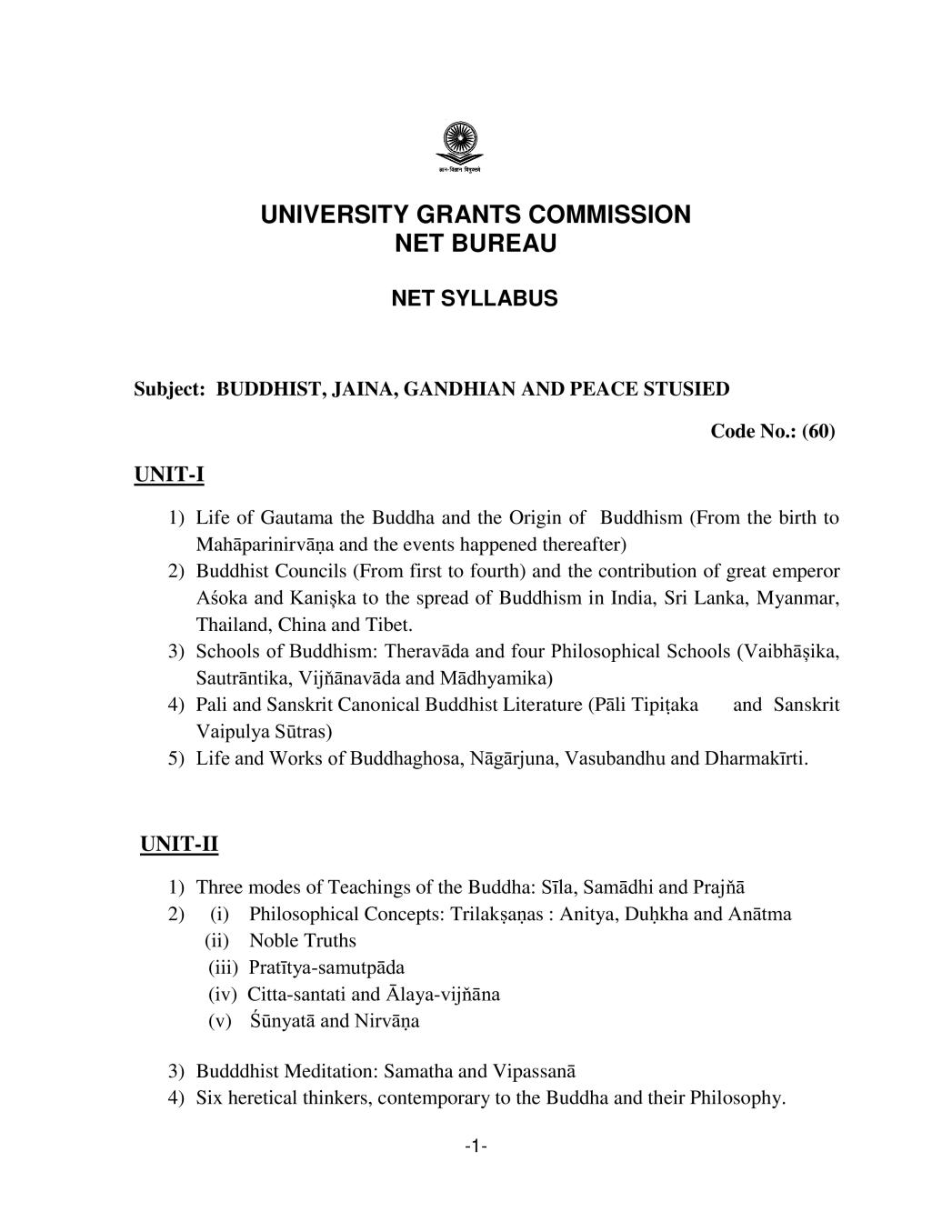
UNIVERSITY GRANTS COMMISSION
m
co
NET BUREAU
.c om e m .
m s
NET SYLLABUS
s e g l a
g l a a
a BUDDHIST, JAINA, GANDHIAN AND PEACE STUSIED
Subject:
Code No.: (60)
UNIT-I
1) Life of Gautama the Buddha and the Origin of Buddhism (From the birth to
m
co
Mahāparinirvāṇa and the events happened thereafter)
.
2) Buddhist Councils (From first to fourth) and the contribution of great emperor
em
Aśoka and Kanișka to the spread of Buddhism in India, Sri Lanka, Myanmar,
l a s
g
Thailand, China and Tibet.
a
3) Schools of Buddhism: Theravāda and four Philosophical Schools (Vaibhāșika,
Sautrāntika, Vijňānavāda and Mādhyamika)
4) Pali and Sanskrit Canonical Buddhist Literature (Pāli Tipiṭaka and Sanskrit
Vaipulya Sūtras)
5) Life and Works of Buddhaghosa, Nāgārjuna, Vasubandhu and Dharmakīrti.
o m
m c
m.
UNIT-II
c. o 1) Three modes of Teachings of the Buddha: Sīla, Samādhi andsePrajňā
em l a
s g
and Anātma
a
2) (i) Philosophical Concepts: Trilakṣaṇas : Anitya, Duḥkha
gl a
a
(ii) Noble Truths
(iii) Pratītya-samutpāda
(iv) Citta-santati and Ᾱlaya-vijňāna
(v) Śūnyatā and Nirvāṇa
3) Budddhist Meditation: Samatha and Vipassanā
4) Six heretical thinkers, contemporary to the Buddha and their Philosophy.
m . c
c. o m
-1-
m s e
se
For more Question Papers, Sample Papers, Notes & Syllabus visit
g l a
Page 1 of 10
Page 3
For more Question Papers, Sample Papers, Notes & Syllabus visit Page 2 of 10
Page 4
. s e
em l a
as a g
UNIT-III
1) Ancient Buddhist Educational Institutions (Mahāvihāras): Nālandā, Valabhi,
Vikramaśilā, Udantapurī, Somapurī and Jagaddala.
2) Buddhist sculpture and Architecture: Nālandā, Bodhagayā Temple, Ajantā
m
co
Caves, Sāncī Stūpa, Sāranātha
om .
3) Places of Buddhist Pilgrimage: Lumbinī, Bodhagayā, Sāranātha and Kuśīnārā
.c e m
m s
4) Revival of Buddhism and Contribution of Anāgarika Dharmapāla, Mahāthera,
se
Kṛpāśaraṇa, Candramaṇi Mahāthera and Bhikṣhu Jagadīśa Kāśyapa.
g l a
g l a a
a
5) Impact of Buddhism on Social and Economic life.
UNIT-IV
1) History of Jainism : Kālacakra (cycle of time) and the tradition of Tīrthaṅkaras
- Life-sketch of Lord Ṛṣabhadeva, Pārśvanātha and Mahāvīra
2) Jain Sects and their sub-division : Digambara and Śvetāmbara and their sub-
sects.
3) Ṇamokāra Mahāmantra, Five Preceptor (Pañca Parameṣṭhi), Prayer, Bhakti,
m
co
Upāsanā; Three Jewels : Samyakdarśana-Jñāna-Cāritra.
.
4) Prakrit Canonical (Āgama) Literature and their VĀCANĀS (councils).
s em
5) Prominent Ācāryas of Jainism : Life and works of Ācārya Kundakunda,
l a
Ācārya Umāsvāmi(ti), Ācārya Siddhasena, Ācārya Akalaṅka svāmi, Ācārya
g
a
Haribhadra Sūri, Ācārya Vīrasena Svāmi, Ācārya Jinasena, Ācārya
Hemchandra Sūri and Ācārya Yaśovijay.
UNIT-V
Vows : vows of Householders- Aṇuvratas, Guṇavratas and Śikṣāvratas; Great
Vows (Mahāvratas) of Monks- Ahiṃsā (non-violence), Satya (truth), Asteya
(non-stealing), Braḥmacarya (celibacy) and Aparigraha (non-possessiveness).
m
c. o
Seven elements and six substance; Theory of Karma and its classification,
m
c. o m
Puruṣārtha.
The concept of Knowledge and its classification.
s e
s em 4) Anekāntavāda and Syādvāda; Jain Yoga and Dhyāna.
la
gla
5) The concept of Liberation in Jainism.
ag
a UNIT-VI
1) Jain Art (Śilpa) and Architecture : Jain caves and temples of Southern India,
Jain Temples of Khajurāho, Devagarḥa, Pālitānā and Mount-Ābu.
2) Jain Sculptures, Paintings and Jain Iconography : important Jain Sculptures
available in India, Idols received from Śravaṇabelagolā and Mathurā.
m . c
c. o m
-3-
m s e
se
For more Question Papers, Sample Papers, Notes & Syllabus visit
g l a
Page 3 of 10
Page 5
(Dāna); Status of women in Jain Religion.
4) Environmental and Ecological thoughts in Jainism; Jainism and Science.
5) Main Centres of Jaina Learning: Śravaṇabelagolā, Jesalamera, Ahmedabad,
Varanasi, Vaishali, Koba, Ladnun, Jaipur, Delhi; Jainism in abroad.
UNIT-VII
1) Mahatma Gandhi:
(i) Family background
(ii) Early life and education in India and England
(iii) Impact of various Religions and their Scriptures
2) Gandhi in South Africa:
(i) The origin of Satyagraha
(ii) Struggle against Racial discrimination, injustice and exploitation
(iii) Impact of Leo Tolstoy, John Ruskin, Henry David Thoreau, Raichandra Bhai
etc.
Unit-VIII
1) Foundations of Gandhi’s Social, Political, Economic and Religious
Thought:
(i) Views on Social Justice, Social inequalities, Caste System and
Untouchability.
(ii) Women’s Problems and Empowerment
(iii) Gandhi’s views on Truth, Non-Violence, Satyagraha and the Theory of
ends and means
2) State and Democracy:
(i) Panchayat Raj
(ii) Parliamentary Democracy, Sovereignty, Freedom, Spiritualization of
politics
(iii) Human Rights and Duties.
-4-
For more Question Papers, Sample Papers, Notes & Syllabus visit Page 4 of 10
Page 6
. s e
em l a
as a g
3) Fundamentals of Gandhian Economics:
(i) Critique of Modern Western Civilization, Labour – Capital Relations
(ii) Small-Scale Cottage Industries
(iii) Constructive Programme and Sustainable Development.
m
m . co
Unit-IX
c. oin Freedom Movement: se m
em
1) Gandhi’s Role
s g l a
a
(ii) lNon-Cooperation a
(i) Champaran
g
a Ahmedabad Mill Strike, Dandi March
(iii)
(iv) Bardoli and Kheda Satyagrahas
(v) His Role in Vykom Satyagraha and Quit India Movement.
2) Gandhi and Partition of India.
Unit-X
m
1) Peace Studies:
. co
em
(i) Understanding Peace – Coercive and Non-Coercive Approaches, Culture of
l a s
g
Peace.
a
(ii) The problem of War: Causes, Types, Attributes and Theories of War.
2) Major Peace Movements:
(i) Pacifism, Civil Rights Movement in U.S.A. Campaign for Nuclear
Disarmament by various Agencies.
(ii) Green Peace Movement.
(iii) The contemporary Global Issues regarding World War and Quest for Peace.
(iv) Legacy of Peace Builders: Mahatma Gandhi, Martin Luther King (Jr.),
m
m c. o
Daisaku Ikeda and Nelson Mandela.
c. o 3) Conflicts: s e m
s em g l a
la a Peace Building, Peace
(i) Concept, Nature and Causes, Methods of Conflict Resolution.
ag (ii) Agencies of Conflict Resolution, UN Peace Keeping,
Education, Adjudication, Role of Shanti Sena, Track–II Diplomacy, etc.
4) Human Security and Terrorism:
(i) The problem of Terrorism
c
(ii) Structural and State Violence
m .
c. o m
-5-
m s e
se
For more Question Papers, Sample Papers, Notes & Syllabus visit
g l a
Page 5 of 10
Page 7
Page 8
. s e
em l a
as a g
m
om . co
.c e m
e m l a s
l a s ag
ag
m
. co
s em
g l a
a
m
m c. o
c. o s e m
s em la
gla ag
a
m . c
c. o s e m
m a
se
For more Question Papers, Sample Papers, Notes & Syllabus visit
g l Page 7 of 10
Page 9
Page 10
. s e
em l a
as a g
m
om . co
.c e m
e m l a s
l a s ag
ag
m
. co
s em
g l a
a
m
m c. o
c. o s e m
s em la
gla ag
a
m . c
c. o s e m
m a
se
For more Question Papers, Sample Papers, Notes & Syllabus visit
g l Page 9 of 10
Page 11
Document Details
| Board / Org | NTA |
| Exam | UGC NET |
| Type | Syllabus |
| Pages | 11 |
| Updated | 08 Jul 2026 |