CMI Entrance Exam 2018 Question Paper Solution M.Sc Computer
Finished viewing? Save it for later —
Download CMI Entrance Exam 2018 Question Paper Solution M.Sc Computer (PDF · 9 pages)About CMI Entrance Exam 2018 Question Paper Solution M.Sc Computer
CMI Entrance Exam 2018 Question Paper Solution M.Sc Computer is available here for free download. Published by Default for CMI Entrance Exam, this solution can be viewed online or downloaded as a PDF (9 pages). Candidates preparing for CMI Entrance Exam can use CMI Entrance Exam 2018 Question Paper Solution M.Sc Computer to understand the exam pattern, the type of questions asked, and the overall difficulty level.
Frequently Asked Questions
How can I download CMI Entrance Exam 2018 Question Paper Solution M.Sc Computer?
Open this page and click the Download button to save CMI Entrance Exam 2018 Question Paper Solution M.Sc Computer as a PDF. It is completely free on AglaSem Docs.
Is CMI Entrance Exam 2018 Question Paper Solution M.Sc Computer free to download?
Yes. CMI Entrance Exam 2018 Question Paper Solution M.Sc Computer can be viewed online and downloaded as a PDF free of cost on AglaSem Docs.
How many pages does CMI Entrance Exam 2018 Question Paper Solution M.Sc Computer have?
CMI Entrance Exam 2018 Question Paper Solution M.Sc Computer contains 9 pages, which you can read online or download together as a single PDF.
Where can I find more CMI Entrance Exam study material?
You can find more CMI Entrance Exam question papers, sample papers, syllabus, and answer keys on AglaSem Docs.
CMI Entrance Exam 2018 Question Paper Solution M.Sc Computer – Text
Read the full text of this solution below — useful to quickly search, copy and reference the content online without downloading the PDF.
📄 View text version (9 pages)
Page 1
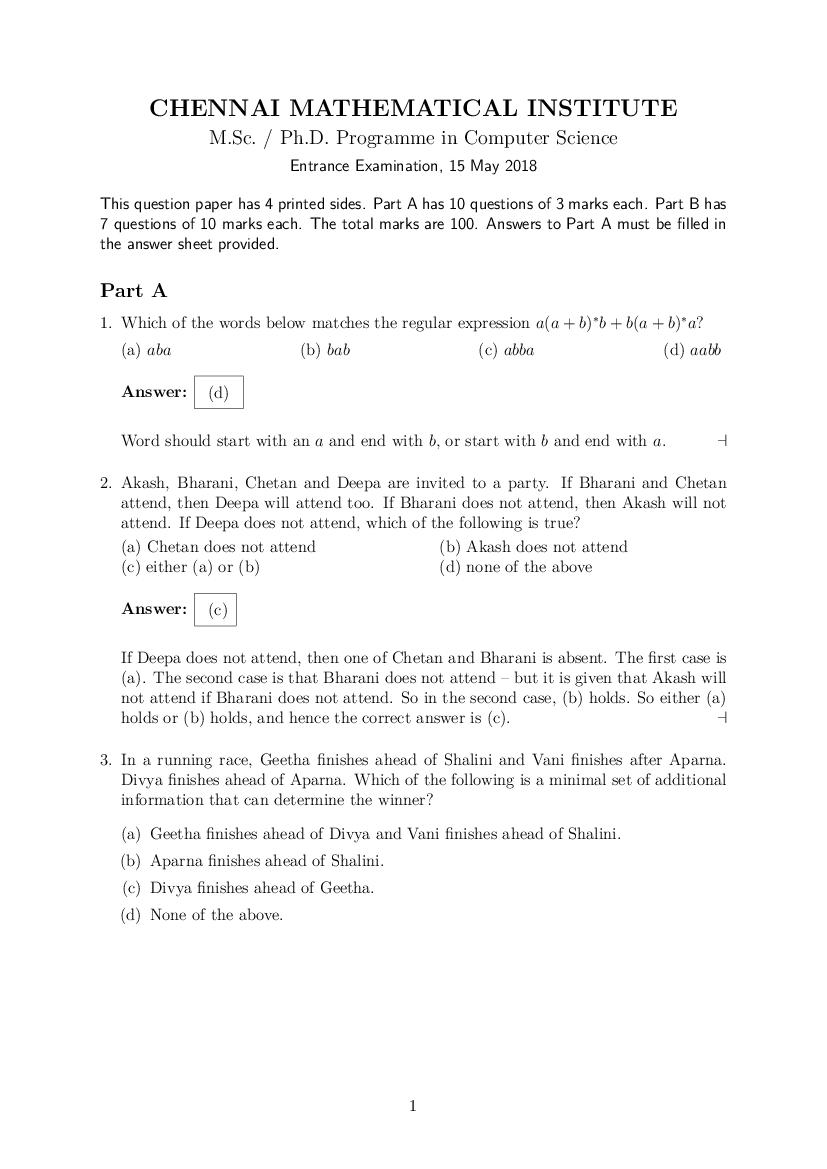
M.Sc. / Ph.D. Programme in Computer Science
Entrance Examination, 15 May 2018
This question paper has 4 printed sides. Part A has 10 questions of 3 marks each. Part B has
7 questions of 10 marks each. The total marks are 100. Answers to Part A must be filled in
the answer sheet provided.
Part A
1. Which of the words below matches the regular expression a(a + b)∗ b + b(a + b)∗ a?
(a) aba (b) bab (c) abba (d) aabb
Answer: (d)
Word should start with an a and end with b, or start with b and end with a. ⊣
2. Akash, Bharani, Chetan and Deepa are invited to a party. If Bharani and Chetan
attend, then Deepa will attend too. If Bharani does not attend, then Akash will not
attend. If Deepa does not attend, which of the following is true?
(a) Chetan does not attend (b) Akash does not attend
(c) either (a) or (b) (d) none of the above
Answer: (c)
If Deepa does not attend, then one of Chetan and Bharani is absent. The first case is
(a). The second case is that Bharani does not attend – but it is given that Akash will
not attend if Bharani does not attend. So in the second case, (b) holds. So either (a)
holds or (b) holds, and hence the correct answer is (c). ⊣
3. In a running race, Geetha finishes ahead of Shalini and Vani finishes after Aparna.
Divya finishes ahead of Aparna. Which of the following is a minimal set of additional
information that can determine the winner?
(a) Geetha finishes ahead of Divya and Vani finishes ahead of Shalini.
(b) Aparna finishes ahead of Shalini.
(c) Divya finishes ahead of Geetha.
(d) None of the above.
1
Page 2
Given: Geetha > Shalini and Divya > Aparna > Vani. The minimal extra information
needed to decide the winner is a comparison between Geetha and Divya. (a) is not
correct since it gives additional comparison between Vani and Shalini. (b) is not
correct since it does not decide the winner. (c) is the correct option, since it decides
Divya to be the winner and does not provide any extra information. (d) is not a
correct option because option (c) is correct.
⊣
4. Let G = (V, E) be an undirected simple graph, and s be a designated vertex in G. For
each v ∈ V , let d(v) be the length of a shortest path between s and v. For an edge
(u, v) in G, what can not be the value of d(u) − d(v)?
(a) 2 (b) -1 (c) 0 (d) 1
Answer: (a)
Note that d(u) ⩽ d(v) + 1 ⊣
5. How many paths are there in the plane from (0, 0) to (m, n) ∈ N × N, if the possible
steps from (i, j) are either (i + 1, j) or (i, j + 1)?
( ) (m) (m+n)
(a) 2mn
(b) n
(c) n
(d) mn
Answer: (c)
From a vertex (i, j) with either i > m or j > n, it is not possible to reach (m, n).
Therefore one cannot overshoot m on the x-axis, and n on the y-axis. The total
number of steps required to reach (m, n) is m + n (m steps on the x-axis and n on
the y-axis). Among the m + n steps, the m x-axis steps and n y-axis steps can be
distributed in any manner. This is obtained by choosing n steps for the y-axis (the
rest would go to the x-axis).
⊣
6. You are given two coins A and B that look identical. The probability that coin A
turns up heads is 41 , while the probability that coin B turns up heads is 43 . You choose
one of the coins at random and toss it twice. If both the outcomes are heads, what is
the probability that you chose coin B?
1
(a) 16 (b) 12 9
(c) 16 9
(d) 10
Answer: (d)
Pr[2 heads | B is chosen ] = 16
9
and Pr[2 heads | A is chosen ] = 16
1
. Hence
Pr[B is chosen | 2 heads ] = 0.9.
⊣
2
Page 3
segment of w has more Y ’s than X’s. Now consider the following problem. A person
stands on the edge of a swimming pool holding a bag of n red and n blue balls. He
draws a ball out one at a time and discards it. If he draws a blue ball, he takes one
step back, if he draws a red ball, he moves one step forward. What is the probability
that the person remains dry?
Cn Cn n · Cn n · Cn
(a) 2n (b) (2n) (c) (d) (2n)
2 n
(2n)! n
Answer: (b)
The total number of ways of choosing 2n balls where n balls are(identical
) of one type,
(2n)! 2n
and the other n balls are identical of a different type is = . For the person
n! · n! n
to remain dry, at any point of time he should have chosen more red balls than blue
balls. This is given by Cn . Hence the answer is (b). ⊣
8. There are 7 switches on a switchboard, some of which are on and some of which are
off. In one move, you pick any 2 switches and toggle each of them—if the switch you
pick is currently off, you turn it on, if it is on, you turn it off. Your aim is to execute
a sequence of moves and turn all 7 switches on. For which of the following initial
configurations is this not possible? Each configuration lists the initial positions of the
7 switches in sequence, from switch 1 to switch 7.
(a) (off,on,off,on,off,off,on) (b) (off,on,on,on,on,on,off)
(c) (on,off,on,on,on,on,on) (d) (off,off,off,off,off,on,off)
Answer: (c)
The parity of switches in each position is unchanged after each move. If all 7 switches
are on at the end, the final parity of ”off” is even and of ”on” is odd. So we can only
achieve this if we start with a configuration where the number of ”off” switches is even
and the number of ”on” switches is odd. The exact order does not matter since we
can pick any two to toggle at each step. ⊣
9. Your college has sent a contingent to take part in a cultural festival at a neighbouring
institution. Several team events are part of the programme. Each event takes place
through the day with many elimination rounds. Your contingent is multi-talented
and each individual has the skills to take part in a subset of the events. However,
the same individual cannot be part of the team for two different events because of a
possible clash in timings. Your aim is to create teams to take part in as many events
as possible.
To do this, you decide to model the problem as a graph where the nodes are the
events and edges represent pairs of events where the team that you plan to send
shares a member. In this setting, the graph theoretic question to be answered is:
(a) Find a maximum length simple cycle
3
Page 4
(c) Find a maximum matching
(d) Find a maximal connected component
Answer: (b)
⊣
10. What does the following function compute in terms of n and d, for integer values of n
and d, d > 1? Note that a//b denotes the quotient (integer part) of a ÷ b, for integers
a and b. For instance 7//3 is 2.
function foo(n,d){
x := 0;
while (n >= 1) {
x := x+1;
n := n//d;
}
return(x);
}
(a) The number of ways of choosing d elements from a set of size n.
(b) The number of ways of rearranging d elements from a set of size n.
(c) The number of digits in the base d representation of n.
(d) The number of ways of partitioning n elements into groups of size d.
Answer: (c)
The code computes ⌊logd (n)⌋ + 1. ⊣
Part B
1. Consider the following non-deterministic finite automata (NFA) A1 and A2 :
a, b a, b
a b
A1 : q0 q1 A2 : p0 p1
(a) Give an example of a word which is accepted by both A1 and A2 .
(b) Give an example of a word which is accepted by A1 , but not by A2 .
(c) Draw the deterministic finite automaton (DFA) equivalent to A1 .
4
Page 5
{q0 } {q0 , q1 }
b
Figure 1: Question 1 (c)
Answer:
(a) ba
(b) a
(c) The equivalent DFA is given in Figure 1.
⊣
2. A student requests a recommendation letter from a professor. The professor gives
three sealed envelopes. Each envelope contains either a good recommendation letter
or a bad recommendation letter.
(a) Make a list of all the possible scenarios.
(b) Suppose now the professor tells the student that exactly one envelope contains
a good recommendation letter and the other two contain bad recommendation
letters. In the list of scenarios you prepared above, mark the ones that are still
possible.
(c) On envelope 1 is written the clue “This contains a bad recommendation letter”.
On envelope 2 is written the clue “This contains a bad recommendation letter”.
On envelope 3 is written the clue “Envelope 2 contains a good recommendation
letter”. Suppose now the professor gives the additional information that exactly
one of these three clues are true and the other two are false. Can the student find
out the contents of the envelopes without breaking their seals?
Answer:
(a) For i ∈ {1, 2, 3}, let gi denote that letter i is good, and bi denote that it is bad.
Here are the possible scenarios:
1. b1 b2 b3
2. b1 b2 g3
3. b1 g2 b3
4. b1 g2 g3
5. g1 b2 b3
6. g1 b2 g3
7. g1 g2 b3
8. g1 g2 g3
(b) 2, 3 and 5.
5
Page 6
we see that exactly one letter is good. Let clue i denote the clue on envelope
i. Now it cannot be the case that both clue 1 and clue 2 are false, since then
both envelope 1 and envelope 2 would contain good letters, contradicting part
(b). Therefore one of clue 1 and clue 2 is true, and clue 3 is definitely false. Since
clue 2 and clue 3 assert opposite facts, this means that clue 2 is true (and hence
clue 1 is false). Thus we have that both g1 and b2 hold. Since exactly one letter
is good, it follows that b3 holds. Hence the exact scenario is g1 b2 b3 .
⊣
3. Let G be a simple graph on n vertices.
( )
(a) Prove that if G has more than n−12
edges then G is connected.
(n−1)
(b) For every n > 2, find a graph Gn which has exactly n vertices and 2
edges,
and is not connected.
Answer:
(a) We show this by an induction on n. When n = 1, there is a single vertex in the
graph, and hence the statement is vacuously true.
Suppose the statement is true for all graphs( with
) ⩽ k vertices. Consider a graph
with k + 1 vertices which has more than k2 edges. There can be no isolated
vertex in such a graph, since the maximum number (k) of edges possible in a graph of
k + 1 vertices that contains an isolated vertex is 2 . Furthermore, we can assume
without loss of generality that there is a vertex of degree at most k − 1, else the
graph is complete and hence connected. Pick an arbitrary (non-isolated) vertex
of degree at most k − 1 and delete
( ) all edges incident
( ) on it. The remaining graph
(on k vertices) has more than k2 − (k − 1) = k−1 2
edges, and hence is connected
by the inductive hypothesis. This implies that the graph on k + 1 vertices is also
connected.
(b) For the second part, consider graphs consisting of an n − 1-clique and an isolated
vertex.
⊣
4. You are given a sorted array of n elements which has been circularly shifted. For
example, {35, 42, 5, 12, 23, 26} is a sorted array that has been circularly shifted by 2
positions.
Give an O(log n) time algorithm to find the largest element in a circularly shifted
array. (The number of positions through which it has been shifted is unknown to
you.)
Answer: Let n be the number of elements in the array. If the array is not shifted at
all, then the first element is smaller than the last element. Say the array is shifted by
n
m positions, for m > 0. If m < , then the first element would be larger than the
2
n
middle element (and the largest element lies in the first half). If m >= , then the
2
6
Page 7
the second half). This suggests a recursive algorithm which reduces the search space
by half at each call, and hence gives a running time of O(log n).
The following code describes this algorithm: a/b gives the integer part of dividing a
by b. The required solution is obtained by calling f(T, 0, n-1), where n is the length
of T.
function f(T, first, last)
if (T[first] <= T[last])
return T[last]
else {
mid := first + (last - first)/2
if (T[mid] > T[mid+1])
return T[mid]
else if (T[first] > T[mid])
return f(T, first, mid-1)
else if (T[mid] >= T[last])
return f(T, mid+1, last)
}
⊣
5. Let G = (V, E) be an undirected graph and V = {1, 2, . . . , n}. The input graph is
given to you by a 0-1 matrix A of size n × n as follows. For any 1 ≤ i, j ≤ n, the entry
A[i, j] = 1 if and only if (i, j) is an edge in G.
A connected component in G is a subgraph in which any two vertices are connected
to each other by paths. Give a simple algorithm to find the number of connected
components in G. Analyze the time taken by your procedure.
Answer: We assume that there is a separate boolean array of size n that tells
which vertex is marked. Initially all vertices are unmarked. Start at vertex 1 and
perform a BFS (breadth-first search). The set of vertices marked during this pro-
cedure constitute the connected component that 1 belongs to. The time taken is
O(n × size of this connected component). Now perform a linear search for the first
unmarked vertex, and start a BFS with that as starting point. Once the BFS ter-
minates, we search for the next unmarked vertex. We repeat this procedure till all
vertices are marked. The number of times we start a BFS with a new vertex in the
above procedure is the number of connected components.
Each BFS takes time O(n × size of that connected component). Since the connected
components partition V , and since we never run a BFS on each connected component
more than once, the overall time taken by all the breadth-first searches is O(n2 ). Since
we search for a new unmarked vertex (to start a new BFS) at most nn times, and
since each search takes at most n time, the overall time taken by the above procedure
is still O(n2 ). ⊣
6. You are playing an old-style video game in which you have to shoot down alien space-
ships as they fly across the screen from left to right. Each spaceship flies across the
7
Page 8
ships at a certain height. Spaceships fly one at a time, so if your gun is set to fire at
the correct height, it will shoot down the spaceship currently flying across the screen.
You can set the initial height at which the gun fires. As the game progresses, you can
reset the height, but only to a lower value. You are given in advance the height at
which each spaceship flies. There are N spaceships numbered 1, 2, . . . , N in the order
in which they fly across the screen. For 1 ≤ i ≤ N , h[i] denotes the height at which
spaceship i flies.
(a) Let V [i] denote the maximum number of spaceships from i, i+1, . . . , N that you
can shoot down with a single gun. Write a recurrence for V [i] and describe a
strategy to compute V [i] using dynamic programming. What is the space and
time complexity of your solution?
(b) Describe an algorithm to compute the minimum number of guns required to shoot
down all the spaceships. Each gun can be initialized separately to a firing height
and each gun can be separately reset to a lower value.
Answer:
(a) If we view h[1], . . . , h[N ] as a list of numbers, we are essentially asked to find the
length of the longest descending subsequence. The recurrence is as follows:
V [N ] = 1
V [i] = 1 + max{V [j] | j > i and h[i] ⩾ h[j]}
The dynamic programming algorithm maintains an array V of size N , to be filled
in from V [N ] to V [1]. Computing the value of V [i] takes O(N ) time, since it
involves potentially examining all entries from V [i + 1] to V [N ]. Thus the time
taken overall is O(N 2 ). The space required is O(N ).
(b) The above algorithm can be modified to produce not just the length of the longest
descending subsequence, but the subsequence itself. Once we do this, we delete
these entries from the h list and find the longest descending subsequence now.
We repeat this process till the original h list has been decomposed into disjoint
descending subsequences. Since each of these subsequences can be handled by one
gun, the minimum number of guns required to shoot down all the spaceships is
the number of disjoint subsequences computed above.
⊣
7. A First In First Out queue is a data structure supporting the operations Enque, Deque,
Print. Enque(x) adds the item x to the tail of the queue. Deque removes the element
at the head of the queue and returns its value. Print prints the head of the queue.
(a) You are given a queue containing 5 elements. Using a single additional temporary
variable X, write down a sequence of statements each being one of Enque, Deque,
Print so that the output of the program results in the 5 elements of the queue
being printed in reverse order.
(b) If the queue had n elements to begin with, how many statements would you need
to print the queue in reverse order?
8
Page 9
(a) Assume the queue contains 1,2,3,4,5 in order, with 1 at the head. We display
below the sequence of instructions and the state of the queue whenever it changes.
Initial queue 12345
X = Deque; Enque(X); 23451
X = Deque; Enque(X); 34512
X = Deque; Enque(X); 45123
X = Deque; Enque(X); 51234
Print; prints 5
X = Deque; Enque(X); 12345
X = Deque; Enque(X); 23451
X = Deque; Enque(X); 34512
X = Deque; Enque(X); 45123
Print; prints 4
X = Deque; Enque(X); 51234
X = Deque; Enque(X); 12345
X = Deque; Enque(X); 23451
X = Deque; Enque(X); 34512
Print; prints 3
X = Deque; Enque(X); 45123
X = Deque; Enque(X); 51234
X = Deque; Enque(X); 12345
X = Deque; Enque(X); 23451
Print; prints 2
X = Deque; Enque(X); 34521
X = Deque; Enque(X); 45123
X = Deque; Enque(X); 51234
X = Deque; Enque(X); 12345
Print; prints 1
As we can see the number of statements in the above program is 45.
(b) Each time we do an X = Deque followed by an Enque(X), we move the element
at the head to the tail. Repeating these two statements n − 1 times moves the last
element to the head, while preserving the order among the rest of the list. Issuing
a Print instruction now prints the current head of the list (which was originally
the last element).
Thus we need 2(n − 1) + 1 instructions to move the last element to the head and
print it. At this point, the last element is what was originally the last but one
element. If we now repeat the above block of 2(n − 1) + 1 instructions, we print
the second last element of the original queue, while bringing the last two elements
of the original queue to the head.
Extending this logic, we see that if repeat the block of code n times, we end up
printing the queue in reverse. The number of statements required is n(2n − 1).
⊣
9
Document Details
| Board / Org | Default |
| Exam | CMI Entrance Exam |
| Type | Solution |
| Pages | 9 |
| Updated | 22 Jul 2026 |