UGC NET Syllabus for Indian Culture 2020
Finished viewing? Save it for later —
Download UGC NET Syllabus for Indian Culture 2020 (PDF · 9 pages)About UGC NET Syllabus for Indian Culture 2020
UGC NET Syllabus for Indian Culture 2020 is available here for free download. Published by NTA for UGC National Eligibility Test, this syllabus can be viewed online or downloaded as a PDF (9 pages). Candidates preparing for UGC National Eligibility Test can use UGC NET Syllabus for Indian Culture 2020 to understand the exam pattern, the type of questions asked, and the overall difficulty level.
Frequently Asked Questions
How can I download UGC NET Syllabus for Indian Culture 2020?
Open this page and click the Download button to save UGC NET Syllabus for Indian Culture 2020 as a PDF. It is completely free on AglaSem Docs.
Is UGC NET Syllabus for Indian Culture 2020 free to download?
Yes. UGC NET Syllabus for Indian Culture 2020 can be viewed online and downloaded as a PDF free of cost on AglaSem Docs.
How many pages does UGC NET Syllabus for Indian Culture 2020 have?
UGC NET Syllabus for Indian Culture 2020 contains 9 pages, which you can read online or download together as a single PDF.
Where can I find more UGC National Eligibility Test study material?
You can find more UGC National Eligibility Test question papers, sample papers, syllabus, and answer keys on AglaSem Docs.
UGC NET Syllabus for Indian Culture 2020 – Text
Read the full text of this syllabus below — useful to quickly search, copy and reference the content online without downloading the PDF.
📄 View text version (9 pages)
Page 1
UGC NET
Syllabus · Indian
Culture
EXAM YEAR TYPE SUBJECT
UGC NET — Syllabus Indian Culture
Notes · Sample Papers · Previous Year Papers · Mock Tests
Page 2
. e
em las
as ag
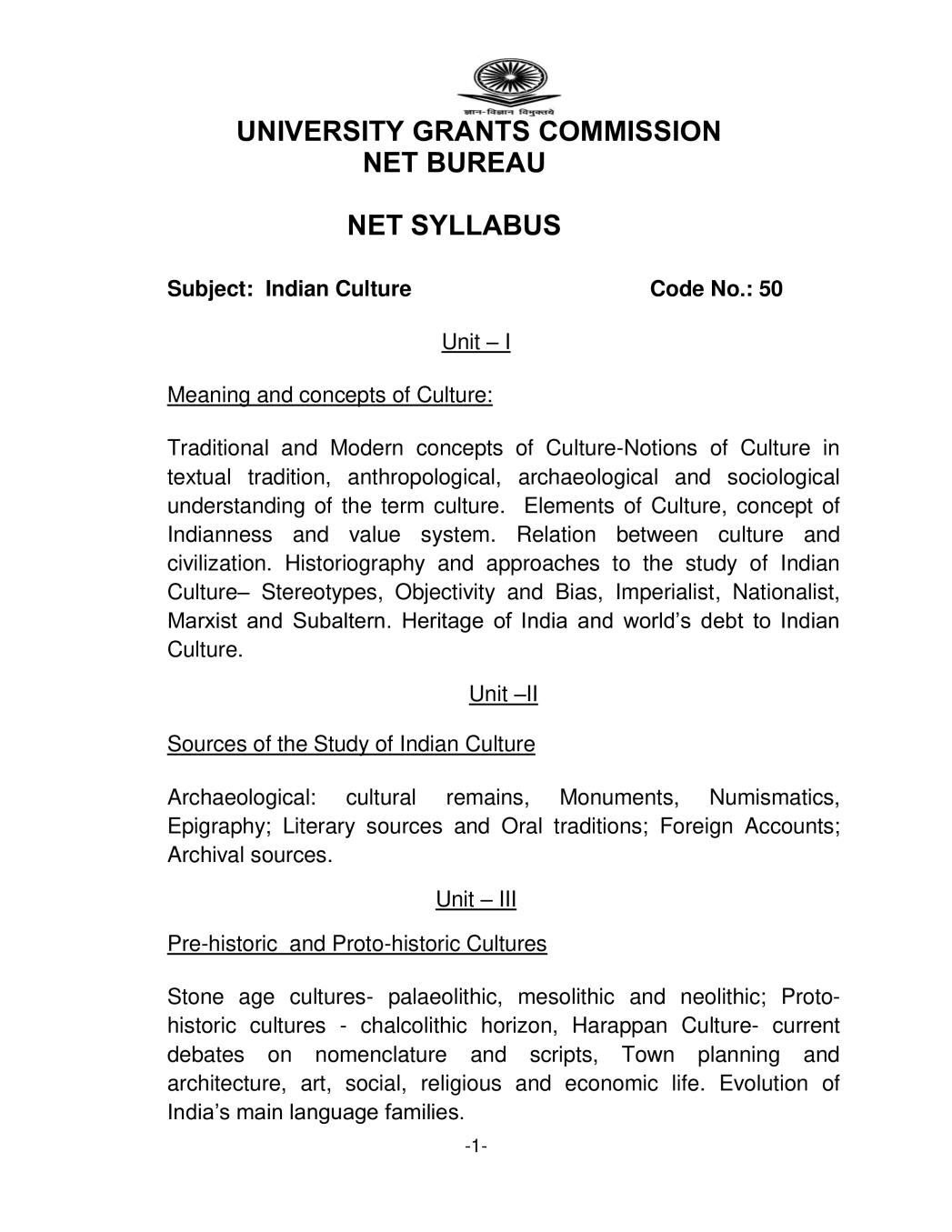
UNIVERSITY GRANTS COMMISSION
NET BUREAU
NET SYLLABUS
m
m . co
c. o Culture
Subject: Indian Code No.: 50
se m
s em g l a
la a
Unit – I
ag
Meaning and concepts of Culture:
Traditional and Modern concepts of Culture-Notions of Culture in
textual tradition, anthropological, archaeological and sociological
understanding of the term culture. Elements of Culture, concept of
Indianness and value system. Relation between culture and
m
. co
civilization. Historiography and approaches to the study of Indian
em
Culture– Stereotypes, Objectivity and Bias, Imperialist, Nationalist,
l a s
Marxist and Subaltern. Heritage of India and world’s debt to Indian
Culture.
a g
Unit –II
Sources of the Study of Indian Culture
Archaeological: cultural remains, Monuments, Numismatics,
m
Epigraphy; Literary sources and Oral traditions; Foreign Accounts;
m c. o
c. o
Archival sources.
e m
em Unit – III
la s
las ag
ag
Pre-historic and Proto-historic Cultures
Stone age cultures- palaeolithic, mesolithic and neolithic; Proto-
historic cultures - chalcolithic horizon, Harappan Culture- current
debates on nomenclature and scripts, Town planning and
architecture, art, social, religious and economic life. Evolution of
India’s main language families.
m . c
c. o m
-1-
m s e
se
For more Question Papers, Sample Papers, Notes & Syllabus visit
g l a
Page 1 of 8
Page 3
Vedic and post-Vedic Period
Early Vedic and later Vedic ideas and institutions: social, religious,
economic, political and scientific. Post Vedic– Religious Movements
and emergence of states, Shramana traditions- Buddhism, Jainism,
Ajivikas and other sects. Education system and centres– Taxila and
Kashi.
Unit –V
Mauryan and Post-Mauryan period
Ideas and Institutions: Social, Religious, Economic and Political.
Ashoka’s Dhamma. Scripts- Brahmi and Kharosthi. Impact of Foreign
Invasions. Art and Architecture. Literature- Arthasashtra, Manusmriti,
Natyashastra, Panchatantra, Buddhacharit and Saundarananda.
Scientific Achievements- Nagarjuna, Sushruta and Charaka.
Education System and Centres. Sangam Age- Society and Culture.
Contacts with outside world.
Unit - VI
Gupta and Post-Gupta period,
Ideas and Institutions: social, religious, philosophical, economic and
political. Scientific Achievements- Mathematics, Astronomy,
Metallurgy. Art and Architecture- evolution of Temples, Paintings of
Ajanta and Bagh. Literature- Kalidasa, Banabhatta, Bharavi, Magha,
Bhavabhuti, Dandi. Canonical Texts- Vishnu Dharmottara Purana.
Education system and centres- Nalanda, Valabhi. Contacts with
outside world.
-2-
For more Question Papers, Sample Papers, Notes & Syllabus visit Page 2 of 8
Page 4
. e
em las
as ag
Unit –VII
Early Medieval Period
m
Legacies of Classical ideas and emergence of new trends: Society-
om . co
Proliferation of castes, outcastes, Vishti, Slavery. Position of women.
.c e m
s
Polity- feudalism. Economy- de-urbanization and agrarian system.
e m l a
s
Religion: Vedic-Puranic, Shramana tradition, Tantra, Bhakti
l a a g
ag
movements. Philosophical thoughts- Shaddarshana. Philosophers-
Shankara, Ramanuja. Pilgrimmage tradition. Art and Architecture-
Nagara, Dravida, Bhumija, Vesara. Education system and centres-
Vikramashila, Nalanda etc. Scientific achievements- Mathematics,
Astronomy. Literature- Kalhana’s Rajatarangini and Al-Birunis’ Kitab-
ul Hind. Contacts with Islam. Canonical texts- Samarangana-
sutradhara, Manasara, Bhuvanapradeepa, Sadhanamala.
m
. co
em
Unit –VIII
l a s
Sultanate Period
a g
Delhi Sultanate - Ideas and Institutions: Political- Iqta; impact of the
new ruling class on society. Economic- market reforms, growth of
new urban centres, percolation of Islam in rural areas, resistance and
acceptance. Extent of slavery. Religion- Acharya traditions, Bhakti
o m
m c
. school of
tradition, Kabir and Ravidas, emergence of Sufism - Chishti and
c. o Suhrawardy. Art and Architecture- emergence of Sultanate
s e m
em l a
las architecture and paintings, regional styles.
ag languages and
Religious and secular
ag structures. Literature - Sanskrit, Persian, Regional
emergence of Hindawi. Amir Khusrau, Chandabardai. Education
system. Vijay Nagar Empire: Ideas and Institutions - political -
Nayankara. Art and Architecture, Literature. Educational institutions.
m . c
c. o m
-3-
m s e
se
For more Question Papers, Sample Papers, Notes & Syllabus visit
g l a
Page 3 of 8
Page 5
Mughal Period
Ideas and Institutions: Polity – Mansab and Jagir, Watan Jagir,
Economy – Zamindari and Zabt. Society – Aristocracy, emergence of
middle classes, labourers, Slaves. Position of Women.
Religion and Philosophy - growth of Vaishnava Bhakti, Panthiesm
and Sufi traditions. Sulh-i kul, Naqshabandis. Gurunanaka, Chaitanya
Mahaprabhu, Meerabai, Narayanabhatta, Raghunandana. Literature-
development in Sanskrit, Persian and vernacular languages-
Tulasidasa, Suradasa, Abdur Rahim Khan-i-khanan, Abdul Fazl,
Faizi, Badauni, Banarasidas (Ardhakathanaka). Translation of
religious texts by Akbar and Dara-Shukoh. Art and Architecture–
Emergence of Mughal Schools; Temples of Vrindavan– Gobinda
Deva and Keshava Das Temple; Four Quarter Gardens. Introduction
of new education curricullum from Akbar’s period onwards Dars-i-
nizami. Religious syncretism in coinage, miniatures and structures.
Science and Technology. – Introduction of mechanical devices,
pindrum gearing and astrolabe; Sawai Jai Singh’s observatories.
Arrival of Europeans and their impact – Portuguese, Spanish, Dutch,
English, French.
-4-
For more Question Papers, Sample Papers, Notes & Syllabus visit Page 4 of 8
Page 6
. e
em las
as ag
Unit – X
Modern Period
m
Emergence of successor states and cultural developments: Awadh,
om
Hyderabad, Mysore, Marathas and Rajputana. Impact of Western
. co
.c e m
em a s
ideas and Indian responses: European studies of India; William Jones
l
l a s Society; Fort William College; influence of Christian
a g
ag
and Asiatic
missionaries. Emergence and Development of New Education
System. Indian Cultural Renaissance. Socio-Religious reform
movements: Reformists- Brahama Samaja, Aligarh Movement,
Ramakrishna Mission and Theosophical Society; Revivalist- Wahabi
and Arya Samaj Movement. Dalit Movements; Sikh reform
m legislation on women,
movements. Administrative
c. o Measures:
e m
a sIqbal; Hindi- Bhartendu Harishchand,
education and social evils. Literature: emergence of Shahr Ashob;
g l
a
Urdu– Mirza Ghalib, Allama
Prem Chand; Bengali-Bankim Chandra Chatterjee, Rabindranath
Tagore, Qazi Nazrul Islam. Science and Technology: emergence of
modern science and technology.
m
m c. o
c. o s e m
s em la
gla ag
a
m . c
c. o m
-5-
m s e
se
For more Question Papers, Sample Papers, Notes & Syllabus visit
g l a
Page 5 of 8
Page 7
Page 8
. e
em las
as ag
m
om . co
.c e m
e m l a s
l a s a g
ag
m
. co
s em
g l a
a
m
m c. o
c. o s e m
s em la
gla ag
a
m . c
c. o s e m
m a
se
For more Question Papers, Sample Papers, Notes & Syllabus visit
g lPage 7 of 8
Page 9
Document Details
| Board / Org | NTA |
| Exam | UGC National Eligibility Test |
| Type | Syllabus |
| Pages | 9 |
| Updated | 15 Jul 2026 |