JEMAS PG 2023 Question Paper M.Sc MM
Finished viewing? Save it for later —
Download JEMAS PG 2023 Question Paper M.Sc MM (PDF · 15 pages)About JEMAS PG 2023 Question Paper M.Sc MM
JEMAS PG 2023 Question Paper M.Sc MM is available here for free download. Published by WBJEEB for JEMAS PG, this question paper can be viewed online or downloaded as a PDF (15 pages). Candidates preparing for JEMAS PG can use JEMAS PG 2023 Question Paper M.Sc MM to understand the exam pattern, the type of questions asked, and the overall difficulty level.
Frequently Asked Questions
How can I download JEMAS PG 2023 Question Paper M.Sc MM?
Open this page and click the Download button to save JEMAS PG 2023 Question Paper M.Sc MM as a PDF. It is completely free on AglaSem Docs.
Is JEMAS PG 2023 Question Paper M.Sc MM free to download?
Yes. JEMAS PG 2023 Question Paper M.Sc MM can be viewed online and downloaded as a PDF free of cost on AglaSem Docs.
How many pages does JEMAS PG 2023 Question Paper M.Sc MM have?
JEMAS PG 2023 Question Paper M.Sc MM contains 15 pages, which you can read online or download together as a single PDF.
Where can I find more JEMAS PG study material?
You can find more JEMAS PG question papers, sample papers, syllabus, and answer keys on AglaSem Docs.
JEMAS PG 2023 Question Paper M.Sc MM – Text
Read the full text of this question paper below — useful to quickly search, copy and reference the content online without downloading the PDF.
📄 View text version (14 pages)
Page 1
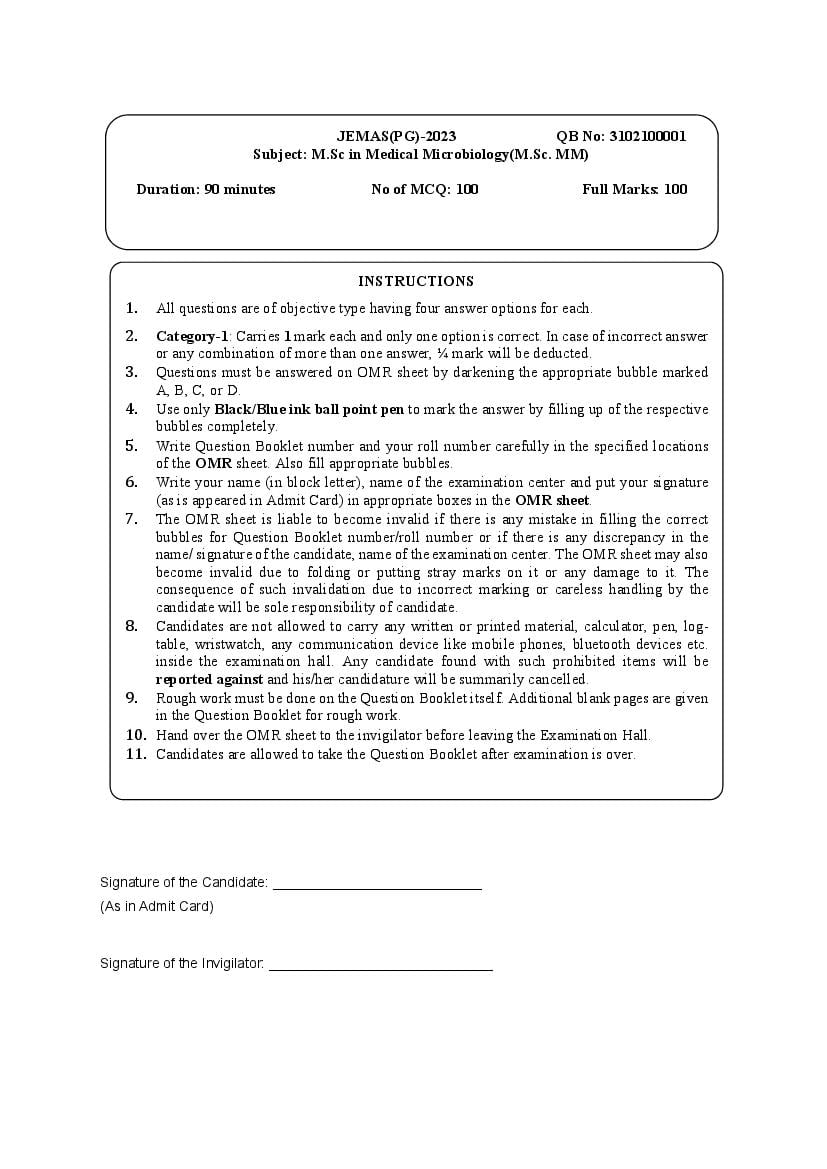
Subject: M.Sc in Medical Microbiology(M.Sc. MM)
Duration: 90 minutes No of MCQ: 100 Full Marks: 100
INSTRUCTIONS
1. All questions are of objective type having four answer options for each.
2. Category-1: Carries 1 mark each and only one option is correct. In case of incorrect answer
or any combination of more than one answer, ¼ mark will be deducted.
3. Questions must be answered on OMR sheet by darkening the appropriate bubble marked
A, B, C, or D.
4. Use only Black/Blue ink ball point pen to mark the answer by filling up of the respective
bubbles completely.
5. Write Question Booklet number and your roll number carefully in the specified locations
of the OMR sheet. Also fill appropriate bubbles.
6. Write your name (in block letter), name of the examination center and put your signature
(as is appeared in Admit Card) in appropriate boxes in the OMR sheet.
7. The OMR sheet is liable to become invalid if there is any mistake in filling the correct
bubbles for Question Booklet number/roll number or if there is any discrepancy in the
name/ signature of the candidate, name of the examination center. The OMR sheet may also
become invalid due to folding or putting stray marks on it or any damage to it. The
consequence of such invalidation due to incorrect marking or careless handling by the
candidate will be sole responsibility of candidate.
8. Candidates are not allowed to carry any written or printed material, calculator, pen, log-
table, wristwatch, any communication device like mobile phones, bluetooth devices etc.
inside the examination hall. Any candidate found with such prohibited items will be
reported against and his/her candidature will be summarily cancelled.
9. Rough work must be done on the Question Booklet itself. Additional blank pages are given
in the Question Booklet for rough work.
10. Hand over the OMR sheet to the invigilator before leaving the Examination Hall.
11. Candidates are allowed to take the Question Booklet after examination is over.
Signature of the Candidate: ___________________________
(As in Admit Card)
Signature of the Invigilator: _____________________________
Page 2
(A) Pasteur.
(B) Jenner.
(C) Koch.
(D) A.L. Hoek.
2. What best approximates the diameter of a DNA molecule?
(A) 2 nanometers.
(B) 1 micron.
(C) 10 Angstroms.
(D) 3 Angstroms.
3. Vaccination is an example of:
(A) Naturally acquired active immunity.
(B) Artificially acquired active immunity.
(C) Naturally acquired passive immunity.
(D) Artificially acquired passive immunity.
4. Retina contains the sensitive cells called:
(A) Rods and cones.
(B) Cones and cortex.
(C) Rods and pelvis.
(D) Cortex and fovea.
5. Some bacteria are considered pleomorphic. This means:
(A) They are shaped like bent rods.
(B) They have a corkscrew shape.
(C) They do not have just one shape.
(D) They are not either bacilli or cocci.
6. Night blindness is caused due to the deficiency of:
(A) Vitamin A.
(B) Vitamin B.
(C) Vitamin E.
(D) Vitamin K.
7. Rabies is transmitted by:
(A) Bugs.
(B) Flies.
(C) Infected mad dogs.
(D) Mosquitoes.
8. Which of the following is the most abundant immunoglobulin?
(A) IgM.
(B) IgG.
(C) IgA.
(D) IgE.
P a g e 1 | 13
Page 3
(A) Antibody mediated hypersensitivity.
(B) IgE mediated hypersensitivity.
(C) Cell mediated hypersensitivity.
(D) IgG mediated hypersensitivity.
10. Tears contain:
(A) IgA.
(B) IgG.
(C) Lysozyme.
(D) All of above.
11. Which of the following disease is best diagnosed by serologic means?
(A) Pulmonary tuberculosis.
(B) Gonorrhea.
(C) Actinomycosis.
(D) Q fever.
12. Which of the following shows a positive urease test?
(A) Proteus.
(B) Klebsiella.
(C) Both a and b.
(D) None of these.
13. Which of the following agent is used to prevent malaria?
(A) Mebendazole.
(B) Chloroquine.
(C) Inactivated vaccine.
(D) Zinc tablet.
14. Which of the following statements are true regarding polio vaccines:
(A) Salk and Sabin are polio vaccines.
(B) Sabin is live attenuated polio vaccine.
(C) Salk is an inactivated polio vaccine.
(D) All of these.
15. Primary lymphoid organs include:
(A) Thymus and spleen.
(B) Thymus and bone marrow.
(C) Thymus, bone marrow and spleen.
(D) Thymus, bone marrow, spleen and lymph nodes.
16. Radical shifts in pH can be prevented by incorporating:
(A) A buffer.
(B) An oxidizing agent.
(C) A reducing agent.
(D) Any of these.
P a g e 2 | 13
Page 4
(A) Bone marrow.
(B) Thymus.
(C) Spleen.
(D) Appendix.
18. Which of the following is the sweetest sugar?
(A) Fructose.
(B) Maltose.
(C) Glucose.
(D) Sucrose.
19. Which of the following is an autoimmune disease?
(A) Type 1 diabetes mellitus.
(B) Type 2 diabetes mellitus.
(C) Haemophilia A.
(D) Sickle cell anemia.
20. Gram positive cells:
(A) Have thick, homogeneous cell walls.
(B) Have large amounts of teichoic acids.
(C) Don’t have an outer membrane.
(D) All of the above are true.
21. Bleeding of gums is one of the symptoms of:
(A) Beri-beri.
(B) Scurvy.
(C) Sterility.
(D) Pellagra.
22. Tubercular granulomas are made up of:
(A) Damaged tissue cells and bacilli only.
(B) Fibrous and damaged tissue and bacilli only.
(C) Necrotic tissue and damaged tissue and bacilli only.
(D) Organized aggregates of immune cells that surround foci of infected tissues.
23. Stuart’s transport medium is used for transport of specimen containing:
(A) Neisseria gonorrhoeae.
(B) Salmonella.
(C) Vibrio cholera.
(D) Shigella
24. The medium which allows the growth of more than one microorganisms of interest but with
morphologically distinguishable colonies is known as:
(A) Selective medium.
(B) Enriched medium.
(C) Differential medium.
(D) None of these.
P a g e 3 | 13
Page 5
clinical specimen is facilitated by the use of media containing
(A) Cellulose.
(B) Certain antibiotics.
(C) Succinate.
(D) None of these.
26. A vaccine can be:
(A) An antigenic protein.
(B) Weakened pathogen.
(C) Live attenuated pathogen.
(D) All of those.
27. The transfer of tissue between genetically identical individuals (like twin) is called:
(A) Autograft.
(B) Xenograft.
(C) Allograft.
(D) Syngeneic graft.
28. The Fc region of antibody:
(A) Contains both heavy and light chains.
(B) Is required for antigen binding.
(C) Generally confers biological activity on the various molecules.
(D) Is not a requirement for placental transmission.
29. The 1st vaccine was developed by:
(A) Louis Pasteur.
(B) Edward Jenner.
(C) Carl Landsteiner.
(D) Joseph Miester.
30. The process of weakening a pathogen is called.
(A) Vaccination.
(B) Attenuation.
(C) Immunization.
(D) Virulence reduction.
31. Gram Staining was developed by:
(A) French microbiologist Louis Pasteur.
(B) Dutch lens maker Leeuwenhoek.
(C) Danish physician Chrisitian Gram.
(D) Dutch physician Christian Gram
32. The gram-negative organism is:
(A) Actinomyces.
(B) Bacillus.
(C) Clostridium.
(D) None of these.
P a g e 4 | 13
Page 6
(A) Hepatitis B vaccine.
(B) Hib vaccine.
(C) Var vaccine.
(D) DPT vaccine.
34. Which of the following organism has the smallest genome?
(A) H. Influenzae.
(B) M. genitalium.
(C) M. tuberculosis.
(D) None of these.
35. Adenosine triphosphate is a type of:
(A) Fatty acid.
(B) Amino acid.
(C) Nucleotide.
(D) Steroid.
36. Acyclovir,Valacyclovirare used in the treatment of:
(A) Chicken pox.
(B) Measles.
(C) Rubella.
(D) Q-Fever.
37. One example of synthetic therapeutic drug is:
(A) Sulphonamides.
(B) Penicillin.
(C) Bacitracin.
(D) Polymyxin.
38. Disease that effects many people at different countries is termed as -
(A) Sporadic.
(B) Pandemic.
(C) Epidemic.
(D) Endemic.
39. Kupffer cell present in the:
(A) Liver.
(B) Lung.
(C) Kidney.
(D) Bone.
40. Whooping Cough is caused by:
(A) Bordetella pertusis.
(B) Mycoplasma pneumonia.
(C) Streptococcous pyogens.
(D) Rickettsia typhi.
P a g e 5 | 13
Page 7
(A) Binet and Simon.
(B) Buoyancy.
(C) Transformation.
(D) Conjugation.
42. Sterilization by means of autoclave is based on:
(A) Steam under pressure.
(B) Dry heat.
(C) Radiation.
(D) Hot air.
43. Negative staining is used for the identification of:
(A) Flagella.
(B) Cell wall.
(C) Pili.
(D) Capsule.
44. Phenol-a disinfectant agent for the first time is invented by:
(A) Cristian Gram.
(B) Joseph Lister.
(C) Louis Pasteur.
(D) Charles Chamberland.
45. Heterocyst is found in:
(A) Blue green algae.
(B) Bacteria.
(C) Protozoa.
(D) Lichen.
46. Dipicolinic acid is a part of bacterial:
(A) Flagella.
(B) Slime layer.
(C) Capsule.
(D) Endospore.
47. An example of negative stain is:
(A) Eosin.
(B) Methylene blue.
(C) Sudan black.
(D) Lactophenol cotton blue.
48. Ethylene oxide is used to sterilized:
(A) Heat-stable products.
(B) Heat-sensitive products.
(C) Light sensitive products.
(D) Fragile products.
P a g e 6 | 13
Page 8
(A) Spo0A.
(B) SpoF.
(C) σG.
(D) KinA.
50. Give an example of chemical specifically utilized for the culture of anaerobic bacteria:
(A) Bile salt.
(B) Crystal violet.
(C) Peptone.
(D) Thioglycolate.
51. An example of basal media is:
(A) Nutrient agar.
(B) MRS agar.
(C) EMB agar.
(D) McConkey agar.
52. Secondary metabolites produced in which phase of the bacterial growth cycle:
(A) Long term stationary phase.
(B) Death phase.
(C) Lag phase.
(D) Stationary phase
53. What is the general mode of bacterial cell division?
(A) Budding.
(B) Binary division.
(C) Conjugation.
(D) Fragmentation.
54. Fenton reaction is:
(A) Fe2+ + H2O2→ Fe3+ + OH∙ + OH-
(B) O2-∙ + NO∙ → ONOO-.
(C) FADH2 + O2→ FAD + H2O2.
(D) O2-∙ + H2O2→OH- + OH∙ + O2.
55. Clinically illness of dengue is similar to:
(A) Chikungunya.
(B) Yellow fever.
(C) Q fever.
(D) Pneumonia.
56. Culex tritaeniorhynchus is a causative agent of:
(A) West Nile virus.
(B) Dengue.
(C) Norovirus.
(D) Japanese Encephalitis.
P a g e 7 | 13
Page 9
(A) Hepatitis A.
(B) Hepatitis C.
(C) Hepatitis E.
(D) Hepatitis B.
58. Numbers of RNA fragment found in influenza is:
(A) 8.
(B) 10.
(C) 6.
(D) 4.
59. Germ tube test is used to detect:
(A) Candida tropicalis.
(B) Candida krusei.
(C) Candida albicans.
(D) Candida stellata.
60. Female anopheles mosquito bite human with which malarial parasite stage:
(A) Ookinete stage.
(B) Schizont stage.
(C) Trophozoite stage.
(D) Sporozoite stage.
61. Mature nascent virion released in influenza infected cells is due to:
(A) Hemagglutininase.
(B) Protease.
(C) Collagenase.
(D) Neuraminidase.
62. Taenia soloium is a causative agent of:
(A) Leshmaniasis
(B) Cysticercosis.
(C) Amoebic dysentery.
(D) Babesiosis.
63. Reverse transcriptase is found in:
(A) Hepatitis A.
(B) HTLV-1.
(C) RSV.
(D) Adenovirus.
64. 17D vaccine is used for:
(A) Yellow fever.
(B) West Nile virus.
(C) Dengue virus.
(D) Poliovirus.
P a g e 8 | 13
Page 10
(A) Diphtheria.
(B) Pertusis.
(C) Anthrax.
(D) Shigellosis.
66. The compound potect Helicobacter pylori in stomach is:
(A) Potassium chloride.
(B) Magnesium hydroxide.
(C) N-acetylglucosamine.
(D) Ammonia.
67. Which one is belong to Streptococcus?
(A) M-proteins.
(B) Protein Z.
(C) α-toxin.
(D) Leukocidins D.
68. An example of enrichment medium is:
(A) EMB agar.
(B) Nutrient agar.
(C) McConkey agar.
(D) Robertson’s Cooked medium.
69. Ludlam's medium is used for the isolation of:
(A) Clostridium.
(B) Mycobacterium.
(C) Staphylococcus.
(D) Mycoplasma.
70. Todd-Hewitt broth is used for the isolation of:
(A) Bordetella.
(B) Streptococcus.
(C) Haemophilus.
(D) Corynebacterium.
71. Which one is not a fungal isolating media?
(A) Potato dextrose agar.
(B) Sabouraud agar.
(C) Rogosa agar.
(D) Czapek dox agar.
72. In which fungul disease, the pathogen is grow inside the macrophage during its
pathogenesis:
(A) Aspergillosis.
(B) Coccidioidomycosis.
(C) Cryptococcosis.
(D) Histoplasmosis.
P a g e 9 | 13
Page 11
(A) Candidiasis.
(B) Histoplasmosis.
(C) Vulvovaginitis.
(D) Endophthalmitis.
74. Smallest human parasite is:
(A) Trichinella spiralis.
(B) Ascarislumbricoides.
(C) Necator americanus.
(D) Schistosoma mansoni.
75. Schistosomiasis is caused by:
(A) Flatworm.
(B) Ringworm.
(C) Pinworm.
(D) Hookworm.
76. What is use of density gradient centrifugation?
(A) To purify viruses, ribosomes, membranes.
(B) To remove dirt.
(C) To remove fine particles.
(D) To remove large particles.
77. Total Magnification of a microscope is obtained by:
(A) Magnifying power of the objective lens.
(B) Magnifying power of condenser lens.
(C) Magnifying power of eyepiece.
(D) Magnifying power of both the objective lens and eyepiece.
78. Which of the following statements does not apply to IgG?
(A) Appears early in the primary immune response.
(B) Neutralizes bacterial toxins.
(C) Can fix complement.
(D) Crosses the human placenta.
79. In batch culture yield factor (Y) can varies according to:
(A) Growth rate.
(B) pH.
(C) Temperature.
(D) All of these.
80. Techoic acid:
(A) Found in the walls of Gram positive bacteria.
(B) Provide receptors for phages.
(C) Make up outer wall of Gram negative bacteria.
(D) Influence the permeability of the membrane.
P a g e 10 | 13
Page 12
(A) Corynebacterium diphtheria.
(B) Clostridium tetani.
(C) Clostridium perfringens.
(D) Clostridium botulinum.
82. Blood agar medium is:
(A) Enrichment medium.
(B) Enriched medium.
(C) Selective medium.
(D) Differential medium.
83. HIV can be transmitted through:
(A) Blood.
(B) Semen.
(C) Vaginal fluid.
(D) All of these.
84. β-pleated sheets are the examples of :
(A) Primary structure.
(B) Secondary structure.
(C) Tertiary structure.
(D) Quaternary structure.
85. Antitoxin is used for _____ immunization.
(A) Active.
(B) Passive.
(C) Both a and b.
(D) None of these.
86. Mycotoxins are produced by:
(A) Bacteria.
(B) Fungi.
(C) Algae.
(D) Protozoans.
87. B Cells are activated by:
(A) Complement.
(B) Antibody.
(C) Antigen.
(D) Interferon.
P a g e 11 | 13
Page 13
(A) Vibrio cholera.
(B) Escherichia coli.
(C) Clostridium perfringens.
(D) Enterococcus faecalis.
89. Monoclonal antibodies recognize a single:
(A) Antigen.
(B) Bacterium.
(C) Epitope.
(D) Virus.
90. Identify the obligate anaerobes:
(A) Salmonella.
(B) Vibrio cholera.
(C) Cl. tetani.
(D) Sarcinae.
91. The following are the RNA viruses, except:
(A) Reo viruses.
(B) Retro viruses.
(C) Bacteriophage Φ C.
(D) Dahila mosaic virus.
92. HPLC methods includes:
(A) Liquid / liquid (partition) chromatography.
(B) Liquid / solid (absorption) chromatography.
(C) Ion exchange and size exclusion chromatography.
(D) All of these.
93. The protein moiety of an enzyme is known as:
(A) Holo enzyme.
(B) Apo enzyme.
(C) Co enzyme.
(D) Enzyme.
94. B and T cells are produced by stem cells that are formed in:
(A) Bone marrow.
(B) The liver.
(C) The circulatory system.
(D) The spleen.
95. What is other name for zonal centrifugation?
(A) Isopynic centrifugation.
(B) Gradient centrifugation.
(C) Density gradient centrifugation.
(D) Differential centrifugation.
P a g e 12 | 13
Page 14
(A) Ring worm of the foot.
(B) Ring worm of scalp.
(C) Ring worm of non-hairy skin of body.
(D) Both a andc.
97. Example for DNA viruses:
(A) Adeno virus.
(B) Hepatites B virus.
(C) Papova virus.
(D) All of the above.
98. The initial complement component that is bound by complement-fixing antibodies is:
(A) C1q.
(B) C1s.
(C) C3b.
(D) C5a.
99. E. coli produce which type of toxins?
(A) Exotoxins.
(B) Endotoxins.
(C) Leucocidin.
(D) Both a and b.
100. Which of the following are acid fast structures?
(A) Mycobacteria.
(B) Bacterial spores.
(C) Nocardia.
(D) All of these.
P a g e 13 | 13
Document Details
| Board / Org | WBJEEB |
| Exam | JEMAS PG |
| Type | Question Paper |
| Pages | 15 |
| Updated | 24 Sep 2026 |