JEMAS PG 2023 Question Paper M.Sc PH HP
Finished viewing? Save it for later —
Download JEMAS PG 2023 Question Paper M.Sc PH HP (PDF · 13 pages)About JEMAS PG 2023 Question Paper M.Sc PH HP
JEMAS PG 2023 Question Paper M.Sc PH HP is available here for free download. Published by WBJEEB for JEMAS PG, this question paper can be viewed online or downloaded as a PDF (13 pages). Candidates preparing for JEMAS PG can use JEMAS PG 2023 Question Paper M.Sc PH HP to understand the exam pattern, the type of questions asked, and the overall difficulty level.
Frequently Asked Questions
How can I download JEMAS PG 2023 Question Paper M.Sc PH HP?
Open this page and click the Download button to save JEMAS PG 2023 Question Paper M.Sc PH HP as a PDF. It is completely free on AglaSem Docs.
Is JEMAS PG 2023 Question Paper M.Sc PH HP free to download?
Yes. JEMAS PG 2023 Question Paper M.Sc PH HP can be viewed online and downloaded as a PDF free of cost on AglaSem Docs.
How many pages does JEMAS PG 2023 Question Paper M.Sc PH HP have?
JEMAS PG 2023 Question Paper M.Sc PH HP contains 13 pages, which you can read online or download together as a single PDF.
Where can I find more JEMAS PG study material?
You can find more JEMAS PG question papers, sample papers, syllabus, and answer keys on AglaSem Docs.
JEMAS PG 2023 Question Paper M.Sc PH HP – Text
Read the full text of this question paper below — useful to quickly search, copy and reference the content online without downloading the PDF.
📄 View text version (13 pages)
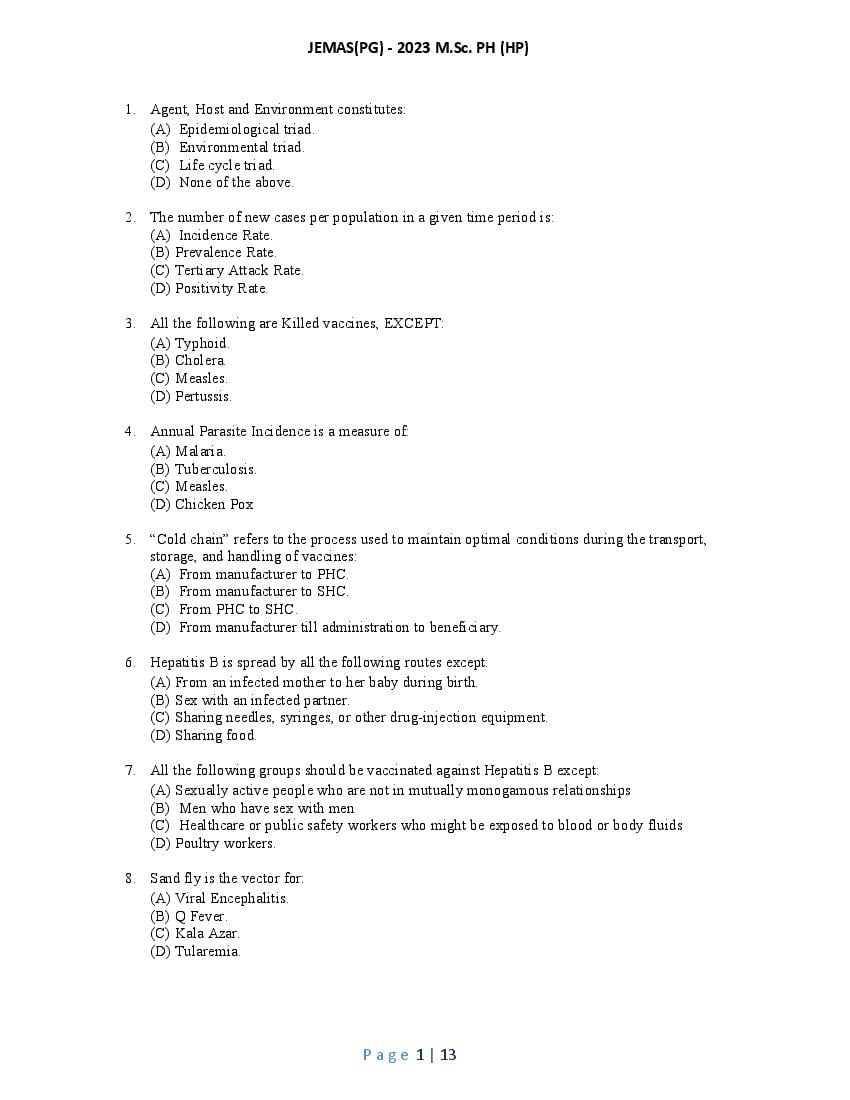
Page 1
(A) Epidemiological triad.
(B) Environmental triad.
(C) Life cycle triad.
(D) None of the above.
2. The number of new cases per population in a given time period is:
(A) Incidence Rate.
(B) Prevalence Rate.
(C) Tertiary Attack Rate.
(D) Positivity Rate.
3. All the following are Killed vaccines, EXCEPT:
(A) Typhoid.
(B) Cholera.
(C) Measles.
(D) Pertussis.
4. Annual Parasite Incidence is a measure of:
(A) Malaria.
(B) Tuberculosis.
(C) Measles.
(D) Chicken Pox
5. “Cold chain” refers to the process used to maintain optimal conditions during the transport,
storage, and handling of vaccines:
(A) From manufacturer to PHC.
(B) From manufacturer to SHC.
(C) From PHC to SHC.
(D) From manufacturer till administration to beneficiary.
6. Hepatitis B is spread by all the following routes except:
(A) From an infected mother to her baby during birth.
(B) Sex with an infected partner.
(C) Sharing needles, syringes, or other drug-injection equipment.
(D) Sharing food.
7. All the following groups should be vaccinated against Hepatitis B except:
(A) Sexually active people who are not in mutually monogamous relationships
(B) Men who have sex with men
(C) Healthcare or public safety workers who might be exposed to blood or body fluids
(D) Poultry workers.
8. Sand fly is the vector for:
(A) Viral Encephalitis.
(B) Q Fever.
(C) Kala Azar.
(D) Tularemia.
P a g e 1 | 13
Page 2
(A) Guppy fish.
(B) Gambusia fish.
(C) Ambylospora.
(D) Fenthion.
10. Scabies is caused by:
(A) Cyclops.
(B) Itch mite.
(C) Fleas.
(D) Ticks.
11. All the following diseases are water borne infections EXCEPT:
(A) Amoebiasis.
(B) Giardiasis.
(C) Salmenellosis.
(D) Chancroid.
12. Coliform count of water indicates:
(A) Water contamination.
(B) Vector breeding.
(C) No. of cholera vibrios.
(D) None of the above.
13. Rats are associated with transmission of all the following diseases EXCEPT:
(A) Plague.
(B) Salmonellosis.
(C) Leptospirosis.
(D) Q fever.
14. Lice are vectors of all the following diseases except:
(A) Epidemic typhus.
(B) Relapsing fever.
(C) Trench fever.
(D) Leptospirosis.
15. Multibacillary leprosy is diagnosed when there are:
(A) > 6 skin lesions.
(B) >5 skin lesions.
(C) >4 skin lesions.
(D) >3 skin lesions.
16. DOTS PLUS is meant for treatment of:
(A) Childhood Tuberculosis
(B) Multidrug resistant T.B.
(C) Pregnant women with TB
(D) HIV and TB co infection.
P a g e 2 | 13
Page 3
(A) Acute Flaccid paralysis.
(B) Anaphylaxis.
(C) Brachial neuritis.
(D) Diarrhea.
18. Polyvalent vaccines are those which are::
(A) Prepared from two or more strains of the same species.
(B) Prepared from two or more strains of different species.
(C) Prepared from single strain of many species.
(D) Prepared from one strain each of the two species.
19. All the following are signs of severe dehydration, except:
(A) Drowsy.
(B) Dry tongue.
(C) Feeble pulse.
(D) Frequent urine.
20. Swachh Bharat Abhiyan (SBA) was launched on::
(A) 2 October 2014.
(B) 2 November 2015.
(C) 14 November 2016.
(D) 1st December 2014.
21. Recommended salt intake per day is:
(A) < 5g.
(B) < 10g.
(C) <15g.
(D) <20g.
22. All the following are contradictions of Intra Uterine devices, except:
(A) Suspected pregnancy.
(B) Pelvic inflammatory disease.
(C) Previous still birth.
(D) Cancer cervix.
23. MAA program stands for:
(A) Mothers’ Absolute Affection
(B) Maternal Attention & Affection
(C) Monthly Attendance Accuracy
(D) Mothers’ Antenatal Attendance.
24. Rashtriya Bal Swasthya Karyakram (RBSK) is an important initiative aims towards early
identification of all the following except:
(A) Defects at birth
(B) Deficiencies
(C) Development delays including disability
(D) Socio economic status.
P a g e 3 | 13
Page 4
(A) 1 ml (1 lakh IU).
(B) 0.5 ml (50,000 IU).
(C) 2 ml (2 lakh IU).
(D) 2.5 ml (2.5 lakh IU).
26. In National Health Mission, ARSH stands for:
(A) Adolescent Reproductive & Sexual Health Program.
(B) Adolescent Reproductive & School Health Program.
(C) Adult Reproductive & Sexual Health Program.
(D) Adult Rehabilitation & Screening Health Program.
27. Rashtriya Bal Swasthya Karyakram (RBSK) is aimed at screening children from:
(A) 0 to 18 years.
(B) 0 to 10 years.
(C) 0 to 5 years.
(D) 0 to 12 years.
28. Water-washed diseases include all the following except:
(A) Skin infections.
(B) Eye infections.
(C) Giardia infection.
(D) None of the above.
29. The natural host of the Nipah virus are:
(A) Fruit bats.
(B) Birds.
(C) Monkeys.
(D) Dogs.
30. Foods rich in trans-fat include all the following except:
(A) Cookies.
(B) Cakes.
(C) Chips.
(D) Nuts.
31. The warm chain to keep the new-born includes all the following except:
(A) Skin-to-skin contact at birth.
(B) Breastfeeding.
(C) Postponing bathing and weighing.
(D) Room heater.
32. Kangaroo mother care provides a new-born all the following except:
(A) Warmth.
(B) Mother’s milk
(C) Protection.
(D) Kangaroo milk. .
P a g e 4 | 13
Page 5
(A) <1.5 Kg.
(B) < 1 Kg.
(C) < 800 gm.
(D) <500 gm.
34. Which of the following international conferences first time advocated the concept of health
promotion?
(A) Ottawa charter.
(B) ICPD.
(C) Jakarta declaration.
(D) Habitat II.
35. All are health promotion strategies, except:
(A) Spraying of Insecticides.
(B) Supply of safe water.
(C) Chemoprophylaxis.
(D) Lifestyle modification.
36. Zero dose of OPV can be given to a newborn within:
(A) First 24 hours
(B) First 48 hours
(C) First 7 days
(D) First 15 days.
37. India is in which stage of demographic cycle?
(A) High stationary
(B) Early expanding
(C) Late expanding
(D) Low stationary.
38. Which of the following is an example of primary prevention?
(A) Cervical cytology screening.
(B) Measles immunization.
(C) Self-examination of breast for lumps.
(D) Smoking cessation after a heart attack.
39. The ratio between the incidence of disease among exposed and incidence among non-exposed
is called:
(A) Causal risk.
(B) Relative risk.
(C) Attributable risk.
(D) Odds ratio.
40. Anti malaria month is observed in the month of:
(A) April.
(B) May.
(C) June.
(D) July.
P a g e 5 | 13
Page 6
(A) Still births.
(B) Hyperactivity.
(C) Deafness.
(D) Delayed development.
42. All have vegetable sources, except
(A) Vitamin A.
(B) Vitamin B 6.
(C) Vitamin B 12.
(D) Vitamin C.
43. What should the minimum iodine content of iodized salt at household level?
(A) 10 ppm.
(B) 15ppm.
(C) 20 ppm.
(D) 25 ppm.
44. Aedes mosquito is the vector for all, except:
(A) Japanese encephalitis.
(B) Yellow fever.
(C) Dengue.
(D) Chikungunya.
45. Principles of Primary Health Care include all, except:
(A) Equitable distribution.
(B) Intersectoral coordination.
(C) Monitoring of health programmes.
(D) Participation of community.
46. The first case of novel corona virus was identified in:
(A) Beijing.
(B) Shanghai.
(C) Wuhan, Hubei.
(D) Hong Kong.
47. Diseases transmitted through faeco-oral route are all, except:
(A) Typhoid fever.
(B) Poliomyelitis.
(C) Measles.
(D) Viral hepatitis.
48. In Cu-T 380 A, 380 represents:
(A) No. of turns of copper wire.
(B) Surface area of Cu-T in sq. mm.
(C) Surface area of copper in sq. mm.
(D) Follow-up within 380 days.
P a g e 6 | 13
Page 7
(A) Mid-year population.
(B) Total pregnant women of the community.
(C) Total births in the year.
(D) Live births in the year.
50. All of the following are adverse effects of Oral Contraceptive Pills, except:
(A) Iron deficiency anemia.
(B) Breast tenderness.
(C) Weight gain.
(D) Elevated blood pressure.
51. Values are arranged in a serial order to determine:
(A) Mean.
(B) Mode.
(C) Median.
(D) Standard deviation.
52. Household waste-water which does not contain human excreta is known as:
(A) Refuse.
(B) Sewage.
(C) Sludge.
(D) Sullage.
53. SPSS stands for:
(A) Software Package for the Social Sciences.
(B) Software Package for the Statistical Sciences.
(C) Statistical Package for the Social Sciences.
(D) Statistical Product for the Social Sciences.
54. In a study carried out in a hospital ward, every 5thadmitted patient was included in the sample,
which sampling procedure is this?
(A) Simple Random sampling.
(B) Stratified sampling.
(C) Quota sampling.
(D) Systematic random sampling.
55. Route for HIV transmission with maximum efficiency is:
(A) Sexual.
(B) Transfusion of blood/ blood products.
(C) Sharing of syringes and needles.
(D) Mother to child transmission.
56. 4-8 qualified persons discussing a topic in front of a large audience is an example of :
(A) Symposium.
(B) Panel discussion.
(C) Workshop.
(D) Group discussion.
P a g e 7 | 13
Page 8
(A) Infant mortality.
(B) Access to knowledge.
(C) Life expectancy.
(D) Gross National income.
58. All of the following are approaches to health education, except:
(A) Service approach.
(B) Regulatory approach.
(C) Health education approach.
(D) Role playing.
59. Headquarter of World Health Organization is at
(A) Rome.
(B) New York.
(C) Washington.
(D) Geneva.
60. In a slum population of 5000, a survey revealed that number of new cases of TB is 480; old
cases in the same population are 120. What is the prevalence of TB?
(A) 10%
(B) 11%
(C) 12%
(D) 13%
61. In calculating Dependency Ratio, the numerator is expressed as:
(A) Population under 10 years plus population more than 60 years.
(B) Population under 15 years plus population more than 60 years.
(C) Population under 10 years plus population more than 65 years.
(D) Population under 15 years plus population more than 65 years.
62. According to IMNCI, fast breathing in a 5 months old child is defined as a respiratory rate:
(A) >30/min
(B) >40/min
(C) >50/min
(D) >60/min
63. Mid-day meal should supply:
(A) At least 1/2 of protein requirement and 1/2 of energy requirement of child.
(B) At least 1/2 of protein and 1/3rd of energy requirement of child.
(C) At least 1/3rd of protein and 1/3rd of energy requirement of child.
(D) At least 1/3rd of protein and 1/2 of energy requirement of child.
64. All the following are advantages of case control studies, except:
(A) Useful in rare diseases.
(B) Relative risk can be calculated.
(C) Odds ratio can be calculated.
(D) Cost-effective and inexpensive.
P a g e 8 | 13
Page 9
(A) 1977.
(B) 1978.
(C) 1979.
(D) 1980.
66. The concept of Health promotion was initiated in:
(A) 1883.
(B) 1884.
(C) 1985.
(D) 1986..
67. Sociocultural factors do not include:
(A) Family.
(B) Religion.
(C) Culture.
(D) Attitude.
68. Which of the following factors is a behavioral determinant of health?
(A) Age.
(B) Sex.
(C) Diet.
(D) Custom.
69. How many wings are there in Health Promotion Logo?
(A) 1.
(B) 2.
(C) 3.
(D) 4.
70. Health promotion involves action in how many areas:
(A) 1.
(B) 3.
(C) 5.
(D) 7.
71. Quota sampling is a type of:
(A) Purposive sampling.
(B) Systematic sampling.
(C) Random sampling.
(D) Snowball sampling.
72. Panel discussion is:
(A) Didactic method.
(B) Socratic method.
(C) Mass method.
(D) All the above.
P a g e 9 | 13
Page 10
(A) Bhore Committee.
(B) Mukherjee Committee.
(C) Kartar Singh Committee.
(D) Srivastav Committee.
74. Three –Tier system of Health Care delivery is based on recommendation of:
(A) Bhore Committee.
(B) Mukherjee Committee.
(C) Kartar Singh Committee.
(D) Srivastav Committee.
75. Director General of Health Services (DGHS) is the principle adviser to the:
(A) Local Self Govt.
(B) State Government.
(C) Union Government.
(D) None of the above.
76. Estimation of pregnant women can be done by following method :
(A) Birth rate x Population / 1000 + add 10 %.
(B) Birth rate x Population / 1000 + add 100 %.
(C) Birth rate x Population / 1000.
(D) Birth rate x Population / 100 + add 10%.
77. 1st trimesters of pregnancy means:
(A) LMP – 12 weeks.
(B) 13 weeks – 28 weeks.
(C) 29 weeks – 40 weeks.
(D) None of the above.
78. Epidemic disease Act was enacted in:
(A) 1897.
(B) 1997.
(C) 2007.
(D) 2019.
79. All of the following are modifiable determinants of health except:
(A) Life style.
(B) Education.
(C) Income.
(D) Gender.
80. All of the following are common causes of Infant death in India except:
(A) ARI.
(B) Diarrhoea.
(C) Hypothermia.
(D) Jaundice.
P a g e 10 | 13
Page 11
(A) Infancy.
(B) Neonatal period.
(C) Early Neonatal period.
(D) Between 28 -37 weeks of pregnancy.
82. Exclusive breast feeding means:
(A) Feeding the child with no other food or drink other than breast milk.
(B) Breast Feeding along with Cow milk, Goat milk etc .if it is available from own home.
(C) Breast feeding along with commercially available milk if affordable.
(D) Breast feeding and giving some water if the baby is thirsty.
83. All of the following are true for Diarrhoea except:
(A) Passage of loose stool three or more times a day.
(B) Passage of large amount of loose stool even for once can also be called Diarrhoea.
(C) It may or may not be associated with Vomiting.
(D) Stool may contain blood also.
84. The most serious danger in Diarrhoea is:
(A) Loss of fluid from the body.
(B) Loss of Electrolytes from the body.
(C) Loss of both the fluid and Electrolytes from the body.
(D) Passage of blood in the stool.
85. Green leafy vegetables are rich in-
(A) Carbohydrate.
(B) Protein.
(C) Fat.
(D) Vitamins.
86. The richest source of Vitamin- C is:
(A) Milk.
(B) Egg.
(C) Orange.
(D) Amla.
87. Deficiency of Essential Fatty acids can cause?
(A) Rickets.
(B) Beriberi.
(C) Night blindness.
(D) Phrynoderma.
88. Deficiency of dietary Iodine can cause all of the following except:
(A) Cretinism.
(B) Pellagra.
(C) Mental retardation.
(D) Decreased fertility.
P a g e 11 | 13
Page 12
(A) 18.5 - 24.99.
(B) 25 - 29.99.
(C) 30 - 34.99.
(D) 35 - 39.99.
90. Sudden outbreak of a disease in a large geographic area is known as:
(A) Disease out break
(B) Endemic.
(C) Epidemic.
(D) Sporadic.
91. All of the followings are true about CONDOM except:
(A) It can protect from STDS& AIDS.
(B) Helps in spacing of births.
(C) Helps to avoid unwanted pregnancies.
(D) It is expensive.
92. The Immunoglobulin that can pass through placenta is:
(A) Ig A.
(B) Ig G.
(C) Ig M.
(D) Ig E.
93. Active search of a disease among apparently healthy people is called:
(A) Surveillance.
(B) Periodic health checks up.
(C) Monitoring.
(D) Screening.
94. Pentavalent vaccine contain:
(A) DPT + JE +Measles vaccine.
(B) DPT + Measles + Rubella vaccine.
(C) DPT + Rota + IPV.
(D) DPT + Hep-B + Hib.
95. All of the following vaccines are live vaccines except:
(A) BCG.
(B) OPV.
(C) Hepatitis – B.
(D) Measles.
96. Separation of a sick/ infected person in a place till he or she becomes non- infectious is called:
(A) Isolation.
(B) Quarantine.
(C) Observation.
(D) None of the above.
P a g e 12 | 13
Page 13
(A) Any bleeding per vagina.
(B) Blurring of vision.
(C) Loss of foetal movements.
(D) All of the above.
98. Which of the following is not a 2 – way communication?
(A) Lecture.
(B) Group discussion.
(C) Panel discussion.
(D) Syposium.
99. In case of Sore nipple, a mother can be advised for all of the following except:
(A) To continue breast feeding more frequently.
(B) To express breast milk to reduce engorgement.
(C) Stop breast feeding.
(D) To give hot compress to relieve pain.
100. Midday meal program provides all of the following except:
(A) 450 calories of energy.
(B) 12 gm. of Protein.
(C) On all school days.
(D) Up to Primary school level.
P a g e 13 | 13
Document Details
| Board / Org | WBJEEB |
| Exam | JEMAS PG |
| Type | Question Paper |
| Pages | 13 |
| Updated | 24 Sep 2026 |