JEMAS PG 2023 Question Paper MOT
Finished viewing? Save it for later —
Download JEMAS PG 2023 Question Paper MOT (PDF · 16 pages)About JEMAS PG 2023 Question Paper MOT
JEMAS PG 2023 Question Paper MOT is available here for free download. Published by WBJEEB for JEMAS PG, this question paper can be viewed online or downloaded as a PDF (16 pages). Candidates preparing for JEMAS PG can use JEMAS PG 2023 Question Paper MOT to understand the exam pattern, the type of questions asked, and the overall difficulty level.
Frequently Asked Questions
How can I download JEMAS PG 2023 Question Paper MOT?
Open this page and click the Download button to save JEMAS PG 2023 Question Paper MOT as a PDF. It is completely free on AglaSem Docs.
Is JEMAS PG 2023 Question Paper MOT free to download?
Yes. JEMAS PG 2023 Question Paper MOT can be viewed online and downloaded as a PDF free of cost on AglaSem Docs.
How many pages does JEMAS PG 2023 Question Paper MOT have?
JEMAS PG 2023 Question Paper MOT contains 16 pages, which you can read online or download together as a single PDF.
Where can I find more JEMAS PG study material?
You can find more JEMAS PG question papers, sample papers, syllabus, and answer keys on AglaSem Docs.
JEMAS PG 2023 Question Paper MOT – Text
Read the full text of this question paper below — useful to quickly search, copy and reference the content online without downloading the PDF.
📄 View text version (15 pages)
Page 1
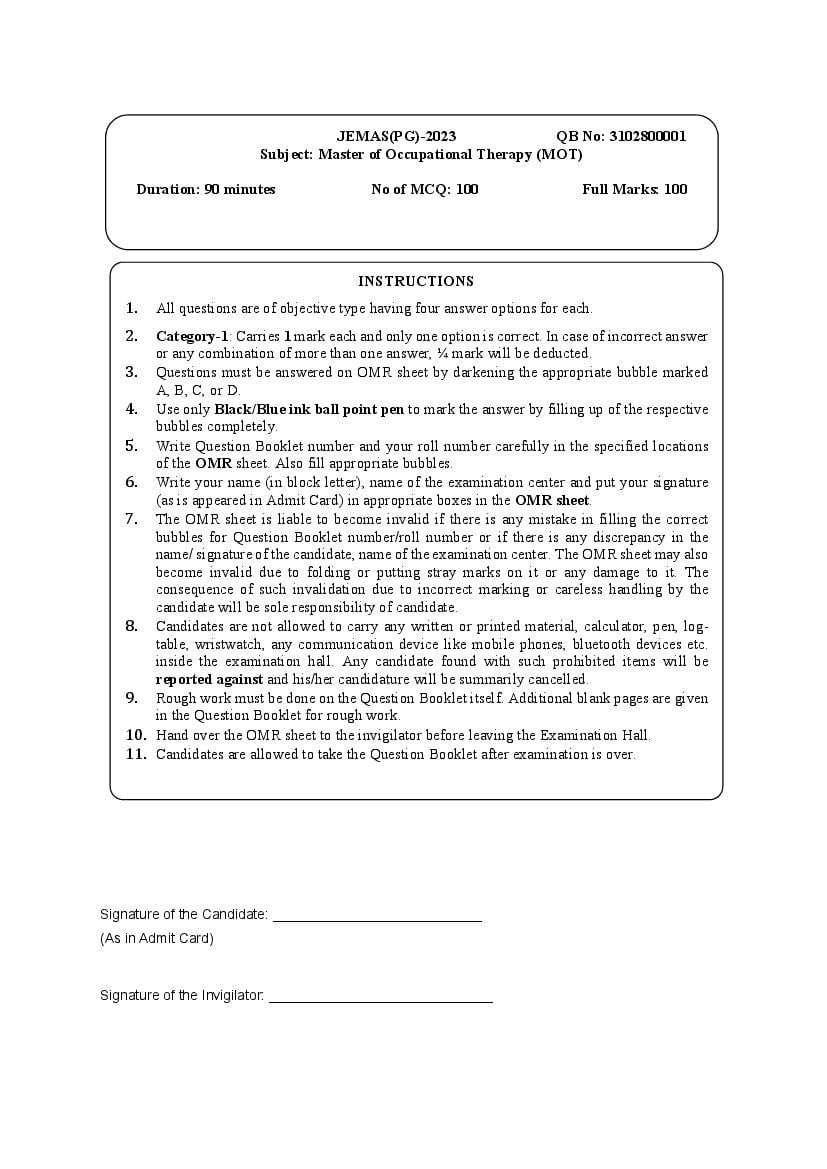
Subject: Master of Occupational Therapy (MOT)
Duration: 90 minutes No of MCQ: 100 Full Marks: 100
INSTRUCTIONS
1. All questions are of objective type having four answer options for each.
2. Category-1: Carries 1 mark each and only one option is correct. In case of incorrect answer
or any combination of more than one answer, ¼ mark will be deducted.
3. Questions must be answered on OMR sheet by darkening the appropriate bubble marked
A, B, C, or D.
4. Use only Black/Blue ink ball point pen to mark the answer by filling up of the respective
bubbles completely.
5. Write Question Booklet number and your roll number carefully in the specified locations
of the OMR sheet. Also fill appropriate bubbles.
6. Write your name (in block letter), name of the examination center and put your signature
(as is appeared in Admit Card) in appropriate boxes in the OMR sheet.
7. The OMR sheet is liable to become invalid if there is any mistake in filling the correct
bubbles for Question Booklet number/roll number or if there is any discrepancy in the
name/ signature of the candidate, name of the examination center. The OMR sheet may also
become invalid due to folding or putting stray marks on it or any damage to it. The
consequence of such invalidation due to incorrect marking or careless handling by the
candidate will be sole responsibility of candidate.
8. Candidates are not allowed to carry any written or printed material, calculator, pen, log-
table, wristwatch, any communication device like mobile phones, bluetooth devices etc.
inside the examination hall. Any candidate found with such prohibited items will be
reported against and his/her candidature will be summarily cancelled.
9. Rough work must be done on the Question Booklet itself. Additional blank pages are given
in the Question Booklet for rough work.
10. Hand over the OMR sheet to the invigilator before leaving the Examination Hall.
11. Candidates are allowed to take the Question Booklet after examination is over.
Signature of the Candidate: ___________________________
(As in Admit Card)
Signature of the Invigilator: _____________________________
Page 2
(A) C5 to T1.
(B) C6 to T1.
(C) C7 to T1.
(D) C8 to T1.
2. Specific Gravity of average human body is approximately __________:
(A) 0.85.
(B) 0.974.
(C) 1.01
(D) 1.024.
3. Which of the following would be considered fast fatigue muscle fibers?
(A) White fibers.
(B) Red fibers.
(C) Fast oxidative glycolytic fibers.
(D) Slow oxidative fibers.
4. In hemiplegia, the lower extremity flexor synergy pattern includes all of the
following components except?
(A) Hip external rotation.
(B) Hip abduction.
(C) Ankle dorsiflexion.
(D) Ankle eversion.
5. Oedema that is in acute inflammation and secondary to increase in vascular
permeability defines ________:
(A) Pitting oedema.
(B) Exudate.
(C) Transudate.
(D) Lymph edema.
6. An inability to perform rapid alternating movements are known as_____:
(A) Dysmetria.
(B) Dysdiadochokinesia.
(C) Apraxia.
(D) Dysphagia.
7. An inability to recognize part of one’s body is denoted by_____:
(A) Asomatognosias.
(B) Anosognosia.
(C) Hemispatial Neglect.
(D) All of the above.
8. Which of the following nerve fiber shows greatest decrease in nerve conduction
velocity after cold application?
(A) Aα (alfa) fibres.
(B) Aδ (delta) fibres.
(C) Aβ (beta) fibres.
(D) C-fibres.
P a g e 1 | 14
Page 3
is______:
(A) 18 to 30°.
(B) 13 to 18°.
(C) 7 to 12°.
(D) 0 to 7°.
10. Which of the following muscle will be paralyzed in Axillary nerve lesion?
(A) Deltoid.
(B) Biceps.
(C) Triceps.
(D) Trapezius.
11. Classification of Levers are based on:
(A) The load and effort located with respect to the fulcrum.
(B) Fulcrum and effort are located with respect to the load.
(C) Where the load and fulcrum are located with respect to the effort.
(D) None.
12. Lower branch of brachial plexus injury leads to:
(A) Erb’s Palsy.
(B) Klumpke’s Palsy.
(C) Wrist Drop.
(D) Shoulder Dislocation.
13. As you stand on your tip toes your foot is acting as what type of lever?
(A) Class –I.
(B) Class –II.
(C) Class –III.
(D) All of the above.
14. A fundamental principle of early intervention is that:
(A) It should begin as early in life as possible.
(B) It should target poor children.
(C) It should begin after infancy, around 18 months to 2years.
(D) It should begin working with pregnant women prior to the birth of the
child.
15. Flat foot is most commonly seen in:
(A) Toddlers.
(B) Os calcis fracture.
(C) Congenital vertical talus.
(D) Spastic Peroneal muscles.
16. The level of the constricting nodule in case of a trigger finger is at:
(A) Neck of the corresponding meta carpal bone.
(B) Meta carpophalangeal joint.
(C) Proximal interphalangeal joint.
(D) Distal interphalangeal joint.
P a g e 2 | 14
Page 4
(A) Capitulam fracture.
(B) Fracture neck of radius.
(C) Supra condylar fracture.
(D) Fracture lateral epicondyle of Humerus.
18. Known factors for “ Idiopathic scoliosis”:
(A) Congenital.
(B) Unknown.
(C) Postural.
(D) Polio.
19. Clinical test of hip dysplasia in New Born is:
(A) Trendelenburg sign.
(B) Faber’s test.
(C) Ortolani’s sign.
(D) Telescopic test.
20. A neonate has an asymmetric Moro’s reflex, Social smile is normal. On
examination weak or absent abduction of shoulder and supination of forearm. The
lesion lies at:
(A) C 3 -6.
(B) C 3 -4.
(C) C 7 -8.
(D) T 1- 4.
21. At which age should a child be able to roll from prone to supine?
(A) 0-3 months.
(B) 3-5 months.
(C) 4-6 months.
(D) 6-8 months.
22. The deformities seen in Rheumatiod hand are all except:
(A) Swan neck deformity.
(B) Boutonniere’s deformity.
(C) Radial deviation.
(D) Adduction, External rotation, Flexion.
23. Lesion in Pyramidal tract causes:
(A) Rigidity.
(B) Athetosis.
(C) Flaccidity.
(D) Spasticity.
24. The normal angle of the acetabulum is:
(A) 5- 7 degree.
(B) 30- 32 degree.
(C) 35- 40 degree.
(D) 50- 55 degree.
P a g e 3 | 14
Page 5
(A) Compression of communication between medial and lateral plantar
nerves.
(B) Exaggeration of longitudinal arches.
(C) Injury of deltoid ligaments.
(D) Shortening of Plantar aponeurosis.
26. In cerebral palsy the intelligence quotient is:
(A) Very Low.
(B) Always borderline.
(C) May or May not be normal.
(D) High.
27. The in-charge nurse on a cardiac unit tells you a patient is exhibiting signs of right-
sided heart failure. Which of the following would indicate right-sided heart failure?
(A) Nausea.
(B) Anorexia.
(C) Rapid weight gain.
(D) Shortness of breath.
28. One of this trait is not seen in a children with Down Syndrome:
(A) Small stature.
(B) Upward slant eye.
(C) Short neck.
(D) Increase muscle tone.
29. What age does the Rooting reflex become integrated?
(A) 3 months.
(B) 6 months.
(C) 8 months.
(D) 10 months.
30. Name of Rotator cuff muscles are:
(A) Deltoid, supraspinatus, trapezius & Triceps.
(B) Supraspinatinatus, Infraspinatus, Teres minor & pectoralis major.
(C) Supraspinatinatus, Infraspinatus, Teres minor & Subscapularis.
(D) None of these.
31. Wrist drop is due to:
(A) Ulnar nerve lesion.
(B) Median nerve lesion.
(C) Sciatic nerve lesion.
(D) Radial nerve lesion.
32. Parts of Mid brain are:
(A) Colliculi, tegmentum & cerebral peduncles.
(B) Frontal lobe, pons& spinal cord.
(C) Cauda equina, thalamus & putamen.
(D) None of these.
P a g e 4 | 14
Page 6
(A) Temporalis, buccinators, masseter &orbicularis oris.
(B) Medial & lateral pterygoid, orbicularis oris & zygomatic major.
(C) Masseter, medial& lateral pterygoid &temporalis.
(D) None of these.
34. Smallest bone of Human skeleton:
(A) Stapes.
(B) Hamate.
(C) Pisiform.
(D) Capitate.
35. Function of Olfactory nerve:
(A) Sense of smell.
(B) Sense of taste.
(C) Visual.
(D) Auditory.
36. How many Bones in axial skeleton (adult)?
(A) 70.
(B) 80.
(C) 126.
(D) 90.
37. Hip joint is an example of:
(A) Saddle joint.
(B) Synovial joint.
(C) Hinge joint.
(D) None of these.
38. Popliteus muscle in the leg is used for…………while walking:
(A) Locking of knee.
(B) Unlocking of knee.
(C) Ankle dorsiflexion.
(D) None of these.
39. Mechanical advantage of lever is equal to:
(A) Length of effort arm divided by length of weight arm.
(B) Length of weight arm divided by length of effort arm.
(C) Length of weight arm multiplied by length of effort arm.
(D) Length of effort arm subtracted from length of weight arm.
40. Intrinsic muscles of hand are supplied by:
(A) Median nerve.
(B) Radial nerve.
(C) Musculo-cutaneous nerve.
(D) Femoral nerve.
P a g e 5 | 14
Page 7
(A) Anatomic pulley for quadriceps.
(B) Anatomic pulley for Hamstring.
(C) Anatomic pulley for calf muscle.
(D) None of these.
42. Nodding movement of head means:
(A) Downward & upward movement of head.
(B) Side to side movement of head.
(C) Movement just like answering No.
(D) None of these.
43. Trendellenburg test is done to detect:
(A) Weakness of hip abductor muscles.
(B) Weakness of hip adductor muscles.
(C) Weakness of hip flexor muscles.
(D) Weakness of hip rotator muscles.
44. Iontophoresis means:
(A) Ion Transfer.
(B) Molecule Transfer.
(C) Sound Transfer.
(D) None of These.
45. Secretions in lungs is cleared by—:
(A) AROM.
(B) PROM.
(C) Mobilization of vertebral joints.
(D) Postural Drainage.
46. Name of 7th Cranial nerve:
(A) Vagus.
(B) Olfactory.
(C) Optic.
(D) Facial.
47. McBurney’s incision is used to access:
(A) Appendectomy.
(B) Splenectomy.
(C) Gall Bladder operation.
(D) Pneumonectomy.
48. Which trimester in pregnancy is relatively uneventful?
(A) 1st Trimester.
(B) 3rd Trimester.
(C) 4th Trimester.
(D) 2nd Trimester.
49. A Boutonniere deformity present as:
(A) PIP-flexed & DIP- hyperextended.
(B) MCP flexed & PIP hyperextended.
(C) MCP Hyperextended & DIP Flexed.
(D) None of these.
P a g e 6 | 14
Page 8
electrical current?
(A) Tendons.
(B) Muscles.
(C) Bones.
(D) Skin.
51. A Proximal Inter phallangeal (PIP) cylindrical blocking splint encourages?
(A) Flexor digitorum superficialis (FDS) excursion at PIP joint.
(B) Flexor digitorum superficialis (FDS) excursion at DIP joint.
(C) Flexor Digitorum Profundus (FDP) excursion at PIP joint.
(D) Flexor Digitorum Profundus (FDP) excursion at DIP joint.
52. Orthostatic Hypotension is most common in patients with Spinal Cord Injury:
(A) At T10 level and above.
(B) At T6 level and above.
(C) At L2 level and above.
(D) All of the above.
53. Isometric contractions are allowed in Rheumatiod arthritis patient:
(A) At 60 % of maximum voluntary contraction.
(B) At 70 % of maximum voluntary contraction.
(C) At 80 % of maximum voluntary contraction.
(D) Isometrics are not allowed.
54. An occupational therapist observes a child with a learning disability who uses an
unusually tight grip when writing with a pencil. This type of problem is most likely
caused by inadequate sensory information from the:
(A) Vestibular system.
(B) Auditory system.
(C) Somatosensory system.
(D) Visual system.
55. Exercise Heart rate range of a 50 year old Individual will be:
(A) 65-145 beats per minute.
(B) 45-145 beats per minute.
(C) 75-149 beats per minute.
(D) 85-149 beats per minute.
56. The Total Active Motion (TAM) in a patient with MP joint flexion 85 degree with
full extension, PIP flexion 100 degree with a lacking of 15 degree extension and
DIP flexion is 65 degree with full extension will be:
(A) 135 degree.
(B) 200 degree.
(C) 235 degree.
(D) 245 degree.
P a g e 7 | 14
Page 9
(MMT) it was found that the part moved through full ROM against gravity and
took less than moderate resistance. The muscle strength will be graded as:
(A) 3+.
(B) 3-.
(C) 4-.
(D) 4+.
58. Reversal of Antagonists techniques in Proprioceptive Neuromuscular Facilitation is
based on:
(A) Sherrington’s principles of successive induction.
(B) Principle of Reciprocal Inhibition.
(C) Principle of Irradiation.
(D) All of the above.
59. A child running in the playground trips and falls forward, landing on outstretched
arms. This behaviour is best described as:
(A) Primitive reflex.
(B) Vertical righting reactions.
(C) Protective extension response.
(D) Rotary righting reactions.
60. Ability to stand on tip toe indicates:
(A) Muscle grade 2 of ankle planter flexors.
(B) Muscle grade 5 of ankle planter flexors.
(C) Muscle grade 2 of ankle Dorsi flexors.
(D) Muscle grade 5 of ankle Dorsi flexors.
61. Use of components such as Velcro , Hinges etc. in a splint are example of:
(A) Serial static splint.
(B) Static splint.
(C) Static progressive splint.
(D) Dynamic splint.
62. Most of the muscles in human body work in ----------------- lever system when they
contract concentrically to produce speed and range of motion:
(A) First class lever system.
(B) Second class lever system.
(C) Third class lever system.
(D) All of the above.
63. A patient with left homonymous hemianopsia has:
(A) Decreased or absent vision in the nasal field of the right eye and the
temporal field of the left eye.
(B) Decreased or absent vision in the nasal field of the left eye and the
temporal field of the right eye.
(C) Decreased or absent vision in the nasal field of the right eye and the
temporal field of the right eye.
(D) Decreased or absent vision in the nasal field of the left eye and the
temporal field of the left eye.
P a g e 8 | 14
Page 10
(A) Active ROM exceeds Passive ROM.
(B) Passive ROM exceeds Active ROM.
(C) Passive ROM and Active ROMs are equal.
(D) None of the above.
65. Strategic planning for Return to work involves putting the injured worker in the
following sequence of duties:
(A) At injury Job, transitionalduty, alternativeduty,normal duty.
(B) At injury job,alternativeduty,transitionalduty,normal duty.
(C) At injury job,Transitionalduty,normalduty,alternatiove duty.
(D) At injury job,alternativeduty,normalduty,transitional duty.
66. MET level of activities that are allowed in the inpatient phase of cardiac
rehabilitation is:
(A) 4 MET activities.
(B) 3.5 MET activities.
(C) 4.5 MET activities.
(D) 6 MET activities.
67. In Festinating gait seen in Parkinson’s disease:
(A) As client walks, the stride length decreases in length.
(B) As client walks, the step length decreases in length.
(C) As client walks, the stride length increases in length.
(D) As client walks, the step length increasess in length.
68. Bringing a hot cup of coffee to the mouth to take a drink and carefully lowering it
back down to the table is an example of:
(A) Closed chain movement with eccentric and concentric contraction.
(B) Open chain movement with eccentric and concentric contraction.
(C) Closed chain movement with concentric contraction.
(D) Open chain movement with eccentric contraction.
69. Kleinert ‘s flexor tendon injury management protocol includes:
(A) Passive flexion and active extension.
(B) Passive flexion and extension.
(C) Active flexion and extension.
(D) All of the above.
70. Autonomic dysreflexia is a phenomenon seen in persons with spinal cord injury:
(A) At C4 –C6 Level.
(B) Above C4 –C6 Level.
(C) At T4-T6 level.
(D) Above T4-T6 level.
P a g e 9 | 14
Page 11
(A) A patient with C7-8 level of spinal cord injury will be able to propel a
manual wheelchair independently.
(B) A patient with C7-8 level of spinal cord injury will be able to propel a
power wheelchair independently.
(C) A patient with C7-8 level of spinal cord injury will be able to propel a
manual wheelchair independent to some assist indoors with non-carpeted,
level surface.
(D) A patient with C7-8 level of spinal cord injury will be able to propel a
manual wheelchair independently with standard arm drive on all surfaces.
72. A patient with Traumatic Brain Injury having initial Glasgow Coma Scale score of
9 to 12,Post Traumatic Amnesia of 1-24 hours has a severity classification of:
(A) Mild severity.
(B) Moderate.
(C) Severe.
(D) Profound.
73. Measurement by using Manual Muscle Testing is a:
(A) Standardized Test.
(B) Non standardized Test.
(C) Ratio level of measurement.
(D) Intervallevel of measurement.
74. In an ergonomically designed chair, the seat pan or back angle should be:
(A) 80-110 degrees.
(B) 90-105 degrees.
(C) 90-110 degrees.
(D) 80-130 degrees.
75. Forearm pain preceding weakness of Flexor pollicis longus, Flexor digitorum
profundus I & II and pronator quatratus indicates presence of:
(A) Cubital tunnel syndrome.
(B) Carpal tunnel syndrome.
(C) Pronator syndrome.
(D) Thoracic outlet syndrome.
76. In Duchene’s muscular dystrophy the child is unable to walk by:
(A) 3 to 4 years.
(B) 8 to 11 years.
(C) 13 to 20 years.
(D) 13 to 15 years.
77. -----------------If persists interferes with standing and walking may evoke toe
walking:
(A) Rooting.
(B) Crossed extension.
(C) Flexor withdrawal.
(D) Plantar grasp.
P a g e 10 | 14
Page 12
but plays beside rather than with children is a:
(A) Onlooker play.
(B) Solitary independent play.
(C) Parallel play.
(D) Associative play.
79. Senile Dementia is a psychotic condition resulting in part from:
(A) Brainstem deterioration.
(B) Cerebral Deterioration.
(C) Cortex Deterioration.
(D) None of the above.
80. In progressing Job Simulation activities, if the program is predicted to last four
weeks the program should equal approximately:
(A) 1/4th of the goal each week.
(B) 1/2 of the goal each week.
(C) 1/3rd of the goal each week.
(D) 1/6th of the goal each week.
81. When evaluating a child who is at risk for shunt malfunction, it is MOST important
for the therapist to observe for:
(A) Increased tone.
(B) Decreased tone.
(C) Back pain.
(D) Irritability and nausea.
82. A high school teacher diagnosed with a right-hemisphere CVA is given a paper
with letters of the alphabet displayed in random order across the page and is
instructed to cross out every "M." The individual misses half of the "M"s in a
random pattern, which MOST likely indicates:
(A) A left visual field cut.
(B) A right visual field cut.
(C) Functional illiteracy.
(D) Decreased attention.
83. During an initial interview, parents described their child as having severe difficulty
communicating and interacting with others. The OT also observes that the child
exhibits many repetitive and ritualistic behaviours. The behaviours described are
MOST likely to be associated with:
(A) Attention deficit hyperactivity disorder.
(B) Childhood conduct disorder.
(C) Obsessive-compulsive disorder.
(D) Pervasive developmental disorder of childhood.
P a g e 11 | 14
Page 13
weakness and atrophy of the thenar muscles and numbness and tingling in the
thumb, index and middle fingers. The individual is not experiencing proximal
upper extremity limitations so the practitioner will MOST likely suspect problems
with which of the following:
(A) Ulnar nerve.
(B) Median nerve.
(C) Radial nerve.
(D) Brachial plexus.
85. The OT practitioner has just completed observing a child eating lunch. Which of
the following statements BEST describes an objective observation?
(A) The child did not appear to like the food presented.
(B) The child demonstrated tongue thrust.
(C) The child was uncooperative and kept pushing the food out of his/her
mouth.
(D) The child was obviously not hungry at the time.
86. An individual is able to complete the full range of shoulder flexion while in a side-
lying position during an evaluation. However, against gravity, the individual is not
quite able to achieve 75% of the range for shoulder flexion. This muscle should be
graded as:
(A) Good ( 4).
(B) Fair (3).
(C) Fair minus (3-)
(D) Poor plus (2+).
87. Minnesota rate of manipulation test(MRMT) assesses:
(A) Finger dexterity.
(B) Gross motor coordination.
(C) Manual or gross motor dexterity.
(D) Hand function in terms of ADL.
88. Kleinerts protocol for flexor tendon injury uses:
(A) Passive digital flexion and extension within the protective splint.
(B) Passive flexion-active extension with rubber band attachments to finer
nails.
(C) Active flexion and extension of digits.
(D) Immobilization of digits.
89. Early intervention describes services for children from:
(A) 1 year to 3 years.
(B) 9 year to 12 years.
(C) Birth to 5 years.
(D) All of the above.
90. Tactile defensiveness is a disorder of:
(A) Sensory registration.
(B) Sensory modulation.
(C) Sensory discrimination.
(D) All of the above.
P a g e 12 | 14
Page 14
(A) Mood disorder.
(B) Eating disorder.
(C) Anxiety disorder.
(D) Thermoregulatory disorder of body.
92. Semmes-Weinstein Monofilaments are used to assess:
(A) Cutaneous pressure thresholds.
(B) Light touch sensation.
(C) Vibration.
(D) Tactile discrimination.
93. Normal two point discrimination at the finger tip is:
(A) 8 mm.
(B) 6 mm or less.
(C) 10 mm.
(D) 8 to 12 mm.
94. If active range of motion (AROM) is less than Passive Range of Motion (PROM),
then there is a problem of:
(A) Ligament tightness.
(B) Capsular tightness.
(C) Muscle tightness.
(D) Muscle weakness.
95. Use of velcros, hinges, turn-buckle screws in fabricating orthosis to create a
mobilizing force to regain motion is a:
(A) Static splint.
(B) Serial static splint.
(C) Static progressive splint.
(D) Dynamic splint.
96. According to Brunnstrom Stages of Motor Recovery (Hand), palmer prehension is
possible in:
(A) Stage II.
(B) Stage III.
(C) Stage IV.
(D) Stage V.
97. Sensory Reeducation can begin when the patient first can appreciate:
(A) Vibration.
(B) Pressure.
(C) Deep, moving touch.
(D) Touch localization.
98. Codman’s pendulum exercises may be contraindicated if the upper extremity has:
(A) Stiffness.
(B) Sensory loss.
(C) Muscle weakness.
(D) Oedema.
P a g e 13 | 14
Page 15
(A) C1 to C4 level of complete tetraplegia.
(B) C5 tetraplegia.
(C) C6 and C7 tetraplegia.
(D) C8 tetraplegia.
100. An occupational therapist is working on pre writing skills with an 11 month old
child. Which of the following activities would be most appropriate for the therapist
to instruct the child to perform?
(A) Scribble on a piece of paper.
(B) Copy a triangle.
(C) Copy a horizontal line on a paper.
(D) Copy numerals on a sheet of paper.
P a g e 14 | 14
Document Details
| Board / Org | WBJEEB |
| Exam | JEMAS PG |
| Type | Question Paper |
| Pages | 16 |
| Updated | 24 Sep 2026 |