CBSE Class 9 Learning Outcomes for Mathematics Syllabus 2021-22
Finished viewing? Save it for later —
Download CBSE Class 9 Learning Outcomes for Mathematics Syllabus 2021-22 (PDF · 3 pages)About CBSE Class 9 Learning Outcomes for Mathematics Syllabus 2021-22
CBSE Class 9 Learning Outcomes for Mathematics Syllabus 2021-22 is available here for free download. Published by CBSE for Class 9, this syllabus can be viewed online or downloaded as a PDF (3 pages). Candidates preparing for Class 9 can use CBSE Class 9 Learning Outcomes for Mathematics Syllabus 2021-22 to understand the exam pattern, the type of questions asked, and the overall difficulty level.
Frequently Asked Questions
How can I download CBSE Class 9 Learning Outcomes for Mathematics Syllabus 2021-22?
Open this page and click the Download button to save CBSE Class 9 Learning Outcomes for Mathematics Syllabus 2021-22 as a PDF. It is completely free on AglaSem Docs.
Is CBSE Class 9 Learning Outcomes for Mathematics Syllabus 2021-22 free to download?
Yes. CBSE Class 9 Learning Outcomes for Mathematics Syllabus 2021-22 can be viewed online and downloaded as a PDF free of cost on AglaSem Docs.
How many pages does CBSE Class 9 Learning Outcomes for Mathematics Syllabus 2021-22 have?
CBSE Class 9 Learning Outcomes for Mathematics Syllabus 2021-22 contains 3 pages, which you can read online or download together as a single PDF.
Where can I find more Class 9 study material?
You can find more Class 9 question papers, sample papers, syllabus, and answer keys on AglaSem Docs.
CBSE Class 9 Learning Outcomes for Mathematics Syllabus 2021-22 – Text
Read the full text of this syllabus below — useful to quickly search, copy and reference the content online without downloading the PDF.
📄 View text version (3 pages)
Page 1
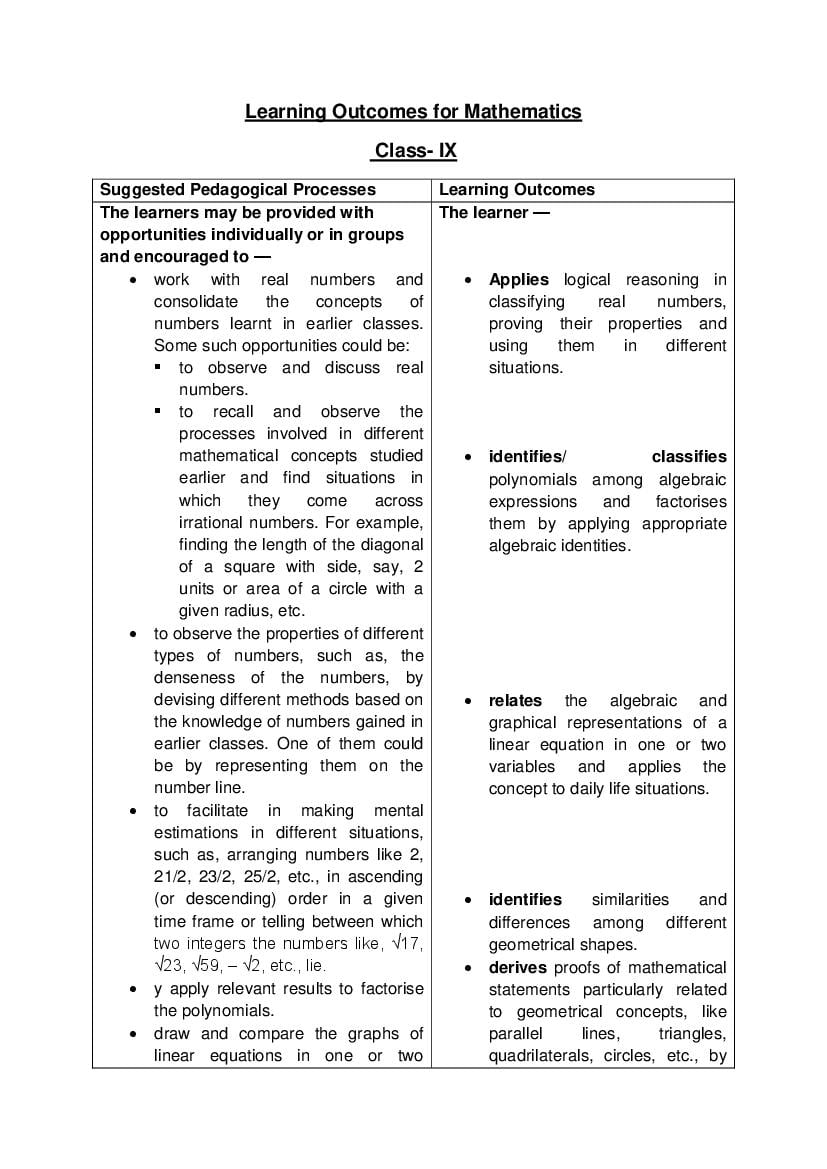
Suggested Pedagogical Processes Learning Outcomes
The learners may be provided with The learner —
work with real numbers and Applies logical reasoning in
consolidate the concepts of classifying real numbers,
numbers learnt in earlier classes. proving their properties and
Some such opportunities could be: using them in different
to observe and discuss real situations.
numbers.
to recall and observe the
processes involved in different
mathematical concepts studied identifies/ classifies
earlier and find situations in polynomials among algebraic
which they come across expressions and factorises
irrational numbers. For example, them by applying appropriate
finding the length of the diagonal algebraic identities.
of a square with side, say, 2
units or area of a circle with a
given radius, etc.
to observe the properties of different
types of numbers, such as, the
denseness of the numbers, by
devising different methods based on relates the algebraic and
the knowledge of numbers gained in graphical representations of a
earlier classes. One of them could linear equation in one or two
be by representing them on the variables and applies the
number line. concept to daily life situations.
to facilitate in making mental
estimations in different situations,
such as, arranging numbers like 2,
21/2, 23/2, 25/2, etc., in ascending
(or descending) order in a given identifies similarities and
time frame or telling between which differences among different
two integers the numbers like, √17, geometrical shapes.
√23, √59, – √2, etc., lie. derives proofs of mathematical
y apply relevant results to factorise statements particularly related
the polynomials. to geometrical concepts, like
draw and compare the graphs of parallel lines, triangles,
linear equations in one or two quadrilaterals, circles, etc., by
Page 2
discuss the proofs of mathematical and solves problems using
statements using axioms and them.
postulates.
play the following games related to
geometry.
For Euclid’s axioms, if one group
says, If equals are added to finds areas of all types of
equals, then the results are triangles by using appropriate
equal. The other group may be formulae and apply them in real
encouraged to provide example life situations.
such as, If a = b, then a + 3 = b constructs different geometrical
+ 3, another group may extend it shapes like bisectors of line segments,
further as a + 3 + 5 = b + 3 + 5, angles and triangles under given
and so on. conditions and provides reasons for
By observing different objects in the processes of such constructions.
the surroundings one group may
find the similarities and the other
group may find the differences
with reference to different
geometrical shapes— lines,
rays, angles, parallel lines, develops strategies to locate
perpendicular lines, congruent points in a Cartesian plane.
shapes, non-congruent shapes,
etc., and justify their findings
logically. identifies and classifies the
work with algebraic identities using daily life situations in which
models and explore the use of mean, median and mode can
algebraic identities in familiar be used.
contexts.
discuss in groups about the
properties of triangles and analyses data by representing
construction of geometrical shapes it in different forms like, tabular
such as, triangles, line segment and form (grouped or ungrouped),
its bisector, angle and its bisector bar graph, histogram (with
under different conditions. equal and varying width and
find and discuss ways to fix position length), and frequency polygon.
of a point in a plane and different
properties related to it.
engage in a survey and discuss calculates empirical probability
about different ways to represent through experiments and
data pictorially such as, bar graphs, describes its use in words.
histograms (with varying base
Page 3
collect data from their surroundings
and calculate central tendencies derives formulae for surface
such as, mean, mode or median. areas and volumes of different
explore the features of solid objects solid objects like, cubes,
from daily life situations to identify cuboids, right circular cylinders/
them as cubes, cuboids, cylinders, cones, spheres and
etc. hemispheres and applies them
play games involving throwing a to objects found in the
dice, tossing a coin, etc., and find surroundings.
their chance of happening. solves problems that are not in
do a project of collecting situations the familiar context of the child
corresponding to different numbers using above learning. These
representing probabilities. problems should include the
visualise the concepts using situations to which the child is
Geogebra and other ICT tools. not exposed earlier.
Class- X
Suggested Pedagogical Processes Learning Outcomes
The learners may be provided with The learner —
extend the methods of finding LCM generalises properties of
and HCF of large numbers learnt numbers and relations among
earlier to general form. them studied earlier to evolve
discuss different aspects of results, such as, Euclid’s division
polynomials, such as — their degree, algorithm, Fundamental
type (linear, quadratic, cubic), zeroes, Theorem of Arithmetic and
etc., relationship between their visual applies them to solve problems
representation and their zeroes. related to real life contexts
play a game which may involve a
series of acts of factorising a
polynomial and using one of its .
factors to form a new one. For develops a relationship between
example, one group factorizing say, algebraic and graphical methods
(x3 – 2x2 – x – 2) and using one of its of finding the zeroes of a
factors x–1 to construct another polynomial.
polynomial, which is further factorized
by another group to continue the
Document Details
| Board / Org | CBSE |
| Exam | Class 9 |
| Type | Syllabus |
| Pages | 3 |
| Updated | 22 Jul 2026 |