NERIST PG 2026 Admission Syllabus
Finished viewing? Save it for later —
Download NERIST PG 2026 Admission Syllabus (PDF · 30 pages)About NERIST PG 2026 Admission Syllabus
NERIST PG 2026 Admission Syllabus is available here for free download. Published by Arunachal Pradesh Exams for NERIST NEE, this syllabus can be viewed online or downloaded as a PDF (30 pages). Candidates preparing for NERIST NEE can use NERIST PG 2026 Admission Syllabus to understand the exam pattern, the type of questions asked, and the overall difficulty level.
Frequently Asked Questions
How can I download NERIST PG 2026 Admission Syllabus?
Open this page and click the Download button to save NERIST PG 2026 Admission Syllabus as a PDF. It is completely free on AglaSem Docs.
Is NERIST PG 2026 Admission Syllabus free to download?
Yes. NERIST PG 2026 Admission Syllabus can be viewed online and downloaded as a PDF free of cost on AglaSem Docs.
How many pages does NERIST PG 2026 Admission Syllabus have?
NERIST PG 2026 Admission Syllabus contains 30 pages, which you can read online or download together as a single PDF.
Where can I find more NERIST NEE study material?
You can find more NERIST NEE question papers, sample papers, syllabus, and answer keys on AglaSem Docs.
NERIST PG 2026 Admission Syllabus – Text
Read the full text of this syllabus below — useful to quickly search, copy and reference the content online without downloading the PDF.
📄 View text version (30 pages)
Page 1
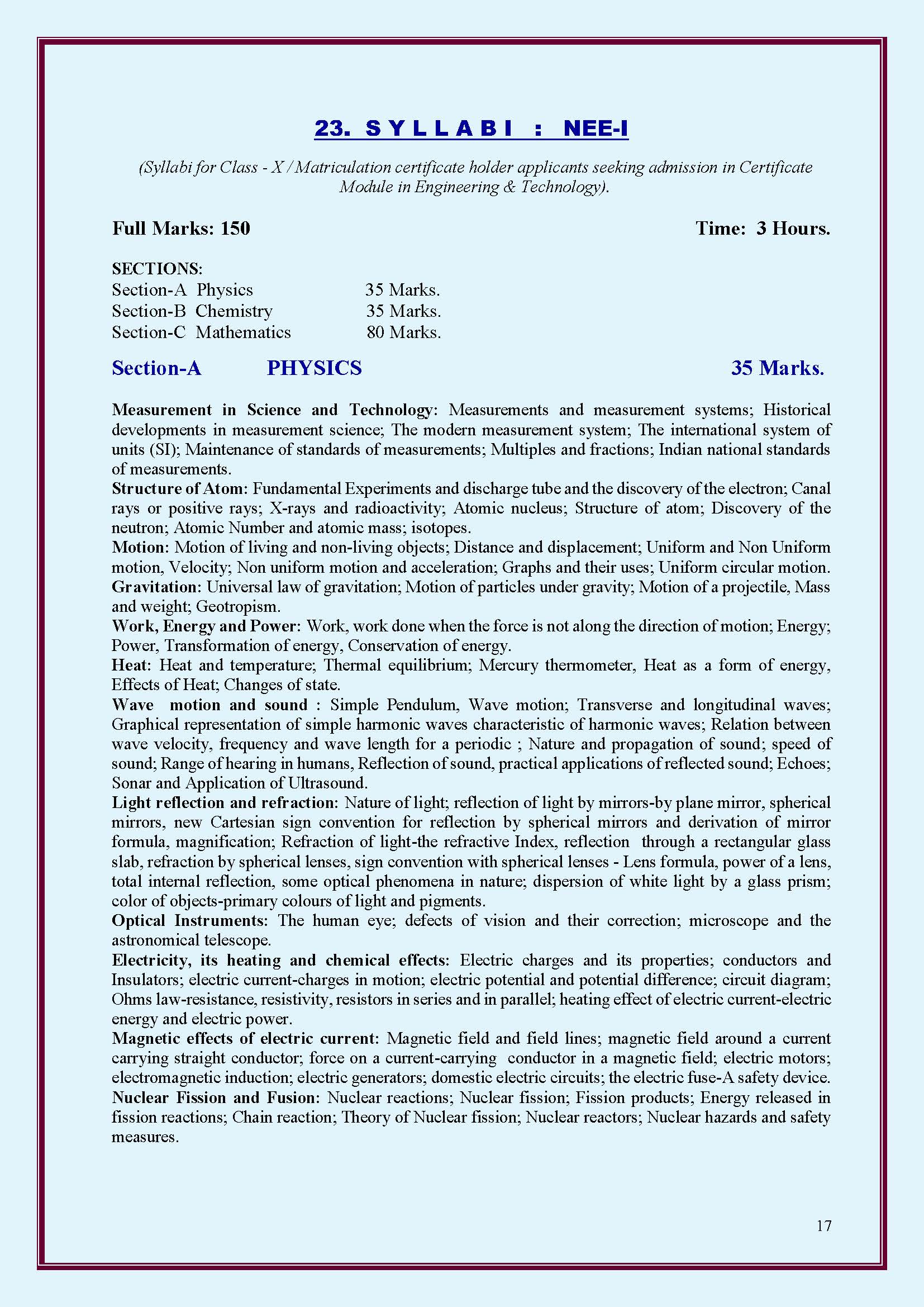
(Syllabi for Class - X / Matriculation certificate holder applicants seeking admission in Certificate
Module in Engineering & Technology).
Full Marks: 150 Time: 3 Hours.
SECTIONS:
Section-A Physics 35 Marks.
Section-B Chemistry 35 Marks.
Section-C Mathematics 80 Marks.
Section-A PHYSICS 35 Marks.
Measurement in Science and Technology: Measurements and measurement systems; Historical
developments in measurement science; The modern measurement system; The international system of
units (SI); Maintenance of standards of measurements; Multiples and fractions; Indian national standards
of measurements.
Structure of Atom: Fundamental Experiments and discharge tube and the discovery of the electron; Canal
rays or positive rays; X-rays and radioactivity; Atomic nucleus; Structure of atom; Discovery of the
neutron; Atomic Number and atomic mass; isotopes.
Motion: Motion of living and non-living objects; Distance and displacement; Uniform and Non Uniform
motion, Velocity; Non uniform motion and acceleration; Graphs and their uses; Uniform circular motion.
Gravitation: Universal law of gravitation; Motion of particles under gravity; Motion of a projectile, Mass
and weight; Geotropism.
Work, Energy and Power: Work, work done when the force is not along the direction of motion; Energy;
Power, Transformation of energy, Conservation of energy.
Heat: Heat and temperature; Thermal equilibrium; Mercury thermometer, Heat as a form of energy,
Effects of Heat; Changes of state.
Wave motion and sound : Simple Pendulum, Wave motion; Transverse and longitudinal waves;
Graphical representation of simple harmonic waves characteristic of harmonic waves; Relation between
wave velocity, frequency and wave length for a periodic ; Nature and propagation of sound; speed of
sound; Range of hearing in humans, Reflection of sound, practical applications of reflected sound; Echoes;
Sonar and Application of Ultrasound.
Light reflection and refraction: Nature of light; reflection of light by mirrors-by plane mirror, spherical
mirrors, new Cartesian sign convention for reflection by spherical mirrors and derivation of mirror
formula, magnification; Refraction of light-the refractive Index, reflection through a rectangular glass
slab, refraction by spherical lenses, sign convention with spherical lenses - Lens formula, power of a lens,
total internal reflection, some optical phenomena in nature; dispersion of white light by a glass prism;
color of objects-primary colours of light and pigments.
Optical Instruments: The human eye; defects of vision and their correction; microscope and the
astronomical telescope.
Electricity, its heating and chemical effects: Electric charges and its properties; conductors and
Insulators; electric current-charges in motion; electric potential and potential difference; circuit diagram;
Ohms law-resistance, resistivity, resistors in series and in parallel; heating effect of electric current-electric
energy and electric power.
Magnetic effects of electric current: Magnetic field and field lines; magnetic field around a current
carrying straight conductor; force on a current-carrying conductor in a magnetic field; electric motors;
electromagnetic induction; electric generators; domestic electric circuits; the electric fuse-A safety device.
Nuclear Fission and Fusion: Nuclear reactions; Nuclear fission; Fission products; Energy released in
fission reactions; Chain reaction; Theory of Nuclear fission; Nuclear reactors; Nuclear hazards and safety
measures.
17
Page 2
and comets. The Structure and evolution of the earth; The stars and constellations; Milky way galaxy and
other galaxies; Space exploration-Space Programme in India.
SECTION-B CHEMISTRY 35 Marks
Matter Around Us: Physical nature of matter, states of matter; General concept about mixture,
solution, colloidal solution, suspension, distillation, condensation, evaporation, sublimation and
fusion; Effect of pressure and temperature on states of matter.
Atomic Structure: Dalton’s atomic theory, elements, compounds, cathode ray, X-ray, Thomson’s
model of an atom, Rutherford’s model of atomic structure. Bohr’s model of atomic structure.
Electronic configuration (in terms of Shells only) of elements up to Atomic No. 20; Atomic number,
Mass number, Isotopes and Isobars; Radioactivity.
Classification of Elements: Mendeleev and Modern periodic table, Periodic trend of metallic and
non-metallic character, atomic size, nature of bonding, oxides and related chemical properties,
prediction of properties of an atom.
Chemical Bonding: Octet rule or inert gas configuration as criteria of stability. Ion, atom and
valency. Ionic bonds, covalent bonds (in simple cases), shape of Molecules of H 2O NH 3, CH4 CC14,
C2H2, C2H4 SF6, PCI5, CO2 BeCl2 BF3
Chemical reactions and Some basic concepts: Decomposition, Displacement reactions,
Isomerization, Combination, Reversible and Irreversible reactions, Chemical equilibrium, Law of
chemical equilibrium, chemical formula and equations, Atomic and Molecular masses, Mole concept,
gram atomic mass and gram molecular mass, Mole concept, gram atomic mass and gram molecular
mass, Determination of formula of unknown compounds, Balancing of chemical reactions.
Energetics: Bond energy, Energy involved in a reaction. Photo-chemical reactions and generation
of free radicals. Electrolysis of water and NaC1, Electrochemical cells (Galvanic cell) with reference
to dry cells and storage cells. Sun and Nuclear energy, Sun and its source of energy (Nuclear fusion),
Nuclear fission, Chain reaction, Nuclear reactors, Nuclear hazards, simple nuclear reactions.
Metals: Physical and chemical properties, Reaction with O 2, dilute acid, C1 2. Elementary metallurgy
of Cu, Fe, Al, and uses of the metals. Washing soda, Baking soda, lime, preparation of Bleaching
Powder, Plaster of Paris, Cement, Glass, Steel. Some common alloys of copper, iron and aluminum.
Corrosion of metals.
Non-Metals: Physical and chemical properties, reactions with O 2, acid, C12, H2, Preparation and
properties of Si, P, S, ammonia, hydrogen and sulphuric acid. Carbon and its compounds: Allotropes
of carbon. Hydrocarbon: Alkanes, Isomerism in alkanes. Petroleum; Preparation and properties of
Methanol, Ethanol, Methanal, Propanone, General properties of organic acids and esters, Synthetic
polymers: addition polymers (PE, PP, PVC, Teflon) and condensation polymers (nylons and
polyesters); Rubber and its vulcanization; Soaps, detergents; Cleansing action of soaps and
detergents.
Bio-mass as fuel: Fossil fuel, Coal, Petroleum, Natural gas; Classification of Fuels. Calorific value
of fuels, Ignition temperature, Combustion of fuels, Characteristics of an ideal fuel.
Environmental Pollution: Types of pollution and pollutants, Acid rain, Green House Effect,
Eutrophication and Soil erosion. Conservation and protection of environment.
SECTION – C MATHEMATICS 80 Marks
Algebra:
Number System: Whole numbers, Integers, Rational and Irrational numbers, Surds and rationalization of
surds, Real numbers
Polynomials: Definition of a polynomial, Factorization of polynomials Factorization of quadratic and
cubic expressions, HCF and LCM of polynomials.
Rational Expressions: Addition, Multiplication and Division of rational expressions
Linear Equations in one & two variables: Solution of Linear equations in one and two variables by cross
multiplication and other simple methods; Application to practical problems.
18
Page 3
(ii) method of completion of square: quadratic formula, Application quadratic equations.
Arithmetic Progression (AP): Definition, nth term of an A.P. , Sum of finite number of terms an A.P.
Geometry:
Lines, Angles and Triangles: Geometrical concepts of a point, Angle and a triangle, Angles made by a
transversal with two lines, Sum of the angles of a triangle, Different criteria for congruence of two
triangles, Properties of Isosceles triangle, Similar triangles, Proportionality theorems, Concurrent Lines in
a triangle. Parallelograms: Definition, Properties of a parallelogram, Types of parallelograms, some
theorems on parallelograms.
Circles: Definition, congruence of circles, chords of a circle Arcs of a circle, Angles subtended by Arcs
and chords at a point on a circle, angles in a cyclic quadrilateral, Tangents to a circle, Properties of tangents
to a circle, Chord of a circle intersecting in a point, Alternate segments and its angles, Common tangents
to circles.
Trigonometry: Trigonometric ratios of angles of measures 00, 300, 450,600,900. Trigonometric ratios of
some specific angles, solution of right triangles; Trigonometric ratios of complementary angles; Simple
problems on heights and distances, Angles of elevation and depressions
Mensuration: Area of a triangle, quadrilateral, Circle, sector and segment of a circle, Trapezium, Concept
of perimeter of these figures. Lateral and total surface area of right triangular prisms, volume of a right
triangular prism. Lateral surface area and volume of a right pyramid, surface Area and volume of a
tetrahedron, Lateral and total surface area and volume of a cuboid, cube, right circular cylinder, right
circular cone hemisphere and surface area and volume of a sphere, surface area and volumes of
combinations of these solids, volume and surface are of a frustum of a right circle cone
Statistics and Probability: Mean, Median Mode and their properties, Measures of central tendency,
Probability as a measure of uncertainty.
Coordinate Geometry (2D): Distance between two points, section formula between two points.
19
Page 4
NEE-II (PCB) Forestry
(Syllabi for Class –XII PCM and PCB applicants seeking admission in B.Tech Courses
(AE/CE/CSE/ECE/EE/ME) and B.Sc.(Hons) in Forestry, respectively).
Full Marks : 150 Time: 3 Hours
SECTIONS :
Section-A Physics 45 marks. (Common for Class -XII PCM as well as PCB Candidates)
Section-B Chemistry 45 marks. (Common for Class -XII PCM as well as PCB Candidates)
Section-C Mathematics 60 marks. (for Class -XIIPCM Candidates)
Section-C Biology 60 marks. (for Class -XIIPCB Candidates)
Section-A PHYSICS 45 marks
Physical World and Measurement: Physics scope and excitement, physics, technology and society,
Forces in nature, Conservation laws, Examples of Gravitational, electromagnetic and Nuclear forces from
daily-life experiences (qualitative only). Need for measurement, Units of measurement, systems of units,
SI units, Fundamental and derived units, length, mass and time measurement, Accuracy and precision of
measuring instruments. Errors in measurement, significant figures. Dimensions of Physical quantities.
Dimensional analysis and application. Elementary concept of differentiation and integration for describing
motion.
Kinematics: Uniform motion in a straight line, Position time graph, speed and velocity, Uniform and non-
uniform motion, average speed and instantaneous velocity . Uniformly accelerated motion, velocity time
graph, relations for uniformly accelerated motion (Graphical method). Scalar and vector quantities,
position and displacement vectors, Equality of vectors, multiplications of vectors by real number, Addition
and subtraction of vectors, Unit vector, Resolution of a vector in a plane. Rectangular components, Scalar
and Vector products of two vectors, vectors in 3 dimensions (elementary idea only) Motion in a plane,
Uniform velocity and uniform acceleration, projectile motion, uniform circular motion.
Laws of Motion: Force and inertia, Newton’s first law of motion, Momentum, Newton’s second law of
motion, Impulse , Newton’s third law of motion, conservation law of linear momentum and its application,
Equilibrium of concurrent forces, Friction, static and dynamic friction, laws of friction, rolling and sliding
friction, lubrication. Dynamics of uniform circular motion, centripetal force, Vehicle on a level road,
Vehicle on a banked road. Inertial and non-inertial frames (Idea only).
Work, Energy and Power: Work done by a constant force and variable force, kinetic energy, Potential
energy, work-energy theorem, power. Potential energy of a spring, conservative and non-conservative
forces, conservation of mechanical energy (kinetic and potential energies), collisions, Elastic and inelastic
collision in 1 dimension and 2 dimensions. Different forms of Energies in nature, Mass-Energy
equivalence (Qualitative Idea).
Motion of system of particles and Rigid Body: Centre of mass of two particle system, generalization to
N-particles, momentum conservation and center of mass motion, Application to familiar systems, Centre
of mass of a rigid body.
Gravitation : The universal law of Gravitation, Gravitational constant, Acceleration due to gravity and its
variation with altitude, latitude, depth and rotation of earth, Mass of the earth, Gravitational potential
energy near the surface of earth, gravitational potential, Escape Velocity. Orbital Velocity of a Satellite.
Weightlessness, Motion of Satellites, geostationary and polar satellites, Kepler’s laws of planetary motion.
Proof of second and third law, (for circular orbit) Inertial and gravitational mass. Moment of force, torque,
angular momentum, Physical meaning of angular momentum, conservation of angular momentum with
some examples ( Planetary motion). Equilibrium of rigid bodies, rigid body rotation and equation of
rotational motion. Moment of Inertia & its physical significance, radius of gyration, parallel and
perpendicular axis theorem (statement only) M.I. of circular ring, disc, cylinder and thin straight rod.
20
Page 5
system, diatomic molecules).
Mechanics of Solids and Fluids: States of matter, inter atomic and inter molecular forces.
a) Solids : Elastic behavior, stress-strain relationship, Hooke’s law, Young’s modulus, bulk modulus,
modulus of rigidity & some practical examples.
b)Fluids: Pressure due to fluid column, Pascal’s law and its application (hydraulic lift and brakes) Effect
of gravity on fluid pressure . Buoyancy, flotation, and Archimedes principle, Viscosity, Stoke’s law,
terminal velocity, stream line flow, trubulent flow. Reynold’s number. Bernoulli’s theorem and its
applications.
c) Surface energy and surface tension, angle of contact, application of surface tension, excess pressure
inside a liquid drop and bubble, capillary rise and action of detergent.
Heat and Thermodynamics: Kinetic theory of gases-assumptions, concept of pressure, kinetic energy
and temperature, r.m.s. speed, degree of freedom, law of equipartition of energy (statement only), mean
free path and Avogadro’s number.
Thermal equilibrium and temperature (Zeroth law of thermodynamics) Heat, work and internal energy,
thermal expansion-thermometry. First law of thermodynamics, specific heat, specific heat of gas at
constant volume and pressure (mono atomic, diatomic gases).Specific heat of solids (Dulong and Petits’
law).
Thermodynamic variables and equation of state, phase diagram; ideal gas equation, isothermal and
adiabatic processes, reversible and irreversible processes carnot’s engine and refrigerator or heat pump.
Efficiency and co-efficient of performance, second law of thermodynamics (statement only); and some
practical applications.
Transfer of heat-Conduction, convection and radiation. Thermal conductivity of solids, Black body
radiation, Kirchhoff’s laws, Wein’s displacement law, Stefan’s law (statement only) Newton’s law of
cooling, solar constant and determination of surface temperature of sun using Stefan’s law.
Oscillations: Periodic motion- period, frequency, displacement as a function of time and periodic
functions. Simple Harmonic Motion (SHM) and its equation, Expression for velocity and acceleration of
SHM. Oscillations of a spring, restoring force and force constant, Energy in SHM-Kinetic and potential
energies, Simple pendulum- derivation of its time period, Free, forced and damped oscillations (qualitative
idea only), resonance, coupled oscillations.
Waves: Longitudinal and transverse wave, wave motion, Displacement relation for progressive wave.
Principle of superposition of waves, Reflection of waves, Standing waves in strings and pipes, fundamental
and higher harmonics, Beats, Doppler’s effect, speed of sound in media.
Electrostatics: Frictional electricity, charges and their conservation, coulomb’s law, Forces between two
point electric charges. Forces between multiple electric charges; Superposition principle and continuous
charge distribution. Electric fields and its physical significance, electric field due to a point charge, electric
field lines, electric field due to a dipole and behavior of a dipole in a uniform electric field. Electric
potential-physical meaning, potential difference, electric potential due to a point charge, a dipole and
system of charges; Equipotential surfaces, Electrical potential energy of a system of two point charges
and of electric dipole in an electrostatic field. Electric flux, statement of Gauss’s theorem and its
applications to find field due to infinitely long straight wire, uniformly changed infinite plane sheet and
uniformly charged thin spherical shell. Conductors and insulators, presence of free charges and bound
charges inside a conductor, Dielectrics and electric polarization, general concept of a capacitor and
capacitance : Combination of capacitors in series and parallel, energy stored in a capacitor, capacitance of
a parallel plate capacitor with and without dielectric medium between the plates; Van de Graff generator.
Current Electricity: Electric current, flow of electric charge in a metallic conductor, drift velocity and
mobility and their relation with electric current, ohm’s law, electrical resistance, V-I characteristics,
Exception, of ohm’s law (Non-linear V-I characteristics), Electrical resistivity and conductivity,
classification of materials in terms of conductivity; Superconductivity (elementary idea); Carbon resistors,
colour code for carbon resistors, combination of resistances- series and parallel.
Temperature dependence of resistance, Internal resistance of a cell, Potential difference and e.m.f. of a
cell, combinations of cells in series and in parallel. Kirchhoff’s laws - illustration by simple application.
Wheatstone bridge and its Applications for temperature Measurements. Metre bridge-special case of
whetstone’s bridge. Potentiometer- principle and application to measure potential difference, and for
comparing e.m.f. of two cells.
21
Page 6
electrolysis; Electrochemical Cells- Primary (Voltaic Lechlanche, Dry Daniel,) and secondary-
rechargeable cells (lead accumulators, alkali accumulators) solid state cells. Thermoelectricity- origin,
elementary idea of See beck effect; Thermocouple. Thermo e.m.f. neutral and inversion temperatures.
Measurement of temperature using a thermocouple.
Magnetic effects of current & magnetism: Concept of magnetic field, Oersted’s experiment, Biot-
Savart law, magnetic field due to an infinitely long current carrying straight wire and a circular loop:
Ampere’s circuital law and its application to straight and toroidal solenoids; Force on a moving charge in
uniform magnetic and electric fields, cyclotron; Force on a current carrying conductor in a uniform
magnetic field, Forces between two parallel current- carrying conductors, definition of ampere. Torque
experienced by a current loop in a uniform magnetic field, moving coil galvanometer-its current sensitivity
and conversion to ammeter and voltmeter. Current loop as a magnetic dipole and its magnetic dipole
moment, magnetic dipole moment of a revolving electron, Magnetic field intensity due to magnetic dipole
(bar magnet) along the axis and perpendicular to the axis; Torque on a magnetic dipole (bar magnet) in a
uniform magnetic field; Bar magnet as an equivalent solenoid, Magnetic field lines. Earth’s magnetic fields
and magnetic elements: Para, dia and ferromagnetic substances with examples. Electromagnets and
permanent magnets.
Electromagnetic Induction & Alternating currents: Electromagnetic Induction, Faraday’s Laws,
Induced e.m.f. and current, Lenz’s law, Eddy currents, Self and mutual inductance. Alternating currents
peak and r.m.s. values of Altemating current/voltage, reactance and impedance; LC oscillations, LCR
series circuit (Phasor diagram) Resonant circuits and Q-factor, Power in AC circuits, Wattless current. AC
generator and transformer.
Electromagnetic Waves: Electromagnetic waves and their characteristics (qualitative idea only);
Transverse nature of electromagnetic waves.
Electromagnetic spectrum (Radio-microwaves, infrared, optical, Ultraviolet, gamma rays) including
elementary facts about their uses, Propagation of electromagnetic waves in atmosphere.
Optics : Refraction of light, total internal reflection and its application, spherical lenses, thin lens formula,
lens maker’s formula; Magnification, Power of a lens, combination of this lenses in contact; Refraction
and dispersion of light due to a prism, Scattering of light. Blue colour of the sky and reddish appearance
of the sun at sun-rise and sun set.
Optical Instruments – Compound Microscope, astronomical telescope (refraction and reflection type) and
their magnifying powers.
Wave front and Huygens’s principle; Reflection and refraction of plane wave at a plane surface using wave
fronts (qualitative idea); Interference- Young’s double slit experiment and expression for fringe width,
Coherent sources and sustained interference of light; Diffraction due to a single slit, width of central
maximum, difference between interference and diffraction.
Resolving power of microscope and telescope, Polarization-plane polarized light, Brewster’s Law, Use of
plane polarized light and Polaroid.
Dual Nature of Matter and Radiation: Photo-Electric effect, Einstein’s Photo-electric equation, Particle
nature of light, Photo Cell, Matter waves, Wave nature of particles, De-Broglie relation, de Broglie wave
length of an electron. Davisson-Germer Experiment.
Atomic Nucleus: Alpha-particle scattering experiment, size of the nucleus, composition of the nucleus,
protons and neutrons, Nuclear instability- Radioactivity-Alpha, Beta and Gamma particles/rays and their
properties, radioactive decay law, simple explanation of decay, beta- decay and gamma-decay. Mass-
energy relation, mass defect, binding energy per nucleon, its variation with mass number. Nature of nuclear
forces, nuclear reaction, Nuclear fission and Nuclear fusion.
Solid and Semi-conductor Devices: Energy bands in solids (qualitative idea only), difference between
metals, insulators and semiconductors using band theory; intrinsic and extrinsic semi-conductors, p-n
junction, semi-conductor diode-characteristics in forward and reverse bias, diode as a rectifier, solar cell,
photodiode. LED, Zener diode as a voltage regulator, Junction transistor, transistor action, characteristics
of a transistor. Transistor as an amplifier (common emitter configuration) and oscillator. Logic gates (OR,
AND,NOT,NAND and NOR); Elementary ideas about IC.
22
Page 7
Some Basic concepts of chemistry: Nature of matter, properties of matter and their measurements,
Law of Chemical combination, Dalton’s Atomic Theory, Atomic and molecular masses, Mole
concept, Stoichiometry and stoichiometric calculations.
Structure of Atoms and Chemical Bonding: Constituent of the atom, electronic structure of atom,
understanding electron behavior, Bohr’s model of hydrogen and hydrogen like atoms, spectrum of
hydrogen, Dual behavior of matter, de Broglie equation, Heisenberg’s uncertainty principle;
Quantum numbers, shapes of orbital, Aufbau principle, Pauli’s exclusion principle, Hund’s rule of
maximum multiplicity; Electronic configuration of elements up to atomic numbers 30. Chemical
bonding: Lewis structure, Hybridization and VSEPR theory with reference to BeC1 2, BF3, CH4,
CC14, NH3, H2O, NH4+, H 3O+, PCl5, SF6, C2H4 and C2H2. Molecular orbital theory with reference to
simple homodiatomic molecules up to atomic number 10. Hydrogen bond. Dipole moment in simple
molecules.
States of Matter: The gaseous state: Kinetic molecular theory of ideal gases. Laws governing the
ideal behavior of gases, deviation from the ideal behavior; van der Waals equation of state for real
gases. Concept of critical constants, Liquefaction of gases.
Solid State: Structure of simple ionic compounds, Close–packed structure, ionic radii; Silicates,
Imperfections in solids, properties of crystalline solids and amorphous solids.
Solutions: Types of solution, Vapor pressure of solution and Raoult’s law, Ideal and non -ideal
solutions. Colligative properties, Abnormal molecular masses.
Chemical Thermodynamics: Some basic concepts; Energy changes during a chemical reaction,
Internal energy and Enthalpy. Enthalpy of reaction, First law of thermodynamics, Concept of
Entropy and Free energy, Spontaneity of a process, Second and Third law of thermodynamics.
Chemical Equilibrium: Equilibria involving physical changes and chemical systems, Law of Mass
action and its application to equilibrium. Le-Chatelier’s principle and its applications. Ionic
Equilibria; Ostwald’s dilution law; Arrhenius, Bronsted-Lowry and Lewis concept of acids and
bases. pH scale, Buffer solutions and Solubility product.
Chemical Kinetics: Rate of reaction, Instantaneous rate of a reaction, Molecularity and order of a
reaction, Factors affecting the rate of a reaction, Elementary and complex reactions, Determination
of the order of a reaction, Dependence of reaction rate on temperature and catalyst, Photochemical
reactions, Mechanism of a reaction.
Surface Chemistry: Adsorption, Colloidal solutions, Emulsions. Homogeneous and heterogeneous
catalysis.
Redox Reactions: Oxidation and reduction as an electron transfer process, Oxidation number,
balancing of redox equations.
Electrochemistry: Electrolytic conductance, Equivalent and molar conductivities, Galvanic cell,
Electrode potential and EMF of a Galvanic cell, Dependence of EMF on concentration and
temperature Electrochemical cell and free energy, Electrolysis, Quantitative aspect of elec trolysis,
Faraday’s Laws, and Criteria for product formation; Some commercial batteries, Corrosion.
s-Block Elements: General trends , characteristics of compounds of Alkali and Alkaline earth
metals. Anomalous behaviour of Lithium and Beryllium. Some important compounds of Sodium and
Calcium. Chemistry of Hydrogen, Water and Hydrogen peroxide.
p-Block Elements: General trends. Anomalous behaviour of Boron and Carbon. Allotropy:
Different allotropes of Carbon, Sulphur, Phosphorus, and Tin. Chemistry of some important
compounds of Boron, Carbon, Silicon, Nitrogen, Phosphorus, Oxygen, Sulphur, and Halogens.
Characteristics of Group-18 elements, and Chemistry of Xenon. Metallurgy of Aluminium.
d- & f-Block Elements: General trends, Characteristic properties of transition and inner transition
elements. General properties of first row transition metal compounds. Metallurgy of Iron and Copper.
Manufacture of steel, Chemistry of some heavy metals like Silver, Gold, Zinc, Mercury, and
Compounds such as Potassium permanganate and Potassium dichromate.
Co-ordination and Organo-metallic Compounds: Co-ordination compounds, Isomerism and
bonding in co-ordination compounds; Stability of co-ordination compounds in solution; Importance
of co-ordination compounds. Organo-metallic compounds.
23
Page 8
stereochemistry. Fundamental concepts in organic reaction mechanism, Methods of purification;
Qualitative and quantitative analysis of organic compounds; Modern methods of structure
elucidation.
Hydrocarbons: Preparation and properties of alkanes, alkenes and alkynes; Aromatic hydrocarbons,
aromaticity. Preparation, properties and structure of Benzene.
Organic compounds with functional group: General methods of preparation, physical and chemical
properties and important uses of haloalkanes, haloarenes, polyhalogen compounds, alcohols,
phenols, ethers, aldehydes, ketones, carboxylic acids and derivatives of carboxylic acids, cyanides,
isocyanides, amines, nitro and azo compounds.
Polymers: Nomenclature and classification of polymers, Types of polymerization, Molecular mass
of polymers; Some commercially important polymers.
Bio-molecules: Structure and function of carbohydrates, proteins, nucleic acids, lipids and vitamins.
Nuclear Chemistry: Discovery of radioactivity and nature of radiation from radio active substances;
Chemical equations for nuclear changes, Radioactive series, Rate of radioactive decay, Artificial
transmutation radioactivity, Synthetic elements, Nuclear fission, Nuclear f usion. Applications of
radioactivity and radio-isotopes.
Chemistry in Everyday life: Dyes, Chemicals in medicines, Chemistry of rocket propellants,
Chemicals in food, Soaps and Detergents.
SECTION-C MATHEMATICS (for PCM Candidates) 60 marks
Algebra:
Sets: Sets and their representations, finite and infinite sets, subsets, empty or null set, universal set, equal
sets, power set and complement of a set, union and intersection of sets and their algebraic properties,
difference of sets, Venn diagrams, application of sets.
Relations and functions: ordered pairs, Cartesian product of sets, relations, domain, co-domain and range,
into and onto functions, one one into and one one onto functions, constant function, identity function,
composition of functions, invertible functions, Binary operations.
Complex Numbers: Complex number in the form (a+ib), representation of complex numbers by points
in plane, Argand diagram, algebra of complex numbers, real and imaginary parts of a complex number,
triangle inequality, modulus and argument (or amplitude) of a complex number, conjugate, square root of
a complex number, cube root of unity, polar representation of a complex number.
Theory of quadratic equation: Solution of a quadratic equation in the complex number system by (i)
factorization (ii) using formula, relation between roots & coefficients, the nature of roots, formation of
quadratic equations with given roots, Symmetric functions of roots, Equations reducible to quadratic
forms.
Sequences and series: Sequence and examples of finite and infinite sequences, Arithmetic progression
(A.P.)- first term, common difference and nth term, sum to n terms of an A.P., Arithmetic mean (A.M.),
insertion of A.M. between any two given numbers, Geometric progression (G.P.)-first term, common ratio
and nth term, Sum to n terms and infinite number of terms of a G.P., recurring decimal numbers as G.P.,
Geometric Mean (G.M.) insertion of G.M. between any two given numbers, Harmonic progression,
Harmonic mean(H.M),relationship among A.M., G.M. and H.M, arithmetico-geometric series, special
cases of n, n 2 , n 3 , exponential series concept of e as the sum of an infinite series, proof of
2<e<3, exponential function (ex) as the infinite series, logarithmic series- infinite series for loge (1+x),
loge(1-x) and related problems.
Permutations and combinations: Fundamental principle of counting, the factorial notation, Permutation
as an arrangement, meaning of P (n,r), combination, meaning of C(n,r) ,application of permutations &
combinations.
Mathematical Induction: The principle of mathematical Induction, simple applications.
Binomial theorems: Statement of binomial theorem, proof of the binomial theorem for positive integral
exponent using the principle of mathematical induction, general and middle terms in binomial expansions,
24
Page 9
properties of binomial coefficients.
Mathematical logic: Mathematical Logic statement, Venn diagrams, negation, basic logical connectives
and compound statement including the negations, truth tables, duality algebra of statements and
applications of logic in solving simple problems. Matrices and determinants: Types of matrices, Equality
of matrices, operations of addition, scalar multiplication and multiplication of matrices, statements of
important results on operations of matrices and their verification by numerical problems only, linear
equations in matrix notation, determinants, determinant of a square matrix, properties of determinants,
minors & cofactors of determinants, applications of determinants in (i) finding area of a triangle (ii)
Solving a system of linear equations, Cramer’s rule, transpose, adjoint and inverse of a matrix, consistency
and inconsistency of system of linear equations, application of matrices in solving simultaneous linear
equations in two or three variables.
Boolean Algebra: Boolean algebra as an algebraic structure, principle of duality, Boolean function,
conditional and biconditional statements, valid arguments, switching circuits, application of Boolean
algebra to switching circuits.
Trigonometry:
Trigonometric functions of sum and difference of numbers, Trigonometric functions of multiples and
submultiples of numbers, conditional identities for the angles of a triangle, Solution of trigonometric
equations, solution of triangles, concept of inverse trigonometric functions and their use to reduce
expression to simplest form.
Vectors: Vectors & scalars, Magnitude and direction of a vector, types of vectors, position vector of a
point dividing a line segment in a given ratio, components of a vector, addition of vectors, multiplication
of a vector by a scalar, scalar (dot) product of vectors, projection of a vector on a line, Vector (cross)
product of two vectors, application of dot & cross products in (i) finding area of a triangle and a
parallelogram (ii) problems of plane geometry and trigonometry (iii) finding work done by a force (iv)
vector moment of a vector about a point, scalar triple product and its applications, Moment of a vector
about a line, co planarity of three vectors or four points using scalar triple product, vector triple product .
Coordinate Geometry: Two Dimension: (i) Area of a triangle, condition for the collinearity of three
points, centroid and in-centre of a triangle, locus and its equation.
The straight line and pair of straightlines –Various forms of equations of a line, intersection of lines, angles
between two lines, condition for concurrency of three lines, distance of a point from a line, coordinates of
orthocentre and Circumcentre of a triangle, equation of family of lines passing through the point of inter-
section of two lines, homogeneous equation of second degree in x & y , angle between pair of lines through
the origin, combined equation of the bisectors of the angles between a pair of lines, condition for the
general second degree equation to represent a pair of lines, point of inter-section and angle between two
lines represented by S=0 and the factors of S.
Circles: Standard form of the equation of a circle, general form of the equation of a circle, its radius and
center, equation of a circle in the parametric form, equation of a circle when the end points of a diameter
are given, points of inter- section of a line and a circle in the center at the origin and condition of a line to
be tangent to the circle, length of tangent, equation of the tangent, equation of a family of circles through
the inter- section of two circles, condition for two inter- secting circles to be orthogonal.
Conic sections- Sections of cones, equations of conic sections (parabola, ellipse, hyperbola) in standard
forms, conditions for y=mx+c to be a tangent and points of tangency.
Geometry of Three Dimension (3D): Coordinate axes, planes in three dimensional space, coordinates of
a point in space, distance between two points, section formula, d.c’.s. and d.r’.s. of a line joining two
points, projection of the join of two points on a given line, angle between two lines whose d.r’.s. are given,
Cartesian and vector equation of a line through (i) a point and parallel to a given vector (ii) through two
points, co- linearity of three points, coplanar & skew line, shortest distance between two lines, condition
for the intersection of two lines, Cartesian & vector equation of a plane (i) when the normal vector and the
distance of the plane from the origin is given (ii) passing through a point and perpendicular to given vector
(iii) passing through a point and parallel to two given lines through the intersection of two other planes
(iv) Containing two lines(v) Passing through three points, Angle between two lines (ii) two planes (iii) a
line and a plane. Condition of co-planarity of two lines in vector and Cartesian form, Length of
perpendicular of a point from a plane by both vector and Cartesian methods, vector and Cartesian equation
of a sphere, its center and radius, diameter form of the equation of a sphere.
25
Page 10
functions, limit of a function, meaning and related notations, left and right hand limits, fundamental
theorems on limits, limit at infinity and infinite limits, continuity of a function (i) at a point (ii) over an
open/closed intervals, Sum, product and quotient of continuous functions, continuity of special functions-
polynomial, trigonometric, exponential, logarithmic, inverse trigonometric functions.
Differentiation: Derivative of a function, its geometrical and physical significance, Relationship between
continuity and differentiability, derivative of some simple functions from first principle, derivative of sum,
difference, product and quotient of functions, derivative of polynomial, trigonometric, exponential,
logarithmic, inverse trigonometric and implicit functions, derivative of functions expressed in parametric
form, chain rule and differentiation by substitution, Derivatives of second order.
Application of Derivatives: Rate of change of quantities, tangents and normals, increasing and
decreasing functions and sign of the derivatives, maxima & minima, greatest and least values, Rolle’s
theorem and mean value theorem (without proof ), curve sketching of simple curves.
Indefinite integrals: Integration as inverse of differentiation, properties of integrals, integration by
substitution, by parts, partial fractions and their use in integration, integration of rational and irrational
functions, integration of trigonometric functions of the type
dx dx
a + b cos x' a + b sin xand sin x cos xdx.
m n
Definite Integrals: Definite integral as limit of a sum, fundamental theorems of integral calculus (without
proof), evaluation of definite integrals by (i) substitution (ii) using properties of definite integrals ,
application of definite internals in finding the areas bounded by a curve, circle, parabola and ellipse in-
standard form between two ordinates and x-axis , area between two curves (line and circle, line & parabola,
line & ellipse).
Differential Equations: Definition, order and degree, general and particular solution, formation of a
differential equation whose general solution is given, solution of differential equation by the method of
separation of variables, homogeneous differential equations, linear differential equation of the type
dy
+ py = Q (x) whose p( x) & Q( x) are functions of x, Solution of second order differential equations.
dx
Statics and Dynamics: Elementary Statics- Introduction, basic concepts, laws of mechanics, force,
resultant of forces acting at point, parallelogram Law of forces, resolved parts of a force, equilibrium of a
particle under three concurrent forces, triangle law of forces and its converse, Lami’s theorem and its
converse, two parallel forces, Like and unlike parallel forces, couple and its moment.
Elementary Dynamics: Basic concept. like displacement, speed, velocity, average speed, instantaneous
speed, acceleration and retardation, resultant of two velocities, Motion of a particle along a line when
moving with constant acceleration, motion of a particle under gravity, projectile motion, the path of a
projectile, its horizontal range, velocity at any instant, greatest height and time of flight.
Probability: Random experiment and associated sample space events as subsets of sample space,
occurrence of an event, impossible events, sure events, combination of events through the operations
“and”, “or”, “not” and their set representation, meaning of equally likely outcomes, definition of
probability of an event as the ratio of the number of favorable equally likely outcomes to the total number
of outcomes, equally likely events, addition rule for mutually exclusive events, Conditional probability,
independent-events, independent experiments, Calculation of probability of events associated with the
independent experiments P (A or B), P (A and B) , Baye’s theorem and its application, recall of concept
of random variables and its probability distribution, mean and variance of random variables, Binomial and
Poisson’s distributions, their mean, variance and application of these distributions in commerce and
industry.
26
Page 11
Origin and Evolution of life: Theories and evidences of origin of life, Concept of species, speciation and
isolation; Homeostasis; Scope of biology; Classification-artificial, natural and phylogenetic; Binomial
nomenclature; Status of bacteria and virus.
Cell biology :Ulta structure of cell; cell organelles and their function; Cell division; Karyotype analysis;
Chromosomal basis and other patterns of inheritance; Linkages and crossing over; Mutation and
chromosomal aberrations; Gene mapping; Human genetics; Structure of RNA and its role in protein
synthesis; Gene expression and its regulation; Nuclear basis of differentiation and development;
Oncogenes; DNA as a genetic material; Recombinant DNA technology; Gene bank; DNA fingerprinting;
Genomics-principles and applications; Transgenic plants, animals and microbes.
Physiology of plants and animals: Plant water relations; Transpiration; Photosynthesis; Respiration,
glycolysis, Kreb’s cycle, compensation point, Respiratory Quotient; Food and Vitamins; Inter- and intra-
cellular digestion; Role of hormones and enzymes in digestion; malnutrition; Respiration and circulation
in animals; Blood, its composition and related disorder; Osmoregulation and excretion.
Reproduction and growth in plants and animals: Vegetative, micropropagation and sexual reproduction;
Flowering-Photoperiodism, Vernalization; Pollination; Double fertilization; Parthenogenesis and
Parthenocarpy; Reproduction in animal-embryonic development, growth, repair, aging and death;
Movement and locomotion in plants and animals; Nervous coordination in animal; Phytochromes; seed
germination; Role of growth regulators in seed dormancy.
Ecology and Environment: Organism and the environment; Population, community, ecosystem and
biosphere; Major biomes; Ecological succession; Productivity; Energy flow in ecosystem; Nutrient
cycling; Natural resources and its conservation; Biodiversity; Environmental pollution; Global
environmental changes; Environmental ethics and legislation.
Morphology of plants and animals: Morphology and modification of root, stem and leaf; Inflorescence,
flower, fruit, seed structure and types; Description of family poaceae, liliaceae, fabacae, solanaceae and
asteraceae; Meristematic and permanent tissues; Anatomy of root, stem and leaf; Secondary growth;
Animal tissues-structure and function of epithelial, connective, muscular and nervous tissues; Salient
features of earthworm, cockroach and rat.
Application of biology: Human population growth and factors; Common problem of drug, Alcohol and
tobacco; Mental and addictive disorder; Common human diseases; Technology for medical application;
Plant tissue culture and its application; Bioenergy; Biopesticide; Biopiracy; Bioethics; Domestication and
improvement of plants and animals; Biomedical technologies such as radiography, angiography,
sonography, ECG,EEG,ELISA test; Types, detection and diagnosis of cancer.
27
Page 12
(Syllabi for Class –XII PCM applicants seeking admission in 4 years B.Sc. in
Physics/Chemistry/Mathematics.
Full Marks : 150 Time: 3 Hours
SECTIONS :
Section-A Physics 50 marks.
Section-B Chemistry 50 marks.
Section-C Mathematics 50 marks.
Section-A PHYSICS 50 marks
Physical World and Measurement: Physics scope and excitement, physics, technology and society,
Forces in nature, Conservation laws, Examples of Gravitational, electromagnetic and Nuclear forces from
daily-life experiences (qualitative only). Need for measurement, Units of measurement, systems of units,
SI units, Fundamental and derived units, length, mass and time measurement, Accuracy and precision of
measuring instruments. Errors in measurement, significant figures. Dimensions of Physical quantities.
Dimensional analysis and application. Elementary concept of differentiation and integration for describing
motion.
Kinematics: Uniform motion in a straight line, Position time graph, speed and velocity, Uniform and non-
uniform motion, average speed and instantaneous velocity . Uniformly accelerated motion, velocity time
graph, relations for uniformly accelerated motion (Graphical method). Scalar and vector quantities,
position and displacement vectors, Equality of vectors, multiplications of vectors by real number, Addition
and subtraction of vectors, Unit vector, Resolution of a vector in a plane. Rectangular components, Scalar
and Vector products of two vectors, vectors in 3 dimensions (elementary idea only) Motion in a plane,
Uniform velocity and uniform acceleration, projectile motion, uniform circular motion.
Laws of Motion: Force and inertia, Newton’s first law of motion, Momentum, Newton’s second law of
motion, Impulse , Newton’s third law of motion, conservation law of linear momentum and its application,
Equilibrium of concurrent forces, Friction, static and dynamic friction, laws of friction, rolling and sliding
friction, lubrication. Dynamics of uniform circular motion, centripetal force, Vehicle on a level road,
Vehicle on a banked road. Inertial and non-inertial frames (Idea only).
Work, Energy and Power: Work done by a constant force and variable force, kinetic energy, Potential
energy, work-energy theorem, power. Potential energy of a spring, conservative and non-conservative
forces, conservation of mechanical energy (kinetic and potential energies), collisions, Elastic and inelastic
collision in 1 dimension and 2 dimensions. Different forms of Energies in nature, Mass-Energy
equivalence (Qualitative Idea).
Motion of system of particles and Rigid Body: Centre of mass of two particle system, generalization to
N-particles, momentum conservation and center of mass motion, Application to familiar systems, Centre
of mass of a rigid body.
Gravitation : The universal law of Gravitation, Gravitational constant, Acceleration due to gravity and its
variation with altitude, latitude, depth and rotation of earth, Mass of the earth, Gravitational potential
energy near the surface of earth, gravitational potential, Escape Velocity. Orbital Velocity of a Satellite.
Weightlessness, Motion of Satellites, geostationary and polar satellites, Kepler’s laws of planetary motion.
Proof of second and third law, (for circular orbit) Inertial and gravitational mass. Moment of force, torque,
angular momentum, Physical meaning of angular momentum, conservation of angular momentum with
some examples ( Planetary motion). Equilibrium of rigid bodies, rigid body rotation and equation of
rotational motion. Moment of Inertia & its physical significance, radius of gyration, parallel and
perpendicular axis theorem (statement only) M.I. of circular ring, disc, cylinder and thin straight rod.
Rolling of a cylinder without slipping. Examples of binary system in nature (Binary Stars, Earth-moon
system, diatomic molecules).
28
Page 13
a) Solids : Elastic behavior, stress-strain relationship, Hooke’s law, Young’s modulus, bulk modulus,
modulus of rigidity & some practical examples.
b)Fluids: Pressure due to fluid column, Pascal’s law and its application (hydraulic lift and brakes) Effect
of gravity on fluid pressure . Buoyancy, flotation, and Archimedes principle, Viscosity, Stoke’s law,
terminal velocity, stream line flow, trubulent flow. Reynold’s number. Bernoulli’s theorem and its
applications.
c) Surface energy and surface tension, angle of contact, application of surface tension, excess pressure
inside a liquid drop and bubble, capillary rise and action of detergent.
Heat and Thermodynamics: Kinetic theory of gases-assumptions, concept of pressure, kinetic energy
and temperature, r.m.s. speed, degree of freedom, law of equipartition of energy (statement only), mean
free path and Avogadro’s number.
Thermal equilibrium and temperature (Zeroth law of thermodynamics) Heat, work and internal energy,
thermal expansion-thermometry. First law of thermodynamics, specific heat, specific heat of gas at
constant volume and pressure (mono atomic, diatomic gases).Specific heat of solids (Dulong and Petits’
law).
Thermodynamic variables and equation of state, phase diagram; ideal gas equation, isothermal and
adiabatic processes, reversible and irreversible processes carnot’s engine and refrigerator or heat pump.
Efficiency and co-efficient of performance, second law of thermodynamics (statement only); and some
practical applications.
Transfer of heat-Conduction, convection and radiation. Thermal conductivity of solids, Black body
radiation, Kirchhoff’s laws, Wein’s displacement law, Stefan’s law (statement only) Newton’s law of
cooling, solar constant and determination of surface temperature of sun using Stefan’s law.
Oscillations: Periodic motion- period, frequency, displacement as a function of time and periodic
functions. Simple Harmonic Motion (SHM) and its equation, Expression for velocity and acceleration of
SHM. Oscillations of a spring, restoring force and force constant, Energy in SHM-Kinetic and potential
energies, Simple pendulum- derivation of its time period, Free, forced and damped oscillations (qualitative
idea only), resonance, coupled oscillations.
Waves: Longitudinal and transverse wave, wave motion, Displacement relation for progressive wave.
Principle of superposition of waves, Reflection of waves, Standing waves in strings and pipes, fundamental
and higher harmonics, Beats, Doppler’s effect, speed of sound in media.
Electrostatics: Frictional electricity, charges and their conservation, coulomb’s law, Forces between two
point electric charges. Forces between multiple electric charges; Superposition principle and continuous
charge distribution. Electric fields and its physical significance, electric field due to a point charge, electric
field lines, electric field due to a dipole and behavior of a dipole in a uniform electric field. Electric
potential-physical meaning, potential difference, electric potential due to a point charge, a dipole and
system of charges; Equipotential surfaces, Electrical potential energy of a system of two point charges
and of electric dipole in an electrostatic field. Electric flux, statement of Gauss’s theorem and its
applications to find field due to infinitely long straight wire, uniformly changed infinite plane sheet and
uniformly charged thin spherical shell. Conductors and insulators, presence of free charges and bound
charges inside a conductor, Dielectrics and electric polarization, general concept of a capacitor and
capacitance : Combination of capacitors in series and parallel, energy stored in a capacitor, capacitance of
a parallel plate capacitor with and without dielectric medium between the plates; Van de Graff generator.
Current Electricity: Electric current, flow of electric charge in a metallic conductor, drift velocity and
mobility and their relation with electric current, ohm’s law, electrical resistance, V-I characteristics,
Exception, of ohm’s law (Non-linear V-I characteristics), Electrical resistivity and conductivity,
classification of materials in terms of conductivity; Superconductivity (elementary idea); Carbon resistors,
colour code for carbon resistors, combination of resistances- series and parallel.
Temperature dependence of resistance, Internal resistance of a cell, Potential difference and e.m.f. of a
cell, combinations of cells in series and in parallel. Kirchhoff’s laws - illustration by simple application.
Wheatstone bridge and its Applications for temperature Measurements. Metre bridge-special case of
whetstone’s bridge. Potentiometer- principle and application to measure potential difference, and for
comparing e.m.f. of two cells.
Electric power, thermal effects of current and Joule’s law, Chemical Effects of Current: Faraday’s laws of
electrolysis; Electrochemical Cells- Primary (Voltaic Lechlanche, Dry Daniel,) and secondary-
29
Page 14
elementary idea of See beck effect; Thermocouple. Thermo e.m.f. neutral and inversion temperatures.
Measurement of temperature using a thermocouple.
Magnetic effects of current & magnetism: Concept of magnetic field, Oersted’s experiment, Biot-
Savart law, magnetic field due to an infinitely long current carrying straight wire and a circular loop:
Ampere’s circuital law and its application to straight and toroidal solenoids; Force on a moving charge in
uniform magnetic and electric fields, cyclotron; Force on a current carrying conductor in a uniform
magnetic field, Forces between two parallel current- carrying conductors, definition of ampere. Torque
experienced by a current loop in a uniform magnetic field, moving coil galvanometer-its current sensitivity
and conversion to ammeter and voltmeter. Current loop as a magnetic dipole and its magnetic dipole
moment, magnetic dipole moment of a revolving electron, Magnetic field intensity due to magnetic dipole
(bar magnet) along the axis and perpendicular to the axis; Torque on a magnetic dipole (bar magnet) in a
uniform magnetic field; Bar magnet as an equivalent solenoid, Magnetic field lines. Earth’s magnetic fields
and magnetic elements: Para, dia and ferromagnetic substances with examples. Electromagnets and
permanent magnets.
Electromagnetic Induction & Alternating currents: Electromagnetic Induction, Faraday’s Laws,
Induced e.m.f. and current, Lenz’s law, Eddy currents, Self and mutual inductance. Alternating currents
peak and r.m.s. values of Altemating current/voltage, reactance and impedance; LC oscillations, LCR
series circuit (Phasor diagram) Resonant circuits and Q-factor, Power in AC circuits, Wattless current. AC
generator and transformer.
Electromagnetic Waves: Electromagnetic waves and their characteristics (qualitative idea only);
Transverse nature of electromagnetic waves.
Electromagnetic spectrum (Radio-microwaves, infrared, optical, Ultraviolet, gamma rays) including
elementary facts about their uses, Propagation of electromagnetic waves in atmosphere.
Optics : Refraction of light, total internal reflection and its application, spherical lenses, thin lens formula,
lens maker’s formula; Magnification, Power of a lens, combination of this lenses in contact; Refraction
and dispersion of light due to a prism, Scattering of light. Blue colour of the sky and reddish appearance
of the sun at sun-rise and sun set.
Optical Instruments – Compound Microscope, astronomical telescope (refraction and reflection type) and
their magnifying powers.
Wave front and Huygens’s principle; Reflection and refraction of plane wave at a plane surface using wave
fronts (qualitative idea); Interference- Young’s double slit experiment and expression for fringe width,
Coherent sources and sustained interference of light; Diffraction due to a single slit, width of central
maximum, difference between interference and diffraction.
Resolving power of microscope and telescope, Polarization-plane polarized light, Brewster’s Law, Use of
plane polarized light and Polaroid.
Dual Nature of Matter and Radiation: Photo-Electric effect, Einstein’s Photo-electric equation, Particle
nature of light, Photo Cell, Matter waves, Wave nature of particles, De-Broglie relation, de Broglie wave
length of an electron. Davisson-Germer Experiment.
Atomic Nucleus: Alpha-particle scattering experiment, size of the nucleus, composition of the nucleus,
protons and neutrons, Nuclear instability- Radioactivity-Alpha, Beta and Gamma particles/rays and their
properties, radioactive decay law, simple explanation of decay, beta- decay and gamma-decay. Mass-
energy relation, mass defect, binding energy per nucleon, its variation with mass number. Nature of nuclear
forces, nuclear reaction, Nuclear fission and Nuclear fusion.
Solid and Semi-conductor Devices: Energy bands in solids (qualitative idea only), difference between
metals, insulators and semiconductors using band theory; intrinsic and extrinsic semi-conductors, p-n
junction, semi-conductor diode-characteristics in forward and reverse bias, diode as a rectifier, solar cell,
photodiode. LED, Zener diode as a voltage regulator, Junction transistor, transistor action, characteristics
of a transistor. Transistor as an amplifier (common emitter configuration) and oscillator. Logic gates (OR,
AND,NOT,NAND and NOR); Elementary ideas about IC.
30
Page 15
Some Basic concepts of chemistry: Nature of matter, properties of matter and their measurements,
Law of Chemical combination, Dalton’s Atomic Theory, Atomic and molecular masses, Mole
concept, Stoichiometry and stoichiometric calculations.
Structure of Atoms and Chemical Bonding: Constituent of the atom, electronic structure of atom,
understanding electron behavior, Bohr’s model of hydrogen and hydrogen like atoms, spectrum of
hydrogen, Dual behavior of matter, de Broglie equation, Heisenberg’s uncertainty principle;
Quantum numbers, shapes of orbital, Aufbau principle, Pauli’s exclusion principle, Hund’s rule of
maximum multiplicity; Electronic configuration of elements up to atomic numbers 30. Chemical
bonding: Lewis structure, Hybridization and VSEPR theory with reference to BeC1 2, BF3, CH4,
CC14, NH3, H2O, NH4+, H 3O+, PCl5, SF6, C2H4 and C2H2. Molecular orbital theory with reference to
simple homodiatomic molecules up to atomic number 10. Hydrogen bond. Dipole moment in simple
molecules.
States of Matter: The gaseous state: Kinetic molecular theory of ideal gases. Laws governing the
ideal behavior of gases, deviation from the ideal behavior; van der Waals equation of state for real
gases. Concept of critical constants, Liquefaction of gases.
Solid State: Structure of simple ionic compounds, Close–packed structure, ionic radii; Silicates,
Imperfections in solids, properties of crystalline solids and amorphous solids.
Solutions: Types of solution, Vapor pressure of solution and Raoult’s law, Ideal and non -ideal
solutions. Colligative properties, Abnormal molecular masses.
Chemical Thermodynamics: Some basic concepts; Energy changes during a chemical reaction,
Internal energy and Enthalpy. Enthalpy of reaction, First law of thermodynamics, Concept of
Entropy and Free energy, Spontaneity of a process, Second and Third law of thermodynamics.
Chemical Equilibrium: Equilibria involving physical changes and chemical systems, Law of Mass
action and its application to equilibrium. Le-Chatelier’s principle and its applications. Ionic
Equilibria; Ostwald’s dilution law; Arrhenius, Bronsted-Lowry and Lewis concept of acids and
bases. pH scale, Buffer solutions and Solubility product.
Chemical Kinetics: Rate of reaction, Instantaneous rate of a reaction, Molecularity and order of a
reaction, Factors affecting the rate of a reaction, Elementary and complex reactions, Determination
of the order of a reaction, Dependence of reaction rate on temperature and catalyst, Photochemical
reactions, Mechanism of a reaction.
Surface Chemistry: Adsorption, Colloidal solutions, Emulsions. Homogeneous and heterogeneous
catalysis.
Redox Reactions: Oxidation and reduction as an electron transfer process, Oxidation number,
balancing of redox equations.
Electrochemistry: Electrolytic conductance, Equivalent and molar conductivities, Galvanic cell,
Electrode potential and EMF of a Galvanic cell, Dependence of EMF on concentration and
temperature Electrochemical cell and free energy, Electrolysis, Quantitative aspect of elec trolysis,
Faraday’s Laws, and Criteria for product formation; Some commercial batteries, Corrosion.
s-Block Elements: General trends , characteristics of compounds of Alkali and Alkaline earth
metals. Anomalous behaviour of Lithium and Beryllium. Some important compounds of Sodium and
Calcium. Chemistry of Hydrogen, Water and Hydrogen peroxide.
p-Block Elements: General trends. Anomalous behaviour of Boron and Carbon. Allotropy:
Different allotropes of Carbon, Sulphur, Phosphorus, and Tin. Chemistry of some important
compounds of Boron, Carbon, Silicon, Nitrogen, Phosphorus, Oxygen, Sulphur, and Halogens.
Characteristics of Group-18 elements, and Chemistry of Xenon. Metallurgy of Aluminium.
d- & f-Block Elements: General trends, Characteristic properties of transition and inner transition
elements. General properties of first row transition metal compounds. Metallurgy of Iron and Copper.
Manufacture of steel, Chemistry of some heavy metals like Silver, Gold, Zinc, Mercury, and
Compounds such as Potassium permanganate and Potassium dichromate.
Co-ordination and Organo-metallic Compounds: Co-ordination compounds, Isomerism and
bonding in co-ordination compounds; Stability of co-ordination compounds in solution; Importance
of co-ordination compounds. Organo-metallic compounds.
31
Page 16
stereochemistry. Fundamental concepts in organic reaction mechanism, Methods of purification;
Qualitative and quantitative analysis of organic compounds; Modern methods of structure
elucidation.
Hydrocarbons: Preparation and properties of alkanes, alkenes and alkynes; Aromatic hydrocarbons,
aromaticity. Preparation, properties and structure of Benzene.
Organic compounds with functional group: General methods of preparation, physical and chemical
properties and important uses of haloalkanes, haloarenes, polyhalogen compounds, alcohols,
phenols, ethers, aldehydes, ketones, carboxylic acids and derivatives of carboxylic acids, cyanides,
isocyanides, amines, nitro and azo compounds.
Polymers: Nomenclature and classification of polymers, Types of polymerization, Molecular mass
of polymers; Some commercially important polymers.
Bio-molecules: Structure and function of carbohydrates, proteins, nucleic acids, lipids and vitamins.
Nuclear Chemistry: Discovery of radioactivity and nature of radiation from radio active substances;
Chemical equations for nuclear changes, Radioactive series, Rate of radioactive decay, Artificial
transmutation radioactivity, Synthetic elements, Nuclear fission, Nuclear f usion. Applications of
radioactivity and radio-isotopes.
Chemistry in Everyday life: Dyes, Chemicals in medicines, Chemistry of rocket propellants,
Chemicals in food, Soaps and Detergents.
SECTION-C MATHEMATICS 50 marks
Algebra:
Sets: Sets and their representations, finite and infinite sets, subsets, empty or null set, universal set, equal
sets, power set and complement of a set, union and intersection of sets and their algebraic properties,
difference of sets, Venn diagrams, application of sets.
Relations and functions: ordered pairs, Cartesian product of sets, relations, domain, co-domain and range,
into and onto functions, one one into and one one onto functions, constant function, identity function,
composition of functions, invertible functions, Binary operations.
Complex Numbers: Complex number in the form (a+ib), representation of complex numbers by points
in plane, Argand diagram, algebra of complex numbers, real and imaginary parts of a complex number,
triangle inequality, modulus and argument (or amplitude) of a complex number, conjugate, square root of
a complex number, cube root of unity, polar representation of a complex number.
Theory of quadratic equation: Solution of a quadratic equation in the complex number system by (i)
factorization (ii) using formula, relation between roots & coefficients, the nature of roots, formation of
quadratic equations with given roots, Symmetric functions of roots, Equations reducible to quadratic
forms.
Sequences and series: Sequence and examples of finite and infinite sequences, Arithmetic progression
(A.P.)- first term, common difference and nth term, sum to n terms of an A.P., Arithmetic mean (A.M.),
insertion of A.M. between any two given numbers, Geometric progression (G.P.)-first term, common ratio
and nth term, Sum to n terms and infinite number of terms of a G.P., recurring decimal numbers as G.P.,
Geometric Mean (G.M.) insertion of G.M. between any two given numbers, Harmonic progression,
Harmonic mean(H.M),relationship among A.M., G.M. and H.M, arithmetico-geometric series, special
cases of n, n 2 , n 3 , exponential series concept of e as the sum of an infinite series, proof of
2<e<3, exponential function (ex) as the infinite series, logarithmic series- infinite series for loge (1+x),
loge(1-x) and related problems.
Permutations and combinations: Fundamental principle of counting, the factorial notation, Permutation
as an arrangement, meaning of P (n,r), combination, meaning of C(n,r) ,application of permutations &
combinations.
Mathematical Induction: The principle of mathematical Induction, simple applications.
Binomial theorems: Statement of binomial theorem, proof of the binomial theorem for positive integral
exponent using the principle of mathematical induction, general and middle terms in binomial expansions,
32
Page 17
properties of binomial coefficients.
Mathematical logic: Mathematical Logic statement, Venn diagrams, negation, basic logical connectives
and compound statement including the negations, truth tables, duality algebra of statements and
applications of logic in solving simple problems. Matrices and determinants: Types of matrices, Equality
of matrices, operations of addition, scalar multiplication and multiplication of matrices, statements of
important results on operations of matrices and their verification by numerical problems only, linear
equations in matrix notation, determinants, determinant of a square matrix, properties of determinants,
minors & cofactors of determinants, applications of determinants in (i) finding area of a triangle (ii)
Solving a system of linear equations, Cramer’s rule, transpose, adjoint and inverse of a matrix, consistency
and inconsistency of system of linear equations, application of matrices in solving simultaneous linear
equations in two or three variables.
Boolean Algebra: Boolean algebra as an algebraic structure, principle of duality, Boolean function,
conditional and biconditional statements, valid arguments, switching circuits, application of Boolean
algebra to switching circuits.
Trigonometry:
Trigonometric functions of sum and difference of numbers, Trigonometric functions of multiples and
submultiples of numbers, conditional identities for the angles of a triangle, Solution of trigonometric
equations, solution of triangles, concept of inverse trigonometric functions and their use to reduce
expression to simplest form.
Vectors: Vectors & scalars, Magnitude and direction of a vector, types of vectors, position vector of a
point dividing a line segment in a given ratio, components of a vector, addition of vectors, multiplication
of a vector by a scalar, scalar (dot) product of vectors, projection of a vector on a line, Vector (cross)
product of two vectors, application of dot & cross products in (i) finding area of a triangle and a
parallelogram (ii) problems of plane geometry and trigonometry (iii) finding work done by a force (iv)
vector moment of a vector about a point, scalar triple product and its applications, Moment of a vector
about a line, co planarity of three vectors or four points using scalar triple product, vector triple product .
Coordinate Geometry: Two Dimension: (i) Area of a triangle, condition for the collinearity of three
points, centroid and in-centre of a triangle, locus and its equation.
The straight line and pair of straightlines –Various forms of equations of a line, intersection of lines, angles
between two lines, condition for concurrency of three lines, distance of a point from a line, coordinates of
orthocentre and Circumcentre of a triangle, equation of family of lines passing through the point of inter-
section of two lines, homogeneous equation of second degree in x & y , angle between pair of lines through
the origin, combined equation of the bisectors of the angles between a pair of lines, condition for the
general second degree equation to represent a pair of lines, point of inter-section and angle between two
lines represented by S=0 and the factors of S.
Circles: Standard form of the equation of a circle, general form of the equation of a circle, its radius and
center, equation of a circle in the parametric form, equation of a circle when the end points of a diameter
are given, points of inter- section of a line and a circle in the center at the origin and condition of a line to
be tangent to the circle, length of tangent, equation of the tangent, equation of a family of circles through
the inter- section of two circles, condition for two inter- secting circles to be orthogonal.
Conic sections- Sections of cones, equations of conic sections (parabola, ellipse, hyperbola) in standard
forms, conditions for y=mx+c to be a tangent and points of tangency.
Geometry of Three Dimension (3D): Coordinate axes, planes in three dimensional space, coordinates of
a point in space, distance between two points, section formula, d.c’.s. and d.r’.s. of a line joining two
points, projection of the join of two points on a given line, angle between two lines whose d.r’.s. are given,
Cartesian and vector equation of a line through (i) a point and parallel to a given vector (ii) through two
points, co- linearity of three points, coplanar & skew line, shortest distance between two lines, condition
for the intersection of two lines, Cartesian & vector equation of a plane (i) when the normal vector and the
distance of the plane from the origin is given (ii) passing through a point and perpendicular to given vector
(iii) passing through a point and parallel to two given lines through the intersection of two other planes
(iv) Containing two lines(v) Passing through three points, Angle between two lines (ii) two planes (iii) a
line and a plane. Condition of co-planarity of two lines in vector and Cartesian form, Length of
perpendicular of a point from a plane by both vector and Cartesian methods, vector and Cartesian equation
of a sphere, its center and radius, diameter form of the equation of a sphere.
33
Page 18
functions, limit of a function, meaning and related notations, left and right hand limits, fundamental
theorems on limits, limit at infinity and infinite limits, continuity of a function (i) at a point (ii) over an
open/closed intervals, Sum, product and quotient of continuous functions, continuity of special functions-
polynomial, trigonometric, exponential, logarithmic, inverse trigonometric functions.
Differentiation: Derivative of a function, its geometrical and physical significance, Relationship between
continuity and differentiability, derivative of some simple functions from first principle, derivative of sum,
difference, product and quotient of functions, derivative of polynomial, trigonometric, exponential,
logarithmic, inverse trigonometric and implicit functions, derivative of functions expressed in parametric
form, chain rule and differentiation by substitution, Derivatives of second order.
Application of Derivatives: Rate of change of quantities, tangents and normals, increasing and
decreasing functions and sign of the derivatives, maxima & minima, greatest and least values, Rolle’s
theorem and mean value theorem (without proof ), curve sketching of simple curves.
Indefinite integrals: Integration as inverse of differentiation, properties of integrals, integration by
substitution, by parts, partial fractions and their use in integration, integration of rational and irrational
functions, integration of trigonometric functions of the type
dx dx
a + b cos x' a + b sin xand sin x cos xdx.
m n
Definite Integrals: Definite integral as limit of a sum, fundamental theorems of integral calculus (without
proof), evaluation of definite integrals by (i) substitution (ii) using properties of definite integrals ,
application of definite internals in finding the areas bounded by a curve, circle, parabola and ellipse in-
standard form between two ordinates and x-axis , area between two curves (line and circle, line & parabola,
line & ellipse).
Differential Equations: Definition, order and degree, general and particular solution, formation of a
differential equation whose general solution is given, solution of differential equation by the method of
separation of variables, homogeneous differential equations, linear differential equation of the type
dy
+ py = Q (x) whose p( x) & Q( x) are functions of x, Solution of second order differential equations.
dx
Statics and Dynamics: Elementary Statics- Introduction, basic concepts, laws of mechanics, force,
resultant of forces acting at point, parallelogram Law of forces, resolved parts of a force, equilibrium of a
particle under three concurrent forces, triangle law of forces and its converse, Lami’s theorem and its
converse, two parallel forces, Like and unlike parallel forces, couple and its moment.
Elementary Dynamics: Basic concept. like displacement, speed, velocity, average speed, instantaneous
speed, acceleration and retardation, resultant of two velocities, Motion of a particle along a line when
moving with constant acceleration, motion of a particle under gravity, projectile motion, the path of a
projectile, its horizontal range, velocity at any instant, greatest height and time of flight.
Probability: Random experiment and associated sample space events as subsets of sample space,
occurrence of an event, impossible events, sure events, combination of events through the operations
“and”, “or”, “not” and their set representation, meaning of equally likely outcomes, definition of
probability of an event as the ratio of the number of favorable equally likely outcomes to the total number
of outcomes, equally likely events, addition rule for mutually exclusive events, Conditional probability,
independent-events, independent experiments, Calculation of probability of events associated with the
independent experiments P (A or B), P (A and B) , Baye’s theorem and its application, recall of concept
of random variables and its probability distribution, mean and variance of random variables, Binomial and
Poisson’s distributions, their mean, variance and application of these distributions in commerce and
industry.
34
Page 19
BACHELOR OF BUSINESS ADMINISTRATION (BBA)
(Syllabi for Class –XII pass/appeared applicants seeking admission in 4 years Bachelor of Business
Administration (BBA)
Full Marks : 150 Time: 3 Hours
SECTIONS :
Section-A English Language/English Proficiency 40 marks.
Section-B Numerical Ability/Quantitative Aptitude 40 marks.
Section-C Logical Reasoning/Reasoning Ability 30 marks.
Section-D General Knowledge/General Awareness 40 marks.
➢ The format is multiple choice questions. Each question has only 1 correct answer.
➢ A candidate appearing a question will be awarded with 1 mark for correct answer. If the
answer is incorrect then 0.25 will be deducted. No marks for unattended questions.
SECTION-A : English Language/English Proficiency 40 marks
This section of the entrance exam checks the English language ability of a student. One has to
have a decent command on the English language to perform well in this section. The following
important topics to be covered in this section:
Vocabulary Reading Comprehension
Synonyms & Antonyms Rearrangement of words in sentences
English comprehensions Rearrangement of the sentence in paragraph
English proficiency English Usage errors
Fill in the blanks Common error
Idioms and Phrases Clone test
One word substitution Spotting errors
Analogies Inappropriate usage of words
SECTION-B : Numerical Ability/Quantitative Aptitude 40 marks
This section is Maths-based. It generally comprises questions from Class 6 to Class 10 to check
a student’s mathematical ability. The topics in this section consists of the following:
Number Theory Logarithms
Square Roots Fraction and Decimals
HCF and LCM Commercial Math
Data Sufficiency Test Ratio and Proportion
Profit And Loss Data Interpretation
35
Page 20
Simplification Partnership
Percentage Mensuration
Approximation Volume
Quantitative Comparison Data Comparison
Average Discounts
SECTION-C : Logical Reasoning/Reasoning Ability 30 marks
Logical reasoning is a section that examines a student’s aptitude for business studies. It is not
meant to test the textbook knowledge but general aptitude to think critically. Below is a list of a
few topics covered for questions under this section:
Number Test Venn Diagram
Analogy Test Relationship Test
Insert Missing Sequence Test Alpha Numeric Symbol Sequence
Direction and distance Test Alphabet Test
Classification (Odd Man Out) Test Cubes and Cubical Dice Test
Logical Word Sequence Test Time Sequence Test
Coding & Decoding Test Statement Arguments
Mathematical Operations Statement Conclusion
Series Test Data Sufficiency Test
Data Arrangement Test Logic Test
Raking Test Statements Assumptions
SECTION-D : General Knowledge/General Awareness 40 marks
This section checks a candidate’s general knowledge as well as business knowledge. General
awareness are the happenings around the world. This will test a candidate’s aptitude to updated
information in the external environment. The following topics cover this section:
Business and General Awareness Science
Business Computer Science
Trade awareness of the world and India Sports
Geography Awards
Economic Study Current Affairs
General polity History
36
Page 21
(For 3-year Diploma holder applicants in the allied disciplines / branches, see Appendix-III, seeking
admission to Degree Module in Engineering & Technology).
Full Marks : 150 Time: 3 Hours.
SECTIONS:
Section-A Physics 25 marks.
Section-B Chemistry 25 marks.
Section-C Mathematics 30 marks.
Section-D BRANCH SUBJECT 70 marks.
Section-A PHYSICS 25 Marks
Units: Fundamental & derived units with particular reference to S.I. units-illustrations. Explanation of
dimensions with examples.
Mechanics: Explanation of vector and scalar quantities with examples. Displacement as vector quality.
Concepts of instantaneous velocity, acceleration. Equations of motion. Definition and explanation of Laws
of motion, force, mass and weight with mathematical expressions, Universal Laws of gravitation and
Projectile motion. Explanation of circular motion, Satellite motion in an orbit: Kepler’s Laws, escape
velocity. Rigid body motion, moment of inertia, angular momentum, torque, Centre of mass, conservation
of angular momentum. Simple harmonic motion and its geometric representation. Derivation of its
equation. Concepts of amplitude, Oscillation, time period, frequency and phase with their mathematical
expressions. Definition and explanation of work, power and energy with mathematical relation. Problems
involving potential and kinetic energies and conservation of energy. Conservative and non-conservative
forces. Static and Dynamic friction.
Properties of Solids: Definition and explanation of strain, stress, elastic limit, ultimate strength, Hooke’s
Law and Young’s modulus. Compression bending, twisting and shear. Elastic moduli and their relations,
Poisson’s ratio. Concepts and examples of properties e.g. hardness, malleability, ductility, brittleness,
toughness abrasion resistance, fatigue.
Properties of Liquids: Thrust of a liquid and pressure, Pressure at different depths, Pascal’s Law and
Hydraulic press, Buoyancy, Archimedes’ Principle: definition and explanation with illustration; surface
tension, viscosity, fluidity and volatility.
Heat & Thermodynamics: Heat and temperature, Construction of mercury thermometers. Measurement,
measuring scales and devices.
Definition and explanation of linear expansion. Area and volume expansion with mathematical relation.
Expansion of gas at constant temperature and at constant pressure. Ideal gas equation.
Measurement of specific heat capacity, relation between Cp and Cv, Isothermal and adiabatic process.
Explanation of change of state of matter with change of temperature. Definition of latent heat of fusion
and vaporization and numerical examples. Transfer of heat, Explanation and examples of conduction,
Convection and radiation processes. Thermal conductivity. Idea of black body radiation. Stefan-
Boltzmann Law. Explanation of first and second laws of Thermodynamics with examples.
SOUND: Wave motion, Concept of longitudinal and transverse waves; Definition of period, frequency,
wave length, amplitude and phase; Speed of sound wave; wave propagation in a medium; Doppler effect.
Properties of sound waves, Reflection, Refraction and Superposition of waves, stationary waves, beats,
Vibration of Strings and Air columns, concept of resonance; Echo, Reverberation.
LIGHT: Explanation of light wave, wave front, ray, velocity of light.
Laws of reflection, reflection in different types of mirrors (plane, spherical, cylindrical, parabolic) with
their geometrical drawing. Definition of image, focal length, radius of curvature, magnification with
formula, numerical examples and application.
Laws of refraction, refractive index, total internal reflection, concave and convex lenses and image
formation through them, formula connecting object and image distances, application in telescopes,
microscopes, theodolite etc., refraction through prism.
37
Page 22
Fringe width. Single slit diffraction, polarisation.
Electrostatics: Explanation of charge on the basis of electron theory, charging by friction, force between
electric charges, concept of unit charge, electric field and electric potential, p.d. and its measurement,
definition of capacitance of parallel plate capacitor, capacitors in series and parallel. Dielectric constant.
Current Electricity: Definition of e.m.f, potential difference, and current with illustrations. Basic direct
current circuits: Units of current, resistance and conductance, Ohm’s Law and solution of simple problems,
effect of temperature on resistance. Series and parallel connections of resistors. Kirchoff’s rules, their
applications and examples.
Magnetic Properties of Materials: Type of magnetic substances, magnetic flux, flux density, relative
permeability, magnetic properties of soft iron and steel.
Electromagnetism: Nature of magnetic field due to a straight conductor, a circular conductor and a
solenoid, Fleming’s left hand and right hand rules, Effect of current flowing through two parallel
conductors, Biot - Savart Law.
Electromagnetic induction: e. m. f. induced in a coil by magnet, Faraday’s law of induction, Calculation
of e.m.f., Direction of induced e .m .f. Lenz’s Law, Explanation of eddy current and explanation of self
and Mutual induction, Calculation of self and mutual inductance.
Generation of alternating e.m.f. Concept of reactance : Capacitive and inductive, Impedance. Simple a.c.
circuits analysis.
Modern Physics: Photoelectric effect, structure of atom, atoms and molecules, intermolecular forces,
chemical bonding. Crystal structure with simple examples.
Radio-activity: Explanation of fission and fusion processes.
Semiconductors: Properties and basic principles, p and n types, Action of transistors.
Section-B CHEMISTRY 25 Marks
Physical Chemistry:
States of Matter: Gaseous State: Postulates of kinetic theory of ideal gases; Derivation of kinetic
equation; Derivation of Ideal gas equation. Continuity of states, Liquefaction of gases. Solid State:
Structure of solids, unit cell, fcc, bcc, ccp structure of solids.
Solution and Colloidal solution: Concentration of solutions: Mass percent, Mass fraction, Mole fraction,
Molality, Normality, Molarity. Dilute solutions: Raoult’s law, its statement and explanation; Ideal and
non-ideal solutions; Colligative properties: Relative lowering of vapour pressure, Elevation in boiling
point, Depression in freezing point, Osmotic pressure and its determination. Determination of molecular
masses based on colligative properties; Van’t Hoff theory of dilute solutions, Van’t Hoff factor.
Colloidal solutions: Definition, Classification, and Preparation of colloidal solutions; Properties of
colloidal state: Tyndall effect, Electrophoresis, Brownian movement; Protective colloids.
Thermodynamics and Thermochemistry: First law of thermodynamics, mathematical formulation of
the law, Isothermal and adiabatic changes; Relation between heat capacities at constant pressure and
constant volume; Second law of thermodynamics: Carnot cycle and derivation of an expression for
efficiency of a reversible engine. Concept and physical significance of Entropy, Gibbs energy and work-
function relation; Gibbs energy change and chemical spontaneity. Thermochemistry: Heats of reaction,
Hess’s Law of constant heat summation.
Kinetics and Chemical Equilibrium: Rate of reaction, law of mass action, velocity constant. Reversible
reactions and chemical equilibrium, Equilibrium constant. Le Chatelier’s principle (statement, explanation
and it’s industrial applications). Molecularity and Order of reaction, First and Second order of reactions,
Rate law equation and mechanism of reactions.
Ionic Equilibria: Modern Ionic theory; Modern concepts on acids and bases; Strength of acids and bases,
Ionic product for water, pH scale. Common-ion effect and Solubility product, Their applications in
qualitative inorganic analysis and indicators.
Inorganic Chemistry:
Atomic Structure and Chemical Bonding: Electrons, protons and neutrons, their charges and relative
masses. The early models of the atom. Rutherford’s model, Hydrogen spectra; Failure of Rutherford’s
model. Bohr’s model of hydrogen and hydrogen like atoms; Dual nature of electron, de-Broglie equation,
38
Page 23
structure of atoms), Concept of atomic orbital, Pauli’s exclusion principle, and Hund’s rule, Aufbau
principle.
Ionic Bonds: Definition, factors influencing the formation of ionic compounds, Lattice energy of ionic
compounds. Covalent Bonds: Nature of covalent bond (Lewis concept), Concept of orbital overlap in
bond formation, Sigma and pi bonds, Hybridization of atomic orbital (sp, sp,2 sp3 hybridization), Properties
of covalent compounds, Structure of simple molecules such as H2O, NH3,CH4, C2H4, C2H2, PCI5 and SF6.
Co-ordinate covalent bonds: Lewis concept, structure of H3O+ and NH4+ ions on the basis of hybridization,
Properties of co-ordinate covalent compounds.
Metallic bonds: Bonding in metals (elementary treatment only), Insulators, Conductors and Semi-
conductor, Extrinsic semi-conductors (n-type and p-type). Hydrogen bond: Types of hydrogen bond,
Consequences of hydrogen bonding.
Periodic Properties of Elements : Mendeleef’s periodic table and periodic law; Long form of periodic
table, its merits and demerits. General characteristics, Properties of s-block, p-block and d-block elements.
Trend of periodic properties of elements such as atomic volume, atomic radii, ionization potential, electron
affinity and electronegativity in periodic table (qualitative treatment only).
Metallurgy: General principles of extraction of metals, Occurrence of metals, sources of different metals.
General method of extraction of metals by pyrometallurgical process and by electrolysis (different
principles only).
Ferrous metallurgy: Ores of iron, Metallurgy of iron and manufacture of steel. Properties of Cast iron,
Wrought iron, Steel; Effects of carbon, silicon, phosphorous, sulphur, manganese on cast iron and steel.
Non-ferrous metallurgy: Ores of aluminium and copper, Metallurgy of aluminium and copper;
Properties and uses of Lead, Zinc, Tin and Chromium.
Alloys: Effects of carbon and other alloying elements on the properties of steel. Composition and uses of
the following alloys: Brass, Bronze, German silver, Bell metal, Gun metal, Duralumin, Nanganin, Type
metal, Nichrome and Solder.
The chemistry of some chemicals: Ammonia, Nitric acid, Sulphuric acid, Hydrochloric acid, Hydrogen
and Oxygen.
Organic Chemistry:
Introduction: Classification and nomenclature of organic compounds. Qualitative detection of Nitrogen,
Sulphur and Halogens.
Hydrocarbons: Saturated and unsaturated aliphatic hydrocarbons. Preparation and properties with special
reference to methane, ethane, ethylene, acetylene. Aromatic hydrocarbons: Preparation and properties of
benzene; Structure of benzene.
Haloalkanes and Haloarenes: Preparation, properties and uses of haloalkanes and
polyhalogenderivatatives such as CHCl3, CHI3, DDT.
Compounds with functional groups containing oxygen: General methods of preparation and properties
of Alcohols and phenols, Aldehydes and ketones, Carboxylic acid and acid derivatives. Compounds with
functional groups containing nitrogen: Preparation and properties of Nitrocompounds, Amines and
Azo-compounds.
Industrial Chemistry: Plastics & Polymers: Definition of a polymer; Polymerization (Addition and
condensation); Thermoplastic and thermosetting resins; Some commercially important plastics.
Rubbers and their vulcanization.
Fuels: Definition of fuel, classification of fuels with examples; Calorific value (gross and net). Solid Fuels:
Different types of solid fuels, ignition point, Carbonization of coal, Destructive distillation of wood
(name of different products only).Liquid fuels: Fractional distillation of crude oil (only names of
different fractions, boiling ranges and uses of different fractions); Properties of liquid fuels: Flash point,
power point, viscosity, specific gravity carbon residue; Octane and cetane number. Gaseous fuels:
Different commercial gaseous fuels with their composition and calorific value; Manufacture of Producer
gas and Water gas (principles with physico-chemical reactions only).
Water: Hard and soft water, Boiler feed water, Scale formation, Priming and foaming, Caustic
embrittlement, Water softening methods, Treatment of water for town supply and sewage disposal.
Corrosion and its protection: Definition, Theories of corrosion, Factors affecting rate of corrosion,
Rusting of iron, Demerits of corrosion, Prevention of corrosion by various methods.
Environmental Pollution: Air and water pollution: causes and remedy.
39
Page 24
Algebra: Arithmetic, Geometric and Harmonic Progressions, Permutation and Combination, Binomial
expansion for positive index, middle term, greatest term, binomial expansion for general index.
Determinants up to third order, their properties and application to solve linear algebraic equations
(Cramer’s rule), concept of a matrix, types of matrices, equality of matrices, operations of addition, scalar
multiplication and multiplication of matrices, determinant of a square matrix, transpose, adjoint and
inverse of a matrix, consistency and inconsistency of a system of linear equations, solving a system of
linear equations in two or three variables using inverse of a matrix.
Trigonometry: Inverse trigonometric functions, solution of inverse trigonometric equations.
Coordinate Geometry(2D): Points and their coordinates in a plane, distance formula, area of a triangle,
condition for the collinearity of three points and section formula, various forms of equations of a line,
intersection of lines, angles between two lines, condition of concurrency of three lines distance of a point
from a line, pair of lines, circle, tangents and normal to a circle, simple problems on parabola, ellipse and
hyperbola.
Differential Calculus: Partial derivatives, maxima & minima of single & two variables, tangent and
normal, curvature and derivative of arc.
Integral Calculus: Integration of rational and irrational functions, integration of transcendental functions,
definite integration, area bounded by curves, length of arc and volume of surface revolution.
Differential equation: Linear differential equations of first and second order & their applications.
Vector Calculus: Gradient, divergence & curl, line integral, surface integral & volume integral.
Coordinate Geometry (3D): Points and coordinates on 3-dimensional space, Distance between points,
direction cosines, direction ratios, projections, equation to a plane, angle between planes, distance of a
point from a plane, angle between lines & planes, condition of co planarity of two lines, shortest distance
between two lines, condition for the intersection of two lines.
Probability: Problems on probabilities, conditional probability, Bye’s Theorem, Binomial & Poisson
distributions.
Section- D BRANCH SUBJECT (70 Marks)
Note: Applicants should choose only one Branch subject from Sl. No. 1 to 6 appropriate to their
academic qualification in 3-year Diploma.
1. AGRICULTURAL ENGINEERING 70 Marks
General Engineering Science: Laws of thermodynamics: Zeroth law, first law, second law. Concept of
enthalpy, internal energy, entropy and absolute temperature. Properties of pure substances and mixtures,
reversibility and irreversibility. Thermodynamic cycles, Carnot cycle and steam power cycles, otto, disel
and dual cycles.
Equivalent forces at a point, simplest resultants in two and three dimensions, equations of equilibrium, free
body diagrams and reactions. Two dimensional frames and trusses. Principle of virtual work, frication
forces. Belt, rope and chain drive and power screws. Centroids, mass centers, second moment and product
of inertia of plant area. Velocity, acceleration, rectilinear, curvilinear co-ordinate system and relative
motion, particle dynamics, equation of motion.
Concept of stress and strain, normal and shearing stresses and stains. Stress-strain diagrams for uniaxial
loading. Deformation of axially loaded members, torsion of circular shafts. Stress and deflections in closed
coiled helical strings subjects to flexural loads. Reactions for statically determine beams, relationships
between load, shearing force and bending moment, shear force and bending moment diagrams. Theory of
simple bending stresses, shearing stresses in beams, principal stresses and principal planes, principle strains,
principal stresses in 3D, relation between elastic constants, combined torsion and bending, pressure vessels,
biaxial, stresses, yield theories, deflection of beams.
40
Page 25
dynamics of fluid flow. Dimensional analysis and similitude. Laminar and turbulent flow in pipes, general
equation for head loss, energy loss trough pipe fittings.
Measurement of distance and areas: Principle and methods of chain surveying, prismatic compass and
chain traversing. Theodolite traversing. Plane table surveying including two point and three point problems.
Leveling and contouring, measurement of areas and volumes.
Engineering properties of granular materials, soil classifications, fundamental definitions and relationships.
Determination of index properties of soil. Permeability and seepage analysis. Stress distribution. Shear
strength. Mohr’s circle of stresses. Compaction. Active and passive earth pressures. Stability analysis of
earthen slopes.
Farm Power and Machinery: Salient features of various source of farm power used in India, Farm engine,
tractors and power tillers, their selection, operation and adjustment. Principles of working and construction
of I.C. engine. Engine valves and operating mechanism, fuel and combustion. Different systems of I.C.
engine such as fuel, lubrication, cooling, intake, exhaust etc. Study of clutch, brake, gearbox, differential,
final drive hydraulic and electrical system of farm tractors. Use of electrical motors as a source of farm
power.
Scope, need and constraints of mechanization. Types of implements, field capacities, constructional details,
design criteria and principals of operations of different types of hand tools. Animal, power tiller and tractor
operated primary and secondary tillage implements such as indigenous plough, mould board plough, disk
plough, rototillers, harrow, cultivator, subsoilar, leveler etc. Types principles and constructional details of
weeder, seed and fertilizer drill, planters, transplanters, sprayer, duster, mower, vertical conveyor reaper,
threshers and combine harvesters.
Soil and Water Conservation Engineering: Water resources utilization in India. Ground water resources
development and utilization, Hydraulics of wells, open well and tube well design and construction. Water
lifts and irrigation pumps. Measurement of irrigation water. Water conveyance and its control. Irrigation
efficiencies, irrigation scheduling. Design of irrigation channel and seepage analysis. Design of
underground pipelines. Soil-plant-water relationships. Land grading and field layout for efficient irrigation.
Introductory concept of farm irrigation methods: border, check basin, furrow, sprinkler and drip. Drainage:
importance, problems, types and requirements in agriculture, drainage coefficient, dynamics of soil-water,
measurement of soil permeability, field drainage layout patterns.
Hydrology: Hydrologic cycle, precipitation, infiltration, evaporation, runoff and its estimation and
measurement. Types and mechanics of wind and water erosions, biological and engineering measures of
controlling erosion, gully control and gully control structures. Vegetative waterways and their design,
stream bank erosion and its control, design, construction and maintenance of farm ponds. Introduction to
watershed management.
Post Harvest/Process, Food Engineering and Farm Structures: Engineering properties of biological
materials: Rheology of agricultural products. Mixing and mixers. Psychrometry; theory of grain drying,
different types of grain dryers and dryer efficiency. Size-reduction and energy requirement, Kick’s law and
Rittinger’s law, roller mill, burr mill and hammer mill. Storage of grains, lateral and vertical pressure
relationship. Importance of agricultural processing: process of cleaning, grading and sorting, and related
equipments. Material handling equipments. Processing of cereals, pulses, oil seeds. Layout, maintenance
and testing of related machinery and plant. By-products utilization; combustion, gasification and other
chemical and bio chemical transformations. Properties and classification of building material like bricks,
lime, cement, sand, coarse aggregates, timber, asbestos, glass etc. Animal shelters and storage structures in
fans.
2. CIVIL ENGINEERING 70 Marks
Strength of Materials & Theory of Structures:
Normal stress, shearing stress, Normal strain, Hooke’s Law, Stress-strain behaviour of mild steel, Poisson’s
Ratio, Shearing strain, Torsion of Circular Shaft, Relations among load, Shear and Bending Moment, Shear
and Bending-Moment Diagrams, Pure Bending, Bending of Members Made of several Materials, Shearing
Stresses in a Beam, Mohr’s Circle for Plane Stress, Principal Stresses, Maximum Shearing Stress, Euler’s
Formula for Pin-Ended Columns and columns with other End conditions.
41
Page 26
by Moment-Area Theorems, Deflections and Slope by Energy Methods, Castigliano’s Theorem, Stability
and Degree of Indeterminacy, Rolling loads and Influence lines for Determinate Beams, Trusses, and Floor
Girders, Cables and Three-Hinged Arch.
Water Resources Engineering: Hydrology: rainfall, stream flow measurements, runoff, hydrographs,
flood studies, reservoir and channel routing, flood forecasting, flood protection measures, river training
works, well hydraulics; Irrigation: Command area, duty and delta, canal outlets,
crop-water requirement.
Fluid Mechanics: Properties of Fluid, Manometry, Forces on Plane and Curved surfaces, Flow
classification, Continuity Equation, Momentum Equation, and Energy Equation and their Applications,
Orifices, Venturimeter, Weirs and Notches, Laminar and Turbulent Flow through Pipes, Darcy Weisbach
Equation, Moody Diagram, Steady Uniform Flow in Open Channels, Manning’s Formula.
Geotechnical Engineering: Preliminary definitions & relationship, Determination of index properties,
classification of soils, soil structure and clay mineralogy, permeability, Darcy’s law, seepage analysis,
compaction, one dimensional consolidation, Terzaghi’s theory, shear strength, theoretical consideration and
tests, shallow and deep foundations, soil exploration.
Highway and Railway Engineering: Highway Geometric Design: Cross sectional elements, Sight
distances, horizontal and vertical alignments; Types and components of Pavement structures, Design of
Flexible Pavements; Traffic Characteristics: Road user and vehicular characteristics, traffic volume studies,
O-D studies and traffic capacity studies;
Railways: Components, construction and maintenance of rail tracks, points and crossings.
Surveying: Contouring, Theodolite and its adjustment, measurement of angles and setting out lines,
Trigonometrical leveling, Tacheometry, Curves and different methods of setting out curves, Introduction to
electronic Theodolites and Total Stations.
Structural Design: Working stress methods of design, singly and doubly reinforced sections, rectangular
and Tee beams, shear, torsion and development length, one and two way slabs, short and long column,
Design of isolated footings, Introduction of limit state design, Design for flexure, shear and compression,
Design of riveted and welded connections, tension and compression members, splicing and lacing, Beam
column connection, roof trusses.
Environmental Engineering: Estimation of quantity of water, per capita demand, population forecasting,
water quality parameters, treatment of water, distribution system, Estimation of quantity of sewage, dry
weather flow and storm run off, sewer appurtenances, characteristics of sewage, treatment and disposal of
sewage, sludge digestion.
3. COMPUTER SCIENCE AND ENGINEERING 70 Marks
Operating System & System Software:
Overview of Operating Systems, Operating Systems Structures, Uses, Types and Functions of Operating
Systems. File Systems, File System Implementation. Concept of Process-Process Management, Process
Synchronization and Deadlocks, Inter-process Communications, CPU Scheduling. Memory Management
– Allocation Schemes, Paging Segmentation, Virtual Memory, Demand Paging, Paging Replacement
Algorithms. Disk Management – Disk Scheduling Algorithms. System Softwares- Functions and Uses of
System Software, Assemblers, Loaders, Linkers, Pass Structure of an Assembler, Loading Schemes,
Macro and Co-Routines, Macro Processing and Macro Calls, Sub-Routines and Sub-Routine Calls.
Digital Electronics & Elements of Logic Design: Various Number Systems and their Implementation,
Binary Arithmetic, 1’s Complement, 2’s Complement, 9’s Complements & 10’s Complements of a
number. Floating Point Numbers, Boolean Algebra and Logic Functions. Different Methods of
Minimizing Boolean Functions. Design of Combinatorial Circuits – Adders, Multiplexer, Demultiplexer,
Decoder, Parity Generator and Checker, Comparator Etc. Switching Algebra, Function Decomposition,
Symmetric Function, Contact Networks, Design of Sequential Circuits (Synchronous & Asynchronous)
Flip-Flops, Register, Counter Fault Tolerant, Hazard, Stuck-At-Fault, Bridging Fault, Stuck-Open-Fault.
Microprocessor, Computer Architecture &Organization :8085 Microprocessor Architecture,
Instruction Set, Assembly Language Program, Counters and Delays, Interrupts, Interfacing Data
42
Page 27
Keyboard/Display Interface, 8254 Interval Timer, 8259 Interrupt Controller, 8237 DMA Controller.
CPU Structure and Function, Basic Idea of Hardware And Software, Instruction Sets : Characteristics,
Functions and Formats, Addressing Modes; Computer Arithmetic, Control Unit : Microprogram Control,
Hardwired Control; Memory : Internal Memory Organization, External Memory (Magnetic Disk, RAID,
Optical Memory, Magnetic Disk), Cache Memory and Mapping Procedures; I/O Organization : Interrupts,
Programmed I/O, Interrupt-Driven I/O, DMA, I/O Channels, Standard I/O Interfaces; RISC and CISC
Processor, Basics of Parallel Processing, Pipelining.
Programming Language Concepts : Programming in C And C++, Syntax, Preprocessor Directives,
Built-In Data Types, User-Defined Data Types, Operators and Precedence, Loops and Conditional Flow
of Control, Enumerated Types, Arrays, Variable Types and Scope of Variables, Global, File and
Namespace, Functions, Pass By Value, Pass By Reference, Input and Output Handling, File Handling.
Operator and Function Overloading, Single Inheritance, Polymorphism, Virtual Member Functions,
Constructor and Destructor, Information Hiding, Encapsulation, Data Members, Member Functions,
Public and Private Access.
Data Structures: Arrays, Link Lists, Stacks, Queues, Trees, Graphs : Representations, Implementations
and their Applications – Arithmetic Expression Evaluation, Recursion, Priority Queues, Etc., Graph and
Tree Traversals, Basic Search Techniques : Tree Searching: Binary Search Trees, Avl Trees, Etc., Hashing
Techniques.
Basic Sorting Techniques : Bubble Sort, Insert Sort, Selection Sort, Radix Sort, Tree Indexes : M-Way
Search Trees, B-Trees, B+Trees.
4. ELECTRONICS & COMMUNICATION ENGINEERING 70 Marks
Electronic Devices and Circuits:
Analog Devices and circuits: Physics of Semiconductor Materials & Components, Energy band diagram,
Fermilevel, Hall effects.
Devices: Diodes, BJT,s FET,s, Thristors, Tunnel diodes, Basics of IC,s and operational amplifiers.
Circuits: Biasing circuits of transistors, Design of power supplies using Diodes and transistors-voltage
Regulator Circuits Transistor Amplifier (BJT & FET), Power amplifiers, feedback amplifiers, oscillators
(qualitative analysis only). Multivibrators, Time base circuits. Regulated Power supply. Time base circuit
Saw-tooth voltage and current generators, transistor switches, wave shaping circuit (diode and transistors)
Electro-static and magnetic deflection methods, low frequency h-parameter transistor & FET models, Pi
models.
Digital Devices and Circuits: Number systems: logic gates-Boolean Algebra-Transistor as a switch-logic
families-Arithmetic and logic circuits-Counters and shift registers-A/D and D/A converters, Multiplexer,
Demultiplexer, Encoder, Decoder.
Microprocessors: Architecture-Assembly language programming of 8085-peripheral devices-Interfacing
of memory and devices.
Semi Conductor Memories: RAM, ROM, Storage devices, printer, Connectors, floppy drives, Organization
of computer, simple programme.
Electronic Instrumentation and Measurements:
Systems, units and standards of Measurement, AC and DC indicating instruments, AC and DC bridge
circuits, Error Analysis of generalized measurement systems, transducers (Strain gauge, LVDT. Thermistor,
Thermocouple etc.) Electronic Measuring Instruments, CRO, Digital Ammeter, Millimeter, Voltmeter,
Time and Frequency measurements, Signal Generators, Q-meter, Wattmeter, Energy meter.
Networks-Filters And Microwave Engineering:
Network theorems, Single and Two port networks, T-type, II-type ladder type networks. Transmission lines:
Characteristics impedances, Attenuators, Equalizers, Basics of wave guides-Transmission line charts.
Filters: type, simple design problems, Basics of Electromagnetic theory , Maxwell’s equations. Basics
principles of wave propagation. Fundamentals of Antennas and Radar, Basics of Microwaves, EM Spectrum
Principles of microwaves devices and circuits.
43
Page 28
Sampling theorem, Parseval’s theorem, convolution, Transmission through linear systems: AM,FM PM,
Pulse modulation; PCM: Amplitude limiting in FM, Pre-emphasis, De-emphasis; Noise in AM and FM:
Multiplexing-FDM, TDM; ASK, FSK, Block schematic of different transmitters for AM, FM,SSB, ISB
systems; Superheterodyne receivers, Mixers, AGC, AFC, spectrum of EM waves; Propagation of EM
waves-sky waves- sky wave, ground wave, space wave, skip distance, maximum usable frequency; Antenna
fundamentals and Radiation; Communication systems;: Principles of telegraphy, telephony and television
broadcasting , Basics of satellite and optical fibre communications: Fundamentals of telematics.
5.ELECTRICAL ENGINEERING 70 Marks
Electrical Circuits: Phasors and phasor algebra, balanced and unbalanced poly-phase circuit, Test
signals, Star-Delta transformation, Network theorems, Parameters of electromagnetic circuits, resonance
in R-L-C Series and Parallel circuits, Network analysis by mesh and node methods.
Electrical Engineering Materials:
Conducting, Insulating materials and Magnetic materials, Properties and applications
Electrical Instruments and Measurements:
Principles of measurements: Classification, accuracy and sensitivity, damping and control forces, shunt
and multiplier, Measurement of resistance: Low, medium and high. Principle and uses of DC
potentiometers, AC Bridges. Indicating instruments: Multimeter, PF meters, synchroscope.
Electrical Machines: Classification of D.C. machines: Constructional features, e.m.f., torque, excitations,
motor performance, speed, power, size considerations, speed control, efficiency.
Transformers: Induced e.m.f., equivalent circuits, regulation, different efficiencies.
Three phase induction machines: Torque characteristics, Starting, equivalent Circuits.
Three Phase Synchronous Machines: Generation, voltage regulation, parallel operation, synchronous
motor, starting and V-curves, Single phase motors: type, starting characteristics.
Generation, Transmission and Distribution:
Generation: Thermal, Hydel and Nuclear Power Stations, Prime movers and alternators.
Transmission: Voltage levels, line conductors, electrical line parameters of short and medium lines,
voltage regulation, corona. Distribution: D.C. and A.C. systems, voltage level, types of distribution
feeders and distributors, voltage drop and effects, power factor improvement plant.
Substation: Different types, site selection, equipments, electrical earthing. Switchgear: Switches,
isolators, circuit breakers and their types. Protection: Fault current and protective devices, fuses, relay
functions, alternator, Transformer protection, thermal relays, over voltage-causes, effect and protective
devices.
Electrical Estimation and Costing: Estimation of materials for industrial and residential installations.
UPS and small diesel generating-set and accessories. Cost estimation of materials and selection criteria,
Design and calculation of the cost of 400V/230V three phase 4 wire, 100-500 KW overhead line, Tenders.
Electrical Power Utilizaion: Design of lighting system. Electrical Heating: Resistance heating,
Induction heating, Arc heating and Dielectric heating, types of electric welding Electrochemical process:
Principles, equipment and procedure. Electrical Drives: Characteristics of various electric drives, speed
control, starting and breaking, mechanical consideration, selection of motors.
Power Electronics: Power diodes and Darlington Pair.Thyristor: Principle, thyristor family, firing
circuits, applications, Selenium rectifiers, uncontrolled and controlled rectification, Power MOSFETS.
Digital Electronics: Digital signals, gates, Boolean algebra, logic families, multiplexures /
demultiplexure, Encoders/decoders, flip-flops, registers, counters and applications of logic gates,
OPAMPS in timing circuits, A/D and D/A conversion.
Computer Programming: Concept of low level and high level languages, Block-diagram, concept of
flow chart, and algorithm, Assemblers, Macros, sub-routines, co-routines, loaders, linkers, editors and
compilers, programming and file handling in C and C++.
44
Page 29
Engineering Mechanics & Strength Of Materials: Vector concepts, rest and motion, Introduction to
force systems (Parallel, Concurrent & Coplanar); Free Body Diagram; Equilibrium principle; Static
analysis of systems; Friction and impending motion; rolling and sliding of cylinders; Newton’s law of
motion and derived concepts. Centroid; Area & mass moment of inertia.Work-Energy principle; Impulse;
Collision of two bodies; Plane motion of particles and applications; Static analysis of simple structures;
Method of joints and method of sections. Virtual work; combined motion of rotation and translation;
Transmission of power by belt and gear drives.
Stress & strain; Shear stresses, Principal stress and strain, Mohr’s circle for stress and strain analysis,
Beams & columns; Shear force and bending moment diagram. Theories of Failures; Columns, Struts;
Stress & strain analysis of shafts under torsion, analysis of springs.
Engineering Materials: Mechanical, thermal, chemical properties, structure of materials, alloys. Iron and
its alloys, Iron carbon phase diagrams, steel and their important alloys of iron, heat treatment processes,
Elastic & plastic behaviors; Plastic deformation. Effect of various alloying elements on mechanical
properties of Iron: Bearing alloys; Powder metallurgy; Fick’s law. Commonly used engineering materials
for tools, engineering components and household objects.
Design of Machine Element: Concept of FOS, material selection, engineering materials, Design of
Rivets, Screws, Bolts with detail analysis. Cotter and Knuckle joints, shafts, keys and couplings, Springs
– helical and leaf types.
Hydraulics and Hydraulic Machines: Properties of liquid, hydraulic pressure and its measurement,
Forces on immersed bodies; Center of pressure; Buoyancy stability of immersed and floating bodies;
Flow of liquids: 1-D, 2-D, & 3-D flows; steady, unsteady, laminar and turbulent flows; continuity equation,
momentum equation, and energy equation and their applications, Euler equation and Bernoulli’s equation;
Orifice, mouth piece and nozzles, flow through pipes and piping systems, losses in piping systems;
fundamentals of channel flow, hydraulic jump; flow measurements :
Dimensional analysis and associated theorems. Non dimensional numbers and their significances;
Stream function and velocity potential function; streamline, streakline and pathline; Rotational and
irrotational flow, circulation and vorticity; Free and forced vortex; Basic flows like rectilinear, source,
sink, doublet etc.
Different types of pump, reciprocating and rotary pumps, operation and maintenances of pumps,
Cavitation and NPSH; Characteristic curves of pumps, losses and efficiencies of pumps. Compressors,
blowers and fans. Different types of turbines, Francis, Kaplan and Pelton turbines, operation and
maintenance of turbines; characteristic curves, work done and efficiency of turbine, specific speed and
selection of pumps and turbines. Hydraulic machinery like hydraulic ram, hydraulic coupling and torque
converter, hydraulic jack, screw pump, Gear pump, Vane pump etc.
Thermal Engineering: Basic thermodynamic concepts; System and surrounding; Thermodynamic
Properties; Intensive and Extensive properties; Point and path functions; Zeroth law, first and second laws
of thermodynamics and associated corollaries; Concepts of absolute temperature, internal energy, enthalpy
&entropy; Clausius inequality, concept of availability, Maxwell’s relations. Application of
thermodynamic laws, reversibility &irreversibility , internal & external irreversibility; Pure substances
and mixtures. Thermodynamic cycles: Carnot cycle, Rankine cycle, Joule-Braytoncycle ; Air standard
cycles; Otto cycle and Diesel cycles.
Ideal gas compression and compressors, jet propulsion, gas compressors, stream generators, Fuel and
combustion, I.C. engine, calculation of efficiencies, testing of IC. Engines; Open and closed gas turbine
cycles, introduction to heat and mass transfer; heat exchanger; LMTD and NTU methods. Principles of
refrigeration, air refrigeration system, Vapor compression refrigeration system, refrigeration cycles, use
of T-S & P-H charts for refrigeration, refrigerants and their properties, vapor absorption system,
psychometric properties and charts.
Types of power plants; components of steam power plant; hydro-electric power plant, nuclear power
plants, diesel power plant. Elementary solar and geothermal power systems.
45
Page 30
different types of mechanisms; degree of freedom & its determination; Grashof’s criteria; velocity
analysis; acceleration analysis; gear trains; balancing of rotating masses; brakes & dynamometer.
Production and Industrial Engineering: Fundamentals of metal cutting, tool geometry, Calculations of
cutting forces and tool life; General purpose machine tool and their operations, various welding techniques
like arc, gas, resistance etc. Metal forming methods like rolling, drawing, extrusion, press working; powder
metallurgy; heat treatment of metals; Introduction to NC and CNC machines; basics of measuring
instruments; study of transducers; static and dynamic characteristic of instruments; Introduction to
metrology: Limits, fits and tolerance, Mechanical and optical comparators; Measuring instruments of
angles; measurements of surface roughness and thread profiles, calibration of various measuring
instruments.
Production planning; Inventory control; material and wage calculation; elements of cost; network
analysis; work study and estimating machining time; break even analysis; TQM & ISO 9000; Shop floor
management; Machines & Industrial safety.
---------------------------------------------------------------------------------------------------------------------------
46
Document Details
| Board / Org | Arunachal Pradesh Exams |
| Exam | NERIST NEE |
| Type | Syllabus |
| Pages | 30 |
| Updated | 23 Oct 2026 |