NBSE Class 9 Question Paper 2024-25 Phase 1
Finished viewing? Save it for later —
Download NBSE Class 9 Question Paper 2024-25 Phase 1 (PDF · 60 pages)About NBSE Class 9 Question Paper 2024-25 Phase 1
NBSE Class 9 Question Paper 2024-25 Phase 1 is available here for free download. Published by Nagaland Board for Class 9, this question paper can be viewed online or downloaded as a PDF (60 pages). Candidates preparing for Class 9 can use NBSE Class 9 Question Paper 2024-25 Phase 1 to understand the exam pattern, the type of questions asked, and the overall difficulty level.
Frequently Asked Questions
How can I download NBSE Class 9 Question Paper 2024-25 Phase 1?
Open this page and click the Download button to save NBSE Class 9 Question Paper 2024-25 Phase 1 as a PDF. It is completely free on AglaSem Docs.
Is NBSE Class 9 Question Paper 2024-25 Phase 1 free to download?
Yes. NBSE Class 9 Question Paper 2024-25 Phase 1 can be viewed online and downloaded as a PDF free of cost on AglaSem Docs.
How many pages does NBSE Class 9 Question Paper 2024-25 Phase 1 have?
NBSE Class 9 Question Paper 2024-25 Phase 1 contains 60 pages, which you can read online or download together as a single PDF.
Where can I find more Class 9 study material?
You can find more Class 9 question papers, sample papers, syllabus, and answer keys on AglaSem Docs.
NBSE Class 9 Question Paper 2024-25 Phase 1 – Text
Read the full text of this question paper below — useful to quickly search, copy and reference the content online without downloading the PDF.
📄 View text version (56 pages)
Page 1
2024
CLASS – IX (Phase-I)
SOCIAL SCIENCES
Total marks : 40 Time : 1½ hours
General instructions :
i) Approximately 8 minutes is allotted to read the question paper and revise the
answers.
ii) The question paper consists of 10 questions. All questions are compulsory.
iii) Internal choice has been provided in some questions.
iv) Marks allocated to every question are indicated against it.
v) Alternate question for the visually impaired students are provided in some questions.
Only the visually impaired students have to attempt such alternate questions.
N.B: Check that all pages of the question paper is complete as indicated on the top left
side.
1. Choose the correct answer from the given alternatives:
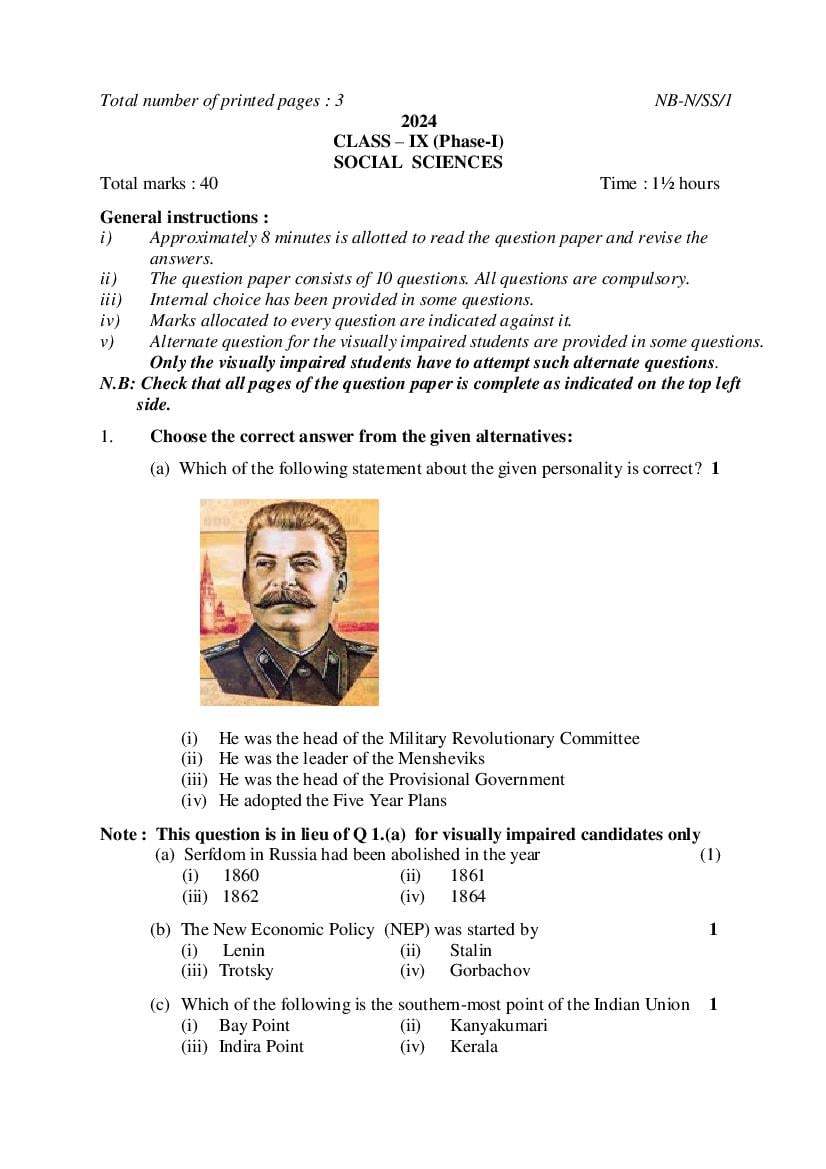
(a) Which of the following statement about the given personality is correct? 1
(i) He was the head of the Military Revolutionary Committee
(ii) He was the leader of the Mensheviks
(iii) He was the head of the Provisional Government
(iv) He adopted the Five Year Plans
Note : This question is in lieu of Q 1.(a) for visually impaired candidates only
(a) Serfdom in Russia had been abolished in the year (1)
(i) 1860 (ii) 1861
(iii) 1862 (iv) 1864
(b) The New Economic Policy (NEP) was started by 1
(i) Lenin (ii) Stalin
(iii) Trotsky (iv) Gorbachov
(c) Which of the following is the southern-most point of the Indian Union 1
(i) Bay Point (ii) Kanyakumari
(iii) Indira Point (iv) Kerala
Page 2
(d) Arrange the following mountain peaks in descending order as per their
height. 1
I. Kanchenjunga
II. K2 (Godwin Austin)
III. Nanga Parbat
IV. Everest
Options:
(i) I, II, III, IV (ii) II, I, III, IV
(iii) III, IV, II, I (iv) IV, II, I, III
(e) A theocracy is 1
(i) rule of a military dictator
(ii) a government run according to the majority religion
(iii) where the King is all in all
(iv) a constitutional government elected directly by the people
(f) Consider the statements given below and choose the correct answer : 1
Statement I : Indian Constitution is a unique blend of flexibility and
rigidity.
Statement II : Most of the provisions of the Constitution can be amended
by a two- thirds majority in both Houses of Parliament.
(i) Statement (I) is correct and (II) is incorrect
(ii) Statement (I) is incorrect and (II) is correct
(iii) Both (I) and (II) are incorrect
(iv) Both (I) and (II) are correct
(g) Which of the following is the most dominant mountain system in
Nagaland? 1
(i) The Low Mountain Range (ii) The Middle Mountain Range
(iii) The Patkai Mountain Range (iv) The Barail Mountain Range
(h) Which of the following instrument have one or more strings stretched
between two fixed points on a body? 1
(i) Aerophones (ii) Idiophones
(iii) Chordophones (iv) Membranophones
Answer the questions in about 20-30 words:
2. Who took command after the fall of Kerensky’s government and what was the
new government called? 2
3.a. Give two characteristic features of winter season.
Or 2
b. What is retreating monsoon?
4.a. What are the two important functions that an economy performs?
Or 2
b. State two characteristics of underdeveloped economies.
Page 3
5. Give two theories of the origin of the word ‘Naga’. 2
Answer the questions in about 50 -70 words:
6.a. Explain the role of the middle class in the French Revolution.
Or 4
b. Explain the importance of the Storming of the Bastille on the course of the
French Revolution.
7.a. Briefly explain any two essential features of democracy.
Or 4
b. Write a short note on a Federal State.
8. Read the source/passage given below and answer the questions that
follow:
Earth has so many creatures living on it. The term wildlife not only caters
to wild animals but also takes into account all undomesticated life forms
including birds, plants, insects, fungi and even microscopic organisms. With the
passage of time these creatures became less numbered due to many reasons.
Their extinction affected our ecosystem which is a biological community of
interacting organisms in the physical environment. From Amur leopards to
Hawksbill turtles, there are many endangered species that are at risk of
extinction. It means that we are at risk of losing these animals completely. The
cause of their extinction are the humans, their habitat destruction and
fragmentation, climate change, air and water pollution, the spread of invasive
species and overfishing. We can save the species for many purposes such as for
the enjoyment of future generation. It is because we get pleasure in seeing these
animals and interacting with them. We need to save them for the environment
and other animals. This is because extinction of one animal upsets the other one
resulting in an unbalanced connection between them. These species are saved
and protected for another important purpose which is its use in the medicine.
Questions :
i) Whose extinction affects our ecosystem? 1
ii) List one factor that causes extinction. 1
iii) Why do we need to save the species for the environment? 2
Answer the questions in about 80 – 100 words :
9.a. Describe the significance of private sector in the Indian economy. 6
Or
b. What is population? Explain the factors that determine the population change.
(1+5=6)
10.a. Explain any three rivers of Nagaland that flows into the Brahmaputra.
Or 6
b. Give an account on the climate condition of Nagaland.
.
*******************************
Page 4
2024
CLASS - IX
ENGLISH - (Phase 1)
Total marks : 40 Time : 1½hours
General instructions:
i) Approximately 10 minutes is allotted to read the question paper and revise the answers.
ii) The question paper consists of 10 questions, divided into four sections A, B, C & D.
iii) Attempt questions based on specific instructions for each part.
iv) Write the correct question number in your answer sheet to indicate the option(s) being
attempted.
N.B: Check that all pages of the question paper are complete as indicated on the top left
side.
SECTION-A (Literature)
1. Choose the correct answer from the alternatives given: 1x2=2
(a) When Rip Van Winkle returned to the village, he found __________.
A. that wolf had disappeared
B. he had slept on the mountain the whole night
C. his beard had grown a foot long
D. the dogs in the village strange
i. A and C ii. C and D
iii. B and C iv.A and D
(b) The Americans abandoned various British things but could not abandon the
_______.
i. language ii. ideas
iii. culture iv. eating habits
2. Answer either 2(i) or 2 (ii) or 2(iii) 5
(i) Dr. T.Ao was proud to be a Naga and wanted to uphold their reputation. How do you
know this?
(ii) Describe the circumstances that led Rip into a deep slumber.
(iii) What does R.K Narayan mean by Bharat English? Explain.
3. Don’t keep saying ‘Yes, Madam’ like a parrot, nincompoop.
i. Who is the speaker here? 1
ii. What traits do the words reveal about the speaker? 2
4. In ‘The Bishop’s Candlesticks’, the convict was a victim of circumstances. Do you
agree or disagree? Give reasons.
Or 3
Why did the Bishop sell the salt-cellars?
Page 5
SECTION - B (Reading)
5. Read the passage given below and answer the questions that follow:
1. Overpowering prey is a challenge for creatures that do not have limbs. Some
species like Russell’s viper inject poison into their prey. Some others opt for an
alternative non-chemical method- rat snakes, for instance, catch and push their prey
against the ground to immobilize them, while pythons use their muscle power to
crush their prey to death. But snakes can’t be neatly divided into poisonous and
non-poisonous categories.
2. Even species listed as non-poisonous are not completely free of poison. The
common Sand Boa, for instance, produces secretions that are particularly poisonous
to birds. So the species doesn’t take any chance—it crushes its prey and injects
poison as an extra step.
3. Do vipers need poison powerful enough to kill hundreds of rats with just one drop?
After all, they eat only one or two at a time. While hunting, animals try their best to
kill most efficiently, their prey will use any trick to avoid getting caught and
becoming a meal, such as developing immunity to poison. For instance, Californian
ground squirrels are resistant to Northern Pacific rattlesnake poison.
4. Competition with prey is not the only thing driving snakes to evolve more and more
deadly poison. Snakes also struggle to avoid becoming prey themselves. Some
snake killers have partial immunity to poison. Famously, mongooses are highly
resistant to cobra poison and with their speed and agility, kill snakes fearlessly. It
would be the death of cobras as a species if they didn’t evolve a more deadly poison
to stop mongooses.
5. Poison has another important role. It’s an extreme meat softener, specific enzymes
break up the insides of the prey. Normally, a reptile depends on the sun’s warm
rays to aid it in its digestion. But I wonder if we cannot use venom in our favour. In
remote parts of India, local hospitality often involves leather-tough meat. I chew
and chew until my jaws start aching. If I spit it out or refuse, our hosts would be
offended, I swallow like a python stuffing a deer down its throat and hope I don’t
choke. If only I had poison.
(i) Answer the following questions:
(a) What immunity does the Californian ground squirrel have? 1
(b) How do rat snakes and pythons attack their prey? 2
(c) Why did the writer wish to have poison when he was in a remote
part of India? 2
(ii) Answer the questions given below as directed: 1x3=3
(a) The liquid substance released from glands is called _________. (Paragraph 2)
i. secretion ii. immunity iii. species iv. injects
(b) How many rats do vipers consume at a time? (Paragraph 3)
i. Seven or eight ii. Five or six
iii. Three or four iv.One or two
Page 6
(c) Why do animals try to kill efficiently?
i. As their prey might attack them.
ii. As their prey will use any trick to avoid becoming a meal.
iii. As they are testing their skills.
iv. As they are trying to learn new tricks.
SECTION -C (Writing)
6. You are Kevin, the Secretary of the Mountaineering Club of Eden High School,
Kohima. Your school has decided to organize a trek to Mount Japfü. Write a notice
giving details about the date, time etc.
Or 4
You have been invited to attend the wedding of your friend’s sister, but you have
contracted typhoid. Compose an e-mail for your friend expressing your inability to
attend the wedding.
7. Answer any one of the following in about 200 words: 7
a. You are Joseph. Your class was taken to visit the Old Age Home in Kohima where
you spent a day with the residents. Write a letter to your friend telling him/her what
you saw, how you felt and in what way you have changed since the visit.
Or
b. Write a speech on the topic, ‘Discipline shapes the future of a student’.
SECTION- D (Grammar)
8. Fill in the blanks as directed in the brackets: 1x2=2
(a) The captain ________ answered all the questions.
(Fill in the blank with a suitable pronoun)
(b) As I am new to this town, I have ________ friends here.
(Insert a suitable quantifier)
9. Rewrite the given sentences as directed in the brackets : 1x3=3
(a) my/ eyes/ neighbour’s /baby/black/large /beautiful/has (Reorder the adjectives
correctly to make a meaningful sentence)
(b) The students are sitting ________ the chairs. (Insert a suitable preposition)
(c) David runs fast. (Underline the Adverb and state its kind)
10. Underline the verbs in the following sentences and name their tenses: 1x3=3
(a) He studied here some years ago.
(b) Next summer vacation, I will be going to Kerala.
(c) I walk to my school every day.
***************************************
Page 7
2024
CLASS-IX (Phase I)
TENYIDIE
Total marks: 40 Time: 1½ hours
General instructions:
i) Approximately 8 minutes is allotted to read the question paper and revise the answers.
ii) The question paper consists of 11 questions. All questions are compulsory.
iii) Internal choice has been provided in some questions.
iv) Write the correct question number in your answer sheet to indicate the option being attempted.
N.B: Check that all pages of the question paper are complete as indicated on the top left side.
(Kesi mhaphrü)
1. Thedzeu phrülie di ketsokeshü hako kelashülie:
Tenyimia kelhouzho nu miakrau kele se mha pete pepiya, mia puo thuo mhanyi ba morei
vi ba rei puo pfu puo chienuo puo thinuo morei puo ramia ze kereirhelie mota ro puo sa phrü
motaya. Mechü nyie nu mia puo thuo mhasi ba rei puo mechü keleu se mo di puo medo chü mia
ze pfhetseipfhekho chüwaya mo. Mechü nyie nu mechü kerüchü di kesimia mu krütamia bu süu se
mia ze kerüchüya, süla thinuo morei rüna donu panyaparakecü die sierya mo. Themia pete rei
therhu pie puo krütamia tsüya, rüna krütamia mha kehoupuorei se thinuo kekrei morei rüna kekrei
ze kerüchü kesie ki, ‘A thinuo die morei a ramia die’ isi di die puya. Süu puo themia kerhu la, siro
miaümia rei die kepu ki puo krütamia kerhu la, ‘A krütamia die’ isi di die puya. Süla lhou
keriemia huoniehuo thezie mu huoniehuo rhu se di lhouya, themia kethezie ro keze viya, derei
kethezie mota ro u donu kezekesuo se vorshüwaya.
U niedimiakoe kenyü ikecüu se mha kesuoko pete kekha se tuoya, kenyü ücü kepuu chü
liro Ukepenuopfü neikemo chüwate ikecüu zo. Kelhouzho nu medzi di lhouyakezhako:- Nhicumia
phichümia ba perieya, nhicumia phichümia mhodzü die pu mhamhaya mo. Mha kehoupuorei
phichümia puta ro phichümia die zeya. Thehethehie nu phichümia bu mha methalie rie di mhakevi
chakelie sie nu mechüu mhacümhakrieya. U nia u meimia neikemo chü kenyü, terhuomia sie u nia
u meimia kezhatho. U krü gei die kesuo pu kenyü, u krü pejawa ro u siedze suotaya.
Kejükesuomia pese kenyü, lhesuomia lalhimia, kenyakemelumia mu kemelomia kre kenyü,
themia hakemhieko kre morei pese ro u siedze vi motaya. Diemo pu suo, hau la dievi nu “kerüsuo
mo ro kuteiü rei telieya mo” isiya. Terhuo die pedie morosuo, puoca liro kemiako, kemelha morei
kemiavita suo. Hakemhie di u niedimiakoe themia bu vi mu puotou nu balieketuo la chü suo, chü
kenyü siro pu suo pu kenyü isikecü kekra se themia kekha se baya.
Diecako donu puotou-u kedashülie:
a. Themia pete rei therhu pie puo _____ tsüya. 1
(i) kesimia (iii) capimia
(ii) krütamia (iv) peyumia
b. Tenyimia kelhouzho nu _____ kele se mha pete pepiya. 1
(i) mialiu (iii) miatsa
(ii) miakrau (iv) miaweu
c. Kenyü ücü kepuu chü liro _____ neikemo chüwate. 1
(i) Rüsomia (iii) phichümia
(ii) krütamia (iv) Ukepenuopfü
d) Themia _____ mota ro u donu kezekesuo se vorshüwaya. 1
(i) kethezie (iii) kedzünga
(ii) kepero (iv) kezevi
e) _____ huoniehuo thezie mu rhu se di lhouya. 1
(i) U pfutsanuoko (iii) Tsiedonuomia
(ii) Kehoumia (iv) Niakiluomia
Page 8
f) Themia pete rei kedipuo pie puo krütamia tsüya ga? 1
(i) Ramei (iii) Zayie
(ii) Therhu (iv) Thetshe
g. Tenyimia kelhouzho nu medzi di lhouyakezha ca kenie thushülie. 2
h. Dieca hanie puo kepetsou dieu thushülie: 1+1=2
i. Miakra ii. Pese
(Diezho mu Thuyie)
2. Diesou hako puoca thushü di se diecha chüshülie: 1x4=4
a. Cüluo mo zo
b. Athiediu chü
c. Kekrükedei
d. Dopfidorü
3. Diekhu mu dierozu kekrü kebako thu kemezhüshülie: 1x3=3
a. U krü nuo rhu moroshuo.
b. Nieki niathutsa nu thuparya.
c. Mha kevi kechü puo jakhra nei.
4. Diecha hako pie Tenyidie nu thushülie. 1x3=3
a. My neighbour’s dogs bark too much.
b. Thank God! You saved my life.
c. We could complete the project on time.
(Diemvü)
5. Diecako donu puotou-u kedashülie: 1x3=3
(a) Kekuomia kedipuo pfülieya ga?
(i) Kenei (iii) Kere
(ii) Thedzü kezei (iv) Thepie kemesi
(b) ‘Nou tsopfhü mo ütsaliko chü,
Mha va pele thenou va pemvü’
Diecha hau geizo kiu nunu se par ga?
(i) Nhicu Zha (iii) N dzüzie hie
(ii) Leliecie (iv) Keliya Zolie
(c) Dieze dze nu u krü die keze-e kedipuo khrü keprei puo zo üdi pu ga?
(i) Terhuomia (iii) Kepethamia
(ii) Krütamia (iv) Sorkari
Ketsokecü hako dieca 20-25 mese nunu kelashülie: 2x4=8
6. Buto bu siazha kimhiecü puo chütuo üta ga? Puoe michiekelie ki kedipuo pu sierta ga?(1+1=2)
7. Samipfü puo nou kedikelie sie puo kekhruohi kimhie vorta üsi ga?
8. ‘Nhicu Zha’ geizo-u nu ükezomiae kiüdi u nhicu tei lepie rünoumo üta ga?
9. ‘N Dzüzei Hie’ geizo nu ükezomia u tarhokeshü ca kenie (2) thushülie.
Ketsokecü hanie puo(1) kedapie dieca 40-50 mese nunu thushülie:
10. a. Ngusanyü mu Jayamo unie kelhou zhorüli nu kedipuo kekrei ga? 4
Moro
Page 9
b. ‘Huo n tshetuo, huo n tha zotuo.
Themia pete nei chü tsolie lho.
Peso geinu pete ngu phre ba.
Le menuo di n thuo n selie.’
i. Diecha hako geizo kiu nunu se par ga? (1)
ii. Kirapuo nu pete ngu phre ba ga? (1)
iii. Kedipuo la mia pete nei chü tsolie lho üdi pu ga? (2)
Ketsokecü hanie puo (1) kedapie dieca 60-90 mese nunu kelashülie:
11. a. ‘N Kelhou rhikeshü rhuo-ue
N chüpie u ngo zokeshü la
N nei phi di puo tshe zoliecie.’
i. Diecha hako geizo kiu nunu se par ga? 1
ii. N kelhou rhikeshü ‘Rhuo-ue’ ikecü süu supuo pu ba ga? 1
iii. N chüpie ungo zokeshü la n bu kimhielie nu ba ga? 1
iv. N chü pekrei pie ungo zokeshü ca kenie thushülie. 2
Moro
b. ‘Menyiepounuo pou kebayo tuoi
Nhicu ki we mha va keziekruo,
Vi mo ürei u kesuoyo rei,
Se rünou di mha we mehou mo.’
i. Diecha hako geizo kiu nunu se par ga? (1)
ii. U nhicu teiki u vie kesuoyo rei se di kikemhie baya üsi ga? (2)
iii. Geizo diecha hako puoca vatshashülie. (2)
*********************
Page 10
2024
CLASS-IX (Phase I)
AO
Total marks: 40 Time: 1½ hours
General instructions:
i) Approximately 8 minutes is allotted to read the question paper and revise the answers.
ii) The question paper consists of 12 questions. All questions are compulsory.
iii) Internal choice has been provided in some questions.
iv) Write the correct question number in your answer sheet to indicate the option being
attempted.
N.B: Check that all pages of the question paper are complete as indicated on the top left side.
(Rajem Latang)
1. Teküboklen agüja aliba junga züngang aser tasüngdangbatemji langzüang:
Ao kin tokolak bushiba tensa ka nung Yisu yimsü Osang tajung bener Sibsagor nungi Rev.
Dr. Clark, tebutsü Mary Mead Clark aser Assamese nunger sayutsüngir Gudhula Ao Naga
tenemi atu. Iba tensaji Aor tzükong aser yim shia pei pei oshi jembiba dak alaka, arok asoshi
kobala oshi ka nung lirumedemtsü ta asüba tangatetba kecha makai liasü.
Ao kini jembiba oshi ya Jungli, Mongsen, Changki aser Nokpu ta lemsatsü akok. Ano
Jungli aser Mongsen anaprongla nungji tzükong shia olasü balala liaka ajaki angatettepa
tebhong küma lungjemer jembia aser zülua aru. Ibaji Ao kin maitsü ayak oshiji lir.
Koba kin pei tetsü oshi maka, iba kin dang “Kin ka” ajatsü makok, saka parnok dang
nemzünemponger ta ajatsü akok. Nüburtem rongnung telungjem adokdaktsübaji oshi ajanga,
mesüra oshi dak keta lir. Tetezü shilu ka nüburtem rongnung kasa oshi jembibaji mangatetra
parnok rongnung tangatettep aser telungjem alitsü tasak asütsü. Lipuyimpurtem, talisa tenem
kintem aika par oshiji tebangi jembiba dak alaka zülubo makai lia aru. Naga kin-a yamaji pei
tetsü oshi jembiaka, zülubo makaba tensa ka nung British sorkar aser Missionary-tem asen
limai aru. Tanü asenoki züluba Ao oshi ya latettsü atema Missionary-temi küm 21 (1872-1893),
tashi agia shisadanger parnok Mundang nung lemtet ta züluyu nungji angutsü.
Ao oshi atema kechi zülujang amshitsü telemtetba agiba kümji Ao oshi zülu lipok tetenzük
ta aseni ashitsü akok. Iba jakdangbo Missionary-temia Hindi aser Assamese agi sayutsü
merangdang. Saka Hindi aser Assamese oshi nung asen Ao o zülua sayutsübaji tamakoktsü ta
parnoki asatet.
Agüja aliba nungi shitak telangzüba shimteta langzüang: 1x6=6
a. Koba tensa nung Ao kin dangi Yisu yimsü osang tajung bener aru.
(i) Khonang bushiba (iii) Tokolak bushiba
(ii) Rongsen bushiba (iv) Akhüm bushiba
b. Sibsagor nungi Rev. Dr. Clark, tebutsü Mary Mead Clark aser Assamese nunger
Gudhula Ao Naga tenemi atubaji kechi inyaker ka liasü?
(i) Tesayur (iii) Yimsüsür
(ii) Sayutsüngir (iv) Walunir
c. Ao kini jembiba oshi pezüji? _____Mongsen, Changki aser Nokpu ta lemsatsü akok.
(i) Hindi (iii) Jungli
(ii) Assamese (iv) English
Page 11
d. Koba kin pei tetsü oshi maka iba kin dang kechi ta ajatsü?
(i) Yimti ka (iii) Kidong ka
(ii) Yimtsüng ka (iv) Nemzünemponger
e. Nüburtem rongnung telungjem adokdaktsübaji kechi ajanga lir?
(i) Oshi (iii) Olasü
(ii) Olem (iv) Rongsen
f. Missionary temi küm kwi agia shisadang?
(i) 23 (ii) 21 (iii) 25 (iv) 30
Item tasüngdangbatem ojang20-25 tashi nung langzüang:
g. Kechi koma tensa ka nung nung Britsih Sorkar aser Missionarytem asen limai aru? 2
h. Missionary-temi tamasa kechi oshitem agi sayutsü merangdang aser koma parnoki
asatet. 2
(Orrlem)
2. Agüja aliba nungi shitak telangzüba agüjang: 1x2=2
a. _____ dak tema züngdangba dang karsa züngdangba ta ajar.
i. Ka ii. Ana iii. Anayim iv. Kayim
b. Amilemji ojang ka kobai nisung aser _____ terenyim telemsa indang rasaa ashir.
i. shiruru ii. rongsen iii. oset iv. libaliru
3. Item oren karsa leni meyipang: 1x2=2
a. Ni yakanü Mon nungi shilang.
b. Pa ozü kidangi aru.
4. Itemi kobala Amilem nungsa densema ali teputep tenüngja agüjang. 1x3=3
a. Item nungdak kangabo madoker.
b. Nenok nem mapa ka lemzüktsür.
c. Onok dangi na arungma.
5. Item oren Ao agi meyipzükang: 1x3=3
a. My neighbour’s dogs bark too much.
b. Thank God! You saved my life.
c. We could complete the project on time.
(Otsü aser Sangro)
6. Agüja aliba nungi shitak telangzüba agüjang: 1x3=3
(a) Nisungi yimya tajung benshia aser kechi timi amshibaji kanga tajung?
(i) Awashi (iii) Jaklaliru
(ii) Libaliru (iv) Sobaliba
(b) Tetsü tasolai _____ jala tasür.
(i) meimba (iii) aginüba
(ii) memeimba (iv) sapuba
(c) Pa mangyimba nüktzü koma ayim?
(i) Tzüba (iii) Ayong
(ii) Tzüyim (iv) Tzünglu
Page 12
Item tasüngdangbatem 20-25 tashi nung langzüang: 2x4=8
7. Awashi metetba ajanga tajangzük kechi angur?
8. Ternemjem awashiji kechi dang ajar?
9. “Saka akümlir lima telongratsü maket
Asür lim longti tenemjiang telongraba!”
Iba oren ya koba sangro nungi aser shibai mejemba?
10. ‘Oagi Alima Ka Lir’, sangro mejemeri teti yongyabaji kechi liasü?
Item tasüngdangbatem ojang 40-50 tashi nung langzüang: 4x1=4
11. a. Meranga inyakba tajangzük pezü (4) shiang.
Mesüra
b. Kechiba aseni pi bendangeri amshiba awashi angazüka benshitsü nüngdaker?
Item tasüngdangbatem ojang 60-90 tashi nung langzüang: 5x1=5
12. a. ‘Oagi alima ka lir
Yimchiyimjung nung lirepa
Nübu aben sünepa lir
Aji kü mera Aoli’
i. Koba sangro nungi agitetba? (1)
ii. Shibai mejemba sangro? (1)
iii. Orentem ya rasaa shiang. (3)
Mesüra
b. ‘Khrista putisür Supongwati jabaso.
Aoli wabangtsü temjena sojasoba
Bendang semer yimdenyimlia nai aben’
i. Koba sangro nungi agitetba? (1)
ii. Shibai mejemba sangro? (1)
iii. Oren jagi shirnok indang ashir rateta züluang. (3)
*********************
Page 13
2024
CLASS-IX ( Phase I )
SUMI (SÜTSAH)
Total marks: 40 Time: 1½ hours
General instructions:
i) Approximately 8 minutes is allotted to read the question paper and revise the answers.
ii) The question paper consists of 13 questions. All questions are compulsory.
iii) Internal choice has been provided in some questions.
iv) Write the correct question number in your answer sheet to indicate the option being
attempted.
N.B: Check that all pages of the question paper are complete as indicated on the top left side.
(Ghili Kiye)
1.Yepua keu phiju no inijü akeqo khochile tsülo:
Khaghilomi ni Sümi Tukahu momu Tapuhu qhalo küghüna ache kemi dolo timi lakhi pa
je Tüqhakhi ache. Pa ye timi shixishila lakhi, aghungu lono küdüu ilhoche keu likhi kumo no pa
phimipi athoghi lhoxü kütau ilhove no itaghi atho no nodiu shikithepe timi lho shiluve
che.Tighunguno Tüghakhi vilo küdüu timi ipiche.
Tüghakhi ye aghütomi lakhi kehu küdüu shipüzü acheaxü lo timi kutomo yepu wuve
ache. Akhotoshi Ghohami eno Hebolimi phu lo timi kutomo yipuwuve tsüche kemu aphu lo
kükami eno aghüyemiqo ye tipau ghili shephe mla no ache. Ghulo lakhi ghi aphu lakhi lo timi
lakhi yipu wuve tsüke tileno akükau no pano phu lo aghüyemiqo sasü aghüsahuli lo aliwo zü
anepa sheju kelaye tipau dolo kitila müdünyi alavephe pula eno tipa lalo ajikiyida puaghi keu
shephelu.Tilehi no akükau no pi. “hikithikighi la lono küdüu shi ighino nighapumi, nighalimi
yipu wuve acheni kenaoe!”
Aghami nu, ningu alaküpüla hipau lo müsütheshini, ikemu asüti ye peitha mono asüghi
no shino ikawuju ani nolo.Tishi veno pananguno asüghi pe la küpla la müsüthepe qhive.
Atsala hami thiu, Tüghakhi ye itaghi aphu tipau lo timi yipu wuniye thosü pa la küpüla
lono akili küdüu lho shive no iloche kelo no aküsü lono kitimeluve. Tithiu akükau no aküsü ika
ighike lau ye akili mepe aghi. Ike akili tipau ye aghü nanu jeli; ausükükha, aghühu, mla küxa eno
avisapu ishi xapusü mepe aghikeu ithulu.Ti ilheche no akükau no oho! Shi “Oh aghaminu!
Ighino hi julo, timi küdüu no lhoxu kütau ilhove püzü nodiu shikithe pe pa tho timi shiluve
cheni ipi küghache keu Tüghakhi hu asüghi lono me anike, ningu pa kütsü lupe huti aghü leku
nike aphu lo aghüyemi kümütsü ighilo” ipi asheshu.
Ti chilu kemtsa aghami lhoxü no wo kuho jupüzü akütsü lupe ‘eu shi he he shi aghü leku;
‘Oh aghü kütsü yempau, Oh aghü kütsü sülipho’ ipi akütsü pewo aghü kütsü kughobo lo ghove.
a. Küdüu timi je khuu kea? 1
(i) Tüghashe (iii) Tapuhu
(ii) Tüghakhi (iv) Tükahu
b. Tüghakhi ye _____ lakhike? 1
(i) Ashihami (iii) aluchemi
(ii) Tüghami (iv) Aghutomi
c. Akükau no aphu lo _____ sasü aghüsahuli lo anepa sheju. 1
(i) Aghutomiqi (iii) Aghamiqo
(ii) Aghümiqo (iv) Aghüyemiqo
d. Aghüsahuli do kitila ______ alavephe pula aghi. 1
(i) Müdünyi (iii) Phepheshi
(ii) Phiphishi (iv) Vejoyi
Page 14
e. Akili tipau ye aghü nanu jeli, ausükükha, aghühu _____ eno avi sapu ishi xapüsü mepe
aghi. 1
(i) Amüla kükha (iii) asapu
(ii) Amili küda (iv) avabo
f. Atsala hami thiu akükau no aliche ika ighi keloye _____ mepe aghi. 1
(i) Akili küdüu (iii) küdüu
(ii) akili (iv) tüghathi
Iniju akeqo khochile:
g. Tüghakhi ye akhoto no khuno ghami phu lowu yipu wuve che kea? 2
h. Aghami lhoxü ye kuu kütsülu pe kishi aghüleku akutsü pesü kulo ghove kea? 2
(Tsaye)
2.Sütsa lo pekili süvelo: 1x3=3
a. My neighbour’s dogs barks too much.
b. Thank God! You saved my life.
c. We could complete the project on time.
3.Achipiu tsathi pe kimeve tsülo: 1x2=2
a. Akavi ye ______ lo tokulu shiluva.
i. ghukuju ii. pekuju iii. thekuju iv. akikishe
b. Atoka paza no aghutu lo aye_____ cheni.
i. sujo ii. ghe iii. xo iv. chu
4. Tsashibe kikije ajeli lakhi je tsulo. . 1
5. Kikihi tsashibe tsathi michiphe tsülo: 1x2=2
a. Niye ghuthu kini pa sasü kusholu va.
b. Kito ye alhokuthu ado achipi lono peitha cheni.
6. Pighi vehu pe atsajo müla lo: 1x2=2
a. Akukuhou’w
b. Ipu’w
(Kichitsatho eno Apu-Asü Leshe)
7. Achipiu tsathipe kimeve lo: 1x3=3
(a) Küghakiche tsa lo Aesop ye _____lakhi no qemi ipi che.
(i) Greekmi (iii) Croesus
(ii) Delphi (iv) Lidiya
(b) Eden ghutu ye _____ küdau ani.
(i) Kulola (iii) Apeu
(ii)Kipela (iv) Ahuu
(c) _____ ghükütsü no
(i) Ayiliu (iii) Apuu
(ii) Amuchou (iv) Topuu
Atsathi 20-30 dolo no khochilelo: 2x4=8
8. Aesop no Xanthus xalu kelo Atsa kishi pa shika kea?
9. Tuluni ye kiu tsala lono pini cheni kea? Tuluni kiqi yelo.
Page 15
10. Galili züghi ye kiu toi keu züghi kea?
11.”Azü nheu ni Thochi no lagha,
Kuwo thosü aki lakhi,
Mishi Toku ha kiphe no haye.”
i. Khuno lagha pi ani kea? (1)
ii. Amishi khije haphe kea? (1)
Atsathi 40-60 dolo no khochile lo:
12. a. “Aqeu ngo Alikhu kishiu pama ghi tihu toi yeve pelo”.
(i) Kiu yeve pelo pi ani kea? 1
(ii) Khuno pi ani kea? 1
(iii) Kiu shive kelono atsa hipau pi ani kea? 2
Momu
b. “O Axeu no kiyimi ghamiye,
Aphi chikha lono hepu wu
Ghola Chuwomi ghuno kusa lo püa kimiye”
(i) Hiye kiu leshe lo ani kea? (1)
(ii) Axeu ye khuu kea? (1)
(iii) Kiu shi kimiye pi ani kea? (2)
Atsathi 60-80 dolo no yelo:
13. a. Anighini Tsala lo müla itha chekeu ghili kishe kulu shi yelo. Alhukho kiqi ye kiu kea? 5
Momu
b. “Ishe ile Anga qa küauye,
apuaza anu küghüvümi nu,
ilomucho chi jotsüni,
süwo amlo küsami nuli pinilo”
(i) Anga qa akeu je khu kea? (1)
(ii) Khuno anu ivü che kea? (1)
(iii) Kiu shi akeu nuli achi pini lo pi ani kea? (1)
(iv) Akiqi tsülo: i. Küghüvümi ii. Ilomucho (2)
*********************
Page 16
2024
CLASS-IX (Phase I)
LOTHA
Total marks: 40 Time: 1½ hours
General instructions:
i) Approximately 8 minutes is allotted to read the question paper and revise the answers.
ii) The question paper consists of 12 questions. All questions are compulsory.
iii) Internal choice has been provided in some questions.
iv) Write the correct question number in your answer sheet to indicate the option being attempted.
N.B: Check that all pages of the question paper are complete as indicated on the top left side.
(Ekhao)
1. Oküpoe erani elio shi khae zesi engao jiang janlana:
Nkolo eran reni wopan motsünga lo tsokhying osi tsolo onte nchyu tirok vancho. Wopan ji lo
nonghori yolo eramo ji yaka jo onte topvü opyonori osi osak-ophong elümoto mmhom tae
tssocho. Onte opyonori mmhom jiang lo epyankae kangtsükangrita vanta vancho. Onte yolo
eramo ji jo opyonori osi osak-ophong jo nmhon tolia elhilanmori lo jo elüm lümbüm theta, nzan
lia, erüm eto lia, etssoephyo mmhona tvü tssocho. Okaong osi ongoang na ota ji elümoto
zerüpzerita onte ota to tia ntsata na yikvüyilota vanta vancho. Tsüngon motsünga lo jo ota na
meta ekoni yentsalo wosi songa nyiv vanathüng opo ji nochonori nmhon kae nochonori sicho.
Kvüthüng onte wopan ji lo hetvü sükhying yicho sana onte onte nlan pita khondarotav benkacho.
Onte na jo khondarota ji yakchia wopan ji lo mmhom hansi yiv to nchümtacho, tolia hoji na ntia
mmhon ntssochev sicho. Hetvü yuta shi lo otsoe eramo ji yentsa lani van, orapvü otsükoso
nmhon, tsokhying tsolo jiang nratav van to shiang nchümri yakchia oyo ji nchümri ekümo tssoe
sicho. Oyo ji na “otsoe eramo ji na a ndüngo vancho salivo oha mmyingvü jiang ombo na a
haniv kasi” to nchümria otsoe ji eyiloa vancho. Onte yolo okhao ji na ha okhae jo shi esüa
nchümchecho. “Ata eramo ji e ndüngo vancho salivo apo nochonoria evamo ji ha ombo na zev
elani ena khondarota evamo shimpa tssolia elaroa nsüngi siv” to phyoa nungra nchümcho.
Kvüthüng otsoe eramo ji na oki oyi jancho sana opo elüm nmhon nochonoria van, oyo ha
onte wopan emhokelüm ji na lümbüm pyingi van elani okaong, ongoang nratav khondarota van
to tssocho. Ota na okaong, ongoang tsarhyui ejyurünyu olan olan pisi ombo na “A na oki shi lo
yuta esüngaro nvamo ji na ntio ejyuran hungi khia”? ota na shi esüa kvüthüng engacho sana onte
na yikra ntia njanlancho tolia onte ntssojan jiang nchümcheta,” Wopan no eramo ji jo opyonori
nmhona sayia, oponori lo zekayio mekcho sayia, eramo jo eramo sayia to phyota ombo thüngi
nlan chontacho. Hoji sülo jo onte onte nlan sitasi eküm tongphi opo ha opvü oni jancho zoyia
elani ota eramo ji yikrachia vanta yi sicho.
Janlan pi elio jiang lona elamo ji ethüngi erana: 1x6=6
a. “Wopan” shi yichak jo.
i. ndüngo iii. oshom
ii. okilo iv. motsünga
b. Lotha kyon ochoang sana jo wopan no tsokhying vandemo ji mying jo _____.
i. Bukdemo iii. Mhademo
ii. Okharo iv. Mhao
c. Yitsüng “tolia” shi jo.
i. tssayioyi iii. tepfüyi
ii. myingtsayi iv. Yishenyi
Page 17
d. Zukhov shi nkhümao ji jo.
i. mmyingvü iii. elüm
ii. tara iv. elamo
e. Wopan ji lo kvüri ji jo ocho la?
i. oyo iii. okharo
ii. opo iv. eramo
f. Okang, ongoang na ota zeprüpzerio ji jo.
i. Opyonori mmhomo ji na iii. Opyonori nmhomo ji na
ii. Ombo eramo etsso ji na iv. Kyon nmhon etsso ji na
Engao shiang janlana: 2x2=4
g. Otsoe eramo ji na yentsalani vanathüng onte wopan ji lo ntio ezüp ntokcho sana erana.
h. Wopan ji lo oyo ji tona okharo ji to oni na otsoe eramo ji elani ota eramo ji nvamo ji
nchümcheta kvüto phyotacho sana erana.
(Yisanlan)
2. Janlan pi elio jiang lona elamo jiang ethüngi erana: 1x3=3
(a) Kyon _____ hepi tsata. (shi lo zonkayi elamo ji khi pyingthoka)
(i) shi (ii) jo (iii) ji (iv) na
(b) Police na ombo rhümacho _____ ombo efüi nchyua. (Yishenyi elamo ji jo)
(i) ntiotssole (ii) khatolia (iii) mekana (iv) tolia
(c) Trillion jo ete Lotha yi na jo kvüto tsala?
(i) Othüng Nzoa (ii) Kara Taro (iii) Gongdong Nzoa (iv) Gongdong Thünga
3. Ejüngi elio shiang myingthong khi pyingthoka: 1x2=2
a. Okhae jo _____ rotav ka.
b. Ombo _____ yithaka.
4. Ejüngi elio shiang etümthokyi khi pyingthoka. 1x2=2
a. Ombo kyon _____ nchyua.
b. Mhao jo vanphen _____ lo chiyicho.
5. Yiren pi elio shiang Lotha yi na khophia. 1x3=3
a. My neighbour’s dogs bark too much.
b. Thank God! You saved my life.
c. We could complete the project on time.
(Erantolan)
6. Engao shiang akvülo elamo ji ethüngi janlana: 1x3=3
(a) Mmyotsomyuyua to ephyo ji jo.
(i) Oyam kholo theo ji (iii) Nrinramo ji
(ii) Jokheman hungi tsoji (iv) Kija li jomo ji
(b) Yansali yichak jo.
(i) Oyano ephyoesan otsolov (iii) Oyan esae otsolov
(ii) Oyan esopvüi otsolov (iv) Oyani lijon otsolov
(c) “Ayako to ntssoyi la” to ephyo ji yichak jo.
(i) Elhi tssona tsso ji (iii) Elhi tssoathüng mmok nchancheo ji
(ii) Elhi ryupaka tsso ji (iv) Elhi na sangtsüng lia npvüchopvürio ji
Page 18
Oküpoe engao shiang yitsung 20-25 harüma na janlana: 2x4=8
7. Omhang li ponjomvü tsükona Nrio na lepok kvütvü tsütsacho la?
8. Hümjonlijon jo ntio la?
9. Ntio tsükona ezhü ntav rocho la?
10. Ntio tsükona ombo shom ji na loroe jiang tongtahungcho la?
Oküpoe engao shiang yitsüng 40-50 harüma na janlana: 4x1=4
11. a. Tssontsotsü jo ocho la? Ntio tsükona ombo na era loroe ji jüpona soa vanhungcho la? Ntio
tsükona era loroe ji opoang na otsolov ji Tssontsotsü thüngi yanpithokvü oyi khichoyicho la?
Mekana
b. “Amotsü oyam na a lüngthav a phanta la hoji tsükona ni na a nzansi kvülo sana a
mphothoka osi a shanchoa, tona ana ha ntio sana ni chokao tvü mmha ni piv ka.”
i. Nrio na lipvüso ji kvülo mphothokcho la? (2)
ii. Kvütolyui Nrio na mmha ji khicho la? (2)
Oküpoe engao shiang yitsüng 60-90 haruma na janlana: 5x1=5
12. a. Chungiyi “Onkhümoe Loroe Retacho” ji yintssen ji erana.
Mekana
b. ‘Sümro rümbüm phongi khi khüma nrhon küma,
Mongsangosü chüppi khi khüma nrhon küma,
Shomvü eni na yio, nkhümjancho,
Ezhü ntav tsayila, zechi le shomvüo.’
i. Sümro to ephyo ji yichak jo ntio la? (1)
ii. Mongsangosü to ephyo ji yichak jo ntio la? (1)
iii. Ezhü ntav tsayi la, to ephyo shi mmhona eroroa. (3)
*********************
Page 23
Total number of printed pages -4
2024
CLASS – IX (Phase I)
Bengali (বাাংলা)
Total marks :40 Time : 1½ hours
General Instructions :
(i) Approximately 8 minutes is allotted to read the question paper and revise the answers.
(ii) The question paper consists of 13 main questions.
(iii) All questions are compulsory.
(iv) Internal choice has been provided in some questions.
(v) Marks allotted to every question are provided indicated against it.
N.B. : Check that all pages of the question paper are complete as indicated on the
top left side.
পাঠ
(READING)
1. নিচের পাঠটি মচিাচ াগ নিচে পড় :
আজকাল ওচেবচেস্ক : ১৫ জানু য়ারী ২০২৪ ০৫ : ৩০ :প্রায় ৪০০ বছরেে প্রাচীন মেলা,
বছরেে এই ববরেষ সেরয় তারত বিড় জোয় দূে দূোরেে োনুষ । বীেিূরেে মেঁদুবলরত েবববাে
শুরু হরয়রছ জয়রেরবে বাউল মেলা, চলরব ১৮ই জানুয়াবে পর্যে। েবববাে মেলাে আনুষ্ঠাবনক
উরবাধন করেরছন োরজেে েন্ত্রী তথা স্থানীয় ববধায়ক চন্দ্রনাথ বসনহা।
দূে দুোে মথরক আগত সাধু -সন্ন্োসী ও পু ণ্োথীো কনকরন ঠাণ্ডা উরপক্ষা করে ম ালা
আকারেে বনরচ সাোোত কাটিরয় মসােবাে অজয় নরেে জরল পু ণ্েস্নান সারেন। মিাে হরতই িরে
ওরঠ অজরয়ে ঘাটগুবল। প্রবত বছে এই ববরেষ সেরয় ববপু ল সং েক পু নোথীে আগেন ঘরট
জয়রেরবে মেলায়। এ বছেও মেলায় ২০০-ে মববে বাউল কীতয রনে আ ড়া ততবে হরয়রছ। প্রায়
৬০০ মোকান বরসরছ মেলা জু রড়। জয়রেব মেলায় বিড় বাড়রত পারে, তা অনুোন করেই
ইলােবাজাে থানাে পু বলে, মগাটা এলাকা বনোপত্তাে চােরে েুরড় মেরলরছ। জয়রেব মেলায়
মেঁদুবলরত পু বলে কররালরুে ম ালা হরয়রছ। পবেবস্থবত বনয়ন্ত্ররণ্ বহু জায়গায় লাগারনা হরয়রছ
বসবসটিবি কোরেো।
নিচিেশািু সাচর নিচের প্রশ্নগুনলর উত্তর িাও :
(ক) বেটি মকান সংবাদপত্রে প্রকাবেত হরয়রছ? 1
(i) আজকাল (ii) আনন্দবাজাে পবিকা
Page 24
NBSE-N/B/1
(iii) তেবনক র্ুগেঙ্খ (iv) তেবনক জাগেণ্
( ) এই মেলায় কে-রববে কতগুবল বাউল কীতয রনে আ ড়া ততবে হরয়রছ? 1
(i) ২০০ টি (ii) ৩০০ টি
(iii) ৫০০ টি (iv) ১০০০ টি
(গ) চন্দ্রনাথ বসনহা মক? 1
(i) বচি পবেচালক (ii) নাটেকাে
(iii) অবিরনতা (iv) ববধায়ক
(ঘ) মেঁদুবল মকান মজলায় অববস্থত? মস ারন কীরসে মেলা বরসরছ? 1+1 =2
(ঙ) মকান থানাে পু বলে মগাটা এলাকা বনোপত্তাে চােরে েুরড় মেরলরছ? 1
(i) ইলােবাজাে (ii) লালাবাজাে
(iii) বনলােবাজাে (iv) পল্টন বাজাে
(চ) এ ারন মকান নরেে কথা েরয়রছ? 1
(i) ব্রহ্মপু ি নে (ii) অজয় নে
(iii) োরোেে নে (iv) করপাতাক্ষ নে
(ছ) পু ণ্োথী সবি ববরেে কেরল হয় – 1
(i) পু ণ্ো+ আথী (ii) পু ণ্োে+ অথী
(iii) পু ণ্ে+ অথী (iv) পু ণ্ে+আথী
(জ) এই মেলাটি কত বছরেে পু েরনা? পবেবস্থবত বনয়ন্ত্ররণ্ কী বযবস্থা মনওয়া হরয়রছ? 1+1 =2
বযাকরণ ও অিু বাি
(GRAMMAR AND TRANSLATION)
2. নিচের বিকল্পগুবি থেচক সঠিক উত্তরটি থবচে িাও :
(ক) র্, ে, ল, ব – এই চােটি বণ্য স্পেযবণ্য ও উষ্মবরণ্যে অেঃ অথযাৎ েধেবতী স্থারন অববস্থত
বরল এরেেরক বলা হয় – 1
(i) কণ্ঠ্যবর্ণ (ii) উষ্মবণ্য
(iii) অেঃস্থ বণ্য (iv) অরর্াগবাহ বণ্য
( ) বেকসা > বেস্কা — কী ধেরণ্ে ধ্ববন পবেবতয ন হরয়রছ? 1
(i) সেীিবন (ii) ববষেীিবন
(iii) বণ্যরলাপ (iv) বণ্যববপর্যয়
(গ) জগৎ + নাথ সবি কেরল পরে হরব – 1
Page 25
NBSE-N/B/1
(i) জগৎনাথ (ii) জগন্ন্াথ
(iii) জগেনাথ (iv) জগনাথ
3. উচ্চারণ স্থাি নিণে ে কচর থকাি বণে থলখ :
(i) গ 1
(ii) ে 1
4. সনিনবচেি কর :
(i) সূ রর্যােয় 1
(ii) গন্তবয 1
5. বাাংলাে অিু বাি কর :
(i) My neighbour’s dogs bark too much. 1
(ii) Thank God! You saved my life. 1
(iii) We could complete the project on time. 1
সানিত্য – গিযাাংশ ও পিযাাংশ
(LITERATURE)
6. নিচের বিকল্পগুবি থেচক সঠিক উত্তরটি থবচে িাও :
(ক) চাণ্কে কারক ববন্দ করেবছরলন? 1
(i) কাতোয়নরক (ii) বিক্ষুকরক
(iii) আরিয়ীরক (iv) প্রহেীরক
( ) “আবে চাই __ মহন উলঙ্গ পোণ্” –শুনেস্থারন উপর্ুক্ত েব্দটি বসাও — 1
(i) বেশু (ii) নােী
(iii) র্ুবা (iv) বৃ দ্ধ
(গ) ‘ছু টি’ গরে েটিরকে পেবব বছল — 1
(i) মচৌধু েী (ii) বাগবচ
(iii) গাঙ্গুবল (iv) চক্রবতী
কম- থবনশ ২০-২৫ টি শচে নিচের থ থকািও োরটি প্রচশ্নর উত্তরটি িাও :
7. ‘বপতৃরস্নহ’ পারঠ আরিয়ীে বাবড় মকাথায় বছল? আরিয়ী কত বছে বয়রস অপহৃত হরয়বছল?1+1 =2
8. “অনরে উবড়রছ তাে ববজয় বনোন” — মকান কববতাে অংে? কাে ‘ববজয় বনোন’ উড়রছ?1+1 =2
Page 26
NBSE-N/B/1
9. “সু তোং তাহাে মচহাো ও িাব ানা প্রিুহীন পরথে কুকুরেে েরতা হইয়া র্ায়।” — কাে
প্রসরঙ্গ এই কথা বলা হরয়রছ? মকন তাে সম্পরকয এই কথাগুরলা বলা হল? (1+1 =2)
10. “জোঠারছরল বববড় ায়, কান ধরে টাবনরয়া।” — ‘জোঠা মছরল’ োরন কী? ‘বববড়’ কী? 1+1 =2
11. ‘জাগ্রত মেবতা’ গে অনুসারে েু ু রেরেে বাড়-বাড়রেে কােণ্ কী? মস বছে কারেে
বাবড়রত পারয়সটা একটু ধরে বগরয়বছল? 1+1 =2
কম – থবনশ ৪০ থেচক ৫০ টি শচে নিচের থ থকািও একটি প্রচশ্নর উত্তর িাও :
12. (ক) “ো, এ ন আোে ছু টি হরয়রছ ো, এ ন আবে বাবড় র্াবে।” –
(i) মকান পারঠে অংে? 1
(ii) মল রকে নাে কী? 1
(iii) মক এই কথাগুবল বরলরছ? 1
(iv) ক ন বরলরছ? 1
অেবা
( ) ‘সাধক’ কববতাটিরত েহৎ প্রারণ্ে কীেকে পবেচয় প্রকাবেত হরয়রছ মল । (4)
িয যিানিক ৬০ থেচক ৯০ টি শচে নিচের থ থকািও একটি প্রচশ্নর উত্তর িাও :
13. (ক) “কত কী মর্ ায় মলারক নাবহ তাে বকনাো।” –
(i) মকান কববতাে অংে? 1
(ii) কবব মক? 1
(iii) কাো বোং ায়? 1
(iv) বােযাে বপ্রয় াবাে কী? 1
(v) ‘েবড়রঙে ঘণ্ট’ কাো ায়? 1
অেবা
( ) ‘জাগ্রত মেবতা’ গরে েহারেব সম্পরকয প্রচবলত নানা কাবহবনগুরলাে র্থার্থ
পবেচয় োও। (5)
********************
Page 27
2024
CLASS-IX(Phase I)
ALTERNATIVE ENGLISH
Total marks: 40 Time: 1½ hours
General instructions:
i) Approximately 8 minutes is allotted to read the question paper and revise the answers.
ii) The question paper consists of 11 questions. All questions are compulsory.
iii) Internal choice has been provided in some questions.
iv) Write the correct question number in your answer sheet to indicate the option being
attempted.
N.B: Check that all pages of the question paper are complete as indicated on the top left side.
Unit – I (Reading)
1. Read the passage and answer the questions that follow:
Indian classical music is a rich tradition that originated in South Asia and can now be
found in all corners of the world. Its origins date back to Vedic scriptures over 6,000 years ago
where chants developed a system of musical notes and rhythmic cycles.
In this way, Indian classical music is very closely connected to nature, taking inspiration
from natural phenomena including the seasons and times of the day to create ‘ragas’ or musical
moods and many time cycles or ‘taals’ that have been further codified.
Compositions are fixed but most of the music is improvised within the structure of notes
and mathematics. This gives the music a spontaneous freedom where each artist and every
performance is ensured to be completely unique.
Indian classical music is generally passed down in an oral tradition where the student
would spend many years with their ‘guru’, developing a very special, spiritual bond, imbibing all
aspects of the music along with philosophical and moral principles that shape them for life.
(a) How is nature connected to classical music? 2
Choose the correct option from the alternatives given: 1x3=3
(b) Where did the Indian classical music originate from?
(i) South East Asia (ii) North East Asia
(iii) North Asia (iv) South Asia
(c) Structure of music involves-
(i) Physics (ii) Mathematics
(iii) Performance (iv) Practice
(d) How is Indian classical music passed down?
(i) Oral traditions (ii) Vedic chants
(iii) Human moods (iv) Nature rhythms
Unit – II (Writing and Applied Grammar)
2.a. One day, on your way to market, you saw an accident. A boy riding a bicycle was knocked
down by a speeding scooter and got hurt. As a reporter, write a newspaper report in the local
daily about the accident in about 150-200 words. 6
Or
b. Write an article in about 150-200 words on “Education should be free.”
3.Complete the following sentence with appropriate modals: 1x2=2
a. Drivers ________ use their mobile phones while driving.
b. I asked my friend if she _______ lend me some money.
Page 28
4.Rewrite the sentences as directed in the brackets: 1x2=2
a.My grandfather _______(was resting/rested/is resting) at home after his surgery last week.
(Choose the correct form of the verb and complete the sentence) (1)
b. _____ identity of the palace intruder remains _____ mystery to this very day.(Fill in the
blanks with suitable articles) (½ + ½ =1)
Unit – III (Literature)
5. Choose the correct answer from the alternatives given: 1x6=6
(a)What is liberty?
(i) It is a personal contract (iii) It is a social contract
(ii) It is an individual contract (iv) It is a group contract
(b) Who is regarded as a predator that kills the imagination in the poem ‘Sonnet to Science’?
(i) Diana (iii) The vulture
(ii) The tree nymph (iv) Science
(c) What was missing on the body of the trapped birds?(The Ogress and the two Orphans)
(i) Heads (iii) Wings
(ii) Legs (iv) Eyes
(d) When was the giant fireball seen moving rapidly across the sky in Central Siberia?
(i) June 30,1907 (iii) Aug 30,1908
(ii) June 30,1908 (iv) July 10,1980
(e) According to APJ Abdul Kalam, what does creativity lead to?
(i) Knowledge (iii) Righteousness
(ii) Learning (iv) Thinking
(f) What is the happy man freed from?
(i) The cares of the world (iii) Servile bands
(ii) Responsibilities (iv) Tears and fears
Answer the following questions in about 20-25 words: 2x3=6
6. What does the rule of the road imply?
7. What is the key point of the Tunguska Event?
8. What is the happy man’s relationship with God?
Answer the following questions in about 40-45 words: 4x2=8
9. a. Prove that the rule of the road is the foundation of social conduct.
Or
b. “Hast thou not dragged Diana from her car,
And driven the Hamadryad from the wood
To seek shelter in some happier star?”
(i) Who is Diana? (1)
(ii) What are the accusations the poet makes? (2)
(iii) Who/What is a Hamadryad? (1)
10.‘The villagers were astonished to see the two brothers alive.’(The Ogress and the Two
Orphans)
(i) What did they assume about the disappearance of the two brothers? (2)
(ii) Why did they give up their search for the two brothers? (1)
(iii) What day was celebrated for their safe return? (1)
Page 29
Read the lines and answer the questions that follow:
11a.‘I asked all of them one question. “What do you want to become?” Out of the several
students who responded, there was one visually challenged boy studying in class IX who
got up.’ (The Indomitable Spirit of Youth)
i) How did the boy answer this question? 2
ii) What was Dr.Kalam’s reaction to his answer? 2
iii) What is the boy currently doing? 1
Or
b. ‘Who God doth late and early pray
More of His grace and gifts to lend;
And entertains the harmless day
With a religious book or friend.’ (The Character of a Happy Life)
i) Pick out the lines that tells us this man is religious. (1)
ii) What does the happy man pray for? What is he not anxious about? (2)
iii) How does the happy man pass his innocent days? (2)
******************************
Page 30
2024
CLASS – IX (Phase-I)
SCIENCE
Total marks : 40 Time : 1½ hours
General instructions:
i) Approximately 10 minutes is allotted to read the question paper and revise the answers.
ii) The question paper consists of 18 questions.
iii) Internal choice has been provided in some questions.
iv) Alternate question for the visually impaired students are provided in some questions.
Only the visually impaired students have to attempt such alternate questions.
v) Marks allocated to every question are indicated against it.
N.B: Check to ensure that all pages of the question paper are complete as indicated on the top left
side.
A. Choose the correct answer from the given alternatives:
1. The similarity between a solid and a liquid is that both have 1
(i) definite shape (ii) same nature
(iii) same boiling point (iv) fixed volume
2. The S.I unit of temperature is 1
(i) Pascal (ii) Thermometer
(iii) Kelvin (iv) Heat
3. Kevi is the tallest boy in his class. Which part of the cell of his body is
responsible for determining his height? 1
(i) Lysosomes (ii) Ribosomes
(iii) Golgi bodies (iv) Chromosomes
4. The circumference of a circle of radius r is given by 1
(i) 2r (ii) 2π
(iii) 2πr (iv) π/r
5. What does the slope of velocity-time graph give? 1
(i) Distance (ii) Displacement
(iii) Acceleration (iv) Change in velocity
6. Buoyant force depends on the 1
(i) depth of the liquid (ii) density of the liquid
(iii) depth of the soil (iv) weight of the liquid
7. Which of the following sets of quantities have similar units? 1
(i) Power and energy (ii) Work and power
(iii) Energy and work (iv) Energy and time
Page 31
B. Answer the following questions in about 20-30 words:
8. Write the chemical formula of the following compounds by showing their valency
charge.
(i) Hydrogen chloride (ii) Aluminium oxide 2
9. Differentiate between chromoplasts and leucoplasts. Give two points each. 2
10. Write two functions of golgi apparatus. 2
11. What is meant by average speed? Give its S.I unit. 2
C. Answer the following questions in about 40-60 words:
12. a. Classify the following into osmosis or diffusion.
(i) Swelling of raisin on keeping in water.
(ii) Spreading of virus on sneezing.
(iii) Shrinking of grapes kept in thick sugar water.
Or 1×3= 3
b. Explain any three factors that affect evaporation with example.
13. Look at the given figure below and answer the following:
(i) Identify the figures ‘A’ and ‘B’.
(ii) Why do they have different shape and size? 2+1=3
Alternate question for the visually impaired students:
Explain three functions of the nucleus in a cell. (3)
14. A motorboat starting from rest on a lake accelerates in a straight line at a constant rate of
3 ms-2 for 8 s. How far does the boat travel during this time? 3
Alternate question for the visually impaired students:
Write three differences between distance and displacement. (3)
Page 32
15. a. What is mechanical energy? Which mechanical energy exists in:
(i) A moving car
(ii) A suspended object on a spring
(iii) A rocket on a launch pad
(iv) Water in a dam? 1+½×4=3
Or
b. Asen carries her school bag on her shoulders and stands for 30 minutes. She gets tired.
Has she done some work or not? Justify your answer. (1+2=3)
16. Certain force acting on a 20kg mass changes its velocity from 5m/sec to 2m/sec.
Calculate the work done by the force. 3
Alternate question for the visually impaired students:
Explain the Law of conservation of energy. (3)
D. Answer the following questions in about 70-100 words:
17. Write any five postulates of Dalton’s atomic theory. 1×5=5
18. a. What is buoyancy? What does the magnitude of buoyancy depend on? An iron nail
sinks and a cork floats when placed on the surface of water. Explain why?
1+1+3=5
Or
b. Differentiate between mass and weight. Write three applications of Archimedes’
principle. (2+3=5)
Alternate question for the visually impaired students:
(i) Why does an object float or sink when placed on the surface of water?
(ii) State the universal law of gravitation. Write two importance of universal law of
gravitation. (2+1+2=5)
***************************************
Page 33
2024
CLASS-IX (Phase I)
MATHEMATICS
Total marks : 40 Time : 1½ hours
General Instructions:
i) Approximately 8 minutes is allotted to read the question paper and revise the answers.
ii) The question paper consists of 11 questions.
iii) All questions are compulsory.
iv) Internal choice has been provided in some questions.
v) Marks allocated to each question are indicated against it.
N.B: Check to ensure that all pages of the question paper is complete as indicated on
the top left side.
Section – A
1. Choose the correct answer from the given alternatives.
(a) How many rational numbers are there between 5 and 4? 1
(i) 0 (ii) 10 (iii) 100 (iv) infinite
(b) The number obtained on rationalizing the denominator of is 1
√
(i) −√5 (ii) √5 (iii) √ (iv)
√
(c) If a > 0 be a real number, p and q are rational numbers, then a p.a q equals 1
(i) a p+q (ii) a pq (iii) a p×q (iv) a p÷q
(d) The degree of the polynomial x5 – x4 + 3 is 1
(i) 5 (ii) 4 (iii) 3 (iv) 2
(e) The value of the equation p(y) = y2 – y + 1 at y = 0 is 1
(i) 1 (ii) 0 (iii) 1 (iv) 2
4
(f) Peter is standing on the school playground. To find his
position, the co-ordinate plane of the playground is 3
drawn. His co-ordinates is 2 1
(i) (0, 0) (ii) (2, 2) 1
(iii) (2, 3) (iv) (2, 0)
0 1 2 3 4
(g) The point (–4, 5) lies in 1
(i) 1st quadrant (ii) 2nd quadrant rd
(iii) 3 quadrant th
(iv) 4 quadrant
(h) The solution of the equation x – 2y = 4 is 1
(i) (0, 2) (ii) (2, 0) (iii) (1, 1) (iv) (4, 0)
Page 34
(i) If the sides of a triangle are 32 m, 24 m and 40 m, then its semi-perimeter is 1
(i) 44m (ii) 48 m (iii) 49 m (iv) 50 m
Section – B
2. Factorise 27y3 + 125z3 using algebraic identities. 2
3. From the graph, find: (a) the co-ordinates of A and C, 2
(b) the points identified by the co-ordinates (4, 4) & (0, 2).
Y
B
3
A 2
1
4 3 2 1 0 1 2 3 4 X
X 1
2 E
3
4
D
5 C
Y
4. Find any two solutions of the equation 2x + y = 7 2
Section – C
5. a. Rationalise the denominator of
√ √
Or 3
b. Locate √3 on the number line.
6. Express 0. 6 in the form , where p and q are integers and q 0 3
7. a. If x + y + z = 0, show that x3 + y3 + z3 = 3xyz
Or 3
3
b. Evaluate (102) using algebraic identities.
8. Find the value of k, if x – 1 is a factor of p(x) = kx2 √2x + 1 3
9. Find the area of a triangle two sides of which are 18 cm and 10 cm, and the
perimeter is 42 cm. 3
Page 35
Section – D
10. Answer any one from the following questions (a) to (c): 5
a. Factorize x3 – 3x2– 9x – 5
Or
b. If the polynomial ax + 4x + 3x – 4 and x3 – 4x + a leave the same remainder
3 2
when divided by x – 3, find the value of a.
Or
c. Give possible expressions for the length and breadth of a rectangle whose area is
25a2 – 35a + 12.
11. Answer any one from the following questions (a) to (c): 5
a. A triangular park ABC has sides 120 m, 80 m, A
50 m. A gardener Roko has to put a fence all 50 m 80 m
around it and also plant grass inside. How much
area does he need to plant? Find the cost of 3m
C
fencing it with barbed wire at the rate of `20/m B 120 m
leaving 3 m space wide for a gate on one side. D 14
Or m
b. The sides of a quadrilateral taken in order are 5,
15 m
12, 14 and 15 meters respectively, and the angle C
contained by the first two sides is a right angle. 12 m
Find the area of the quadrilateral.
Or A 5m B
c. The perimeter of a triangular plot of land is
540 m and its sides are in the ratio 25 : 17 : 12.
Find the area of the triangle.
**************************************
Page 36
2024
CLASS - IX (Phase I)
FOUNDATION OF INFORMATION TECHNOLOGY
Total marks : 35 Time : 1½ hours
General Instructions:
i). Approximately 10 minutes is allowed to read the question paper and revise the answers.
ii). All questions are compulsory.
iii). The question paper consists of 16 questions.
iv). Marks allocated to every question are indicated against it.
N.B: Check that all pages of the question paper is complete as indicated on the top left side.
Choose the correct answer from the given alternatives:
1. The term bit is short for __________. 1
(a) megabyte (b) binary language
(c) binary digit (d) binary number
2. Which is the fastest storage device? 1
(a) Pen drive (b) Hard disk
(c) Zip disk (d) SSD
3. A translator is a ________. 1
(a) person (b) program
(c) teacher (d) HLL
4. Which of the following shortcut keys can be used for saving a document? 1
(a) Ctrl + P (b) Ctrl + X
(c) Ctrl + S (d) Ctrl + W
5. To copy images in a document from the other document, use of the _______ comes
into play. 1
(a) ClipArt (b) Format Painter
(c) Clipboard (d) SmartArt
Answer the following questions in about 10-20 words:
6. What is a hard disk? 2
7. Define Processor Management. 2
8. What is the difference between minimize and maximize button? 2
9. What is the use of Thesaurus? 2
10. What is format painter? 2
Page 37
Answer the following question in about 20-30 words:
11. What is the difference between impact printer and non-impact printer? Explain with
examples. 3
12. Differentiate between Application software and System software. 3
13. What is the difference between CUI and GUI? 3
14. Explain the different sections of File Explorer Window. 3
Answer the following question in about 50-70 words:
15. Discuss any four characteristics of computers. 4
16. Explain any four features of Windows Operating System. 4
************************
Page 38
2024
CLASS - IX (Phase-I)
MUSIC
Total marks : 35 Time : 1½ hours
General instructions:
i) Approximately 7 minutes is alloted to read the question paper and revise the
answers.
ii) All questions are compulsory.
iii) The question paper consists of 15 questions.
iv) Marks allocated to every question are indicated against it.
N.B: Check to ensure that all pages of the question paper is complete as indicated on the
top left side.
SECTION-A: (Ethnic Music)
1. Write short notes on any two of the following. 2½+2½=5
a) Labour or work songs b) Story songs
c) Lament (funerary) songs
SECTION - B : (Western Music)
2. What is the other name of treble clef ? 1
a) E clef b) G clef
c) F clef d) B clef
3. Which of the following terms best describe the distance from G to A ? 1
a) tone b) semitone
c) interval d) unison
4. A ‘rest’ in music indicates : 1
a) sound b) silence
c) accent d) sustain
5. The minim gets 1beat in the time signature : 1
a) b)
c) d)
Page 39
6. Name the given notes. ¼x4=2
7. Add the total number of crotchet beats in the given notes and rests : 1+1=2
a)
b)
8. Add bar lines to agree with the time signature : 1+1=2
a)
b)
9. Write a 4-bar rhythm using the notes and rests that you know. Include
at least one syncopated pattern. 2
10. State whether tone or semitone. ¼x4=2
11. Label the following scales. 1+1=2
a)
b)
12. Fill in the brackets, as directed, to complete the bars : 1½+1½=3
a) with correctly grouped rests.
b) with correctly beamed quavers.
Page 40
13. W rite the correct i nterv al s above each note : 1x3= 3
14. Transpose the following as directed : 1½x2= 3
a) Up an octave
b) Down an octave
15. Using crotchets, write the following scales as directed : 1x5=5
a) E natural minor scale, going down, with key signature (treble clef).
b) F major scale, going up, without key signature (bass clef).
c) A harmonic minor scale, going up (bass clef).
d) G major scale, going down, without key signature (treble clef).
e) D natural minor scale, going up, without key signature (treble clef).
*****************************
Page 41
2024
CLASS IX(Phase I)
BOOK-KEEPING & ACCOUNTANCY
Total marks : 35 Time : 1 ½ hours.
General instructions:
i) Approximately 8 minutes is allotted to read the question paper and revise the
answers.
ii) The question paper consists of 14 questions. All questions are compulsory.
iii) Internal choice has been provided in some questions.
iv) Marks allocated to every question are indicated against it.
N.B:Check that all pages of the question paper is complete as indicated on the top left side.
Choose the correct answer from the given alternatives:
1. The double entry system was first evolved by 1
(a) Northcott (b) Luca Pacioli
(c) R N Carter (d) J R Batliboi
2. Read the statements and choose the correct answer: 1
Statement I: As per dual concept, for every debit there is always credit
Statement II: Every transaction should have two sided effect to the extent of
same amount
(a) Statement I is true and II is false
(b) Statement II is true and I is false
(c) Both the statements are true
(d) Both the statements are false
3. Which of the voucher is documentary evidence of all non cash transactions
of the business? 1
(a) transfer voucher (b) debit voucher
(c) credit voucher (d) cash voucher
4. If the capital of a business is `50,000 and liabilities are of `30,000. What is
the amount of asset? 1
(a) ` 30,000 (b) ` 50,000
(c) ` 20,000 (d) ` 80,000
5. The amount charged by bank on dishonouring of bill or cheque is called 1
(a) bank charge (b) noting charge
(c) collection charge (d) service charge
Page 42
Answer the questions in about 20-30 words:
6. Write the meaning of accountancy. 2
7. What is meant by outstanding expenses? 2
8. Mention any two transactions with contra entries. 2
Answer the questions in about 30-50 words:
9. Write short notes on: 1x3 = 3
a) business entity concept
b) accounting period concept
c) cash basis of accounting
10. It is a source document prepared by the seller when he sells goods on credit.
It contains the details about the name of the party, to whom goods are sold,
quantity, rate and the total amount of sales. Usually, these are made in
duplicate. The original copy is sent to the purchaser and the duplicate copy is
retained by the seller for recording in the books of account and also for future
reference.
i) Identify the source document. 1
ii) Draw the specimen of the source document discussed in the passage. 2
11. State any three advantages of Imprest System of petty cash book. 3
Answer the questions in about 70-100 words:
12. a. Explain the process of book keeping.
Or 5
b. Explain the objectives of Accountancy.
13. a. What is meant by source document? Explain any four of them. 1+4 = 5
Or
b. Prepare an accounting equation from the following transactions: (5)
i) Max started business with `50,000 as capital
ii) Purchased goods for cash `20,000.
iii) Received commission `1,000.
iv) Sold goods on credit (cost price `5,000) for `7,000.
v) Deposited into bank `500.
Page 43
14. a. What is cash book? State any four features of a cash book. 1+4 = 5
Or
b. Enter the following transactions in the cash book with cash and bank
column: (5)
Date Particulars Amount (`)
2022
Jan. 1 Cash in hand 8,000
Cash at bank 10,000
Jan. 4 Sold goods for cash 15,000
Jan. 8 Purchased goods by cheque 8,000
Jan. 10 Paid into bank 2,000
******************************
Page 44
2024
CLASS – IX (Phase I)
Information Technology ES (Vocational)
Total marks: 25 Time: 1 hour
General instructions:
i) Approximately 8 minutes is allotted to read the question paper and revise the answers.
ii) All questions are compulsory.
iii) The question paper consists of 11 questions.
iv) Marks allocated to every question are indicated against it.
N.B: Check to ensure that all pages of the question paper are complete as indicated on the top left
side.
Choose the correct answer from the given alternatives: 1x5=5
1. i) Which of the following is a process of extracting meaning from communication that has
been received?
(a) Feedback (b) Decoding
(c) Receiver (d) Communication channel
ii) Process of conveying information or ideas using spoken words is called
(a) Oral communication (b) Non-verbal communication
(c) Written communication (d) Visual Communication
iii) Which of the following is referred to as ‘Garbage’ in the usage ‘Garbage in, Garbage
out’?
(a) Disease (b) Error in input
(c) Program (d) Dust
iv) The avoidance of completing a necessary task is referred to as
(a) Mistake (b) Reality
(c) Ignorance (d) Procrastination
v) The most popular design of the computer keyboard is
(a) QEWRTY (b) DVORAK
(c) QWERYT (d) QWERTY
Answer the following questions in one word or one sentence:
2. What is non-verbal communication? 1
3. What is self-confidence? 1
4. Write the full form of MRI. 1
5. What is statistics window? 1
Answer the following questions in 20-50 words:
6. Write any two uses IT in home computing. 2
7. State any two colours and its indications of the results window in rapid typing. 2
8. What is mail merge? Name two documents used for mail merge. 1+1=2
9. Name any two parts of writer window and write its functions. 2
Answer the following questions in 60-100 words:
10. a. Explain in brief any four characteristics of computer. .
Or 4
b. Explain any four special keys of the computer keyboard.
11. Write the steps to print multiple pages of the document on a single sheet of paper. 4
******************************************
Page 45
2024
CLASS – IX (Phase-1)
Retail (Vocational)
Total marks: 25 Time: 1 hour
General instructions:
i) Approximately 5 minutes is allotted to read the question paper and revise the answers.
ii) All questions are compulsory.
iii) The question paper consists of 11 questions.
iv) Marks allocated to every question are indicated against it.
N.B: Check that all pages of the question paper are complete as indicated on the top left side.
1. Choose the correct answer from the given alternatives: 1x5=5
i. The process of conveying information or ideas using spoken words is known as
(a) written communication (b) oral communication
(c) non-verbal communication (d) visual communication
ii. It is the degree to which a person perceive control over a situation.
(a) Locus of control (b) Self-efficacy
(c) Self-esteem (d) Positive thinking
iii. It is the exchange of small amounts of commodities between the producer and
the consumer to meet their unique requirement.
(a) Business (b) Shopping
(c) Retailing (d) Marketing
iv. Which of the following is defined as two or more outlets that are collectively
owned and operated?
(a) Corporate retailers (b) Voluntary chain
(c) Franchise (d) Consumer cooperatives
v. Goods that are purchased randomly without much consideration and thought are called
(a) Staple goods (b) Convenience goods
(c) Shopping goods (d) Impulse goods
Answer the following questions in one word or one sentence:
2. What is communication? 1
3. Who act as a middleman between the wholesalers and the customers? 1
4. Define storage. 1
5. State two examples of consumer goods. 1
Answer the following questions in 20-50 words:
6. What are organizational skills? State any two behaviors required to develop
organizational skills. 1+1=2
7. Write any four basic functions of a retailer. 2
8. Differentiate between supermarket and department store. 2
9. State any two benefits of handling goods properly. 2
Page 46
Answer the following questions in 60-100 words:
10. (a) Write any four differences between organized and unorganized retailing.
Or 4
(b) Briefly explain the four main aspects that is essential to the retailing strategy.
11. State any four procedures required for dispatching goods. 4
*************************************
Page 47
2024
CLASS – IX (Phase-1)
Tourism & Hospitality (Vocational)
Total marks: 25 Time: 1 hour
General instructions:
i) Approximately 5 minutes is allotted to read the question paper and revise the answers.
ii) All questions are compulsory.
iii) The question paper consists of 11 questions.
iv) Marks allocated to every question are indicated against it.
N.B: Check that all pages of the question paper are complete as indicated on the top left side.
1. Choose the correct answer from the given alternatives: 1x5=5
i. Which of the following type of communication is more natural?
(a) Written (b) Gestures
(c) Oral (d) Non-verbal
ii. One of the characteristics of people with high confidence is
(a) Extremely critical (b) Self-awareness
(c) Negative outlook (d) Lack of initiative
iii. Which of the following is not an element of tourism?
(a) Amenities (b) Historical factors
(c) Scenic attraction (d) Bread and butter
iv. It is a type of F&B service that is operated on 24x7 basis.
(a) Coffee shops (b) Night clubs
(c) Pubs (d) Discotheques
v. Trolley service is also known as
(a) English service (b) Gueridon service
(c) Buffet service (d) American service
Answer the following questions in one word or one sentence:
2. What is decoding in communication cycle? 1
3. State any two socio-economic factors affecting tourism. 1
4. What is the main objective of commercial catering? 1
5. Who is a sommelier? 1
Answer the following questions in 20-50 words:
6. Briefly explain any two different types of skills that form self-management. 2
7. Write two impacts of tourism. 2
8. What is transport catering? Give one example. 1+1=2
9. Define ‘flatware’. State two examples. 1+1=2
Page 48
Answer the following questions in 60-100 words:
10. Explain any four primary constituents of tourism industry. 4
11. (a) Describe any four types of F&B outlets.
Or 4
(b) Explain in brief any four attributes of a good waiter.
*************************************
Page 49
2024
CLASS – IX (Phase-I)
Beauty & Wellness (Vocational)
Total marks: 25 Time: 1 hour
General instructions:
i) Approximately 5 minutes is allotted to read the question paper and revise the answers.
ii) All questions are compulsory.
iii) The question paper consists of 11 questions.
iv) Marks allocated to every question are indicated against it.
N.B: Check that all pages of the question paper are complete as indicated on the top left side.
1. Choose the correct answer from the given alternatives: 1x5=5
i. The word ‘communication’ is derived from the_______ word.
a) Devanagri b) Latin
c) Greek d) Arabic
ii. Which of the following communication is more natural?
a) Written b) Oral
c) Gestures d) Non-verbal
iii. What does self-confident people look for?
a) Failures b) Opportunities
c) Hurdles d) Short-comings
iv. It is a paste used for temporary decoration
a) Bleaching b) Waxing
c) Mehndi d) Make up
v. Which segment deals with treatments different from Western treatments?
a) Rejuvenation b) Dermatology
c) Alternative d) Beauty salon
Answer the following questions in one word or one sentence:
2. What is hairdo? 1
3. Name any one business center in beauty and wellness industry. 1
4. What is the correct posture of lifting heavy objects? 1
5. Name any one cosmetic product applied on the face. 1
Answer the following questions in 20-50 words:
6. What are the three components of a paragraph? 2
7. Write any two potential risks in a salon. 2
8. What are the four benefits of a face clean-up? 2
9. Why should salons have proper ventilation? 2
Page 50
Answer the following questions in 60-100 words:
10. (a) Write two benefits of makeup and hairdo. 2+2=4
Or
(b) Explain some tips that can help in cleaning and organizing salon. (4)
11. What are the benefits of beauty therapy qualification? Who are well suited for
this career? 4
*************************************
Page 51
2024
CLASS –IX (Phase I)
Electronics(Vocational)
Total marks : 25 Time : 1 hour
General instructions :
i) Approximately 8 minutes is allotted to read the question paper and revise the answers.
ii) All questions are compulsory.
iii) The question paper consists of 11 questions.
iv) Marks allocated to every question are indicated against it.
N.B: Check to ensure that all pages of the question paper are complete as indicated on the top left
side.
1. Choose the correct answer from the given alternatives: 1x5=5
i. Which of the following is a passive component in a circuit?
(a) LED (b) Transistor
(c) Inductor (d) Diode
ii. An invoice template does not consist of
(a) Quantity of items sold (b) Rate and discount
(c) Delivery and payments terms (d) Warranty coverage
iii. A particular electronic segment with two electrodes called anode and cathode is known as
(a) Diode (b) Inductor
(c) Capacitor (d) Resistor
iv. Eye contact is an example of
(a) Verbal communication (b) Non-verbal communication
(c) Oral communication (d) Visual communication
v. The avoidance of completing a necessary task is referred to as
(a) Negligence (b) Mistake
(c) Procrastination (d) Indiscipline
Answer the following questions in one word or one sentence:
2. Define warranty coverage. 1
3. List any two points required of a field technician to achieve customer’s satisfaction. 1
4. Write any two components of communication cycle. 1
5. Identify the given electronic component. 1
Answer the following questions in 20-50 words:
6. Give two uses of capacitors. 2
7. What is the function of electromechanical components in a circuit? List any two
electromechanical components. 1+1=2
8. Write any two objectives of documentation in customer service. 2
9. Briefly explain any two types of skills that form self-management. 2
Page 52
Answer the following questions in 60-100 words:
10. Write any four steps required to inform the customers about modules replacement.
4
11. (a) What is a transistor? Write any three applications of transistor as an amplifier.
Or 1+3=4
(b) What is LED? State any three advantages of LED.
******************************************
Page 53
2024
CLASS – IX (Phase-1)
Multi Skill Foundation Course (Vocational)
Total marks: 25 Time: 1 hour
General instructions:
i) Approximately 5 minutes is allotted to read the question paper and revise the answers.
ii) All questions are compulsory.
iii) The question paper consists of 11 questions.
iv) Marks allocated to every question are indicated against it.
N.B: Check that all pages of the question paper are complete as indicated on the top left side.
1. Choose the correct answer from the given alternatives: 1x5=5
i. The process of extracting meaning from communication that has been received is
known as
(a) coding (b) decoding
(c) encoding (d) feedback
ii. Self-management does not include
(a) goal setting (b) problem solving
(c) career guidance (d) resource utilisation
iii. Which of the following tool is used to identify and mark the location where a screw
is to be fixed?
(a) Poker (b) Chisel
(c) Spanner (d) Screwdriver
iv. The dark brown liquid that is collected from the vermicompost bed which has the
fertilizer properties is called
(a) manure (b) soil
(c) feces (d) vermiwash
v. Which of the following agricultural equipment is used for ploughing and clod
crushing simultaneously?
(a) Cultivator (b) Ridger
(c) Rotavator (d) Iron plough
Answer the following questions in one word or one sentence:
2. Mention any one characteristic of people with low confidence. 1
3. What are basic quantities? 1
4. Write the formula to determine the age of animals using their horn rings. 1
5. What is the S.I. unit of time? 1
Answer the following questions in 20-50 words:
6. What is verbal communication? Give two examples. 1+1=2
7. What is tapping? Write any two tools used for tapping. 1+1=2
8. State any two characteristics of cement. 2
9. Name any two agricultural tools and write their uses. 1+1=2
Page 54
Answer the following questions in 60-100 words:
10. Mention four different types of pipe joints and write their applications. 4
11. (a) Explain briefly the method of vermicomposting.
Or 4
(b) Explain any two types of seedbeds.
*************************************
Page 55
2024
CLASS – IX (Phase I)
Agriculture (Vocational)
Total marks: 25 Time: 1 hour
General instructions:
i) Approximately 8 minutes is allotted to read the question paper and revise the
answers.
ii) All questions are compulsory.
iii) The question paper consists of 11 questions.
iv) Marks allocated to every question are indicated against it.
N.B: Check to ensure that all pages of the question paper are complete as indicated on the
top left side.
1. Choose the correct answer from the given alternatives: 1x5=5
i. The Latin word ‘Pomo’ means
(a) Flower (b) Fruit
(c) Vegetables (d) Garden
ii. Which of the following is the edible part of carrot?
(a) Rhizome (b) Bulb
(c) Leaves (d) Roots
iii. The favourable temperature range for seed germination of solanaceous crops is
(a) 13o-19 o C (b) 13 o -20 o C
o o
(c) 13 -21 C (d) 13 o -22 o C
iv. ‘Pusa Purple Round’ is the name of which of the following crop?
(a) Brinjal (b) Tomato
(c) Potato (d) Pepper
v. Glancing, staring and blinking are examples of
(a) Verbal communication (b) Non-verbal communication
(c) Visual communication (d) Written communication
Answer the following questions in one word or one sentence:
2. State one role of plant pathologist. 1
3. Define coco peat. 1
4. What is visual communication? 1
5. State two advantages of self-management. 1
Answer the following questions in 20-50 words:
6. Write one importance and deficiency symptoms of carbohydrates. 1+1=2
7. Differentiate between thinning out and heading back methods of pruning. 2
8. State any two differences between monocotyledonous and dicotyledonous
seeds. 2
9. What is self-confidence? Write one characteristic of a person with high self-
confidence. 1+1=2
Page 56
Answer the following questions in 60-100 words:
10. What is the purpose of crop classification? List any three basis of classifying
horticultural crops. 1+3=4
11. (a) What is nursery bed? Briefly explain the three types of nursery bed. 1+3=4
Or
(b) List any four precautions taken during seed sowing (4)
*************************************
Page 57
2024
CLASS – IX (Phase-I)
Automotive (Vocational)
Total marks: 25 Time: 1 hour
General instructions:
i) Approximately 8 minutes is allotted to read the question paper and revise the
answers.
ii) All questions are compulsory.
iii) The question paper consists of 11 questions.
iv) Marks allocated to every question are indicated against it.
N.B: Check to ensure that all pages of the question paper are complete as indicated on
the top left side.
1. Choose the correct answer from the given alternatives: 1x5=5
i. Which of the following watt in standard calculations is equivalent to one horse power?
(a) 756 (b) 746
(c) 736 (d) 726
ii. Which of the following is a feature of passive safety in vehicle?
(a) Chassis balance (b) Airbags
(c) Cruise control (d) Brake assist
iii. It indicates the traffic to give way to the fellow traffic on the right
(a) Giveaway (b) Round about
(c) Barrier ahead (d) Hump or rough
iv. The process of extracting meaning from communication that has been received is
called
(a) Channel (b) Receiver
(c) Decoding (d) Feedback
v. The degree to which you perceive control over a situation being internal or external
is known as
(a) Self-control (b) Locus of control
(c) Self-awareness (d) Self-monitoring
Answer the following questions in one word or one sentence:
2. Name any two types of two wheelers. 1
3. When and which car brand first used electric ignition instead of manual cranks? 1
4. What is the purpose of piston? 1
5. Write any two types of skills that form self-management. 1
Answer the following questions in 20-50 words:
6. What is cruise control? Name the car where it was first used. 1+1=2
7. Give a brief description of forklift. . 2
8. State any two requirements of transmission system. 2
9. What is visual communication? State any one advantage of visual communication.
1+1=2
Page 58
Answer the following questions in 60-100 words:
10. (a) Mention four differences between disc brake and drum brake. .
Or 4
(b) Briefly describe what a commercial vehicle is with the help of examples.
11. Define number plate. Write any three colors of number plates and their significance.
1+3=4
******************************************
Page 59
2024
CLASS – IX (Phase-1)
Plumbing (Vocational)
Total marks: 25 Time: 1 hour
General instructions:
i) Approximately 5 minutes is allotted to read the question paper and revise the
answers.
ii) All questions are compulsory.
iii) The question paper consists of 11 questions.
iv) Marks allocated to every question are indicated against it.
N.B: Check that all pages of the question paper are complete as indicated on the top left side.
1. Choose the correct answer from the given alternatives: 1x5=5
i. The process of extracting the meaning from communication that has
been received is known as
(a) message (b) decoding
(c) encoding (d) feedback
ii. It refers to a belief about your own ability to deal with events and challenges.
(a) Positive thinking (b) Self-esteem
(c) Self-efficacy (d) Self-monitoring
iii. Water is supplied to a house or building through
(a) pipes (b) storage tanks
(c) roofing system (d) sewerage system
iv. Spanner is a
(a) holding tool (b) bending tool
(c) cutting tool (d) fitting tool
v. The type of pipe suitable for supplying water of higher temperature
up to 120°c is
(a) PVC (b) UPVC
(c) CPVC (d) PEX or XLPE
Answer the following questions in one word or one sentence:
2. List any two forms of communication. 1
3. State any two job roles of a Plumber. 1
4. What is a drill machine? 1
5. Why is putty used in plumbing? 1
Answer the following questions in 20-50 words:
6. Mention any two advantages of self-management. 2
7. Proper planning and designing of plumbing system are crucial.
Give two reasons. 2
8. Name any two holding tools and write their uses. 1+1=2
9. Differentiate between ductile iron pipes and copper pipes. 2
Page 60
Answer the following questions in 60-100 words:
10. Write any four points that a Plumber must keep in mind before starting
the work. 4
11. (a) List any four precautionary measures to be considered for the safe
use of plumbing tools.
Or 4
(b) List any four precautions that should be taken while laying
galvanized iron pipes.
*************************************