NBSE Class 9 Question Paper 2023-24 Phase 1
Finished viewing? Save it for later —
Download NBSE Class 9 Question Paper 2023-24 Phase 1 (PDF · 56 pages)About NBSE Class 9 Question Paper 2023-24 Phase 1
NBSE Class 9 Question Paper 2023-24 Phase 1 is available here for free download. Published by Nagaland Board for Class 9, this question paper can be viewed online or downloaded as a PDF (56 pages). Candidates preparing for Class 9 can use NBSE Class 9 Question Paper 2023-24 Phase 1 to understand the exam pattern, the type of questions asked, and the overall difficulty level.
Frequently Asked Questions
How can I download NBSE Class 9 Question Paper 2023-24 Phase 1?
Open this page and click the Download button to save NBSE Class 9 Question Paper 2023-24 Phase 1 as a PDF. It is completely free on AglaSem Docs.
Is NBSE Class 9 Question Paper 2023-24 Phase 1 free to download?
Yes. NBSE Class 9 Question Paper 2023-24 Phase 1 can be viewed online and downloaded as a PDF free of cost on AglaSem Docs.
How many pages does NBSE Class 9 Question Paper 2023-24 Phase 1 have?
NBSE Class 9 Question Paper 2023-24 Phase 1 contains 56 pages, which you can read online or download together as a single PDF.
Where can I find more Class 9 study material?
You can find more Class 9 question papers, sample papers, syllabus, and answer keys on AglaSem Docs.
NBSE Class 9 Question Paper 2023-24 Phase 1 – Text
Read the full text of this question paper below — useful to quickly search, copy and reference the content online without downloading the PDF.
📄 View text version (53 pages)
Page 1
2023
CLASS – IX (Phase-I)
SOCIAL SCIENCES
Total marks : 40 Time : 90 Minutes
General instructions :
i) Approximately 8 minutes is allotted to read the question paper and revise the answers.
ii) The question paper consists of 10 questions. All questions are compulsory.
iii) Internal choice has been provided in some questions.
iv) Marks allocated to every question are indicated against it.
N.B: Check that all pages of the question paper is complete as indicated on the top left side.
1. Choose the correct answer from the given alternatives:
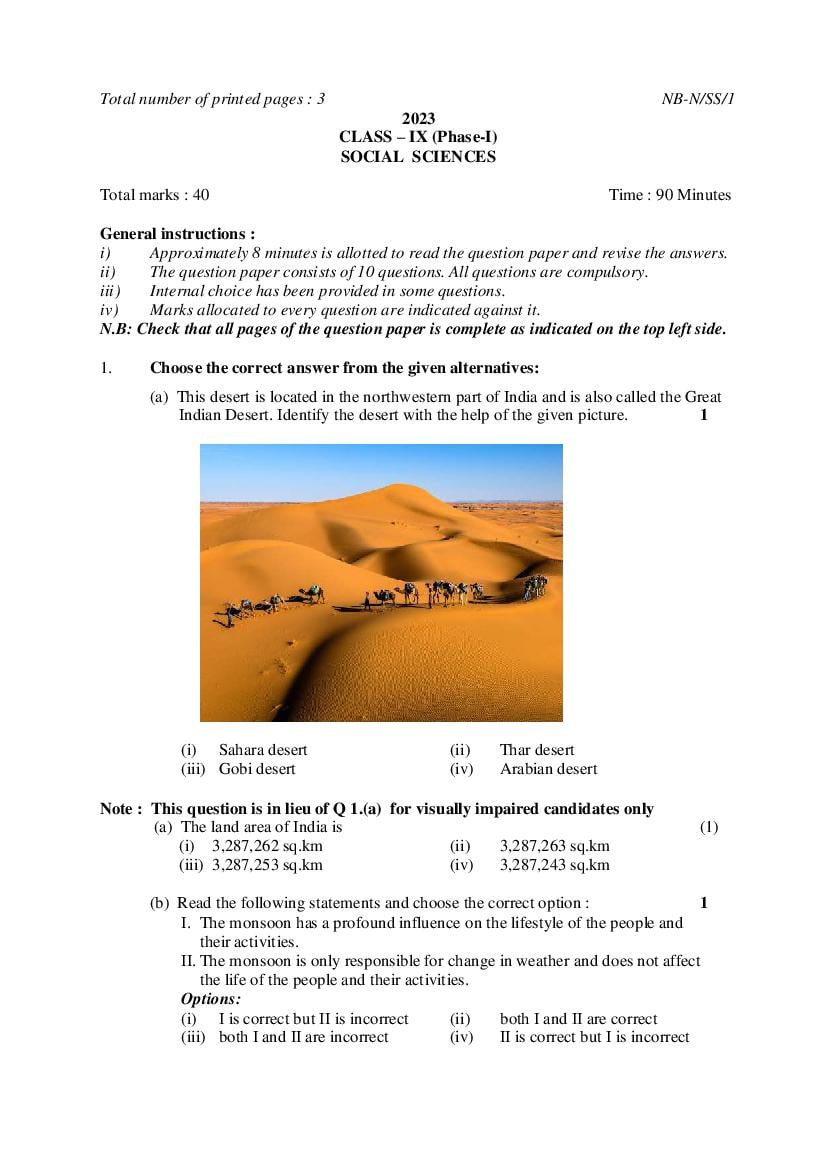
(a) This desert is located in the northwestern part of India and is also called the Great
Indian Desert. Identify the desert with the help of the given picture. 1
(i) Sahara desert (ii) Thar desert
(iii) Gobi desert (iv) Arabian desert
Note : This question is in lieu of Q 1.(a) for visually impaired candidates only
(a) The land area of India is (1)
(i) 3,287,262 sq.km (ii) 3,287,263 sq.km
(iii) 3,287,253 sq.km (iv) 3,287,243 sq.km
(b) Read the following statements and choose the correct option : 1
I. The monsoon has a profound influence on the lifestyle of the people and
their activities.
II. The monsoon is only responsible for change in weather and does not affect
the life of the people and their activities.
Options:
(i) I is correct but II is incorrect (ii) both I and II are correct
(iii) both I and II are incorrect (iv) II is correct but I is incorrect
Page 2
(c) Who defined democracy as ‘a government by the people, of the people and for
the people’? 1
(i) Winston Churchill (ii) George Washington
(iii) Reinhold Niebuhr (iv) Abraham Lincoln
(d) When was the Indian Constitution enacted and passed? 1
(i) 26 November, 1949 (ii) 26 November, 1950
(iii) 26 January, 1950 (iv) 26 January, 1949
(e) Which one of the following characteristics is not found in a developed economy? 1
(i) High per capita income (ii) High level of national income
(iii) Low standard of living (iv) Full exploitation of resources
(f) Rita, a resident of Delhi has to shift to Mumbai due to her service transfer. In this
case, her movement in context to Indian population, will be referred to as 1
(i) export (ii) import
(iii) external migration (iv) internal migration
(g) Which President of India inaugurated Nagaland as a State? 1
(i) Rajendra Prasad (ii) Dr. S. Radhakrishnan
(iii) A.P.J. Abdul Kalam (iv) V.V.Giri
(h) Who said “ I am a farmer like my ancestors before me; trying to make two blades
of rice grow where only one grew before”.? 1
(i) P.Shilu Ao (ii) T.N. Angami
(iii) A. Kevichüsa (iv) Dr. Hokishe Sema
Answer the questions in about 20-30 words:
2.a. Briefly explain the role played by the middle class in the French Revolution.
Or 2
b. Explain the difference between the Bolsheviks and Mensheviks.
3.a. Mention any two main physical regions of India. 2
Or
b. What is the Standard Meridian of India? What is its importance? (1+1=2)
4. State any two causes of poor performance of public sector undertakings in India. 2
5. Give two theories of the origin of the word ‘Naga’. 2
Answer the questions in about 50 -70 words:
6.a. Write any four characteristic features of hot weather season.
Or 4
b. State any four methods to conserve wildlife in India.
7.a. Give any four arguments against democracy. 4
Page 3
Or
b. What is a Constitution? Mention any three roles of a Constitution. (1+3=4)
8. Read the source/passage given below and answer the following questions that follows:
The population of the world is not spread evenly over the earth. Its distribution
is effected by various factors such as climatic conditions, developments, fertility of
land, topography, etc. The most densely populated continents are Asia and Europe. If
we consider the population of India, it has a large number of population unevenly
distributed all over the country. The current high population growth rate is due to the
large size of the population in the re-productive age group, higher fertility due to unmet
need of contraception and a high wanted fertility due to prevailing high Infant Mortality
Rate. In most of the cases, a huge population is considered to be an obstacle for the
growth and development of any nation. On the other hand, population growth can also
be advantageous as population growth will lead to economic expansion since more
people can produce more goods. As population increases, the economy can also benefit
from a bigger talent pool, economies of scale and greater specialisation. All these can
result in a higher per capita income which will elevate the living standard of the people
and help in the growth of the country’s economy.
Questions :
i) Mention one factor that effect the distribution of population. 1
ii) “ The population of India is increasing rapidly at a high rate.” Write any
one major reason for the high growth rate of the country’s population. 1
iii) “Population growth can be a boon for the country’s economy.” Support
the statement with any two reasons. 2
Answer the questions in about 80 – 100 words :
9.a. Discuss the political and social causes of the French Revolution.
Or 6
b. Discuss the immediate consequences of the Russian Revolution.
10.a. ‘The arrival of the missionaries brought about transformation in the Naga history’.
Elucidate.
Or 6
b. Give an account on the ‘Battle of Kohima’.
.
*******************************
Page 4
2023
CLASS – IX (Phase-I)
SCIENCE
Total marks : 40 Time : 1½ hours
General instructions:
i) Approximately 10 minutes is allotted to read the question paper and revise the answers.
ii) The question paper consists of 18 questions.
iii) Internal choice has been provided in some questions.
iv) Alternate question for the visually impaired students are provided in some questions.
Only the visually impaired students have to attempt such alternate questions.
v) Marks allocated to every question are indicated against it.
N.B: Check to ensure that all pages of the question paper are complete as indicated on the top left
side.
A. Choose the correct answer from the given alternatives:
1. The chemical formula of sodium nitrate is 1
(i) Na2NO3 (ii) NaN3
(iii) NaNO2 (iv) NaNO3
2. Which of the following is an example of chemical change? 1
(i) Freezing of water (ii) Mixing iron and sand
(iii) Melting of butter (iv) Rusting of iron
3. Which of the following figures represent uniform motion of a moving car? 1
Alternate question for the visually impaired students:
The SI unit of acceleration is (1)
(i) m2 (ii) ms-1
(iii) m (iv) ms-2
4. The odometer of an automobile measures the 1
(i) time taken (ii) acceleration
(iii) distance travelled (iv) velocity
Page 5
5. The value of acceleration due to gravity ‘g’ is 1
(i) greater at poles
(ii) greater at equator
(iii) same on the surface of moon and earth
(iv) same at all places on surface of earth
6. In the picture given below, who does the work? 1
(i) Cart (ii) Wheel
(iii) Bullock (iv) Road
7. The mathematical expression for kinetic energy of an object is 1
(i) Ek=mv2 (ii) Ek= ½ mv
2
(iii) Ek= ½ m v (iv) Ek= ½ mv2
B. Answer the following questions in about 20-30 words:
8. Why are cotton clothes preferred in summer? 2
9. Write the chemical formulae of -
(i) carbon tetrachloride (ii) aluminium chloride 2
10. State the Universal law of gravitation. Write the S.I unit of universal gravitational
constant. 2
11. The potential energy of a free falling object decreases progressively.
(i) What happens to the kinetic energy?
(ii) What happens to the total mechanical energy? 2
C. Answer the following questions in about 40-60 words:
12. a. Name A,B,C,D,E and F in the following diagram showing change in its state.
Or 3
b. Define evaporation. Explain any two factors that affect evaporation.
Page 6
13. (i) Define molecular mass.
(ii) Calculate the molecular mass of CH3OH. (Atomic mass of Hydrogen= 1, Oxygen=
16 and Carbon= 12) 1+2=3
14. Given below is a sketch diagram of a certain generalized cell.
(i) Identify whether it is a plant cell or an animal cell.
(ii) Give two reasons in support of your answer. 1+2=3
Alternate question for the visually impaired students:
Give any three differences between a plant cell and an animal cell. (3)
15. (i) What is meant by acceleration due to gravity?
(ii) Gravitational force on the surface of the moon is only 1/6 as strong as gravitational
force on the Earth. What is the weight in Newton of a 10kg object on the moon and
on the earth? 1+2=3
Alternate question for the visually impaired students:
(i) What is meant by acceleration due to gravity?
(ii) Why will a sheet of paper fall slower than one that is crumpled into a ball?
(1+2=3)
16. a. (i) Define power.
(ii) An electric heater is rated 1500W. How much energy does it use in 10 hours?
(Given, 1 hour=60×60 seconds)
Or 1+2=3
b. (i) Define 1 J of work.
(ii) An object of mass 15kg is moving with a uniform velocity of 4ms-1. What is the
kinetic energy possessed by the object?
D. Answer the following questions in about 70-100 words:
17. With the help of diagrams, explain the two types of cell division. 2+3=5
Alternate question for the visually impaired students:
Why are lysosomes known as suicidal bags? Explain the two types of cell division.
(2+3=5)
Page 7
18. a. A train starting from rest attains a velocity of 72 km h-1 in 5 minutes. Assuming that
the acceleration is uniform,
(i) find the acceleration.
(ii) find the distance travelled by the train for attaining this velocity.
(iii) When is a body said to be in uniform acceleration?
Or 2+2+1=5
b. Joseph jogs from one end, A to the other end, B of a straight 300m road in 2 minutes
30 Seconds. He turns around and jogs 100m back to point C in another 1 minute. What
is his average speed and velocity in jogging
(i) from A to B?
(ii) from A to C?
(iii) Define speed.
Alternate question for the visually impaired students:
(i) Define acceleration. When is a body said to be in uniform acceleration and non
uniform acceleration?
(ii) Distinguish between speed and velocity. (1+2+2=5)
***************************************
Page 8
2023
CLASS-IX (Phase I)
TENYIDIE
Total marks: 40 Time: 1½ hours
General instructions:
i) Approximately 8 minutes is allotted to read the question paper and revise the answers.
ii) The question paper consists of 11 questions. All questions are compulsory.
iii) Internal choice has been provided in some questions.
iv) Write the correct question number in your answer sheet to indicate the option being attempted.
N.B: Check that all pages of the question paper are complete as indicated on the top left side.
(Kesi mhaphrü)
1. Thedzeu phrülie di ketsokeshü hako kelashülie:
Tenyimia ha kethezie phi di lhouyakezha la u krotho-u lhou thenou mvüthor zo. Seyie
kekreimia u kelhou ngukeshü ki Tenyimia üse lhou kemezhie phi ba nhie ikecü le rei talie vi zo.
Kekreilamonyü u mhatho mhachüko krathor mu u thuo mia pele modi u va krakecü la puotei
pete nu merei sei-i di lhouya. Derei u donu huohuo thezie phi di lhoukecü la thenoukemvüu thuo
kemezhiekezhü-u va pejüwa di lhou u nei se baya zo. Kethezie di lhoukecü la u thuo huohuo ngu
u neithor di seyie kekreimia mehoumengu di lhou vor mo.
We u zho kevikesuo hakemhie kekra se lhouyakezha la seyie kekreimia vor u ze lhou rei
teicie thepfü ker ketso rei u zho silie mo di lhou u kemha chü di lhou kevor dze si phi. U
Tenyimia ha kethezie di lhou vorkecü la kecüca kevi kehoupuorei u thuo u rübei cüwa khrieya
süla we mha kevi huo cü mu krietuoü liro u siezanuomia ze keza cü meya zo. Morei kecüca kevi
huo se thehouba nu pie vo mia ze keza cü seiya. Süsie mia vie cükeliemia kehoupuorei nie la
ketheguoliewe, icü die pu motaya mo. Siro kecüca kenie ba liro a thuo kecüca kesuou cütuo mu a
zemia bu keviu cütuo ikecü le phreya. We u kelhou nu kethezie se di lhou vorkecü la mhatho-
mhachü tei puo vor zorei a thuo mhatho kere kemesiu chü beituo mu a zemia bu mhatho kerüu
morei kemedzau chülietuo ikecü le phre di lhou vor. Mhathomhachü nu kecükekrie nu rübei zo
mo, derei mha pete nu kethezie di lhoukecü la kelhou-u lhou u nyieta monyü lhou thenoumvü
huohuo ngu u neithor di lhou vorwe.
a. Ketheziekecü hau cau liro. 1
(i) Kemezhie tuoketuo (iii) Huohuo rhukecü
(ii) Ketheza zokecü (iv) Huohuo thikecü
b. U Tenyimia kethezie di lhoukecü la _____ thuo kemezhiekezhüu va pejüwaya? 1
(i) mehoumengu (iii) thenoukemvüu
(ii) mhathoko (iv) kemedzau
c. Kecüca keviko u rübei cü mo di se vo kirapuo nu keza cü reiya ga? 1
(i) Rüna dahouko (iii) Mhachaki
(ii) Leshükinu (iv) Kichüki
d. Mia vie cükeliemia kedipuo pu motaya mo ga? 1
(i) N pezie (iii) Cü kevitho-u
(ii) Ketheguoliewe (iv) U neithor we
e. Mhathomhachü tei puo vor rei u zemia bu mhatho kimhiecü chüketuo le phre di lhou vor
ga? 1
(i) Mhatho kerüu (iii) Mhatho kerieu
(ii) Mhatho kereu (iv) Mhatho kemesiu
Page 9
f. Mha pete nu kethezie di lhoukecü la kelhou _____ mo di lhou vor. 1
(i) U khriekecü (iii) U pesekecü
(ii) U neithor (iv) U nyieta
g. U Tenyimia ha u thuo kecüca keviko cüwa khriekecü la kedipuo chüya üsi ga? 2
h. Dieca hanie kepetsou die thushülie. 1+1=2
(i) Kevi (ii) Kemesi
(Diezho mu Thuyie)
2. Diesou hako puoca thushü di se diecha chüshülie: 3x1=3
a. A thu a ri
b. Hielahieluo
c. Kechükenyü
3. Diekhu mu dierozu kekrü kebako thu kemezhüshülie: 3x1=3
a. Sorkari-e keze kevi hudo pethoshüte.
b. Kidzü nu sü do yo puo zo.
c. Puo kemeko se ya.
4. Diecha hako pie Tenyidie nu thushülie. 4x1=4
a. Their mother forgot to buy the bananas on her way back.
b. Can you please shut the window?
c. Oh! What a beautiful scenery it is.
d. The corn from your garden is very tasty.
(Diemvü)
5. Diecako donu puotou-u kedashülie: 3x1=3
(a) _____ teiki Ngusanyü-e puo misi pielie di rühou seikhrietsa nu tsu.
(i) Teisei (iii) Teile
(ii) Therü (iv) Teirü
(b) Kemenuomia kedipuo ngulieya ga?
(i) Kenei (iii) Thetshe
(ii) Theja (iv) Therhu
(c) _____ üse kechü themiau.
(i) Rünyo (iii) Kesa
(ii) Ketsie (iv) Ketho
Ketsokecü hako dieca 20-25 mese nunu kelashülie: 4x2=8
6. Ngusanyü puo kelhou thelatsa kimhieta ga?
7. Thenu samipfü puo nou kemezhiekelie ki kedipuo kemhieta ga?
8. ‘N dzüzei hie’ geizo-u nu u bu supuo pelelie nu pu ga? Mu we mhatho kevi chükelie ki
kimhieta suo üdi pu ga?
9. ‘Leliecie’ geizo-u nu u Rhuo-ue u chüpie kimhieshü mu süla u bu kedipuo chülienu pushü ga?
Page 10
Ketsokecü hanie puo(1) kedapie dieca 40-50 mese nunu thushülie:
10. a. Thezho kiko keze-e u nou kekhrie se di ze morosuo ga? 4
Moro
b. “Niepuu-e puo nuonuo puo khrieko pechü di pethaya, mu puo nuonuo zelieketa kheko vü di
zelieya.”
i. Diecha hako ketholeshü kiu nu thupie zhü ga? (1)
ii. Thenu samipfü nuoyo kimhie di siata üsi ga? (2)
iii. We kemezhiekecü dzükelie ki Ukepenuopfü üse u khrie mo ükecü leta zhü me? (1)
Ketsokecü hanie puo (1) kedapie dieca 60-90 mese nunu kelashülie:
11. a. ‘Kesa dojü kevi cha kese
U dzü we zie vokezhü nu we
Mhiphra kevi nhicu zha pevo
Watuoluo mu le rünoumolie.’
i. Diecha hako geizo kiu nunu se par ga? 1
ii. Nhicu ki kedipuo dojülie kevi zo üsi ga? 1
iii. Kiüdi u nhicu tei lepie rünou mo üta ga? 3
Moro
b. ‘N ketuo cha nu zei zo shierei
N melou bu thachüta hiecie
Themvü kezie n chatha zo se,
N keneira vo tsoshü zotuo.’
i. Diecha hako geizo kiu nunu se par mu supuo zoshü ga? (2)
ii. Kiüdi u bu u chamezieta hienu pu ga? (1)
iii.Kedipuo chüta rei u nou jü di u thuo u selie nushü ga? (2)
*********************
Page 11
2023
CLASS-IX (Phase I)
AO
Total marks: 40 Time: 1½ hours
General instructions:
i) Approximately 8 minutes is allotted to read the question paper and revise the answers.
ii) The question paper consists of 12 questions. All questions are compulsory.
iii) Internal choice has been provided in some questions.
iv) Write the correct question number in your answer sheet to indicate the option being attempted.
N.B: Check that all pages of the question paper are complete as indicated on the top left side.
(Rajem Latang)
1. Teküboklen agüja aliba junga züngang aser tasüngdangbatemji langzüang:
Tebang o putu ka nungi putu ka tashi belenzüka jembia aruba zülu nung ayutsübaji tanü kanga
nüngdaka kümogo. Oshi ka tezüluba nung ayutsü tasa aika lira aser itemji tanü putu nungbo mela mela
inyaktettsü lenmang jenti lir.
Rev. Dr. Clark asen limai atua kenozülu metenzük tashi Ao oshi tezüluba nung kecha melii liasü.
Oshioben jembishinü aser kenten menü kechisarenaji tebang o kisüng liasü. Iba mapang kenozülu
meteta kaket adokteter nungtugu nisung Dr. Clark asen limai arua keno zülu kimung mesemteta yutsü.
Zülu makaba oshi kaji jenjang makaba oshi ta meteta Clark-I zülua rizünga yutsütsü tasa jenti bushitet
aser itemji mapa küma inyaktet.
Joko tanü putu nung tebang o kisüngji teperi aser temeten mesüi akümer, aji asünung tsürabur nungi
tebang o belentepa aruba kechisarena tezüluba balala nung ayutsü nüngdaker. Oshioben renloka
tejakleni aotsü atema mulungzüng o kong shisatsü tarok lir, item ajakji tarensena aser liromedema zülua
meyura itemji tesama tulu asütsü. Anungji kin ka oshi mesamatsü atema tezüluba tasa inyakyim balala
amshia rizünga ayutsüla.
Oshioben tezüluba nung rizünga ayutsü atema tongtibangtiba mapangji aroka bushiba maparen
ajanga inyaktetsü. Item ama shisatsü ajanga samaya aliba oshioben tera ajak bushiteta rizüngtet. Aroka
bushiyim leniba ajanga oshi kaji molutetshia tajungba yanglutsü digital age ta ajaba putu nung lenmang
jenti lir.
Agüja aliba nungi shitak telangzüba shimteta langzüang: 6x1=6
a. Shibai asen lima nung kenozülu kimung mesemteta yutsü?
(i) Miles Brownson (iii) Godhula Brown
(ii) Süngpongmeren (iv) Rev. Dr. Clark
b. Zülu makaba oshi kaji kechi ta Clark-i bushitet?
(i) Jenjang makaba (iii) Terenlok makaba
(ii) Takidak makaba (iv) Sobaliba maliba
c. Oshioben renloka tejakleni aotsü atema kechi inyaktsüla?
(i) Mulungzüng (iii) Tarensena aser liromedena zülua ayutsüla
(ii) Kanga jung zülua ayuba (iv) Samayaa aliba bushitsüla
d. Kin ka oshi mesamatsü atema kechi inyaktsüla?
(i) Tezüluba tasa (iii) Maneni benshitsüla
(ii) Maneni jembitsüla (iv) Maneni sayutsüla
e. Oshioben tezüluba nung rizünga ayutsü atema tongtibangtiba mapaji kechi?
(i) Aroka shisadangba (iii) Angazüka ayuba
(ii) Aroka bushiyim (iv) Mapa küma inyakba
f. Kechiba tanü putu nung tebang o kisüngji teperi masü?
(i) Alima tejaleni aoba agi (iii) Kuli makai akümer
(ii) Arentaka bilemba agi (iv) Temeten mesüi akümer
Page 12
Item tasüngdangbatem ojang20-25 tashi nung langzüang:
g. Aroka bushiyim ajanga oshi kaji kechi koma moluteta akümer? 2
h. Item tetezü agüjang. 1+1=2
(i) Kenozülu (ii) Oshioben
(Orrlem)
2. Agüja aliba nungi shitak telangzüba agüjang: 2x1=2
a. Anayim nung züngdangba dang _____ züngdangba ta ajar.
i. Tarep iii. Karsa
ii. Tongjala iv. Jenti
b. Amilem ya tapu _____ nung asadanger.
i. Pezüsü iii. Asemsü
ii. Pungusü iv. Anasü
3. Item oren karsa leni meyipang: 2x1=2
a. Na ilen jagi maotsüla.
b. Kü ket nung nok ka lir.
4. Itemi kobala Amilem nungsa densema ali teputep tenüngja agüjang. 3x1=3
a. Asenok obang ka südi.
b. Parnoki ken ka aten.
c. Nai ashiba olen ya shitak lir.
5. Item oren Ao agi meyipzükang: 3x1=3
a. Their mother forgot to buy the bananas on her way back.
b. Can you please shut the window?
c. The corn from your garden is very tasty.
(Otsü aser Sangro)
6. Agüja aliba nungi shitak telangzüba agüjang: 3x1=3
(a) _____ yimya ya meimchir dak aketba yimya tajung rongnung ka lir.
(i) Tesangra (iii) Awashi
(ii) Wainshin (iv) Saksalem
(b) Tesem aisü nung meimchir aser shiruru tsüngda nung _____ angutsü.
(i) tepila (iii) tesendaktep
(ii) balala (iv) temeimtep
(c) Tasür lima tonga senti atang _____.
(i) senzüdang (iii) jajadang
(ii) atudang (iv) süidang
Item tasüngdangbatem 20-25 tashi nung langzüang: 4x2=8
7. Awashi metetba nisung ka ta shitettsü atema nai kechi inyaktsüla?
8. Sobaliba aser awashi koma melenshia aor?
9. Kechiba sangro mejemsang bendang lima taso shia maliasü?
10. Kechiba jalai maremteti ani mesüngzükteti ola adoka ajeb?
Page 13
Item tasüngdangbatem ojang 40-50 tashi nung langzüang: 1x4=4
11. a. Shirurui meimchir nem kechisa tajongzük agütsür rasaa shiang.
Mesüra
b. Awashi yimya balala amshiren rateta langzüang. .
Item tasüngdangbatem ojang 60-90 tashi nung langzüang: 1x5=5
12.a. ‘Yashi sangwa milen tanübo ayaterem. Na mali yabo tsüngdangpia konga azüng.’
a. Koba sangro nungi? (1)
b. Shibai zülu? (1)
c. Oren jagi kechi ashir rasaa züluang. (3)
Mesüra
b. Tasütsü meroa ayongpang semer asem- “Ni südakjang, ni südakjang” ta jeba nemzü.
i. Oren ya koba sangro nungi aser shibai mejemba? (2)
ii. Iba oren ya shibai jembiba lir aser kechi tensa ka nung jembiba? (3)
*********************
Page 14
2023
CLASS-IX (Phase I)
SUMI (SÜTSAH)
Total marks: 40 Time: 1½ hours
General instructions:
i) Approximately 8 minutes is allotted to read the question paper and revise the answers.
ii) The question paper consists of 13 questions. All questions are compulsory.
iii) Internal choice has been provided in some questions.
iv) Write the correct question number in your answer sheet to indicate the option being attempted.
N.B: Check that all pages of the question paper are complete as indicated on the top left side.
(Ghili Kiye)
1. Yepua keu phiju no inijü akeqo khochile tsülo:
Atsü lakhi ati pitipe ake atiqo tsüni ye ashi hawu kelono aqhu no neqhive. Astüti qoye aza
ighini keu khelhoqhiyi akemu aza ighimove eno ighono muzü sheve kehu, timi vilo iza ye khilau
wuvea kea? Ipi. Timi no oza ye ashi hawu kelono asheno neqhivae ipi. Atsütiqo no aza mkhü
lunike ghengu no Alhou vilo Atsütsü ngo ayeghi dolo khuno akijeu kea? Ipi iniju. Alhou no
“Angushuu akijeu ke” ipi. Atsüti qono angushuu lau wuno, atsütsü ngo ayeghi küma dolo nono
akijeu ke, nono iza mkhü lutsülo ipi. Angushuu no pa kilo panongu puzüve, Putholo atsütiqo no
angushuu peju niye igha ke angushuu no aküha msa ke igha kevilo ipi. Tileno thoghiu ye aküha
lau wuno papelo amkhü lutsü peni keu shive eno pakilo züve. Itaghi putholo amlhu ighi kelo
atsütiqono aküha pejuni ke ghenguno igha ithughi ke, Aküha no tüghami msake inaqhoi shilo ipi
kehu itaghi, tüghami lau wuno aza mkhü lutsülo ipi no pakilo panongu puzüve. Putholo atsütiqo
no igha ithughi ke, timi msake igha kevilo ipi. Tile no timi akijeu kena ipi no timi lau ighi no
kishekulu pike, timi no pa kilo puzüve. Putholo atsüti qono igha ithughi ke, timi no msa kevilo
ipive. Thanau itheno ithu puzü atsüti pelo azü lesü süghipe no azüta angu chighi luveno aghokilo
lhoxu nepa akeqo shope ighipe no, ‘Hino keshea? Hino keshea?’ ipi ashi jeli kümtsü piye, ashe
kha shi aqhu nepa pe ighike, “hino oza neqhive ke” ipi timi no pi. Tileno timi no ashi thani keu
shive eno atsüti qono aqhu pape haighi nikeu shive no akutho ato hache no aghoki lo ilhe iloghi
kelono timi no angu pe chheqhive. Atsütiqo no hino iza neghive tsü kepi aqhu kinilo miki tsü.
Ashi phu no kije kelo apukhu lakhi atsü saje ‘Atsüsa’ kuto tsüke. Tithiu ye ashi hawu no ashi
yilu kelo atsüsa tipau tsümove aye ayekipemi lau no atsa küghalu chini. Kughengu atsüsa
tsümove aye ashiha tsü tipau ye alomove cheni ipi.
a. Kiu no atsü aza neqhive tsü kea? 1
(i) Angushuu (iii) Aqhu
(ii) Ashe (iv) Amishi
b. Atsütiqo ye kiu Alhou vilo iniju kea? 1
(i) Khuno akijeu kela (iii) Khuno aghulou kela
(ii) Khuu pavikela (iv) Khuno akiviu kela
c. Tüghami ye khuu msa akea? 1
(i) Timi (iii) Alhou
(ii) Aküha (iv) Angushuu
d. Atsü aza ye kishino thive kea? 1
(i) Veqhive (iii) Ighimove
(ii) Neqhive (iv) Kühave
e. Khisa hipau akiqi pitsülo. 1
(i) Ashi kijekeu (iii) Alikasa tsükeu
(ii) Atsüsa tsükeu (iv) Timisa tsü keu
Page 15
f. Atsüsa/Atsüsaje tsümo aye kishive cheni kea? 1
(i) Mtove cheni (iii) Tsümove cheni
(ii) Atsa kügha cheni (iv) Palokutove cheni
Iniju akeqo khochile:
g. Atsütiqo no aqhu kini miki tsükeu ye kiu ghenguno kea? 1+1=2
h. Sümi tsalo ashihau keqo tsü pesü kiu pi cheni kea? Eno ashi hau chekemi timi vilo kiu pi
cheni kea? 1+1=2
(Tsayeh)
2. Sütsa lo pekili süvelo: 2x1=2
a. Their mother forgot to buy the bananas on her way back.
b. Can you please shut the window?
3. Achipiu tsathi pe kimeve tsülo: 3x1=3
a. No ye kuhu kupu lono ighi ani ______ .
i. ohaküsa ii. okümgha iii. alova iv. okimiye
b. No ye axathi _____ chukhave kea?
i. kümtsü ii. kuchopu iii. apanagha iv. lakhimu
c. Atovi no pamu nguno _____.
i. kushuwa ii. akiqheu iii. kunguu iv. akuchuquw
4. Tsashibe kikijei aje lakhi tsülo. . 1
5. Kikihi tsashibe tsathi michiphe tsülo: 2x1=2
a. Pa ye alhokuthu hile ighi cheni.
b. Ni ye ghuthu lakhi li sasü kusholuva.
6. Pighi vehu tsathi michi tsülo: 2x1=2
a. Alobo’w yesüta khile ani kea?
b. Paki (atsajo mlave tsülo).
(Kichitsatho eno Apu-Asü Leshe )
7. Achipiu tsathi pe kimeve lo: 3x1=3
(a) Alhou liu no Aesop _____ bukughüqüve tsü.
(i) Kütsü (iii) Mili
(ii) Pukhu (iv) Au
(b) _____ ye aghulhuni tipa kiqi ye Ani tsala akijeu.
(i) Aghizani (iii) Anigheni
(ii) Ashigheni (iv) Mucholani
(c) Oza no no mishi _____ khu.
(i) kini (iii) tsügho
(ii) küthü (iv) toku
Atsathi 20-30 dolo no khochilelo: 4x2=8
8. Pa no zühughi keloye asamou no akivi tsüche keu alhouliu no pa juno numigheyi aghi. ‘Pa’ ye
khuu kea? Khuno pa juaghi kea?
Page 16
9. Mucholani tsalalo muchomi qoye kishi mla cheni keno yelo.
10. Eden ghutu ye kiu kea? Eno khuu ghenguno kutotsü kea?
11. Leshe tsajo hipau hepho tsülo.
“Isheni khuzalimi ghauye.”
Atsathi 40-60 dolo no khochile lo:
12. a. Ishe khaghi ye nivilo
A-a kivi lo aleye,
Agho Sülo ni chheyewo
Ito timi kivi sholuyewo
Asholiu ipeleye moye.
i. “A-a kivilo” ipi keu ye kiu toi keu pi ani kea? 1
ii. Asholiu ipi akeu ye khuu vilo pi ani kea? 1
iii. “Timi kivi sholuyewo” khuu sholu kea? 1
iv. Leshe hiye khuno leshelo ani kea? 1
Momu
b. Okükümsü lono akithi züghi (dead sea) ye aküpulumi kiu toi keqo timi küxü kiqi piye tsü
kela yelo. (4)
Atsathi 60-80 dolo no yelo:
13. a Akiu aghümi ye pihughiyewo kucho iphi kidi pesü aghapeli veche po woghi ye kucho
axeu no thi ani pilo.
i. Kiu ghümi pi ani kea? 1
ii. “Aghapeli” ipi keu kiqi pitsülo. 1
iii. “Axeu” ye khuu vilo pi ani kea? 1
iv. Khuno leshelo ani kea? 1
v. Akiu ipi keu pidelau ye kiu pi cheni kea? 1
Momu
b. Sümi kukhuaye lo angu ngo amakishiu pama ye Tuluni lo kishi ikhilu kile cheni keno
akivishi pitsülo. (5)
*********************
Page 17
2023
CLASS-IX (Phase I)
LOTHA
Total marks: 40 Time: 1½ hours
General instructions:
i) Approximately 8 minutes is allotted to read the question paper and revise the answers.
ii) The question paper consists of 12 questions. All questions are compulsory.
iii) Internal choice has been provided in some questions.
iv) Write the correct question number in your answer sheet to indicate the option being attempted.
N.B: Check that all pages of the question paper are complete as indicated on the top left side.
(Ekhao)
1. Oküpoe erani elio shi khae zesi engao jiang janlana:
Limha shi jo ojü na nkonzhücho. Ojü jo kyon eküm tsükona tai opvü tssotsso mek, tolia
ekümrümo, otssüngotong, worowoni jiang topvü tsükona ethev eli motsünga.
Ojü jo oxygen tona hydrogen to oni tssotsüi kümcho. Oxygen echi eni tona hydrogen echia to
tssotsüa na ojü kümala. Kyon na ojü ji lanka olan olon lona hungala. Eryu, zhükhü, jükha,
wozhü, jübokphen tona jümang to shiang lona ete na ojü shi hungala. Ete limha shi echi mezhü
lo echi ethüm jo ojü na pyingcho.
Ojü ji olan eni lia. Ojü ekhüngü/ ntssamü (hard water) tona ojü polav/ enyipvü (soft water)
to. Ojü jiang lo kvüthüng majü, jonjü osi yunjakjü to shiang jüa sana ojü ji ntsanala, osi hojitvü
jü jo ojü ntsana/ ntssana (hard water) to tsala. Ojü ntsamü jo shapon thelia tsyurom/ etsyu
nthakatala. Elani tssoyanmori osi jaha elumü tsükona ha nmhon, ojü ntssamü ji enyipthokvü
tsükona lanka elarotso ji jo ojü mmhona elakthoko ji.
Ojü jo lanka elümoto lo ethelan lia. Ete otsükoso ntssüngrüng tsükona ojü ethev lia. Ojü jo
ete tsük osi ejen tsükona ha ethev lia. Ojü na mman mmhonkathokvü lo e nzanchiala. Ojü na ete
tsük etssho shi ji kheti vanthokala ojü na mpensü jiang tssülatssütüngala. Ojü na oyuohan jiang
etsüi sisi tssoyanmori tsoala. Ojü na etsoyui jiang tssoyanphyoyan ni tsoala. Ojü lona mizhü
wondang ha chiyithokala. Hoji yankchia meta jiang tüngra osi meria vanthokala.
Ojü mmhom jiang jo ntssünga vanala, osi orhümori ha nliala. Lomolosü, nmenmyak,
chonpyalyu osi oraori shiang na ojü nmenala. Elani kyon na jukha ji lo na tsükakinzhü,
tsipfühanpfü sü nna ekümrümo na nzhüngothechi to etsso ji yakchia ojü ji nmenala. Ojü jo
pokpok elakthoki, rongchopeni na mmhona rongchoe eyuv ethev lia. Ojü mmhom osi enyipvü
you yakchia ete tsük oso mmhona vamvü. Jukha osi jübokphen jiang ji ntssüngrünga vanthokvü
na lia. Hoji tsükona ojü jiang ji ntangshona osi etum elan lona tsütsav shikvü na lia.
Janlan pi elio jiang lona elamo ji ethüngi erana: 6x1=6
a. Ojü jo _____ to tssotsiü kümala.
i. oxygen iii. ekhüngü/ ntssamü
ii. oxygen tona hydrogen iv. polar/ enyipvü
b. Ojü jo olan kvüta lia?
i. Motsünga iii. ethüm
ii. Eni iv. mezhü
c. Limha shi _____ ojü na pyincho.
i. echü motsünga iii. echü ethüm
ii. echü eni iv. echü mezhü
d. Ojü na ntio chiyithokala?
i. Eryu iii. Oyuohan
ii. Zhükhü iv. Mizhü wondang
Page 18
e. Ete otsükoso mmhona vanthokvü tsükona ntio ethiv lia.
i. Mpensü mmhom iii. Ojü
ii. Oyuohan iv. Lomolonsü
f. Ojü ji enyipthokvü tsükona lanka elarotso ji jo _____.
i. ntssüngrünga vanthovü iii. mmyim thoko ji
iii. elakthoko ji iv. rongcho ji
Engao shiang janlana: 2x2=4
g. Ojü jo ntio lona hungala?
h. Ojü ntssamü tona ojü polav to oni echümpota jiang erana.
(Yisanlan)
2. Janlan pi elio jiang lona elamo jiang ethüngi erana: 3x1=3
(a) Ombo _____ kako eranala. (shi lo zonkayi elamo ji khi pyingthoka)
(i) jo (ii) ji (iii) ti (iv) na
(b) Ombo na nrocheta la, _____ ombo ra vana. (Yishenyi elamo ji jo)
(i) ntiotssole (ii) khatolia (iii) küma (iv) mekana
(c) Billion jo ete Lotha yi na jo kvüto tsala?
(i) Kana (ii) Gongdong (iii) Othüng nzoa (iv) Kana nzoa
3. Ejüngi elio shiang etümthokyi khi pyingthoka: 2x1=2
a. Phiro jo oyan _____ motsünga vancho.
b. Kakos hi püngnoe _____ ji pia.
4. Ejüngi elio shiang myingthong khi pyingthoka. 2x1=2
a. _____ ninyangtacho ka.
b. Onte yulo _____ rothoka.
5. Yiren pi elio shiang Lotha yi na khophia. 3x1=3
a. Their mother forgot to buy the bananas on her way back.
b. Can you please shut the window?
c. Children must obey their parents.
(Erantolan)
6. Engao shiang akvülo elamo ji ethüngi janlana: 3x1=3
(a) Lüngkümvü jiang na nrio thüngi ntio yantso picho la?
(i) Sümro rümbüm (iii) Senthan mvüri
(ii) Lepok yanthan (iv) Eshong tivü
(b) Era loroe ji jo _____ to tsacho.
(i) Yankhosali (iii) Yensali
(ii) Yansali (iv) Yisali
(c) Lendong ji yichak jo.
(i) Shompo (iii) Loroe
(ii) Oshomvü (iv) Khyingroe
Oküpoe engao shiang yitsung 20-25 harüma na janlana: 4x2=8
7. Ntio tsükona loroe ji na khyingroe thanpoe jiang oyi nkhichoyicho la?
8. Oli wota le era loroe ji pono ntio tssocho la?
9. Süpen thera jo kvüto rhona la?
10. Chungiyi “onkhümoe loroe Retacho” ji lo okhen engoe ji na engae evao loroe ji jo kvütvü la?
Page 19
Oküpoe engao shiang yitsüng 40-50 harüma na janlana: 1x4=4
11. a. Ete meta lo hümjonlijon jiang mmhonkathokvü tsükona lanka jiang erana.
Mekana
b. “Ena samo na etsoyui ji nhung küma, ni na ha nra rhowoa.”
i. Yiren shi jo ochoang na phyocho la? (1)
ii. Ocho thüngi ezocho la? (1)
iii. Etsoyui jiang tsosi Nrio na kvüto phyoa chiyicho la? (2)
Oküpoe engao shiang yitsüng 60-90 haruma na janlana: 1x5=5
12. a. Chungyi “Süpen Thera” ji yintssen ji mmhona erana.
Mekana
b. ‘Ena tsencho yanaloyi na, ayako to ntssoyi la’, yiren shi eroroa.
*********************
Page 23
Total number of printed pages -5
2023
CLASS – IX (Phase I)
BENGALI (বাাংলা)
Total marks :40 Time : 1½ hours
General Instructions :
(i) Approximately 8 minutes is allotted to read the question paper and revise the answers.
(ii) The question paper consists of 13 questions.
(iii) All questions are compulsory.
(iv) Internal choice has been provided in some questions.
(v) Marks allotted to every question are provided indicated against it.
N.B. : Check that all pages of the question paper are complete as indicated on the top
left side.
পাঠ (Reading)
1. নিচের পাঠটি মচিাচ াগ নিচে পড় :
আনন্দবাজার অনলাইন ডেস্ক :কলকাতা: ডেষ আপডেট:০২ অগস্ট ২০২৩ ১৭:৫০
এখন সারা বছরই বাজারর পালং শারের দেখা দেরল। বাঙালল বাল়ির েধ্যাহ্নর াজ এবং ননশর ারজ
থারে পালং শারের নানা পে। লবরশষ েরর দবগুন, কুের়িা লেরে েলরচ দোল দ া োরেেরধ্যই হরে
থারে। এ ছা়িা পালং শাে লেরে লচরেন, পলনর দখর ও েন্দ লারে না। দরাটিন, ফাইবার, ল টালেন এ
এবং লস-র রপু র এই শাে খােয াললোে দৃলিশলি বার়ি, হজে াল হে, রিচাপ লনেন্ত্ররে থারে।
লহরোরলালবন েরে দেরলও ডারেরট পালং শাে রাখরল উপোর পাওো যারব। রব অরনরেই শরীর
চাঙ্গা রাখর পালং শারের রস লেংবা স্মুলে দখরে থারেন। এই ারব শাে দখরল লে আরেৌ উপোর
পাওো যাে?
পু লিলবেরের দেউ দেউ বলরছন এই ারব দরাজ পালং শারের রস লেংবা স্মুলে দখরল
লেডলনর পাথর হওোর েুুঁ লে বার়ি। পালং শাে আেররনর াল উৎস, রব এর অক্সারলট নােে
এেটি দযৌেও থারে। এই দযৌেরে শরীর সম্পূ েণ ারব দশাষে েরর পারর না, ফরল জোট বাুঁরধ্
লেডলনর । ইোনীং লেডলনর পাথর এেনলে েলব্লাডারর পাথর ন লর হওোর অনয ে রধ্ান োরে
এই দযৌে। আোরের শরীর য টা পলরোরে অক্সারলট দশাষে েরর পারর এে লাস পালংরের ররস
Page 24
[2]
ার দথরে েশ গুে দবলশ অক্সারলট থারে। এই দযৌে েযাললশোরের সরঙ্গ জোট দবুঁরধ্ লেডলন লেংবা
েলব্লাডারর পাথর ন লর েরর।
কী কী সমসযা হডত পাডর ডবশে পালং োক ডেডল?
১) পালং শারে থারে অক্সাললে অযালসড। এই উপাোনটি অল লরি পলরোরে সলি হরল,
শরীররর ররোজনীে খলনজ পোথণ দশাষরের োত্রা েরে যাে। ফরল শরীরর খলনজ পোরথণর ঘাটল দেখা
দযর পারর।
২) পালং শারে লহস্টালেন থারে। যা শরীরর অযালালজণর ের া উপসেণ ন লর েরর পারর। রব
এই উপসেণ রবল হওোর আশঙ্কা েেই।
৩) পালং শারের ফাইবাররর পলরোে অরনেটা। াই অল লরি পলরোরে দখরল েযাস অম্বরলর
সেসযা, লেংবা দপরটর দোলরযাে দেখা লের পারর। যাুঁরের আরের দথরে দোলাইটিরসর ের া
সেসযা ররেরছ, াুঁরের অরনেরেই শাে দখর লনরষধ্ েররন লচলেৎসেরা।
৪) যাুঁরের থাইররেরডর সেসযা আরছ, াুঁরেরও এই শাে বু রেশুরন দখর হরব। এই শাে
অল লরি দখরল থাইরলক্সন হররোরনর ক্ষরে েরে যাওোর সম্ভাবনা থারে।
নিচিেশািু সাচর নিচের প্রশ্নগুনলর উত্তর িাও :
(ক) খবরটি ককোথো কথকক প্রকোশিত হকেকে? 1
(i) কলকোতো (ii) লেলি
(iii) কেন্নোই (iv) মু ম্বোই
(খ) এখোকে ককোে িোককর কথো বলো হকেকে? 1
(i) কলশম (ii) কমশথ
(iii) পোলং (iv) ক েঁ শক
(গ) কী কখকল শকডশেকত পোথর হওেোর ঝুেঁ শক বোকে? 1
(i) পোলং পশের (ii) িোক ভোজো
(iii) পোলং শেককে (iv) িোককর রস
(ঘ) অক্সারলট কী? 1
(i) ক ৌগ (ii) খশেজ
(iii) কমৌল (iv) ক্ষোর
Page 25
[3]
(ঙ) পোলং িোক কখকল কী কী উপকোর হে? 2
(ে) থোইরকেকডর সমসযো থোককল পোলং িোক কখকল ককোে হরকমোে ক্ষরণ ককম োে? 1
(i) অশিে (ii) কেকটোকেরণ
(iii) কমলোেশেে (iv) থাইরলক্সন
(ে) শহটোশমে থোকোে পোলং িোক কখকল ককোে উপসগগ কেখো শেকত পোকর? 1
(i) অযালালজণ (ii) জ্বর
(iii) মোথোবযথো (iv) বশমভোব
(জ) অশতশরক্ত পশরমোকে পোলং িোক কখকল কী কী হওেোর সম্ভোবেো থোকক? 2
বযাকরণ ও অিু বাি (Grammar and Translation)
2. নিচের শবকল্পগুশল থেচক সঠিক উত্তরটি থবচে িাও :
(ক) স্কুল> ইস্কুল — কী ধরকের ধ্বশে পশরবতগ ে হকেকে? 1
(i) বণগকলোপ (ii) স্বরোগম
(iii) স্বরভশক্ত (iv) বণগশবপ গে
(খ) ‘ক’ কথকক ‘ম’ প গন্ত এই পেঁ শেিটি বণগকক বলো হে — 1
(i) কণ্ঠ্যবণগ (ii) তোলবযবণগ
(iii) স্পিগবণগ (iv) অন্তঃস্থ বণগ
(গ) পরস্পর সশন্নশহত দুটি বকণগর শমলেকক বকল — 1
(i) সশি (ii) সমোস
(iii) র যে (iv) উপসগগ
3. সাংজ্ঞা সহ উিাহরণ িাও :
(i) অকঘোষ বণগ 1
(ii) বণগ- শবপ গে 1
Page 26
[4]
4. সনি নবচেি কর :
(i) শবেযোলে 1
(ii) শবকেে 1
5. বাাংলাে অিু বাি কর :
(i) Their mother forgot to buy the bananas on her way back. 1
(ii) Can you please shut the window? 1
(iii) Oh! What a beautiful scenery it is! 1
সানহত্য – গিযাাংশ ও পিযাাংশ (Literature)
6. নিচের শবকল্পগুশল থেচক সঠিক উত্তরটি থবচে িাও :
(ক) েোণকয ককোে কমৌ গ সম্রোকের মন্ত্রী শেকলে? 1
(i) েন্দ্রগুপ্ত (ii) শবন্দু সোর
(iii) সমু দ্রগুপ্ত (iv) অরশাে
(খ) “আরকিোলো মু কখ শেকে সু কখ খোে ___________” 1
(i) বোঙোশল (ii) েীেোরো
(iii) ফরোশস (iv) জোপোশে
(গ) কস বের ববিোশখ পূ শণগমোর শেে কক পোগল হকেকে বকল সবোই কভকবশেল? 1
(i) োেব (ii) মোধব
(iii) েীলমশণ (iv) শবকি
কম-চবনশ ২০-২৫ টি শচে নিচের থ থকািও োরটি প্রচশ্নর উত্তর িাও : 2x4=8
7. কোতযোেে কক? তোেঁকক কক বশন্দ ককরকেে? (1+1=2)
8. ‘সোধক’ কশবতোে কশব শেকজকক শককসর সোধক বকলকেে/ কতজস্বী প্রোণ কোর অেু করোধ
প্রতযখযোে ককর? (1+1=2)
9. মো ফটিককক ককে কলকোতোে পোঠিকে শেকলে?
10. ‘খোই খোই’ কশবতোে কক সু ে খোে? েোকরোগো কী খোে? (1+1=2)
11. কস বের ববিোশখ পূ শণগমোর শেে একজেও পোগল েো হওেোে মোতব্বর হোলেোর মহোিকের অশভমত
কী শেল?
Page 27
[5]
কম- থবনশ ৪০ থেচক ৫০ টি শচে নিচের থ থকািও একটি প্রচশ্নর উত্তর িাও :
12. (ক) “েোমহীে শবপকের েোেো সেোতে পু করর সকলকক আতশিত কশরেো রোশখল।”—
(i) ককোে পোকের অংি? 1
(ii) কলখক কক? 1
(iii) সেোতে পু করর সককলর মকে েোমহীে অমঙ্গকলর আিিো হকেশেল ককে? 2
অেবা
(খ) “কথো কিোকেো, মোথো খোও, করোদ্দুকর ক ও েো,
আর োহো খোও বোপু শবষমটি কখকেো েো।”—
(i) ককোে পোকের অংি? (1)
(ii) কশবর েোম কী? (1)
(iii) ‘মোথো খোও’ মোকে কী? (1)
(iv) কশব শবষম কখকত বোরণ করকেে ককে? (1)
িয যিানিক ৬০-৯০ টি শচে নিচের থ থকািও একটি প্রচশ্নর উত্তর িাওঃ
13. (ক) “মু কুতো মোশণকয শেশধ/ আমোকর শেও েো শবশধ” —
(i) ককোে কশবতোর অংি? 1
(ii) কোর কলখো? 1
(iii) ‘শেশধ’ ও ‘শবশধ’ িব্দ দু’টির অথগ কী? 1
(iv) কশবর ককে এমে আকবেে ককরকেে? 2
অেবা
(খ) শবশ্বম্ভর বোবু কক? শতশে ফটিককক ককে ককোথোে শেকে শগকেশেকলে? ‘েু টি’ গকে তোেঁর
ভূশমকো আকলোেেো কর। (1+1+3=5)
********************
Page 28
2023
CLASS-IX (Phase I)
ALTERNATIVE ENGLISH
Total marks: 40 Time: 1½ hours
General instructions:
i) Approximately 8 minutes is allotted to read the question paper and revise the answers.
ii) The question paper consists of 11 questions. All questions are compulsory.
iii) Internal choice has been provided in some questions.
iv) Write the correct question number in your answer sheet to indicate the option being attempted.
N.B: Check that all pages of the question paper are complete as indicated on the top left side.
Unit – I (Reading)
1. Read the passage and answer the questions that follow:
A sparrow is a small bird which is found throughout the world. There are many different species of
sparrows. Sparrows are only about four to six inches in length. Many people appreciate their beautiful
song. Sparrows prefer to build their nests in low places- usually on the ground, clumps of grass, low trees
and low bushes. In cities they build their nests in building nooks or holes. They rarely build their nests in
high places. They build their nests out of twigs, grasses and plant fibers. Their nests are usually small and
well-built structures.
Female sparrows lay four to six eggs at a time. The eggs are white with reddish brown spots. They
hatch between eleven to fourteen days. Both the male and female parents care for the young. Insects are
fed to the young after hatching. The large feet of the sparrows are used for scratching seeds. Adult
sparrows mainly eat seeds. Sparrows can be found almost everywhere, where there are humans. Many
people throughout the world like these delightful birds.
The sparrows are some of the few birds that engage in dust bathing. Sparrows first scratch a hole in
the ground with their feet, then lie in it and fling dirt or sand over their bodies with flicks of their wings.
They also bathe in water, or in dry or melting snow. Water bathing is similar to dust bathing, with the
sparrow standing in shallow water and flicking water over its back with its wings, also ducking its head
under the water. Both activities are social, with up to a hundred birds participating at once, and is
followed by preening and sometimes group singing.
a. Describe how the Sparrows take bath. 2
Choose the correct option from the alternatives given: 3x1=3
b. What does the word “Species” mean?
i. Sparrow ii. Small bird iii. Kind iv. Nest
c. What is the main food of an adult Sparrow?
i. Grass ii. Plant fibers iii. Fruits iv. Seeds
d. Who takes care of the young sparrow?
i. Humans ii. Both Parent iii. Male sparrows iv. Female sparrows
Unit – II (Writing and Applied Grammar)
2. a. Write a report in about 150-200 words for your school magazine on ‘World Environment Day’
conducted in your school. 6
Or
b. Write an article in about 150-200 words on ‘Beat Plastic Pollution’.
3. Complete the following sentence with appropriate modals: 2x1=2
a. I ________ have reached the party on time, nobody arrived for a long time.
b. ________ you open the window, please? It’s very hot.
4. Rewrite the sentences as directed in the brackets:
a. The policeman _______ (catch) the robber red-handed. (Use Simple Past Tense of the verb) 1
Page 29
b. I noticed ________ stranger loitering around the doorway, eating ________ ice cream. (Fill in the
blanks with suitable Articles) ½+½=1
Unit – III (Literature)
5. Choose the correct answer from the alternatives given: 6x1=6
(a) What is ‘social anarchy’ according to AG Gardiner?
(i) Confusion (iii) Public lawlessness
(ii) Arrogance (iv) Tendency to forget
(b) Which of the following goddess or nymph is not mentioned in the poem ‘Sonnet to Science’?
(i) Diana (iii) Venus
(ii) Hamadryad (iv) Naiad
(c) Whom did the two boys consult about the peculiar phenomenon?
(i) Villagers (iii) Ogress
(ii) Relatives (iv) Elders
(d) Sagan suggests that in order to prevent a nuclear war, man must understand-
(i) Natural catastrophes (iii) Science
(ii) Consequences of war (iv) Peaceful co-existence
(e) For what two categories did Madame Curie win the Nobel Prize?
(i) Biology and Chemistry (iii) Mathematics and Science
(ii) Physics and Chemistry (iv) Physics and Biology
(f) What is the armour of a happy man according to the poet?
(i) Praise (iii) Freedom
(ii) Simple truth (iv) Honest thought
Answer the following questions in about 20-25 words: 3x2=6
6. What are Dr. Kalam’s four proven steps towards achievement?
7. Write the account of one of the witnesses of the ‘Tunguska Event’.
8. How does Science prey upon the poet’s heart?
Answer the following questions in about 40-45 words: 2x4=8
9. a. ‘For a number of days, she never went outside the house and was always with them, attending to
their needs, reassuring them by showing profuse affection.’ (The Ogress and the two Orphans)
i) Who is ‘she’ and ‘them’ referred to? (2)
ii) Why was she always with them? (2)
Or
b. What is the impression you form of the poet from the poem, ‘Sonnet to Science’? Does this match
your own image of a poet? (3+1=4)
10. ‘How happy is he born and taught
that serveth not another’s will;
Whose armour is his honest thought,
And simple truth his utmost skill.’ (Character of a Happy Life)
i. What do you learn about this person’s independence? (2)
ii. What is the special talent or ability that he enjoys? (2)
Read the lines and answer the questions that follow:
11.a Describe ‘freedom’ as you understand it from the poem, ‘Character of a Happy Life’. Are you
comfortable with this definition? 4+1=5
Or
b. ‘There is a danger of the world getting liberty-drunk these days, like the old lady with the basket,
and it is just as well to remind ourselves of what the rule of the road means.’
i) What does the writer mean by ‘liberty drunk’? (1)
ii) How is the old woman ‘liberty-drunk’? (2)
iii) What does the ‘Rule of the Road’ imply? (2)
*********************
Page 30
2023
CLASS-IX (Phase I)
MATHEMATICS
Total marks : 40 Time : 1½ hours
General Instructions:
i) Approximately 8 minutes is allotted to read the question paper and revise the answers.
ii) The question paper consists of 11 questions.
iii) All questions are compulsory.
iv) Internal choice has been provided in some questions.
v) Marks allocated to each question are indicated against it.
N.B: Check to ensure that all pages of the question paper is complete as indicated on the top
left side.
Section - A
1. Choose the correct answer from the given alternatives.
(a) The decimal expansion of is 1
(i) a finite decimal (ii) 1.41421
(iii) non-terminating repeating (iv) non-terminating non-repeating
(b) 3 + √23 − √23 is 1
(i) an irrational number (ii) a rational number
(iii) neither a rational nor an irrational number (iv) none of these
(c) 125 equals 1
(i) 15 (ii) 5 (iii) 5 (iv) 25
(d) The coefficient of x2 in 2 – x2 + x3 is 1
(i) 2 (ii) 1 (iii) 0 (iv) 1
(e) Zero of the polynomial p(x), where p(x) = x – 5 is 1
(i) 5 (ii) 0 (iii) 5 (iv) 5
(f) In the Cartesian plane, what is the name of the point where the two lines
intersect? 1
(i) x - coordinate (ii) y - coordinate (iii) quadrant (iv) origin
(g) The name of each part of the plane formed by the two lines is 1
(i) x - axis (ii) y - axis (iii) quadrant (iv) origin
(h) The linear equation y = 3x + 5 has: 1
(i) a unique solution (ii) only two solutions
(iii) infinitely many solutions (iv) no solution
Page 31
(i) The area of an equilateral triangle is 100√3 cm2. Then its side is 1
(i) 20√3 cm (ii) 20cm (iii) 10√3 cm (iv) 5 cm
Section – B
2. Factorise : 4a2 + 12ab + 9b2 – 8a – 12b 2
3. Write the coordinates of the given points in the figure. 2
Y
M
4
B
3
2
1
X 5 4 3 2 1 0 1 2 3 4 X
1
2
3
L 4 S
Y
4. Find the value of k when x = 2, y = 1 is a solution of the equation 2x + 3y = k. 2
Section – C
5. Find the value of a and b if = − √2 3
√ √
6. a. Show how √5 can be represented on the number line.
Or 3
b. Represent √9.3 on the number line.
7. Use the Factor Theorem to determine whether g(x) = x – 3 is a factor of
p(x) = x3 – 4x2 + x + 6 3
8. a. Factorise 4y2 – 4y + 1 by using suitable identities.
Or 3
b. Evaluate the product 95 × 96 without multiplying directly.
9. The adjoining signage is in the shape of an
equilateral triangle, with side a. Find the area of the
signage using Heron’s formula. If its perimeter is SCHOOL AHEAD
180 cm, what will be the area of the signage? 3
Page 32
Section – D
10. Answer any one from the following questions (a) to (c): 5
a. Factorise + 13 + 32 + 20
Or
b. Verify that:
+ + −3 = ( + + )[( − ) + ( − ) + ( − ) ]
Or
c. If both (x + 1) and (x – 1) are factors of ax3 + x2 – 2x + b, find a and b.
11. Answer any one from the following questions (a) to (c): 5
a. The displayed model shows one side of
the Louvre Museum in Paris, which is in
the shape of an isosceles triangle. If its
area is 60 m2 and the length of equal sides
is 13 m, find its base.
Or
b. The triangular side walls of a fly-over
have been used for advertisements. The 122m 22m
sides of the walls are 122 m, 22 m and 120m
120 m as shown in the figure. The
advertisement yield an earning of `5000
per m2 per year. A company hired one of
its walls for 3 months. How much rent
did it pay?
Or
c. A school is in a triangular plot of
land. If the sides of the plot are in
the ratio of 3 : 5 : 7 and its
perimeter is 300m then, find the
area of the plot.
******************************************
Page 33
2023
CLASS – IX(Phase 1)
ENGLISH
Total marks : 40 Time : 1½hours
General instructions:
i) Approximately 10 minutes is allotted to read the question paper and revise the answers.
ii) The question paper consists of 10 questions, divided into four sections A, B, C & D.
iii) Attempt questions based on specific instructions for each part.
iv) Write the correct question number in your answer sheet to indicate the option(s) being
attempted.
N.B: Check that all pages of the question paper are complete as indicated on the top left
side.
SECTION-A (Literature)
1. Choose the correct answer from the alternatives given: 2x1=2
(a) What was Rip’s way of avoiding Dame Van Winkle’s anger?
i. Stroll in the woods ii. Fish all day
iii. Help his neighbour iv. Play with the children
(b) Select the options that list the qualities of Dr. T.Ao.
A. Articulate
B. Observant
C. Vain
D. Hesitant
i. Only A ii. B and C
iii. A and B iv.B and D
2. Answer either 2(i) or 2 (ii) or 2(iii) 5
(i) Give the character sketch of Rip Van Winkle.
(ii) R.K. Narayan approves and disapproves of American English. Elaborate
with examples.
(ii) Dr. T.Ao achieved excellence in the twin discipline of sports and academics. Justify
this statement and cite examples from the lesson to substantiate your answer.
3. Persome: Oh, Mon Dieu! It is hopeless. We shall have nothing left.
i. Who are ‘we’ referred to here? 1
ii. What does the speaker mean by ‘nothing left’? 2
4. How was the convict treated in the prison?
Or 3
Although it was quite late at night, why had the Bishop not returned?
Page 34
SECTION - B (Reading)
5. Read the passage given below and answer the questions that follow:
(1) Reading is fundamental to all ages. It is the window to the outside world. Reading
books can be a good experience as you learn a lot about the world, be it about general
knowledge or about special cultures and races. It is important that the nurturer
introduces the child to the world of books, a habit which is essential to the overall
development of a child. It is also an enjoyable method of gathering information,
which ranges from subject related facts to trivia. Parents and schools can inculcate
good reading habits in children from a young age and should nurture them throughout
the time the child is under their loving care.
(2) In the early years, a class library should be set up in each class and a book should
be sent home with the child over the weekend. Parents can contribute by reading
bedtime stories to children. As the child grows older, they should be encouraged to
carry books on excursions and holidays so that they can read on their journey or while
waiting at platforms or airports or during their free time. Schools should engage
children in activities like book reviews and reading competitions, wherein children
who read maximum books are rewarded in some way.
(3) Book Reading Clubs could also play an important role in motivating students to
read. This will provide them with a formal platform to discuss various books read by
them. Schools should organize book fairs. They may send students to literary fests
and book exhibitions to encourage reading. All this is sure to propagate the habit of
reading and make them avid readers.
(i) Answer the following questions:
(a) When should the habit of reading be inculcated in children? 1
(b) What is the purpose of Book Reading Clubs? 2
(c) How can reading books be an enriching experience? 2
(ii) Answer the questions given below as directed: 3x1=3
(a) ________ is the window to the outside world. (Paragraph 1)
i. Reading ii. Travelling iii. Parents iv. School
(b) Which of the following is NOT mentioned in the Passage? (Paragraph 2)
i. Class library should be set up in each class.
ii. Children should be encouraged to carry books on holidays.
iii. Children should read only when instructed by elders.
iv. School should engage children in activities like book reviews.
(c) In Paragraph 3, which word has the same meaning as ‘arrange’?
i. propagate ii. avid iii. provide iv. organize
Page 35
SECTION -C (Writing)
6. You are the Principal of Saramati Hr. Sec. School, Dimapur. Write a notice
informing the students not to bring mobile phones to the school. Mention the
penalties to the defaulters.
Or 4
You are the sports captain of your school. A well-known personality lives in your
locality. Write an invitation, inviting him/her as the chief guest for your school’s
Annual Sports Day.
7. Answer any one of the following in about 200 words: 7
a. You are Angap. Write a letter to your friend who is giving up on his studies and
encourage him not to give up by telling him about the importance of education in
one’s life.
Or
b. Write an article in about 150-200 words on the topic “Value of Time” for your
school magazine.
SECTION- D (Grammar)
8. Fill in the blanks as directed in the brackets: 3x1=3
(a) ________ Pharaohs were buried in Pyramids.
(Fill in the blank with a suitable article)
(b) How ________ time does it take for you to reach school?
(Insert a suitable quantifier)
(c) One of the boys ________ here.
(Fill in the blank with a suitable verb)
9. Rewrite the given sentences as directed in the brackets : 2x1=2
(a) has/pink/high/Liza/heeled/expensive/shoes. (Reorder the adjectives correctly to
make meaningful sentence)
(b) The poor child looked on hungrily. (Underline the adverb and state its kind)
10. Fill in the blanks with the correct tense as directed in the brackets: 3x1=3
(a) I ________ (sing) at the concert yesterday. (Simple Past Tense)
(b) He ________ (revise) Geography today.(Present Continuous Tense)
(c) We ________(go) there next week.(Simple Future Tense)
***************************************
Page 36
2023
CLASS – IX (Phase I)
FOUNDATION OF INFORMATION TECHNOLOGY
Total marks : 35 Time : 1½ hours
General Instructions:
i). Approximately 10 minutes is allowed to read the question paper and revise the answers.
ii). All questions are compulsory.
iii). The question paper consists of 16 questions.
iv). Marks allocated to every question are indicated against it.
N.B: Check that all pages of the question paper is complete as indicated on the top left side.
Choose the correct answer from the given alternatives:
1. The speed of a dot matrix printer is __________. 1
(a) 40 cps – 1000 cps (b) 500 cps – 100 cps
(c) 1500 cps – 2000 cps (d) 300 cps
2. The diameter of a CD-ROM is 1
(a) 6 cm (b) 12cm
(c) 4 cm (d) 8 cm
3. BOSS stands for ________. 1
(a) BOSS Operating System Solutions (b) Byte Operating System Solutions
(c) Bharat Operating System Solutions (d) Bit Operating System Solutions
4. In H2 O, the figure 2 is appeared lowered. Which effect has been applied? 1
(a) Superscript (b) Lowered
(c) Subscript (d) Laid down
5. Shortcut key for replacing text is 1
(a) Ctrl + F (b) Ctrl + H
(c) Ctrl + S (d) Ctrl + R
Answer the following questions in about 10-20 words:
6. What is fault tolerance in IT? 2
7. Write a brief note on impact printer. 2
8. What is Control Panel? 2
9. What is meant by toggle case? 2
10. What is WordArt? 2
Page 37
Answer the following question in about 20-30 words:
11. Explain any three limitations of Computer. 3
12. Explain the different types of ROM. 3
13. What is specific purpose application software? Explain any two. 3
14. Mention any six features of Windows 7. 3
Answer the following question in about 50-70 words:
15. Explain any four commonly used Operating System. 4
16. Explain any four user interface elements of MS-Word. 4
************************
Page 38
2023
CLASS - IX (Phase-I)
MUSIC
Total marks : 35 Time : 1½ hours
General instructions:
i) Approximately 7 minutes is alloted to read the question paper and revise the
answers.
ii) All questions are compulsory.
iii) The question paper consists of 15 questions.
iv) Marks allocated to every question are indicated against it.
N.B: Check to ensure that all pages of the question paper is complete as indicated on the
top left side.
SECTION-A: (Ethnic Music)
1. Write short notes on any two of the following. 2½+2½=5
a) War song b) Feast (festival) song
c) Story song
SECTION - B : (Western Music)
2. Music is usually written on a set of five lines called : 1
a) bar b) stave
c) sequence d) triad
3. What does the top number of a time signature indicate? 1
a) type of beat b) number of beats in a bar
c) tempo of beat d) group of beats
4. A minim note in common time is equivalent to : 1
a) 4 quavers b) 8 quavers
c) 6 quavers d) 2 quavers
5. The distance between two notes is called an : 1
a) interval b) inversion
c) ostinato d) arpeggio
6. Write the correct time signature in the boxes : 1+1=2
a)
b)
Page 39
7. What is the other way of writing the following?. 1+1=2
a) b)
8. Fill in the brackets as directed to complete the bars : 1+1=2
a) With correctly grouped rests.
b) With correctly beamed quavers.
9. Write a 4-bar rhythm using the notes and rest values that you know.
Include at least one syncopated pattern. 2
10. Name the given notes. ½x4=2
11. How do we find the tonic of a relative major key? What is the relative
major of E minor? 1+1=2
12. The following notes are tied unnecessarily. Write the music correctly. 3
13. Name the following intervals. 3x1= 3
14. Transpose the given tunes as directed : 1½+1½= 3
a) Up an octave
b) Down an octave
Page 40
15. Using semibreves, write the following scales on the bass stave, going up. 5x1=5
a) E harmonic minor scale with key signature.
b) F major scale with key signature.
c) D harmonic minor scale with key signature
d) A natural minor scale.
e) G major scale without key signature.
Page 41
2023
CLASS IX (Phase I)
BOOK-KEEPING & ACCOUNTANCY
Total marks : 35 Time : 1 ½ hours.
General instructions:
i) Approximately 8 minutes is allotted to read the question paper and revise the
answers.
ii) The question paper consists of 14 questions. All questions are compulsory.
iii) Internal choice has been provided in some questions.
iv) Marks allocated to every question are indicated against it.
N.B:Check that all pages of the question paper is complete as indicated on the top left side.
Choose the correct answer from the given alternatives:
1. Book keeping is mainly concerned with 1
(a) recording of financial data
(b) designing the system of summarizing the recorded data
(c) interpreting the data for internal and external users
(d) preparation of financial statements of the business enterprise
2. In accounts, recording is made for: 1
(a) personal transactions of the proprietor
(b) financial as well as non-financial transactions
(c) only financial transactions
(d) only non-financial transactions
3. The Companies Act, 2013 recognise which of the following basis 1
(a) Cash basis of Accounting (b) Accrual basis of Accounting
(c) Matching basis (d) Dual basis
4. A voucher prepared at the time of receipt on payment of cash or cheque is
known as 1
(a) Debit voucher (b) Credit voucher
(c) Cash voucher (d) Non-cash voucher
5. The expenses that are not entered in any separate column in analytical petty
cash book are entered in a column titled as 1
(a) prepaid expenses (b) outstanding expenses
(c) petty expenses (d) sundry expenses
Answer the questions in about 20-30 words:
6. Write the meaning of source document in accountancy. 2
Page 42
7. What is meant by accounting equation? 2
8. Why is cash book needed? 2
Answer the questions in about 30-50 words:
9. Explain the disadvantages of Double Entry System. 3
10. Write a short note on money measurement concept. 3
11. ‘Cash Book itself is a cash account’. Mention the observations while
preparing Simple Cash Book or Single Column Cash Book. 3
Answer the questions in about 70-100 words:
12. a. State the characteristics of book keeping.
OR 5
b. Explain any five (5) advantages of Accountancy.
13. a. State any five features of vouchers.
OR 5
b. Prepare accounting equation on the basis of the following:
i) Zhenito started business and introduced capital of `5,00,000 in
Cash.
ii) Purchased goods in cash `30,000.
iii) Purchased from M/S Zhanuo Furniture `50,000.
iv) Sold goods costing `20,000 for `30,000.
v) Paid M/S Zhanuo Furniture in cash.
14. a. Explain any two types of cash book.
OR 5
b. Prepare an analytical Petty Cash Book on the Imprest System from the
following:
Date Particulars Amount (`)
2020
Jan. 1 Received 500 for Petty Cash -
Jan. 3 Paid bus fare 20
Jan. 5 Paid cartage 30
Jan. 7 Paid for postage and telegrams 60
Jan. 10 Paid wages for casual labourers 50
*********************************
Page 43
2023
CLASS – IX (Phase I)
INFORMATION TECHNOLOGY (Vocational)
Total marks: 25 Time: 1 hour
General instructions:
i) Approximately 5 minutes is allotted to read the question paper and revise the answers.
ii) All questions are compulsory.
iii) The question paper consists of 11 questions.
iv) Marks allocated to every question are indicated against it.
N.B: Check to ensure that all pages of the question paper are complete as indicated on the top left
side.
Choose the correct answer from the given alternatives: 5x1=5
1. i) The term ‘communication’ is derived from which word?
(a) Devanagri (b) English
(c) Latin (d) Greek
ii) Eye gaze falls under which category of communication?
(a) Verbal communication (b) Non-verbal communication
(c) Written communication (d) Visual Communication
iii) Rigid thoughts are related to which factors?
(a) Environment (b) Language
(c) Prejudices (d) Feelings
iv) What does the acronym R specify in SMART goal techniques?
(a) Reality (b) Reference
(c) Realistic (d) Remove
v) Which of the following is a characteristic of low confidence level?
(a) Positive mindset (b) Focus on growth
(c) Self aware (d) Negative outlook
Answer the following questions in one word or one sentence:
2. Write the full form of GIGO. 1
3. What is e-banking? 1
4. What is touch typing? 1
5. What is web view of writer window? 1
Answer the following questions in 20-50 words:
6. Mention any two reasons how IT has helped in science and engineering. 2
7. Name any two special keys on a keyboard and write its uses. 1+1=2
8. Write the two steps to delete rows and columns. 2
9. State any two reasons why BPO business in India is so successful. 2
Answer the following questions in 60-100 words:
10. (a) Write any four tips for successful typing. .
Or 4
(b) Write any four advantages of libre office writer.
11. Explain briefly uses of ICT in education. 4
******************************************
Page 44
2023
CLASS – IX (Phase-1)
Retail (Vocational)
Total marks: 25 Time: 1 hour
General instructions:
i) Approximately 5 minutes is allotted to read the question paper and revise the answers.
ii) All questions are compulsory.
iii) The question paper consists of 11 questions.
iv) Marks allocated to every question are indicated against it.
N.B: Check that all pages of the question paper are complete as indicated on the top left side.
1. Choose the correct answer from the given alternatives: 5x1=5
i. The method of using words for sharing messages or information is referred to as
(a) visual communication (b) verbal- communication
(c) non-verbal communication (d) written communication
ii. It is the feeling of self-worth.
(a) Self-awareness (b) Self-confidence
(c) Self-consciousness (d) Self-esteem
iii. Which of the following sector is controlled and regulated by the Government?
(a) Store retail (b) Non-store retail
(c) Organised retail (d) Unorganised retail
iv. The distribution of finished goods starts with the manufacturers and finishes with the
(a) final consumer (b) retailers
(c) stockist (d) wholesalers
v. Which of the following is not consumer goods?
(a) Convenience goods (b) Shopping goods
(c) Specialty goods (d) Capital goods
Answer the following questions in one word or one sentence:
2. Who is a retailer? 1
3. Name any two leading global retailers. 1
4. Write any two examples of shopping goods. 1
5. What is self-management skill? 1
Answer the following questions in 20-50 words:
6. Write the meaning of non-verbal communication with two examples. 1+1=2
7. Write any two differences between store retail and non-store retail. 2
8. State any two needs for storage in retail. 2
9. What is meant by material handling? List any two main material handling
operations. 1+1=2
Page 45
Answer the following questions in 60-100 words:
10. (a) Briefly explain any four functions of retailers. 4
Or
(b) Explain the following: (2+2=4)
i) Automatic Vending Machine
ii) Hypermarket
11. Describe the causes of overstocking. 4
*************************************
Page 46
2023
CLASS – IX (Phase-1)
Tourism & Hospitality (Vocational)
Total marks: 25 Time: 1 hour
General instructions:
i) Approximately 5 minutes is allotted to read the question paper and revise the answers.
ii) All questions are compulsory.
iii) The question paper consists of 11 questions.
iv) Marks allocated to every question are indicated against it.
N.B: Check that all pages of the question paper are complete as indicated on the top left side.
1. Choose the correct answer from the given alternatives: 5x1=5
i. Views, ideas and ways of thinking are considered as
(a) communication (b) channel
(c) feedback (d) perspective
ii. The core skills that govern our attitude and approach towards life is the
(a) communication skills (b) self-management skills
(c) ICT skills (d) green skills
iii. A person who travels from one place to another, irrespective of the purpose
of travel or duration of stay is called
(a) excursionist (b) visitor
(c) traveler (d) tourist
iv. It refers to a group of establishments, organisations and business that offers
meals to be consumed away from home.
(a) Catering industry (b) Commercial catering
(c) Welfare catering (d) Food & beverage industry
v. Which of the following refers to all the duties that are carried out to keep the
service area ready for the guest?
(a) Mise-en-scene (b) A la carta
(c) Table d hote (d) Mise-en-place
Answer the following questions in one word or one sentence:
2. What is self- confidence? 1
3. Name two front-of-house department staff. 1
4. List any two career opportunities in catering industry. 1
5. Define the term ‘menu’. 1
Answer the following questions in 20-50 words:
6. Mention any two forms of communication and define them. 1+1=2
7. Differentiate between a tourist and an excursionist. 2
8. What is institutional catering? Give two examples. 1+1=2
9. Write any two types of crockery and their uses. 1+1=2
Page 47
Answer the following questions in 60-100 words:
10. Briefly explain any four recent trends in the travel and tourism industry. 4
11. (a) Describe the various career opportunities available in the catering industry.
Or 4
(b) Describe the relationship of F&B service department with any four
departments of a hotel. 4
*************************************
Page 48
2023
CLASS – IX (Phase-1)
Beauty & Wellness (Vocational)
Total marks: 25 Time: 1 hour
General instructions:
i) Approximately 5 minutes is allotted to read the question paper and revise the answers.
ii) All questions are compulsory.
iii) The question paper consists of 11 questions.
iv) Marks allocated to every question are indicated against it.
N.B: Check that all pages of the question paper are complete as indicated on the top left side.
1. Choose the correct answer from the given alternatives: 5x1=5
i. Which of the following is an example of written communication?
a) Websites b) Charts
c) Voice d) Gestures
ii. It implies performing the right action without being told to do so.
a) Accountability b) Positive thinking
c) Self-esteem d) Initiative
iii. It also involves being mentally de-stressed and relaxed.
a) Skin care b) Wellness
c) Facial Care d) Massage
iv. The use of products to lighten dark areas of the skin is known as
a) Foundation b) Concealer
c) Waxing d) Bleaching
v. What should be the first priority when it comes to salon maintenance?
a) Proper lighting b) Electrical safety
c) Cleanliness and hygiene d) Chemical safety
Answer the following questions in one word or one sentence:
2. In which beauty service is cosmetics applied on the face? 1
3. What is self-confidence? 1
4. What is a hair salon? 1
5. Write any two beauty equipment that should be sterilized and disinfected
after serving each customer. 1
Answer the following questions in 20-50 words:
6. State any two potential risks in a salon. 2
7. What is non-verbal communication? List any two examples. 1+1=2
8. List any four career opportunities for those with beauty therapy qualifications. 2
9. What is threading? State two benefits of threading. 1+1=2
Page 49
Answer the following questions in 60-100 words:
10. (a) State any two types of fire extinguisher. Write three rescue techniques to
be kept in mind during fire emergency. 1+3=4
Or
(b) Briefly explain the Beauty and Wellness industry in India. (4)
11. Write four benefits each of waxing and face clean up. 2+2=4
*************************************
Page 50
2023
CLASS – IX (Phase I)
ELECTRONICS & HARDWARE (Vocational)
Total marks : 25 Time : 1 hour
General instructions :
i) Approximately 5 minutes is allotted to read the question paper and revise the answers.
ii) All questions are compulsory.
iii) The question paper consists of 11 questions.
iv) Marks allocated to every question are indicated against it.
N.B: Check to ensure that all pages of the question paper are complete as indicated on the top left
side.
1. Choose the correct answer from the given alternatives: 5x1=5
i. What is the fuel used in thermal electric power plants?
(a) Charcoal (b) Uranium
(c) Diesel (d) Petrol
ii. A transistor has three terminal, labelled as base, collector and
(a) Emission (b) Emitter
(c) Entrance (d) Electric
iii. Which of the following is connected in parallel?
(a) Decorating lights (b) Ammeter
(c) Voltmeter (d) Fuse
iv. Eye gaze falls under which category of communication?
(a) Verbal communication (b) Non-verbal communication
(c) Written communication (d) Visual communication
v. Appearance, fitness, agility and ability are examples of
(a) Social factors (b) Traditional factors
(c) Cultural factors (d) Physical factors
Answer the following questions in one word or one sentence:
2. What is electric current? 1
3. Draw the symbol of zener diode. 1
4. Write the use of wire stripper. 1
5. Give one example of self management skills. 1
Answer the following questions in 20-50 words:
6. Differentiate between combination and nose pliers. 2
7. State the functions and types of inductor. 2
8. Find equivalent resistance, if three resistances of 10 ohms each are connected in series. 2
9. State two uses of smart phones as an ICT tool. 2
Answer the following questions in 60-100 words:
10. State Kirchhoff voltage law with the help of a suitable diagram. 4
11. (a) Explain briefly the construction of a transformer. 4
Or
(b) List any two precautions taken while using multimeter and two advantages of
multimeter. (2+2=4)
******************************************
Page 51
2023
CLASS – IX (Phase-1)
Multi Skill Foundation Course (Vocational)
Total marks: 25 Time: 1 hour
General instructions:
i) Approximately 5 minutes is allotted to read the question paper and revise the answers.
ii) All questions are compulsory.
iii) The question paper consists of 11 questions.
iv) Marks allocated to every question are indicated against it.
N.B: Check that all pages of the question paper are complete as indicated on the top left side.
1. Choose the correct answer from the given alternatives: 5x1=5
i. Which of the following is a correct example of oral communication?
(a) Reports (b) Newspapers
(c) Face to face conversation (d) Emails
ii. The alloy formed by mixing lead and tin is known as
(a) solder material (b) soldering gun
(c) flux (d) soldering iron
iii. The process of drilling a metal and creating threads in the inner side of the job is called
(a) Threading (b) Tapping
(c) Drilling (d) Welding
iv. Which of the following tool is used for watering plants and seedlings?
(a) Hand fork (b) Spade
(c) Watering can (d) Spray pump
v. The application of manures and fertilizers in standing crop is known as
(a) fertilizing (b) mulching
(c) earthing up (d) top dressing
Answer the following questions in one word or one sentence:
2. What is concrete? 1
3. What is vermicompost? 1
4. Write two types of skills that form self-management. 1
5. What is self-esteem? 1
Answer the following questions in 20-50 words:
6. What is combustible gas? Give two examples of combustible gas. 1+1=2
7. State the applications of T-Joint and L-bow Joint in plumbing. 1+1=2
8. Write any two types of non-verbal communication with examples. 1+1=2
9. Mention any two advantages of organic pesticides. 2
Page 52
Answer the following questions in 60-100 words:
10. Briefly explain any four types of tools used in engineering workshop. 4
11. (a) What is innovative gardening? Explain any two ways of innovative
gardening. 1+3=4
Or
(b) Mention two methods of age determination and two importance of
knowing the age of an animal. (2+2=4)
*************************************
Page 53
2023
CLASS – IX (Phase I)
AGRICULTURE (Vocational)
Total marks: 25 Time: 1 hour
General instructions:
i) Approximately 5 minutes is allotted to read the question paper and revise the answers.
ii) All questions are compulsory.
iii) The question paper consists of 11 questions.
iv) Marks allocated to every question are indicated against it.
N.B: Check to ensure that all pages of the question paper are complete as indicated on the top left
side.
1. Choose the correct answer from the given alternatives: 5x1=5
i. Which of the following belongs to cruciferous vegetables?
(a) Tomato (b) Cauliflower
(c) Okra (d) Cucumber
ii. The study of vegetable science is known as
(a) Floriculture (b) Vermiculture
(c) Viticulture (d) Olericulture
iii. This kind of nursery bed is prepared for winter and is handy
(a) Sunken bed (b) Raised nursery bed
(c) Flat nursery bed (d) Wet bed nursery
iv. The best time for soil solarisation is in the month of
(a) March and April (b) May and June
(c) June and July (d) July and August
v. Which of the following refers to a belief that deals with events and challenges?
(a) Self esteem (b) Self monitoring
(c) Self efficacy (d) Positive thinking
Answer the following questions in one word or one sentence:
2. Who is a Greenhouse Manager? 1
3. What is a seed? 1
4. State any two elements of communication cycle. 1
5. Write any two positive results of self management. 1
Answer the following questions in 20-50 words:
6. Write any two importance and also deficiency symptoms of vitamin A. 2
7. Differentiate between seed treatment and soil sterilization. 2
8. What is pruning? List one objective of pruning. 2
9. What is oral communication? Write one benefit of oral communication. 2
Answer the following questions in 60-100 words:
10. What is training? Mention any three objectives of training. 1+3=4
11. (a) Explain briefly any four factors affecting seed germination. 4
. Or
(b) What is sowing? Briefly explain any two seed sowing methods. (1+3=4)
.
******************************************
Page 54
2023
CLASS – IX (Phase-I)
Automotive (Vocational)
Total marks: 25 Time: 1 hour
General instructions:
i) Approximately 5 minutes is allotted to read the question paper and revise the answers.
ii) All questions are compulsory.
iii) The question paper consists of 11 questions.
iv) Marks allocated to every question are indicated against it.
N.B: Check to ensure that all pages of the question paper are complete as indicated on the top
left side.
1. Choose the correct answer from the given alternatives: 5x1=5
i. The world’s first true automobile steam powered trolley was a
(a) Two wheeled vehicle (b) Three wheeled vehicle
(c) Four wheeled vehicle (d) Ford’s model T
ii. An official document that allows a commercial vehicle to travel from one place to
another is
(a) Motor vehicle permit (b) Vehicle registration card
(c) Vehicle insurance (d) Driving license
iii. In communication cycle, the person who transmits the message is called
(a) Channel (b) Sender
(c) Receiver (d) Decoding
iv. The body of a car is made up of a sheet of
(a) Cast iron (b) Steel
(c) Metal or fiber glass (d) Copper
v. The avoidance of completing a necessary task is referred to as
(a) Negligence (b) Dishonest
(c) Procrastination (d) Indiscipline
Answer the following questions in one word or one sentence:
2. What invention has proved to be the biggest blessing for humanity? 1
3. What is VIN? 1
4. What is road safety? Mention one type of road sign boards. 1
5. State any two characteristics of people with high confidence level. 1
Answer the following questions in 20-50 words:
6. Define horse power. How is horse power calculated in today’s vehicle? 1+1=2
7. Write two differences between agriculture vehicle and construction equipment vehicle. 2
8. State any four different components of a chassis. 2
9. What is written communication? State any one disadvantage of a written communication. 2
Answer the following questions in 60-100 words:
10.(a) What are special vehicles? Explain any two types of special vehicle. 1+3=4
. Or
(b) Explain briefly the different types of braking system. (4)
11. What are road signs? Draw and name three basic types of traffic signs. 1+3=4
******************************************
Page 55
2023
CLASS – IX (Phase-1)
Plumbing (Vocational)
Total marks: 25 Time: 1 hour
General instructions:
i) Approximately 5 minutes is allotted to read the question paper and revise the
answers.
ii) All questions are compulsory.
iii) The question paper consists of 11 questions.
iv) Marks allocated to every question are indicated against it.
N.B: Check that all pages of the question paper are complete as indicated on the top left side.
1. Choose the correct answer from the given alternatives: 5x1=5
i. It is crucial in a building as it takes care of the hygiene requirements
of the occupants.
(a) Floor system (b) Roofing system
(c) Bathroom system (d) Plumbing system
ii. Pipe vice is a tool for
(a) holding (b) cutting
(c) pipe bending (d) fitting
iii. Which of the following pipes are used for the removal of rainwater from
the roof, soil and waste?
(a) Copper (b) Asbestos Cement
(c) Polyvinyl Chloride (d) Galvanised Iron
iv. Communication using body language and gestures is an example of
(a) oral communication (b) verbal communication
(c) non-verbal communication (d) visual communication
v. It refers to how much of your behavior is influenced by gestures of other people
and situations.
(a) Self-efficacy (b) Self-monitoring
(c) Self-esteem (d) Positive thinking
Answer the following questions in one word or one sentence:
2. Write any two different types of skills that form self-management. 1
3. List any two fitting tools in plumbing. 1
4. What is Thread Seal Tape used for? 1
5. What is sanitary work? 1
Page 56
Answer the following questions in 20-50 words:
6. What is communication? Write any two elements of communication
cycle. 1+1=2
7. Differentiate between GI and CI pipes. 2
8. State any two main components of plumbing system. 2
9. What are wrenches? List any two types of wrenches. 1+1=2
Answer the following questions in 60-100 words:
10. (a) Mention any four steps involved in laying of pipes. 4
Or
(b) What are fitting tools? Briefly explain any two commonly used
cutting tools. (1+3=4)
11. Draw and label the plumbing cycle. 2+2=4
*************************************