JEMAS PG 2023 Question Paper MPO
Finished viewing? Save it for later —
Download JEMAS PG 2023 Question Paper MPO (PDF · 14 pages)About JEMAS PG 2023 Question Paper MPO
JEMAS PG 2023 Question Paper MPO is available here for free download. Published by WBJEEB for JEMAS PG, this question paper can be viewed online or downloaded as a PDF (14 pages). Candidates preparing for JEMAS PG can use JEMAS PG 2023 Question Paper MPO to understand the exam pattern, the type of questions asked, and the overall difficulty level.
Frequently Asked Questions
How can I download JEMAS PG 2023 Question Paper MPO?
Open this page and click the Download button to save JEMAS PG 2023 Question Paper MPO as a PDF. It is completely free on AglaSem Docs.
Is JEMAS PG 2023 Question Paper MPO free to download?
Yes. JEMAS PG 2023 Question Paper MPO can be viewed online and downloaded as a PDF free of cost on AglaSem Docs.
How many pages does JEMAS PG 2023 Question Paper MPO have?
JEMAS PG 2023 Question Paper MPO contains 14 pages, which you can read online or download together as a single PDF.
Where can I find more JEMAS PG study material?
You can find more JEMAS PG question papers, sample papers, syllabus, and answer keys on AglaSem Docs.
JEMAS PG 2023 Question Paper MPO – Text
Read the full text of this question paper below — useful to quickly search, copy and reference the content online without downloading the PDF.
📄 View text version (13 pages)
Page 1
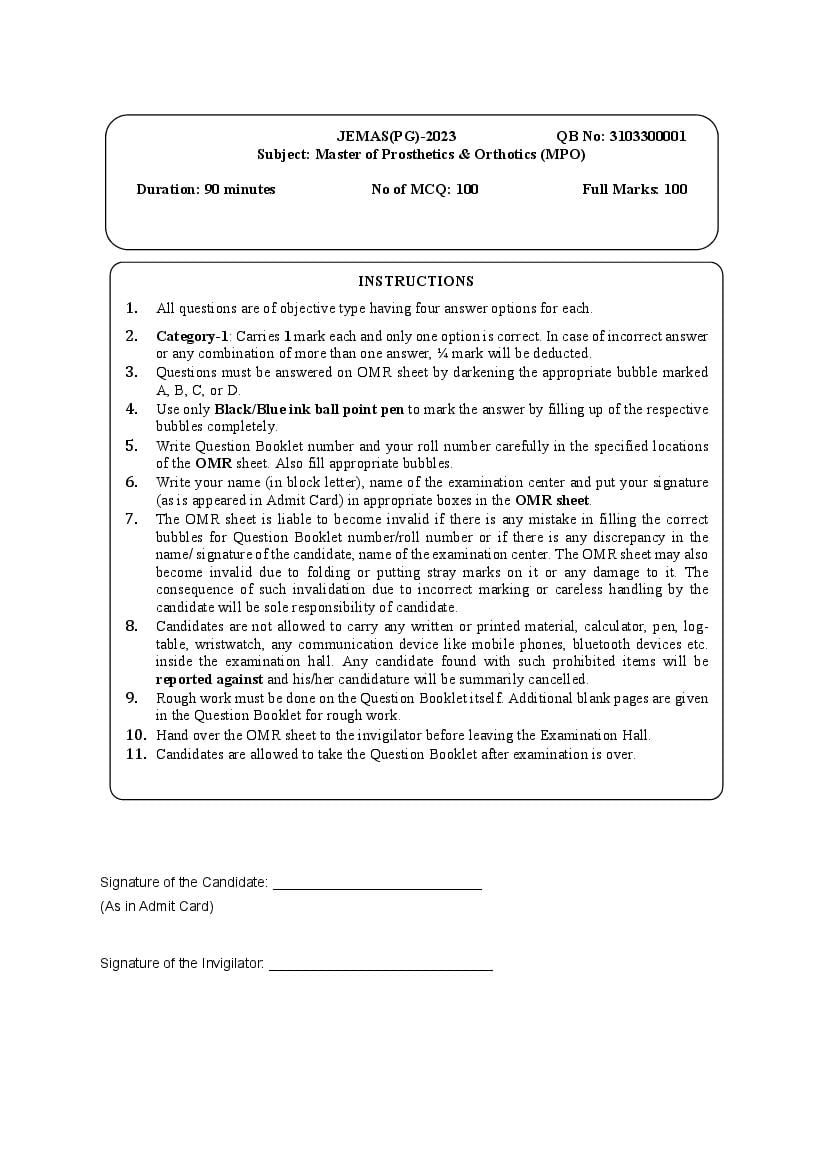
Subject: Master of Prosthetics & Orthotics (MPO)
Duration: 90 minutes No of MCQ: 100 Full Marks: 100
INSTRUCTIONS
1. All questions are of objective type having four answer options for each.
2. Category-1: Carries 1 mark each and only one option is correct. In case of incorrect answer
or any combination of more than one answer, ¼ mark will be deducted.
3. Questions must be answered on OMR sheet by darkening the appropriate bubble marked
A, B, C, or D.
4. Use only Black/Blue ink ball point pen to mark the answer by filling up of the respective
bubbles completely.
5. Write Question Booklet number and your roll number carefully in the specified locations
of the OMR sheet. Also fill appropriate bubbles.
6. Write your name (in block letter), name of the examination center and put your signature
(as is appeared in Admit Card) in appropriate boxes in the OMR sheet.
7. The OMR sheet is liable to become invalid if there is any mistake in filling the correct
bubbles for Question Booklet number/roll number or if there is any discrepancy in the
name/ signature of the candidate, name of the examination center. The OMR sheet may also
become invalid due to folding or putting stray marks on it or any damage to it. The
consequence of such invalidation due to incorrect marking or careless handling by the
candidate will be sole responsibility of candidate.
8. Candidates are not allowed to carry any written or printed material, calculator, pen, log-
table, wristwatch, any communication device like mobile phones, bluetooth devices etc.
inside the examination hall. Any candidate found with such prohibited items will be
reported against and his/her candidature will be summarily cancelled.
9. Rough work must be done on the Question Booklet itself. Additional blank pages are given
in the Question Booklet for rough work.
10. Hand over the OMR sheet to the invigilator before leaving the Examination Hall.
11. Candidates are allowed to take the Question Booklet after examination is over.
Signature of the Candidate: ___________________________
(As in Admit Card)
Signature of the Invigilator: _____________________________
Page 2
1. Common deformities seen in partial foot amputation?
(A) Equinovarus deformity.
(B) Calcanovalgus deformity.
(C) Pronation deformity.
(D) Supination deformity.
2. Direct prehension control is possible in which of the following amputation?
(A) Shoulder disarticulation.
(B) Krukenberg procedure.
(C) Osseointrgration.
(D) Wrist disarticulation.
3. Spilt socket is indicated for :
(A) Amputations immediately distal to the elbow joint.
(B) Inadequate strength of the elbow flexor.
(C) Inability to tolerate the high unit pressure on the volar surface of the forearm.
(D) All of the above.
4. Traumatic spodylolisthesis of C2 is known as :
(A) Jefferson fracture.
(B) Hangman fracture.
(C) Whiplash injury.
(D) Slice fracture.
5. A person with a facet joint problem in the spine is generally most comfortable in which
of the following positions?
(A) Lying prone.
(B) Lying supine with legs extended.
(C) Side-lying with top leg extended behind the body.
(D) Side-lying with both legs flexed toward the chest.
6. What deformity is most likely to result from ankylosing spondylitis?
(A) Flexion.
(B) Extension.
(C) Lateral rotation.
(D) Hyperlordosis.
7. In Erb’s palsy, what part of the brachial plexus is affected?
(A) The lower trunk (C8-T1).
(B) Both upper and lower trunks.
(C) Middle trunk (C7).
(D) The upper trunk (C5-C6).
8. A WHO : wrist extension assist could be used for nerve damage at what level?
(A) Axillary nerve at mid humeral level.
(B) Radial nerve at mid humeral level.
(C) Medial nerve at mid humeral level.
(D) Ulnar nerve at wrist level.
P a g e 1 | 12
Page 3
with 3 point palmar Prehension. What other type of Prehension will they use?
(A) Isotonic contractions.
(B) Isokinetic contractions.
(C) Static contractions.
(D) All of the above.
10. A "Claw Hand" deformity is the result of an injury to which nerves?
(A) Radial nerve.
(B) Median nerve.
(C) Median and/or ulnar nerve.
(D) Ulnar nerve.
11. In amputee wheelchair axle are set in backwards because of :
(A) Moving the COM anteriorly to prevent tipping.
(B) Easy forward propulsion.
(C) Allows equal weight distribution between front and back.
(D) Allows easy transfer to bed.
12. Where does the greatest amount of cervical flexion occur?
(A) C2-C3.
(B) C3-C4.
(C) C5-C6.
(D) C6-C7.
13. Which lumbar segment is the most mobile?
(A) L2-L3.
(B) L4-L5.
(C) L3-L4.
(D) L1-L2.
14. Which of the following cervical orthosis does notlimit rotation?
(A) Halo vest.
(B) Minerva brace.
(C) Aspen collar.
(D) Sterno-occipital-mandibular immobilizer (SOMI).
15. Guyon canal syndrome is :
(A) Compression of Radial nerve at Guyon canal.
(B) Compression of Ulnar nerve at Guyon canal.
(C) Compression of Median nerve at Guyon canal.
(D) Compression of Median nerve at carpal tunnel.
16. How many disabilities have been included in RPWD act, 2014?
(A) 21.
(B) 15.
(C) 17.
(D) 20.
17. In third class lever mechanical advantages is always :
(A) Greater than 1.
(B) Less than 1.
(C) Equal to 1.
(D) May be equal, greater or less than 1.
P a g e 2 | 12
Page 4
(A) Abnormal STJ pronation with hypermobility of the first ray.
(B) Abnormal STJ supination with hypermobility of the first ray.
(C) Abnormal STJ pronation with hypomobility of the first ray.
(D) Abnormal STJ supination with hypomobility of the first ray.
19. Crutch height is equals to :
(A) 67% of patient’s height.
(B) 70% of patient’s height.
(C) 77% of patient’s height.
(D) 80% of patient’s height.
20. What is the most common type of cerebral palsy (CP)?
(A) Mixed type.
(B) Dyskinetic.
(C) Flaccid.
(D) Spastic.
21. Please select the statement that is false concerning stress and strain :
(A) Stress is force over tissue surface area.
(B) Strain is the tissue's change in shape when stress is applied.
(C) The steeper the stress/strain curve, the more ductile is the material.
(D) The steeper the stress/strain curve, the more brittle the material.
22. What is the medical term for “knock-kneed”?
(A) Genu varum.
(B) Genu valgum.
(C) Genu recurvatum.
(D) Genu anterium.
23. The sartorius muscle is innervated by which nerve?
(A) Superior gluteal nerve.
(B) Inferior gluteal nerve.
(C) Sciatic nerve.
(D) Femoral nerve.
24. The most common deformity seen in patient with a osteoporotic spine is :
(A) Scoliosis.
(B) Kyphosis.
(C) Lordosis.
(D) Scoliokyphosis.
25. Which is not Prognostic tool for Scoliotic curve progression :
(A) Peak growth age.
(B) Degree of maturity.
(C) Peak height velocity.
(D) Chronological age.
26. Reliable indicators for differentiating resolving from progressive scoliosis :
(A) Rib vertebral angle difference (RVAD).
(B) Cobb angle.
(C) Risser sign.
(D) Menarchal status.
P a g e 3 | 12
Page 5
(A) Extension.
(B) Distraction.
(C) Distraction and flexion.
(D) Compression and extension.
28. Function of soft collar includes :
(A) To provide gentle support after a soft tissue or ligamentous injury.
(B) Serve as a concrete reminder for patients to follow their treatment regimen.
(C) Function as a transition between wearing a more rigid orthosis and not wearing an
orthosis.
(D) All of the above.
29. In myelomeningocele scoliosis occurs due to :
(A) Asymmetrical paralysis of spinal and abdominal muscles.
(B) Congenital deformities of vertebrae.
(C) Fixed pelvic obliquity.
(D) Any of above.
30. Which brace is given to stop movements of cervical spine?
(A) Cervical collar.
(B) Corrective collar.
(C) SOMI brace.
(D) Taylor brace.
31. The Coleman lateral block test is used to asses flexibility of which presentation :
(A) Hindfoot valgus.
(B) Hindfootvarus.
(C) Forefoot varus.
(D) Forefoot valgus.
32. If adjacent joints are to be controlled which biomechanical forces are most effective for
controlling both joints?
(A) 2 point force system.
(B) 3 point force system.
(C) 4 point force system.
(D) 3 point force system + 4 points force system.
33. The bulbar palsy child with complete paralysis of extremities can be treated in
following ways :
(A) Wheelchair management.
(B) Crutch walking.
(C) Bedridden care.
(D) Calipers and walking.
34. Contraindication of tone reducing AFO :
(A) Mild to moderate spasticity.
(B) Minimal to moderate varus instability of subtalar joint.
(C) Fixed equines deformity.
(D) Need for reduction of hypertonic foot reflex activity.
P a g e 4 | 12
Page 6
(A) Subtalar joint in neutral position.
(B) Subtalar joint in inversion.
(C) Subtalar joint in eversion.
(D) Subtalar joint in neutral with midtarsal joint in plantarflexion.
36. Indication of craig-scott orthosis is :
(A) Poliomyelitis.
(B) Cerebral palsy.
(C) Paraplegia.
(D) Myopathy.
37. Swash orthosis is
(A) Knee orthosis for cerebral palsy.
(B) Hip orthosis for cerebral palsy child.
(C) Knee ankle foot orthosis for cerebral palsy child.
(D) Hip knee ankle foot orthosis for cerebral palsy child.
38. Wheaton brace is designed to maintain :
(A) Forefoot abduction.
(B) Forefoot adduction.
(C) Hindfoot adduction.
(D) Hindfoot abduction.
39. For pes Varus, what shoe modification is required?
(A) Thomasheel.
(B) Lateralwedge.
(C) Heelcushion.
(D) MTbar.
40. Purpose of double rocker sole is:
(A) To eliminate weight-bearing forces on the forefoot.
(B) To reduce pressure under the metatarsal heads.
(C) To unload the mid foot area.
(D) To relieve fore foot pressure by shifting the weight-bearing forces to the hind foot
and midfoot
.
41. Carlyle index is:
(A) Ratio of total height to stump length.
(B) Ratio of total height to normal side length of corresponding stump length.
(C) Ratio of stump length to total height.
(D) Ratio of stump length to normal side length of corresponding stump length.
42. Campbell index is:
(A) Ratio of humeral length to stump antero-posterior diameter.
(B) Ratio of radius length to stump antero-posterior diameter.
(C) Ratio of femur length to stump end circumference.
(D) Ratio of tibial length to stump end circumference.
43. Which Body motion is required to control a terminal device of upper limb prosthesis?
(A) Biscapular adduction.
(B) Glenohume al flexion.
(C) Glenohumer al extension.
(D) Glenohumer al elevation.
P a g e 5 | 12
Page 7
(A) Control of prosthes is by muscle electrical.
(B) Control of prosthes is bynerve signal.
(C) Control of prosthes is by signal produced by muscle sound.
(D) Control of prosthes is by muscle movement.
45. Orthotic treatment of Tennis Elbow is :
(A) Elbow cage.
(B) Elbow strap to relax muscles over medial epicondyle.
(C) Elbow strap to relax muscles over lateral epicondyles.
(D) Elbow strap to relax muscles over olecranon process.
46. Which of the following may be described as one of the cause of abducted gait?
(A) Weak hip abductors.
(B) Abducted socket.
(C) Prosthes is too long.
(D) Insufficient support by the lateral socket wall.
47. In very light weight transfemoral prosthesis CG shifted to :
(A) Upward and towards Sound side.
(B) Upward and towards Prosthetic side.
(C) Down ward and towards sound side.
(D) Downward and towards Prosthetic side.
48. The ICOR of four barknee in flexion locates:
(A) Superior & Posterior.
(B) Superior & Anterior.
(C) Inferior & Posterior.
(D) Inferior & Anterior.
49. The highest point of medial arch is located between :
(A) Sustentaculumtali and Talonavicularjoint.
(B) Talo-crural and subtalarjoints.
(C) Talo-crural and calcaneocuboidjoints.
(D) Intermetatarsal and interphalangealjoints.
50. The Blount’s disease refers to :
(A) Lateral bowing of tibia in children.
(B) Latera lbowing of legs at the knee.
(C) Genu-valgum of the knee.
(D) Lateral displacement of the knee.
Group – B
51. How rotation occurs in feet with elastic keel?
(A) Due to Movement of flexible keel within the rubber housing.
(B) Due to movement of o ring with the snubber.
(C) Due to movement of ball with the ankle joint.
(D) Due to movement of rigid keel with the ankle joint.
P a g e 6 | 12
Page 8
(A) Endolite Élan.
(B) FillaurerRaize.
(C) OssurProprio.
(D) Biom foot.
53. TRAC interface incorporates design elements from
(A) Split socket and three quarter type socket.
(B) Split socket and supracondylar socket.
(C) Muenster socket and northwestern socket.
(D) Muenster and suprastyloid socket.
54. Which type of orthosis would be used to manage a patient with skin grafts in the
axillary region?
(A) Mobile arm support.
(B) Shoulder abduction orthosis.
(C) Shoulder sling.
(D) Gun slinger splint.
55. If chronic ulcers in plantar aspect of the foot developed in a Hansen’s disease what is
the most suitable orthosis for that?
(A) M C R sandal with excavation.
(B) Shoe with M C R insole.
(C) P T B orthosis with soft insert.
(D) AFO.
56. What motion does a cushioned heel simulated?
(A) Plantarflexion at heel strike.
(B) Foot flat.
(C) Tibial forward progression at midstance.
(D) Dorsiflexion at foot flat.
57. Which of these back braces is primarily used for stable vertebral anterior compression
fractures?
(A) Williams brace.
(B) Chairback brace.
(C) Taylor brace.
(D) None of the above.
58. Which truncal orthosis uses a three-point pressure system to allow for extension but
limit flexion?
(A) Jewett brace.
(B) Williams brace.
(C) Taylor brace.
(D) Clam shell brace.
59. Which orthotics is used for low back pain during pregnancy?
(A) Lumbosacral orthosis (LSO) with a rigid frame.
(B) Corset.
(C) Wide belt.
(D) Rainey orthosis.
P a g e 7 | 12
Page 9
(A) Shoe that provides maximum stability.
(B) Flexible shoe.
(C) Forefoot should be flexible.
(D) Custom molded shoe with hindfoot support.
61. What type of plastic is plastizote?
(A) High temp thermoplastic.
(B) Closed cell polyethylene foam.
(C) Polypropylene.
(D) Open cell polyethylene foam.
62. What is the suitable orthosis for bony chance fracture at T12 level?
(A) Custom fabricated rigid TLSO.
(B) Jewett Brace.
(C) Cash brace.
(D) Taylor Brace.
63. Comminuted fracture of occipital condyles are treated by
(A) Halo brace
(B) Aspelcollar.
(C) SOMI brace.
(D) Philadelphia collar.
64. The orthotic management of a T1 level fracture will have its best 3-point pressure
system with which orthosis?
(A) Thoracolumbosacral orthosis (TLSO).
(B) Cervico-Thoracolumbosacral orthosis (CTLSO).
(C) Cervical thoracic orthosis (CTO).
(D) Lumbosacral orthosis (LSO).
65. With which conditions would it be acceptable to have the anterior panel of a LSO
corset be shorter than the ideal height?
(A) L5 fracture.
(B) Mechanical Low back pain.
(C) Spondylolisthesis.
(D) Osteoporosis.
66. Placement of orthotic ankle joint in sagittal plane is at
(A) Distal tip of the medial malloeus.
(B) Distal tip of the lateral malleous.
(C) Mid of the medial malleuos.
(D) 1/3 distal to the medial malloeus.
67. Carville rocker is otherwise known as :
(A) Negative heel rocker sole.
(B) Severe-angle rocker sole.
(C) Heel to toe rocker sole.
(D) Double rocker sole.
P a g e 8 | 12
Page 10
(A) Medial longitudinal arch.
(B) Metatarsal pad.
(C) Counter.
(D) Heel bed.
69. Which option is not suitable for management of flaccid equines?
(A) Spring Wire AFO for Dorsiflexion Assist.
(B) Klenzak AFO for Dorsiflexion Assist.
(C) Functional Electrical Stimulation for Dorsiflexion Assist.
(D) Free motion ankle joint for Dorsiflexion Assist.
70. The more effective Orthosis in equinovarus deformity is
(A) Foot drop stop.
(B) RJ heel.
(C) Inside T bar.
(D) Outside T bar with foot drop stop.
71. Following are example of internal shoe modification except :
(A) Heel wedge.
(B) Excavation.
(C) Metatarsal pad.
(D) Rocker bar.
72. The anterior strap of Pelvic harness is tightened to maintain hip joint in :
(A) Flexion.
(B) Extension.
(C) Abduction.
(D) Internal rotation.
73. Most effective wt. relieving orthosis in LCPD is :
(A) Toronto orthosis.
(B) Glimcher orthosis.
(C) Trilateral hip abduction orthosis.
(D) Craig bar.
74. Function of PLS AFO includes all except :
(A) Controlled plantarflexion at loading response.
(B) Dorsiflexion range of motion during late midstance through terminal stance.
(C) Prevents mediolateral instability of the ankle and subtalar joint.
(D) Providing clearance of the foot during swing phase of gait.
75. Placement of orthotic hip joint is :
(A) 1 inch superior & ½ inch anterior to apex of greater trochanter.
(B) 1 inch superior & ½ inch Posterior to apex of greater trochanter.
(C) 1inch superior & 1 inch anterior to apex of greater trochanter.
(D) 1 inch superior & 1 cm anterior to apex of greater trochanter.
76. The length of the bar in Denis Browne splint should approximate :
(A) Width of the child both the shoulder level.
(B) Width of the child chest.
(C) Width of the child waist.
(D) Width of the child pelvis.
P a g e 9 | 12
Page 11
(A) Hip and knee flexion contractures less than 30 degrees.
(B) Active hip flexor strength.
(C) Obesity.
(D) No significant spinal deformity.
78. Gas filled struts which provide knee extension moment is present in which type of
RGO?
(A) RGO.
(B) ARGO.
(C) IRGO.
(D) Not present in any version of RGO.
79. David Hart walker is :
(A) IStanding frame attached with two pedals.
(B) A modular THKAFO with wheeled carrier.
(C) Lightweight frame attached with two swivelling foot pedals.
(D) 4 wheeled base connected with vertical and horizontal uprights in 3 sides.
80. Which of the following material is a thermosetting plastics?
(A) Phenolics.
(B) Melamine.
(C) Epoxies.
(D) All of the above.
81. The forearm is set in initial flexion in which type of socket?
(A) North western socket.
(B) AHI socket.
(C) Muenster socket.
(D) Floating brim socket.
82. Indication of supra styloid suspension socket is :
(A) Long trans radial stump.
(B) Wrist disarticulation with prominent styloid.
(C) Mid carpal amputation.
(D) Meta carpo phalangeal disarticulation.
83. Main feature of Three-quarter type below elbow socket :
(A) Indicated for short transradial amputation.
(B) Set in initial flexion.
(C) Narrow M-L.
(D) Has a Olecrenon cutout.
84. Main principles of CRS socket:
(A) Longitudinal depressions added in the socket walls.
(B) Open release areas are created between the depressions that receive the displaced
tissue.
(C) Requires selective pressure.
(D) All of the above.
P a g e 10 | 12
Page 12
(A) Anatomically Contoured and Comfort Interface.
(B) Anatomically Contoured and Controlled Interface.
(C) Angulation contoured and controlled interface.
(D) None of the above.
86. TRAC interface in corporates design elements from :
(A) Split socket and three quarter type socket.
(B) Split socket and supracondylar socket.
(C) Muenster socket and north western socket.
(D) Muenster and supra styloid socket.
87. Flexible hinges is indicated for :
(A) Amputation through the proximal third of the forearm.
(B) Amputation through the distal third of the forearm.
(C) Amputation through the middle third of the forearm.
(D) Amputation through mid of the forearm.
88. Function of “InvertedY strap” is to :
(A) Resist displacement of the socket on the residual limb when the prosthesis is
subjected to heavy loading.
(B) Permit the use of scapular abduction and shoulder flexion on the amputated side for
operation of the terminal device.
(C) Prevent to lateral rotation of prosthetic socket during prosthetic function.
(D) None of the above.
89. Bowden control cable system is used with :
(A) Trans radial prosthesis.
(B) Elbow disarticulation prosthesis.
(C) Trans humeral prosthesis.
(D) Shoulder disarticulation prosthesis.
90. Dual control cable system is used with :
(A) Elbow disarticulation prosthesis.
(B) Short Transhumeral prosthesis.
(C) Long Transhumeral prosthesis.
(D) All of the above.
91. The PTB supracondylar, suprapatellar (PTB-SCSP) socket does not provide :
(A) Increased mediolateral stability.
(B) Increased functional kneeling.
(C) Increased anteroposterior stability.
(D) Increased area of pressure distribution.
92. Which one is the advantage of sleevesuspension?
(A) Provides added kneest ability.
(B) Suspension is greatly decreased if the sleeve is punctured.
(C) Perspiration may build up under the sleeve and create skin irritation or hygiene
problems.
(D) Helps minimize socket pistoning.
P a g e 11 | 12
Page 13
(A) Single axis.
(B) SACH.
(C) Flexible keel dynamic response.
(D) Multiaxis.
94. The pelvic band and hip joint suspension is used for :
(A) Short stump.
(B) Long stump.
(C) Medium stump.
(D) Very short stump.
95. What device is used to convert direct current to alternating current?
(A) Oscillator.
(B) Amplifier.
(C) Transformer.
(D) Filter.
96. What characteristic of read-only memory (ROM) makes it useful?
(A) ROM information can be easily updated.
(B) Data in ROM is non-volatile, that is, it remains there even with out electrical power.
(C) ROM provides very large amounts of inexpensive data storage.
(D) ROM chips are easily swapped between different brands of computers.
97. BCD is :
(A) Binary Coded Decimal.
(B) Bit Coded Decimal.
(C) Binary Coded Digit.
(D) Bit Coded Digit.
98. ASCII stands for:
(A) American Stable Code for International Interchange.
(B) American Standard Case for Institutional Interchange.
(C) American Standard Code for Information Interchange.
(D) American Standard Code for Interchange Information.
99. What are the effects of an orthos is setin 5degree dorsiflexion?
(A) Increases knee flexion moment.
(B) Increases instability in early stance phase.
(C) Greatertoe clearance in swing.
(D) All of the above.
100. Craig-Scott KAFO :
(A) Control frontal plane.
(B) Control Sagittal plane.
(C) Control transverse plane.
(D) Control all plane.
P a g e 12 | 12
Document Details
| Board / Org | WBJEEB |
| Exam | JEMAS PG |
| Type | Question Paper |
| Pages | 14 |
| Updated | 24 Sep 2026 |