Goa Board Class 12 Syllabus 2027 Physics
Finished viewing? Save it for later —
Download Goa Board Class 12 Syllabus 2027 Physics (PDF · 12 pages)About Goa Board Class 12 Syllabus 2027 Physics
Goa Board Class 12 Syllabus 2027 Physics is available here for free download. Published by Goa Board for Class 12, this syllabus can be viewed online or downloaded as a PDF (12 pages). Candidates preparing for Class 12 can use Goa Board Class 12 Syllabus 2027 Physics to understand the exam pattern, the type of questions asked, and the overall difficulty level.
Frequently Asked Questions
How can I download Goa Board Class 12 Syllabus 2027 Physics?
Open this page and click the Download button to save Goa Board Class 12 Syllabus 2027 Physics as a PDF. It is completely free on AglaSem Docs.
Is Goa Board Class 12 Syllabus 2027 Physics free to download?
Yes. Goa Board Class 12 Syllabus 2027 Physics can be viewed online and downloaded as a PDF free of cost on AglaSem Docs.
How many pages does Goa Board Class 12 Syllabus 2027 Physics have?
Goa Board Class 12 Syllabus 2027 Physics contains 12 pages, which you can read online or download together as a single PDF.
Where can I find more Class 12 study material?
You can find more Class 12 question papers, sample papers, syllabus, and answer keys on AglaSem Docs.
Goa Board Class 12 Syllabus 2027 Physics – Text
Read the full text of this syllabus below — useful to quickly search, copy and reference the content online without downloading the PDF.
📄 View text version (13 pages)
Page 1
Goa Board Class 12
Syllabus 2027 Physics
EXAM YEAR TYPE SUBJECT
Goa Class 12 2027 Syllabus Physics
Notes · Sample Papers · Previous Year Papers · Mock Tests
Page 2
m .co
m .co s e m
se
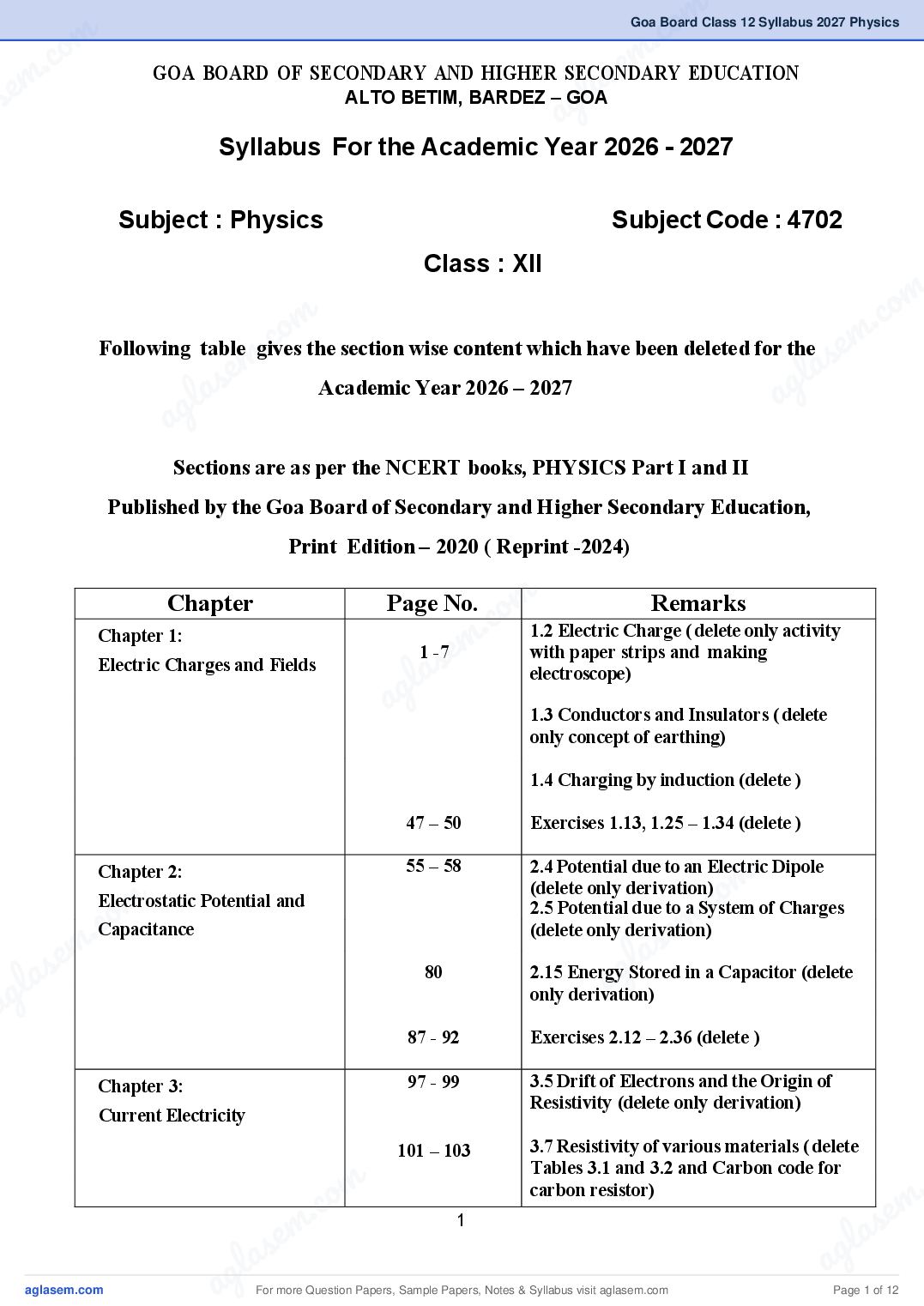
GOA BOARD OF SECONDARY AND HIGHER SECONDARY EDUCATION
g l
ALTO BETIM, BARDEZ – GOA a
a
Syllabus For the Academic Year 2026 - 2027
Subject : Physics Subject Code : 4702
Class : XII
m
o m .co
. c the section wise content which have been deleted for the em
e m
Following table gives
l as
l as Academic Year 2026 – 2027
a g
ag
Sections are as per the NCERT books, PHYSICS Part I and II
Published by the Goa Board of Secondary and Higher Secondary Education,
Print Edition – 2020 ( Reprint -2024)
m
c. o 1.2 Electric Charge ( delete only activity
Chapter Page No. Remarks
Chapter 1:
e m
Electric Charges and Fields
las1 -7 with paper strips and making
g
electroscope)
a 1.3 Conductors and Insulators ( delete
only concept of earthing)
1.4 Charging by induction (delete )
47 – 50 Exercises 1.13, 1.25 – 1.34 (delete )
55 – 58
m
Chapter 2: 2.4 Potential due to an Electric Dipole
.co
(delete only derivation)
m
.co
Electrostatic Potential and
em
2.5 Potential due to a System of Charges
e m
Capacitance
s
(delete only derivation)
la in a Capacitor (delete
l as 80 2.15 EnergygStored
a
ag only derivation)
87 - 92 Exercises 2.12 – 2.36 (delete )
Chapter 3: 97 - 99 3.5 Drift of Electrons and the Origin of
Resistivity (delete only derivation)
Current Electricity
101 – 103 3.7 Resistivity of various materials ( delete
Tables 3.1 and 3.2 and Carbon code for
m .
.co m
carbon resistor)
s e
em a
1
s l
l a ag
ag For more Question Papers, Sample Papers, Notes & Syllabus visit Page 1 of 12
Page 3
and Parallel (delete only derivation)
120 – 123 3.15 Meter Bridge (delete )
3.16 Potentiometer (delete )
127 - 131 Exercises 3.10, 3.12, 3.14 – 3.23 (delete )
Chapter 4: 135 Table 4.1(delete )
Moving Charges and
140 – 142 4.4.1 Velocity Selector (delete )
Magnetism 4.4.2 Cyclotron (delete )
152 - 153 4.8.2 The Toroid (delete )
162 -163 4.10.3 The magnetic Dipole Moment of a
Revolving Electron (delete )
170 - 172 Exercises 4.14 – 4.28 (delete )
Chapter 5: 176 – 179 5.2.2 Bar magnet as an equivalent
Solenoid (delete only derivation)
Magnetism and Matter
5.2.3 Dipole in a Uniform Magnetic Field
(delete only derivation)
180 Example 5.4 (delete )
185 – 188 5.4 Earth’s Magnetism (delete )
5.4.1 Magnetic Declination and Dip
(delete )
189 – 190 5.5 Magnetisation and Magnetic Intensity
(delete only derivation)
191 Table 5.2 (delete )
192 – 196 5.6.2 Paramagnetism ( delete only Curie’s
Law)
5.6.3 Ferromagnetism ( delete only
Curie’s temperature; and Hysterises)
5.7 Permanent Magnets and
Electromagnets (delete )
Exercises 5.1, 5.2, 5.9 – 5.11, 5.13 – 5.25
200 - 203
(delete )
Chapter 6: 215 – 219 6.7 Energy Consideration : A Quantitative
study (delete )
Electromagnetic Induction
6.8 Eddy Currents (delete )
2
For more Question Papers, Sample Papers, Notes & Syllabus visit Page 2 of 12
Page 4
m .co
m .co 220 - 224
s e m
6.9.1 Mutual Inductance (delete only
se g l a
derivation)
a
6.9.2 Self Inductance (delete only
derivation)
230 - 232 Exercises 6.6, 6.10 – 6.17 (delete )
Chapter 7: 240 Figure 7.7 Magnetisation and
Demagnetisation of an inductor (delete )
Alternating Current
m
.co
243 Figure 7.10 Charging and discharging of a
m capacitor(delete )
m .co s em
e 246 – 247
la
7.6.2 Analytical Solution (delete )
l as g
a of
ag
248 – 251 7.6.3 Resonance ( delete only Sharpness
Resonance)
255 – 259 7.8 LC Oscillations (delete )
266 - 268 Exercises 7.6, 7.8, 7.10, 7.12 – 7.26
(delete )
Chapter 8: 270 -272 8.2 Displacement Current (delete only
m
derivation)
.co
Electromagnetic Waves
273 – 274 Example 8.1 (delete )
s em
275 - 277 8.3.2 Nature of Electromagnetic Waves
g la ( delete only about ether and page 277)
a279 - 280 Example 8.4 and 8.5 (delete )
287 Exercises 8.11 – 8.15 (delete )
Chapter 9: 314 9.3 Refraction ( delete only advanced
sunrise and delayed sunset)
Ray Optics and Optical
Instruments 319 – 320 m
.co
9.4.1(i) Mirage (delete )
m
.co
9.4.2 (ii) Diamond (delete )
e m
e m 330 – 332
l as
9.7 Some Natural Phenomena due to
l as ag
Sunlight (delete )
ag 333- 339
9.7.1 The Rainbow (delete )
9.7.2 Scattering of light (delete )
9.8.1 The Microscope (delete only
derivation)
9.8.2 Telescope (delete only derivation)
344 Exercise 9.18 (delete )
Chapter 10: 354 – 355 10.3.4 The Doppler Effect (delete )
Wave Optics
om .
355 Example 10.1(delete )
.c e m
em
3
l as
l as ag
ag For more Question Papers, Sample Papers, Notes & Syllabus visit Page 3 of 12
Page 5
Young’s Experiment ( retain the final
expression for dark and bright fringes but
delete the derivation; delete expression for
fringe width)
363 – 367 10.6.1 The single Slit (delete the
derivation)
368 – 371 10.6.3 Resolving Power of Optical
Instruments (delete )
10.6.4 The Validity of ray Optics (delete )
375 – 377 10.7.1 Polarisation by Scattering (delete )
10.7.2 Polarisation by Reflection (delete )
379 - 381 Exercises 10.7 – 10.21
Chapter 11: 384 Table 11.1 (delete )
Dual Nature of Matter and
384 – 385 11.3.1 Hertz’s Observations ( only
Radiation qualitative treatment)
11.3.2 Hallwachs’ and Lenard’s
Observations ( only qualitative treatment)
393 Example 11.3 ( delete)
394 – 400 11.8 Wave Nature of Matter ( delete only
derivation for de Broglie wavelength of
accelerated electrons; and Heisenberg’s
Uncertainty Principle)
11.9 Davisson and Germer Experiment
( delete)
403 – 407 Exercises 11.5, 11.7, 11.12 – 11.14, 11.16,
11.17, 11.19 -11.37 (delete)
Appendix 11.1 The History of Wave –
408 - 409
Particle Flip – Flop (delete)
Chapter 12: 417 – 418 12.3.1 Spectral Series (delete)
Atoms
418 – 422 12.4 Bohr model of the Hydrogen Atom
(retain only the expression for radius of
nth possible orbit but delete its derivation)
424 – 426 12.5 The Line Spectra of the Hydrogen
Atom ( retain only qualitative treatment)
426 Example 12.6 (delete)
432 - 433 Exercises 12.3, 12.11 – 12.17 (delete)
4
For more Question Papers, Sample Papers, Notes & Syllabus visit Page 4 of 12
Page 6
m .co
c. o Chapter 13: 442 – 447
s e m
m
13.6.1 Law of Radioactive Decay (delete)
se g l a
13.6.2 Alpha Decay (delete)
a
Nuclei
13.6.3 Beta Decay (delete)
13.6.4 Gamma Decay (delete)
448 – 451 13.7.2 Nuclear Reactor (delete)
458 - 462 Exercises 13.1, 13.2, 13.6 – 13.10, 13.12 –
13.14, 13.18, 13.22 – 13.31 ( delete)
m
.co
Chapter 14: 481 - 486 14.8 Special Purpose p-n Junction Diodes
m
.co
(delete)
Semiconductor Electronics :
e m
Materials, Devices m
e and 493 - 494 Exercises 14.7 – 14.10 (delete)
l as
simple circuitsas
l ag
ag
Topic – Wise Weightage
Sr. Chapter Marks Allotted for
No.
m Mid - First Term Final Board
.co
Term Examination
1 Electric Charges and Fields
e m 04 06 06
2
las
Electrostatic Potential and Capacitance 04 05 06
3 Current Electricity ag 06 06 07
4 Moving Charges and Magnetism ---- 08 06
5 Magnetism and Matter ---- 05 03
6 Electromagnetic Induction ---- 06 04
7 Alternating Current ---- 08 05
8 Electromagnetic Waves ---- 03 03
m08
c. o 05
9 Ray Optics and Optical Instruments 06 05
m
c. o 11 m
10 ----
e
Wave Optics ---
em Dual Nature of Matter and Radiation ----
l as--- 04
las 12 Atoms ---- g
a ---- ---- 03
ag 13 Nuclei ---- 03
14 Semiconductor Electronics : Materials, ---- 08 07
Devices and simple circuits
Total 20 60 70
m .
.co s e m
em a
5
s l
l a ag
ag For more Question Papers, Sample Papers, Notes & Syllabus visit Page 5 of 12
Page 7
for the Academic Year 2026 - 2027
Sr.No.
1 Time Duration 180 Minutes
2 Maximum Marks 70
3 Weightage to Knowledge : 30 %
Objective
Understanding : 50 %
Application : 20 %
4 Weightage to the LA ( 4 marks) X3 = 12
type of
Questions SAII ( 3 marks) X 8 = 24
SAI ( 2 marks) X 10 = 20
VSA ( 1 marks) X 14 = 14
( 7 MCQ)
Total 35 questions = 70
5 Scheme of options Options in 3 LA Type + 1 SAII Type = 21%
6 Difficulty Level Easy = 20%
Average = 60%
Difficult = 20 %
Additional Guidelines for paper setting
7 Numericals 20% - 23% ( 14 – 16 Marks)
( As far as possible avoid/ minimize the use of
Logarithmic tables)
8 Derivations 20% - 23% ( 14 – 16 Marks)
2 qns from LA Type + 2 qns from SAII
Type ( = 20%)
+ 1 qn from SAI ( total 23%)
6
For more Question Papers, Sample Papers, Notes & Syllabus visit Page 6 of 12
Page 8
om .co
m . c Pattern and Design of Mid - Term Examinations
s em
2026 - 2027
se g l a
1 Time Duration a60 Minutes
2 Maximum Marks 20
3 Weightage to Objective Knowledge : 30 %
Understanding : 50 %
Application : 20 %
4 Difficulty Level Easy = 20%
Average = 60%
m
.co
Difficult = 20 %
m
.co
5 Weightage to the type of SA-II ( 3 marks) X 02 = 06
e m
Questions
em
SA-I ( 2 marks) X 05 = 10
l as
s
laScheme of options
VSA ( 1 marks) X 04
( 2 MCQs)
= 04
ag
6 ag Option in
1 SA- II Type question
7 Numericals 20% - 25% ( 04 – 05 Marks)
( As far as possible avoid/ minimize the
use of Logarithmic tables)
m
c. o
Pattern and Design of First - Term Examinations 2026 - 2027
1 Time Duration
s em 150 Minutes
2 Maximum Marks
l a 60
3 Weightage to Objective ag Understanding
Knowledge : 30 %
: 50 %
Application : 20 %
4 Difficulty Level Easy = 20%
Average = 60%
Difficult = 20 %
5 Weightage to the type of LA ( 4 marks) X 2 qns = 08
Questions SAII ( 3 marks) X 6 qns = 18
m
m SAI ( 2 marks) X 10 qns = 20
.co
m .co VSA ( 1 marks) X 14 qns = 14
s e m
s e ( 7 MCQ)
g l a
g l a Total 32 questions
a
a 6 Scheme of options Options in 2 LA Type + 1 SAII Type
7 Numericals 20% - 23% ( 12 – 14 Marks)
( As far as possible avoid/ minimize the
use of Logarithmic tables)
m .
.co s e m
em a
7
s l
l a ag
ag For more Question Papers, Sample Papers, Notes & Syllabus visit Page 7 of 12
Page 9
for the Academic Year 2026 – 2027
1. Time duration : 180 minutes
2. Maximum Marks 20
3. Students would be required to perform two experiments,
one from each section A and B 08 + 08 = 16
Practical Record ( Journal) = 02
Viva – Voce on Experiments = 02
Total = 20
4. External Examiner : One experiment (08) + Viva - Voce (02) = 10
5. Internal Examiner : One experiment (08) + Journal (02) = 10
PRACTICAL PORTION :
At least 12 Experiments [ minimum 6 from each section] to be performed by the
students during the academic year 2026 -2027].
List of Experiments
SECTION–A
1. To determine resistance per cm of a wire by plotting a graph for potential
difference versus current.
2. To find resistance of a given wire using metre bridge and hence to determine the
specific resistance of its material.
3. To verify the laws of combination (series) of resistances using a metre bridge.
/OR/
To verify the laws of combination (parallel) of resistances using a metre bridge.
4. To determine resistance of a galvanometer by half-deflection method and to find
its figure of merit.
8
For more Question Papers, Sample Papers, Notes & Syllabus visit Page 8 of 12
Page 10
om .co
. c e m
m as
5. To convert the given galvanometer (of known resistance and figure of merit)
se into a voltmeter of desired range and to verify the same. gl
a
/OR/
To convert the given galvanometer (of known resistance and figure of merit) into
an ammeter of desired range and to verify the same.
6. To find the frequency of AC mains with a sonometer.
7. To draw the I-V characteristic curve for a p-n junction diode in forward bias. m
m .co
.co s e m
SECTION-B
s em l a
g laof v for different values of u in case of a concave mirror and
1. To find the value ag
a
to find the focal length.
2. To find the focal length of a convex mirror, using a convex lens.
3. To find the focal length of a convex lens by plotting graph between v and u.
/OR/
m
.co
4. To find the focal length of a convex lens by plotting a graph between 1/v and
1/u.
s em
g lafor a given prism by plotting a graph
a
5. To determine angle of minimum deviation
between angle of deviation and angle of incidence.
6. To determine refractive index of a glass slab using a travelling microscope.
7. To find the refractive index of a liquid using convex lens and plane mirror.
8. To find the refractive index of a liquid using a concave mirror.
m
m .co
m .co s e m
s e g l a
g l a a
a
m .
.co s e m
em a
9
s l
l a ag
ag For more Question Papers, Sample Papers, Notes & Syllabus visit Page 9 of 12
Page 11
Areas for the internal assessment for XII standard students in the subject Physics, for the
academic year 2026-27.
Students shall be assessed for 20 marks based on the two areas (10 marks each) during
the academic year 2026 – 27.
1) Area 1
Students to perform any 5 activities from the listed 13 activities and to maintain the
record in the Physics Journal.
Total marks : 10 (5 activities X 2 marks)
List of Activities:
1. To measure the resistance and impedance of an inductor with or without iron core.
2. To measure resistance, voltage (AC/DC), current (AC) and check continuity of a given
circuit using multimeter.
3. To assemble a household circuit comprising three bulbs, three (on/off) switches, a fuse
and a power source.
4. To assemble the components of a given electrical circuit.
5. To study the variation in potential drop with length of a wire for a steady current.
6. To draw the diagram of a given open circuit comprising at least a battery, resistor /
rheostat, key, ammeter and voltmeter. Mark the components that are
not connected in proper order and correct the circuit and also the circuit diagram.
7. To identify a diode, an LED, a resistor and a capacitor from a mixed collection of such
items.
8. Use of multimeter to see the unidirectional flow of current in case of a diode and an
LED and check whether a given electronic component (e.g., diode) is in working
order.
9. To study effect of intensity of light (by varying distance of the source) on an LDR.
10. To observe refraction and lateral deviation of a beam of light incident obliquely on a
glass slab.
11. To observe diffraction of light due to a thin slit.
12. To study the nature and size of the image formed by a (i) convex lens, or (ii) concave
10
For more Question Papers, Sample Papers, Notes & Syllabus visit Page 10 of 12
Page 12
m c
. of the candle
. co on a screen by using a candle and a screen (for different distances
mirror,
s e m
m a
se 13. To obtain a lens combination with the specified focal length l
from the lens/mirror).
g
a by using two lenses from
the given set of lenses.
2) Area 2
For remaining 10 marks, students can select any one topic from the list provided. After
completion of the selected area students are supposed to submit the report (individually)
m
m
as per the guidelines given. Students can work as a group or can complete the task
.co
individually.
m .co s e m
s e l a
ag
Distribution of 10 marks:
i) Report : 05 g l a
a marks
ii) Presentation : Viva – voce : 03 marks
iii) Objective achieved from the selected topic of study : 02 marks
m
.co
Guidelines for report submission
1. Title
e m
2. Abstract
las
3. Table of content ag
4. Hypothesis / Objective
5. Background research / Theory
6. Material List
7. Experimental procedure
m
c o m
8. Data analysis
m.co
m .
9. Conclusion s e
s eIdeas for future research g l a
g l a
10.
a
a 11. Acknowledgment
12. Bibliography
m .
.co s e m
em a
11
s l
l a ag
ag For more Question Papers, Sample Papers, Notes & Syllabus visit Page 11 of 12
Page 13
1. Innovative Project
2. Physics in Sports
Explaining the Physics principles involved in any two sports.
3. Conducting Science quiz ( with demonstrations) for lower classes ( XI or IX and X)
4. Field trip at any of the higher education institutes like, IIT ( Goa), NIT (Goa), NIO,
Goa university etc and to find out about the research work going on at the institute.
5. Physics in Kitchen
To study 3-5 physics principle applied in the kitchen
6. Visit to Power ( Electricity) Department and getting first hand information on the
functioning of different sections of the department. Interacting with the Engineers
and lines man.
7. Visit to I.T.I. / Repair – Technician
To learn the Physics involved in the functioning of different equipment/ machines , like
Mixer – Grinder, Refrigerator, Electric Fan, Two – Wheeler etc.
8. Physics in Musical instruments
Explaining the Physics principles involved in any two musical instruments ( wind
instruments/ string instruments/ percussion instruments…etc).
9. Physics principles in structural designs
To study the application of Physics principles in structural design and construction of
building and bridges by visiting a construction site with prior permission from the
builder/ contractor/supervisor. Interacting with civil engineer and architect.
10. Physics principles in Ship building
To study the application of Physics principles in designing, building and fabrication of
boats, barges and ships by visiting a dockyard/ Goa Shipyard/ Ship building institute
with prior permission from the authorities.
11. Similar to the above, students are to be encouraged to explore areas beyond points 1
to 10 and learn the fascinating applications of Physics.
12
For more Question Papers, Sample Papers, Notes & Syllabus visit Page 12 of 12
Document Details
| Board / Org | Goa Board |
| Exam | Class 12 |
| Type | Syllabus |
| Pages | 12 |
| Updated | 04 Nov 2026 |