HBSE Class 10 Sample Paper 2026 Answers Social Science
Finished viewing? Save it for later —
Download HBSE Class 10 Sample Paper 2026 Answers Social Science (PDF · 9 pages)About HBSE Class 10 Sample Paper 2026 Answers Social Science
HBSE Class 10 Sample Paper 2026 Answers Social Science is available here for free download. Published by Haryana Board for Class 10, this answer key can be viewed online or downloaded as a PDF (9 pages). Candidates preparing for Class 10 can use HBSE Class 10 Sample Paper 2026 Answers Social Science to understand the exam pattern, the type of questions asked, and the overall difficulty level.
Frequently Asked Questions
How can I download HBSE Class 10 Sample Paper 2026 Answers Social Science?
Open this page and click the Download button to save HBSE Class 10 Sample Paper 2026 Answers Social Science as a PDF. It is completely free on AglaSem Docs.
Is HBSE Class 10 Sample Paper 2026 Answers Social Science free to download?
Yes. HBSE Class 10 Sample Paper 2026 Answers Social Science can be viewed online and downloaded as a PDF free of cost on AglaSem Docs.
How many pages does HBSE Class 10 Sample Paper 2026 Answers Social Science have?
HBSE Class 10 Sample Paper 2026 Answers Social Science contains 9 pages, which you can read online or download together as a single PDF.
Where can I find more Class 10 study material?
You can find more Class 10 question papers, sample papers, syllabus, and answer keys on AglaSem Docs.
HBSE Class 10 Sample Paper 2026 Answers Social Science – Text
Read the full text of this answer key below — useful to quickly search, copy and reference the content online without downloading the PDF.
📄 View text version (9 pages)
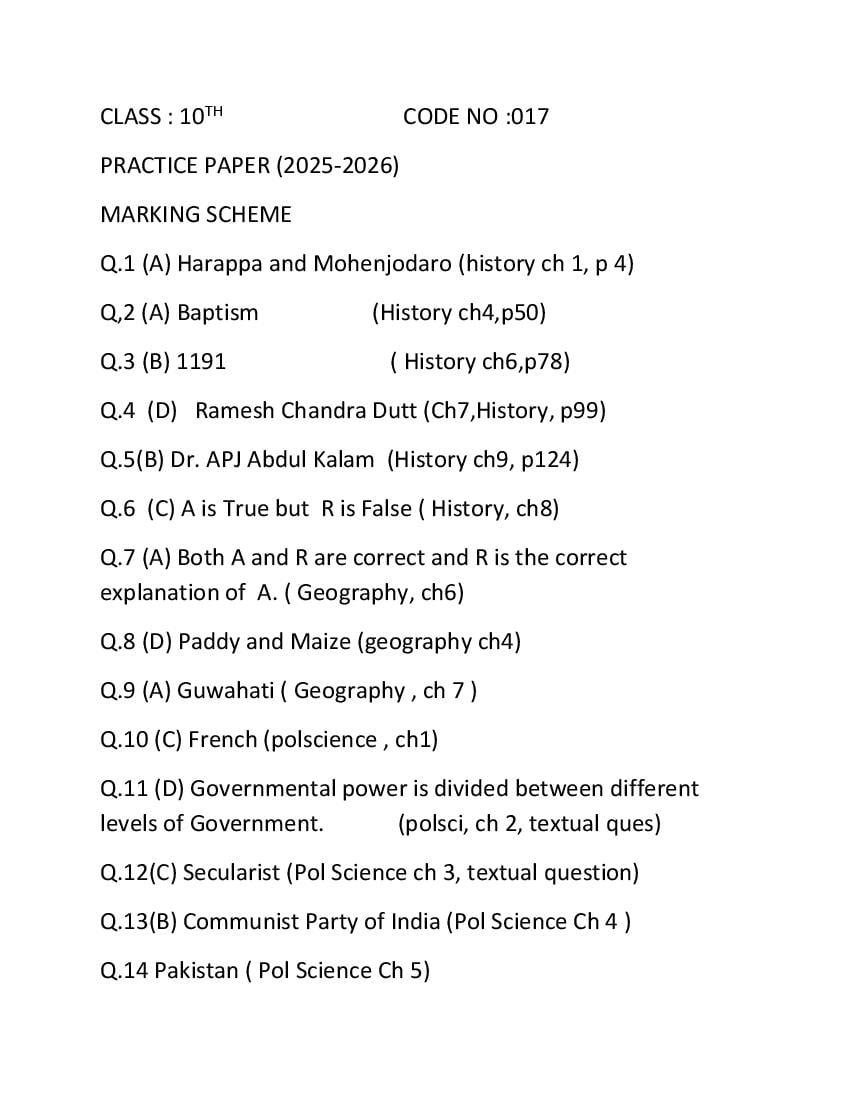
Page 1
PRACTICE PAPER (2025-2026)
MARKING SCHEME
Q.1 (A) Harappa and Mohenjodaro (history ch 1, p 4)
Q,2 (A) Baptism (History ch4,p50)
Q.3 (B) 1191 ( History ch6,p78)
Q.4 (D) Ramesh Chandra Dutt (Ch7,History, p99)
Q.5(B) Dr. APJ Abdul Kalam (History ch9, p124)
Q.6 (C) A is True but R is False ( History, ch8)
Q.7 (A) Both A and R are correct and R is the correct
explanation of A. ( Geography, ch6)
Q.8 (D) Paddy and Maize (geography ch4)
Q.9 (A) Guwahati ( Geography , ch 7 )
Q.10 (C) French (polscience , ch1)
Q.11 (D) Governmental power is divided between different
levels of Government. (polsci, ch 2, textual ques)
Q.12(C) Secularist (Pol Science ch 3, textual question)
Q.13(B) Communist Party of India (Pol Science Ch 4 )
Q.14 Pakistan ( Pol Science Ch 5)
Page 2
Q.16 Infant Mortality Rate ( Economics, Ch 1 )
Q.17 GDP ( Gross Domestic Product ) ( Economics, Ch2 )
Q.18 (C) Traders and Money Lenders ( Economics, Ch3)
Q.19 (D) All of these ( Economics , Ch4 )
Q.20 (D) 2005 ( Economics Ch 5 )
Q.21 The tall temple built in the shape of pyramids in the
citiesof Sumer are called Ziggurats. (History ch2, p18)
Q.22 Khyber pass, Gomal pass, Bolan pass( any two)
(ch6 history)
Q.23(i)The indian Wildlife (protection) Act was implemented in
1972 with various provisions for protecting Habitat.
(ii)The central government also announced several projects for
protecting specific habitats . (geography ch 2)
Q.24 Tea is a labour intensive Industry .It requires abundant,
cheap , and skilled labour.Tea is processed within the tea
garden to restore its freshness. (Geography ch4)
Q.25 Two elements of Belgian Model are:
Page 3
French- speaking ministries shall be equal in the central
government.
(ii)Many power of Central Government have been given to
State Government of the two regions of the country.
(ch1.political science)
Q.26 Since no single party got a clear majority in Lok Sabha, the
major National parties had to enter into an alliance with many
parties including regional parties to form a government at the
centre.This led to a new culture of power sharing.
(ch2, political science)
Q.27 Collateral is an asset that the borrowers owns and uses
this as a guarantee to the lender. If the borrower fails to repay
the loan , the lender has the right to sell the asset or collateral
to obtain payments. (economics , ch 3)
Q.28 These certification helps consumer get assured of quality
while purchasing the goods or services. These organization
allow producers to use their logos provided they follow certain
quality standards. (ch5,Economics)
Q.29.1 Church
Q29.2 After the fall of Roman empire , period of political
instability in Europe.
Page 4
Q.30.1 Primitive subsitence farming or Shifting cultivation(Slash
and burn agriculture
Q30.2 (C) BOTH A and B
Q30.3 No (geography, ch4)
Q.31.1 True
Q31.2 Bhartiya Janta Party(BJP), Indian National Congress.
Note: any one of the 6 national parties in India
Q31.3 (B) 6% ( posci,ch4)
Q.32.1 Farming (Agriculture)
Q32.2 (b) secondary sector
Q32.3 Secondary sector (economics,ch2)
Q.33 An Englishmannamed Rand was appointed as the Plague
commissioner during 1897AD plague in Poona. He created
discontent by entering people’s homes and Temples
unabated.Two brothers, Damodar Chapekar and and Balkrishn
Chapekar were caught and sentenced to death for killing Rand
.They were probably influenced by Tilak. ( History ch 8,p108)
Q.34 i) The cane production in southern states have higher
sucrose content.
Page 5
iii) The cooperatives are more successful in these states.
(Geography, ch6)
Q.35Democracy is not simply rule by majority opinion. Majority
needs to work with the minority so that government functions
to represent the general view.The rule by majority community
does not become rule by majority community in terms of
religion or race or linguistic group. Ability to handle social
differences, division and conflicts is thus a definite plus point
of demographic regimes. (polsci, ch5,textual)
Q.36 Removing barrier or restrictions set by the government is
known as liberalization .With liberalization of trade , businesses
are allowed to make decisions freely about import or export
commodities. The government imposes much less restrictions
than before. ( economics , ch 4)
Q.37 Jainism comes under the ancient philosophies of the
world. It is also called philosophy of ‘Shramana’. There have
been 24 Tirthankars in Jain philosophy. The first is Rishabhdev
and the last one is Mahavir Swami. The mention of first
Tirthankar is also found in the Vedas and it was through him
that Jain philosophy emerged. He is considered the founder and
propagator of Jain philosophy.
Five Mahavratas of Jain philosophy:
Page 6
Jainism, non violence by thoughts, deeds or words.
• Amrisha (truth): every person should speak the truth in
every situation.
• Asteya(non-stealing): one should not take or want
anything from other person without permission.
• Aprigraha(non attachment): not accumulation things
more than necessity.
• Brahamcharya(Celibacy): staying away from attachment
and keeping restraints on the senses. (history,ch3,p37)
OR
The society of Saraswati-Sindhu civilization must have
been divided into many classes. The town was divided
into fortification area and housing area .the rich people or
the ruling class resided in the town forts . The fortified
area of Dholavira was divided into two parts. Traders ,
soldiers, officers, craftsmen and labourers lived in the
residential area . Other important classes were farmers,
potters, carpenters, labourers, sailors, jewelers and
weavers.
The people of Saraswati-Sindhu civilization were both
vegetarian and non vegetarian . The rich used to wear
ornaments made of gold and silver ,ivory etc while poor
wore ornaments made of clay , bone and stone.
(history ch1, p5-6)
Page 7
traditionally constructed tanks for storing drinking water. They
are big and apart of the well – developed rooftop rainwater
harvesting system. The tanks are constructed inside the main
house or the court yard, and are connected to the sloping roofs
of the houses through a pipe. The rain falling on the roof top
travels down and is stored in the tanks. The first spell of rain is
not collected as this water cleans the roofs and the pipe. The
water from the subsequent spells is collected. It is a reliable
source of water. The tank also help in cooling the house.
(geography,ch3)
OR .
It is also known as Regur soil or Black cotton soil.
Black soil is ideal for growing cotton. Climatic conditions along
with parent rock material are important factors for the
formation of black soil. It is made up of Lava flows.They are
made up of fine clayey material. They are well known for their
capacity to hold moisture. They develop deep cracks during hot
weather and become sticky when wet.
Geographical distribution: Maharashtra , Madhya Pradesh,
Gujrat, Malwa , Godavari and Krishna Valley.
(geography,ch1)
Page 8
Legislative powers between the Union Government and the
State Governments which is as follow :
• Union list includes subjects of National importance, such
as Defence, foreign affairs, banking and currency. We need
a uniform policy on these matters throughout the country.
The Union Government alone can make laws relating to
the subjects mentioned in the Union list.
• State list contains subjects of State and local importance,
such as police, trade, agriculture and irrigation. The State
Governments alone can make law related to these
subjects.
• Concurrent list includes subjects of common interest to
both the Union Government as well as the State
Governments, such as education, forests and trade unions.
(pol sci, ch2)
OR
In India, the proportion of women in legislature has been
very low. The percentage of elected women members in
Lok Sabha has touched 14.36 percent of its total strength
for the first time in 2019. Their share in the state
assemblies is less than 5 percent.
In Panchayati Raj, one-third of seats in local Government
bodies-in Panchayats and Municipality-are now reserved
Page 9
women representatives in rural and urban local bodies.
(polsci,ch3)
Q.40 Map based Questions
Document Details
| Board / Org | Haryana Board |
| Exam | Class 10 |
| Type | Sample Paper |
| Pages | 9 |
| Updated | 24 Sep 2026 |