PSEB 12th Class Syllabus 2023 Business Studies
Finished viewing? Save it for later —
Download PSEB 12th Class Syllabus 2023 Business Studies (PDF · 5 pages)About PSEB 12th Class Syllabus 2023 Business Studies
PSEB 12th Class Syllabus 2023 Business Studies is available here for free download. Published by Punjab Board for Class 12, this syllabus can be viewed online or downloaded as a PDF (5 pages). Candidates preparing for Class 12 can use PSEB 12th Class Syllabus 2023 Business Studies to understand the exam pattern, the type of questions asked, and the overall difficulty level.
Frequently Asked Questions
How can I download PSEB 12th Class Syllabus 2023 Business Studies?
Open this page and click the Download button to save PSEB 12th Class Syllabus 2023 Business Studies as a PDF. It is completely free on AglaSem Docs.
Is PSEB 12th Class Syllabus 2023 Business Studies free to download?
Yes. PSEB 12th Class Syllabus 2023 Business Studies can be viewed online and downloaded as a PDF free of cost on AglaSem Docs.
How many pages does PSEB 12th Class Syllabus 2023 Business Studies have?
PSEB 12th Class Syllabus 2023 Business Studies contains 5 pages, which you can read online or download together as a single PDF.
Where can I find more Class 12 study material?
You can find more Class 12 question papers, sample papers, syllabus, and answer keys on AglaSem Docs.
PSEB 12th Class Syllabus 2023 Business Studies – Text
Read the full text of this syllabus below — useful to quickly search, copy and reference the content online without downloading the PDF.
📄 View text version (5 pages)
Page 1
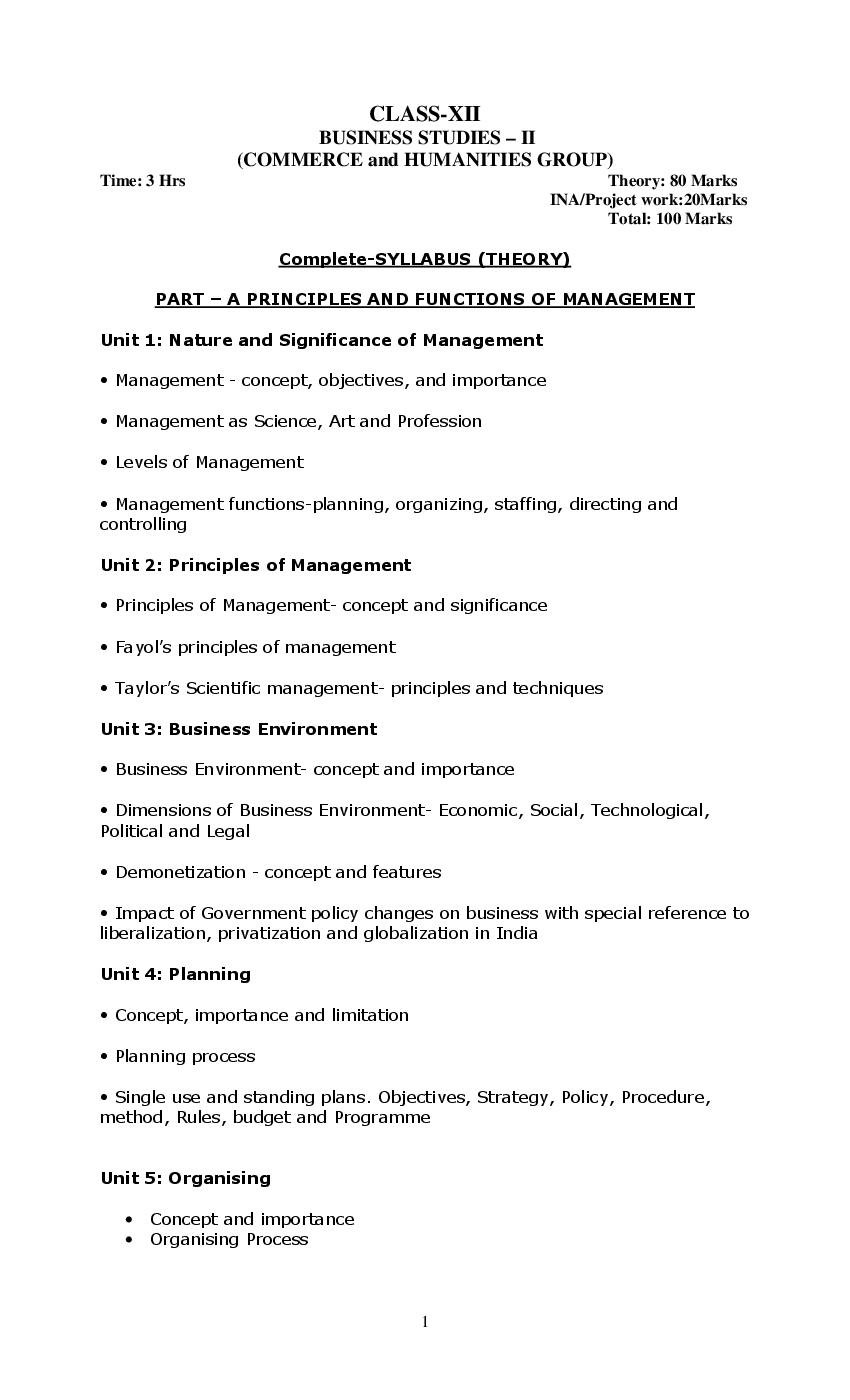
BUSINESS STUDIES – II
(COMMERCE and HUMANITIES GROUP)
Time: 3 Hrs Theory: 80 Marks
INA/Project work:20Marks
Total: 100 Marks
Complete-SYLLABUS (THEORY)
PART – A PRINCIPLES AND FUNCTIONS OF MANAGEMENT
Unit 1: Nature and Significance of Management
• Management - concept, objectives, and importance
• Management as Science, Art and Profession
• Levels of Management
• Management functions-planning, organizing, staffing, directing and
controlling
Unit 2: Principles of Management
• Principles of Management- concept and significance
• Fayol’s principles of management
• Taylor’s Scientific management- principles and techniques
Unit 3: Business Environment
• Business Environment- concept and importance
• Dimensions of Business Environment- Economic, Social, Technological,
Political and Legal
• Demonetization - concept and features
• Impact of Government policy changes on business with special reference to
liberalization, privatization and globalization in India
Unit 4: Planning
• Concept, importance and limitation
• Planning process
• Single use and standing plans. Objectives, Strategy, Policy, Procedure,
method, Rules, budget and Programme
Unit 5: Organising
• Concept and importance
• Organising Process
1
Page 2
and informal organisation- concept
• Delegation: concept, elements and importance
• Centralisation – concept and features
• Decentralization: concept, features and importance
Unit 6: Staffing
• Concept and importance of staffing
• Staffing as a part of Human Resource Management - concept
• Staffing process
• Recruitment process
• Selection - process
• Training and Development - Concept and importance, Methods of
training - on the job and off the job - vestibule training, apprenticeship
training and internship training
Unit 7: Directing
• Concept and importance
Elements of Directing
• Supervision- Concept and importance
• Motivation - concept, Maslow’s hierarchy of needs, Financial and non-
financial incentives
• Leadership - concept, styles - authoritative, democratic and laissez
faire
• Communication - concept, formal and informal communication;
barriers to effective communication, how to overcome the barriers.
Unit 8: Controlling
• Controlling - Concept and importance
• Relationship between planning and controlling
• Steps in process of control
Unit 9- Coordination
Coordination: Meaning, Nature and importance.
2
Page 3
Unit 10: Business Finance
•Financial decisions: investment, financing and dividend- Meaning and
factors affecting financial decisions.
•Financial Planning - concept and importance
•Capital Structure – concept and factors affecting capital structure
•Fixed and Working Capital - Concept and factors affecting their
requirements
Unit 11: Financial Markets
• Financial Markets: Concept, Functions and types
• Money market and its instruments
• Capital market and its types (primary and secondary), methods of
floatation in the primary market
• Stock Exchange - Functions and trading procedure
• Securities and Exchange Board of India (SEBI) - Objectives and functions
Unit 12: Marketing
• Marketing – Concept, functions and philosophies
• Marketing Mix – Concept and elements
• Product - branding, labelling and packaging – Concept
• Price - Concept, Factors determining price
• Physical Distribution – concept, components and channels of distribution
• Promotion – Concept and elements; Advertising, Personal Selling, Sales
Promotion and Public Relations
Unit 13: Consumer Protection
• Concept and importance of consumer protection
• Consumer Protection Act 1986: Meaning of consumer
• Rights and responsibilities of consumers
• Who can file a complaint?
• Redressal machinery
• Remedies available
• Consumer awareness - Role of consumer organizations and Non-
Governmental Organizations (NGOs)
3
Page 4
The project work marks will be allocated on the following heads.
1 Initiative, cooperativeness and participation 2 Marks
2 Creativity in presentation 2 Mark
3 Content, observation and research work 4 Marks
4 Analysis of situations 4 Marks
5 Viva 3 Marks
Total 15 Marks
Division of Marks for Internal Assesment
1 Book Bank 2 marks
2 Average of Periodic tests 3 marks
3 Total 5 marks
Students are supposed to select one unit out of four and are required to
make only ONE project from the selected unit (consist of one project of 20
marks)
PROJECT 1: Elements of business environment (students can select any
one of the topic)
(a) Changes witnessed over the last few years on mode of packaging,
labelling and its impact.
(b) Changing role of women in the past 25 years.
(c) Types of packaging and its impact.
(d) Sources of business finance based on a real life company.
(e) The changes in the pattern of import and export of different products.
(f) Climate change on business environment.
PROJECT 2: Principles of Management. (Henry Fayol and Taylor)
Students are required to observe the application of the general principles
of management given by Henry Fayol in a departmental store or an industrial
unit, fast food outlet or any small business unit.
OR
They may observe the application of scientific management techniques by
FW Taylor in a departmental store or an industrial unit, fast food outlet or any
small business unit.
Project 3: Stock Exchange.
(a) Brief history of Stock Exchange in India.
(b) Listing procedure of securities in stock exchange.
(c) Dematerialisation of securities in stock exchange.
(d) Causes of fluctuations of prices in stock exchange.
4
Page 5
Students can take the example of any consumer product like moisturizer,
noodles, wipes, air conditioners, baby diapers, fruit candy, hair oil, bike,
inverter, blanket, bread, ladies bag, kurti, footwear, coffee, chocolate, mobile,
microwave oven, newspaper, washing powder, etc and give information about:
(a) Why they have selected this product?
(b) Name of the product.
(c) Feature of product
(d) Benefits and demerits of the product
(e) Its 5 competitive brands in the market
(f) Its unique selling proposition.
(g) The product’s brand strategy
(h) Logo and tag line of the product.
(i) Developing a promotion plan for the product.
(j) Packing of the product.
(k) Explanation of its labelling.
(l) Social message for the label.
(m) What means of transport will be used and why?
Presentation and submission of project report.
At the end of the stipulated term, each student will prepare and submit
his/her project report.
Following essentials are required to be fulfilled for its preparation and
submission.
1. The whole project will be in a file format
2. The project will be handwritten.
3. The project will be presented in a neat folder.
4. The students will prepare project on ruled sheets or will use an interleaf
practical notebook.
5. The project report will be developed in the following sequence-
• Cover page should project the title, student information, school and year.
• List of contents.
• Acknowledgements and preface (acknowledging the institution, the
newspapers read, T.V. channels viewed, places visited and persons
who have helped).
• Introduction.
• Topic with suitable heading.
• Planning and activities done during the project, if any.
• Observations and findings while conducting the project.
• Conclusions (summarised suggestions or findings, future scope of study).
• Appendix (if needed).
5
Document Details
| Board / Org | Punjab Board |
| Exam | Class 12 |
| Type | Syllabus |
| Pages | 5 |
| Updated | 22 Jul 2026 |