CBSE Class 10 Question Paper 2022 Social Science (Solved)
Finished viewing? Save it for later —
Download CBSE Class 10 Question Paper 2022 Social Science (Solved) (PDF · 11 pages)About CBSE Class 10 Question Paper 2022 Social Science (Solved)
CBSE Class 10 Question Paper 2022 Social Science (Solved) is available here for free download. Published by CBSE for Class 10, this question paper can be viewed online or downloaded as a PDF (11 pages). Candidates preparing for Class 10 can use CBSE Class 10 Question Paper 2022 Social Science (Solved) to understand the exam pattern, the type of questions asked, and the overall difficulty level.
Frequently Asked Questions
How can I download CBSE Class 10 Question Paper 2022 Social Science (Solved)?
Open this page and click the Download button to save CBSE Class 10 Question Paper 2022 Social Science (Solved) as a PDF. It is completely free on AglaSem Docs.
Is CBSE Class 10 Question Paper 2022 Social Science (Solved) free to download?
Yes. CBSE Class 10 Question Paper 2022 Social Science (Solved) can be viewed online and downloaded as a PDF free of cost on AglaSem Docs.
How many pages does CBSE Class 10 Question Paper 2022 Social Science (Solved) have?
CBSE Class 10 Question Paper 2022 Social Science (Solved) contains 11 pages, which you can read online or download together as a single PDF.
Where can I find more Class 10 study material?
You can find more Class 10 question papers, sample papers, syllabus, and answer keys on AglaSem Docs.
CBSE Class 10 Question Paper 2022 Social Science (Solved) – Text
Read the full text of this question paper below — useful to quickly search, copy and reference the content online without downloading the PDF.
📄 View text version (11 pages)
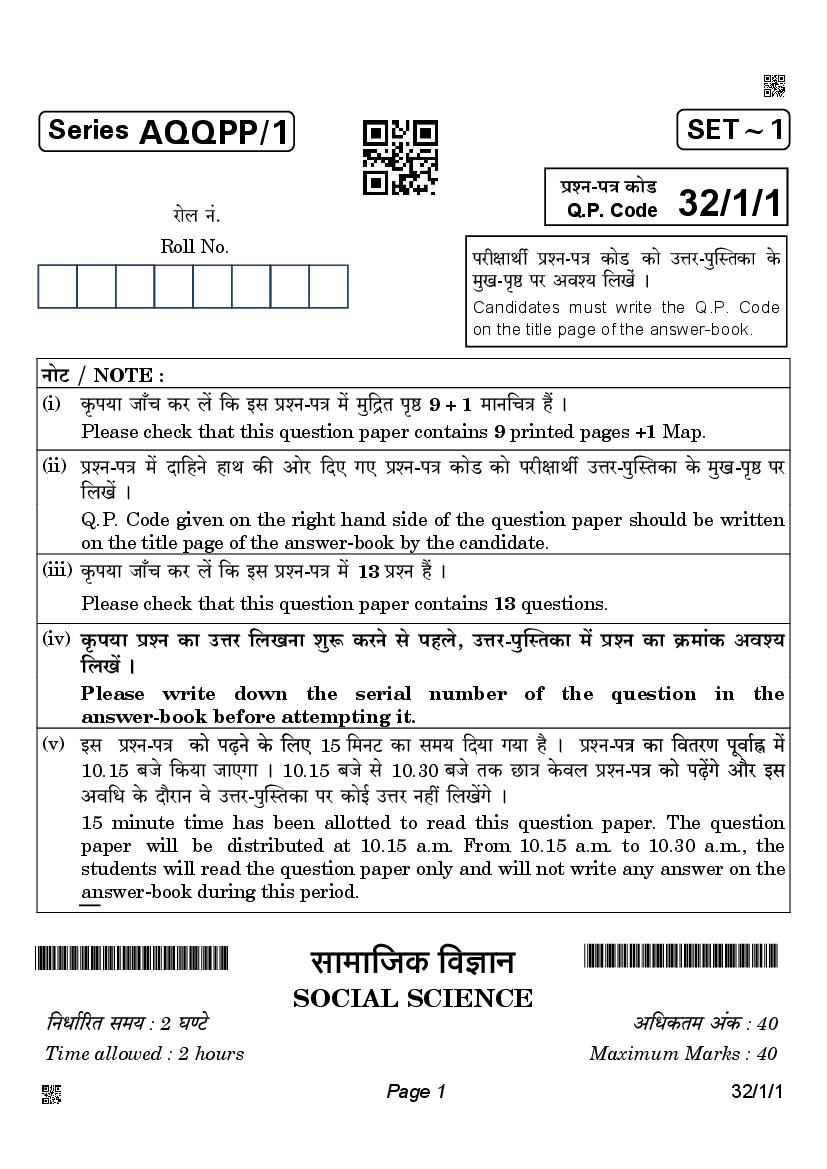
Page 1
àíZ-nÌ H$moS>
amob Z§. Q.P. Code 32/1/1
Roll No.
narjmWu àíZ-nÌ H$moS> >H$mo CÎma-nwpñVH$m Ho$
_wI-n¥ð >na Adí` {bIo§ &
Candidates must write the Q.P. Code
on the title page of the answer-book.
ZmoQ> / NOTE :
(i) H¥$n`m Om±M H$a b| {H$ Bg àíZ-nÌ _o§ _w{ÐV n¥ð> 9 + 1 _mZ{MÌ h¢ &
Please check that this question paper contains 9 printed pages +1 Map.
(ii) àíZ-nÌ _| Xm{hZo hmW H$s Amoa {XE JE àíZ-nÌ H$moS> H$mo narjmWu CÎma-nwpñVH$m Ho$ _wI-n¥ð> na
{bI| &
Q.P. Code given on the right hand side of the question paper should be written
on the title page of the answer-book by the candidate.
(iii) H¥$n`m Om±M H$a b| {H$ Bg àíZ-nÌ _| >13 àíZ h¢ &
Please check that this question paper contains 13 questions.
(iv) H¥$n`m àíZ H$m CÎma {bIZm ewê$ H$aZo go nhbo, CÎma-nwpñVH$m _| àíZ H$m H«$_m§H$ Adí`
{bI| &
Please write down the serial number of the question in the
answer-book before attempting it.
(v) Bg àíZ-nÌ 15 {_ZQ >H$m g_` {X`m J`m h¡ & àíZ-
10.15 ~Oo {H$`m OmEJm & 10.15 ~Oo go 10.30 ~Oo VH$ N>mÌ Ho$db àíZ-
Ad{Y Ho$ Xm¡amZ do CÎma-nwpñVH$m na H$moB© CÎma Zht {bI|Jo &
15 minute time has been allotted to read this question paper. The question
paper will be distributed at 10.15 a.m. From 10.15 a.m. to 10.30 a.m., the
students will read the question paper only and will not write any answer on the
answer-book during this period.
gm_m{OH$ {dkmZ
SOCIAL SCIENCE
:2 : 40
Time allowed : 2 hours Maximum Marks : 40
Page 1 32/1/1
Page 2
:
(i)
13
(ii) 1 5 2
40
(iii) 6 8 3
80
(iv) 9 10 5
120
(v) 11 12 4
(vi) 13 3
13 1 13 2
(vii)
(viii)
IÊS> H$
(A{V bKw-CÎmar` àíZ) (5 2=10)
1. ?
ñnîQ> H$s{OE & 2
2. Xoe _| n[adhZ Ho$ gmYZ Ho$ ê$n _| nmBnbmBZ Ho$ _hÎd H$s naI H$s{OE & 2
3. ? ñnîQ> H$s{OE & 2
4. _m±J O_m {H$g àH$ma _wÐm H$m _hÎdnyU© bjU h¡ ? 2
Page 2 32/1/1
Page 3
Read the following instructions very carefully and strictly follow them :
(i) This question paper comprises five sections Sections A, B, C, D and E.
There are 13 questions in the question paper. All questions are compulsory.
(ii) Section A Questions no. 1 to 5 are very short answer type questions, carrying
2 marks each. Answer to each question should not exceed 40 words.
(iii) Section B Questions no. 6 to 8 are short answer type questions, carrying
3 marks each. Answer to each question should not exceed 80 words.
(iv) Section C Questions no. 9 and 10 are long answer type questions, carrying
5 marks each. Answer to each question should not exceed 120 words.
(v) Section D Questions no. 11 and 12 are case-based questions, carrying
4 marks each.
(vi) Section E Question no. 13 is map-based, carrying 3 marks with two parts,
13(a) from History (1 mark) and 13(b) from Geography (2 marks).
(vii) There is no overall choice in the question paper. However, an internal choice
has been provided in few questions. Only one of the choices in such questions
have to be attempted.
(viii) Attach map along with your answer-book.
SECTION A
(Very Short Answer Type Questions) (5 2=10)
1. Why did Indian merchants and industrialists support the Civil
Disobedience Movement ? Explain. 2
2. Examine the significance of pipeline as a means of transportation in the
country. 2
3. Why has India adopted a multi-party system ? Explain. 2
4. How is an essential feature of money ? 2
Page 3 32/1/1
Page 4
~wZmB© a§JmB© d
aoem CËnmXZ YwZmB© H$VmB© dñÌ {d{Z_m©U
n[aîH$aU
aoem gyV dñÌ (Jm_]Q>)
(5.1) dñÌ {d{Z_m©U Ho$ {bE Amdí`H$ AmYma^yV gm_J«r H$m¡Z-gr h¡ ? 1
(5.2) dñÌ CÚmoJ _| _yë` g§dY©Z H$m EH$ CXmhaU Xr{OE & 1
IÊS> I
(bKw-CÎmar` àíZ) (3 3=9)
6. (H$) G U Ho$ Am¡nMm[aH$ Am¡a AZm¡nMm[aH$ òmoVm| _| A§Va ñnîQ> H$s{OE & 3
AWdm
(I) ~¢H$, {dÎmr` àUmbr Ho$ EH$ _yb KQ>H$ Ho$ ê$n _| {H$g àH$ma H$m`© H$aVm h¡ ? ñnîQ>
H$s{OE & 3
7. AnZr amîQ´>r` nhMmZ H$mo Ty>± AVrV _| Jm¡ad H$m ^md n¡Xm H$aZo Ho$ {bE
bmoH$ na§namAm| H$mo ~Mm H$a aIZm µOê$ar Wm & ^maV Ho$ g§X^© _| Bg H$WZ H$s nw{îQ>
H$s{OE & 3
8. ^maV _| amOZr{VH$ Xbm| Ho$ n§OrH$aU Am¡a _mÝ`Vm _| MwZmd Am`moJ H$s ^y{_H$m H$mo ñnîQ>>
H$s{OE & 3
IÊS> J
(XrK©-CÎmar` àíZ) (2 5=10)
9. (H$) bmoH$V§Ì emgZ, AÝ` ì`dñWmAm| ({dH$ënm|) go ~ohVa h¡ & Bg H$WZ H$m
{díbofU H$s{OE & 5
AWdm
(I) gmar Xþ{Z`m _| bmoH$V§Ì Ho$ {dMma Ho$ {bE ^mar g_W©Z Ho$ H$maUm| H$m {díbofU
H$s{OE & 5
10. (H$) CZ H$maH$m| H$s naI H$s{OE Omo ^maV _| d¡ídrH$aU H$mo àmoËgm{hV H$aZo _| `moJXmZ
XoVo h¢ & 5
AWdm
(I) _yë`m§H$Z H$s{OE {H$ {H$g àH$ma d¡ídrH$aU Zo ì`mnH$ g_mO Ho$ OrdZ H$mo à^m{dV
{H$`m h¡ & 5
Page 4 32/1/1
Page 5
Dyeing and
Finishing
Garments
(5.1) Which is the basic material required for garment manufacturing ? 1
(5.2) Give one example of value addition in the textile industry. 1
SECTION B
(Short-Answer Type Questions) (3 3=9)
6. (a) Differentiate between formal and informal sources of Credit. 3
OR
(b) How does a bank work as a key component of the financial
system ? Explain. 3
7. to
national identit
statement in reference to India. 3
8. Explain the role of Election Commission in the registration and
recognition of political parties in India. 3
SECTION C
(Long-Answer Type Questions) (2 5=10)
9. (a)
5
OR
(b) Analyse the reasons for the overwhelming support for the idea of
democracy all over the world. 5
10. (a) Examine the factors which facilitate globalization in India. 5
OR
(b) Assess, how globalization has touched the lives of larger society. 5
Page 5 32/1/1
Page 6
(Ho$g-AmYm[aV àíZ) (2 4=8)
11. ZrMo {XE JE Ho$g H$mo Ü`mZnyd©H$ : 4
ñdV§ÌVm {Xdg H$s enW, 26 OZdar, 1930
h_mam {dídmg h¡ {H$ {H$gr ^r g_mO H$s Vah ^maVr` OZVm H$m ^r `h EH$ AhaUr`
(inalienable) A{YH$ma h¡ {H$ CÝh| AmµOmXr {_bo, AnZr _ohZV H$m \$b {_bo Am¡a OrdZ
^r {dídmg h¡ {H$ `{X H$moB© ^r gaH$ma AnZr OZVm H$mo BZ A{YH$mam| go d§{MV aIVr h¡
Am¡a X~mVr h¡ Vmo OZVm H$mo ^r gaH$ma H$mo ~XbZo `m Cgo g_yb g_má H$aZo H$m A{YH$ma
h¡ & ^maV _| {~«{Q>e ({~«VmZr) gaH$ma Zo Z Ho$db ^maVr` OZVm H$mo ñdV§ÌVm go d§{MV
{H$`m h¡ ~pëH$ CgZo OZVm H$m emofU {H$`m h¡ Am¡a Xoe H$mo Am{W©H$, amOZr{VH$,
gm§ñH¥${VH$ Ed§ AmÜ`mpË_H$ ñVa na Zï> H$a {X`m h¡ & Bg{bE h_mam {dídmg h¡ {H$ ^maV
H$mo A{Zdm`© ê$n go {~«Q>oZ Ho$ gmW AnZo g^r g§~§Ym| H$mo g_má H$aHo$ nyU© ñdamO àmá
H$aZm Mm{hE &
(11.1) ? 1
(11.2) ^maV Ho$ bmoJm| Ûmam nyU© ñdamO H$mo Amdí`H$ ? 1
(11.3) H$m±Jog« Ho$ bmhm¡a A{YdoeZ (1930) Ho$ _hÎd H$s ì`m»`m H$s{OE & 2
12. ZrMo {XE JE Ho$g H$mo Ü`mZnyd©H$ : 4
amï´>r` AW©ì`dñWm H$s OrdZ aoImE±
~hþV g_` VH$ ì`mnma VWm n[adhZ gw{dYm EH$ gr{_V joÌ VH$ hr {H$`m OmVm
Wm & {dkmZ VWm àm¡Úmo{JH$s Ho$ {dH$mg Ho$ gmW ì`mnma d n[adhZ Ho$ à^md joÌ _| {dñV¥V
©V hmo
J`m h¡ & n[adhZ H$m `h {dH$mg g§Mma gmYZm| Ho$ {dH$mg H$s ghm`Vm go hr g§^d hmo gH$m
h¡ & Bgr{bE n[adhZ, g§Mma d ì`mnma EH$-Xÿgao Ho$ nyaH$ h¢ &
AmO ^maV AnZo {demb AmH$ma, {d{dYVmAm|, ^mfmB© VWm gm_m{OH$ d gm§ñH¥${VH$
~hþbVmAm| Ho$ ~mdOyX g§gma Ho$ g^r joÌm| go gwMmé Ed§
Ob n[adhZ, g_mMma-nÌ, ao{S>`mo, XÿaXe©Z, {gZo_m VWm B§Q>aZoQ>, Am{X BgHo$
gm_m{OH$-Am{W©H$ {dH$mg _| AZoH$ àH$ma go ghm`H$ h¢ & ñWm{ZH$ go A§Vam©ï´>r` ñVar`
ì`mnma Zo AW©ì`dñWm H$mo OrdZ e{º$ Xr h¡ & BgZo h_mao OrdZ H$mo g_¥Õ {H$`m h¡ VWm
Amam_Xm`H$ OrdZ Ho$ {bE gw{dYmAm| d gmY
(12.1) n[adhZ Ho$ {dH$mg _| {dkmZ {H$g àH$ma EH$ _hÎdnyU© H$maH$ h¡ ? 1
Page 6 32/1/1
Page 7
(Case-based questions) (2 4=8)
11. Read the case given below carefully and answer the questions that follow : 4
The Independence Day Pledge, 26 January, 1930
other people, to have freedom and to enjoy the fruits of their toil and have
the necessities of life, so that they may have full opportunities of growth.
We believe also that if any government deprives a people of these rights
and oppresses them, the people have a further right to alter it or to
abolish it. The British Government in India has not only deprived the
Indian people of their freedom but has based itself on the exploitation of
the masses, and has ruined India economically, politically, culturally, and
spiritually. We believe, therefore, that India must sever the British
(11.1) Why was freedom considered an inalienable right of the Indian
people ? 1
(11.2) Why was Purna Swaraj considered essential by the people of
India ? 1
(11.3) Explain the significance of the Lahore Session of Congress (1930). 2
12. Read the case given below carefully and answer the questions that follow : 4
Lifelines of National Economy
For a long time, trade and transport were restricted to a limited space.
With the development in science and technology, the area of influence of
trade and transport expanded far and wide. Today, the world has been
converted into a large village with the help of efficient and fast moving
transport. Transport has been able to achieve this with the help of
equally developed communication system. Therefore, transport,
communication and trade are complementary to each other.
Today, India is well-linked with the rest of the world despite its vast size,
diversity and linguistic and socio-cultural plurality. Railways, airways,
waterways, newspapers, radio, television, cinema and internet, etc. have
been contributing to its socio-economic progress in many ways. The
trades from local to international levels have added to the vitality of its
economy. It has enriched our life and added substantially to growing
amenities and facilities for the comforts of life.
(12.1) How is science an important factor in the development of
transport ? 1
Page 7 32/1/1
Page 8
ñnîQ> H$s{OE & 1
(12.3) {H$gr amîQ´> Ho$ {bE g§Mma Ho$ _hÎd H$m {díbofU H$s{OE & 2
IÊS> L>
(_mZ{MÌ-AmYm[aV àíZ) (1+2=3)
13. (i) {XE JE ^maV Ho$ amOZr{VH$ aoIm-_mZ{MÌ (n¥ð> 11 na), _| {ZåZ{b{IV OmZH$mar
H$s ghm`Vm go A
ItMr JB© aoIm na CgH$m ghr Zm_ {b{IE &
A. dh ñWmZ Ohm± qhgm Ho$ H$maU Agh`moJ Am§XmobZ H$mo dm{ng {b`m J`m & 1
(ii) {XE JE ^maV Ho$ Bgr aoIm-_mZ{MÌ na {ZåZ{b{IV H$mo A§{H$V H$s{OE Am¡a CZHo$
Zm_ {b{IE &
(H$) (I) Zamoam na_mUw D$Om© g§`§Ì 1
AWdm
(II) ~|Jbwé 1
(I) B§{Xam Jm±Yr AÝVam©îQ´>r` hdmB© nÎmZ 1
: 13
3 1=3
(13.1) Cg amÁ` H$m Zm_ {b{IE Ohm± 1927 _| ^maVr` amîQ´>r` H$m±J«og H$m A{YdoeZ
hþAm & 1
(13.2) (H$) Cg amÁ` H$m Zm_ {b{IE Ohm± Zamoam na_mUw D$Om© g§`§Ì pñWV h¡ & 1
AWdm
(I) Cg amÁ` H$m Zm_ {b{IE Ohm± ~|Jbwé 1
(13.3) Cg eha H$m Zm_ {b{IE Ohm± B§{Xam Jm±Yr A§Vam©îQ´>r` hdmB© nÎmZ pñWV h¡ & 1
Page 8 32/1/1
Page 9
(12.3) Analyse the significance of communication for a nation. 2
SECTION E
(Map-Based Question) (1+2=3)
13. (i) On the given political outline map of India (on page 11), identify
the place marked as A with the help of the following information
and write its correct name on the line marked near it.
A. The place where Non-Cooperation Movement was called off
due to violence. 1
(ii) On the same given map of India, locate and label the following :
(a) (I) Narora Nuclear Power Plant 1
OR
(II) Bengaluru Software Technology Park 1
(b) Indira Gandhi International Airport 1
Note : The following questions are for the Visually Impaired Candidates
only, in lieu of Q. No. 13. 3 1=3
(13.1) Name the State where the session of Indian National Congress
was held in 1927. 1
(13.2) (a) Name the State where Narora Nuclear Power Plant is
located. 1
OR
(b) Name the State where Bengaluru Software Technology Park
is located. 1
(13.3) Name the city where Indira Gandhi International Airport is
located. 1
Page 9 32/1/1
Page 10
Page 11
^maV H$m aoIm-_mZ{MÌ (amOZr{VH$)
Outline Map of India (Political)
A
Page 11 32/1/1
Document Details
| Board / Org | CBSE |
| Exam | Class 10 |
| Type | Question Paper |
| Pages | 11 |
| Updated | 30 Apr 2026 |