JKBOSE 8th Class Model Paper 2023 Social Science
Finished viewing? Save it for later —
Download JKBOSE 8th Class Model Paper 2023 Social Science (PDF · 5 pages)About JKBOSE 8th Class Model Paper 2023 Social Science
JKBOSE 8th Class Model Paper 2023 Social Science is available here for free download. Published by JKBOSE for Class 8, this sample paper can be viewed online or downloaded as a PDF (5 pages). Candidates preparing for Class 8 can use JKBOSE 8th Class Model Paper 2023 Social Science to understand the exam pattern, the type of questions asked, and the overall difficulty level.
Frequently Asked Questions
How can I download JKBOSE 8th Class Model Paper 2023 Social Science?
Open this page and click the Download button to save JKBOSE 8th Class Model Paper 2023 Social Science as a PDF. It is completely free on AglaSem Docs.
Is JKBOSE 8th Class Model Paper 2023 Social Science free to download?
Yes. JKBOSE 8th Class Model Paper 2023 Social Science can be viewed online and downloaded as a PDF free of cost on AglaSem Docs.
How many pages does JKBOSE 8th Class Model Paper 2023 Social Science have?
JKBOSE 8th Class Model Paper 2023 Social Science contains 5 pages, which you can read online or download together as a single PDF.
Where can I find more Class 8 study material?
You can find more Class 8 question papers, sample papers, syllabus, and answer keys on AglaSem Docs.
JKBOSE 8th Class Model Paper 2023 Social Science – Text
Read the full text of this sample paper below — useful to quickly search, copy and reference the content online without downloading the PDF.
📄 View text version (5 pages)
Page 1
Subject: Social Science Class: 8th
Max. Marks: 40 Time: 2 ½ Hours
Term: II
General Instructions
i. The question paper is divided into four sections – A, B, C and D. There
are 24 questions in the question paper.
ii. Questions from serial number 1 to 10 in Section A contain multiple
choice questions. Each of these carry one mark.
iii. Questions 11 to 16 in Section B carry 2 marks each. Attempt any 4
questions from this section. Answer to these questions should be up to
20 words each.
iv. Questions 17 to 22 in Section C carry 3 marks each. Attempt any 4
questions from this section. Answer to these questions should be 40 to
50 words each.
v. Question number 23 and 24 in Section D carrying 5 marks each.
Answer to these questions should be 80 to 100 words each. An internal
choice has been provided in these questions. Attempt any one choice.
SECTION – A
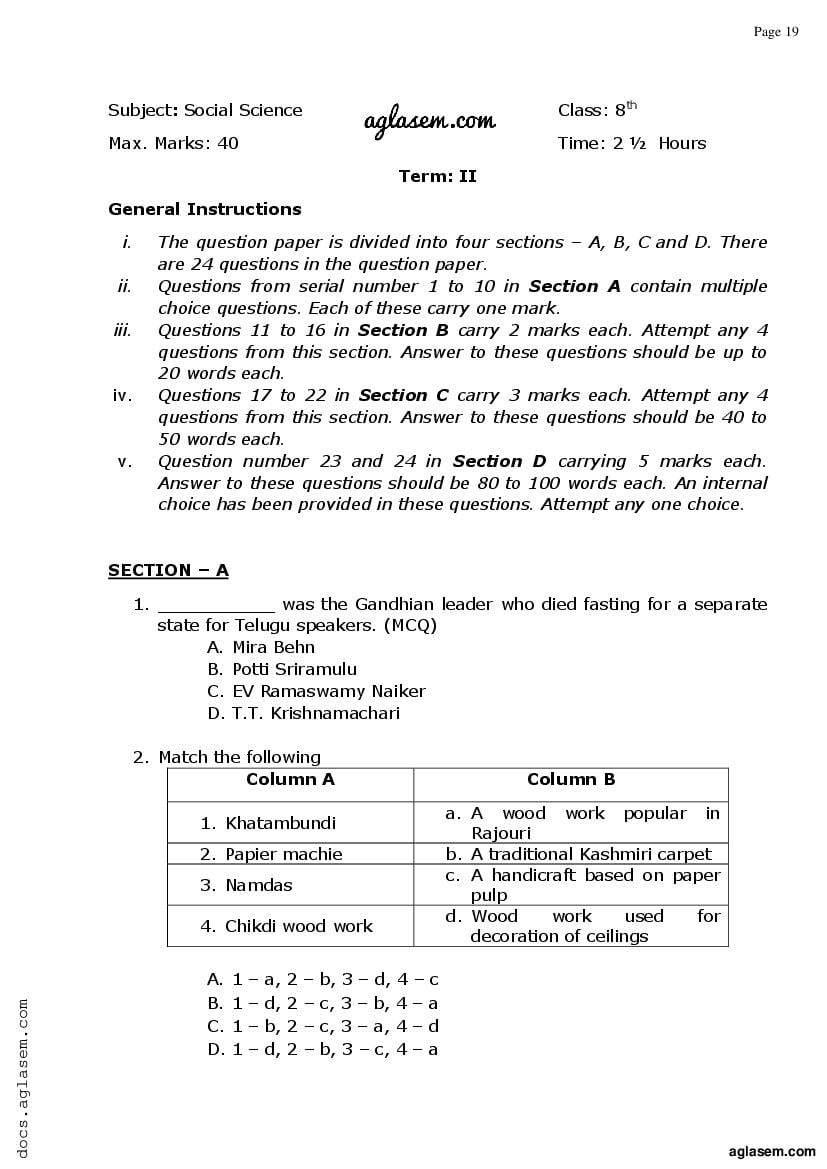
1. ___________ was the Gandhian leader who died fasting for a separate
state for Telugu speakers. (MCQ)
A. Mira Behn
B. Potti Sriramulu
C. EV Ramaswamy Naiker
D. T.T. Krishnamachari
2. Match the following
Column A Column B
a. A wood work popular in
1. Khatambundi
Rajouri
2. Papier machie b. A traditional Kashmiri carpet
c. A handicraft based on paper
3. Namdas
pulp
d. Wood work used for
4. Chikdi wood work
decoration of ceilings
A. 1 – a, 2 – b, 3 – d, 4 – c
B. 1 – d, 2 – c, 3 – b, 4 – a
C. 1 – b, 2 – c, 3 – a, 4 – d
D. 1 – d, 2 – b, 3 – c, 4 – a
Page 2
3. Begum Rukieya Sakhawat Hussain started schools for ________ in
Patna and Calcutta. (MCQ)
A. Muslim girls
B. Girls
C. Women
D. So called low castes
4. On October 1, 1953, the first linguistic state of ______________ came
into being.
A. Maharashtra
B. Arunachal Pradesh
C. Andhra Pradesh
D. Telengana
5. High death rate and low birth rate ______________ population
growth.
A. leads to rapid
B. leads to slow
C. Has no effect on
D. Rarely affects
6. Golden fibre refers to
A. Tea
B. Cotton
C. Jute
D. Silk
7. Horticulture means
A. Growing of fruits and vegetables
B. Primitive farming
C. Growing of wheat
D. Fish rearing
8. According to the Child Labour (Prohibition and regulation) Act, 1986
amended in 2016 the employment of Children below the age of 14
years is banned
A. In all occupations
B. In Hazardous occupations and processes
C. In mining processes
D. In day to day tasks of home.
9. ____________ refers to treating a person, group, or a concept as
insignificant.
A. Sensitization
B. Marginalization
C. Deprivation
D. Bullying
10. Which of the following arguments does not favour inclusion of socially
excluded people
Page 3
A. Inclusive education be made compulsory at all levels of
schooling.
B. There should be separate schools for specially abled children.
C. Special emphasis be laid on promoting self-employment among
differently abled persons.
D. Sports for specially abled should be encouraged
SECTION - B
11. Arrange the following events in chronological order.
A. Division of Punjab into Punjab and Haryana.
B. Death of Sri Potti Sriramulu.
C. Division of Bombay into separate states for Marathi and
Gujarati speakers.
D. Creation of Andhra Pradesh as a state.
12. People were reluctant to send girls to schools that were opened in 19 th
century. In the same way people today are reluctant to give mobile
phone to students for online learning. Identify one reason for the same.
13. In your opinion what did B R Ambedkar want to achieve through the
temple entry movement?
14. The Constitution of India recognises the right to water as being a part of
the Right to Life under Article 21. What does this mean to you as a
citizen?
15. List the factors influencing cropping pattern in an area.
16. Why is iron and steel industry often referred to as the backbone of
modem industry?
SECTION - C
17. In 19th century many reformers in India described certain practices like
the custom of Sati, child marriage, widowhood as evils. Ascertain any
one such evil that is still practiced. Suggest how it can be eradicated.
18. Jyotirao Phule criticised caste inequality in society. Do you agree with
him? Justify you response.
19. The first Prime Minister of India, Jawaharlal Nehru, said that India could
not and must not become a “Hindu Pakistan”. What did he mean by this
statement? In what context he said it?
20. Why were Christian missionaries attacked by many people in the
country? Would some people have supported them too? If so, for what
reasons?
21. Formulate a plane for a successful programme on drug de-addiction in
your locality.
Page 4
22. India is about to overtake China in population in 2023. Besides growing
more crops, improving irrigation, using fertilisers, sowing High Yielding
Variety seeds suggest some new methods of farming to meet the
growing needs of food.
SECTION – D
23. The abrupt suspension of Non-Cooperation Movement in 1922 was
resented by almost all prominent Congress leaders. Why did Gandhi do
so? What were the reasons behind this decision?
OR
Why did our Prime Minister and Deputy Prime Minister allow the
creation of linguistic states? What made them to accept it?
24. List the various public facilities in your area in the given format?
Government
Serial Public initiative/Suggestion
Adequate/inadequate
number facility for improvement if
inadequate
1
2
3
4
OR
Locate the following places on a blank map of the world given below
and tell why each of these is densely populated?
a) Ganga Plains
b) Plains of Chang Jiang
c) Jerusalem
d) Vatican City
e) Mumbai
LIST OF LEARNING OUTCOMES
1. The learner interprets the world map for uneven distribution of
population and explains the causes of population change.
2. The learner draws interrelationship between types of farming,
conservation practices and development.
3. The learner classifies different types of industries and describes their
interdependence.
Page 5
4. The learner analyses the factors due to which some countries are
known for production of major crops, like wheat, rice, jute, cotton etc.
5. The learner analyses the significant developments in the process of
nation building.
6. The learner outlines the course of Indian National movement from
1870s to Independence.
7. The learner analyses the issues related to caste, women, widow-
remarriage, child marriage, social reforms and laws and policies of
colonial administration towards these issues.
8. The learner outline major developments that occurred during the
modern period in the field of arts.
9. The learner describes the process of making (e.g. Domestic Violence
Act, RTI Act, RTE etc.) a law.
10. The learner identifies the role of Government in providing public
facilities such as water, sanitation, road, electricity etc. and recognises
their availability.
11. The learner analyses the causes and consequences of marginalisation
faced by disadvantaged sections of one own region.