Finished viewing? Save it for later —
Download CBSE Class 9 Syllabus 2022-23 Kokborok (PDF · 5 pages)About CBSE Class 9 Syllabus 2022-23 Kokborok
CBSE Class 9 Syllabus 2022-23 Kokborok is available here for free download. Published by CBSE for Class 9, this syllabus can be viewed online or downloaded as a PDF (5 pages). Candidates preparing for Class 9 can use CBSE Class 9 Syllabus 2022-23 Kokborok to understand the exam pattern, the type of questions asked, and the overall difficulty level.
Frequently Asked Questions
How can I download CBSE Class 9 Syllabus 2022-23 Kokborok?
Open this page and click the Download button to save CBSE Class 9 Syllabus 2022-23 Kokborok as a PDF. It is completely free on AglaSem Docs.
Is CBSE Class 9 Syllabus 2022-23 Kokborok free to download?
Yes. CBSE Class 9 Syllabus 2022-23 Kokborok can be viewed online and downloaded as a PDF free of cost on AglaSem Docs.
How many pages does CBSE Class 9 Syllabus 2022-23 Kokborok have?
CBSE Class 9 Syllabus 2022-23 Kokborok contains 5 pages, which you can read online or download together as a single PDF.
Where can I find more Class 9 study material?
You can find more Class 9 question papers, sample papers, syllabus, and answer keys on AglaSem Docs.
CBSE Class 9 Syllabus 2022-23 Kokborok – Text
Read the full text of this syllabus below — useful to quickly search, copy and reference the content online without downloading the PDF.
📄 View text version (5 pages)
Page 1
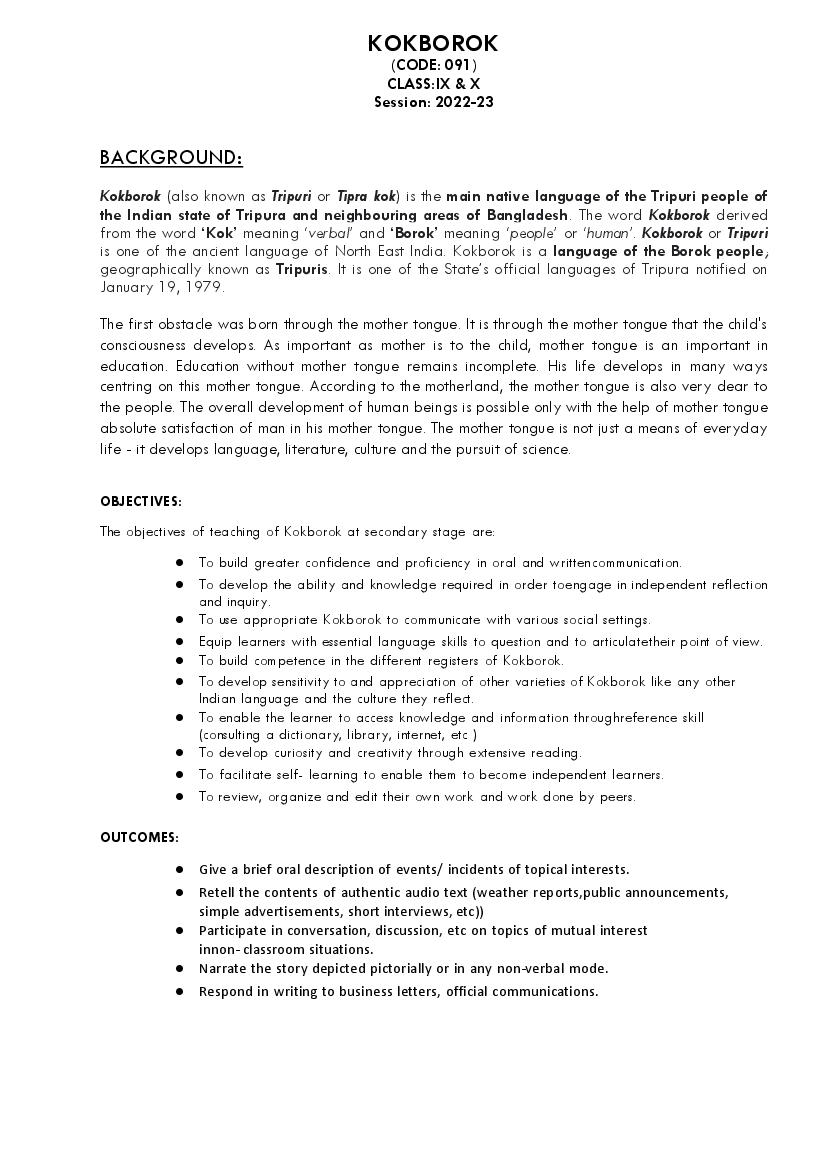
(CODE: 091)
CLASS:IX & X
Session: 2022-23
BACKGROUND:
Kokborok (also known as Tripuri or Tipra kok) is the main native language of the Tripuri people of
the Indian state of Tripura and neighbouring areas of Bangladesh. The word Kokborok derived
from the word ‘Kok’ meaning ‘verbal’ and ‘Borok’ meaning ‘people’ or ‘human’. Kokborok or Tripuri
is one of the ancient language of North East India. Kokborok is a language of the Borok people;
geographically known as Tripuris. It is one of the State’s official languages of Tripura notified on
January 19, 1979.
The first obstacle was born through the mother tongue. It is through the mother tongue that the child's
consciousness develops. As important as mother is to the child, mother tongue is an important in
education. Education without mother tongue remains incomplete. His life develops in many ways
centring on this mother tongue. According to the motherland, the mother tongue is also very dear to
the people. The overall development of human beings is possible only with the help of mother tongue
absolute satisfaction of man in his mother tongue. The mother tongue is not just a means of everyday
life - it develops language, literature, culture and the pursuit of science.
OBJECTIVES:
The objectives of teaching of Kokborok at secondary stage are:
● To build greater confidence and proficiency in oral and written communication.
● To develop the ability and knowledge required in order toengage in independent reflection
and inquiry.
● To use appropriate Kokborok to communicate with various social settings.
● Equip learners with essential language skills to question and to articulatetheir point of view.
● To build competence in the different registers of Kokborok.
● To develop sensitivity to and appreciation of other varieties of Kokborok like any other
Indian language and the culture they reflect.
● To enable the learner to access knowledge and information throughreference skill
(consulting a dictionary, library, internet, etc )
● To develop curiosity and creativity through extensive reading.
● To facilitate self- learning to enable them to become independent learners.
● To review, organize and edit their own work and work done by peers.
OUTCOMES:
● Give a brief oral description of events/ incidents of topical interests.
● Retell the contents of authentic audio text (weather reports,public announcements,
simple advertisements, short interviews, etc))
● Participate in conversation, discussion, etc on topics of mutual interest
innon- classroom situations.
● Narrate the story depicted pictorially or in any non-verbal mode.
● Respond in writing to business letters, official communications.
Page 2
(CODE: 091)
Section Details of Topic/ Chapters Total Marks No. of Periods
Section A Reading Comprehension 15 Marks 32 Periods
Section B Writing 10 Marks 40 Periods
Section C Grammar 20 Marks 40 Periods
Section D Literature Text book & 35 Marks 80 Periods
Supplementary Book
Total 80 Marks 192 Periods
Internal Options:
● Section A: Reading: There will be no options. All direct questions.
● Section B: Writing part will have internal options in respect to report writing, and
Notice Writing
● Section C: Grammar being a vast course, internal options should be given to all
the students.
● Section D: In the textbook part, it is desired that the students should go through the
medieval and ancient literature. Keeping this in view prose and poetry have been
selected from the prescribed textbook assigning 10 marks separately for the both part
(prose and poetry). Optional questions should be set from all the chapters for convenience
of the learners.
Page 3
QUESTION PAPER DESIGN
CLASS – IX & X (2022-23)
Time: 3 hrs Max. Marks: 80
S. Typology of Questions Very Short Short Short Long Total %
No. Answer- Answer-I Answer- Answer (LA) Marks Weightage(approx.)
Objective (SA) ( II (SA) (4 Marks)
type (VSA) (I Marks) (Marks)
Mark)
1 Remembering: Exhibit 5x4=20 20 20%
memory of previously
learned material by
recalling facts, terms,
basic concepts and
answers.
2 Understanding: 5x3=15 15 15%
Demonstrate
understanding of facts
and ideas by
organizing, comparing,
translating,
interpreting, giving
descriptions and stating
main ideas
3 Applying: Solve 5x2=10 5x2=10 20 20%
problem to new
situations by applying
acquired knowledge,
facts, techniques and
rules in a different
4 Analysing: Examine 5x2=10 10 25%
and break information
into parts by
identifying motives or
causes. Make
inferences and find
evidence to support
generalizations.
Evaluating: Present
and defend opinions 5x3=15 15
by making judgements
about information,
validity of ideas, or
quality of work based
on a set of criteria.
Creating: Compile
information together in
a different way by
combining elements in
a new pattern or
proposing alternative
solutions.
Total 45 35 80 80%
PRESCRIBED BOOKS: (CLASS: IX)
1. Rwng Kwchar Kokrwbai Bwchap Published by ‘Kokborok Tei Kubuni Borok Bangthaya
Bosongni Kok Dagikhung’.
2. Supplementary Reader: Kothoma Bwsa Published by ‘Kokborok Tei Kubuni Borok
Bangthaya Bosongni Kok Dagimung’.
3. Maidamik Kokborok Kokma Tei Swimung, Published By Kokborok Tei Kubuni Bosongni
Kok Dagikhung.
Page 4
EXAMINATION STRUCTURE
CLASS: IX
Time: 3 Hours Total Marks: 80
SECTION TOPIC TYPES OF QUESTIONS No. Of Qs Marks
Comprehension for Passage For each passage: QxM
– 1: 4S.A.( Direct 4 4x1=4
Four direct questions from passage) 5
questions from 1 S.A-(Grammar based 1 1x1=1
given passage. questions)
Fifth question should 2: 4 S.A. ( Direct 4 4x1=4
be Grammar question from passage) 5
A – READING based(Khorang 1 S.A –( Grammar 1 1x1=1
Manju( Sandhi), based question)
Kokbwtang 3: 4 S.A.( Direct 4 4x1=4
swnammung(Senten questions from passage) 5
ce making), Juda 1 S.A –( Grammar 1 1x1=1
Kokmang ( based questions)
Opposite Word) 15
Composition:
Kokthum Swimung L.A. 1 1x5=5
B- WRITING SKILLS (Report Writing) L.A. 1 1x5=5 10
Notice Swimung
(Notice Writing)
Khorang manju V.S.A. 5 5x1=5
Kok Bwtangni
V.S.A. 5 5x1=5
C- GRAMMAR
dalberem tei 20
swlaimung
Wasa V.S.A. 5 5x1=5
Kok khochormung V.S.A. 5 5x1=5
Prose:
1. Ochai Baruani MCQ 5 5x1=5
kothoma – Sunil
DebBarma L.A. 1 1x5=5
2. Parakaklaima – (1+1+3
Sudhanwa )/(2+3)
D- LITERATURE DebBarma (Reference to Context) 15
3. Ramkumarni Latha
– Snehamayraoy L.A. (Explanation) 1 1x5=5
Chowdhuri
4. Sukhini-ni Emang –
Rabindra Kishore
DebBarma
Poetry: 1 1x5=5
1. Nograi – L.A. (Reference to (1+1+3
Sachlang Tripura Context) )/(2+3)
2. Janga bisingni
Toksa – Narendra
10
DebBarma
3. Bumuol Kholnani – 1x5=5
Sefali DebBarma 1
4. Rwng – L.A. (Explanation)
Gupiballab Kalai
Supplementary Reader: MCQ 5 5x1=5
1. Biyal – Snehamoy L.A. 1 1x5=5
Roy Chowdhuri
10
2. KuwaiKendara–
Chandramohan
DebBarma
Literature + Supplementary
35
Reader
Page 5
Internal Assessment-
1) Periodic Test- 10 marks
2) Subject Enrichment Activity- 5 marks
3) Notebook keeping- 5 marks
Document Details
| Board / Org | CBSE |
| Exam | Class 9 |
| Type | Syllabus |
| Pages | 5 |
| Updated | 15 Jul 2026 |