AHSEC HS 1st Year Syllabus 2026 History
Finished viewing? Save it for later —
Download AHSEC HS 1st Year Syllabus 2026 History (PDF · 5 pages)About AHSEC HS 1st Year Syllabus 2026 History
AHSEC HS 1st Year Syllabus 2026 History is available here for free download. Published by Assam Board for Class 11, this syllabus can be viewed online or downloaded as a PDF (5 pages). Candidates preparing for Class 11 can use AHSEC HS 1st Year Syllabus 2026 History to understand the exam pattern, the type of questions asked, and the overall difficulty level.
Frequently Asked Questions
How can I download AHSEC HS 1st Year Syllabus 2026 History?
Open this page and click the Download button to save AHSEC HS 1st Year Syllabus 2026 History as a PDF. It is completely free on AglaSem Docs.
Is AHSEC HS 1st Year Syllabus 2026 History free to download?
Yes. AHSEC HS 1st Year Syllabus 2026 History can be viewed online and downloaded as a PDF free of cost on AglaSem Docs.
How many pages does AHSEC HS 1st Year Syllabus 2026 History have?
AHSEC HS 1st Year Syllabus 2026 History contains 5 pages, which you can read online or download together as a single PDF.
Where can I find more Class 11 study material?
You can find more Class 11 question papers, sample papers, syllabus, and answer keys on AglaSem Docs.
AHSEC HS 1st Year Syllabus 2026 History – Text
Read the full text of this syllabus below — useful to quickly search, copy and reference the content online without downloading the PDF.
📄 View text version (5 pages)
Page 1
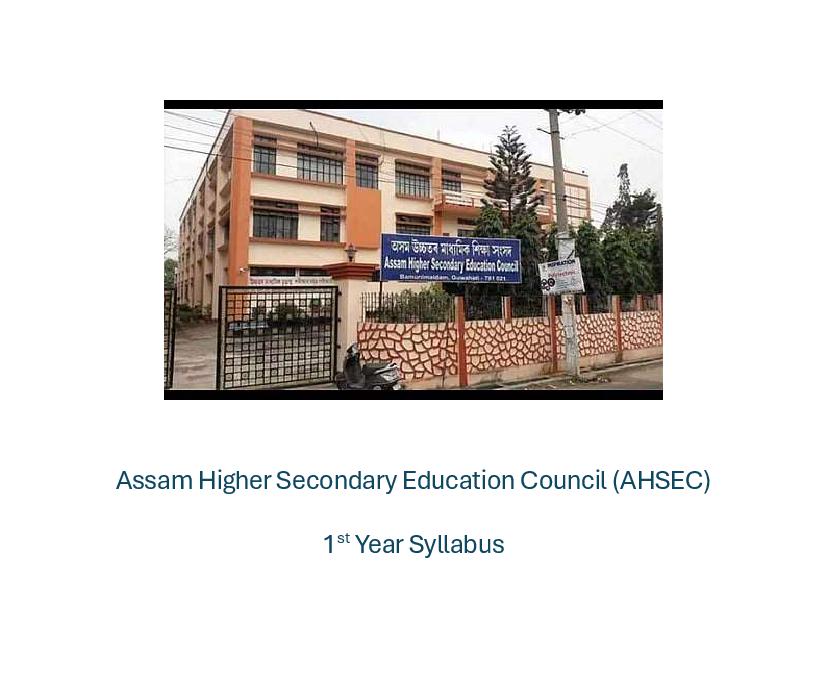
1st Year Syllabus
Page 2
HISTORY
REVISED SYLLABUS FOR CLASS XI
2025-2026
One Paper Time:Three hour Marks : 100 (80+20)
Theme wise Distribution of Marks & Periods:
Themes Topics Marks Periods
Section I.: Early Societies 10 25
Introduction 05
Timeline I (6 MYA to 1 BCE)
Theme 1: Writing and City Life 20
Section II: Empires 20 45
Introduction 05
Time line II (c.100 BCE to 1300 CE)
Theme 2: An Empire Across Three Continents 20
Theme 3: Nomadic Empires 20
Section III: Changing Traditions 25 45
Introduction 05
Time line III (c. 1300 to 1700)
Theme 4: Three Orders 20
Theme 5: Changing Cultural Traditions 20
Section IV: Towards Modernization 25 45
Introduction 05
Time line IV (c. 1700 to 2000)
Theme 6: Displacing Indigenous Peoples 20
Theme 7: Paths To Modernization 20
(Excluded: The Story of Korea,
Rapid Industrialization under Strong
Leadership, Continued Economic
Growth and cause for
Democratization, Korean Democracy
and The IMF Crisis)
Section V: Project Work 20 20
Total: 100 180
Theme wise Distribution of Course Contents with specific learning objectives:
Section I.: Early Societies
Introduction
Theme 1: Writing and City Life
Focus: Mesopotamia, 3rd millennium BC Familiarise the learner with the
(a) Growth of towns nature of early urban centers.
(b) Nature of early urban societies. Discuss whether rewriting is
Debate on uses of writing significant as a marker of civilization
Page 3
Section II: Empires
Introduction
Theme 2: An Empire across Three Continents
Focus: Roman Empire.27 BC to AD 600 Familiarize the learner with the
(a) Political evolution history of a major World Empire.
(b) Economic expansion
(c) Religion Discuss whether slavery was a significant
(c) Late Antiquity element in the economy.
Debate on the institution of slavery.
Theme 3: Nomadic Empires
Focus: the Mongol, 13th to 14th century. Familiarise the learner with the varieties
(a) The nature of nomadism of nomadic society and their
(b) Formation of empires institutions.
(c) Conquests and relations with other states Discuss whether state formation is
Debate on nomadic societies and state possible in nomadic societies.
formation.
Section III: Changing Traditions
Introduction
Theme 4: Three orders
Focus: Western Europe, 9th-16th century Familiarise the learner with the nature
(a) Feudal society and economy. of the economy and society of this
(b) Formation of states. Period and the changes within them.
(c) Church and society. Show how the debate on the decline
Debate on decline of feudalism processes of of feudalism help in understanding
transition.
Theme 5: Changing Cultural Traditions
Focus: Europe, 14th to 17th century Explore the intellectual trends in the
(a) New ideas and new trends in literature period.
and arts. Familiarize students with the paintings
(b) Relationship with earlier ideas and buildings of the period.
(c)The contribution of West Asia. Introduces the debate around the idea
Debate: Is the nation 'European Renaissance valid? of‘ Renaissance’.
Section IV: Towards Modernisation
Introduction
Theme 6: Displacing Indigenous People
Focus: North America and Australia, Sensitise students to the processes of
18th-20th century displacement that accompanied the
(a) European colonists in North America development of America and Australia
and Australia.
(b) Formation of white settler societies. Understand the implications of such
(c) Displacement and repression of local processes for the displaced
people. populations.
Debate on the impact of European
settlement on indigenous populations.
Page 4
Theme 7: Paths to Modernisation,
Focus: East Asia.Late19th and 20th Make students aware that transformation
century. in the modern world takes many different
(a) Militarization and economic growth in Japan. forms.
(b) China and the Communist alternative. Show how notions like 'modernisation’
'Debate on the meaning of Modernisation. need to be critically assessed.
Section V
INTERNAL ASSESSMENT: (PROJECT WORK) (Total mark : 20)
Project Work on Theme 1 – 7
General Guideline for project work
Introduction:
From the session 2025-26, the Board has decided to incorporate project work into the history
curriculum for class XI as part of regular classroom learning. The principal objective is to allow the
students to explore beyond textbook, offering them a platform to refer to various materials, collect
information, analyze it and identify relevant content. As a result, they will learn to make decisions
about what to include, gaining an understanding of how history is constructed and interpreted.
Guide to the Teachers
Teachers should ensure that project work is assigned to students either individually or in
groups and that it is discussed at various stages—from the assignment of the topic and review
of drafts to the final submission.
Project report should be Hand written only.(Eco-friendly materials can be used by students)
The word limit of a project report should be 600 to 1000 words.
The Project report should include names of reference books and other sources consulted.
The following steps are suggested:
Teachers should create and prepare a list of 15-20 project topics, allowing students the option
to select a project based on their individual interests. The project must be done individually or
in-groups.
The topic should be assigned after discussion with the students in the class to avoid repetition
and should then be discussed at every stage of submission of the draft/final project work.
The teacher should act as a facilitator, closely supervising the project completion process.
They should guide students by offering necessary inputs, resources and support to help for
enhance the content and quality of the project.
Students may use alternative sources available in local archives and libraries. They may use
newspaper cuttings, photographs, film footage and recorded written/speeches.
Prescribed Text book: Themes in World History, Published by NCERT
িব ইিতহাসৰ িবষয়ব সমূহ, Published by ASSEB, Division-II.
[Note: The textbooks are available in Bengali and Bodo Medium also]
Page 5
Notes
Model Papers Class 6 Notes
Sample Papers Class 7 Notes
Half Yearly Sample Papers Class 8 Notes
Class 9 Notes
Important Resources
Class 10 Notes
Periodic Table
Class 11 Notes
Writing Skills / Formats
Maps of India / World Class 12 Notes
Books and Solutions
NCERT Books
NCERT Book Solutions
HC Verma Chapter Wise Solutions
RD Sharma Solutions
CGBSE Solutions
Document Details
| Board / Org | Assam Board |
| Exam | Class 11 |
| Type | Syllabus |
| Pages | 5 |
| Updated | 24 Sep 2026 |