TS ECET 2023 Syllabus Civil Engineering
Finished viewing? Save it for later —
Download TS ECET 2023 Syllabus Civil Engineering (PDF · 9 pages)About TS ECET 2023 Syllabus Civil Engineering
TS ECET 2023 Syllabus Civil Engineering is available here for free download. Published by TGCHE for Telangana Engineering Common Entrance Test, this syllabus can be viewed online or downloaded as a PDF (9 pages). Candidates preparing for Telangana Engineering Common Entrance Test can use TS ECET 2023 Syllabus Civil Engineering to understand the exam pattern, the type of questions asked, and the overall difficulty level.
Frequently Asked Questions
How can I download TS ECET 2023 Syllabus Civil Engineering?
Open this page and click the Download button to save TS ECET 2023 Syllabus Civil Engineering as a PDF. It is completely free on AglaSem Docs.
Is TS ECET 2023 Syllabus Civil Engineering free to download?
Yes. TS ECET 2023 Syllabus Civil Engineering can be viewed online and downloaded as a PDF free of cost on AglaSem Docs.
How many pages does TS ECET 2023 Syllabus Civil Engineering have?
TS ECET 2023 Syllabus Civil Engineering contains 9 pages, which you can read online or download together as a single PDF.
Where can I find more Telangana Engineering Common Entrance Test study material?
You can find more Telangana Engineering Common Entrance Test question papers, sample papers, syllabus, and answer keys on AglaSem Docs.
TS ECET 2023 Syllabus Civil Engineering – Text
Read the full text of this syllabus below — useful to quickly search, copy and reference the content online without downloading the PDF.
📄 View text version (9 pages)
Page 1
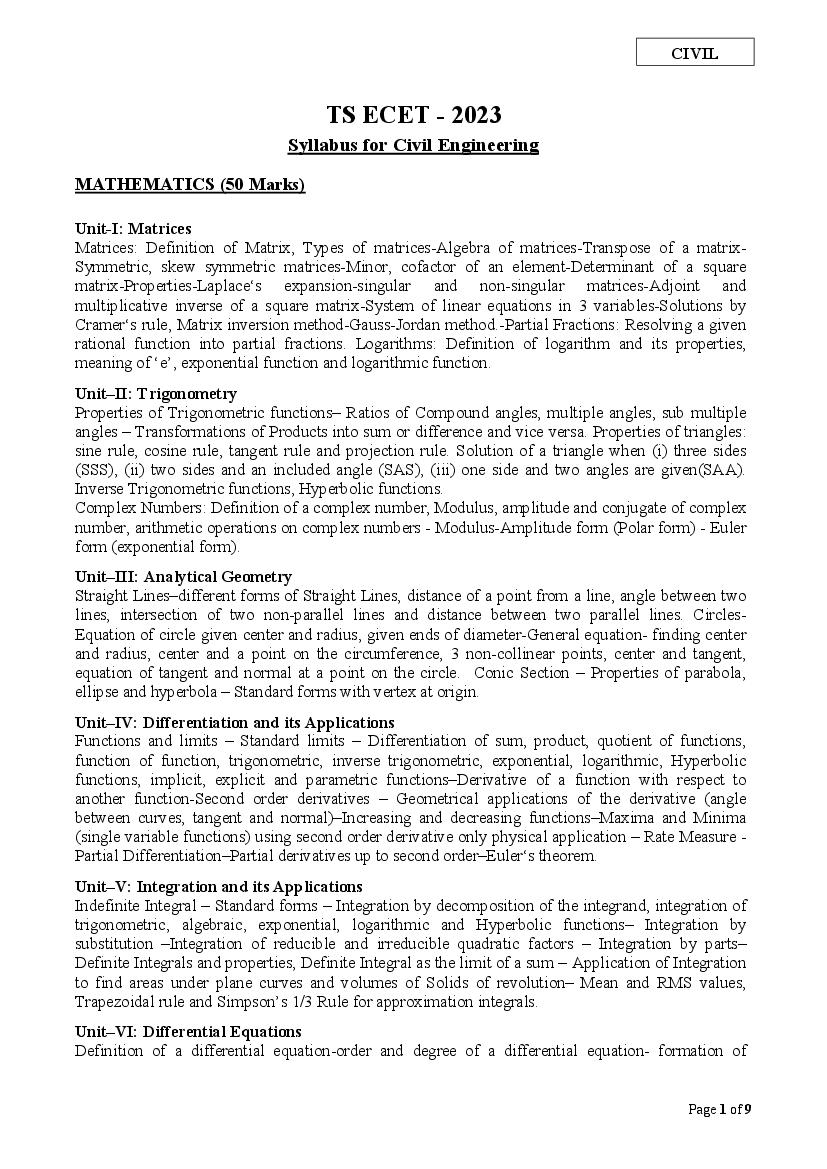
Syllabus for Civil Engineering
MATHEMATICS (50 Marks)
Unit-I: Matrices
Matrices: Definition of Matrix, Types of matrices-Algebra of matrices-Transpose of a matrix-
Symmetric, skew symmetric matrices-Minor, cofactor of an element-Determinant of a square
matrix-Properties-Laplace‘s expansion-singular and non-singular matrices-Adjoint and
multiplicative inverse of a square matrix-System of linear equations in 3 variables-Solutions by
Cramer‘s rule, Matrix inversion method-Gauss-Jordan method.-Partial Fractions: Resolving a given
rational function into partial fractions. Logarithms: Definition of logarithm and its properties,
meaning of ‘e’, exponential function and logarithmic function.
Unit–II: Trigonometry
Properties of Trigonometric functions– Ratios of Compound angles, multiple angles, sub multiple
angles – Transformations of Products into sum or difference and vice versa. Properties of triangles:
sine rule, cosine rule, tangent rule and projection rule. Solution of a triangle when (i) three sides
(SSS), (ii) two sides and an included angle (SAS), (iii) one side and two angles are given(SAA).
Inverse Trigonometric functions, Hyperbolic functions.
Complex Numbers: Definition of a complex number, Modulus, amplitude and conjugate of complex
number, arithmetic operations on complex numbers - Modulus-Amplitude form (Polar form) - Euler
form (exponential form).
Unit–III: Analytical Geometry
Straight Lines–different forms of Straight Lines, distance of a point from a line, angle between two
lines, intersection of two non-parallel lines and distance between two parallel lines. Circles-
Equation of circle given center and radius, given ends of diameter-General equation- finding center
and radius, center and a point on the circumference, 3 non-collinear points, center and tangent,
equation of tangent and normal at a point on the circle. Conic Section – Properties of parabola,
ellipse and hyperbola – Standard forms with vertex at origin.
Unit–IV: Differentiation and its Applications
Functions and limits – Standard limits – Differentiation of sum, product, quotient of functions,
function of function, trigonometric, inverse trigonometric, exponential, logarithmic, Hyperbolic
functions, implicit, explicit and parametric functions–Derivative of a function with respect to
another function-Second order derivatives – Geometrical applications of the derivative (angle
between curves, tangent and normal)–Increasing and decreasing functions–Maxima and Minima
(single variable functions) using second order derivative only physical application – Rate Measure -
Partial Differentiation–Partial derivatives up to second order–Euler‘s theorem.
Unit–V: Integration and its Applications
Indefinite Integral – Standard forms – Integration by decomposition of the integrand, integration of
trigonometric, algebraic, exponential, logarithmic and Hyperbolic functions– Integration by
substitution –Integration of reducible and irreducible quadratic factors – Integration by parts–
Definite Integrals and properties, Definite Integral as the limit of a sum – Application of Integration
to find areas under plane curves and volumes of Solids of revolution– Mean and RMS values,
Trapezoidal rule and Simpson’s 1/3 Rule for approximation integrals.
Unit–VI: Differential Equations
Definition of a differential equation-order and degree of a differential equation- formation of
Page 1 of 9
Page 2
separable, homogeneous equations, exact, linear differential equation of the form dy/dx+Py=Q,
Bernoulli‘s equation, 2nd order linear differential equation with constant coefficients both
homogeneous and non-homogeneous and finding the Particular Integrals for the functions eax, sin
ax, cos ax, ax2 +bx+c (a,b,c are real numbers).
Unit–VII: Laplace Transforms
Laplace Transforms (LT) of elementary functions-Linearity property, first shifting property, change
of scale property, multiplication and division by t - LT of derivatives and integrals, Unit step
function, LT of unit step function, second shifting property, evaluation of improper integrals,
Inverse Laplace transform (ILT)-shifting theorems, change of scale property, multiplication and
division by s, ILT by using partial fractions and convolution theorem. Applications of LT to solve
linear ordinary differential equations up to second order with initial conditions.
Unit–VIII: Fourier Series
Fourier series, Euler’s formulae over the interval (C, C+2π) for determining the Fourier coefficients.
Fourier series of simple functions in (0, 2π) and (–π, π). Fourier series for even and odd functions in
the interval (–π, π) – Half range Fourier series – sine and cosine series over the interval (0, π).
PHYSICS (25 Marks)
Unit-I: UNITS, DIMENSIONS AND FRICTION
Physical quantity - Fundamental and derived quantities – Unit –definitions - S.I units - Advantages
of S.I. units - Dimensions and dimensional formula - definitions-units and dimensional formula for
physical quantities - Principle of homogeneity - Applications of dimensional analysis–Friction –
causes - types of friction - Normal reaction - Laws of static friction - coefficients of friction -
expression-rough horizontal surface - expressions for Acceleration, Displacement, Time taken to
come to rest and Work done - Advantages and disadvantages of friction - Methods to reduce friction
– Problems on friction only.
Unit-II: ELEMENTS OF VECTORS
Scalar and vector quantities – definitions and examples –Graphical representation of a vector -
Classification of vectors (Proper vector, Unit vector, Equal vector, Negative vector, Collinear vector
and Position vector) Resolution of a vector - Triangle law of vector addition – Parallelogram law of
vectors – statement- expression for magnitude and direction of resultant vector –derivation-
illustrations (working of sling and flying bird) - Representation of a vector in unit vectors i, j and
k– Scalar product of vectors-definition- application to work done by force – properties of scalar
product - Vector product of vectors –definition – Right hand thumb rule and right hand screw rule -
application to moment of force - properties of vector product - area of parallelogram and triangle in
terms of vector product - related problems
Unit-III: MECHANICS
Projectile motion – definition - examples - Horizontal projection – Time of flight and Horizontal
range – derivations - Oblique projection – Expression for path of a projectile in oblique projection -
derivation– Maximum height, Time of ascent, Time of descent, Time of flight, Horizontal range and
maximum horizontal range - derivations – Circular motion, angular velocity, time period and
frequency of revolutions–Definitions– Relation between linear velocity and angular velocity -
derivation–centripetal force – centrifugal force – definitions and expressions only- application
Page 2 of 9
Page 3
Unit-IV: PROPERTIES OF MATTER
Elasticity and plasticity- definitions – examples - Stress and Strain – definitions and expressions -
elastic limit - Hooke’s law – statement - modulus of elasticity - Young’s modulus – Derivation –
Cohesive and adhesive forces - Surface tension - Illustrations - Capillarity –angle of contact –
definition- examples for capillarity- Formula for Surface tension based on capillarity (no derivation)
– Viscosity - Illustrations of viscosity - Newton’s formula for viscous force – derivation -
Coefficient of viscosity - Poiseuille’s equation - Effect of temperature on viscosity of liquids and
gases– streamlines - laminar flow - turbulent flow - Reynold’s number - equation of continuity –
statement - related problems.
Unit-V: HEAT AND THERMODYNAMICS
Heat – expansion of gases - Boyle’s law –concept of absolute zero - Absolute scale of temperature –
Charles’ laws - Ideal gas equation – derivation - value of universal gas constant ‘R’ –Isothermal
and Adiabatic processes - Differences between isothermal and adiabatic processes - Internal energy
and external work done – Expression for work done – derivation – first law of thermodynamics –
application of first law to isothermal and adiabatic processes - second law of thermodynamics –
specific heat of a gas – molar specific heat of a gas – definitions – derive relation between CP and Cv
- related problems.
Unit-VI: CONSERVATION LAWS AND ENERGY SOURCES
Work and Energy - Potential Energy and kinetic energy–examples – expressions for PE and KE -
derivations - Work-Energy theorem – derivation – Law of conservation of energy – examples - Law
of conservation of energy in the case of freely falling body – proof – Illustration of conservation of
energy in the case of simple pendulum– Non renewable and renewable energy sources - related
problems
Unit-VII: WAVES AND SOUND
Wave motion – definition and characteristics – audible range – infrasonic and ultrasonic –
longitudinal and transverse waves – examples – Relation between wavelength, frequency and
velocity of a wave – derivation –stationary waves- beats - applications of beats - Doppler effect –
list the applications – ultrasound and radar in medicine and engineering as special emphasis- echo –
definition - applications - relation between time of echo and distance of obstacle –derivation-
Reverberation and time of reverberation - Sabine’s formula - Free and forced vibrations - Resonance
- Conditions of good auditorium - noise pollution – definition – causes, effects and methods to
minimize noise pollution - problems
Unit-VIII: SIMPLE HARMONIC MOTION
Periodic motion - Simple Harmonic Motion (SHM)– definition - examples - Conditions for SHM –
Projection of circular motion on any diameter of a circle is SHM - Expressions for Displacement,
Velocity and Acceleration of a particle executing SHM – derivations - Time period, frequency,
amplitude and phase of a particle in SHM - Ideal simple pendulum – time period of simple
pendulum –derivation - laws of simple pendulum-Seconds pendulum- problems
Unit-IX: MODERN PHYSICS
Photo electric effect - Einstein’s photo electric equation – Work function and threshold frequency -
laws of photo electric effect - applications of photo electric effect – photo cell - concept of
Refraction of light - critical angle and total internal reflection - principle of Optical fiber -
Applications of optical fiber – LASER – definition and characteristics – principle of LASER -
Page 3 of 9
Page 4
Unit-X: MAGNETISM
Magnetic field - magnetic lines of force -properties - Uniform and Non-uniform magnetic field –
Magnetic length, pole strength – magnetic induction field strength- definition - Coulomb’s inverse
square law of magnetism - expression for moment of couple on a bar magnet placed in a uniform
magnetic field – derivation - expression for magnetic induction field strength at a point on the axial
line of a bar magnet –derivation - Dia, Para and Ferro magnetic materials – examples - related
problems.
Unit-XI: ELECTRICITY AND MEASURING INSTRUMENTS
Ohm’s law – Ohmic and non ohmic conductors – examples - Temperature dependence of resistance
– coefficients of resistance with examples - Specific resistance – units – conductance- series and
parallel combination of resistors - moving coil galvanometer - conversion of galvanometer into
ammeter and voltmeter with diagram (qualitatively) – Kirchhoff’s current and voltage laws in
electricity – Expression for balancing condition of Wheatstone’s bridge – derivation – Meter bridge
–working with neat diagram –Superconductivity-definition-superconductors - definition and
examples – applications - related problems.
Unit-XII: ELECTRONICS
Solids – definition – energy bands in solids- valence band, conduction band and forbidden band –
Energy band diagram of conductors, insulators and semiconductors – concept of Fermi level -
Intrinsic semiconductors - examples - Concept of holes in semiconductors - Doping - Extrinsic
semiconductor - P-type and N-type semiconductors - PN Junction diode – Forward Bias and
Reverse Bias - Applications of PN diode - Diode as rectifier – principle – principle of Light
Emitting Diode and solar cell.
CHEMISTRY (25 Marks)
Unit-I: Fundamentals of Chemistry
Atomic Structure: Introduction - Atomic number - Mass number- Bohr's Atomic theory - Aufbau
principle - Hund's rule - Pauli's exclusion Principle- Orbitals, shapes of s, p and d orbitals -
Electronic configuration of elements
Chemical Bonding: Introduction - Electronic theory of valency - Types of chemical bonds - Ionic,
covalent and co-ordinate covalent bond with examples - Properties of Ionic and Covalent
compounds
Oxidation-Reduction: Electronic Concepts of Oxidation-Reduction, Oxidation Number-
calculations.
Unit -II: Solutions and Colloids
Introduction-Classification of solutions based on physical state- Molecular weights,Equivalent
weights - Expression of concentration - Mole concept, Molarity, Normality, Numerical problems on
Mole, Molarity and Normality - Colloids- Types of colloids- Lyophilic and Lyophobic colloids -
Industrial applications of colloids.
Unit -III: Acids and Bases
Introduction - theories of acids and bases and limitations - Arrhenius theory-Bronsted-Lowry theory
- Lewis acid base theory - Ionic product of water - pH and related numerical problems - Buffer
Page 4 of 9
Page 5
Unit -IV: Environmental Studies-I
Introduction - environment -scope and importance of environmental studies- important terms -
renewable and non-renewable energy sources - Concept of ecosystem, producers, consumers and
decomposers - Biodiversity, definition and threats to Biodiversity- Forest resources- Over
exploitation-Deforestation.
Unit -V: Water Technology
Introduction -soft and hard water - causes of hardness – types of hardness -disadvantages of hard
water - degree of hardness (ppm) - softening methods - permutit process - ion exchangeprocess -
drinking water - municipal treatment of water for drinking purpose - Osmosis, Reverse Osmosis -
advantages of Reverse Osmosis – Desalination by Electro dialysis - Defluoridation – Nalgonda
technique.
Unit -VI: Electrochemistry
Conductors, insulators, electrolytes –Types of electrolytes - Arrhenius theory of electrolytic
dissociation - electrolysis -electrolysis of fused NaCl and aqueous NaCl - applications of
electrolysis - Faraday's laws of electrolysis- numericalproblems.
Unit -VI I: Metallurgy
Characteristics of Metals - distinguish between Metals and Non Metals- Ore, Gangue, Flux and Slag
- Concentration of Ore -Froth floatation - Methods of Extraction of crude Metal - Roasting,
Calcination and Smelting - Alloys-purpose of making alloys - Composition of Brass, German silver,
Nichrome, Stainless steel and Duralumin
Unit –VIII: Corrosion
Introduction - factors influencing the rate of corrosion - electrochemical theory of corrosion -
composition, stress and concentration cells- rusting of iron and its mechanism - prevention of
corrosion - coating methods, Paints-constituents and characteristics of paints-cathodic protection
Unit –IX: Polymers
Introduction - polymerization - types of polymerization - addition, condensation with examples -
plastics - types of plastics - advantages of plastics over traditional materials - Disadvantages of
using plastics - preparation and uses of the following plastics: 1. Polythene 2. PVC 3.Teflon
4.Polystyrene 5.Urea formaldehyde 6. Bakelite - Rubber - Elastomers -Preparationof Butyl rubber,
Buna-s rubber, Neoprene rubber and their uses-Fibres-Preparation and uses of fibres-Nylon 6,6-
Polyester
Unit –X: Fuels
Definition and classification of fuels- characteristics of good fuel - Calorific value-HCV and LCV-
Calculation of oxygen required for combustion of methane and ethane - composition and uses of
gaseous fuels - a) Water gas b) Producer gas, c) Natural gas, d) Coal gas, e) Bio gas and f)
Acetylene.
Unit –XI: Electro Motive Force
Galvanic cell – standard electrode potential -electro chemical series -emf of cell – Batteries-Types
of batteries-Fuel cells.
Unit –XII: ENVIRONMENTAL STUDIES-II
Introduction- classification of air pollutants based on origin and states of matter - Air pollution;
causes and effects - control methods - Water pollution; causes and effects - control measures.
Page 5 of 9
Page 6
Page 7
Unit–I: ENGINEERING MECHANICS
Forces and moments- Vectors and scalars, resultant forces at a point, types of supports, types of
loading. Centroid – rectangle, triangle, parallelogram, circle, semicircle, trapezium. Location of
centroid of T, L, I, channel, Z sections. built-up sections. Moment of Inertia – T, L, I and built up
sections, radius of gyration of built-up sections; Polar moment of inertia of solid and hollow
circular sections using perpendicular axis theorem only. Simple stresses and strains - ductile
materials-Mechanical properties of materials- Hooke‘s law - lateral strain-Poisson‘s ratio-Elastic
constants and the relation between them- Composite sections.
Unit-II: STRENGTH OF MATERIALS
Shear force and Bending Moment Diagrams for cantilever, Simply supported and overhanging
beams subjected to Point loads and UDL. Theory of simple bending-assumptions-bending
equation-bending Stresses-Section Modulus-Shear stress distribution across various sections like
rectangular, circular and I - Sections-Torsion-solid and hollow circular shafts subjected to pure
torsion – shear stress – distribution in shafts – power transmitted by circular shafts.
Slope and Deflection of cantilevers and simply supported beams by Double Integration method
and Deflection of simply supported beams by Macaulay‘s method – Mohr‘s theorems for slopes
and deflections-Moment area method-Symmetrical loading. Columns and struts-types-
slenderness ratio- Euler’s and Rankine’s formulae for axial loading.
Unit-III: REINFORCED CONCRETE STRUCTURES
Grades of concrete, characteristic strength, Modulus of Elasticity-I.S.456-2000- Philosophy of
Limit state design. Limit state of Strength and Serviceability, partial safety factor-design strength
of materials and design loads- assumptions.
Analysis and Limit state design of rectangular Beams-Singly, Doubly reinforced and T-beams.
Shear in RCC beams - Development length. Slabs-analysis and limit state design of one-way and
two-way slabs as per IS.456-2000, Torsion reinforcement. Design of continuous slabs and beams
- Deflection check for slabs and beams. Detailing of reinforcement in singly reinforced and
doubly reinforced simply supported beams of rectangular sections and lintels, one way and two
way slabs.
Columns: Codal provisions of I.S 456-2000 - short and long columns-different shapes-design of
short columns by limit state method-long columns- concept, effective length for different end
conditions. Footings-Isolated column footings-one way shear and two way shear. Stairs – types.
Unit-IV: SURVEYING
Chain surveying - purpose and principle-offsets - errors and corrections- different operations in
chain surveying- obstacles - methods of calculation of area. Compass Surveying - purpose and
principle - bearings- traversing using prismatic compass- local attraction - errors. Levelling -
definitions - component parts of Dumpy level - errors - Methods of levelling - contouring -
characteristics and methods. Theodolite - principles and component parts- fundamental lines and
relationship among them - adjustments of theodolite - measurement of horizontal and vertical
angles - errors-traverse computations - Bowditch and Transit rule. Tachometry - principle - stadia
tachometry - tangential tachometry, Principle and uses of E.D.M, Electronic Theodolite, Total
Station, Global positioning System - Importance, G.I.S – Use and applications in Civil
Engineering, Curves - simple curves, elements of simple curve, setting out of simple curves by
Page 7 of 9
Page 8
Unit-V: HYDRAULICS
Fluid properties - specific weight – mass density-specific gravity - surface tension - capillarity-
viscosity. Atmospheric pressure, gauge pressure and absolute pressure. Fluid pressure on plane
surfaces - Centre of pressure and total pressure, measurement of fluid pressure using piezo meter
and manometers. Types of flows-uniform, non-uniform, steady, unsteady, laminar and turbulent
flows. Energies of liquid in motion - continuity equation. Bernoulli‘s theorem - Pitot tube –
Venturi meter. Flow thorough small and large orifices, coefficients of orifices - Cc, Cv and Cd.
Flow through internal, external, convergent and divergent mouthpieces. Types of Notches -
rectangular and triangular, flow over notches. Types of Weirs- sharp crested and broad crested-
mathematical formulae for discharge- Francis and Bazin’s empirical formulae.
Flow through pipes-major and minor losses - Chezy‘s and Darcy‘s formulae for loss of head due
to friction-HGL & TEL. Flow through open channels-rectangular and trapezoidal - Chezy‘s
formula for discharge – Kutter's and Manning‘s equation for Chezy‘s constants-Most economical
sections. Reciprocating and Centrifugal pumps (without problems). Classification of Turbines -
Kaplan, Francis and Pelton wheel (without problems) -Types and uses of Draft tubes. Hydro-
electric installations - components and uses.
Unit-VI: IRRIGATION ENGINEERING
Necessity of Irrigations - Perennial and inundation Irrigation, Flow and Lift Irrigation, Principal
seasons - kharif and rabi crops - Duty, delta and base period. Methods of Irrigation - check
flooding, basin flooding, Border strip, furrow, sprinkler and drip Irrigations. Hydrology -
Rainfall, types of Rain gauges, types of catchments-rainfall and runoff. Measurement of velocity
of flow in streams. Classification of Head works - component parts of diversion head works.
Weirs and Barrages. Percolation and uplift pressures. Types of Reservoirs - dead storage and live
storage.
Storage Head works-different types of dams- gravity dams-low and high dams. Elementary
profile of a dam. Failures of gravity dams - drainage galleries. Types of spillways. Earth dams -
types, failures and precautions. Phreatic lines and drainage arrangements in earthen dams.
Distribution works-classifications and alignment of canals-typical cross section of a canal-berms -
balanced depth of cutting- canal lining. Cross drainage works – types and functions. Soil erosion,
Types and causes-measures to control erosion.
Unit-VII: TRANSPORTATION ENGINEERING
Importance of transportation engineering- I.R.C. – Classification of roads as per I.R.C.,
recommended I.R.C. values of camber for different roads. Gradients – Ruling gradient, limiting
and exceptional gradient Recommended-I.R.C values of gradients.
Traffic Engg.- Traffic census and its importance, Road intersections- Traffic signs- Informatory
signs- Mandatory signs, Cautionary signs. Highway constructions and Maintenance - Purpose of
road drainage- surface and sub-surface drainage, Typical cross section of highway in cutting and
embankment. Water bound macadam roads, Cement concrete roads. Permanent way of Railways,
Importance of Railways- Gauge, Types of gauges, Structure of permanent way –different types of
rails, requirements of a good rail, Sleepers- functions, Types of sleepers, characteristics of a good
sleeper –spacing of sleepers-sleeper density.
Unit-VIII : WATER SUPPLY AND SANITARY ENGINEERING
Quality of water, Need for protected water supply, Total quantity of water for a town, per capita
Page 8 of 9
Page 9
incremental increase methods, Sources and conveyance of water: surface sources, underground
sources, Types of Intakes. Quality and Methods of purification of water.
Distribution System: Methods of supply, Storage-Distribution systems, Types of layout- dead
end, grid, radial and ring system their merits and demerits and their suitability. General layout of
water supply arrangements in buildings.
System of sewage disposal-types of sewerage systems, Different shapes of cross-section for
sewers, Strength of sewage, sampling of sewage, characteristics of sewage - principles of
treatment, Preliminary treatment, secondary treatment. Sewers –sewer appurtences-shapes, merits
and demerits.
Unit-IX: BUILDING MATERIALS AND CONSTRUCTION PRACTICE
Stones-classification of rocks. Bricks – manufacturing, tests on bricks. Tiles- types of tiles.
Cement- classification manufacturing-tests. Mortars – classification - proportioning. Concrete-
proportioning – water-cement ratio – workability – admixtures-curing methods-R.M.C. Timber
and surface protective materials. Characteristics-types and uses.
Classification of buildings, foundations-N.B.C. classification-bearing capacity of soil- types of
foundations. Masonry-Bonds in brick masonry. Plastering-purpose. Pointing purpose and types.
*****
Page 9 of 9
Document Details
| Board / Org | TGCHE |
| Exam | Telangana Engineering Common Entrance Test |
| Type | Syllabus |
| Pages | 9 |
| Updated | 22 Jul 2026 |