TS ECET 2024 Syllabus Electrical and Electronics Engineering
Finished viewing? Save it for later —
Download TS ECET 2024 Syllabus Electrical and Electronics Engineering (PDF · 10 pages)About TS ECET 2024 Syllabus Electrical and Electronics Engineering
TS ECET 2024 Syllabus Electrical and Electronics Engineering is available here for free download. Published by TGCHE for Telangana Engineering Common Entrance Test, this syllabus can be viewed online or downloaded as a PDF (10 pages). Candidates preparing for Telangana Engineering Common Entrance Test can use TS ECET 2024 Syllabus Electrical and Electronics Engineering to understand the exam pattern, the type of questions asked, and the overall difficulty level.
Frequently Asked Questions
How can I download TS ECET 2024 Syllabus Electrical and Electronics Engineering?
Open this page and click the Download button to save TS ECET 2024 Syllabus Electrical and Electronics Engineering as a PDF. It is completely free on AglaSem Docs.
Is TS ECET 2024 Syllabus Electrical and Electronics Engineering free to download?
Yes. TS ECET 2024 Syllabus Electrical and Electronics Engineering can be viewed online and downloaded as a PDF free of cost on AglaSem Docs.
How many pages does TS ECET 2024 Syllabus Electrical and Electronics Engineering have?
TS ECET 2024 Syllabus Electrical and Electronics Engineering contains 10 pages, which you can read online or download together as a single PDF.
Where can I find more Telangana Engineering Common Entrance Test study material?
You can find more Telangana Engineering Common Entrance Test question papers, sample papers, syllabus, and answer keys on AglaSem Docs.
TS ECET 2024 Syllabus Electrical and Electronics Engineering – Text
Read the full text of this syllabus below — useful to quickly search, copy and reference the content online without downloading the PDF.
📄 View text version (10 pages)
Page 1
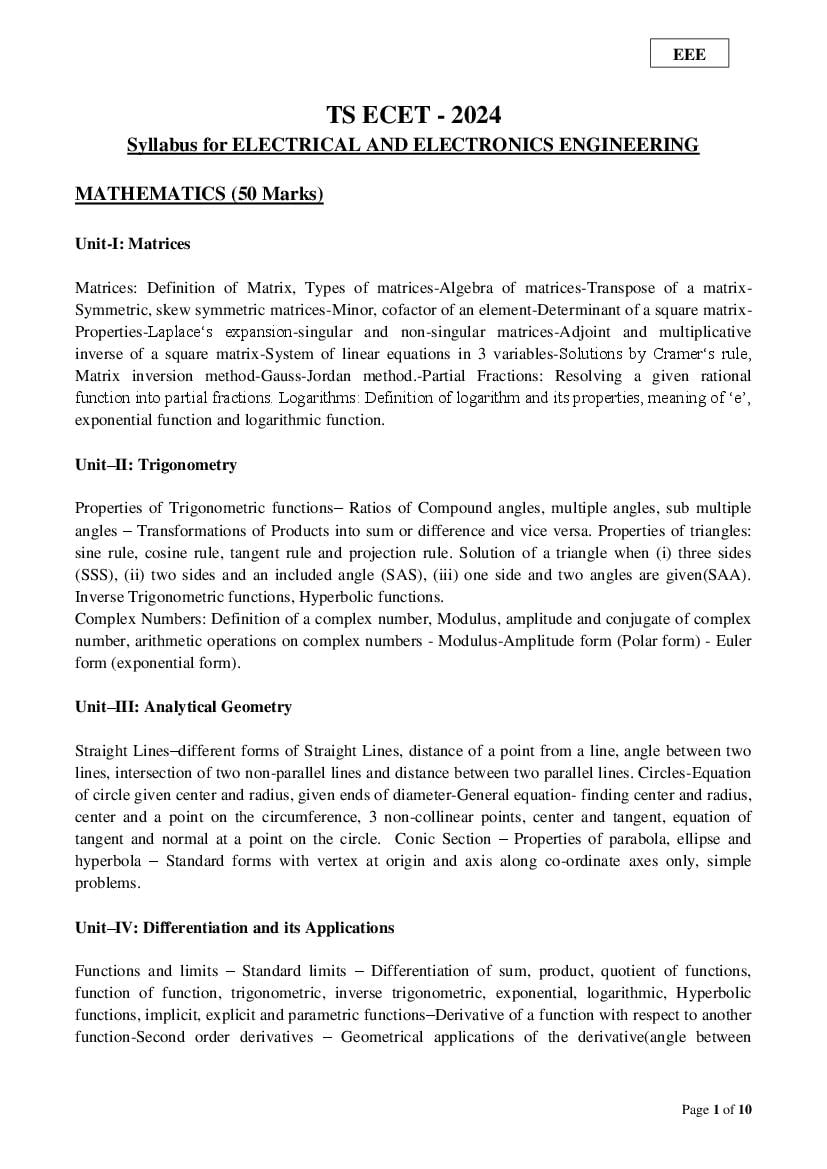
TS ECET - 2024
Syllabus for ELECTRICAL AND ELECTRONICS ENGINEERING
MATHEMATICS (50 Marks)
Unit-I: Matrices
Matrices: Definition of Matrix, Types of matrices-Algebra of matrices-Transpose of a matrix-
Symmetric, skew symmetric matrices-Minor, cofactor of an element-Determinant of a square matrix-
Properties-Laplace‘s expansion-singular and non-singular matrices-Adjoint and multiplicative
inverse of a square matrix-System of linear equations in 3 variables-Solutions by Cramer‘s rule,
Matrix inversion method-Gauss-Jordan method.-Partial Fractions: Resolving a given rational
function into partial fractions. Logarithms: Definition of logarithm and its properties, meaning of ‘e’,
exponential function and logarithmic function.
Unit–II: Trigonometry
Properties of Trigonometric functions– Ratios of Compound angles, multiple angles, sub multiple
angles – Transformations of Products into sum or difference and vice versa. Properties of triangles:
sine rule, cosine rule, tangent rule and projection rule. Solution of a triangle when (i) three sides
(SSS), (ii) two sides and an included angle (SAS), (iii) one side and two angles are given(SAA).
Inverse Trigonometric functions, Hyperbolic functions.
Complex Numbers: Definition of a complex number, Modulus, amplitude and conjugate of complex
number, arithmetic operations on complex numbers - Modulus-Amplitude form (Polar form) - Euler
form (exponential form).
Unit–III: Analytical Geometry
Straight Lines–different forms of Straight Lines, distance of a point from a line, angle between two
lines, intersection of two non-parallel lines and distance between two parallel lines. Circles-Equation
of circle given center and radius, given ends of diameter-General equation- finding center and radius,
center and a point on the circumference, 3 non-collinear points, center and tangent, equation of
tangent and normal at a point on the circle. Conic Section – Properties of parabola, ellipse and
hyperbola – Standard forms with vertex at origin and axis along co-ordinate axes only, simple
problems.
Unit–IV: Differentiation and its Applications
Functions and limits – Standard limits – Differentiation of sum, product, quotient of functions,
function of function, trigonometric, inverse trigonometric, exponential, logarithmic, Hyperbolic
functions, implicit, explicit and parametric functions–Derivative of a function with respect to another
function-Second order derivatives – Geometrical applications of the derivative(angle between
Page 1 of 10
Page 2
curves, tangent and normal)–Increasing and decreasing functions–Maxima and Minima(single
variable functions) using second order derivative only physical application – Rate Measure - Partial
Differentiation–Partial derivatives up to second order–Euler’s theorem.
Unit–V: Integration and its Applications
Indefinite Integral – Standard forms – Integration by decomposition of the integrand, integration of
trigonometric, algebraic, exponential, logarithmic and Hyperbolic functions– Integration by
substitution –Integration of reducible and irreducible quadratic factors – Integration by parts–
Definite Integrals and properties, Definite Integral as the limit of a sum – Application of Integration
to find areas under plane curves and volumes of Solids of revolution– Mean and RMS values,
Trapezoidal rule and Simpson’s 1/3 Rule for approximation integrals.
Unit–VI: Differential Equations
Definition of a differential equation-order and degree of a differential equation- formation of
differential equations-solution of differential equation of the type first order first degree, variable-
separable, homogeneous equations, exact, linear differential equation of the form dy/dx+Py=Q,
Bernoulli‘s equation, 2nd order linear differential equations with constant coefficients both
homogeneous and non-homogeneous and finding the Particular Integrals for the functions eax, sin ax,
cos ax, ax2 +bx+c (a,b,c are real numbers).
Unit–VII: Laplace Transforms
Laplace Transforms (LT) of elementary functions-Linearity property, first shifting property, change
of scale property, multiplication by tn and division by t - LT of derivatives and integrals, Unit step
function, LT of unit step function, second shifting property, evaluation of improper integrals, Inverse
Laplace transform (ILT)-shifting theorems, change of scale property, multiplication by sn and
division by s, ILT by using partial fractions and convolution theorem. Applications of LT to solve
linear ordinary differential equations up to second order with initial conditions.
Unit–VIII: Fourier Series
Fourier series, Euler’s formulae over the interval (C, C+2π) for determining the Fourier coefficients.
Fourier series of simple functions in (0, 2π) and (–π, π). Fourier series for even and odd functions in
the interval (–π, π) – Half range Fourier series – sine and cosine series over the interval (0, π).
PHYSICS( 25 Marks)
Unit-I: UNITS, DIMENSIONS AND MEASUREMENTS
Physical quantity – Fundamental and derived quantities, unit – definitions – system of units –
Advantages of S.I. units.
Dimensions and dimensional formula – definitions, units and dimensional formulae for physical
Page 2 of 10
Page 3
quantities, Dimensionless quantities, Principle of homogeneity, Applications of dimensional analysis
– Checking the correctness of physical equations – conversion of unit from one system to another
system – problems on density, force and energy.
Unit-II: VECTORS
Scalar and Vector quantities – definition and examples, representation of a vector, Classification of
vectors - Proper vector, Equal vectors, Unit vector, Negative vector, null vectorand Position vector,
Resolution of avector.
Lami’s theorem, Parallelogram law of vectors – statement- expression for magnitude and direction of
resultant vector –derivation-, Representation of a vector in unit vectors i, j and k. – numerical
problems.
Scalar product of vectors- application to work done by force and power – properties of scalar
product. – Numerical problems.
Vector product of vectors– Right hand thumb rule and righthand screw rule - application to torque -
properties of vector product - Application to area of parallelogram and triangle -numerical problems.
Unit-III: MECHANICS
Concept of Friction - Normal reaction, Angle of friction, Motion of a body over a rough horizontal
surface - expressions for Acceleration, Displacement, Time taken to come to rest - derivations,
inclined plane - Motion of a body over a smooth inclined plane and rough inclined plane–forces
acting on the body -angle of repose, Application of friction – brake systemin bicycle– numerical
problems
Projectile motion – definition – examples, Horizontal projection - Oblique projection, Expression for
path of a projectile in oblique projection –derivation, Maximum height, Time of ascent, Time of
descent, Time of flight, Horizontal range and maximum horizontal range in oblique projection–
derivations, numerical problems
Circular motion – definition of angular displacement, angular velocity, angular acceleration,
frequency and time period, Relation between linear and angular velocity – derivation – related
numerical problems,Central force – examples, Expressions for centripetal and centrifugal forces (no
derivation), Applications of centripetal and centrifugal forces - Banking of roads and its expression,
bending of cyclist and principle of centrifuge - related numerical problems.
Unit-IV: PROPERTIES OF MATTER
Elasticity – Elastic body –definition - examples, Stress and Strain – definitions and expressions,
types of stress and strain, elastic limit - Hooke’s law – statement – modulus of elasticity, significance
of stress and strain curve -Young’s modulus – Derivation, numerical problems.
Surface tension - Capillarity –angle of contact – definition- examples for capillarity- Formula for
Surface tension based on capillarity (no derivation), effect of temperature and impurity on surface
tension, applications and illustrations of surface tension, numerical problems.
Viscosity - Newton’s formula for viscous force – derivation - Coefficient of viscosity - Poiseuille’s
equation (formula only), Effect of temperature on viscosity of liquids and gases, applications of
viscosity, numerical problems.
Concept of fluid motion –streamline and turbulent flow,Reynold’s number, equation of continuity,
Bernoulli’s theorem (only formula) and applications - related problems.
Page 3 of 10
Page 4
Unit-V: CONSERVATION LAWS AND ENERGYSOURCES
Work, Power and Energy – explanation, Potential Energy and Kinetic energy–examples – expressions
for Potential energy and Kinetic energy– derivations, Work-Energy theorem – derivation, Law of
conservation of energy – examples, Law of conservation of energy in the case of freely falling body
– proof – Illustration of conservation of energy in the case of simple pendulum, related problems
Unit-VI: HEAT
Heat – thermal expansion of solids – Coefficients of expansions, Boyle’s law – statement, concept of
absolute zero - Absolute scale of temperature, Charles’ laws, Ideal gas equation – derivation - value
of universal gas constant ‘R’, Gas equation in terms of density, Isothermal and Adiabatic processes -
Differences between isothermal and adiabatic processes, Internal energy and External work done,
Expression for work done – derivation, first law of thermodynamics –application of first law to
isothermal and adiabatic processes, second law of thermodynamics, specific heats of a gas, related
numerical problems.
Unit-VII: SIMPLE HARMONIC MOTION
Periodic motion - Simple Harmonic Motion (SHM)– definition – examples, Conditions for SHM,
Time period, frequency, amplitude and phase of a particle in SHM, Expressions for Displacement,
Velocity, Acceleration, Time period and frequency of a particle executing SHM – derivations,
Ideal simple pendulum – time period of simple pendulum –derivation, laws of simple pendulum,
Second’s pendulum- related numerical problems
Unit-VIII: SOUND
Stationary waves, beats - applications of beats, echo –definition - applications - relation between
time of echo and distance of obstacle,
Doppler effect in sound (no derivation, formulae only) – list the applications – ultrasound and radar
in medicine and engineering- –derivation- Reverberation and time of reverberation - Sabine’s
formula - Free and forced vibrations - Resonance - Conditions of good auditorium, noise pollution –
causes, effects and methods to minimize noise pollution, related numerical problems.
Unit-IX: MAGNETISM AND ELECTRICITY
Basics of magnetism, Coulomb’s inverse square law in magnetism, moment of couple on a bar
magnet placed in a uniform magnetic field – derivation, expression for magnetic induction field
strength at a point on the axial line of a bar magnet –derivation,
Kirchhoff’s laws in electricity, Wheatstone bridge – balancing condition, application of Wheatstone
bridge –Meter bridge,
Concept of electromagnetic induction - self-induction and mutual induction, Faraday’s Laws, Lenz’s
law, principle and working of transformer-types of transformers, types of magnetic materials – dia,
para and ferromagnetic materials, related numerical problems.
Unit-X: OPTICS
Light theories-dual nature, reflection, refraction, and interference,
Photo electric effect - Einstein’s photo electric equation – Work function and threshold frequency -
laws of photo electric effect - applications of photo electric effect – photo cell.
Page 4 of 10
Page 5
Unit-XI: MODERN PHYSICS
LASER – definition, Spontaneous emission and Stimulated emission –principle and working of
LASER, characteristics of LASER- types of LASER, applications of LASER,
Total internal reflection, critical angle, conditions for total internal reflection, Principle and working
of Optical fiber –types- Applications of optical fiber –
Nanotechnology, nano particles and nano materials-applications and devices, Superconductivity-
basic concept-applications of Superconductors.
Unit-XII: SEMICONDUCTOR PHYSICS
Energy bands in solids- valence band- conduction band – forbidden gap – Energy band diagram of
conductors, insulators and semiconductors – concept of Fermi level - Intrinsic semiconductors -
examples - Concept of holes in semiconductors - Doping - Extrinsic semiconductors - P-type and N-
type semiconductors, PN Junction diode – Forward Biasing and Reverse Biasing - Volt-Ampere (V-
I) characteristics - Applications of PN diode - Diode as rectifier (half wave rectifier), Light Emitting
Diode – principle and working, solar cell – principle and working.
CHEMISTRY (25 Marks)
UNIT-I: FUNDAMENTALS OF CHEMISTRY
Atomic Structure: Introduction – Atomic number – Mass number- Isotopes and Isobars - Bohr's Atomic
Theory - Orbitals - Shapes of s, p and d orbitals – Aufbau principle - Hund's rule - Pauli's exclusion
principle - Electronic configuration of elements.
Chemical Bonding: Introduction – Electronic theory of valency - Types of chemical bonds - Ionic,
Covalent, Co-ordinate covalent, Metallic and Hydrogen bonds with examples - Properties of Ionic and
Covalent compounds - Types of Hydrogen bonds – Effect of hydrogen bonding on physical properties.
Oxidation-Reduction: Electronic concept of Oxidation, Reduction - Oxidation Number - Calculations.
UNIT-II: SOLUTIONS AND COLLOIDS
Introduction - Solution – Solubility - Classification of solutions based on physical state- Atomic weight,
Molecular weight, Equivalent weight - Mole concept – Molarity and Normality - Numerical problems on
mole, molarity and normality – Colloids - Types of colloids - Lyophilic and Lyophobic colloids –
Protective colloids - Gold number - Properties of colloids - Industrial applications of colloids.
UNIT-III: ACIDS AND BASES
Introduction - Theories of acids and bases and limitations - Arrhenius theory - Bronsted -Lowry theory -
Lewis’s acid base theory - Ionic product of water - pH and related numerical problems - Buffer solutions-
buffer action - Applications of buffer solutions- Ostwald’s theory of indicators.
UNIT-IV: ENVIRONMENTAL SCIENCE
Introduction - Environment - Scope and importance of environmental studies - Important terms - Concept
Page 5 of 10
Page 6
of ecosystem - Producers, consumers and decomposers - Food chain - Food web - Carbon and nitrogen
cycles - Biodiversity, definition and threats to Biodiversity - Forest resources - Deforestation – Green
Chemistry – E-waste – Management of e-waste.
UNIT-V: WATER TECHNOLOGY
Introduction - Soft and hard water - Causes of hardness – Types of hardness - Disadvantages of hard
water using in industries - Degree of hardness - Softening methods - Permutit process and Ion exchange
process - Drinking water - Municipal treatment of water for drinking purpose – Osmosis and Reverse
Osmosis - Advantages of Reverse Osmosis – Desalination by Electro dialysis – Defluoridation –
Nalgonda Technique.
UNIT-VI: ELECTROCHEMISTRY
Conductors, insulators, electrolytes – Types of electrolytes - Arrhenius theory of electrolytic dissociation
- Electrolysis – Electrolysis of fused NaCl and aqueous NaCl –Applications of electrolysis - Faraday's
laws of electrolysis - Numerical problems.
UNIT-VII:METALLURGY
Characteristics of metals - Distinguish between metals and non-metals - Mineral, Ore, Gangue, Flux,
Slag - Concentration of ore - Construction and operation of Reverberatory furnace and Blast furnace -
Methods of extraction of crude metal - Roasting, Calcination and Smelting – Alloys - Purpose of making
alloys - Composition and uses of Brass, German Silver, Nichrome, Stainless Steel and Duralumin.
UNIT–VIII: CORROSION
Corrosion - Factors influencing the rate of corrosion – Dry and wet theories of corrosion – Composition
cell, Stress cell and Concentration cell - Rusting of iron and its mechanism - Prevention of corrosion –
Protective coatings - Cathodic protection - Paint – Constituents of paint – Functions of constituents of
paint.
UNIT–IX: POLYMERS
Polymers - Polymerization - Types of polymerizations – Addition polymerization and Condensation
polymerization - Plastics - Types of plastics - Advantages of plastics over traditional materials -
Disadvantages of using plastics - Preparation and uses of the some plastics; 1. Polythene 2. PVC 3.
Teflon 4. Polystyrene 5. Urea formaldehyde 6. Bakelite - Compounding and moulding of plastics –
Natural rubber – Vulcanization of natural rubber - Elastomers – Preparation and uses of Butyl rubber,
Buna-S rubber and Neoprene rubber - Fibres - Preparation and uses of Nylon 6,6 and Polyester
(Polyethylene terephthalate) - Biodegradable polymers and their general applications.
UNIT–X: FUELS AND LUBRICANTS
Definition and classification of fuels - Characteristics of good fuels - Calorific value - HCV and LCV -
Calculation of oxygen required for combustion of methane and ethane – Preparation method,
Page 6 of 10
Page 7
composition, calorific value, and uses of some gaseous fuels; a) CNG b) LPG c) Water gas, d) Producer
gas, e) Coal gas, and f) Bio gas – Explosives – Classification of explosives – Applications of explosives –
Lubricants – Classification and functions of lubricants.
UNIT-XI: ELECTROCHEMICAL CELL AND BATTERIES
Galvanic cell - Standard electrode potential - Reference electrodes - Types of reference electrodes -
Electro chemical series - EMF of cells and batteries -Types of batteries - Fuel cells.
UNIT–XII: ENVIRONMENTAL STUDIES
Introduction - Classification of air pollutants based on origin and physical state of matter - Air pollution –
Causes, effects and controlling methods of air pollution - Water pollution – Causes, effects and
controlling methods of water pollution – Soil pollution – Causes of soil pollution – General effects of soil
pollution - Controlling methods of soil pollution – Carbon Trading - Causes and effects - Control
measures.
ELECTRICAL AND ELECTRONICS ENGINEERING (100 Marks)
UNIT I:BASIC ELECTRICAL ENGINEERING
Ohms and Kirchhoff‘s Laws, Series and Parallel resistance circuits, Star/Delta transformation,
Network theorems, Work Power and Energy, Heating effects of Electric current, Magnetic effects of
Electric current, Electromagnetic Induction, Types of Electrical Engineering materials-Conducting,
Semi conducting, Magnetic, Insulating, Dielectric, Special purpose materials- Properties and uses.
Batteries-Types, Properties and applications.
UNIT II: ELECTRICAL & ELECTRONIC MEASURING INSTRUMENTS
Measuring Instruments: Classification, Deflection, Controlling and damping torques -
Construction, Working Principle of Operation of moving Coil, Moving Iron, Dynamometer type,
Induction type meters,Induction type Energy meter, Errors, Instrument Transformers, Shunts and
Multipliers, Measurement of Resistance, Megger, Potentiometer, Transducers and Sensors – Types,
Thermistor, Thermocouple, LVDT and Strain gauges. Electronics and digital instruments. Rectifier
type, Digital Multimeter, Digital Energy meter, Digital Frequency meter and Clamp meter.
UNIT III: D.C. MACHINES
D.C. Generators: Construction, Operation, types, EMF Equation, types of Windings, Armature
reaction, Characteristics, Efficiency and Parallel operation, Applications.
DC Motors: Principle of operation, Back EMF, Torque Equation, Types, Characteristics, Starters,
Speed Control and Testing,Losses, Efficiency & Applications.
Page 7 of 10
Page 8
UNIT IV: A.C. CIRCUITS
A.C. Circuits:AC Fundamentals, Average value, RMS value, form factor and peak factor of periodic
wave forms. Series and parallel AC Circuits, Resonant circuits, Polyphase Circuits, Measurement of
3-phase power by 1,2,3 Wattmeter’s method for balanced loads.
UNIT V: A.C. MACHINES
Transformers: Single-phase Transformer -Construction, Operation, EMF Equation, Testing,
Equivalent circuit, regulation, All day efficiency and Applications. Auto-Transformers, Three-phase
Transformers, types of connections and their applications.
Alternators: Construction, Operation, EMF equation, regulation, testing and parallel Operation.
UNIT VI: A.C. MOTORS
Synchronous Motors:Construction, Operation and performance, effects of field excitation, ‘V‘-
Curve and inverted ‘V‘- Curve, methods of Starting and uses. Hunting and its effects.
Three-Phase Induction Motors: Construction, Principle of Operation, Torque Equation, torque-
slip characteristics, losses, efficiency, testing, circle diagram, speed control methods, starters and
applications, double-cage motors.
Single-phaseInduction Motors and Special purpose Motors:
Types, Principle of operation and applications of single phase Induction Motors.
Principle of operation and applications of AC Series Motors, Universal Motor, Stepper Motor,
Servomotor and BLDC Motors.
UNIT VII:-ELECTRICAL POWER SYSTEMS
Generating Stations: Conventional and Non-conventional sources of energy, working principle,
Components, Thermal, Hydel, Nuclear and Gas Power stations. Renewable energy sources: Solar,
Photovoltaic and windmill, Pollution control, Power Stations auxiliaries.
Transmission and Distribution: Types of supply systems, Transmission line parameters,
inductance and capacitance, performance of short and medium lines, regulation, Ferranti effect,
Corona, Skin effect, Basic concepts of HVDCTransmission, types, advantages and disadvantages of
HVDC Transmission. Components of lines, supports, conductor spacing, ground clearance and sag,
insulators, voltage distribution across the string, string efficiency, methods of improving string
efficiency. substation and Substation equipment.Merits and demerits of Gas Insulated Substation.
Cables - Classification, insulation resistance, specifications.
Distribution – Radial and ring distributors, variation of load voltage, concept of micro and smart
grids.
Page 8 of 10
Page 9
UNIT VIII: - PROTECTION OF POWER SYSTEMS
Switch gear –
Types of faults in power system,
Switches, Fuses and Isolators. Circuit Breakers – Types, Principle of operation and uses- Current
Limiting reactors.
Relays:Basic requirements, Classification, Principle of Operation of Electro magnetic type and
Induction typeover current relay, Directional over current relays, PSM and TSM settings,Principle of
Impedance distance relay.
Protection of alternators, Transformers, Bus-bars, Transmission lines and feeders, Lightening
arrestors, neutral grounding.
UNIT IX: - ELECTRICAL ESTIMATION AND UTILISATION
Electric Wiring: Tools, Wires, Types of wiring, Accessories, wiring systems Lamp Circuits.
Estimating and costing of domestic, industrial, power, irrigation pump sets, overhead lines and 11kV
Substations. Rural electrification, departmental tests, earthing, maintenance of electrical machines.
Electric Lighting: Requirements of good lighting different types of lamp fittings, laws of
illumination.
Electric heating: Requirements of good heating element, Types of resistance heating, Electric arc
furnaces, Types of induction heating, Dielectric heating-Principle of operation and Applications.
Electric welding: Types of welding, welding generator and welding transformer, Applications.
Electric Traction: Systems of Train Electrification, Speed-time Curves ( Trepizoidal speed time
curve only) for different services, Schedule speed, Tractive Effort, coefficient of adhesion Traction
system auxiliaries, Traction motor, Supply systems.
UNIT X: - BASIC ELECTRONICS
Classification of resistors, inductors, capacitors and applications, Semi-Conductor devices, PN
diode, Zener diode, Characteristics, PNP and NPN Transistors, Transistor configurations and biasing
methods-stabilization techniques, characteristics, Half and Full wave rectifiers, Bridge rectifiers,
Filters, Zener diode regulation. Special devices: UJT, FET, JFET, MOSFET. Amplifiers Types,
Principles of operation, Characteristics, Multistage, Coupled amplifiers, Power amplifiers, and
Feedback amplifiers.
Oscillators- Types, working, principle of operation and applications. Nonlinear wave shaping
circuits. Operational amplifiers differential amplifier, characteristics, block diagram, types, pin
configuration of 741IC.
UNIT XI: - DIGITAL ELECTRONICS
Digital Electronics: Various number systems, inter conversions, Boolean Algebra, Logic families,
performance of AND, OR, NOT, NOR, NAND, EX-OR gates, combinational Logic Circuits,
sequential logic circuits, Registers, A/D and D/A converters, counters, timers and flip-flops.
Page 9 of 10
Page 10
UNIT XII: - POWER ELECTRONICS
Power Electronic Devices: Construction and working of SCR, DIAC, TRIAC, IGBT, LASCR,
Volt- ampere characteristics, Triggering of SCR using UJT, Protection of SCR, Converters, AC
regulators, Choppers, Inverters, UPS,SMPS.
UNIT XIII. PLC AND C LANGUAGE
PLC- Components and concepts of Ladder diagrams. C Language-key words & Identifiers, constants
& variables, Operators & Expressions- basic programming.
Unit XIV: Electrical Vehicles:
Introduction to Electric Vehicle (EV)- Hybrid Electric Vehicles (HEV)- Plug in Hybrid Electric
vehicles- Types of EV based on Drive Train Configuration- various components in EV
Page 10 of 10
Document Details
| Board / Org | TGCHE |
| Exam | Telangana Engineering Common Entrance Test |
| Type | Syllabus |
| Pages | 10 |
| Updated | 22 Jul 2026 |