HBSE Class 9 Syllabus 2024 Science
Finished viewing? Save it for later —
Download HBSE Class 9 Syllabus 2024 Science (PDF · 20 pages)About HBSE Class 9 Syllabus 2024 Science
HBSE Class 9 Syllabus 2024 Science is available here for free download. Published by Haryana Board for Class 9, this syllabus can be viewed online or downloaded as a PDF (20 pages). Candidates preparing for Class 9 can use HBSE Class 9 Syllabus 2024 Science to understand the exam pattern, the type of questions asked, and the overall difficulty level.
Frequently Asked Questions
How can I download HBSE Class 9 Syllabus 2024 Science?
Open this page and click the Download button to save HBSE Class 9 Syllabus 2024 Science as a PDF. It is completely free on AglaSem Docs.
Is HBSE Class 9 Syllabus 2024 Science free to download?
Yes. HBSE Class 9 Syllabus 2024 Science can be viewed online and downloaded as a PDF free of cost on AglaSem Docs.
How many pages does HBSE Class 9 Syllabus 2024 Science have?
HBSE Class 9 Syllabus 2024 Science contains 20 pages, which you can read online or download together as a single PDF.
Where can I find more Class 9 study material?
You can find more Class 9 question papers, sample papers, syllabus, and answer keys on AglaSem Docs.
HBSE Class 9 Syllabus 2024 Science – Text
Read the full text of this syllabus below — useful to quickly search, copy and reference the content online without downloading the PDF.
📄 View text version (20 pages)
Page 1
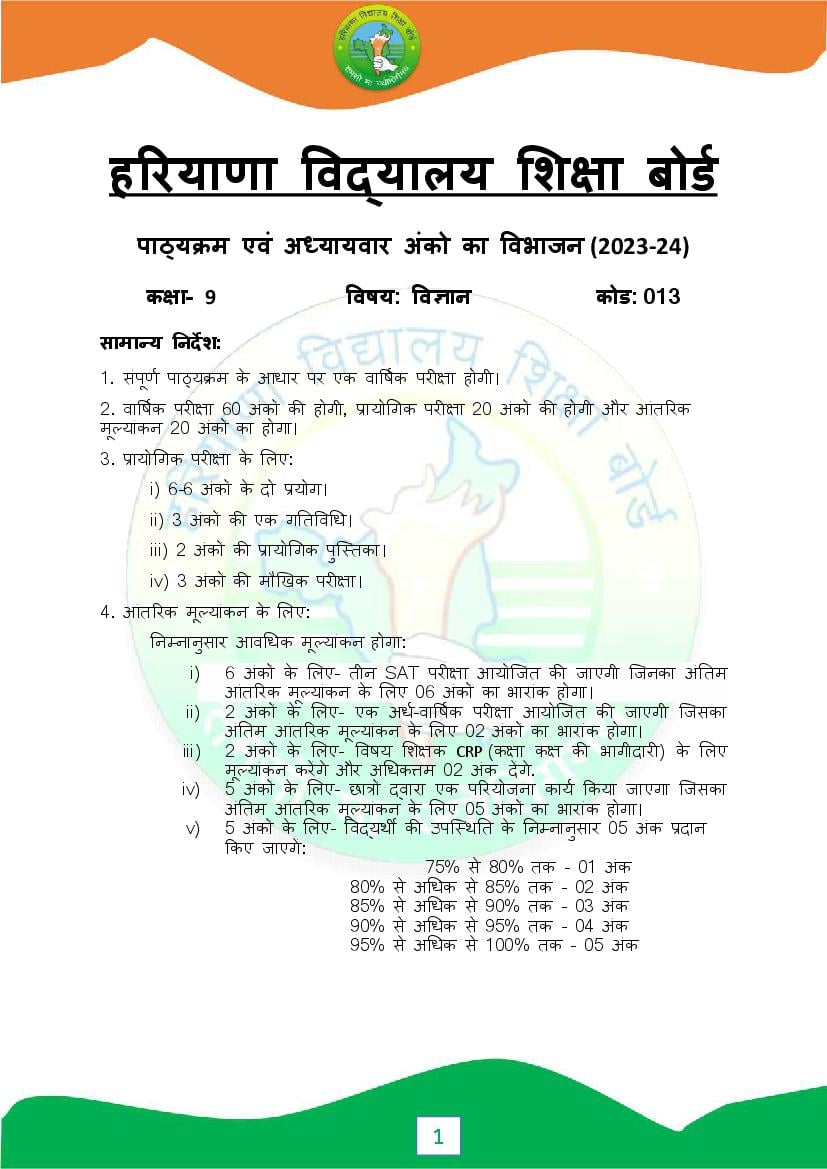
पा य म एवं अ यायवार अंको का वभाजन (2023-24)
क ा- 9 वषय: व ान कोड: 013
सामा य नदश:
1. संपूण पा य म के आधार पर एक वा षक पर ा होगी।
2. वा षक पर ा 60 अंक क होगी, ायो गक पर ा 20 अंक क होगी और आंत रक
मू यांकन 20 अंक का होगा।
3. ायो गक पर ा के लए:
i) 6-6 अंक के दो योग।
ii) 3 अंक क एक ग त व ध।
iii) 2 अंक क ायो गक पुि तका।
iv) 3 अंक क मौ खक पर ा।
4. आंत रक मू यांकन के लए:
न नानुसार आव धक मू यांकन होगा:
i) 6 अंक के लए- तीन SAT पर ा आयोिजत क जाएगी िजनका अं तम
आंत रक मू यांकन के लए 06 अंक का भारांक होगा।
ii) 2 अंक के लए- एक अध-वा षक पर ा आयोिजत क जाएगी िजसका
अं तम आंत रक मू यांकन के लए 02 अंक का भारांक होगा।
iii) 2 अंक के लए- वषय श क CRP (क ा क क भागीदार ) के लए
मू यांकन करगे और अ धक म 02 अंक दगे.
iv) 5 अंक के लए- छा वारा एक प रयोजना काय कया जाएगा िजसका
अं तम आंत रक मू यांकन के लए 05 अंक का भारांक होगा।
v) 5 अंक के लए- व यथ क उपि थ त के न नानुसार 05 अंक दान
कए जाएग:
75% से 80% तक - 01 अंक
80% से अ धक से 85% तक - 02 अंक
85% से अ धक से 90% तक - 03 अंक
90% से अ धक से 95% तक - 04 अंक
95% से अ धक से 100% तक - 05 अंक
1
Page 2
क ा- 9 वषय: व ान कोड: 013
म इकाई अ याय अंक
सं या
1 पदाथ- कृ त और यवहार हमारे आस-पास के पदाथ
या हमारे आस-पास के पदाथ शु ध ह?
परमाणु एवं अणु 20
परमाणु क संरचना
2 जीव जगत म संगठन जीवन क मौ लक इकाई 14
ऊ क
3 ग त, बल और काय गत
बल और ग त के नयम
गु वाकषण
22
काय तथा ऊजा
वन
4 खा य उ पादन खा य संसाधन म सध
ु ार 4
कुल 60
ायो गक पर ा 20
आंत रक मू यांकन 20
कुल योग 100
2
Page 3
अ याय 1: हमारे आस-पास के पदाथ
पदाथ का भौ तक व प: पदाथ कण से मलकर बना होता है, पदाथ के ये
कण कतने छोटे ह; पदाथ के कण के अ भला णक गण ु : पदाथ के कण के
बीच र त थान होता है, पदाथ के कण नरं तर ग तशील होते ह, पदाथ के
कण एक-दस ू रे को आक षत करते ह; पदाथ क अव थाएँ: ठोस अव था, व
अव था, गैसीय अव था; या पदाथ अपनी अव था को बदल सकता है: तापमान
प रवतन का भाव, दाब-प रवतन का भाव; वा पीकरण: वा पीकरण को
भा वत करने वाले कारक,वा पीकरण के कारण शीतलता कैसै होती है।
अ याय 2: या हमारे आस-पास के पदाथ शु ध ह?
म ण या है: म ण के कार; वलयन या है: वलयन क सां ता, नलंबन
या है, कोलाइडल वलयन या है; भौ तक एवं रासाय नक प रवतन; शु ध
पदाथ के या कार ह: त व, यौ गक
अ याय 3: परमाणु एवं अणु
रासाय नक संयोजन के नयम: यमान संर ण का नयम, ि थर अनुपात का
नयम; परमाणु या होता है: व भ न त व के परमाणओ ु ं के आधु नक तीक
या ह, परमाणु यमान, परमाणु कस कार अि त व म रहते ह; अणु या
है : त व के अण,ु यौ गक के अण,ु आयन या होता है; रासाय नक सू लखना:
सरल यौ गक के सू ; आि वक यमान: आि वक यमान, सू इकाई
यमान
अ याय 4: परमाणु क संरचना
पदाथ म आवे शत कण; परमाणु क संरचना: टॉमसन का परमाणु का मॉडल,
रदरफ़ोड का परमाणु मॉडल, बोर का परमाि वक मॉडल, यू ॉन; व भ न क ाओं
म इले ॉन कैसे वत रत होते ह:; संयोजकता; परमाणु सं या तथा यमान
सं या: परमाणु सं या, यमान सं या; सम था नक: समभा रक
इकाई 2: जीव जगत म संगठन
अ याय 5: जीवन क मौ लक इकाई
सजीव कससे बने होते ह; को शका कससे बनी होती है? को शका का
संरचना मक संगठन या है: लै मा झ ल अथवा को शका झ ल , को शका
भ , क क, को शका य, को शका अंगक: अंत यी जा लका, गॉ जी
उपकरण, लाइसोसोम, माइटोकॉि या, लैि टड, रसधा नयाँ; को शका वभाजन
3
Page 4
या पौधे और जंतु एक ह तरह के ऊ क से बने होते ह; पादप ऊ क:
वभ यो क, थायी ऊ क: सरल थायी ऊ क, ज टल थायी ऊ क; जंतु
ऊ क: ए पथी लयमी ऊ क, संयोजी ऊ क, पेशीय ऊ क, तं का ऊ क
इकाई 3: ग त, बल और काय
अ याय 7: ग त
ग त का वणन: सरल रे खीय ग त, एकसमान ग त और असमान ग त; ग त क
दर का मापन: दशा के साथ चाल; वेग म प रवतन क दर; ग त का ाफ़ य
दशन: दरू -समय ाफ़, वेग-समय ाफ़; एकसमान व ृ ीय ग त
अ याय 8: बल और ग त के नयम
संतु लत और असंतु लत बल; ग त का थम नयम; जड़ व तथा यमान;
ग त का वतीय नयम: ग त के वतीय नयम क ग णतीय गणना; ग त
का तत ृ ीय नयम
अ याय 9: गु वाकषण
गु वाकषण: गु वाकषण का साव क नयम, गु वाकषण के साव क नयम
का मह व; मु त पतन: गु वीय वरण g के मान का प रकलन, प ृ वी के
गु वीय बल के भाव म व तओ ु ं क ग त; यमान; भार: कसी व तु का
चं मा पर भार; णोद तथा दाब: तरल म दाब, उ लावकता, पानी क सतह
पर रखने पर व तए
ु ँ तैरती या डूबती य ह; आ क मडीज़ का स धांत
अ याय 10: काय तथा ऊजा
काय: कठोर काम करने के बावजूद कुछ अ धक ‘काय’ नह ं, काय क वै ा नक
संक पना, एक नयत बल वारा कया गया काय; ऊजा: ऊजा के प, ग तज
ऊजा, ि थ तज ऊजा, कसी ऊँचाई पर व तु क ि थ तज ऊजा, या ऊजा के
व भ न प पर पर प रवतनीय ह, ऊजा संर ण का नयम; काय करने क
दर
अ याय 11: वन
व न का उ पादन; व न का संचरण: व न तरं ग अनद ु ै य तरं ग ह, व न
तरं ग के अ भल ण, व भ न मा यम म व न क चाल; व न का परावतन:
त व न, अनरु णन, व न के बहुल परावतन के उपयोग; यता का प रसर;
परा व न के अनु योग
4
Page 5
अ याय 12: खा य संसाधन म सध
ु ार
फसल उ पादन म उ न त: फसल क क म म सुधार, फसल उ पादन बंधन:
पोषक बंधन, संचाई, फसल पैटन, फसल सरु ा बंधन; पशप
ु ालन: पशु कृ ष,
मुग पालन, म य उ पादन: समु म यक , अत: थल म यक , मधुम खी
पालन
योग:
1. दशाएं क गैस सग ु मता से संपी ड़त होती ह ले कन व नह ं।
2. ऊधवपातनीय ठोस को गरम करने पर उनक अव था म प रवतन का अ ययन
कर।
3. सामा य लवण का यमान आधा रत 10% संघटन का वलयन बनाएं।
4. संयु त सू मदश के व भ न अंगो का अ ययन कर।
5. याज के छ के का अ भरं िजत, अ थायी आरोपण व इसक को शकाओं का
अ ययन कर।
6. व भ न कार के जंतु ऊ क का चाट क सहायता से अ ययन कर।
7. एकसमान चाल से ग तमान कसी प ड के लए दए गए s तथा t के आंकड़
के समु चय से दरू -समय(s-t) ाफ खींच तथा प ड क चाल ात कर।
8. एकसमान वरण से ग तमान प ड के लए दए गए (v-t) आंकड़ के समु चय
से वेग-समय(v-t) ाफ खींच तथा प ड का वरण तथा प ड वारा चल गयी
दरू ात कर।
9. दो कमानीदार तुलाओं का उपयोग करके ग त के तीसरे नयम का अ ययन
कर।
10. आ क मडीज़ के नयम को स या पत कर।
11. व न के परावतन का अ ययन कर।
12. व भ न कार के अनाज, दाल और तलहन के बीज इक ठा कर।
5
Page 6
क ा- 9 वषय: व ान कोड: 013
मास वषय- व तु श ण कालांश दोहराई योगा मक
कालांश काय
अ ैल अ याय 1: हमारे आस-पास के 8 1
पदाथ
योग: दशाएं क गैस सुगमता
से संपी ड़त होती ह ले कन व 1
नह ं।
योग: ऊधवपातनीय ठोस को
गरम करने पर उनक अव था 1
म प रवतन का अ ययन कर।
अ याय 7: ग त 8 1
योग: एकसमान चाल से
ग तमान कसी प ड के लए
दए गए s तथा t के आंकड़ के 1
समु चय से दरू -समय(s-t) ाफ
खींच तथा प ड क चाल ात
कर।
योग: एकसमान वरण से
ग तमान प ड के लए दए गए
(v-t) आंकड़ के समु चय से
वेग-समय(v-t) ाफ खींच तथा
प ड का वरण तथा प ड 1
वारा चल गयी दरू ात कर।
मई अ याय 2: या हमारे आस-पास 8 1
के पदाथ शु ध ह?
योग: सामा य लवण का
यमान आधा रत 10% संघटन 1
का वलयन बनाएं।
अ याय 5: जीवन क मौ लक
इकाई 8 1
6
Page 7
व भ न अंगो का अ ययन कर। 1
योग: याज के छ के का
अ भरं िजत, अ थायी आरोपण व
इसक को शकाओं का अ ययन 1
कर।
जून
ी मकाल न अवकाश (उपरो त अ याय से संबं धत कोई प रयोजना काय
दया जाए।)
जल
ु ाई अ याय 6: ऊ क 10 1
योग: व भ न कार के जंतु 2
ऊ क का चाट क सहायता से
अ ययन कर।
अग त अ याय 8: बल और ग त के 8 1
नयम
योग: दो कमानीदार तुलाओं का
उपयोग करके ग त के तीसरे 1
नयम का अ ययन कर।
अ याय 9: गु वाकषण 8 1
योग: आ क मडीज़ के नयम को 1
स या पत कर।
सतंबर अध-वा षक पर ा के लए 12
दोहराई
अध-वा षक पर ा
अ तू ब र अ याय 3: परमाणु एवं अणु 10 2
अ याय 10: काय तथा ऊजा 8 1
नवंबर अ याय 4: परमाणु क संरचना 10 2
दसंबर अ याय 11: वन 8 1
योग: व न के परावतन का 1
अ ययन कर।
7
Page 8
सुधार
योग: व भ न कार के 1
अनाज, दाल और तलहन के
बीज इक ठा कर।
जनवर शीतकाल न अवकाश: 1 से 15
जनवर
दोहराई 12
फ़रवर दोहराई 20
माच वा षक पर ा
नोट:
वषय श क को सलाह द जाती है क वे छा को श दावल या अवधारणा क
प टता को बढ़ाने के लए अ याय म उपयोग क जाने वाल श दावल / प रभाषा मक
श द क नोटबुक तैयार करने के लए नद शत कर।
NCERT क पा य पु तक पाठ म ब से म जानकार तुत करती ह। ये छा को
वैचा रक प टता ा त करने म मदद करते ह। हालां क, इन ब से म मौजद
ू जानकार
का आंकलन साल के अंत क पर ा म नह ं कया जाएगा।
नधा रत पु तक:
1. व ान-क ा नौवीं के लए पा य पु तक- BSEH काशन (© NCERT)
2. योगशाला पुि तका- व ान- क ा नौवीं, NCERT काशन
3. न द शका- व ान- क ा नौवीं, NCERT काशन
8
Page 9
क ा- 9 वषय: व ान कोड: 013
न का अंक सं या ववरण कुल अंक
कार
व तु न ठ 1 15 6 बहु- वक पीय न, 15
न 3 र त थान भरो न,
3 एक श द य उ र के न,
3 अ भकथन-कारण न
अत 2 6 क ह 2 न म आंत रक 12
लघु रा मक वक प दया जाएगा
न
लघु रा मक 3 6 क ह 2 न म आंत रक 18
न वक प दया जाएगा
दघ 5 3 सभी न म आंत रक 15
उ रा मक वक प दया जाएगा
न
कुल 30 60
9
Page 10
Syllabus and Chapter wise division of Marks (2023-24)
Class- 9 Subject: Science Code: 013
General Instructions:
1. There will be an Annual Examination based on the entire syllabus.
2. The Annual Examination will be of 60 marks, Practical Examination will be
of 20 marks and 20 marks weightage shall be for Internal Assessment.
3. For Practical Examination:
i) Two experiments of 6 marks each.
ii) One activity of 3 marks.
iii) Practical record of 2 marks.
iv) Viva-voce of 3 marks.
4. For Internal Assessment:
There will be Periodic Assessment that would include:
i) For 6 marks- Three SAT exams will be conducted and will have
a weightage of 06 marks towards the final Internal Assessment.
ii) For 2 marks- One half yearly exam will be conducted and will
have a weightage of 02 marks towards the final Internal
Assessment.
iii) For 2 marks- Subject teacher will assess and give maximum 02
marks for CRP (Class room participation).
iv) For 5 marks- A project work to be done by students and will have
a weightage of 05 marks towards the final Internal Assessment.
v) For 5 marks- Attendance of student will be awarded 05 marks as:
75% to 80% - 01 marks
Above 80% to 85% - 02 marks
Above 85% to 90% - 03 marks
Above 90% to 95% - 04 marks
Above 95% to 100% - 05 marks
10
Page 11
Class- 9 Subject: Science Code: 013
Sr. No. Unit Chapter Marks
1 Matter-Nature and Matter in Our Surroundings
Behaviour
Is Matter around Us Pure 20
Atoms and Molecules
Structure of Atom
2 Organization in the Living Fundamental Unit of Life 14
World Tissues
3 Motion, Force and Work Motion
Force and Laws of Motion
Gravitation 22
Work and Energy
Sound
4 Food Production Improvement in Food Resources 4
Total 60
Practical Examination 20
Internal Assessment 20
Grand Total 100
11
Page 12
Chapter 1: Matter in Our Surroundings
Physical nature of matter: Matter is made up of particles, How
small are these particles of matter; Characteristics of particles of
matter: Particles of matter have space between them, Particles of
matter are continuously moving, Particles of matter attract each
other; States of Matter: The solid state, The liquid state, The
gaseous state; Can Matter change its state: Effect of change of
temperature, Effect of change of pressure; Evaporation: Factors
affecting evaporation, How does evaporation cause cooling
Chapter 2: Is Matter around us Pure?
What is a mixture: Type of mixtures; What is a solution:
Concentration of a solution, What is a suspension, What is a
colloidal solution; Physical and Chemical changes; What are the
types of pure substances: Elements, Compounds
Chapter 3: Atoms and Molecules
Laws of chemical combination: Law of conservation of mass, Law
of constant proportions; What is an atom: What are the modern-
day symbols of atoms of different elements, Atomic mass, How do
atoms exist; What is a molecule: Molecules of elements, Molecules
of compounds, What is an ion; Writing chemical formulae:
Formulae of simple compounds; Molecular mass: Molecular mass,
Formula unit mass
Chapter 4: Structure of the Atom
Charged particles in matter; The structure of an atom:
Thomson’s model of an atom, Rutherford’s model of an atom,
Bohr’s model of an atom, Neutrons; How are electrons distributed
12
Page 13
number: Atomic number, Mass Number; Isotopes: Isobars.
Unit 2: Organization in the Living World
Chapter 5: The Fundamental Unit of Life
What are living organisms made of; What is a Cell Made Up of?
What is the Structural Organisation of a Cell: Plasma membrane
or Cell Membrane, Cell wall, Nucleus, Cytoplasm, Cell organelles:
Endoplasmic reticulum, Golgi apparatus, Lysosomes, Mitochondria,
Plastids, Vacuoles; Cell Division.
Chapter 6: Tissues
Are plants and animals made up of same type of tissues; Plant
tissues: Meristematic tissue, Permanent tissue: Simple permanent
tissue, Complex permanent tissue; Animal tissues: Epithelial tissue,
Connective tissue, Muscular tissue, Nervous tissue.
Unit 3: Motion, Force and Work
Chapter 7: Motion
Describing motion: Motion along a straight line, Uniform motion
and non-uniform motion; Measuring the rate of motion: Speed
with direction; Rate of change of velocity; Graphical
representation of motion: Distance-time graphs, Velocity-time
graphs; Uniform circular motion
Chapter 8: Force and Laws of Motion
Balanced and Unbalanced forces; First law of motion; Inertia
and mass; Second law of motion: Mathematical formulation of
second law of motion; Third law of motion
13
Page 14
Gravitation: Universal law of gravitation, Importance of universal
law of gravitation; Free fall: To calculate the value of g, Motion of
objects under the influence of gravitational force of earth; Mass;
Weight: Weight of an object on the moon; Thrust and pressure:
Pressure in fluids, Buoyancy, Why objects float or sink when placed
on the surface of water; Archimedes’ principle
Chapter 10: Work and Energy
Work: Not much ‘work’ in spite of working hard, Scientific
conception of work, Work done by a constant force; Energy: Forms
of energy, Kinetic energy, Potential energy, Potential energy of an
object at a height, Are various energy forms interconvertible, Law of
conservation of energy; Rate of doing work
Chapter 11: Sound
Production of sound; Propagation of sound: Sound waves are
longitudinal waves, Characteristics of a sound wave, Speed of sound
in different media; Reflection of sound: Echo, Reverberation, Uses
of multiple reflection of sound; Range of hearing; Applications of
ultrasound.
Unit 4: Food Production
Chapter 12: Improvement in food resources
Improvement in crop yields: Crop variety improvement, Crop
production management: Nutrient management, Irrigation,
Cropping patterns, Crop protection management; Animal
Husbandry: Cattle farming, Poultry farming, Fish production:
marine fisheries, inland fisheries, Beekeeping.
Practicals:
1. Show that gases are readily compressible, and liquids are not.
2. Study the changes in state of sublimate solids on heating.
14
Page 15
4. Study the different parts of a compound microscope.
5. Prepare a stained, temporary mount of onion peel and to study its cells.
6. Study different types of animal tissues with the help of a chart.
7. Plot distance – time (s–t) graph for an object moving with a uniform
speed from a given set of s and t data and to determine the speed of the
object.
8. Plot the velocity–time (v-t) graph for an object moving with uniform
accelerations from a given set of v-t data and to determine the
acceleration of the moving object and the distance moved by the object.
9. Study the third law of motion using two spring balances.
10.Verify Archimedes’ principle.
11.Study the reflection of sound.
12.Collect seeds of different types of cereals, pulses and oil seeds.
15
Page 16
Class- 9 Subject: Science Code: 013
Month Subject- content Teaching Revision Practical
Periods Periods Work
April Chapter 1: Matter in Our 8 1
Surroundings
Practical: Show that gases 1
are readily compressible,
and liquids are not.
Practical: Study the
changes in state of 1
sublimate solids on
heating.
Chapter 7: Motion 8 1
Practical: Plot distance –
time (s–t) graph for an
object moving with a 1
uniform speed from a
given set of s and t data
and to determine the
speed of the object.
Practical: Plot the
velocity–time (v-t) graph
for an object moving with
uniform accelerations
from a given set of v-t 1
data and to determine the
acceleration of the
moving object and the
16
Page 17
object.
May Chapter 2: Is Matter 8 1
around us Pure?
Practical: Prepare a
solution of common salt 1
of 10% composition by
mass.
Chapter 5: The 8 1
Fundamental Unit of Life
Practical: Study the
different parts of a 1
compound microscope.
Practical: Prepare a
stained, temporary mount
of onion peel and to study 1
its cells.
June
Summer Vacation (Any Project work should be given related to
above chapters)
July Chapter 6: Tissues 10 1
Practical: Study different
types of animal tissues 2
with the help of a chart.
August Chapter 8: Force and 8 1
Laws of Motion
1
17
Page 18
law of motion using two 8 1
spring balances.
Chapter 9: Gravitation 1
Practical: Verify
Archimedes’ principle.
September Revision for Half-Yearly 12
Exam
Half-Yearly Exam
October Chapter 3: Atoms and 10 2
Molecules
Chapter 10: Work and 8 1
Energy
November Chapter 4: Structure of 10 2
the Atom
December Chapter 11: Sound 8 1
Practical: Study the 1
reflection of sound.
Chapter 12: Improvement 8 1
in food resources
Practical: Collect seeds of
different types of cereals, 1
pulses and oil seeds.
January Winter Vacation: 1st to
15th January
Revision 12
18
Page 19
March Annual Examination
Note:
Subject teachers are advised to direct the students to prepare notebook
of the Terminology/Definitional Words used in the chapters for
enhancement of vocabulary or clarity of the concept.
The NCERT textbooks present information in boxes across the book.
These help students to get conceptual clarity. However, the
information in these boxes would not be assessed in the year-end
examination.
Prescribed Books:
1. Science- Text book for Class IX, BSEH Publication (© NCERT)
2. Laboratory Manual-Science-Class IX, NCERT Publication
3. Exemplar Problems- Science-Class IX, NCERT Publication
19
Page 20
Class- 9 Subject: Science Code: 013
Type of Marks Number Description Total
Question Marks
Objective 1 15 6 Multiple Choice Questions, 15
Questions 3 Fill in the Blanks
Questions,
3 One Word Answer Type
Questions, 3 Assertion-
Reason Questions
Very Short 2 6 Internal choice will be given 12
Answer Type in any 2 questions
Question
Short Answer 3 6 Internal choice will be given 18
Type in any 2 questions
Question
Essay Answer 5 3 Internal options will be given 15
Type in all the questions
Question
Total 30 60
20
Document Details
| Board / Org | Haryana Board |
| Exam | Class 9 |
| Type | Syllabus |
| Pages | 20 |
| Updated | 30 Apr 2026 |