JEMAS PG 2021 Question Paper M.Sc MLT
Finished viewing? Save it for later —
Download JEMAS PG 2021 Question Paper M.Sc MLT (PDF · 14 pages)About JEMAS PG 2021 Question Paper M.Sc MLT
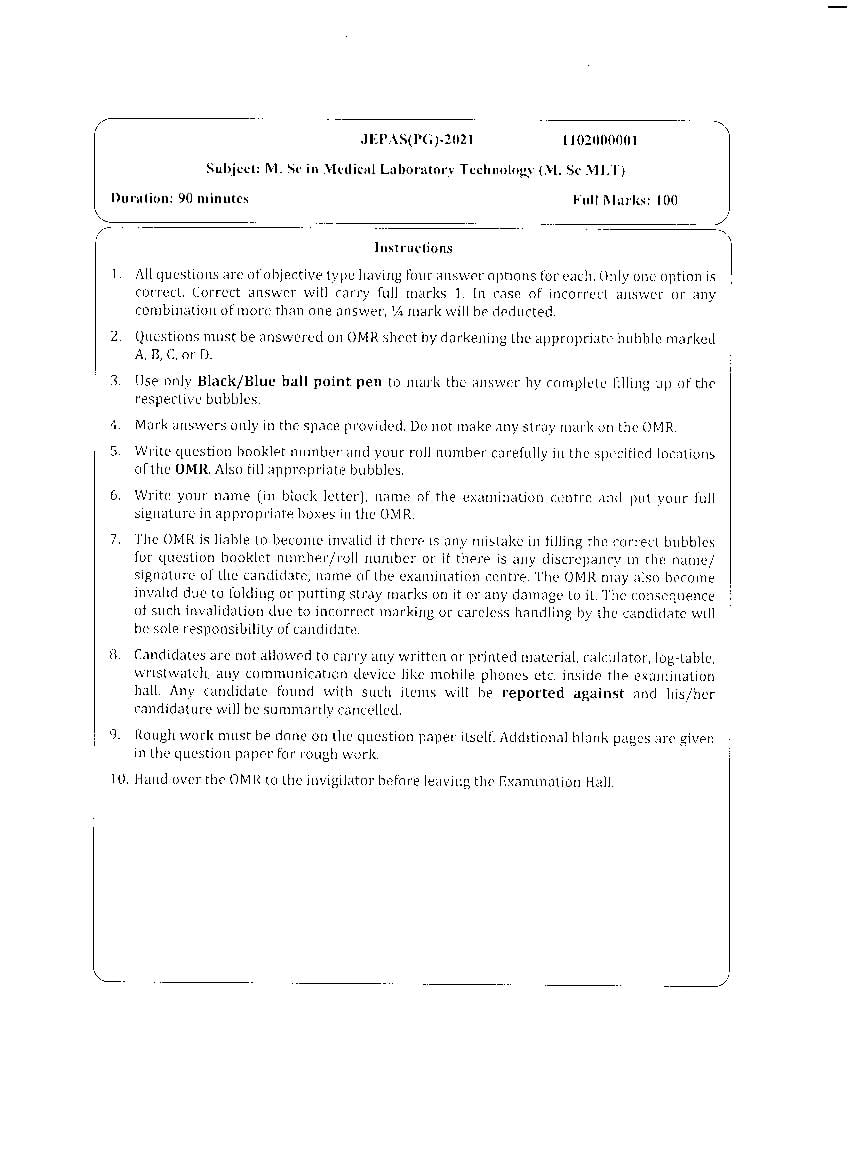
JEMAS PG 2021 Question Paper M.Sc MLT is available here for free download. Published by WBJEEB for WB JEMAS PG, this question paper can be viewed online or downloaded as a PDF (14 pages). Candidates preparing for WB JEMAS PG can use JEMAS PG 2021 Question Paper M.Sc MLT to understand the exam pattern, the type of questions asked, and the overall difficulty level.
Frequently Asked Questions
How can I download JEMAS PG 2021 Question Paper M.Sc MLT?
Open this page and click the Download button to save JEMAS PG 2021 Question Paper M.Sc MLT as a PDF. It is completely free on AglaSem Docs.
Is JEMAS PG 2021 Question Paper M.Sc MLT free to download?
Yes. JEMAS PG 2021 Question Paper M.Sc MLT can be viewed online and downloaded as a PDF free of cost on AglaSem Docs.
How many pages does JEMAS PG 2021 Question Paper M.Sc MLT have?
JEMAS PG 2021 Question Paper M.Sc MLT contains 14 pages, which you can read online or download together as a single PDF.
Where can I find more WB JEMAS PG study material?
You can find more WB JEMAS PG question papers, sample papers, syllabus, and answer keys on AglaSem Docs.
JEMAS PG 2021 Question Paper M.Sc MLT – Text
Read the full text of this question paper below — useful to quickly search, copy and reference the content online without downloading the PDF.
📄 View text version (13 pages)
Page 2
Group – A
1. Albumin, Alpha1, Alpha2, Beta and Gamma globulin are electrophoric part of
a) Hemoglobin.
b) Urine.
c) Serum.
d) Tissue extract.
2. Which of the following is not a cause of acute pancreatitis?
a) Hyperlipidemia.
b) Ethanol.
c) Steroids.
d) Hypotension.
3. Which of the following is not directly related with Alzheimer’s disease?
a) Senile plaques.
b) Diabetes mellitus.
c) Tangles.
d) Dementia.
4. A substance that produces prolonged prothrombin time when given orally is
a) Heparin.
b) Protamin sulfate.
c) Coumarin.
d) Salicylate.
5. Fibrinogen determination is performed on
a) Plasma only.
b) Serum Only.
c) Either Plasma or Serum.
d) Any body fluid other than Serum or Plasma.
6. To make 1:5 dilution of serum sample, one have to make
a) 1 ml serum + 5 ml diluent.
b) 5ml serum + 1 ml diluent.
c) 1 ml serum + 4 ml Diluent.
d) 1 ml Serum + 6 ml Diluent.
7. In human body sodium is responsible for the maintenance of
a) Cardiac muscle contraction.
b) Blood coagulation.
c) Osmotic balance.
d) Salt intake.
Page 3
Creatinine Phosphokinase (CPK), 3. Serum Glutamate Oxaloacetate Transaminase (SGOT)
a) 1 and 2.
b) 2 and 3.
c) Only 2.
d) 1, 2 and 3.
9. Blood Glucose level is directly regulated by the hormone
a) Insulin.
b) Thyroxin.
c) ACTH.
d) ADH.
10. What is the arithmetic mean of the data set: 4, 5, 0, 10, 8, and 3?
a) 4.
b) 5.
c) 6.
d) 7.
11. Which is the total yield of ATP in a TCA cycle in eucaryotic cell
a) 38.
b) 30.
c) 32.
d) 2.
12. Which of the following is not directly related with Hasimoto’s thyroiditis?.
a) Hypothyroidism.
b) Slow onset.
c) Neuropathy.
d) Autoimmune disease.
13. When using a buffer of pH 8.6, each of the serum proteins in an electrical field migrates towards
a) Cathode (+ve electrode).
b) Anode (-ve electrode).
c) Towards both.
d) Either depending upon molecular weight.
14. The Ketone bodies include Acetoacetic acid, Acetone and.
a) Oxalic Acid.
b) Beta hydroxy butyric acid.
c) Lactic acid.
d) Pyruvic acid.
15. Alkaline phosphatase is GREATLY elevated in
a) Myocardial infarction.
b) Obstructive jaundice.
c) Liver disease.
d) Kidney disease.
Page 4
a) Factor VII deficiency.
b) Factor IX deficiency.
c) Hemophilia.
d) Platelet function.
17. Which of the following amino acids if added to a acidic solution will have buffer action on solution at
physiological pH
a) Alanine.
b) Glycine.
c) Histidine.
d) Arginine.
18. An Alpha helix represents
a) Primary structure of protein.
b) Secondary structure of protein.
c) Tertiary structure of protein y.
d) Quaternary structure of protein.
19. Which one of the disease is not related to thyroid gland
a) Cretinism.
b) Myxoedema.
c) Goitere.
d) Acromegaly.
20. Proteinuria can be defined as the presence of protein in urine greater than
a) 30 mg/dl.
b) 300 mg/dl.
c) 10 mg/dl.
d) 3 mg/dl.
21. Creatinine clearance test is used for
a) Estimation of renal blood flow.
b) Estimation of glomerular filtration rate.
c) Evaluation of glomerular Nephroticthiasis.
d) None of the above.
22. What is the rate limiting enzyme in glycolysis
a) Hexokinase.
b) Phosphofructokinase isomerase.
c) Glyceraldehyde 3 phosphate dehydrogenase.
d) Enolase.
23. The catalytic activity of two different enzymes can be compared by
a) Km value.
b) pH of the optimum value.
c) Molecular size of the enzyme.
d) Formation of product.
Page 5
a) Liniolenic acid.
b) Oleic acid.
c) Palmitic acid.
d) All of the above.
25. Which force maintain the 3D structure of protein mainly
a) Non Co-valemt.
b) Covalent.
c) Coordinate.
d) Covalent & Non covalent.
26. Which of the following hormone inhibit Gluconeogenesis?
a) Insulin.
b) Glucagon.
c) Growth Hormone.
d) None.
27. Which of the following is the end product of purine metabolism in human?
a) Xanthine.
b) Uric acid.
c) Urea.
d) Allantoin.
28. Arrangement of nucleotides in DNA can be seen by
a) Ultra Centrifugation.
b) X Ray Crystalography.
c) Light microscope.
d) Electron microscope.
29. Values at 3SD limits are called
a) Action limit.
b) Warning limit.
c) Assay is satisfactory.
d) None of the above.
30. What is the name of an instrument used to measure the absorbance of a coloured compound?
a) Spectrofluorometer.
b) pH meter.
c) Voltameter.
d) Colorimeter.
31. The β-hCG secreted from
a) Adrenal medulla.
b) Prostate gland.
c) Ovarian follicles.
d) Syncytiotrophoblastic cells of the placenta.
Page 6
a) 10mg/ml.
b) 20mg/ml.
c) 2mg/ml.
d) 15mg/ml.
33. Heller's nitric acid test of urine is done to detect
a) Sugar.
b) Protein.
c) Ketone bodies.
d) Bile salt.
34. The measure of closeness of the estimated value to the true value
a) Precision.
b) Accuracy.
c) Internal quality.
d) External quality.
35. If 500mg glucose is dissolved in 100mL water then the concentration of glucose in 2mL solution is
a) 5mg.
b) 200mg.
c) 10mg.
d) 20mg.
36. Elevated phosphorus levels are seen in
a) Renal failure.
b) Vit-D overdosage.
c) Pancreatitis.
d) Liver disease.
37. Hemophilia is due to absence of
a) Factor VI.
b) Factor VII.
c) Factor VIII.
d) Factor X.
38. Which of the following is not an essential amino acid?
a) Proline.
b) Histidine.
c) Leucine.
d) Methionine.
39. The DNA molecule is a double helical strand having the following nucleotide bases:
a) Cytosine, thymine, alanine, guanine.
b) Adenine, guanine, valine, thymine.
c) Cytosine, lysine, adenine, guanine.
d) Adenine, guanine, cytosine, thymine.
Page 7
a) Glucose & galactose.
b) Glucose & Glucose.
c) Glucose & Lactose.
d) Fructose & Lactose.
41. Enzymes for beta oxidation of fatty acids are located in
a) Mitochondria.
b) Mitochondria & cytoplasm.
c) Mitochondria & Golgi.
d) Mitochondria & peroxisome.
42. Gout is caused by the build up of what substance in the body?
a) WBCs.
b) Synovial fluid.
c) Uric acid.
d) Blood plasma.
43. Indirect ELISA, which is detected in sample?
a) Antigens.
b) Antibody.
c) Both option 1&2.
d) None of the above.
44. The enzyme used for the synthesis of cDNA
a) DNA Polymerase.
b) DNA Ligase.
c) Reverse transcriptase & Taq polymerase.
d) Reverse transcriptase.
45. Bence-Jones protein can be detected in urine by-
a) Biuret test.
b) Heat test.
c) Rother's test.
d) Millon's test.
46. Name the coenzyme of riboflavin
a) NAD or NADP.
b) FAD or FMN.
c) Coenzyme A.
d) Thiamine pyrophosphate.
47. Which of the following mineral deficiency may result into impaired growth and development, skin
lesson and loss of appetite?
a) Zinc.
b) Cobalt.
c) Iron.
d) Magnesium.
Page 8
a) Precipitation.
b) Opsonization.
c) Agglutination.
d) Floculation.
49. Example of basic amino acid-
a) Arginine.
b) Proline.
c) Leucine.
d) Alanine.
50. All are precipitation reaction except
a) VDRL test.
b) Kahn test.
c) Widal Test.
d) Ascoli's test.
Group – B
51. Fungi are commonly identified on the basis of their
a) Serologic and biochemic characteristics.
b) Staining properties of polychrome dyes.
c) Solubility in 20% potassium hydroxide.
d) Sporulation and spore arrangement in hyphae.
52. In serologic tests of syphilis, reagin test may result from an acute or chronic infection such as
a) Pneumonia.
b) Infectious hepatitis.
c) Lupus erythematosus.
d) Helicobactor pylori.
53. Only receiving cannot accept a specimen unless it has
a) An uncontaminated signed requisition with billing information.
b) A correct legible label.
c) An intact container with correct media.
d) All of the above.
54. Which one of the following differentiates staphylococcus aureus from other species of staphylococci
a) Oxidase.
b) Coagulase.
c) Dehydrogenase.
d) Fibrinolysin.
55. A trophozoit of entamoeba histolytica usually contains
a) Bacteria and coarse granules in the cytoplasm.
b) Eccentracillay located endosome in the nucleus.
c) Red blood cells in the cytoplasm.
d) A coarse, granular blunt pseudopod.
Page 9
a) Neutrophil.
b) B cell.
c) Macrophage.
d) T cell.
57. Which of the following cells is involved in cell-mediated immunity?
a) Leukaemia.
b) T cells.
c) Mast cells.
d) Thrombocytes.
58. Which media is used to isolate Staphylococcus aureus from a sample containing mixed bacterial flora
such as feces
a) Mannitol salt agar.
b) An enrichment broth.
c) Mac Conky agar.
d) EMB agar.
59. A compound light microscope allows clear visualization of objects no smaller than a:
a) Typical virus.
b) DNA molecule.
c) Small bacterium.
d) Large protozoa.
60. Chemicals released from mast cells during an allergic reaction include all of the following except:
a) Histamine.
b) Interferons.
c) Prostaglandins.
d) Leukotrienes.
61. A structural component that is found in all viruses is:
a) The envelope.
b) Capsid.
c) DNA.
d) Spikes.
62. Which of the following microscope was used to first identify human rotavirus?
a) Light microscope.
b) Phase-contrast microscope.
c) Dissection microscope.
d) Electron microscope.
63. What is the other name for coccidioidomycosis?
a) Yellow fever.
b) San Joaquin Valley fever.
c) Rocky mountain fever.
d) Relapsing fever.
Page 10
a) Nose.
b) Skin wounds.
c) Both of the above.
d) None of the above.
65. Which of the following is not a recognised cause of diarrhoea?
a) Vibrio cholerae.
b) Escherichia coli.
c) Clostridium perfringens.
d) Enterococcus faecalis.
66. Ring worm is a disease caused by
a) Fungus.
b) Bacteria.
c) Tape worm.
d) Round worm.
67. Microbes which are capable of growing over a wide range of temperature are called
a) Stenothermal.
b) Thermotolerant.
c) Thermophilic.
d) Eurythermal.
68. The disease commonly called by “lock jaw” is caused by
a) Bacillus pertussis.
b) Mycobacterium.
c) Clostridium tetani.
d) Treponema pallidum.
69. Weil felix test is done for trhe diagnosis of
a) Rickettsia.
b) Patussis.
c) Cholera.
d) African sleeping sickness.
70. The vector for the transmission of the disease KALA AZAR is
a) Ades.
b) Anopheles.
c) Glossina.
d) Sandflies.
71. Exponential growth observed in which phase of Bacterial growth curve
a) Log phase.
b) Lag phase.
c) Stationary phase.
d) Decline phase.
Page 11
a) Prototrophic.
b) Pleotrophic.
c) Hydrotrophic.
d) Methanotrophic.
73. Infective form of Taenia solium is
a) Cysticercus cellulosae.
b) Both cysticercus cellulose and egg.
c) None.
d) Only egg.
74. Negri bodies are found in
a) Hepatitis B.
b) Rabies.
c) Dengue.
d) None.
75. Donated blood undergoes screening for which diseases
a) HIV.
b) Viral Hepatitis.
c) Diabetes.
d) A and B.
76. Which is needed for performing Direct Coomb's test?
a) Patient's RBC.
b) Patient's serum.
c) Haemolysis.
d) Cells from buffy coat.
77. An epitope is
a) Antigenic determining site.
b) Antibody.
c) T-cell.
d) B-cell.
78. Eosinophilia is found in all, except
a) Allergic condition.
b) Parasitic condition.
c) Typhoid.
d) Skin disease.
79. Which antibody type protects against bacteria, virus and toxins in secondary immune response?
a) Ig A.
b) Ig D.
c) Ig E.
d) Ig G.
Page 12
a) Crossing the blood-brain barrier.
b) Meningococcemia.
c) Skin lesions.
d) Upper respiratory colonization.
81. A vaccine can be
a) An antigenic protein.
b) Weakened pathogen.
c) Live attenuated pathogen.
d) All of these.
82. In which of the following phases of growth is a Gram-positive Bacterium most susceptible to the action
of penicilin?
a) Lag.
b) Exponential.
c) Stationary.
d) Death.
83. A premature baby, 4 days old, has developed a white coating on her buccal mucosa extending onto her
lips. It appears to be painful. What is the most likely causative agent?
a) Aspergillus.
b) Fusobacterium.
c) Candida.
d) Microsporum.
84. Injection of anti-venom to a patient for snake bite is an example of
a) Naturally acquired active immunity.
b) Artificially acquired active immunity.
c) Naturally acquired passive immunity.
d) Artificially acquired passive immunity.
85. Receptors for steroid hormones usually reside at
a) Plasma membrane.
b) Cytoplasm.
c) Nuclear membrane.
d) Nucleoplasm.
86. A burn patient has an infected area with odiferous, blue-green pus.What is the most likely causative
agent?
a) Aspergillus fumigatus.
b) Pseudomonas aeruginosa.
c) Staphylococcus aureus.
d) Streptococcus pyogenes.
87. Hybridoma technology was developed by
a) Kohler & Milstein.
b) Khorana & Nirenberg.
c) Khorana & Korenberg.
d) Beedle & Tautum.
Page 13
a) Primary syphilis.
b) Secondary syphilis.
c) Tertiary syphilis.
d) Congenital syphilis.
89. In the following pairs of organisms, which two are easiest to distinguish from each other by Gram stain?
a) Bacillus & Clostridium.
b) Listeria & Proteus.
c) Salmonella & Shigella.
d) Haemophillus & Lactobacillus.
90. MHC class I is a cell surface molecule present on
a) B cells.
b) All nucleated cells.
c) APCs.
d) T cells.
91. Transfer of DNA from one bacterium to another by a bacteriophage is called-------
a) Conjugation.
b) Transduction.
c) Transformation.
d) Transposition.
92. Tuberculin test is which type of hypersensitivity reaction
a) IgE type.
b) Cytolytic & cytotoxic type.
c) Immune complex.
d) Delayed type.
93. A single Ig molecule contains-----
a) 1 light &1 heavy chain.
b) 2 light &1 heavy chain.
c) 2 light & 2 heavy chain.
d) 1 light & 2 heavy chain.
94. The culture methods used for antibiotic sensitivity testing is------
a) Streak method.
b) Stoke's method.
c) Lawn culture.
d) Pour platemethod.
95. The biochemical reaction that helps in the identification of M. tuberculosis is ------
a) Niacin test.
b) Aryl sulfatasetest.
c) Heat stable catalase test.
d) Oxidase test.
Page 14
a) Widal test.
b) RPR test.
c) PCR.
d) None of the above.
97. What is the full form of VDRL?
a) Venereal disease research laboratory test.
b) Vison detected research test.
c) Variation in different research laboratory test.
d) None of the above.
98. Filarial larva can be collected from man's---
a) Peripheral blood at mid night.
b) Smears ofspleen.
c) Biopsy of liver.
d) Smears of intestinal contents.
99. Streptococcus pyogens is
a) Alpha heamolytic.
b) Beta heamolytic.
c) Gamma heamolytic.
d) No heamolysis.
100. Gas gangrene caused by
a) Clostridium botulinum.
b) Clostridium tetani.
c) Clostridium perfringens.
d) Clostridium difficile.
Document Details
| Board / Org | WBJEEB |
| Exam | WB JEMAS PG |
| Type | Question Paper |
| Pages | 14 |
| Updated | 09 Jun 2026 |