JEMAS PG 2021 Question Paper M.Phil PSW
Finished viewing? Save it for later —
Download JEMAS PG 2021 Question Paper M.Phil PSW (PDF · 14 pages)About JEMAS PG 2021 Question Paper M.Phil PSW
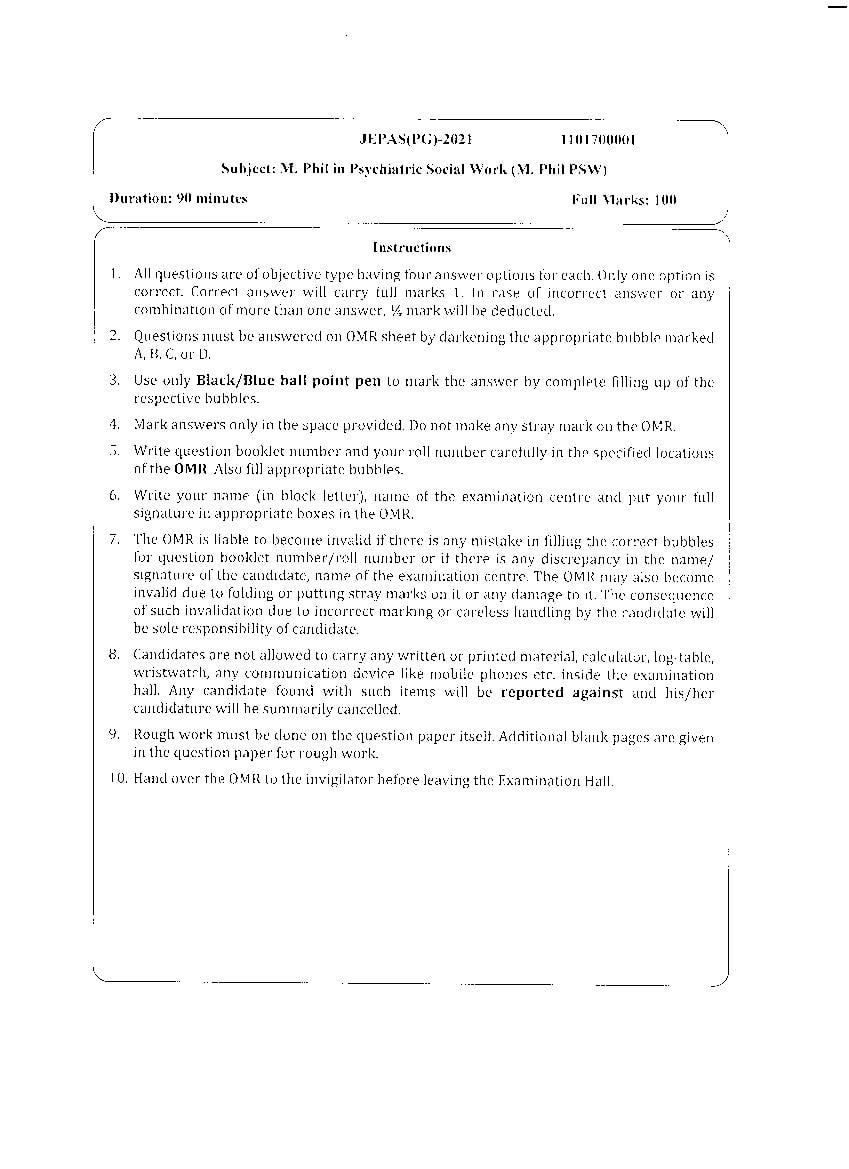
JEMAS PG 2021 Question Paper M.Phil PSW is available here for free download. Published by WBJEEB for WB JEMAS PG, this question paper can be viewed online or downloaded as a PDF (14 pages). Candidates preparing for WB JEMAS PG can use JEMAS PG 2021 Question Paper M.Phil PSW to understand the exam pattern, the type of questions asked, and the overall difficulty level.
Frequently Asked Questions
How can I download JEMAS PG 2021 Question Paper M.Phil PSW?
Open this page and click the Download button to save JEMAS PG 2021 Question Paper M.Phil PSW as a PDF. It is completely free on AglaSem Docs.
Is JEMAS PG 2021 Question Paper M.Phil PSW free to download?
Yes. JEMAS PG 2021 Question Paper M.Phil PSW can be viewed online and downloaded as a PDF free of cost on AglaSem Docs.
How many pages does JEMAS PG 2021 Question Paper M.Phil PSW have?
JEMAS PG 2021 Question Paper M.Phil PSW contains 14 pages, which you can read online or download together as a single PDF.
Where can I find more WB JEMAS PG study material?
You can find more WB JEMAS PG question papers, sample papers, syllabus, and answer keys on AglaSem Docs.
JEMAS PG 2021 Question Paper M.Phil PSW – Text
Read the full text of this question paper below — useful to quickly search, copy and reference the content online without downloading the PDF.
📄 View text version (13 pages)
Page 2
1. A social worker has been asked to see a couple who report frequent verbal conflicts and who are asking
for help in improving their communication skills. The social worker's FIRST response should be to:
a) Evaluate what the couple means by 'improved communication’.
b) Evaluate what the couple means by 'improved communication’.
c) Pursue relevant psychosocial background information.
d) Initiate a role-play experience to explore their communication patterns.
2. A double-barrelle question has the potential of having:
a) Two acceptable responses/answers.
b) Two answers but incompatible with each other.
c) Both (a) and (b).
d) None of these.
3. In theoretical field social research aims at:
a) Finding problems of human being.
b) Identifying delinquent behavior.
c) Reducing social conflict.
d) None of these.
4. Who among the following has proposed a model to explain the differentiation of social system, based on
an analysis o the way in which a particular system responds to forces for change
a) N. J. Smelser.
b) Talcott Parsons.
c) Daniel Bell.
d) Ulrich Beck.
5. Alienation as a widespread social problem was first highlighted by
a) Idealism.
b) Pragmatism.
c) Marxism.
d) Realism.
6. Worker Bee in an Honey Comb is an example of
a) Altruism.
b) Social Work.
c) Voluntary Work.
d) Selfishness.
7. Which of the following functions is usually associated with the basal ganglia?
a) Motor.
b) Speech.
c) Somatosensory.
d) Regulation of emotion.
Page 3
a) 50 per cent.
b) 16 per cent.
c) 25 per cent.
d) 10 per cent.
9. Isolation of affect occurs in
a) Obsessive Compulsive Disorder.
b) Manic phase.
c) Generalized anxiety disorder.
d) None of the above.
10. Which of the following methods are used in epidemiological research?
a) Cohort study.
b) Observation.
c) None of the above.
d) Both of the above.
11. Jung used the term "Collective Unconscious" to indicate
a) The unconscious tendencies inherited by an individual from primordial racial tendencies.
b) All the factors that together constitute to strengthen an individual's unconscious.
c) The unconscious potential of a group or mob.
d) The effects of all the unconscious urges which made a person's behaviour problematic.
12. Somatization is a type of ------------------ defence.
a) Narcisistic.
b) Immature.
c) Neurotic.
d) Mature.
13. The recent changes that have come with effect after passing Mental Health Care Act 2018 addresses
a) Decriminalisation of suicide.
b) Allowing patients to take decisions regarding their health.
c) Access to healthcare and treatment without discrimation.
d) All of the above.
14. ----------- is a not an example of non-parametric test.
a) Mann- Whitney U test.
b) Wilcoxon Rank Sum test.
c) Kruskal Wallis Test.
d) Independent Sample T-Test.
15. The term “Ambivalence” was coined by
a) Erick Erikson.
b) Emil Kraepelin.
c) Eugen Bleuler.
d) Robert Baron.
Page 4
a) Encoding social cues.
b) Deception.
c) Anger management.
d) Memory retrieval.
17. If you studied Spanish in high school, you might have a hard time learning German vocabulary words in
college because of
a) Retroactive Interference.
b) Proactive interference.
c) Generalization.
d) Decay.
18. Which of the following statement is true?
a) A person attempting suicide is necessarily an attention seeker.
b) A person who threats to commit suicide would never commit the same.
c) A person taking Psychiatric medicine will be dependent on medicine for.
d) None of the above.
19. For a person suffering from acute psychological trauma, the primary thing to do is –
a) To talk to his/her family members.
b) To hospitalize.
c) Crisis intervention.
d) Psychoanalysis.
20. Executive functioning does not include
a) Social judgment.
b) Prioritizing.
c) Speech regulation.
d) Planning.
21. Which of the following statistical technique is used to find out homogeneity of variance in a sample?
a) Levene’s Test.
b) Kruskal Wallis test.
c) Student’s t-test.
d) Wilcoxon Signed Rank test.
22. The fifth edition on the Diagnostic and Statistical Manual of Mental Disorders was published in the year
a) 2011.
b) 2013.
c) 2015.
d) 2017.
23. _________ is a book by Eric S Fromm which combines Marxism and Psychoanalysis:
a) Freud and Beyond.
b) Escape from Freedom.
c) To Have or to Be?
d) None of the above.
Page 5
a) Friedman Test.
b) Wilcoxon Signed Rank test.
c) Kruskal Wallis Test.
d) Mann Whitney U Test.
25. Cartell’s Culture Fair Intelligence Test is presumed to measure:
a) Crystallised Intelligence.
b) Verbal fluency.
c) Fluid Intelligence.
d) Convergent thinking.
26. Which of the following strategies is classified as ‘problem-focused’ rather than ‘emotion-focused’
a) Learning techniques of relaxation.
b) Seeking social support.
c) Engaging in physical exercise.
d) Engaging in cognitive reappraisal.
27. To describe a predisposition toward and risk triggers for a mental disorder, modern theorists use a
a) Diathesis-stress model.
b) Neurodevelopmental model.
c) Clinical-reductionist model.
d) Syndrome-sign model.
28. Mature defence mechanism is exemplified by all except
a) Anticipation.
b) Blocking.
c) Humour.
d) Suppression.
29. One neurotransmitter involved in producing positive symptoms of psychosis is
a) Adrenaline.
b) GABA.
c) Serotonin.
d) Dopamine.
30. In Survey Research
a) Existing data are examined.
b) New data is generated.
c) A control group is necessary.
d) A sample of people are asked questions.
31. Expectancy theory is the example of
a) Cognitive theory.
b) Needs theory.
c) Hierarchical theory.
d) Process theory.
Page 6
a) Introspection Method.
b) Experimental Method.
c) Observational Method.
d) Case History Method.
33. Language’ as phonemes is typically evident in children of which age?
a) One year.
b) 6 months.
c) 2 years.
d) Above 2 years.
34. Predictor of aggression and violent conduct -
a) Antisocial behaviour.
b) Family history.
c) History of mental illness.
d) a and b.
35. The concept of Extraversion and introversion was first given by
a) Alfred Alder.
b) Karen Horney.
c) Carl Jung.
d) Hans J. Eysenck.
36. Which is the most basic and common obstacle to problem solving?
a) Confirmation bias.
b) Fixation.
c) Functional Fixedness.
d) Mental Set.
37. You see cut marks on the left wrist of a girl you are interviewing. Your immediate response would be:
a) Ask why.
b) Call parents.
c) Take history.
d) Administer a personality inventory.
38. To ensure availability and accessibility of minimum mental healthcare for all in foreseeable future,
Government of India implemented _________ in 1982.
a) NMHP.
b) RCI.
c) DMHP.
d) MHA.
39. Bio feedback therapy is based on which of the following
a) Classical conditioning.
b) Observational learning.
c) Operant conditioning.
d) Cognitive learning.
Page 7
a) Frontal lobe.
b) Parietal lobe.
c) Occipital lobe.
d) Association cortex.
41. Limbic System plays a role in
a) Formation of emotional memories.
b) Emotional reactions and behaviour.
c) Control.
d) All of the above.
42. Who is known as the originator of Psychology as an experimental science?
a) Freud.
b) Watson.
c) Roger.
d) Wundt.
43. Persons high in achievement motivation tend to prefer tasks that are _____.
a) Very easy.
b) Extremely difficult.
c) Moderately difficult.
d) All types of task.
44. Social structures are
a) Those aspects of a culture that are held in high regard, are desirable and therefore worthy of
emulation.
b) Principles of right and wrong actions and the rules & laws that govern the acceptable &unacceptable
behaviour.
c) Made up of a set of expectations about low people should behave in certain circumstances.
d) Methods of placing people in social strata.
45. The law of three stages of Social Development is originally propounded by
a) Karl Marx.
b) Talcott Persons.
c) Auguste Compte.
d) Herbert Spencer.
46. In which part of the Indian Constitution social policy is outlined?
a) Part I.
b) Part II.
c) Part III.
d) Part IV.
47. Assertion (A): Technological advancement adds to the complexity of human society. Reason (R): To
keep the advancement giving some of its negative implications need to be understood and dealt with
a) Both (A) and (R) are true.
b) Both (A) and (R) are not true.
c) (A) is not true, but (R) is the explanation of (A).
d) (A) is true, and (R) is not true.
Page 8
a) Community.
b) School.
c) Peer group.
d) Family.
49. Sometimes children face trouble in reading. This is known as
a) Minimal brain dysfunction.
b) Hyperactivity.
c) Dyslexia.
d) Specific organic disability.
50. Assertion (A): Psychologists generally agree that Intelligence Quotient (I.Q.) gets affected by
environment.
Reason (R): Intelligence Quotient (I.Q.) is a biological trait and it cannot be changed.
Codes:
a) Both (A) and (R) are true.
b) Both (A) and (R) are false.
c) (A) is true, but (R) is false.
d) (A) is true and (R) is the correct explanation of (A).
51. In classical conditioning, what happens to a neutral stimulus after it is associated with the unconditioned
stimulus? It becomes
a) Conditioned stimulus.
b) Conditioned response.
c) Unconditioned response.
d) TTAGGG sequence.
52. A person initially presenting with an episode of mania is classified as:
a) Unipolar.
b) Bipolar.
c) Affective disorder.
d) Personality disorder.
53. Symptoms usually present in somatisation disorder include:
a) Dysmenorrhoeal.
b) Palpitations.
c) Anxiety.
d) Nausea.
54. Which of the following is THE MOST IMPORTANT predictor of bipolar disorder in adolescent
depression?
a) Diurnal variation of mood.
b) Hypomania symptoms after taking antidepressants.
c) Hypersonic.
d) Increased weight.
Page 9
a) Illusions.
b) Hallucinations.
c) Delusions.
d) Affect episodes.
56. Deterioration of mental functions caused by the loss of nerve cells in brain is called
a) Mental retardation.
b) Delirium.
c) Dementia.
d) Depressive neurosis.
57. First “Padmashree” in athletics
a) P.T.Usha.
b) Milkha singh.
c) Bandhu singh.
d) None of these.
58. The smallest state of India is
a) Rajasthan.
b) Sikkim.
c) Himachal Pradesh.
d) Goa.
59. Kathak, Nauntanki, Jhora and Kajri are the important dances of
a) Uttaranchal.
b) Uttar Pradesh.
c) Jharkhand.
d) Chhattisgarh.
60. Assertion (A): Crime rate in India is increasing day-by-day.
Reason (R): Crime rate is increasing because people lack skills and use illegitimate means to achieve
their goals.
Codes:
a) Both (A) and (R) are true.
b) (A) is not true and (R) is the explanation of (A).
c) Both (A) and (R) are not true.
d) (A) is true and (R) is not the correct explanation of (A).
61. The ‘Group’ in the Social Group work is
a) Spontaneous.
b) Disunited.
c) Formed in a planned manner.
d) Disorganised.
62. The Universal Declaration of Human Rights was proposed by:
a) UNESCO.
b) UNICEF.
c) WHO.
d) UN.
Page 10
i. Members of similar age-group available with interest in recreational activities.
ii. Group becomes cohesive and goals achieved.
iii. Group goals are identified and clearly stated.
iv. Programme planned and carried out.
Codes:
a) iii iv ii i.
b) i iii iv ii.
c) i ii iii iv.
d) iii iv i ii.
64. Who among the following suggested two tier system for Panchayati Raj?
a) Balwantrai Mehta.
b) Ashok Mehta.
c) Vasantrao Naik.
d) None of the above.
65. Without warmth the professional social worker may be ‘technically correct but therapeutically impotent’
has been said by
a) Mary Richmond.
b) Florance Hollis.
c) Goldstein.
d) Gordon Hamilton.
66. As per the Right of Children to Free and Compulsory Education Act, 2009 every child shall be provided
free and compulsory education in the age-group of
a) 3-14 years.
b) 2.5-16 years.
c) 6-14 years.
d) 1-14 years.
67. The Universal Declaration of Human Rights was adopted in
a) 1944.
b) 1945.
c) 1947.
d) 1948.
68. Self disclosure is an effective method of——————.
a) Group study.
b) Group diagnosis.
c) Group relations.
d) Group treatment.
69. An Interview in which interviewer encourage the respondent to talk freely about a given topic is
a) Focused Interview.
b) Structural Interview.
c) Unstructured Interview.
d) Clinical Interview.
Page 11
a) Measures of deviation.
b) Ways of sampling.
c) Measures of control tendency.
d) None of the above.
71. Controlled Group” is a term used in..............
a) Survey research.
b) Historical research.
c) Experimental research.
d) Descriptive research.
72. In which sample population is divided into different strata and sample is taken from different strata?
a) Quota Sampling.
b) Snow ball sampling.
c) Stratified sampling.
d) Purposive Sampling.
73. In …………… the main purpose is to formulate a problem for more precise investigation.
a) Exploratory or Formulative study.
b) Descriptive study.
c) Diagnostic study.
d) None of the above.
74. A declarative statement of relationship between or among variables is called
a) Concept.
b) Value.
c) Hypothesis.
d) None of the above.
75. Which of the following is not an ascribed status?
a) Age.
b) Caste.
c) Sex.
d) Knowledge.
76. Consider the following statements: “I am ill, because of my negligence”, “If I get medicine from my
doctor, I will be alright”. These statements are examples of-
a) Susceptibility.
b) Illness beliefs.
c) Self-efficacy.
d) None of the above.
77. Snowball sampling is helpful -
a) Access deviant or hidden populations.
b) Overcome the problem of not having an accessible sampling frame.
c) Theorise inductively in a qualitative study.
d) All the above.
Page 12
a) Thalamus.
b) Prefrontal cortex.
c) Pons.
d) Cerebellum.
79. Which of the following is not based on operant conditioning?
a) Contingency management.
b) Implosion.
c) Token economies.
d) Premack principle.
80. ‘Cognitive Revolution’ movement (1950) in psychology took form as a response to----
a) Psychoanalysis.
b) Behaviourism.
c) Gestalt psychology.
d) All of the above.
81. Who gave the concept of Intelligence Quotient (IQ)?
a) Alfred Binet.
b) William Stern.
c) Robert Sternberg.
d) David Wechsler.
82. The Universal Immunization programme was started in India in the year
a) 1975.
b) 1995.
c) 1955.
d) 1985.
83. Advocacy, Advertising, toll free phone lines, Faxing and Websites are examples of
a) Government lobbying.
b) Campaign Lobbing.
c) Public Interest Lobbing.
d) Grassroots Lobbying.
84. Symbolic interactionism tends to focus on
a) Macro level social change.
b) Small scale social change.
c) Meso level social change.
d) Change in the behavior of the ego.
85. Survey Means:
a) Overlooking.
b) Organizing social data.
c) Observation.
d) All of the above.
Page 13
a) Ethology.
b) Ritualization.
c) Imprinting.
d) Observation.
87. Marginalization of targeted individuals, excluding them from community life and denying access to
resources is called
a) Prejudice.
b) Discrimination.
c) Isolation.
d) Stigma.
88. Strains and disparities appears in the child's personality on account of
a) Social maladjustment.
b) Bad environment.
c) Parent’s psychological behaviour towards the child.
d) Parent’s aggressive behaviour in front of the child.
89. The state having maximum cities is
a) Uttar Pradesh.
b) West Bengal.
c) Madhya Pradesh.
d) Kerala.
90. Group morale refers to ——————————.
a) Cooperation in a group.
b) Coordination in a group.
c) Unity in a group.
d) Team spirit in a group.
91. The basic objective of group work is ———.
a) Personality development.
b) Problem solving.
c) Readjustment.
d) Remediation.
92. Charity Organisation Society (COS) in USA was established in the year:
a) 1870.
b) 1877.
c) 1818.
d) 1900.
93. The time interval between invasion by an infectious agent and appearance of first sign or symptom of
the disease in question is called
a) Quarantine.
b) Inoculation.
c) Incubation period.
d) None of the above.
Page 14
a) Making a diagnostic formulation of the client as he speaks.
b) Clarify what the client relates without being paternalistic.
c) Evaluate the effect that transference is having on the social worker-client relationship.
d) Understand both what the client & the social worker are saying and the undercurrents of unspoken
feelings between the two.
95. La belle indifference is a feature seen in
a) Depressive disorder.
b) Delusional disorder.
c) Dissociative disorder.
d) Delirium.
96. A rapid spread of infectious disease to a large number of people in a given population within a short
period of time is known as:
a) Epidemic.
b) Endemic.
c) Pandemic.
d) None of the above.
97. The first psychological laboratory was established in India at
a) Delhi University.
b) Bombay University.
c) Calcutta University.
d) Banaras Hindu University.
98. Motivation is best understood as a state that
a) Reduces a drive.
b) Aims at satisfying a biological need.
c) Energises an organism to act.
d) Energises and directs behaviour.
99. All type of language loss is known as-
a) Aphasia.
b) Dysphasia.
c) Dyslexia.
d) Ataxia.
100. In Albert Ellis's Rational Emotive Therapy ABC model, Ellis believed that a person's ___________,
are responsible for depression or other psychological disorders.
a) Activating events.
b) Beliefs.
c) Consequences.
d) Diathesis.
Document Details
| Board / Org | WBJEEB |
| Exam | WB JEMAS PG |
| Type | Question Paper |
| Pages | 14 |
| Updated | 09 Jun 2026 |