Karnataka 2nd PUC Model Question Paper 2023 for Biology
Finished viewing? Save it for later —
Download Karnataka 2nd PUC Model Question Paper 2023 for Biology (PDF · 7 pages)About Karnataka 2nd PUC Model Question Paper 2023 for Biology
Karnataka 2nd PUC Model Question Paper 2023 for Biology is available here for free download. Published by Karnataka Board for Class 12, this sample paper can be viewed online or downloaded as a PDF (7 pages). Candidates preparing for Class 12 can use Karnataka 2nd PUC Model Question Paper 2023 for Biology to understand the exam pattern, the type of questions asked, and the overall difficulty level.
Frequently Asked Questions
How can I download Karnataka 2nd PUC Model Question Paper 2023 for Biology?
Open this page and click the Download button to save Karnataka 2nd PUC Model Question Paper 2023 for Biology as a PDF. It is completely free on AglaSem Docs.
Is Karnataka 2nd PUC Model Question Paper 2023 for Biology free to download?
Yes. Karnataka 2nd PUC Model Question Paper 2023 for Biology can be viewed online and downloaded as a PDF free of cost on AglaSem Docs.
How many pages does Karnataka 2nd PUC Model Question Paper 2023 for Biology have?
Karnataka 2nd PUC Model Question Paper 2023 for Biology contains 7 pages, which you can read online or download together as a single PDF.
Where can I find more Class 12 study material?
You can find more Class 12 question papers, sample papers, syllabus, and answer keys on AglaSem Docs.
Karnataka 2nd PUC Model Question Paper 2023 for Biology – Text
Read the full text of this sample paper below — useful to quickly search, copy and reference the content online without downloading the PDF.
📄 View text version (7 pages)
Page 1
MODEL QUESTION PAPER
BIOLOGY (36)
II PUC
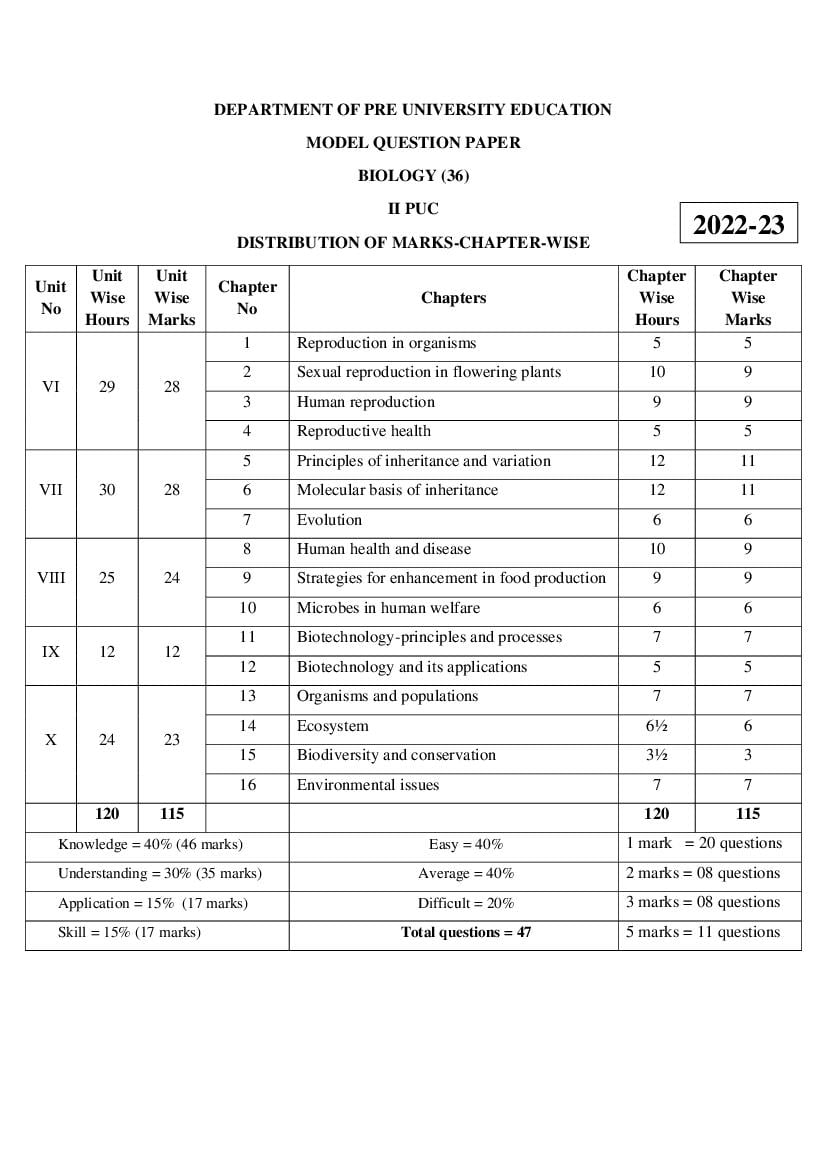
DISTRIBUTION OF MARKS-CHAPTER-WISE
2022-23
Unit Unit Chapter Chapter
Unit Chapter
Wise Wise Chapters Wise Wise
No No
Hours Marks Hours Marks
1 Reproduction in organisms 5 5
2 Sexual reproduction in flowering plants 10 9
VI 29 28
3 Human reproduction 9 9
4 Reproductive health 5 5
5 Principles of inheritance and variation 12 11
VII 30 28 6 Molecular basis of inheritance 12 11
7 Evolution 6 6
8 Human health and disease 10 9
VIII 25 24 9 Strategies for enhancement in food production 9 9
10 Microbes in human welfare 6 6
11 Biotechnology-principles and processes 7 7
IX 12 12
12 Biotechnology and its applications 5 5
13 Organisms and populations 7 7
14 Ecosystem 6½ 6
X 24 23
15 Biodiversity and conservation 3½ 3
16 Environmental issues 7 7
120 115 120 115
Knowledge = 40% (46 marks) Easy = 40% 1 mark = 20 questions
Understanding = 30% (35 marks) Average = 40% 2 marks = 08 questions
Application = 15% (17 marks) Difficult = 20% 3 marks = 08 questions
Skill = 15% (17 marks) Total questions = 47 5 marks = 11 questions
Page 2
MODEL QUESTION PAPER
II PUC- BIOLOGY (36)
2022-23
UNIT-WISE WEIGHTAGE
UNIT APPLICATION / EXPRESSION/ TOTAL MARKS
TEACHING KNOWLEDGE UNDERSTANDING
NO UNITS APPRECIATION SKILL QUESTIONS WEIGHTAGE
HOURS
1M 2M 3M 5M 1M 2M 3M 5M 1M 2M 3M 5M 1M 2M 3M 5M 1M 2M 3M 5M
VI REPRODUCTION 29 6 2 1 1 1 1 1 6 3 2 2 28
VII GENETICS AND EVOLUTION 30 4 2 1 1 1 1 1 1 4 4 2 2 28
VIII BIOLOGY IN HUMAN WELFARE 25 1 2 1 1 1 2 3 2 3 24
IX BIOTECHNOLOGY 12 1 1 1 1 2 2 12
X ECOLOGY 24 2 1 1 2 1 1 1 1 5 1 2 2 23
120 40% (46 MARKS) 30% (35 MARKS) 15% (17 MARKS) 15% (17 MARKS) 20 8 8 11 115
NOTE:
1. The question paper must be prepared based on the individual blueprint on the basis of weightage of marks fixed for each chapter.
2. A variation of 1% per objective weightage is allowed.
3. A variation of 1 mark per unit/chapter is allowed. However, the total marks should not exceed 115 marks.
4. At least one question each carrying 1 mark, 2 marks, 3 marks, and 5 marks have to be derived from each unit.
5. When a question carrying 5 marks is divided into sub-questions (3+2/2+2+1/1+1+1+1+1), the sub-questions have to be derived from the same chapter. One of the 5
marks questions should be subdivided into 5 questions carrying 1 mark each.
6. When a question carrying 5 marks is divided into sub-questions, the sub-questions have to be derived from different topics of the same chapter.
7. Skill-based questions should not expect descriptive answers.
8. MCQs and fill-in-the-blank type of questions should be simple and straightforward.
Page 3
MODEL QUESTION PAPER
II PUC- BIOLOGY (36)
2022-23
CHAPTER-WISE WEIGHTAGE
Unit Total Chapter
CHAPTERS Hours KNOWLEDGE UNDERSTANDING APPLICATION SKILL Total Questions Unit
No hours No Chapter
wise
1 2 3 5 1 2 3 5 1 2 3 5 1 2 3 5 1 2 3 5 wise
M M M M M M M M M M M M M M M M M M M M
marks
marks
1 Reproduction in organisms 5 1 1 1 1 2 5
VI 29 2 Sexual reproduction in flowering plants 10 2 1 1 2 1 1 9
28
3 Human reproduction 9 1 1 1 1 1 1 9
4 Reproductive health 5 2 1 2 1 5
5 Principles of inheritance and variation 12 2 1 1 1 2 2 1 11
VII 30 6 Molecular basis of inheritance 12 1 1 1 1 1 1 1 1 11 28
7 Evolution 6 1 1 1 1 1 1 6
8 Human health and disease 10 1 1 1 1 1 1 9
Strategies for enhancement in food
VIII 25 9 9 1 1 1 1 1 1 9 24
production
10 Microbes in human welfare 6 1 1 1 1 6
11 Biotechnology : Principles and processes 7 1 1 1 2 1 7
IX 12 12
12 Biotechnology and its applications 5 1 1 5
13 Organisms and populations 7 1 1 1 2 1 7
14 Ecosystem 6½ 2 1 1 3 1 6
23
X 24 15 Biodiversity and conservation 3½ 1 1 3
16 Environmental issues 7 1 1 1 1 7
120 Total Questions 120 14 4 3 3 3 2 1 5 1 2 2 2 2 2 1 20 8 8 11 115 115
OBJECTIVE WEIGHTAGE 40% (46 MARKS) 30% (35 MARKS) 15% (17 MARKS) 15% (17 MARKS)
Page 4
MODEL QUESTION PAPER - 2022-23
II PUC
SUB: BIOLOGY (36)
TIME: 3 HOURS 15 MINUTES MAX. MARKS: 70
General instructions:
1. The question paper consists of four parts A, B, C, and D.
2. PART-A consists of I & II and Part-D consists of V & VI.
3. All the parts are compulsory.
4. Draw diagrams wherever necessary, unlabelled diagrams or illustrations do not attract any
marks.
PART- A
I. Select the correct alternative from the choices given below: 1 x 15 = 15
1. Which of the following organism exhibits oestrous cycle?
a) Monkey b) Human c) Rat d) Apes
2. Triploid condition is observed in
a) Egg cell b) Synergid c) Antipodals d) Primary endosperm nucleus
3. The first movements of the foetus are observed during which month of the pregnancy?
a) First month b) Second month c) Fifth month d) Sixth month
4. An example for non-medicated IUD is
a) Cu-T b) Lippes loop c) LNG-20 d) Multiload 375
5. Appearance of autosomal recessive trait results in a condition called
a) Phenylketonuria b) Turners’syndrome c) Haemophila d) Colour blindness
6. Biopsy is useful in the detection of
a) Typhoid b) Cancer c) AIDS d) Allergy
7. Biofortified bitter gourd is enriched with
a) Vitamin A b) Protein c) Vitamin C d) Iron
8. A typical example for mycorrhiza forming fungus is
a) Penicillium b) Aspergillus c) Trichoderma d) Glomus
9. Select the correct sequence of steps in polymerase chain reaction:
a) Annealing Denaturation Extension
b) Denaturation Annealing Extension
c) Annealing Extension Denaturation
d) Denaturation Extension Annealing
Page 5
a) Respiratory quotient b) Respiration loss
c) Intrinsic rate of natural increase d) Regression coefficient
11. Medical termination of pregnancies are considered relatively safe during
a) First trimester of pregnancy b) Second trimester of pregnancy
c) Third trimester of pregnancy d) Eighth month of pregnancy
12. A disorder characterized by trisomy of 21 is
a) Down’s syndrome b) Haemophila c) Thalassemia d) Cystic fibrosis
13. The process of degradation of detritus into simpler inorganic substances by bacterial and
fungal enzymes is
a) Fragmentation b) Leaching c) Catabolism d) Humification
14. Desert lizards bask in the sun when their body temperature drops below the comfort zone
and move into shade when ambient temperature starts increasing. This is an example for
a) Morphological adaptation b) Behavioural adaptation
c) Physiological adaptation d) Biochemical adaptation
15. Each tropic level has certain mass of living material at a particular time called as
a) Standing state b) Standing crop c) Biomass d) Productivity
II. Fill in the blanks by choosing the appropriate word/words from those given below:
(Saltation, Pioneer species, Tapetum, β-galactosidase, Retrovirus) 1x5=5
16. The commonly used vector for cloning genes in animals is ………………
17. The species that invade bare areas are called……………..
18. The tissue that nourishes the developing pollen grains is…………………
19. In lac operon, the ‘z’ gene codes for…………………
20. A single-step large mutation that causes speciation is……………..
PART-B
III. Answer any FIVE of the following questions in 3-5 sentences each, wherever
applicable: 2 x 5 = 10
21. What is parthenogenesis? Give an example.
22. Define a) Emasculation b) Bagging
23. List the criteria for a molecule that can act as genetic material.
24. What are homologous organs? Give an example.
25. Differentiate between seasonal breeders and continuous breeders.
Page 6
27. Draw the pedigree symbols for: a) Affected male individual b) Mating between
relatives.
28. Sketch and label a scrubber used in controlling air pollution.
PART – C
IV. Answer any FIVE of the following questions in about 40-80 words each, wherever
applicable: 3 x 5 = 15
29. What is placenta? Name the hormones secreted by it.
30. Explain natural methods for birth control.
31. Mention the different steps involved in DNA fingerprinting.
32. Draw a labelled diagram of Stanley Miller’s apparatus.
33. Describe any three barriers of innate immunity with examples.
34. a) Why meristerm is preferred in tissue culture as explant? (1)
b) Mention the objectives of plant breeding. (2)
35. a) Define endemism. (1)
b) “Over-exploitation of natural resources by humans resulted in the extinction of many
species in the last 500 years”. List any two examples for this. (2)
36. Schematically represent phosphorous cycling in a terrestrial ecosystem.
PART- D
V. Answer any THREE of the following questions in about 200-250 words each,
wherever applicable: 5 x 3 = 15
37. Describe the structure of a mature female gametophyte in angiosperms.
38. Explain any five features of genetic code.
39. Explain the different steps involved in the development of a new genetic variety of crop
plant.
40. Mention the roles played by microbes in household products.
41. Explain the process of separation and isolation of DNA fragments using gel-
electrophoresis.
42. Define the following:
a) Biochemical oxygen demand b) Eutrophication c) Biomagnification
d) Algal bloom e) Ecological sanitation
Page 7
applicable: 5 x 2 = 10
43. Draw a sectional view of the human male reproductive system.
44. Explain the benefits of transgenic animals for humans.
45. In Mendel’s experiment, when two pairs of traits are combined in a hybrid, segregation of
one pair of characters is independent of other pair of characters. Justify this by
representing schematically the two gene inheritance.
46. a) Differentiate between euryhaline animals and stenohaline animals. (2)
b) Describe sexual deceit in Ophrys. (3)
47. List out the measures used for prevention and control of alcohol and drugs abuse among
adolescents.
Document Details
| Board / Org | Karnataka Board |
| Exam | Class 12 |
| Type | Sample Paper |
| Pages | 7 |
| Updated | 30 Apr 2026 |