ICAR AIEEA PG 2022 Question Paper Plant Biotechnology
Finished viewing? Save it for later —
Download ICAR AIEEA PG 2022 Question Paper Plant Biotechnology (PDF · 19 pages)About ICAR AIEEA PG 2022 Question Paper Plant Biotechnology
ICAR AIEEA PG 2022 Question Paper Plant Biotechnology is available here for free download. Published by ICAR for ICAR AIEEA PG, this question paper can be viewed online or downloaded as a PDF (19 pages). Candidates preparing for ICAR AIEEA PG can use ICAR AIEEA PG 2022 Question Paper Plant Biotechnology to understand the exam pattern, the type of questions asked, and the overall difficulty level.
Frequently Asked Questions
How can I download ICAR AIEEA PG 2022 Question Paper Plant Biotechnology?
Open this page and click the Download button to save ICAR AIEEA PG 2022 Question Paper Plant Biotechnology as a PDF. It is completely free on AglaSem Docs.
Is ICAR AIEEA PG 2022 Question Paper Plant Biotechnology free to download?
Yes. ICAR AIEEA PG 2022 Question Paper Plant Biotechnology can be viewed online and downloaded as a PDF free of cost on AglaSem Docs.
How many pages does ICAR AIEEA PG 2022 Question Paper Plant Biotechnology have?
ICAR AIEEA PG 2022 Question Paper Plant Biotechnology contains 19 pages, which you can read online or download together as a single PDF.
Where can I find more ICAR AIEEA PG study material?
You can find more ICAR AIEEA PG question papers, sample papers, syllabus, and answer keys on AglaSem Docs.
ICAR AIEEA PG 2022 Question Paper Plant Biotechnology – Text
Read the full text of this question paper below — useful to quickly search, copy and reference the content online without downloading the PDF.
📄 View text version (19 pages)
Page 1
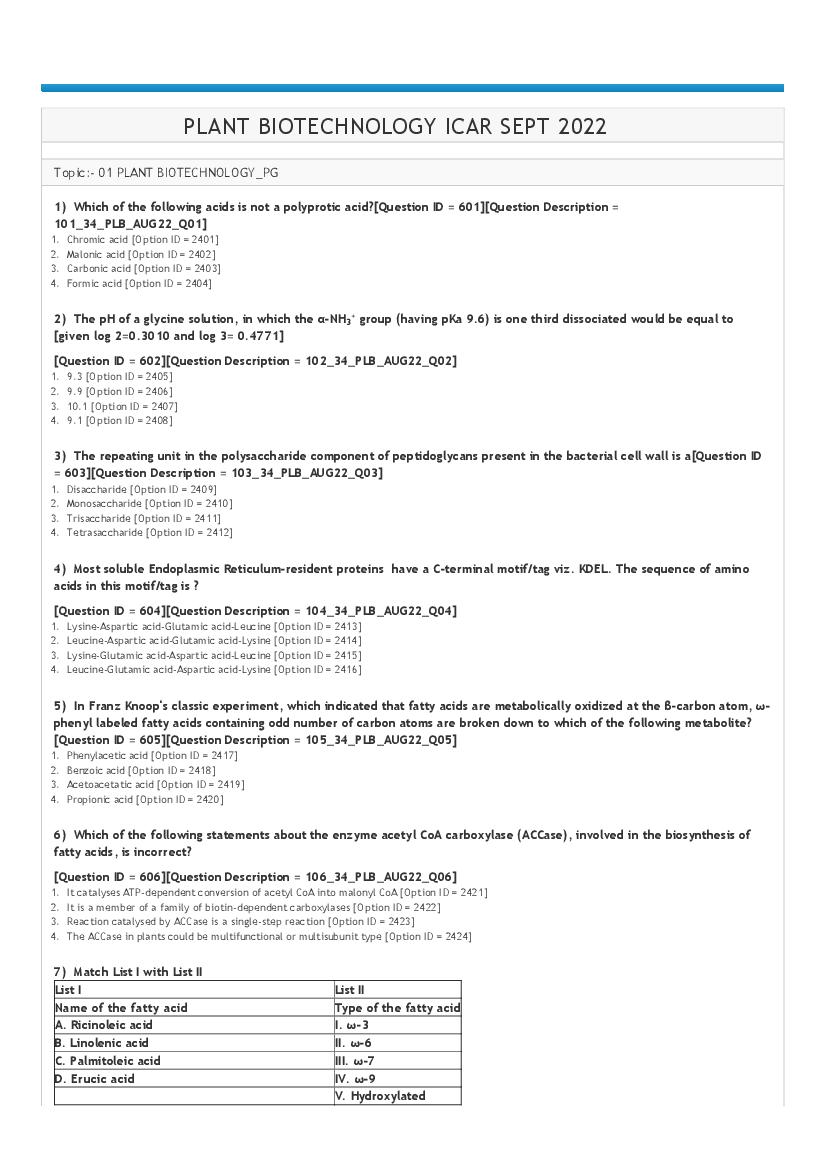
Topic:‐ 01 PLANT BIOTECHNOLOGY_PG
1) Which of the following acids is not a polyprotic acid?[Question ID = 601][Question Description =
101_34_PLB_AUG22_Q01]
1. Chromic acid [Option ID = 2401]
2. Malonic acid [Option ID = 2402]
3. Carbonic acid [Option ID = 2403]
4. Formic acid [Option ID = 2404]
2) The pH of a glycine solution, in which the α‐NH3+ group (having pKa 9.6) is one third dissociated would be equal to
[given log 2=0.3010 and log 3= 0.4771]
[Question ID = 602][Question Description = 102_34_PLB_AUG22_Q02]
1. 9.3 [Option ID = 2405]
2. 9.9 [Option ID = 2406]
3. 10.1 [Option ID = 2407]
4. 9.1 [Option ID = 2408]
3) The repeating unit in the polysaccharide component of peptidoglycans present in the bacterial cell wall is a[Question ID
= 603][Question Description = 103_34_PLB_AUG22_Q03]
1. Disaccharide [Option ID = 2409]
2. Monosaccharide [Option ID = 2410]
3. Trisaccharide [Option ID = 2411]
4. Tetrasaccharide [Option ID = 2412]
4) Most soluble Endoplasmic Reticulum‐resident proteins have a C‐terminal motif/tag viz. KDEL. The sequence of amino
acids in this motif/tag is ?
[Question ID = 604][Question Description = 104_34_PLB_AUG22_Q04]
1. Lysine‐Aspartic acid‐Glutamic acid‐Leucine [Option ID = 2413]
2. Leucine‐Aspartic acid‐Glutamic acid‐Lysine [Option ID = 2414]
3. Lysine‐Glutamic acid‐Aspartic acid‐Leucine [Option ID = 2415]
4. Leucine‐Glutamic acid‐Aspartic acid‐Lysine [Option ID = 2416]
5) In Franz Knoop's classic experiment, which indicated that fatty acids are metabolically oxidized at the β‐carbon atom, ω‐
phenyl labeled fatty acids containing odd number of carbon atoms are broken down to which of the following metabolite?
[Question ID = 605][Question Description = 105_34_PLB_AUG22_Q05]
1. Phenylacetic acid [Option ID = 2417]
2. Benzoic acid [Option ID = 2418]
3. Acetoacetatic acid [Option ID = 2419]
4. Propionic acid [Option ID = 2420]
6) Which of the following statements about the enzyme acetyl CoA carboxylase (ACCase), involved in the biosynthesis of
fatty acids, is incorrect?
[Question ID = 606][Question Description = 106_34_PLB_AUG22_Q06]
1. It catalyses ATP‐dependent conversion of acetyl CoA into malonyl CoA [Option ID = 2421]
2. It is a member of a family of biotin‐dependent carboxylases [Option ID = 2422]
3. Reaction catalysed by ACCase is a single‐step reaction [Option ID = 2423]
4. The ACCase in plants could be multifunctional or multisubunit type [Option ID = 2424]
7) Match List I with List II
List I List II
Name of the fatty acid Type of the fatty acid
A. Ricinoleic acid I. ω‐3
B. Linolenic acid II. ω‐6
C. Palmitoleic acid III. ω‐7
D. Erucic acid IV. ω‐9
V. Hydroxylated
Page 2
1. A ‐V, B ‐I , C ‐III , D ‐IV [Option ID = 2425]
2. A ‐V , B ‐II , C ‐I , D ‐IV [Option ID = 2426]
3. A ‐III , B ‐I , C ‐V , D ‐II [Option ID = 2427]
4. A ‐IV , B ‐II , C ‐III , D ‐I [Option ID = 2428]
8) Which of the following molecules functions as provitamin D3?[Question ID = 608][Question Description =
108_34_PLB_AUG22_Q08]
1. 7‐Dehydrocholesterol [Option ID = 2429]
2. Ergosterol [Option ID = 2430]
3. Ergocalciferol [Option ID = 2431]
4. 1, 25‐Dihydroxy cholecalciferol [Option ID = 2432]
9) The vitamin B12 deficiency will lead to the accumulation of which of the following metabolites?
[Question ID = 609][Question Description = 109_34_PLB_AUG22_Q09]
1. Pyruvic acid [Option ID = 2433]
2. Methyl malonic acid [Option ID = 2434]
3. α‐Keto glutarate [Option ID = 2435]
4. Biotin [Option ID = 2436]
10) The enzyme Papain, derived from papaya, is commonly used in food industry as a meat tenderizer. It is a/an:[Question
ID = 610][Question Description = 110_34_PLB_AUG22_Q10]
1. Serine protease [Option ID = 2437]
2. Metalloprotease [Option ID = 2438]
3. Cysteine protease [Option ID = 2439]
4. Aspartic protease [Option ID = 2440]
11) How does the effectiveness of a competitive inhibitor gets affected under high physiological concentration of the
substrate?[Question ID = 611][Question Description = 111_34_PLB_AUG22_Q11]
1. The inhibitor becomes more effective. [Option ID = 2441]
2. The effectiveness of the inhibitor gets reduced. [Option ID = 2442]
3. The inhibitor remains equally effective [Option ID = 2443]
4. The inhibitor gets irreversibly inactivated [Option ID = 2444]
12) Which of the followings is not true about the DNA denaturation process?[Question ID = 612][Question Description =
112_34_PLB_AUG22_Q12]
1. DNA denaturation causes decrease in UV absorption at all the wavelengths [Option ID = 2445]
2. DNA denaturation is a cooperative process [Option ID = 2446]
3. The melting temperature of the DNA decreases under alkaline conditions. [Option ID = 2447]
4. The melting temperature of the DNA increases linearly with its GC content [Option ID = 2448]
13) In globular proteins, α‐helices have an average span of 12 residues, which would correspond to how much length of the
helix?[Question ID = 613][Question Description = 113_34_PLB_AUG22_Q13]
1. 5.4 Ao [Option ID = 2449]
2. 18 Ao [Option ID = 2450]
3. 3.6 Ao [Option ID = 2451]
4. 36 Ao [Option ID = 2452]
14) Which of the following enzymes is involved in the plant defense against herbivores and requires ascorbic acid as its
cofactor?[Question ID = 614][Question Description = 114_34_PLB_AUG22_Q14]
1. Lipoxygenase [Option ID = 2453]
2. Myrosinase [Option ID = 2454]
3. Phenylalanine Ammonia Lyase [Option ID = 2455]
4. Chorismate Synthase [Option ID = 2456]
15) Given below are two statements, one is labelled as Assertion A and the other is labelled as Reason R
Assertion A : Although most of the animals cannot digest α‐keratin but clothes moth larvae can very easily do so.
Reason R : The clothes moth larvae has a very high concentration of mercaptans in their digestive tract that helps them to
cleave disulfide bonds abundantly present in α‐keratin.
In light of the above statements, choose the correct answer from the options given below
Page 3
1. Both A and R are true and R is the correct explanation of A [Option ID = 2457]
2. Both A and R are true but R is NOT the correct explanation of A [Option ID = 2458]
3. A is true but R is false [Option ID = 2459]
4. A is false but R is true [Option ID = 2460]
16) Which of the following molybdenum‐containing enzymes do not contain molybdopterin as its cofactor?[Question ID =
616][Question Description = 116_34_PLB_AUG22_Q16]
1. Xanthine oxidase [Option ID = 2461]
2. Nitrate reductase [Option ID = 2462]
3. Sulfite oxidase [Option ID = 2463]
4. Nitrogenase [Option ID = 2464]
17) Match List I with List II
List I List II
Enzyme (Reaction catalyzed
A. Glutamate
I. Catalyzes ATP‐dependent conversion of glutamate to glutamine using ammonium as substrate.
dehydrogenase
II. Catalyzes reductive amination of 2‐oxoglutarate to form glutamate using ammonium as
B. GS
substrate.
C. GOGAT III. Catalyzes the synthesis of two molecules of glutamate from glutamine and α‐ketoglutarate.
D. Glutamate
IV. Catayzes the synthesis of GABA from glutamate.
decarboxylase
V. Catalyses synthesis of aminolevulinic acid in the chlorophyll biosynthetic pathway.
[Question ID = 617][Question Description = 117_34_PLB_AUG22_Q17]
1. A ‐I , B ‐II , C ‐III , D ‐V [Option ID = 2465]
2. A ‐II , B ‐I , C ‐III , D ‐IV [Option ID = 2466]
3. A ‐I , B ‐III , C ‐II , D ‐V [Option ID = 2467]
4. A ‐III , B ‐I , C ‐II , D ‐IV [Option ID = 2468]
18) If a 100 μM solution of NADH exhibits an absorbance of 0.62 at a wavelength of 340 nm in a 1 cm cell, then its molar
extinction coefficient would be equal to:[Question ID = 618][Question Description = 118_34_PLB_AUG22_Q18]
1. 6.2 cm2 mol‐1 [Option ID = 2469]
2. 6.2 x 102 cm2 mol‐1 [Option ID = 2470]
3. 6.2 x 104 cm2 mol‐1 [Option ID = 2471]
4. 6.2 x 106 cm2 mol‐1 [Option ID = 2472]
19) The mitochondria play a direct role in which of the following subtype(s) of C4 photosynthesis?[Question ID = 619]
[Question Description = 119_34_PLB_AUG22_Q19]
1. NADP‐dependent malic enzyme (NADP‐ME) subtype [Option ID = 2473]
2. NADP‐ME and NAD‐dependent malic enzyme (NAD‐ME) subtypes [Option ID = 2474]
3. PEP‐carboxykinase (PCK) subtype [Option ID = 2475]
4. NAD‐ME and PCK subtypes [Option ID = 2476]
20) Which one of the following statements is not true about Z‐DNA structure?
[Question ID = 620][Question Description = 120_34_PLB_AUG22_Q20]
1. Phosphate backbone in Z‐DNA zig‐zag left rather than to the right as in B‐DNA. [Option ID = 2477]
2. Z‐DNA has only minor groove and major groove is absent. [Option ID = 2478]
3. Z‐DNA is much broader than B‐DNA. [Option ID = 2479]
4. There is alternate stacking of bases in anti‐ and syn‐ conformation. [Option ID = 2480]
21) Match List I with List II
List I List II
Inhibitor
Changes observed in the Kinetic parameters
I. No effect on the apparent value of the Vmax/Km ratio but apparent value of Vmax gets
A. Competitive
affected.
II. The apparent values of both the Vmax/Km ratio and Vmax are altered but by the same
B. Uncompetitive
magnitude.
III. The apparent values of both the Vmax/Km ratio and Vmax are altered but by the different
C. Noncompetitive
magnitude.
Page 4
V. No changes observed in any of the kinetic parameter
[Question ID = 621][Question Description = 121_34_PLB_AUG22_Q21]
1. A ‐IV , B ‐I , C ‐II , D ‐III [Option ID = 2481]
2. A ‐I , B ‐II , C ‐IV , D ‐V [Option ID = 2482]
3. A ‐III , B ‐I , C ‐II , D ‐V [Option ID = 2483]
4. A ‐IV , B ‐III , C ‐I , D ‐II [Option ID = 2484]
22) Given below are two statements, one is labelled as Assertion A and the other is labelled as Reason R
Assertion A : The uncompetitive inhibitors bind only to the enzyme‐substrate (ES) complex and not to the free enzyme.
Reason R : Binding of the substrate to the enzyme causes a change in its conformation, which reveals the inhibitor‐binding
site.
In light of the above statements, choose the correct answer from the options given below
[Question ID = 622][Question Description = 122_34_PLB_AUG22_Q22]
1. Both A and R are true and R is the correct explanation of A [Option ID = 2485]
2. Both A and R are true but R is NOT the correct explanation of A [Option ID = 2486]
3. A is true but R is false [Option ID = 2487]
4. A is false but R is true [Option ID = 2488]
23) Given below are two statements, one is labelled as Assertion A and the other is labelled as Reason R
Assertion A : The presence of thick and fleshy water‐storing leaves or stems in CAM plants enhances their photosynthetic
efficiency.
Reason R : The photosynthetic rates in CAM plants are limited by their vacuolar storage capacity, as malate synthesized at
night through carboxylation of PEP has to be stored in the large central vacuole until the daytime.
In light of the above statements, choose the correct answer from the options given below
[Question ID = 623][Question Description = 123_34_PLB_AUG22_Q23]
1. Both A and R are true and R is the correct explanation of A [Option ID = 2489]
2. Both A and R are true but R is NOT the correct explanation of A [Option ID = 2490]
3. A is true but R is false [Option ID = 2491]
4. A is false but R is true [Option ID = 2492]
24) Given below are two statements, one is labelled as Assertion A and the other is labelled as Reason R
Assertion A : In Gas‐Liquid Chromatography (GLC) the Fatty Acid Methyl Esters (FAMEs) with long fatty acyl chains come out
first from the column.
Reason R : Increased chain length of fatty acids leads to lower volatility and their increased retention on the GLC column.
In light of the above statements, choose the correct answer from the options given below
[Question ID = 624][Question Description = 124_34_PLB_AUG22_Q24]
1. Both A and R are true and R is the correct explanation of A [Option ID = 2493]
2. Both A and R are true but R is NOT the correct explanation of A [Option ID = 2494]
3. A is true but R is false [Option ID = 2495]
4. A is false but R is true [Option ID = 2496]
25) The antibiotic oligomycin inhibits the oxidative phosphorylation by which of the following mechanisms?[Question ID =
625][Question Description = 125_34_PLB_AUG22_Q25]
1. By binding and blocking Fo component of the mitochondrial ATP synthase complex [Option ID = 2497]
2. By binding and blocking F1 component of the mitochondrial ATP synthase complex. [Option ID = 2498]
3. By inactivating both the Fo and F1 components of the ATP Synthase. [Option ID = 2499]
4. By collapsing the proton motive force [Option ID = 2500]
26) Six enzyme classes have been recognized and approved by International Union of Biochemistry since 1961. In 2018,
which one of the following group of enzymes has been added as the seventh class, with Enzyme Commission number 7 (EC
7), by the Nomenclature Committee of the International Union of Biochemistry and Molecular Biology (NC‐IUBMB)?[Question
ID = 626][Question Description = 126_34_PLB_AUG22_Q26]
1. Racemases [Option ID = 2501]
2. Translocases [Option ID = 2502]
Page 5
4. Ubiquitinases [Option ID = 2504]
27) Components of the mitochondrial Electron Transport Chain (ETC):
A. NADH‐Coenzyme Q oxidoreductase
B. Cytochrome bc1 complex
C. Ubiquinone
D. Cytochrome C
E. Cytochrome C Oxidase
Choose the correct sequence of electron tranfer through the aforementioned components of the mitochondrial ETC
[Question ID = 627][Question Description = 127_34_PLB_AUG22_Q27]
1. A, B, C, D, E [Option ID = 2505]
2. A, C, B, D, E [Option ID = 2506]
3. A, D, B, C, E [Option ID = 2507]
4. A, B, D, C, E [Option ID = 2508]
28) Enzymes involved in the complete oxidation and utilization of odd‐chain fatty acids:
A. Propionyl CoA carboxylase
B. Thiolase
C. Fatty acyl CoA synthetase
D. Methylmalonyl CoA mutase
E. Methylmalonyl CoA racemase
Choose the correct sequence in which aforementioned enzymes act for the purpose of oxidation and utilization of odd‐chain
fatty acids as a source of energy.
[Question ID = 628][Question Description = 128_34_PLB_AUG22_Q28]
1. C, B, A, E, D [Option ID = 2509]
2. B, C, A, D, E [Option ID = 2510]
3. A, D, E, C, B [Option ID = 2511]
4. A, E, D, B, C [Option ID = 2512]
29) Enzymes of the "Kennedy pathway" for the triacylglycerol biosynthesis in plants:
A. Glycerol‐3‐P dehydrogenase
B. Glycerol‐3‐phosphate acyltransferase
C. Lysophosphatidic acid acyltransferase
D. Phosphatidic acid phosphatase
E. Diacylglycerol acyltransferase
Choose the correct sequence of the action of aforementioned enzymes of the "Kennedy pathway" in the triacylglycerol
biosynthesis.
[Question ID = 629][Question Description = 129_34_PLB_AUG22_Q29]
1. A, B, C, D, E [Option ID = 2513]
2. B, A, D, C, E [Option ID = 2514]
3. B, A, C, D, E [Option ID = 2515]
4. B, A, C, E, D [Option ID = 2516]
30) Names of the coenzymes and prosthetic groups:
A. Thiamine pyrophosphate
B. Lipoic acid
C. Pyridoxal phosphate
D. Coenzyme A
E. Nicotinamide adenine dinucleotide (NAD+)
Page 6
Pyruvate dehydrogenase:
[Question ID = 630][Question Description = 130_34_PLB_AUG22_Q30]
1. A, D and E only [Option ID = 2517]
2. A, C and E only [Option ID = 2518]
3. A, B, D and E only [Option ID = 2519]
4. A, B, C, D and E only [Option ID = 2520]
31) The biochemical nature of Nuclear Localization Signal is?[Question ID = 631][Question Description =
131_34_PLB_AUG22_Q31]
1. Sequence of amino acids [Option ID = 2521]
2. Sequence of nucleotides similar to DNA [Option ID = 2522]
3. Sequence of nucleotides similar to RNA [Option ID = 2523]
4. Sequence of nucleosides [Option ID = 2524]
32) Which of the following microorganism can undertake symbiotic relationship with plants?[Question ID = 632][Question
Description = 132_34_PLB_AUG22_Q32]
1. Virus [Option ID = 2525]
2. Fungi [Option ID = 2526]
3. Mycoplasma [Option ID = 2527]
4. Protozoa [Option ID = 2528]
33) Which of the following statement is correct for DNA polymerase I of E. coli?
A. Also known as Kornberg polymerase
B. Possesses 5’exonuclease activity
C. Possesses 3’exonuclease activity
D. Plays central role in replication of its genome
Choose the correct answer from the options given below
[Question ID = 633][Question Description = 133_34_PLB_AUG22_Q33]
1. A, B and C only [Option ID = 2529]
2. A, C and D only [Option ID = 2530]
3. B, C and D only [Option ID = 2531]
4. A, B, C and D [Option ID = 2532]
34) Which of the following combination is appropriate for hybridoma production?
[Question ID = 634][Question Description = 134_34_PLB_AUG22_Q34]
1. Lymphocytes from immune mice, HAT, Myeloma cells [Option ID = 2533]
2. Lymphocytes from immune mice, HAT, PEG [Option ID = 2534]
3. Sendai virus, HAT, Myeloma cells [Option ID = 2535]
4. Lymphocytes from immune mice, Aminopterin, Myeloma cells [Option ID = 2536]
35) In order to protect DNA from DNase, which of the following chemical is used during DNA extraction?
[Question ID = 635][Question Description = 135_34_PLB_AUG22_Q35]
1. EDTA
[Option ID = 2537]
2. DEPC
[Option ID = 2538]
3. EtOH
[Option ID = 2539]
4. CTAB
[Option ID = 2540]
36) Which of the following is most critical temperature, to be decided by primer sequence, in any PCR experiment?
[Question ID = 636][Question Description = 136_34_PLB_AUG22_Q36]
1. Annealing temperature [Option ID = 2541]
2. Denaturation temperature [Option ID = 2542]
3. Primer extension temperature [Option ID = 2543]
4. Final holding temperature [Option ID = 2544]
Page 7
= 137_34_PLB_AUG22_Q37]
1. Promoter region [Option ID = 2545]
2. Operator region [Option ID = 2546]
3. Lac I [Option ID = 2547]
4. IPTG [Option ID = 2548]
38) Which of the following library you would prefer to screen to isolate a sequence that encodes a specific protein?
[Question ID = 638][Question Description = 138_34_PLB_AUG22_Q38]
1. gDNA library [Option ID = 2549]
2. cDNA library [Option ID = 2550]
3. peptide library [Option ID = 2551]
4. RNASeq library [Option ID = 2552]
39) Which of the following is correct extended form of URL?
[Question ID = 639][Question Description = 139_34_PLB_AUG22_Q39]
1. Uniform Resource Location [Option ID = 2553]
2. Uniform Resource Locator [Option ID = 2554]
3. Uniform Research Linkage [Option ID = 2555]
4. Uniform Resource Learning [Option ID = 2556]
40) Which of the following is NOT an application of plant tissue culture?
[Question ID = 640][Question Description = 140_34_PLB_AUG22_Q40]
1. Propagating asexual plants [Option ID = 2557]
2. Clonal propagation [Option ID = 2558]
3. Isolation of plant variants [Option ID = 2559]
4. Obtaining high quality metabolite [Option ID = 2560]
41) Which of the following is used as blocking agent in hybridization analysis?[Question ID = 641][Question Description =
141_34_PLB_AUG22_Q41]
1. Salmon sperm DNA [Option ID = 2561]
2. SSPE [Option ID = 2562]
3. NaOH [Option ID = 2563]
4. NaCl [Option ID = 2564]
42) Which of the following is required for wet‐heat sterilization in plant tissue culture experiments?[Question ID = 642]
[Question Description = 142_34_PLB_AUG22_Q42]
1. Laminar flow [Option ID = 2565]
2. Filtration assembly [Option ID = 2566]
3. Oven [Option ID = 2567]
4. Autoclave [Option ID = 2568]
43) Which of the following can result heterosis?
[Question ID = 643][Question Description = 143_34_PLB_AUG22_Q43]
1. Dominance
[Option ID = 2569]
2. Over dominance
[Option ID = 2570]
3. Epistasis
[Option ID = 2571]
4. More than one answer are correct
[Option ID = 2572]
44) Which of the following technique(s) is used for protein‐protein interaction studies?
[Question ID = 644][Question Description = 144_34_PLB_AUG22_Q44]
1. Co‐immunoprecipitation [Option ID = 2573]
2. Yeast one hybrid system [Option ID = 2574]
3. Western blotting [Option ID = 2575]
4. 2D gel electrophoresis [Option ID = 2576]
45) Which of the following nuclease is/are used in genetic engineering?[Question ID = 645][Question Description =
Page 8
1. ZFN [Option ID = 2577]
2. EcoRI [Option ID = 2578]
3. Cas9 [Option ID = 2579]
4. More than one answer are correct [Option ID = 2580]
46) Which type of following primers may be used in Reverse Transcriptase‐PCR?[Question ID = 646][Question Description =
146_34_PLB_AUG22_Q46]
1. oligo‐dT [Option ID = 2581]
2. Random [Option ID = 2582]
3. Gene specific [Option ID = 2583]
4. More than one answer are correct [Option ID = 2584]
47) Which of the following technique(s) can be used to study differential gene expression in two tissues under two
different external conditions?
A. Northern hybridization
B. Whole genome RNA sequencing
C. qPCR
D. Semi‐quantitative PCR
E. Whole Genome Sequencing
Choose the correct answer from the options given below
[Question ID = 647][Question Description = 147_34_PLB_AUG22_Q47]
1. A, B, C and D only [Option ID = 2585]
2. A, C, D and E only [Option ID = 2586]
3. B, C, D and E only [Option ID = 2587]
4. A, B, D and E only [Option ID = 2588]
48) Which of the following is correct statement for RNA synthesis?
A. A single RNA polymerase can synthesize all types of RNA in prokaryotes
B. RNA polymerase II can synthesize mRNA in eukaryotes
C. A single RNA polymerase can synthesize all types of RNA in eukaryotes
D. RNA polymerase II can synthesize all types of RNA in prokaryotes
E. E. coli cell has only one type of RNA polymerase
Choose the correct answer from the options given below
[Question ID = 648][Question Description = 148_34_PLB_AUG22_Q48]
1. A, B and E only [Option ID = 2589]
2. A, B and C only [Option ID = 2590]
3. B, C and E only [Option ID = 2591]
4. B, C and D only [Option ID = 2592]
49) Bacterial conjugation can lead to gain of new alleles in recipient cell
Statement I: Through involving crossing over between DNA fragment of donor and recipient cell
Statement II: Through gain of plasmid from donor bacterium to recipient bacterium
In light of the above statements, choose the correct answer from the options given below
[Question ID = 649][Question Description = 149_34_PLB_AUG22_Q49]
1. Both Statement I and Statement II are true [Option ID = 2593]
2. Both Statement I and Statement II are false [Option ID = 2594]
3. Statement I is true but Statement II is false [Option ID = 2595]
4. Statement I is false but Statement II is true [Option ID = 2596]
50) Match List I with List II
List I List II
A. Gene I. Barbara McClintock
B. Jumping gene II. Johannsen
Page 9
D. Rolling circle θX DNA replicationIV. Dressler
V. Cairns
[Question ID = 650][Question Description = 150_34_PLB_AUG22_Q50]
1. A‐V, B‐IV, C‐I, D‐II [Option ID = 2597]
2. A‐IV, B‐V, C‐I, D‐II [Option ID = 2598]
3. A‐II, B‐I, C‐III, D‐IV [Option ID = 2599]
4. A‐I, B‐V, C‐III, D‐II [Option ID = 2600]
51) Match List I with List II
List I List II
A. Functional genomics I. Homologous recombination
B. Gene inactivation II. Protein‐Protein interaction
C. In‐vivo protein‐protein interactionIII. Mass spectrometry
D. Identification of unknown protein IV. Bimolecular Fluorescence Complementation
V. Yeast 2‐hybrid assay
[Question ID = 651][Question Description = 151_34_PLB_AUG22_Q51]
1. A‐I, B‐V, C‐II, D‐IV [Option ID = 2601]
2. A‐V, B‐IV, C‐I, D‐II [Option ID = 2602]
3. A‐II, B‐I, C‐IV, D‐III [Option ID = 2603]
4. A‐II, B‐III, C‐IV, D‐V [Option ID = 2604]
52) The major groups of multicellular eukaryotes ‐ plants, fungi and animals ‐ each evolved from a different group of the
eukaryotes generally referred to as protists.
A. Most protists are unicellular.
B. Chloroplast containing protists gave rise to plants.
C. Multicellularity evolved in several protists lineages.
D. Archaea are also protists
Choose the correct answer describing Protists from the options given below
[Question ID = 652][Question Description = 152_34_PLB_AUG22_Q52]
1. A and B only [Option ID = 2605]
2. B and C only [Option ID = 2606]
3. A and C only [Option ID = 2607]
4. A, B and C only [Option ID = 2608]
53) Blue‐white colonies screening of transformed E. coli cells involved disruption of which of the following gene of cloning
vector?[Question ID = 653][Question Description = 153_34_PLB_AUG22_Q53]
1. X gal [Option ID = 2609]
2. Kanamycin [Option ID = 2610]
3. Ampicillin [Option ID = 2611]
4. Lac Z’ [Option ID = 2612]
54) Which of the following is NOT correct for vacuole?
[Question ID = 654][Question Description = 154_34_PLB_AUG22_Q54]
1. Storage of reserves [Option ID = 2613]
2. Contains different types of enzymes involved in breakdown and recycling [Option ID = 2614]
3. Accumulate toxic compounds used in defense against microbial pathogens [Option ID = 2615]
4. Present in a fixed number and size [Option ID = 2616]
55) Which of the following usually have less dependency on nitrogenous fertilizer for its commercial cultivation?[Question
ID = 655][Question Description = 155_34_PLB_AUG22_Q55]
1. Wheat [Option ID = 2617]
2. Chickpea [Option ID = 2618]
3. Rice [Option ID = 2619]
4. Maize [Option ID = 2620]
56) Which of the following statement(s) are correct in describing the gene in DNA?
Page 10
Statement II: The start/initiator codon for the genes can be found on the 3ʹ 5ʹ strand of DNA
Choose the correct answer from the options given below
[Question ID = 656][Question Description = 156_34_PLB_AUG22_Q56]
1. Statement I is incorrect and statement II is correct [Option ID = 2621]
2. Statement I is correct and statement II is incorrect [Option ID = 2622]
3. Both the statements are correct [Option ID = 2623]
4. Both the statements are incorrect [Option ID = 2624]
57) Somatic embryogenesis is a desired method of plant regeneration for plant transformation because[Question ID = 657]
[Question Description = 157_34_PLB_AUG22_Q57]
1. It mainly results into chloroplast transformation [Option ID = 2625]
2. It largely favours marker‐free transgenics [Option ID = 2626]
3. It produces confirmed transgenics [Option ID = 2627]
4. It produces chimeric transgenics [Option ID = 2628]
58) Joining two DNA molecules using an adapter involves the following steps
A. Artificial synthesis of an adapter
B. Treating with polynucleotide kinase
C. Blunt end ligation to add an adapter to a blunt‐ended DNA molecule
D. Joining two DNA molecules with sticky ends
What is the correct sequence in which these steps are performed?
[Question ID = 658][Question Description = 158_34_PLB_AUG22_Q58]
1. B, A, D, C [Option ID = 2629]
2. A, C, B, D [Option ID = 2630]
3. D, B, C, A [Option ID = 2631]
4. C, A, D, B [Option ID = 2632]
59) Bt brinjal was developed for resistance to
[Question ID = 659][Question Description = 159_34_PLB_AUG22_Q59]
1. Salinity [Option ID = 2633]
2. Fruit and shoot borer [Option ID = 2634]
3. Damping off disease [Option ID = 2635]
4. Drought [Option ID = 2636]
60) Which of the following is also known as golden fibre?[Question ID = 660][Question Description =
160_34_PLB_AUG22_Q60]
1. Cotton [Option ID = 2637]
2. Silk [Option ID = 2638]
3. Jute [Option ID = 2639]
4. Flax [Option ID = 2640]
61) What types of DNA molecules are copied using rolling circle replication process?[Question ID = 661][Question
Description = 161_34_PLB_AUG22_Q61]
1. Bacterial chromosomes [Option ID = 2641]
2. Some bacteriophage genomes (such as λ) [Option ID = 2642]
3. Mitochondrial genome [Option ID = 2643]
4. Yeast chromosomes [Option ID = 2644]
62) Plasmid vector will essentially have
[Question ID = 662][Question Description = 162_34_PLB_AUG22_Q62]
1. Origin of replication, a selectable marker and multiple cloning sites [Option ID = 2645]
2. Promoter [Option ID = 2646]
3. Selectable marker and multiple cloning sites [Option ID = 2647]
4. Terminator [Option ID = 2648]
63) Genetic engineering involves the following steps
A. Gene manipulation and vector construction
Page 11
C. Gene isolation
D. Genetic transformation
What is the correct sequence in which these steps are performed?
[Question ID = 663][Question Description = 163_34_PLB_AUG22_Q63]
1. B, A, D, C [Option ID = 2649]
2. A, D, C, B [Option ID = 2650]
3. D, B, C, A [Option ID = 2651]
4. C, A, D, B [Option ID = 2652]
64) Alkaline phosphatase is used to
[Question ID = 664][Question Description = 164_34_PLB_AUG22_Q64]
1. Add the phosphate group onto free 5ʹ terminus of a DNA molecule [Option ID = 2653]
2. Add one or more deoxyribonucleotides onto the 5ʹ terminus of a DNA molecule [Option ID = 2654]
3. Remove the phosphate group at 5ʹ terminus of a DNA molecule [Option ID = 2655]
4. Change the conformation of covalently closed circular DNA [Option ID = 2656]
65) Which of the restriction enzyme does produce fragments with blunt end upon restriction digestion?
[Question ID = 665][Question Description = 165_34_PLB_AUG22_Q65]
1. BamH [Option ID = 2657]
2. HindIII [Option ID = 2658]
3. NotI [Option ID = 2659]
4. SmaI [Option ID = 2660]
66) Which of the following is NOT a millet crop?
[Question ID = 666][Question Description = 166_34_PLB_AUG22_Q66]
1. Jowar [Option ID = 2661]
2. Wheat [Option ID = 2662]
3. Ragi [Option ID = 2663]
4. Bajra [Option ID = 2664]
67) A transgenic event is differentiated from other events by
[Question ID = 667][Question Description = 167_34_PLB_AUG22_Q67]
1. Copy number [Option ID = 2665]
2. Site of integration [Option ID = 2666]
3. Both copy number and site of integration [Option ID = 2667]
4. Type of protein produced [Option ID = 2668]
68) Maximum number of types of alleles a recombinant inbred line population derived from crossing two genotypes of rice
can generally show at an SSR locus is
[Question ID = 668][Question Description = 168_34_PLB_AUG22_Q68]
1. 4 [Option ID = 2669]
2. 3 [Option ID = 2670]
3. 2 [Option ID = 2671]
4. 1 [Option ID = 2672]
69) Plasmid DNA isolation methods are primarily based on the
[Question ID = 669][Question Description = 169_34_PLB_AUG22_Q69]
1. Location [Option ID = 2673]
2. Sequence [Option ID = 2674]
3. Size and conformation [Option ID = 2675]
4. Restriction sites [Option ID = 2676]
70) Tissue culture for plant transformation should be free from
[Question ID = 670][Question Description = 170_34_PLB_AUG22_Q70]
1. Somaclonal variation [Option ID = 2677]
2. Agrobacterium co‐cultivation [Option ID = 2678]
3. High rate of shoot regeneration [Option ID = 2679]
4. High rate of root regeneration [Option ID = 2680]
Page 12
A) to repair single‐stranded breaks that arise in double‐stranded DNA
B) to join together two individual fragments of double stranded DNA
Choose the correct answer from the options given below
[Question ID = 671][Question Description = 171_34_PLB_AUG22_Q71]
1. Both A and B are correct [Option ID = 2681]
2. Both A and B are incorrect [Option ID = 2682]
3. Only A is correct and B is incorrect [Option ID = 2683]
4. Only B is correct and A is incorrect [Option ID = 2684]
72) Agar, the gelling agent used for tissue culture media, is obtained from
[Question ID = 672][Question Description = 172_34_PLB_AUG22_Q72]
1. Green algae [Option ID = 2685]
2. Red algae (Gelidium amansii) [Option ID = 2686]
3. Blue‐green algae [Option ID = 2687]
4. Brown algae [Option ID = 2688]
73) Suspension culture is generally used for
[Question ID = 673][Question Description = 173_34_PLB_AUG22_Q73]
1. Haploid production [Option ID = 2689]
2. Micropropagation [Option ID = 2690]
3. In vitro pollination [Option ID = 2691]
4. Production of secondary metabolites [Option ID = 2692]
74) Which of the following is an example of a protein domain?[Question ID = 674][Question Description =
174_34_PLB_AUG22_Q74]
1. β‐sheet [Option ID = 2693]
2. Zinc finger [Option ID = 2694]
3. Exon [Option ID = 2695]
4. Globin protein [Option ID = 2696]
75) What is an open reading frame (ORF)?[Question ID = 675][Question Description = 175_34_PLB_AUG22_Q75]
1. All of the nucleotides of a gene that are transcribed into mRNA [Option ID = 2697]
2. The nucleotides of a gene that make up the codons specifying amino acids [Option ID = 2698]
3. The nucleotides of an mRNA molecule before the introns have been removed [Option ID = 2699]
4. The amino acid sequence of a polypeptide [Option ID = 2700]
76) The isoelectric point of a protein is defined as[Question ID = 676][Question Description = 176_34_PLB_AUG22_Q76]
1. The pH at which a protein has no net charge [Option ID = 2701]
2. The pH at which a protein loses its activity [Option ID = 2702]
3. The pH at which a protein has maximum activity [Option ID = 2703]
4. The pH at which a protein’s amino acids are all ionized [Option ID = 2704]
77) Hot‐start PCR involves the following steps
A. Adding PCR mixtures (water, buffer, dNTPs, primers, template)
B. Adding polymerase
C. Attaining reaction temperature
D. Continuing PCR to amplify the specific amplicons
What is the correct sequence in which these steps are performed?
[Question ID = 677][Question Description = 177_34_PLB_AUG22_Q77]
1. B, A, D, C [Option ID = 2705]
2. A, C, B, D [Option ID = 2706]
3. D, B, C, A [Option ID = 2707]
4. C, A, D, B [Option ID = 2708]
78) Match List I with List II
List I List II
A. pBR322 I. Vector facilitating in vitro transcription
Page 13
C. pGEM3Z III. E. coli plasmid vector to clone DNA
D. M13mp1IV. A lac selection plasmid
V. F plasmid based vector for handling longer DNA inserts for genomic library construction
[Question ID = 678][Question Description = 178_34_PLB_AUG22_Q78]
1. A‐III, B‐IV, C‐I, D‐II [Option ID = 2709]
2. A‐I, B‐III, C‐II, D‐IV [Option ID = 2710]
3. A‐II, B‐I, C‐III, D‐IV [Option ID = 2711]
4. A‐IV, B‐II, C‐III, D‐V [Option ID = 2712]
79) Which of the following statement(s) are correct
Statement I: Bal31 exonuclease removes the nucleotides from both the strands of a double‐stranded DNA
Statement II: E. coli exonuclease III degrades both the strands of a double‐stranded DNA
Choose the correct answer from the options given below
[Question ID = 679][Question Description = 179_34_PLB_AUG22_Q79]
1. Only the statement I is correct and the statement II is incorrect [Option ID = 2713]
2. Only the statement II is correct and the statement I is incorrect [Option ID = 2714]
3. Both the statement I and statement II are correct [Option ID = 2715]
4. Both the statement I and statement II are incorrect [Option ID = 2716]
80) Codon‐anticodon interactions occur by
[Question ID = 680][Question Description = 180_34_PLB_AUG22_Q80]
1. Covalent bonds [Option ID = 2717]
2. Electrostatic interactions [Option ID = 2718]
3. Hydrogen bonds [Option ID = 2719]
4. Hydrophobic interactions [Option ID = 2720]
81) The region of the soil around the root surface is called[Question ID = 681][Question Description =
181_34_PLB_AUG22_Q81]
1. Rhizosphere [Option ID = 2721]
2. Endosphere [Option ID = 2722]
3. Phyllosphere [Option ID = 2723]
4. Hydrosphere [Option ID = 2724]
82) Water is a liquid over the range of temperatures most compatible with life. The energy required to convert one mole
of liquid water to one mole of water vapor is called[Question ID = 682][Question Description = 182_34_PLB_AUG22_Q82]
1. Heat of vaporization [Option ID = 2725]
2. Dielectric constant [Option ID = 2726]
3. Heat of fusion [Option ID = 2727]
4. Hydration shell [Option ID = 2728]
83) Exudation of sap from the cut surface of the stem of a well‐watered herbaceous plant is due to the positive pressure in
the xylem, which is termed as[Question ID = 683][Question Description = 183_34_PLB_AUG22_Q83]
1. Root pressure [Option ID = 2729]
2. Transpiration pull [Option ID = 2730]
3. Osmoregulation [Option ID = 2731]
4. Root hydraulic conductivity [Option ID = 2732]
84) Which one of the following is NOT involved in photosynthetic electron transport process?
[Question ID = 684][Question Description = 184_34_PLB_AUG22_Q84]
1. Plastoquinone(PQ) [Option ID = 2733]
2. Pheophytin (Pheo) [Option ID = 2734]
3. ATP synthase [Option ID = 2735]
4. Photosystem I [Option ID = 2736]
85) In metabolically active cells, the osmotic pressure is equal to[Question ID = 685][Question Description =
185_34_PLB_AUG22_Q85]
1. Pressure potential [Option ID = 2737]
2. Solute potential [Option ID = 2738]
3. Matric potential [Option ID = 2739]
Page 14
86) The membrane protein channels or pores controlling the selective movement of water are[Question ID = 686][Question
Description = 186_34_PLB_AUG22_Q86]
1. Aquaporins [Option ID = 2741]
2. Channel proteins [Option ID = 2742]
3. Carrier proteins [Option ID = 2743]
4. Transport proteins [Option ID = 2744]
87) Match List I with List II
List I List II
A. F. W. Went I. Abscisic acid
B. E. Kurosawa II. Cytokinins
C. F. Skoog III. Gibberellin
D. P. F. WaringIV. Auxin
V. Ethyelene
[Question ID = 687][Question Description = 187_34_PLB_AUG22_Q87]
1. A ‐IV , B ‐ III, C ‐II , D ‐ I [Option ID = 2745]
2. A ‐IV , B ‐II , C ‐III , D ‐V [Option ID = 2746]
3. A ‐I , B ‐II , C ‐IV , D ‐V [Option ID = 2747]
4. A ‐IV , B ‐V , C ‐II , D ‐III [Option ID = 2748]
88) The regulation of plant development by light is termed as[Question ID = 688][Question Description =
188_34_PLB_AUG22_Q88]
1. Photomorphogenesis [Option ID = 2749]
2. Photosynthesis [Option ID = 2750]
3. Differentiation [Option ID = 2751]
4. Photorespiration [Option ID = 2752]
89) Natural rubber is a polymer of
[Question ID = 689][Question Description = 189_34_PLB_AUG22_Q89]
1. Isopentenyl units [Option ID = 2753]
2. Amino acids [Option ID = 2754]
3. Glucose units [Option ID = 2755]
4. Steroid glycosides [Option ID = 2756]
90) The seeds requiring light for induction of germination process is termed as[Question ID = 690][Question Description =
190_34_PLB_AUG22_Q90]
1. Positively photoblastic [Option ID = 2757]
2. Long‐day [Option ID = 2758]
3. Negatively photoblastic [Option ID = 2759]
4. Short day [Option ID = 2760]
91) The precursor for ethylene synthesis in plants is[Question ID = 691][Question Description = 191_34_PLB_AUG22_Q91]
1. Tryptophan [Option ID = 2761]
2. Methionine [Option ID = 2762]
3. Indole [Option ID = 2763]
4. ent‐Kaurene [Option ID = 2764]
92) The principal function of the light‐dependent reactions of photosynthesis is to generate[Question ID = 692][Question
Description = 192_34_PLB_AUG22_Q92]
1. NADPH and ATP [Option ID = 2765]
2. NADH and ATP [Option ID = 2766]
3. FADH2 and ATP [Option ID = 2767]
4. NADP and ATP [Option ID = 2768]
93) In plants, the tubular extensions of plasma‐membrane that connect the cytoplasm of adjacent cells are called[Question
ID = 693][Question Description = 193_34_PLB_AUG22_Q93]
1. Apoplast [Option ID = 2769]
2. Symplast [Option ID = 2770]
3. Plasmodesmata [Option ID = 2771]
4. Root hairs [Option ID = 2772]
Page 15
= 694][Question Description = 194_34_PLB_AUG22_Q94]
1. trans‐Zeatin [Option ID = 2773]
2. Kinetin [Option ID = 2774]
3. Benzyladenine [Option ID = 2775]
4. Thidiazuron [Option ID = 2776]
95) The amount of carbon dioxide assimilated by photosynthesis divided by amount of water transpired is known
as[Question ID = 695][Question Description = 195_34_PLB_AUG22_Q95]
1. Water use efficiency [Option ID = 2777]
2. Transpiration ratio [Option ID = 2778]
3. Quantum efficiency [Option ID = 2779]
4. Quantum yield [Option ID = 2780]
96) Which one of the following is correctly matched
A. Sugarcane: Kranz anatomy
B. Pineapple: C4 plant
C. Rice: C3 plant
D. Groundnut: C3 plant
[Question ID = 696][Question Description = 196_34_PLB_AUG22_Q96]
1. A, C and D only [Option ID = 2781]
2. A, B and D only [Option ID = 2782]
3. A and B only [Option ID = 2783]
4. B and D only [Option ID = 2784]
97) The organelles involved in the process of photorespiration are[Question ID = 697][Question Description =
197_34_PLB_AUG22_Q97]
1. Chloroplast, Mitochondria, and Golgybody [Option ID = 2785]
2. Chloroplast, Mitochondria, and Peroxisomes [Option ID = 2786]
3. Chloroplast, Mitochondria, and Nucleus [Option ID = 2787]
4. Chloroplast, Mitochondria, and Vacuole [Option ID = 2788]
98) In mitochondria, the enzymes of the Krebs Cycle are located[Question ID = 698][Question Description =
198_34_PLB_AUG22_Q98]
1. On the membrane cristae [Option ID = 2789]
2. In the matrix [Option ID = 2790]
3. In between the membranes [Option ID = 2791]
4. Smooth inner membrane [Option ID = 2792]
99) Pressure potential in the xylem of an actively transpiring plant is[Question ID = 699][Question Description =
199_34_PLB_AUG22_Q99]
1. Zero [Option ID = 2793]
2. Negative [Option ID = 2794]
3. Positive [Option ID = 2795]
4. ~ 0.1 MPa [Option ID = 2796]
100) The world’s leading exporter of sunflower seed oil is[Question ID = 700][Question Description =
200_34_PLB_AUG22_Q100]
1. Germany [Option ID = 2797]
2. Ukraine [Option ID = 2798]
3. Cananda [Option ID = 2799]
4. India [Option ID = 2800]
101) Based on water use efficiency, identify the sequence of crops in ascending order:
[Question ID = 701][Question Description = 201_34_PLB_AUG22_Q101]
1. Pearl millet < redgram< maize
[Option ID = 2801]
Page 16
[Option ID = 2802]
3. Pineapple < rice< cotton
[Option ID = 2803]
4. Sorghum < wheat< brinjal
[Option ID = 2804]
102) Identify the correct sequence of e‐ flow leading to ATP synthesis in cyclic‐ photophosphorylation
[Question ID = 702][Question Description = 202_34_PLB_AUG22_Q102]
1. P 700 → PC → Cyt b6f complex → Ao/A1 → FeSX → Fd → P700 [Option ID = 2805]
2. P 700 → Cyt b6f complex → Ao/A1 → FeSX → Fd → PC → P700 [Option ID = 2806]
3. P 700 → Fd → Cyt b6f complex → PC → Ao/A1 → FeSX → P700 [Option ID = 2807]
4. P 700 → Ao/A1 → FeSX → Fd → Cyt b6f complex → PC → P700 [Option ID = 2808]
103) Identify the sequence of nutrient elements in crops, capable of getting re‐distributed under deficiency conditions in
ascending order
[Question ID = 703][Question Description = 203_34_PLB_AUG22_Q103]
1. N < Fe< B
[Option ID = 2809]
2. K <Mn< Ca
[Option ID = 2810]
3. P <Mg< B
[Option ID = 2811]
4. B <Fe< N
[Option ID = 2812]
104) An example of Short Day Plant[Question ID = 704][Question Description = 204_34_PLB_AUG22_Q104]
1. Spinach [Option ID = 2813]
2. Barley [Option ID = 2814]
3. Henbane [Option ID = 2815]
4. Cucumber [Option ID = 2816]
105) Abscisic acid synthesis in plants involves :
A. Isoprenoid patway
B. SAM pathway
C. Carotenoid pathway
D. Indole‐acetal doxim pathway
[Question ID = 705][Question Description = 205_34_PLB_AUG22_Q105]
1. A, B and D only [Option ID = 2817]
2. A and C only [Option ID = 2818]
3. C and D only [Option ID = 2819]
4. B and D only [Option ID = 2820]
106) Given below are two statements
Statement I: Methyl viologen, also known as Paraquat, used as herbicide inhibits light reactions of photosynthesis.
Statement II: Paraquat blocks electron flow at plastoquinone acceptors of PS II by competing for binding sites of
plastoquinone.
In light of the above statements, choose the most appropriate answer from the options given below
[Question ID = 706][Question Description = 206_34_PLB_AUG22_Q106]
1. Both Statement I and Statement II are correct [Option ID = 2821]
2. Both Statement I and Statement II are incorrect [Option ID = 2822]
3. Statement I is correct but Statement II is incorrect [Option ID = 2823]
4. Statement I is incorrect but Statement II is correct [Option ID = 2824]
107) The essential co‐factor in water‐oxidizing process at PS II in the light reactions of photosynthesis[Question ID = 707]
Page 17
1. Mg 2+ [Option ID = 2825]
2. Mn 2+ [Option ID = 2826]
3. Fe 2+ [Option ID = 2827]
4. Cu 2+ [Option ID = 2828]
108) In acid soils at pH of < 5, the element that becomes available in toxic amounts is
5, the element that becomes available in toxic amounts
[Question ID = 708][Question Description = 208_34_PLB_AUG22_Q108]
1. Nitrogen
[Option ID = 2829]
2. Phosphorus
[Option ID = 2830]
3. Aluminium
[Option ID = 2831]
4. Molybdenum
[Option ID = 2832]
109) Phytochrome is localised within :[Question ID = 709][Question Description = 209_34_PLB_AUG22_Q109]
1. Chloroplast [Option ID = 2833]
2. Mitochondria [Option ID = 2834]
3. Plasma membrane [Option ID = 2835]
4. Cytosol [Option ID = 2836]
110) Bakane disease in rice is associated with discovery of this plant hormone
[Question ID = 710][Question Description = 210_34_PLB_AUG22_Q110]
1. Ethylene [Option ID = 2837]
2. Cytokinins [Option ID = 2838]
3. Abscisic acid [Option ID = 2839]
4. Gibberellins [Option ID = 2840]
111) When tissue culture medium contains both auxin and kinetin in the ratio of 10:1, the pith cells of tobacco grow and
form callus. Further,
Statement I: If the ratio of auxin to cytokinin is less in the medium, a number of roots are initiated from callus
Statement II: If the ratio is more ( less cytokinin than auxin), a number of shoot buds are initiated.
In light of the above statements, choose the most appropriate answer from the options given below
[Question ID = 711][Question Description = 211_34_PLB_AUG22_Q111]
1. Both Statement I and Statement II are correct [Option ID = 2841]
2. Both Statement I and Statement II are incorrect [Option ID = 2842]
3. Statement I is correct but Statement II is incorrect [Option ID = 2843]
4. Statement I is incorrect but Statement II is correct [Option ID = 2844]
112) Short term treatment for about 16‐20 hours, given to cut flowers with high concentration of sucrose, AgNO3, Benzyl
Adenine etc to increase the shelf‐life is called[Question ID = 712][Question Description = 212_34_PLB_AUG22_Q112]
1. Grating [Option ID = 2845]
2. Holding [Option ID = 2846]
3. Pulsing [Option ID = 2847]
4. Priming [Option ID = 2848]
113) Match List I with List II
List I List II
( Nutrient Element ) (Physiological function)
A. Calcium I. Constituent of superoxide dismutase
B. Zinc II. Activation of RuBP carboxylase
C. Sulphur III. Synthesis of chlorophyll precursor
D. Magnesium IV. Constituent of glutathione
V. Structural component of chromosomes
Page 18
1. A ‐ I, B ‐ V, C ‐ II, D ‐ III [Option ID = 2849]
2. A ‐ II, B ‐ III, C ‐ I, D ‐ V [Option ID = 2850]
3. A ‐ III, B ‐ II, C ‐ V, D ‐ I [Option ID = 2851]
4. A ‐ V, B ‐ I, C ‐ IV, D ‐ II [Option ID = 2852]
114) Match List I with List II
List I List II
(Type of senescence) ( Example )
A. Overall senescence I. Sugarbeet
B. Progressive senescence II. Gulmohar
C. Top senescence III. Lemna
D. Deciduous senescence IV. Wheat
V. Tobacco
[Question ID = 714][Question Description = 214_34_PLB_AUG22_Q114]
1. A ‐ V , B ‐ IV , C ‐ III, D ‐ I [Option ID = 2853]
2. A ‐ IV, B ‐ V, C ‐ I , D ‐ II [Option ID = 2854]
3. A ‐ V, B ‐ IV, C ‐ II , D ‐ I [Option ID = 2855]
4. A ‐ III, B ‐ IV, C ‐ I , D ‐ V [Option ID = 2856]
115) Most widely used chemicals for sugarcane ripening
A. Ethrel
B. GA3
C. Salicylic acid
D. Glyphosate
[Question ID = 715][Question Description = 215_34_PLB_AUG22_Q115]
1. A and D only [Option ID = 2857]
2. B and C only [Option ID = 2858]
3. A and C only [Option ID = 2859]
4. C and D only [Option ID = 2860]
116) Identify "Recalcitrant seeds"
A. Mungbean
B. Rubber
C. Tea
D. Wheat
[Question ID = 716][Question Description = 216_34_PLB_AUG22_Q116]
1. A, B and D only [Option ID = 2861]
2. B, C and D only [Option ID = 2862]
3. B and C only [Option ID = 2863]
4. A and D only [Option ID = 2864]
117) Examples of "Climacteric fruits"
A. Banana
B. Grape
C. Tomato
D. Mango
[Question ID = 717][Question Description = 217_34_PLB_AUG22_Q117]
Page 19
[Option ID = 2865]
2. B, C and D only
[Option ID = 2866]
3. A, B and C only
[Option ID = 2867]
4. A, C and D only
[Option ID = 2868]
118) The compound discovered as natural trigger for the metaboic explosion that raises the temperature of thermogenic
inflorescence of Arum lillie is
[Question ID = 718][Question Description = 218_34_PLB_AUG22_Q118]
1. Abscisic acid [Option ID = 2869]
2. Salicylic acid [Option ID = 2870]
3. Brassino steroids [Option ID = 2871]
4. Ethylene [Option ID = 2872]
119) The following are found translocated abundantly in phloem
A. Aminoacids
B. Sucrose
C. Phosphorus
D. Potassium
[Question ID = 719][Question Description = 219_34_PLB_AUG22_Q119]
1. A, B and D only [Option ID = 2873]
2. B, C and D only [Option ID = 2874]
3. B and D only [Option ID = 2875]
4. A and D only [Option ID = 2876]
120) Identify the "Growth Retardants" used in crop plants
A. Maleic Hydrazide
B. Chloromequat Chloride
C. Paclobutrazole
D. Triiodobenzoic acid
[Question ID = 720][Question Description = 220_34_PLB_AUG22_Q120]
1. A, C and D only
[Option ID = 2877]
2. A, B and D only
[Option ID = 2878]
3. B, C and D only
[Option ID = 2879]
4. B and C only
[Option ID = 2880]
Document Details
| Board / Org | ICAR |
| Exam | ICAR AIEEA PG |
| Type | Question Paper |
| Pages | 19 |
| Updated | 24 Sep 2026 |