AHSEC HS 1st Year Syllabus 2026 Logic Philosophy
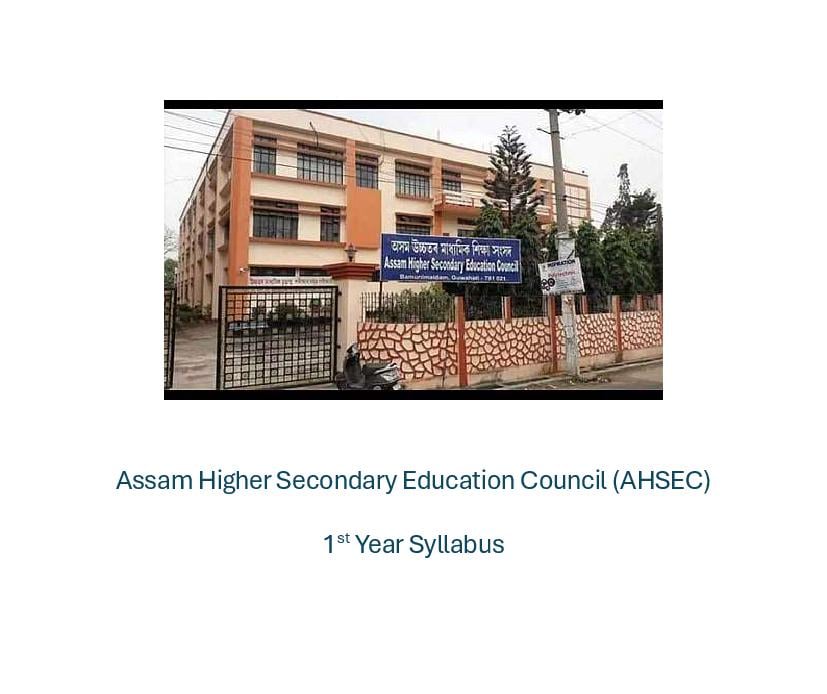
Finished viewing? Save it for later —
Download AHSEC HS 1st Year Syllabus 2026 Logic Philosophy (PDF · 4 pages)About AHSEC HS 1st Year Syllabus 2026 Logic Philosophy
AHSEC HS 1st Year Syllabus 2026 Logic Philosophy is available here for free download. Published by Assam Board for Class 11, this syllabus can be viewed online or downloaded as a PDF (4 pages). Candidates preparing for Class 11 can use AHSEC HS 1st Year Syllabus 2026 Logic Philosophy to understand the exam pattern, the type of questions asked, and the overall difficulty level.
Frequently Asked Questions
How can I download AHSEC HS 1st Year Syllabus 2026 Logic Philosophy?
Open this page and click the Download button to save AHSEC HS 1st Year Syllabus 2026 Logic Philosophy as a PDF. It is completely free on AglaSem Docs.
Is AHSEC HS 1st Year Syllabus 2026 Logic Philosophy free to download?
Yes. AHSEC HS 1st Year Syllabus 2026 Logic Philosophy can be viewed online and downloaded as a PDF free of cost on AglaSem Docs.
How many pages does AHSEC HS 1st Year Syllabus 2026 Logic Philosophy have?
AHSEC HS 1st Year Syllabus 2026 Logic Philosophy contains 4 pages, which you can read online or download together as a single PDF.
Where can I find more Class 11 study material?
You can find more Class 11 question papers, sample papers, syllabus, and answer keys on AglaSem Docs.
AHSEC HS 1st Year Syllabus 2026 Logic Philosophy – Text
Read the full text of this syllabus below — useful to quickly search, copy and reference the content online without downloading the PDF.
📄 View text version (4 pages)
Page 1
1st Year Syllabus
Page 2
LOGIC AND PHILOSOPHY
SYLLABUS FOR HIGHER SECONDARY FIRST YEAR COURSE
Objective:
Philosophy enquires into the meaning and significance of life and the world. It is called a second
order discipline in so far as it enquires into the foundations and presuppositions of various disciplines.
Logic is a Science which deals with forms of arguments. In an extended sense it studies the methodology
of deductive as well as inductive Science. Modern logic is a rapidly developing Science and it is closely
related to mathematics. It does not cancel the Aristotelian logic but points out its limitations. So in the
syllabus, we intend to acquaint the students with the elements of traditional logic, modern logic and scien-
tific method. The syllabus will also acquaint students with a few essential problems of Western and Indian
Philosophy.
One Paper Time : Three hours Marks : 100
Unitwise Distribution of Marks & Periods :
Unit Topics Marks Periods
GROUP-A : LOGIC (Marks-60)
Unit-1 Logic 10 20
Unit-2 Proposition 20 40
Unit-3 Inference, Categorical syllogism 15 30
Unit-4 Symbolic Logic 15 30
Unit-5 Philosophy 10 15
Unit-6 Indian Philosophy 10 15
Unit-7 Theory of Knowledge, Pramanas 10 15
Unit-8 Realism and Idealism 10 15
Total : 100 180
Unitwise Distribution of Course Contents:
GROUP-A : LOGIC (Marks-60)
Unit-I : Logic :
Definition, Nature. Scope and Utility, Traditional and Modern Logic, Utility of Symbols.
Unit-2 : Proposition :
Definition, Structure. Traditional classification of Proposition according to Quality and
Quantity. The four fold scheme of Proposition AEIO. Transformation of ordinary sentence
into logical forms - AEIO, Distribution of Terms. Modern classification of Proposition
Simple. Compound and General.
Page 3
Unit-3 : Inference :
Definition, Type- Deduction and Inductive, Mediate 'and Immediate.
Categorical syllogism :
Structure, Rules. Figure. Valid-mood, Testing of syllogistic reasoning.
Unit-4 : Symbolic Logic :
Characteristics, Symbols, Use of Symbols, Constant, Variables, Truth Function. Basic
Truth Function, Construction of Truth Table.
Unit-5 : Philosophy :
Its relation to Science, Epistemology, Metaphysics, Axiology.
Unit-6 : Indian Philosophy :
Its Characteristics, Classification of Indian Philosophy- Vedic and Non-Vedic.
Unit-7 : Theory of knowledge :
Rationalism and Empiricism.
Pramanas : Pratyaksa and Anumana.
Unit-8 : Realism and Idealism :
Their basic features.
Prescribed Textbook : 1. Logic and Philosophy, Published by AHSEC.
1. Ó¬fl¡«ø¬ı:±Ú ’±1n∏ √˙«Ú, Published by AHSEC.
[Note : The textbooks are available in Bengali Medium also]
Page 4
Notes
Model Papers Class 6 Notes
Sample Papers Class 7 Notes
Half Yearly Sample Papers Class 8 Notes
Class 9 Notes
Important Resources
Class 10 Notes
Periodic Table
Class 11 Notes
Writing Skills / Formats
Maps of India / World Class 12 Notes
Books and Solutions
NCERT Books
NCERT Book Solutions
HC Verma Chapter Wise Solutions
RD Sharma Solutions
CGBSE Solutions
Document Details
| Board / Org | Assam Board |
| Exam | Class 11 |
| Type | Syllabus |
| Pages | 4 |
| Updated | 24 Sep 2026 |