ICAR AIEEA PG 2022 Question Paper Forestry Agroforestry Silviculture
Finished viewing? Save it for later —
Download ICAR AIEEA PG 2022 Question Paper Forestry Agroforestry Silviculture (PDF · 20 pages)About ICAR AIEEA PG 2022 Question Paper Forestry Agroforestry Silviculture
ICAR AIEEA PG 2022 Question Paper Forestry Agroforestry Silviculture is available here for free download. Published by ICAR for AIEEA PG, this question paper can be viewed online or downloaded as a PDF (20 pages). Candidates preparing for AIEEA PG can use ICAR AIEEA PG 2022 Question Paper Forestry Agroforestry Silviculture to understand the exam pattern, the type of questions asked, and the overall difficulty level.
Frequently Asked Questions
How can I download ICAR AIEEA PG 2022 Question Paper Forestry Agroforestry Silviculture?
Open this page and click the Download button to save ICAR AIEEA PG 2022 Question Paper Forestry Agroforestry Silviculture as a PDF. It is completely free on AglaSem Docs.
Is ICAR AIEEA PG 2022 Question Paper Forestry Agroforestry Silviculture free to download?
Yes. ICAR AIEEA PG 2022 Question Paper Forestry Agroforestry Silviculture can be viewed online and downloaded as a PDF free of cost on AglaSem Docs.
How many pages does ICAR AIEEA PG 2022 Question Paper Forestry Agroforestry Silviculture have?
ICAR AIEEA PG 2022 Question Paper Forestry Agroforestry Silviculture contains 20 pages, which you can read online or download together as a single PDF.
Where can I find more AIEEA PG study material?
You can find more AIEEA PG question papers, sample papers, syllabus, and answer keys on AglaSem Docs.
ICAR AIEEA PG 2022 Question Paper Forestry Agroforestry Silviculture – Text
Read the full text of this question paper below — useful to quickly search, copy and reference the content online without downloading the PDF.
📄 View text version (20 pages)
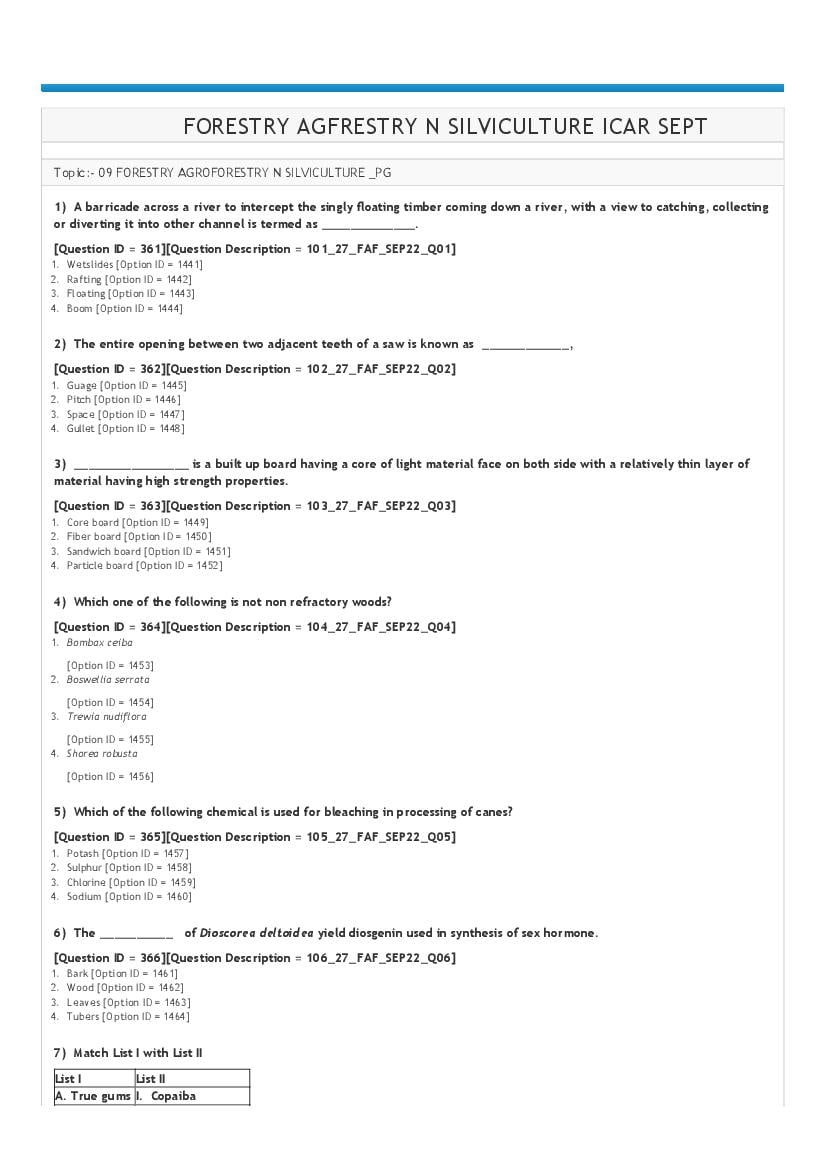
Page 1
Topic:‐ 09 FORESTRY AGROFORESTRY N SILVICULTURE _PG
1) A barricade across a river to intercept the singly floating timber coming down a river, with a view to catching, collecting
or diverting it into other channel is termed as _____________.
[Question ID = 361][Question Description = 101_27_FAF_SEP22_Q01]
1. Wetslides [Option ID = 1441]
2. Rafting [Option ID = 1442]
3. Floating [Option ID = 1443]
4. Boom [Option ID = 1444]
2) The entire opening between two adjacent teeth of a saw is known as ____________,
[Question ID = 362][Question Description = 102_27_FAF_SEP22_Q02]
1. Guage [Option ID = 1445]
2. Pitch [Option ID = 1446]
3. Space [Option ID = 1447]
4. Gullet [Option ID = 1448]
3) ________________ is a built up board having a core of light material face on both side with a relatively thin layer of
material having high strength properties.
[Question ID = 363][Question Description = 103_27_FAF_SEP22_Q03]
1. Core board [Option ID = 1449]
2. Fiber board [Option ID = 1450]
3. Sandwich board [Option ID = 1451]
4. Particle board [Option ID = 1452]
4) Which one of the following is not non refractory woods?
[Question ID = 364][Question Description = 104_27_FAF_SEP22_Q04]
1. Bombax ceiba
[Option ID = 1453]
2. Boswellia serrata
[Option ID = 1454]
3. Trewia nudiflora
[Option ID = 1455]
4. Shorea robusta
[Option ID = 1456]
5) Which of the following chemical is used for bleaching in processing of canes?
[Question ID = 365][Question Description = 105_27_FAF_SEP22_Q05]
1. Potash [Option ID = 1457]
2. Sulphur [Option ID = 1458]
3. Chlorine [Option ID = 1459]
4. Sodium [Option ID = 1460]
6) The __________ of Dioscorea deltoidea yield diosgenin used in synthesis of sex hormone.
[Question ID = 366][Question Description = 106_27_FAF_SEP22_Q06]
1. Bark [Option ID = 1461]
2. Wood [Option ID = 1462]
3. Leaves [Option ID = 1463]
4. Tubers [Option ID = 1464]
7) Match List I with List II
List I List II
A. True gums I. Copaiba
Page 2
C. Oleo resins III. Sandarac
D. Gum‐resinsIV. Pyrogallol
V. Gum Tragacanth
[Question ID = 367][Question Description = 107_27_FAF_SEP22_Q07]
1. A ‐ IV, B ‐ V, C ‐ III, D ‐ II [Option ID = 1465]
2. A ‐ II, B ‐ III, C ‐ I, D ‐V [Option ID = 1466]
3. A ‐ III, B ‐ II, C ‐ V, D ‐ I [Option ID = 1467]
4. A ‐ V, B ‐ III, C ‐ I, D ‐ II [Option ID = 1468]
8) Match List I with List II
List I List II
A. Agar oil I. Gaultheria fragrantissima
B. Linaloe oil II. Cymbopogon flexuosus
C. Wintergreen oilIII. Clausena heptaphylla
D. Lemon grass oil IV. Aquilaria malaccensis
V. Bursera penicillata
[Question ID = 368][Question Description = 108_27_FAF_SEP22_Q08]
1. A ‐ V, B ‐ IV, C ‐ II, D ‐ I [Option ID = 1469]
2. A ‐ IV, B ‐ V, C ‐ I, D ‐ II [Option ID = 1470]
3. A ‐ III, B ‐ I, C ‐ IV, D ‐ V [Option ID = 1471]
4. A ‐II, B ‐III, C ‐V, D ‐ IV [Option ID = 1472]
9) Match List I with List II
List I List II
A. Oil preservative I. Hardi proof
B. Water soluble preservative II. Acetic anhydride
C. Organic solvent preservativeIII. Solignum
D. Chemically modified wood IV. ASCU
V. Zinc sulphate
[Question ID = 369][Question Description = 109_27_FAF_SEP22_Q09]
1. A ‐ IV, B ‐ I, C ‐ III, D ‐ II [Option ID = 1473]
2. A ‐ III, B ‐ IV, C ‐ I, D ‐ II [Option ID = 1474]
3. A ‐ II, B ‐ V, C ‐ IV, D ‐ III [Option ID = 1475]
4. A ‐ II, B ‐ III, C ‐ V, D ‐ I [Option ID = 1476]
10) Match List I with List II
List I List II
A. Kamela I. Caesalpinia coriaria
B. Annatto II. Mallotus philippensis
C. Divi‐divi III. Acacia mollissima
D. Wattle IV. Bixa orellana
V. Terminalia chebula
[Question ID = 370][Question Description = 110_27_FAF_SEP22_Q10]
1. A ‐ III, B ‐ IV, C ‐ II, D ‐ V [Option ID = 1477]
2. A ‐ V, B ‐ III, C ‐ IV, D ‐ I [Option ID = 1478]
3. A ‐ IV, B ‐ II, C ‐ V, D ‐ I [Option ID = 1479]
4. A ‐ II, B ‐ IV, C ‐ I, D ‐ III [Option ID = 1480]
11) Match List I with List II
List I List II
A. Pepper I. Ricinus communis
B. Wild turmericII. Elettaria cardamomum
Page 3
D. Castor IV. Piper longum
V. Curcuma aromatica
[Question ID = 371][Question Description = 111_27_FAF_SEP22_Q11]
1. A ‐ III, B ‐ I, C ‐ IV, D ‐ II [Option ID = 1481]
2. A ‐ IV, B ‐ V, C ‐ II, D ‐ I [Option ID = 1482]
3. A ‐II, B ‐ IV, C ‐I, D ‐ III [Option ID = 1483]
4. A ‐ V, B ‐III, C ‐ I, D ‐ IV [Option ID = 1484]
12) __________ and _____________ are two important products obtained from distillation of oleo‐resins of Indian pines.
[Question ID = 372][Question Description = 112_27_FAF_SEP22_Q12]
1. Lac and shellac [Option ID = 1485]
2. Turpentine and rosin [Option ID = 1486]
3. Katha and cutch [Option ID = 1487]
4. Copaiba and Elmi [Option ID = 1488]
13) Sodium hydroxide is used as cooking chemical in _____________ pulping process.[Question ID = 373][Question
Description = 113_27_FAF_SEP22_Q13]
1. Acidic [Option ID = 1489]
2. Semi chemical [Option ID = 1490]
3. Alkaline [Option ID = 1491]
4. Mechanical [Option ID = 1492]
14) Elite trees are declared on the basis of __________.[Question ID = 374][Question Description =
114_27_FAF_SEP22_Q14]
1. Performance of selected phenotypes [Option ID = 1493]
2. Performance of progenies of selected parents [Option ID = 1494]
3. Mean phenotypic values of entire families chosen for selection [Option ID = 1495]
4. Performance of siblings of selected individuals [Option ID = 1496]
15) Which one of the following is the product of Narrow‐Sense Heritability and Selection Differential?
[Question ID = 375][Question Description = 115_27_FAF_SEP22_Q15]
1. Genetic advance [Option ID = 1497]
2. Genetic Co‐efficient of Variation [Option ID = 1498]
3. Heterosis [Option ID = 1499]
4. Genetic Gain [Option ID = 1500]
16) Identify the mechanism of promoting self‐pollination in the following?
[Question ID = 376][Question Description = 116_27_FAF_SEP22_Q16]
1. Dichogamy [Option ID = 1501]
2. Male sterility [Option ID = 1502]
3. Cleistogamy [Option ID = 1503]
4. Self‐incompatibility [Option ID = 1504]
17) Identify the method in which multiple traits are considered while selection and found to be widely used, less time
consuming and comparably easier.
[Question ID = 377][Question Description = 117_27_FAF_SEP22_Q17]
1. Recurrent selection [Option ID = 1505]
2. Tandem Selection [Option ID = 1506]
3. Independent culling [Option ID = 1507]
4. Family cum within family selection [Option ID = 1508]
18) Given below are two statements related to tree improvement
Statement I: Clones established in the CSO are derived from plants propagated through vegetaive means from respective
plus trees.
Statement II: Trees established in the SPA are derived from plants propagated through seeds collected from selected plus
trees.
In light of the above statements, choose the correct answer from the options given below
Page 4
1. Both Statement I and Statement II are true [Option ID = 1509]
2. Both Statement I and Statement II are false [Option ID = 1510]
3. Statement I is false but Statement II is true [Option ID = 1511]
4. Statement I is true but Statement II is false [Option ID = 1512]
19) In general, there are three types of resistance to insects are recognized. One of them is specifying that the insects are
killed/injured from completing its normal life cylce after feeding on a tree and it is called as __________.
[Question ID = 379][Question Description = 119_27_FAF_SEP22_Q19]
1. Vulnerable [Option ID = 1513]
2. Tolerance [Option ID = 1514]
3. Non‐preference [Option ID = 1515]
4. Antibiosis [Option ID = 1516]
20) How many crosses do you need it for 20 parents in a Full Diallel and a Half Diallel (Excluding selfs) designs?[Question ID
= 380][Question Description = 120_27_FAF_SEP22_Q20]
1. 400 & 190, respectively [Option ID = 1517]
2. 200 & 45, respectively [Option ID = 1518]
3. 625 & 300, respectively [Option ID = 1519]
4. 361 & 171, respectively [Option ID = 1520]
21) What do you mean by the mechanism in which the embryo develops from an unreduced egg in an embryo sac from a
nuclear cell?[Question ID = 381][Question Description = 121_27_FAF_SEP22_Q21]
1. Adventitious embryony [Option ID = 1521]
2. Apogamy [Option ID = 1522]
3. Apospory [Option ID = 1523]
4. Diplospory [Option ID = 1524]
22) Match List I with List II based on the Organizations, working on conservation and tree imrpvoement, and its head
quarter/location
List I List II
National/International organization/Institute Location of head quarter
A. IPGRI I. Bogor
B. IFGTB II. Rome
C. CIFOR III. Dehradun
D. NBPGR IV. Coimbatore
V. New Delhi
[Question ID = 382][Question Description = 122_27_FAF_SEP22_Q22]
1. A ‐I, B ‐III, C ‐ II, D ‐V [Option ID = 1525]
2. A ‐II, B ‐IV, C ‐I, D ‐V [Option ID = 1526]
3. A ‐V, B ‐IV, C ‐I, D ‐III [Option ID = 1527]
4. A ‐ V, B ‐IV, C ‐I, D ‐II [Option ID = 1528]
23) Identify correct eligible criteria (characters) used while registering tree varieties under PPV FRA, India[Question ID =
383][Question Description = 123_27_FAF_SEP22_Q23]
1. Distinctness, Uniformity & Successfulness [Option ID = 1529]
2. Difference, Unique & Synchrony [Option ID = 1530]
3. Distinctness, Uniformity & Stability [Option ID = 1531]
4. Novelty, Unique & Strength [Option ID = 1532]
24) Given below are two statements regarding combining ability, where it is the ability of parents or crosses to combine
among each other during hybridization process which results in transmission of desirable genes or characters to the their
progenies.
Statement I: SCA is attributable through half‐sib families where in one parent is known.
Statement II: Where GCA is attributable due to full sib families.
In light of the above statements, choose the most appropriate answer from the options given below
[Question ID = 384][Question Description = 124_27_FAF_SEP22_Q24]
1. Both Statement I and Statement II are correct [Option ID = 1533]
2. Both Statement I and Statement II are incorrect [Option ID = 1534]
Page 5
4. Statement I is incorrect but Statement II is correct [Option ID = 1536]
25) Which one of the following wild animals is not proposed/suggested for reintroduction as Wildlife Management apporach?
[Question ID = 385][Question Description = 125_27_FAF_SEP22_Q25]
1. Great Indian Rhinoceros [Option ID = 1537]
2. Brow‐antlered Deer [Option ID = 1538]
3. The Asiatic Lion [Option ID = 1539]
4. Tiger [Option ID = 1540]
26) The following deer looks like a pig and they live in the grasslands.[Question ID = 386][Question Description =
126_27_FAF_SEP22_Q26]
1. Hog deer [Option ID = 1541]
2. Hangul [Option ID = 1542]
3. Barking deer [Option ID = 1543]
4. Mouse deer [Option ID = 1544]
27) One of the following terms refer to the Status or Place of an organism in its community/food pyramid and it is
________.
[Question ID = 387][Question Description = 127_27_FAF_SEP22_Q27]
1. Habitat [Option ID = 1545]
2. Territory [Option ID = 1546]
3. Protected Area [Option ID = 1547]
4. Niche [Option ID = 1548]
28) Match List I with List II based on Wetlands and states in which they belong.
List I List II
Name of wetlands States
A. Chilika lake I. Assam
B. Harike wetland II. Punjab
C. Sambhar lake III. West Bengal
D. Sundarban wetlandIV. Odisha
V. Rajasthan
[Question ID = 388][Question Description = 128_27_FAF_SEP22_Q28]
1. A ‐ V, B ‐ III, C ‐ IV, D ‐ II [Option ID = 1549]
2. A ‐ IV, B ‐ II, C ‐ I, D ‐ III [Option ID = 1550]
3. A ‐ IV, B ‐ II, C ‐ V, D ‐ III [Option ID = 1551]
4. A ‐ I, B ‐ IV, C ‐ V, D ‐ III [Option ID = 1552]
29) In India, the Ramsar Convention came into force on _____________.[Question ID = 389][Question Description =
129_27_FAF_SEP22_Q29]
1. 2nd Feb 1971 [Option ID = 1553]
2. 3r d Mar 1973 [Option ID = 1554]
3. 1st Feb 1982 [Option ID = 1555]
4. 29th Dec 1993 [Option ID = 1556]
30) Under which section of the Wild Life (Protection) Amendment Act‐ 2002, the conservation reserve and the community
reserve are declared?[Question ID = 390][Question Description = 130_27_FAF_SEP22_Q30]
1. Section 36A & 36C [Option ID = 1557]
2. Section 33B & 34A [Option ID = 1558]
3. Section 18A & 18B [Option ID = 1559]
4. Section 5A & 5B [Option ID = 1560]
31) Under which section of Biological Diveristy Act, provision has been made for notifying biodiversity heritage sites?
[Question ID = 391][Question Description = 131_27_FAF_SEP22_Q31]
1. Section 8 [Option ID = 1561]
2. Section 22 [Option ID = 1562]
3. Section 37 [Option ID = 1563]
4. Section 41 [Option ID = 1564]
32) What do you mean by a cultivated variety of plants including trees that was developed, grown and exchanged
Page 6
[Question ID = 392][Question Description = 132_27_FAF_SEP22_Q32]
1. Folk variety [Option ID = 1565]
2. Local cultivar [Option ID = 1566]
3. Land Race [Option ID = 1567]
4. Commercial Variety [Option ID = 1568]
33) The following articles of CBD deals with In situ and Ex situ conservation of Biological diversity.[Question ID = 393]
[Question Description = 133_27_FAF_SEP22_Q33]
1. Articles 6 & 10, respectively [Option ID = 1569]
2. Articles 8 & 10, respectively [Option ID = 1570]
3. Articles 8 & 15, respectively [Option ID = 1571]
4. Articles 12 & 15, respectively [Option ID = 1572]
34) Shanti Vanas are created by planting the tree seedlings and is popularly known as _____________.[Question ID = 394]
[Question Description = 134_27_FAF_SEP22_Q34]
1. Temple Groves [Option ID = 1573]
2. School Forests [Option ID = 1574]
3. Backyard planting [Option ID = 1575]
4. Graveyard Forests [Option ID = 1576]
35) Given below are two statements
Statement I: Herpetology means study of frogs, lizards, snakes.
Statement II: Herpetology means study of amphibians like frogs and reptiles like birds and snakes.
In light of the above statements, choose the correct answer from the options given below
[Question ID = 395][Question Description = 135_27_FAF_SEP22_Q35]
1. Both Statement I and Statement II are true [Option ID = 1577]
2. Both Statement I and Statement II are false [Option ID = 1578]
3. Statement I is true but Statement II is false [Option ID = 1579]
4. Statement I is false but Statement II is true [Option ID = 1580]
36) The active factors of soil formations are ____________ and _____________.
[Question ID = 396][Question Description = 136_27_FAF_SEP22_Q36]
1. Time and Relief [Option ID = 1581]
2. Climate and Organisms [Option ID = 1582]
3. Time and Organisms [Option ID = 1583]
4. Parent materials and Organisms [Option ID = 1584]
37) The soils formed from glacial drift materials, exhibiting evidences of cryoturbation (frost mixing or churning) belongs to
_______ Soil Order.
[Question ID = 397][Question Description = 137_27_FAF_SEP22_Q37]
1. Gelisols [Option ID = 1585]
2. Oxisols [Option ID = 1586]
3. Vertisols [Option ID = 1587]
4. Andisols [Option ID = 1588]
38) There is an increase in soil _________ and ________ following forest fire.
[Question ID = 398][Question Description = 138_27_FAF_SEP22_Q38]
1. pH and EC [Option ID = 1589]
2. EC and CEC [Option ID = 1590]
3. OC and CEC [Option ID = 1591]
4. EC and OC [Option ID = 1592]
39) A forest area (forming the whole or part of working plan area) organized with a particular object and under one
silvicultural system and one set of working plan prescriptions is called as _________ .
[Question ID = 399][Question Description = 139_27_FAF_SEP22_Q39]
1. Working circle [Option ID = 1593]
2. Annual coupe [Option ID = 1594]
3. Compartment [Option ID = 1595]
4. Block [Option ID = 1596]
Page 7
[Question ID = 400][Question Description = 140_27_FAF_SEP22_Q40]
1. V. Verma [Option ID = 1597]
2. Tansely [Option ID = 1598]
3. R. H. Whittaker [Option ID = 1599]
4. W. Faunal [Option ID = 1600]
41) The instrument used to measure diameter at any convenient height.
[Question ID = 401][Question Description = 141_27_FAF_SEP22_Q41]
1. Tree Calliper [Option ID = 1601]
2. Blue Tape [Option ID = 1602]
3. Wheeler’s Penta Prism [Option ID = 1603]
4. Relaskop [Option ID = 1604]
42) Select the correct matched ones:
A. World Water day 22n d March
B. World Environment day 5th May
C. World Forestry Day 21st March
D. World Biodiversity day 3rd October
[Question ID = 402][Question Description = 142_27_FAF_SEP22_Q42]
1. A and C only [Option ID = 1605]
2. B and C only [Option ID = 1606]
3. B and D only [Option ID = 1607]
4. A and D only [Option ID = 1608]
43) The Scheduled Tribes and Other Traditional Forest Dwellers (Recognition of Forest Rights) Act, was enacted in the
year ______________.
[Question ID = 403][Question Description = 143_27_FAF_SEP22_Q43]
1. 2006 [Option ID = 1609]
2. 2008 [Option ID = 1610]
3. 1988 [Option ID = 1611]
4. 1998 [Option ID = 1612]
44) A Forest Officer of a rank not inferior to that of a Forest Ranger under _______ section of Indian Forest Act, 1927 has
got power to compound Forest Offences.
[Question ID = 404][Question Description = 144_27_FAF_SEP22_Q44]
1. 68 [Option ID = 1613]
2. 72 [Option ID = 1614]
3. 27 [Option ID = 1615]
4. 19 [Option ID = 1616]
45) The formula based on the relationship between volume and increment was introduced by
[Question ID = 405][Question Description = 145_27_FAF_SEP22_Q45]
1. Von Mantel in 1852 [Option ID = 1617]
2. Hundeshogen in 1826 [Option ID = 1618]
3. D Brandis in 1896 [Option ID = 1619]
4. Champion and Seth in 1922 [Option ID = 1620]
46) Which of the following best describes/describe the aim of ‘Green India Mission’ of the Government of India?
A. Incorporating environmental benefits and costs into the Union and State Budgets thereby implementing the `green
accounting’
B. Launching the second green revolution to enhance agricultural output so as to ensure food security to one and all in the
future
C. Restoring and enhancing forest cover and responding to climate change by a combination of adaptation and mitigation
measures
Page 8
1. A only [Option ID = 1621]
2. C only [Option ID = 1622]
3. B only [Option ID = 1623]
4. A and C only [Option ID = 1624]
47) _____________is the rotation (takes in to account the price /size gradients and cost of maintenance),which yields the
highest net returns on the invested capitals.
[Question ID = 407][Question Description = 147_27_FAF_SEP22_Q47]
1. Financial rotation [Option ID = 1625]
2. Rotation of maximum volume production [Option ID = 1626]
3. Technical rotation [Option ID = 1627]
4. Silvicultural rotation [Option ID = 1628]
48) The volume at the age of 40 years is 4000 cft. and at the age of 50 years is 5000 cft. and a thinning carried out at the
age of 45 years gave 1000 cft., then increment percent (p) by Pressler’s formula will be :
[Question ID = 408][Question Description = 148_27_FAF_SEP22_Q48]
1. 4.0 [Option ID = 1629]
2. 5.0 [Option ID = 1630]
3. 2.5 [Option ID = 1631]
4. 4.5 [Option ID = 1632]
49) Find the annual yield by Von Mantel's formula for a sal forest having total volume 10,000 cubic meter and the rotation
age is 100 years.
[Question ID = 409][Question Description = 149_27_FAF_SEP22_Q49]
1. 200 cubic meter [Option ID = 1633]
2. 220 cubic meter [Option ID = 1634]
3. 20 cubic meter [Option ID = 1635]
4. 100 cubic meter [Option ID = 1636]
50) The British Ecologist who used the term Ecosystem for first time in the year 1935.
[Question ID = 410][Question Description = 150_27_FAF_SEP22_Q50]
1. Tansley [Option ID = 1637]
2. Odum [Option ID = 1638]
3. Chacko [Option ID = 1639]
4. Ignacimuthu [Option ID = 1640]
51) The Bombay Natural History Society (BNHS) was founded in the year_____________ to collect information and
specimens of flora and fauna .
[Question ID = 411][Question Description = 151_27_FAF_SEP22_Q51]
1. 1883 [Option ID = 1641]
2. 1838 [Option ID = 1642]
3. 1983 [Option ID = 1643]
4. 1903 [Option ID = 1644]
52) International Union for Conservation of Nature and Natural Resources (IUCN) is an organization dedicated to conserving
nature and promoting sustainable use of natural resources and it's headquarter is at _____________.
[Question ID = 412][Question Description = 152_27_FAF_SEP22_Q52]
1. Paris (France)
[Option ID = 1645]
2. Morges (Switzerland)
[Option ID = 1646]
3. New Delhi (India)
[Option ID = 1647]
4. New York (USA)
[Option ID = 1648]
53) The first National Forest Policy in independent India came into effect in the year _________.
[Question ID = 413][Question Description = 153_27_FAF_SEP22_Q53]
Page 9
2. 1952 [Option ID = 1650]
3. 1954 [Option ID = 1651]
4. 1988 [Option ID = 1652]
54) The mono‐climax theory of succession has been put forwarded by ____.
[Question ID = 414][Question Description = 154_27_FAF_SEP22_Q54]
1. Clements [Option ID = 1653]
2. Whittaker [Option ID = 1654]
3. Odum [Option ID = 1655]
4. Fosberg [Option ID = 1656]
55) ________________ refers to the faithfulness of the species in occurrence in a particular kind of community.
[Question ID = 415][Question Description = 155_27_FAF_SEP22_Q55]
1. Constance [Option ID = 1657]
2. Dominance [Option ID = 1658]
3. Gregarousness [Option ID = 1659]
4. Fidelity [Option ID = 1660]
56) Out of the total number of fires which occurs in our country about _________ percent are caused by the natural
causes (lightening, rolling stones or rubbing of dry bamboo with each other).
[Question ID = 416][Question Description = 156_27_FAF_SEP22_Q56]
1. 5 [Option ID = 1661]
2. 15 [Option ID = 1662]
3. 25 [Option ID = 1663]
4. 20 [Option ID = 1664]
57) Which of the following is a Teak defoliator?
[Question ID = 417][Question Description = 157_27_FAF_SEP22_Q57]
1. Hyblaea puera [Option ID = 1665]
2. Plecoptera reflexai [Option ID = 1666]
3. Hoplocerambyx spinicornis [Option ID = 1667]
4. Eutectona machaeralis [Option ID = 1668]
58) Sandalwood spike disease (SSD), the most destructive of known diseases to infect Indian sandalwood (Santalum album
L.) is caused by________________.
[Question ID = 418][Question Description = 158_27_FAF_SEP22_Q58]
1. Phytoplasmas [Option ID = 1669]
2. Polyphagous insect [Option ID = 1670]
3. Rhizoctonia spp. [Option ID = 1671]
4. Viruses [Option ID = 1672]
59) ___________ a nitrogen‐fixing actinomycete, forms root nodules with eight non‐leguminous plant families.
[Question ID = 419][Question Description = 159_27_FAF_SEP22_Q59]
1. Frankia spp. [Option ID = 1673]
2. Bacillus spp. [Option ID = 1674]
3. Rhizobium spp. [Option ID = 1675]
4. Streptomysis spp. [Option ID = 1676]
60) The bio‐control agent for control of lantana (Lantana camera) weed is ____________.
[Question ID = 420][Question Description = 160_27_FAF_SEP22_Q60]
1. Ophimyia lantanae [Option ID = 1677]
2. Bacillus lantanae [Option ID = 1678]
3. Rhizobium spp. [Option ID = 1679]
4. Helicoverpa armigera [Option ID = 1680]
61) In India diameter or girth at breast height is measured at _________ whereas, in Europe ,UK and other commonwealth
countries it is measured at ____________.
[Question ID = 421][Question Description = 161_27_FAF_SEP22_Q61]
1. 1.37 m ; 1.30 m [Option ID = 1681]
2. 1.30 m ; 1.37 m [Option ID = 1682]
Page 10
4. 1.37 m ; 1.20 m [Option ID = 1684]
62) Match List I with List II
List I List II
A. Net squared timber from logI. Frustrum of cone
B. Quarter girth formula II. Frustrum of neiloid
C. Bottom portion of tree III. 63.6 % of the actual volume
D. Middle portion of tree IV. 78.50 % of the actual volume
V. Frustrum of paraboloid
[Question ID = 422][Question Description = 162_27_FAF_SEP22_Q62]
1. A ‐IV , B ‐III , C‐ II, D ‐ V [Option ID = 1685]
2. A ‐IV , B ‐II , C‐ III, D ‐ I [Option ID = 1686]
3. A ‐III , B ‐IV , C ‐I, D ‐ V [Option ID = 1687]
4. A ‐III , B ‐IV , C‐ II, D ‐ V [Option ID = 1688]
63) A. The diameter at the thin end of the log determines the sawn volume that can be taken out of it, the greater the
rate of taper, the lesser is the length of the log.
B. The diameter at the thick end of the log determines the sawn volume that can be taken out of it, the greater the rate of
taper, the lesser is the length of the log.
C. The diameter at the thin end of the log determines the sawn volume that can be taken out of it, the greater the rate of
taper, the greater is the length of the log.
D. The diameter at the thick end of the log determines the sawn volume that can be taken out of it, the greater the rate of
taper, the greater is the length of the log.
[Question ID = 423][Question Description = 163_27_FAF_SEP22_Q63]
1. A and D only [Option ID = 1689]
2. A and B only [Option ID = 1690]
3. A and C only [Option ID = 1691]
4. A only [Option ID = 1692]
64) A. According to Metzer’s theory, the stem of the tree is built up in such a way as, with the maximum of material, to
offer uniformly the greatest resistance to the stresses to which it is subjected.
B. According to Metzer’s theory, the stem of the tree is built up in such a way as, with the minimum of material, to offer
uniformly the greatest resistance to the stresses to which it is subjected.
C. According to Metzer’s theory, the stem of the tree is built up in such a way as, with the maximum of material, to offer
uniformly the equal resistance to the stresses to which it is subjected.
D. According to Metzer’s theory, the stem of the tree is built up in such a way as, with the minimum of material, to offer
uniformly the equal resistance to the stresses to which it is subjected.
[Question ID = 424][Question Description = 164_27_FAF_SEP22_Q64]
1. A only [Option ID = 1693]
2. B only [Option ID = 1694]
3. C only [Option ID = 1695]
4. D only [Option ID = 1696]
65) In India the first teak plantation was established at Nilambur, Kerala during the year
[Question ID = 425][Question Description = 165_27_FAF_SEP22_Q65]
1. 1942 [Option ID = 1697]
2. 1842 [Option ID = 1698]
3. 1947 [Option ID = 1699]
4. 1893 [Option ID = 1700]
66) A. Total number of plants that can be accommodated in 6 ha of land with a spacing of 3X2 is approximately 100000
B.Total number of plants that can be accommodated in 6 ha of land with a spacing of 3X2 is approximately 10000
Page 11
D. Total number of plants that can be accommodated in 6 ha of land with a spacing of 3X2 is approximately 9000
E.Total number of plants that can be accommodated in 6 ha of land with a spacing of 3X2 is approximately 1000
[Question ID = 426][Question Description = 166_27_FAF_SEP22_Q66]
1. A only [Option ID = 1701]
2. B only [Option ID = 1702]
3. C only [Option ID = 1703]
4. D only [Option ID = 1704]
67) Given below are two statements
Statement I: In horizontal point sampling, a series of sampling points are selected randomly or systematically distributed over
the entire area to be inventoried.
Statement II: Trees around this point are viewed through any angle gauge at breast height and all trees forming an angle
lesser than the critical angle of instrument are counted.
In light of the above statements, choose the correct answer from the options given below
[Question ID = 427][Question Description = 167_27_FAF_SEP22_Q67]
1. Both Statement I and Statement II are true [Option ID = 1705]
2. Both Statement I and Statement II are false [Option ID = 1706]
3. Statement I is true but Statement II is false [Option ID = 1707]
4. Statement I is false but Statement II is true [Option ID = 1708]
68) Given below are two statements
Statement I: Instrument called Conimeter is used for vertical point sampling.
Statement II: Within a full 360o sweep around the sample point all trees appearing taller than a critical angle C are counted.
In light of the above statements, choose the correct answer from the options given below
[Question ID = 428][Question Description = 168_27_FAF_SEP22_Q68]
1. Both Statement I and Statement II are true [Option ID = 1709]
2. Both Statement I and Statement II are false [Option ID = 1710]
3. Statement I is true but Statement II is false [Option ID = 1711]
4. Statement I is false but Statement II is true [Option ID = 1712]
69) One of the best examples of the Clear Felling System with artificial regeneration is[Question ID = 429][Question
Description = 169_27_FAF_SEP22_Q69]
1. Madhya Pradesh technique for teak
[Option ID = 1713]
2. Saranda technique for sal
[Option ID = 1714]
3. South Raipur technique for sal [Option ID = 1715]
4. Casuarina plantations in coastal areas [Option ID = 1716]
70) Systems of concentrated regeneration are those silvicultural systems in which regeneration fellings are for the time
being concentrated on part of the felling series. Identify the system which is not aimed at concentrated
regeneration[Question ID = 430][Question Description = 170_27_FAF_SEP22_Q70]
1. The Clear Felling System followed by artificial regeneration [Option ID = 1717]
2. The Uniform Shelterwood System [Option ID = 1718]
3. The Wedge System [Option ID = 1719]
4. The Selection system [Option ID = 1720]
71) Taungya system of raising plantations was first time introduced in India by[Question ID = 431][Question Description =
171_27_FAF_SEP22_Q71]
1. J Westoby [Option ID = 1721]
2. D Brandis [Option ID = 1722]
3. D Conolly [Option ID = 1723]
4. Chatumenon [Option ID = 1724]
72) Stump planting in teak was developed by[Question ID = 432][Question Description = 172_27_FAF_SEP22_Q72]
1. Bourdilloni and Chatumenon [Option ID = 1725]
2. D Brandis and Chatumenon [Option ID = 1726]
Page 12
4. Chaturvedi and Khanna [Option ID = 1728]
73) Under Indian conditions, aspects are exposed to greater amount of insolation.
[Question ID = 433][Question Description = 173_27_FAF_SEP22_Q73]
1. South Western [Option ID = 1729]
2. North Eastern [Option ID = 1730]
3. Southern [Option ID = 1731]
4. Northern [Option ID = 1732]
74) The process of establishment of plant in the new site from germination to its reproduction is known as[Question ID =
434][Question Description = 174_27_FAF_SEP22_Q74]
1. Ecesis [Option ID = 1733]
2. Aggregation [Option ID = 1734]
3. Reaction [Option ID = 1735]
4. Competition [Option ID = 1736]
75) In Shelterwood system, the seeding felling aims to retain _____ trees.
[Question ID = 435][Question Description = 175_27_FAF_SEP22_Q75]
1. Middle‐aged healthy and vigorous trees capable of producing adequate seeds [Option ID = 1737]
2. Middle‐aged healthy and vigorous trees capable of producing few seeds [Option ID = 1738]
3. Healthy and vigorous trees incapable of producing seeds [Option ID = 1739]
4. Over mature trees capable of producing seeds [Option ID = 1740]
76) Classical ordinary thinning consists of the removal of[Question ID = 436][Question Description =
176_27_FAF_SEP22_Q76]
1. Mature Superior trees [Option ID = 1741]
2. Mature diseased trees [Option ID = 1742]
3. Immature inferior trees [Option ID = 1743]
4. Immature healthy trees [Option ID = 1744]
77) Normally broadcasting method of seed sowing is followed for small seeds and identify the species for which the
broadcasting is suitable[Question ID = 437][Question Description = 177_27_FAF_SEP22_Q77]
1. Melia dubia [Option ID = 1745]
2. Tectona grandis [Option ID = 1746]
3. Acrocarpus fraxinifolius [Option ID = 1747]
4. Casuarina equisetifolia [Option ID = 1748]
78) Passing an angled horizontal blade beneath a nursery bed at a specified depth to cut newly penetrating roots and to
loosen and aerate soil.[Question ID = 438][Question Description = 178_27_FAF_SEP22_Q78]
1. Side cutting [Option ID = 1749]
2. Undercutting [Option ID = 1750]
3. Root Pruning [Option ID = 1751]
4. Wrenching [Option ID = 1752]
79) The number of plants that can be accommodated with the spacing of 3 m X 3 m by following triangular system of
planting in 8 ha area is[Question ID = 439][Question Description = 179_27_FAF_SEP22_Q79]
1. 10222 [Option ID = 1753]
2. 11222 [Option ID = 1754]
3. 12222 [Option ID = 1755]
4. 17778 [Option ID = 1756]
80) Tropical dry evergreen forests are restricted to[Question ID = 440][Question Description = 180_27_FAF_SEP22_Q80]
1. Annamalai Hills. [Option ID = 1757]
2. Western Ghats [Option ID = 1758]
3. Vishakapattanam to Puri [Option ID = 1759]
4. Tirunelveli to Nellore [Option ID = 1760]
81) Given below are two statements on tending
Statement I: Tending is an operation carried out for the benefit of the forest crop at any stage of its life. Tending operations
are carried out for establishment of regeneration and subsequent development of forest after harvesting.
Statement II: Tending essentially covers the operations on the crop itself as well as the environment around it and readies
Page 13
In light of the above statements, choose the correct answer from the options given below
[Question ID = 441][Question Description = 181_27_FAF_SEP22_Q81]
1. Both Statement I and Statement II are true [Option ID = 1761]
2. Both Statement I and Statement II are false [Option ID = 1762]
3. Statement I is true but Statement II is false [Option ID = 1763]
4. Statement I is false but Statement II is true [Option ID = 1764]
82) Following are the statements on Liberation cutting
A. Liberation cutting is defined as a cutting made in a young stand, past the sapling stage, for the purpose of freeing the
young growth from older individuals (wolf trees) which are overtopping.
B. Desirable young stems can be overtopped by residual trees left after timber harvesting or by faster‐growing sprouts of an
undesirable species.
C. Liberation cutting should be applied only when potentially valuable crop trees can be benefitted.
D.This cutting type includes all operations designed to regulate the species composition or improve the growth of very
young stands, ordinarily those not past the sapling stage.
[Question ID = 442][Question Description = 182_27_FAF_SEP22_Q82]
1. A, B and D only [Option ID = 1765]
2. B, C and D only [Option ID = 1766]
3. A, B, C and D [Option ID = 1767]
4. B and C only [Option ID = 1768]
83) Indian Council of Forestry Research and Education is the apex body of Forestry Research and Education in India and has
the Head Quarter at[Question ID = 443][Question Description = 183_27_FAF_SEP22_Q83]
1. New Delhi [Option ID = 1769]
2. Chennai [Option ID = 1770]
3. Bengaluru [Option ID = 1771]
4. Dehradun [Option ID = 1772]
84) The Indian Council of Agricultural Research located in New Delhi was established during the year[Question ID = 444]
[Question Description = 184_27_FAF_SEP22_Q84]
1. 1929 [Option ID = 1773]
2. 1947 [Option ID = 1774]
3. 1956 [Option ID = 1775]
4. 1950 [Option ID = 1776]
85) AICRP under Indian Council of Agricultural Research stands for[Question ID = 445][Question Description =
185_27_FAF_SEP22_Q85]
1. All India Crop Research Programme [Option ID = 1777]
2. All India Coordinated Research Planning [Option ID = 1778]
3. All India Coordinated Review Programme [Option ID = 1779]
4. All India Coordinated Research Project [Option ID = 1780]
86) Match List I with List II
List I List II
A. MGNREGA I. Developing rural areas by provisioning economic, social and physical infrastructure facilities.
B. PMAY‐G II. Lend support to the process of participatory planning for the Gram Panchayat Development Plan
C. DDU‐GKY III. Part of the National Rural Livelihood Mission
D. Mission AntyodayaIV. Public housing programme
V. Objective is to provide at least 100 days of guaranteed wage employment in a financial year
[Question ID = 446][Question Description = 186_27_FAF_SEP22_Q86]
1. A ‐ V, B ‐ IV, C ‐III , D ‐ II [Option ID = 1781]
2. A ‐ IV, B ‐ V, C ‐III , D ‐ II [Option ID = 1782]
3. A ‐ IV, B ‐ V, C ‐II , D ‐ I [Option ID = 1783]
4. A ‐ II, B ‐ IV, C ‐V, D ‐ I [Option ID = 1784]
87) Given below are two statements
Page 14
selected to restore landslide areas.
Statement II: One of the methods to stabilize sand dunes is to lay micro‐wind breaks on the dune slopes as parallel strips
across the direction of the wind.
In light of the above statements, choose the correct answer from the options given below
[Question ID = 447][Question Description = 187_27_FAF_SEP22_Q87]
1. Statement I is false but Statement II is true [Option ID = 1785]
2. Both Statement I and Statement II are false [Option ID = 1786]
3. Statement I is true but Statement II is false [Option ID = 1787]
4. Both Statement I and Statement II are true [Option ID = 1788]
88) Given below are two statements
Statement I: Land which is not producing green biomass consistently is called as culturable land
Statement II: A high‐density shelterbelt will provide a higher level of shelter over a shorter distance than a medium or low‐
density belt.
In light of the above statements, choose the correct answer from the options given below
[Question ID = 448][Question Description = 188_27_FAF_SEP22_Q88]
1. Both Statement I and Statement II are true [Option ID = 1789]
2. Both Statement I and Statement II are false [Option ID = 1790]
3. Statement I is true but Statement II is false [Option ID = 1791]
4. Statement I is false but Statement II is true [Option ID = 1792]
89) Given below are two statements
Statement I: A high‐density shelterbelt will provide a higher level of shelter over a shorter distance than a medium or low‐
density belt.
Statement II: Orientation of windbreaks should be parallel to the prevailing wind
In light of the above statements, choose the correct answer from the options given below
[Question ID = 449][Question Description = 189_27_FAF_SEP22_Q89]
1. Both Statement I and Statement II are true [Option ID = 1793]
2. Both Statement I and Statement II are false [Option ID = 1794]
3. Statement I is true but Statement II is false [Option ID = 1795]
4. Statement I is false but Statement II is true [Option ID = 1796]
90) Hormones that affect flowering in plants[Question ID = 450][Question Description = 190_27_FAF_SEP22_Q90]
1. Florin acetic acid [Option ID = 1797]
2. Florigen [Option ID = 1798]
3. Indole Acetic acid [Option ID = 1799]
4. Indole butaric acid [Option ID = 1800]
91) Match List I with List II
List I List II
A. Coppice forest I. Seed origin
B. Decurrent branching II. Fruit yielding trees
C. Excurrent branching III. Vegetative means
D. High forest IV. Evergreen conifers
V. Sympodial in nature
[Question ID = 451][Question Description = 191_27_FAF_SEP22_Q91]
1. A ‐ IV, B ‐ II, C ‐ I, D ‐ V [Option ID = 1801]
2. A ‐ IV, B ‐III , C ‐V , D ‐ I [Option ID = 1802]
3. A ‐ III, B ‐II , C ‐IV , D ‐ I [Option ID = 1803]
4. A ‐ II, B ‐III , C ‐IV , D ‐ I [Option ID = 1804]
92) Given below are two statements
Statement I: Generally, success rates of aerial seeding are often low compared to seedling planting.
Page 15
landslide reclamation because the soil is poor in nutrients.
In light of the above statements, choose the most appropriate answer from the options given below
[Question ID = 452][Question Description = 192_27_FAF_SEP22_Q92]
1. Statement I is correct but Statement II is incorrect [Option ID = 1805]
2. Both Statement I and Statement II are incorrect [Option ID = 1806]
3. Statement I is incorrect but Statement II is correct [Option ID = 1807]
4. Both Statement I and Statement II are correct [Option ID = 1808]
93) Given below are two statements
Statement I: Biodrainage requires high maintenance after initial establishment
Statement II: Land which is producing green biomass consistently is called culturable land
In light of the above statements, choose the most appropriate answer from the options given below
[Question ID = 453][Question Description = 193_27_FAF_SEP22_Q93]
1. Both Statement I and Statement II are correct [Option ID = 1809]
2. Both Statement I and Statement II are incorrect [Option ID = 1810]
3. Statement I is correct but Statement II is incorrect [Option ID = 1811]
4. Statement I is incorrect but Statement II is correct [Option ID = 1812]
94) According to the Forest Survey of India (ISFR 2021), the total forests and tree cover in India constitutes _______ of
the total geographical area of India.[Question ID = 454][Question Description = 194_27_FAF_SEP22_Q94]
1. 24.62% [Option ID = 1813]
2. 21.71 % [Option ID = 1814]
3. 33.33% [Option ID = 1815]
4. 2.91% [Option ID = 1816]
95) The biological model which is expected to perform in predictable manner within a defined environment is called ‐‐‐‐‐‐‐
‐‐‐‐‐‐[Question ID = 455][Question Description = 195_27_FAF_SEP22_Q95]
1. Alleopathy [Option ID = 1817]
2. Sustainability [Option ID = 1818]
3. Ideotype [Option ID = 1819]
4. Symbiosis [Option ID = 1820]
96) Concept of nutrient pumping in agroforestry is based on tree roots extending into[Question ID = 456][Question
Description = 196_27_FAF_SEP22_Q96]
1. O horizon [Option ID = 1821]
2. A horizon [Option ID = 1822]
3. C horizon [Option ID = 1823]
4. Water table [Option ID = 1824]
97) Tropical homegardens are one of the typical examples for _________ agroforestry system.
[Question ID = 457][Question Description = 197_27_FAF_SEP22_Q97]
1. Interpolated [Option ID = 1825]
2. Coincident [Option ID = 1826]
3. Concomitant [Option ID = 1827]
4. Intermitant [Option ID = 1828]
98) Match List I with List II
List I List II
A. Central Agroforestry Research Institute I. Karnal, Haryana
B. Central Research Institute on Dryland AgricultureII. Jodhpur, Rajsthan
C. Central Arid Zone Research Institute III. Hyderabad, Telangana
D. Central Soil Salinity Research Institute IV. Jhansi, Uttar Pradesh
V. New Delhi
[Question ID = 458][Question Description = 198_27_FAF_SEP22_Q98]
1. A ‐V, B ‐ II, C ‐III, D ‐ I [Option ID = 1829]
2. A ‐V, B ‐ III, C ‐II, D ‐ I [Option ID = 1830]
3. A ‐IV, B ‐ III, C ‐II, D ‐ I [Option ID = 1831]
4. A ‐III, B ‐ IV, C ‐II, D ‐ I [Option ID = 1832]
Page 16
[Question ID = 459][Question Description = 199_27_FAF_SEP22_Q99]
1. KFRI, Peechi [Option ID = 1833]
2. FCRI, Mettupalayam [Option ID = 1834]
3. FRI, Dehradun [Option ID = 1835]
4. CIFOR, New Delhi [Option ID = 1836]
100) Match List I with List II
List I List II
A. Sympodial bamboo I. The Selection System
B. Monopodial bamboo II. The Shelterwood System
C. Silvicultural system for bambooIII. Clumping bamboo
D. Seedling felling IV. Running bamboo
V. The Culm Selection System
[Question ID = 460][Question Description = 200_27_FAF_SEP22_Q100]
1. A ‐ IV, B ‐III, C ‐V, D ‐ II [Option ID = 1837]
2. A ‐ III, B ‐IV, C ‐V, D ‐ I [Option ID = 1838]
3. A ‐ IV, B ‐III, C ‐I, D ‐ II [Option ID = 1839]
4. A ‐ III, B ‐IV, C ‐V, D ‐ II [Option ID = 1840]
101) Match List I with List II
List I List II
A. The Uniform System I. The strips are usually 2 to 5 m wide and at intervals of 80 m
B. The Group Shelterwood SystemII. Felling progresses against the direction of the wind
C. The Shelterwood Strip System III. The Irregular Shelterwood System
D. The Wedge System IV. Not suitable for wind thrown areas
V. Karl Gayer
[Question ID = 461][Question Description = 201_27_FAF_SEP22_Q101]
1. A ‐V, B ‐IV , C ‐I, D ‐ II [Option ID = 1841]
2. A ‐IV, B ‐V, C ‐I , D ‐ II [Option ID = 1842]
3. A ‐IV, B ‐V, C ‐III, D ‐ I [Option ID = 1843]
4. A ‐V, B ‐IV , C ‐I, D ‐ III [Option ID = 1844]
102) Given below are two statements
Statement I: The government forests are now managed primarily for ecological services and meeting local communities’
subsistence needs, ending decades of commercial focus.
Statement II: Forest‐based industries, accustomed to getting subsidised raw material supplies from government forests, are
now expected to meet their requirements from non‐forest lands by establishing a direct relationship with farmers.
In light of the above statements, choose the correct answer from the options given below
[Question ID = 462][Question Description = 202_27_FAF_SEP22_Q102]
1. Statement I is true but Statement II is false [Option ID = 1845]
2. Statement I is false but Statement II is true [Option ID = 1846]
3. Both Statement I and Statement II are true [Option ID = 1847]
4. Both Statement I and Statement II are false [Option ID = 1848]
103) Identify the species which is unsuitable for the waterlogged conditions.
[Question ID = 463][Question Description = 203_27_FAF_SEP22_Q103]
1. Terminalia arjuna [Option ID = 1849]
2. Calophyllum inophyllum [Option ID = 1850]
3. Syzygium cumini [Option ID = 1851]
4. Tectona grandis [Option ID = 1852]
104) Match List I with List II
List I List II
Page 17
B. Shorea robusta II. Verbenaceae
C. Terminalia tomentosaIII. Fabaceae
D. Acacia catechu IV. Myrtaceae
V. Dipterocarpaceae
[Question ID = 464][Question Description = 204_27_FAF_SEP22_Q104]
1. A‐II, B‐V, C‐I, D‐III [Option ID = 1853]
2. A‐III, B‐V, C‐I, D‐II [Option ID = 1854]
3. A‐IV, B‐V, C‐II, D‐III [Option ID = 1855]
4. A‐II, B‐IV, C‐I, D‐III [Option ID = 1856]
105) According to FAO (2022), the total area under forests and tree cover in the world is ____________.
[Question ID = 465][Question Description = 205_27_FAF_SEP22_Q105]
1. 3.50 billion ha [Option ID = 1857]
2. 14 .06 billion ha [Option ID = 1858]
3. 4.06 billion ha [Option ID = 1859]
4. 500 million ha [Option ID = 1860]
106) Globally, the area under planted forests ( FAO 2022) is ___________ with the area increasing by a rate of just under
1 per cent per year from 2015 to 2020.
[Question ID = 466][Question Description = 206_27_FAF_SEP22_Q106]
1. 2.94 billion ha [Option ID = 1861]
2. 200 million ha [Option ID = 1862]
3. 194 million ha [Option ID = 1863]
4. 294 million ha [Option ID = 1864]
107) Given below are two statements
Statement I: Trees and forests are major means for combating climate change.
Statement II: Forests contain 662 billion tonnes of carbon, which is more than half the global carbon stock in soils and
vegetation.
In light of the above statements, choose the correct answer from the options given below
[Question ID = 467][Question Description = 207_27_FAF_SEP22_Q107]
1. Both Statement I and Statement II are true [Option ID = 1865]
2. Both Statement I and Statement II are false [Option ID = 1866]
3. Statement I is true but Statement II is false [Option ID = 1867]
4. Statement I is false but Statement II is true [Option ID = 1868]
108) Given below are two statements
Statement I: Agroforestry systems tend to be more resilient than conventional agriculture to environmental shocks and the
effects of climate change.
Statement II: Depending on the system and local conditions, agroforestry can achieve 50–80 per cent of the biodiversity of
natural forests; increase food security and nutrition by serving as a safety net, and increase crop productivity.
In light of the above statements, choose the most appropriate answer from the options given below
[Question ID = 468][Question Description = 208_27_FAF_SEP22_Q108]
1. Both Statement I and Statement II are correct [Option ID = 1869]
2. Both Statement I and Statement II are incorrect [Option ID = 1870]
3. Statement I is correct but Statement II is incorrect [Option ID = 1871]
4. Statement I is incorrect but Statement II is correct [Option ID = 1872]
109) Given below are two statements
Statement I : Trees and forests are major means of combating climate change.
Statement II: Forests do influence on the microclimate of the region
In light of the above statements, choose the most appropriate answer from the options given below
[Question ID = 469][Question Description = 209_27_FAF_SEP22_Q109]
1. Both Statement I and Statement II are correct [Option ID = 1873]
Page 18
3. Statement I is correct but Statement II is incorrect [Option ID = 1875]
4. Statement I is incorrect but Statement II is correct [Option ID = 1876]
110) Three related forest pathways for achieving green recovery and tackling environmental crises, including climate
change and biodiversity loss are:
A. Halting deforestation and maintaining forests.
B. Enhansing forest tree density cover in the existing forest and conversion of land for non‐forest acitivities.
C. Sustainable use of forests and building green value chains.
D. Restoring degraded land and expanding agroforestry.
[Question ID = 470][Question Description = 210_27_FAF_SEP22_Q110]
1. B, C and D only [Option ID = 1877]
2. A, C and D only [Option ID = 1878]
3. A, B and D only [Option ID = 1879]
4. A, B and C only [Option ID = 1880]
111) Which of the following combinations describes Agroforestry as the ideal one ?
[Question ID = 471][Question Description = 211_27_FAF_SEP22_Q111]
1. Annual herbaceous crop + Animal component
[Option ID = 1881]
2. Annual herbaceous crop + Animal component + Timber yielding trees
[Option ID = 1882]
3. Animal component + Timber yielding trees
[Option ID = 1883]
4. Annual herbaceous crop + Timber yielding trees
[Option ID = 1884]
112) Agroforestry can be used to improve degraded lands through their effects on
[Question ID = 472][Question Description = 212_27_FAF_SEP22_Q112]
1. Improving wood production [Option ID = 1885]
2. Improving agriculture production [Option ID = 1886]
3. Improving income of farmer [Option ID = 1887]
4. Improving soil property [Option ID = 1888]
113) Alley cropping trees are generally[Question ID = 473][Question Description = 213_27_FAF_SEP22_Q113]
1. Having nitrogen‐fixing ability [Option ID = 1889]
2. Having a shallow root system [Option ID = 1890]
3. Having large canopy [Option ID = 1891]
4. Having a slow decomposing rate of litter [Option ID = 1892]
114) A. Agroforestry promotes plant diversity
B. Agroforestry increases invasive alien species
C. Agroforestry provide habitat for wild species
D. Agroforestry indirectly protects conservation areas
[Question ID = 474][Question Description = 214_27_FAF_SEP22_Q114]
1. A and B are true [Option ID = 1893]
2. B and C are true [Option ID = 1894]
3. B and D are true [Option ID = 1895]
4. A, C and D are true [Option ID = 1896]
115) Trees help to maintain soil organic matter in an agroforestry system though
[Question ID = 475][Question Description = 215_27_FAF_SEP22_Q115]
1. Nutrient pumping [Option ID = 1897]
2. Litter and root residues [Option ID = 1898]
3. Blanketing effect [Option ID = 1899]
Page 19
116) Match List I with List II
List I List II
A. A Text Book of Silviculture I. Ramprakash
B. An Introduction to Agroforestry II. A P Dwivedi
C. Forest Mensuration III. Nair, P K R.
D. A Guide to Forest Seed HandlingIV. Bertram Husch, Thomas W. Beers, John A. and Kershaw Jr.
V. FAO
[Question ID = 476][Question Description = 216_27_FAF_SEP22_Q116]
1. A‐III, B ‐I, C ‐IV, D ‐ II [Option ID = 1901]
2. A‐III, B ‐II, C ‐IV, D ‐ I [Option ID = 1902]
3. A‐III, B ‐II, C ‐IV, D ‐ V [Option ID = 1903]
4. A‐II, B ‐III, C ‐IV, D ‐ V [Option ID = 1904]
117) Given below are two statements
Statement I: Tectona grandis is a good example of nitrogen‐fixing tree
Statement II: Transfer of nutrients from trees to crops in the agroforestry system is through pruning, leaf drops or root
decomposition
In light of the above statements, choose the correct answer from the options given below
[Question ID = 477][Question Description = 217_27_FAF_SEP22_Q117]
1. Both Statement I and Statement II are true [Option ID = 1905]
2. Both Statement I and Statement II are false [Option ID = 1906]
3. Statement I is true but Statement II is false [Option ID = 1907]
4. Statement I is false but Statement II is true [Option ID = 1908]
118) Match List I with List II
List I List II
A. Wheeler's PentaprismI. Leaf Area Index
B. Wedge Prism II. Vertical point sampling
C. Conimeter III. Horizontal point sampling
D. Canopy analyser IV. Diameter of the standing tree
V. Form factor
[Question ID = 478][Question Description = 218_27_FAF_SEP22_Q118]
1. A ‐ V, B ‐ III, C ‐ II, D ‐ IV [Option ID = 1909]
2. A ‐ IV, B ‐ III, C ‐ II, D ‐ I [Option ID = 1910]
3. A ‐ IV, B ‐ III, C ‐ I, D ‐ V [Option ID = 1911]
4. A ‐ IV, B ‐ III, C ‐ I, D ‐ II [Option ID = 1912]
119) The transitional zone between two ecosystems is known as
[Question ID = 479][Question Description = 219_27_FAF_SEP22_Q119]
1. Ecocline [Option ID = 1913]
2. Ecotone [Option ID = 1914]
3. Biome [Option ID = 1915]
4. Savannaha [Option ID = 1916]
120) Given below are two statements
Statement I: A tree species is said to be fast‐growing if it attains an average height growth of 60 cm per annum
Statement II: Fast‐growing tree species should have a minimum mean annual increment of 10 m3ha‐1year‐1
In light of the above statements, choose the most appropriate answer from the options given below
[Question ID = 480][Question Description = 220_27_FAF_SEP22_Q120]
1. Both Statement I and Statement II are correct [Option ID = 1917]
2. Both Statement I and Statement II are incorrect [Option ID = 1918]
3. Statement I is correct but Statement II is incorrect [Option ID = 1919]
Page 20
Document Details
| Board / Org | ICAR |
| Exam | AIEEA PG |
| Type | Question Paper |
| Pages | 20 |
| Updated | 24 Sep 2026 |