Finished viewing? Save it for later —
Download CBSE Class 9 German Syllabus 2021-22 (PDF · 5 pages)About CBSE Class 9 German Syllabus 2021-22
CBSE Class 9 German Syllabus 2021-22 is available here for free download. Published by CBSE for Class 9, this syllabus can be viewed online or downloaded as a PDF (5 pages). Candidates preparing for Class 9 can use CBSE Class 9 German Syllabus 2021-22 to understand the exam pattern, the type of questions asked, and the overall difficulty level.
Frequently Asked Questions
How can I download CBSE Class 9 German Syllabus 2021-22?
Open this page and click the Download button to save CBSE Class 9 German Syllabus 2021-22 as a PDF. It is completely free on AglaSem Docs.
Is CBSE Class 9 German Syllabus 2021-22 free to download?
Yes. CBSE Class 9 German Syllabus 2021-22 can be viewed online and downloaded as a PDF free of cost on AglaSem Docs.
How many pages does CBSE Class 9 German Syllabus 2021-22 have?
CBSE Class 9 German Syllabus 2021-22 contains 5 pages, which you can read online or download together as a single PDF.
Where can I find more Class 9 study material?
You can find more Class 9 question papers, sample papers, syllabus, and answer keys on AglaSem Docs.
CBSE Class 9 German Syllabus 2021-22 – Text
Read the full text of this syllabus below — useful to quickly search, copy and reference the content online without downloading the PDF.
📄 View text version (5 pages)
Page 1
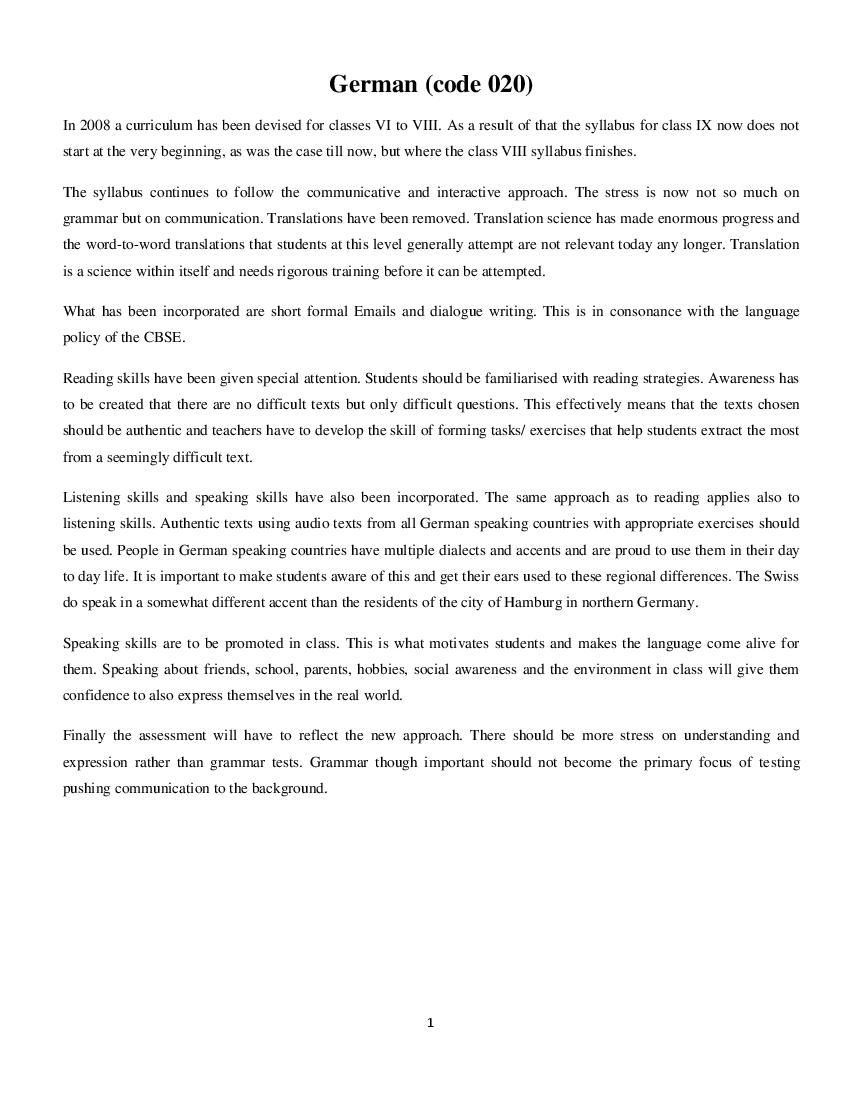
In 2008 a curriculum has been devised for classes VI to VIII. As a result of that the syllabus for class IX now does not
start at the very beginning, as was the case till now, but where the class VIII syllabus finishes.
The syllabus continues to follow the communicative and interactive approach. The stress is now not so much on
grammar but on communication. Translations have been removed. Translation science has made enormous progress and
the word-to-word translations that students at this level generally attempt are not relevant today any longer. Translation
is a science within itself and needs rigorous training before it can be attempted.
What has been incorporated are short formal Emails and dialogue writing. This is in consonance with the language
policy of the CBSE.
Reading skills have been given special attention. Students should be familiarised with reading strategies. Awareness has
to be created that there are no difficult texts but only difficult questions. This effectively means that the texts chosen
should be authentic and teachers have to develop the skill of forming tasks/ exercises that help students extract the most
from a seemingly difficult text.
Listening skills and speaking skills have also been incorporated. The same approach as to reading applies also to
listening skills. Authentic texts using audio texts from all German speaking countries with appropriate exercises should
be used. People in German speaking countries have multiple dialects and accents and are proud to use them in their day
to day life. It is important to make students aware of this and get their ears used to these regional differences. The Swiss
do speak in a somewhat different accent than the residents of the city of Hamburg in northern Germany.
Speaking skills are to be promoted in class. This is what motivates students and makes the language come alive for
them. Speaking about friends, school, parents, hobbies, social awareness and the environment in class will give them
confidence to also express themselves in the real world.
Finally the assessment will have to reflect the new approach. There should be more stress on understanding and
expression rather than grammar tests. Grammar though important should not become the primary focus of testing
pushing communication to the background.
1
Page 2
The following objectives build upon the objectives already stated for classes VI to VIII. The objectives given below will
apply to both classes IX and X which can be treated as one unit
1. Listening and responding
By the end of class X students should be able to
➢ Listen and understand the main points and some details from an extended dialogue or a short-spoken text and
respond.
➢ Listen to a short audio text and respond by asking for more details.
➢ Listen to announcements at public places e.g., railway stations and act accordingly.
➢ Listen to an audio text, extract the relevant details and complete the gaps in a written text.
2. Speaking
By the end of class X students should be able to
➢ Talk about plans and intentions.
➢ Ask someone to clarify and elaborate what they have just said.
➢ Give or seek informal views, suggestions and advice in an informal discussion with friends.
➢ Recall and narrate an incident they have seen or remember from their childhood.
3. Reading and responding
By the end of class X students should be able to
➢ Read and respond to an extract from newspaper article or simple text from the internet.
➢ Read blog entries and advertisements and respond to them.
➢ Read personal messages such as E-Mails, SMS etc. and respond to them.
4. Writing
By the end of class X students should be able to
➢ Write a short dialogue.
➢ Writing a semi-official or informal E-mails with complete sentence constructions.
5. Intercultural awareness
By the end of class X students should be able to
➢ Handle everyday problems i.e., cope with less routine problems on public transport, handle travel arrangements.
➢ Demonstrate understanding of and respect for cultural diversity.
➢ Recognise how aspects of the culture of different countries become incorporated into the daily life of others.
➢ Recognise advantages of another culture and try and apply to their own lives e.g., environmental awareness and
waste management.
6. Knowledge about language
By the end of class X students should be able to
➢ Learn to use subordinate clauses of time, place and purpose to qualify the main clause.
➢ Learn the use of grammatical structure e.g.,tenses, verbs with prepositions to express oneself more succinctly.
7. Language learning strategies
By the end of class X students should be able to
➢ Apply known rules when creating new language
➢ Integrate new language into previously learnt language
➢ Use the context of what they see/ read to determine some of the meaning
2
Page 3
Lesson Situation/ Speech intention Structure
Topic
Lesson 1 Celebration • To talk about future plans • Subordinate clause “ wenn”
• To allocate responsibilities “zu” + Infinitive
• To give a suggestion • “brauchen” +…+ “zu”
• To accept and decline a proposal +Infinitive
• Preposition of time“während” +
Genitive
Lesson 2 Shopping • To follow a timeline and describe an • Subordinate clause “um…zu”
and event • Subordinate clause “damit”
consumption • To give reasons for one’s actions
and decisions
Lesson 3 Feelings and • To ask for someone’s opinion • Question word “Wo(r)”+
relationships and give one’s own opinion Preposition
• To agree or disagree • Pronouns “da(r)”+ Preposition
• To talk about what one would do • Subjunctive II:
in a particular situation “würde”+Infinitive
• Articles and Nouns in Genitive
Lesson 4 Hamburg: A • To give a suggestion • Subjunctive II: “sollen”
city tour • To give chronological sequence • Subordinate clauses of time
of events ▪ “während”
• To talk about activities ▪ “bevor”
happening simultaneously
Lesson 5 Relationships • To give reasons • Causal preposition “wegen”+
and conflicts • To express likes and dislikes Genitive
• To lay down restrictions • Double barrel conjunction:
“zwar…aber”
• Relative clause : relative
pronouns in Nominative,
Accusative and Dative
3
Page 4
ANNUAL EXAMINATION MAX. MARKS 80
Section A-Reading (20 marks)
1. Comprehension (unseen passage) 5 marks
2. Comprehension (unseen passage) 5 marks
3. Comprehension (unseen passage) 10 marks
Section B –Writing (10 marks)
1. Based on stimulus, compose an E-Mail (30-40 words) 5 marks
2. Based on stimulus, compose a dialogue 5 marks
Section C – Applied Grammar (35 marks)
1. Fixed prepositions with verbs 6 marks
2. Separable verbs 6 marks
3. Subordinate clauses (um…zu, wӓhrend, bevor, zwar….aber, wenn) 6 marks
4. Subjunctive (Konjunktiv II) 6 marks
5. Relative pronouns (Nominative, Accusative and Dative) 6 marks
6. Article and nouns in Genitive 5 marks
Section D -Textbook (15 marks)
1. Completing a seen passage with the vocabulary provided 5 marks
2. Comprehension (seen) 5 marks
3. Comprehension (seen) 5 marks
4
Page 5
(Total weightage out of 20)
1. Periodic tests, dictations 5/20
2. Listening comprehensions 5/20
3. Speaking activities – role play, presentations, recitation… 5/20
(could be conducted as individual or group activity)
4. Regularity and quality of classwork & homework 5/20
PRESCRIBED TEXT BOOK : Beste Freunde B 1.1 (Lessons 1-5)
(Hueber Publications, Published in India by Goyal Publishers)
SUGGESTED REFERENCES : Team Deutsch 2/1
Planet 2
Ping Pong 2
DVD- Wir Live
Langenscheidt Euro Dictionary
K.M. Sharma; German-Hindi/ Hindi-
German Dictionary. Rachna
Publishing House
5
Document Details
| Board / Org | CBSE |
| Exam | Class 9 |
| Type | Syllabus |
| Pages | 5 |
| Updated | 15 Jul 2026 |