Uttrakhand Board Class 9 Syllabus 2020-21
Finished viewing? Save it for later —
Download Uttrakhand Board Class 9 Syllabus 2020-21 (PDF · 34 pages)About Uttrakhand Board Class 9 Syllabus 2020-21
Uttrakhand Board Class 9 Syllabus 2020-21 is available here for free download. Published by Uttarakhand Board for Class 9, this syllabus can be viewed online or downloaded as a PDF (34 pages). Candidates preparing for Class 9 can use Uttrakhand Board Class 9 Syllabus 2020-21 to understand the exam pattern, the type of questions asked, and the overall difficulty level.
Frequently Asked Questions
How can I download Uttrakhand Board Class 9 Syllabus 2020-21?
Open this page and click the Download button to save Uttrakhand Board Class 9 Syllabus 2020-21 as a PDF. It is completely free on AglaSem Docs.
Is Uttrakhand Board Class 9 Syllabus 2020-21 free to download?
Yes. Uttrakhand Board Class 9 Syllabus 2020-21 can be viewed online and downloaded as a PDF free of cost on AglaSem Docs.
How many pages does Uttrakhand Board Class 9 Syllabus 2020-21 have?
Uttrakhand Board Class 9 Syllabus 2020-21 contains 34 pages, which you can read online or download together as a single PDF.
Where can I find more Class 9 study material?
You can find more Class 9 question papers, sample papers, syllabus, and answer keys on AglaSem Docs.
Uttrakhand Board Class 9 Syllabus 2020-21 – Text
Read the full text of this syllabus below — useful to quickly search, copy and reference the content online without downloading the PDF.
📄 View text version (34 pages)
Page 1
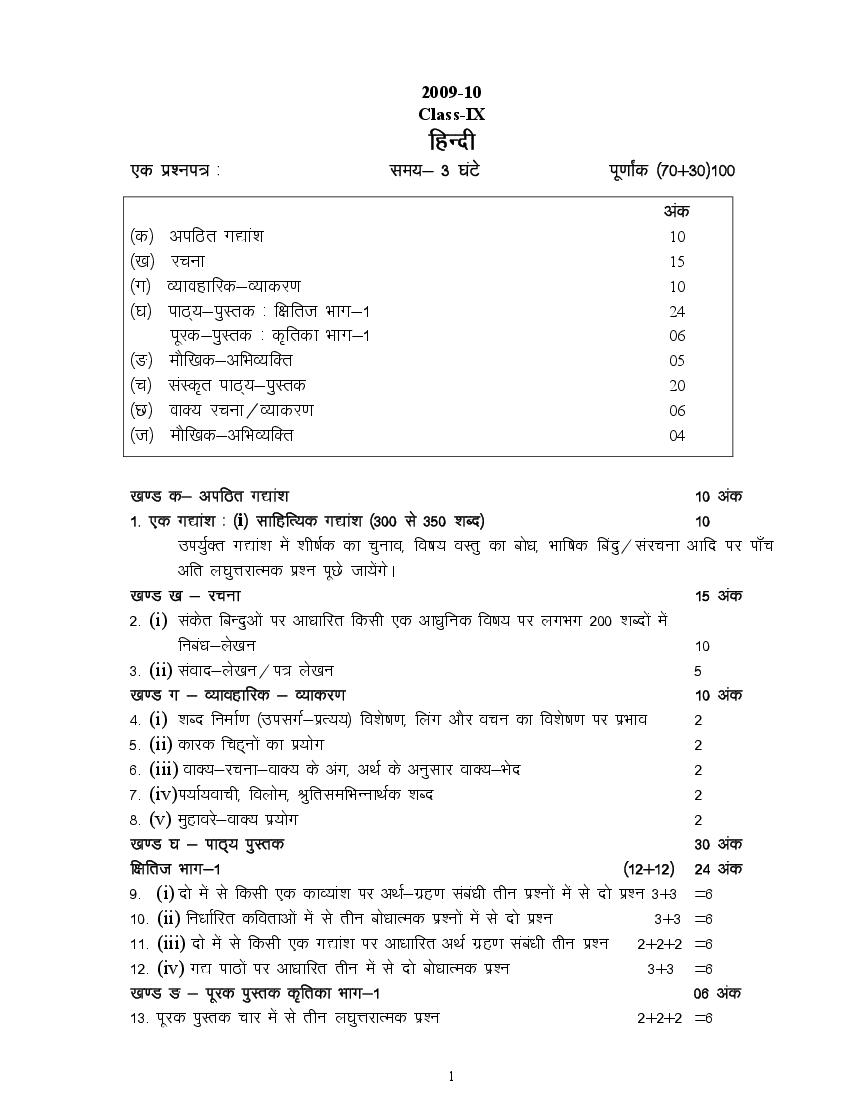
Class-IX
fgUnh
,d iz”ui= % le;& 3 ?kaVs iw.kkZad ¼70$30½100
vad
¼d½ vifBr x|ka”k 10
¼[k½ jpuk 15
¼x½ O;kogkfjd&O;kdj.k 10
¼?k½ ikB~;&iqLrd % f{kfrt Hkkx&1 24
iwjd&iqLrd % d`frdk Hkkx&1 06
¼³½ ekSf[kd&vfHkO;fDr 05
¼p½ laLd`r ikB~;&iqLrd 20
¼N½ okD; jpuk@O;kdj.k 06
¼t½ ekSf[kd&vfHkO;fDr 04
[k.M d& vifBr x|ka”k 10 vad
1- ,d x|ka”k % ¼i½ lkfgfR;d x|ka”k ¼300 ls 350 “kCn½ 10
mi;qZDr x|ka”k esa “kh’kZd dk pquko] fo’k; oLrq dk cks/k] Hkkf’kd fcanq@lajpuk vkfn ij ik¡p
vfr y?kqÙkjkRed iz”u iwNs tk;saxsA
[k.M [k & jpuk 15 vad
2- (i) ladsr fcUnqvksa ij vk/kkfjr fdlh ,d vk/kqfud fo’k; ij yxHkx 200 “kCnksa esa
fuca/k&ys[ku 10
3- (ii) laokn&ys[ku@i= ys[ku 5
[k.M x & O;kogkfjd & O;kdj.k 10 vad
4- (i) “kCn fuekZ.k ¼milxZ&izR;;½ fo”ks’k.k] fyax vkSj opu dk fo”ks’k.k ij izHkko 2
5- (ii) dkjd fpg~uksa dk iz;ksx 2
6- (iii) okD;&jpuk&okD; ds vax] vFkZ ds vuqlkj okD;&Hksn 2
7- (iv)Ik;kZ;okph] foykse] JqfrlefHkUukFkZd “kCn 2
8- (v) eqgkojs&okD; iz;ksx 2
[k.M ?k & ikB~; iqLrd 30 vad
f{kfrt Hkkx&1 ¼12$12½ 24 vad
9- (i) nks esa ls fdlh ,d dkO;ka”k ij vFkZ&xzg.k laca/kh rhu iz”uksa esa ls nks iz”u 3$3 ¾6
10- (ii) fu/kkZfjr dforkvksa esa ls rhu cks/kkRed iz”uksa esa ls nks iz”u 3$3 ¾6
11- (iii) nks esa ls fdlh ,d x|ka”k ij vk/kkfjr vFkZ xzg.k laca/kh rhu iz”u 2$2$2 ¾6
12- (iv) x| ikBksa ij vk/kkfjr rhu esa ls nks cks/kkRed iz”u 3$3 ¾6
[k.M ³ & iwjd iqLrd d`frdk Hkkx&1 06 vad
13- iwjd iqLrd pkj esa ls rhu y?kqÙkjkRed iz”u 2$2$2 ¾6
1
Page 2
[k.M p & ikB~;&iqLrd laLd`r fouksfnuh Hkkx &1 20 vad
(i) x| vuqPNsn ij vk/kkfjr pkj esa ls rhu iz”uksa ds mÙkj 2$2$2 ¾6
(ii) i| vuqPNsn ij vk/kkfjr rhu esa ls nks iz”uksa ds mÙkj 2$2 ¾6
(iii) ikB~; iqLrd ij vk/kkfjr ik¡p esa ls rhu iz”uksa ds mÙkj 2$2$2 ¾6
(iv) fn, x;s “kCnksa dh lgk;rk ls okD; iwjk djuk
¼N% iz”uksa eas ls pkj okD; cukuk½ 1$1$1$1 ¾4
[k.M N & laLd`r O;kdj.k 06 vad
(i) Le`fr vk/kkfjr iz”u@”yksd@okD; jpuk
(ii) {laf/k] Loj laf/k ¼nh?kZ] o`f) ,oa xq.k laf/k½ lekl] dkjd] milxZ}
pkj iz”uksa esa ls rhu iz”uksa ds mÙkj 2$2$2 ¾6
[k.M t& ekSf[kd vfHkO;fDr fgUnh rFkk la Ld`r 04 vad
1- lquuk
of.kZr ;k ifBr lkexzh dks lqudj vFkZxzg.k djuk] okrkZyki] okn fookn] Hkk’k.k]
dfork ikB vkfn dks lqudj le>uk] ewY;kadu djuk vkSj vfHkO;fDr ds <ax dks
tkuuk
2- cksyuk
(i) Hkk’k.k] okn&fookn
(ii) Xkfr] y;] vkjksg&vojksg lfgr lLoj dfork&okpu
(iii) okrkZyki vkSj mldh vkSipkfjdrk,¡
(iv) dk;ZØe&izLrqfr
(v) dFkk&dgkuh vFkok ?kVuk lquuk
(vi) ifjp; nsuk] ifjp; izkIr djuk
(vii) Hkkokuqdwy laokn&okpu
okrkZyki dh n{krk,¡
fVIi.kh % okrkZyki dh n{krkvksa dk ewY;kadu fujarjrk ds vk/kkj ij ijh{kk ds le; gksxkA
Jo.k ¼lquuk½ dk ewY;kadu
Ikjh{kd fdlh izklafxd fo’k; ij ,d vuqPNsn dk Li’V okpu djsxkA vuqPNsn
rF;kRed ;k lq>kokRed gks ldrk gSA vuqPNsn yxHkx 200 “kCnksa dk gksxkA ijh{kd
dks lqurs&lqurs ijh{kkFkhZ vyx dkxt ij fn;s gq, Jo.k cks/k ds vH;klksa dks gy dj
ldsaxsA vH;kl fjDr LFkku iwfrZ cgqfodYih; vFkok lR;@vlR; dk pquko vkfn
fo/kkvksa esa gks ldrs gSaA
opu ¼cksyuk½ dk ijh{k.k
1- fp=ksa ds Øe ij vk/kkfjr o.kZu % bl Hkkx esa vis{kk dh tk,xh fd ijh{kkFkhZ
fooj.kkRed Hkk’kk dk iz;ksx djsaA
2- fdlh fp= dk o.kZu % ¼fp= yksxksa ds ;k LFkkuksa ds gks ldrs gSaA½
3- fdlh fu/kkZfjr fo’k; ij cksyuk ftlls og vius O;fDrxr vuqHko dk izR;kLej.k dj
ldsaA
4- dksbZ dgkuh lquuk ;k fdlh ?kVuk dk o.kZu djukA
2
Page 3
1- ijh{k.k ls iwoZ ijh{kkFkhZ dks rS;kjh ds fy, dqN le; fn;k tk;A
2- fooj.kkRed Hkk’kk esa orZeku dky dk iz;ksx visf{kr gSA
3- fu/kkZfjr fo’k; ijh{kkFkhZ ds vuqHko lalkj ds gksa tSls % dksbZ pqVdqyk ;k gkL;&izlax
lqukuk] gky esa i<+h iqLrd ;k ns[ks x;s flusek dh dgkuh lqukukA
4- tc ijh{kkFkhZ iz”u i= izkjEHk dj nsa rks ijh{kd de ls de gLr{ksi djsaA
dkS”kyksa ds varj.k dk ewY;kadu
Jo.k ¼lquuk½ Okpu ¼cksyuk½
1- fo|kFkhZ esa ifjfpr lanHkksZ esa iz;qDr “kCnksa 1- f”k{kkFkhZ dsoy vyx&vyx “kCnksa vkSj inksa
vkSj inksa dks le>us dh lkekU; ;ksX;rk gS ds iz;ksx dh ;ksX;rk iznf”kZr djrk gS fdUrq
fdUrq lqlac) vk”k; dks ugha le> ikrkA ,d lqlac) Lrj ij ugha cksy ldrkA
2- NksVs lEc) dFkuksa dks ifjfpr lanHkksZ esa 2- ifjfpr lanHkksZ dks dsoy NksVs lac) dFkuksa
le>us dh ;ksX;rk gSA dk lhfer “kq)rk ls iz;ksx djrk gSA
3- ifjfpr ;k vifjfpr nksuksa lanHkksZ esa dfFkr 3- vis{kkd`r nh?kZ Hkk’k.k esa vf/kd tfVy
lwpuk dks Li’V le>us dh ;ksX;rk gS] dFkuksa ds iz;ksx dh ;ksX;rk iznf”kZr djrk
v”kqf);k¡ djrk gS ftlls izs’k.k esa :dkoV gS] vHkh Hkh dqN v”kqf);k¡ djrk gS ftuesa
vkrh gSA izs’k.k esa #dkoV ugha vkrhA
4- nh?kZ dFkuksa dh J`a[kyk dks Ik;kZIr “kq)rk ls 4- vifjfpr fLFkfr;ksa esa fopkjksa dks rkfdZd
le>rk gS vkSj fu’d’kZ fudky ldrk gSA <ax ls laxfBr dj /kkjk izokg :i esa
izLrqr dj ldrk gS ,slh xyfr;k¡ djrk gS
ftuls izs’k.k esa :dkoV ugha vkrhA
5- tfVy dFkuksa ds fopkj&fcUnqvksa dks le>us 5- mn~ns”; vkSj Jksr ds fy, mi;qDr “kSyh dks
dh ;ksX;rk iznf”kZr djrk gS] mn~ns”; ds viuk ldrk gS] dsoy ekewyh xyfr;k¡
vuqdwy lquus dh dq”kyrk iznf”kZr djrk djrk gSA
gSA
fu/kkZfjr iqLrdsa %
1- f{kfrt&Hkkx 1
2- d`frdk&Hkkx 1
3- laLd`r ikB~;&iqLrd& fouksfnuh Hkkx&1
fuEufyf[kr ikBksa dk ewY;kadu ugha fd;k tk;sxk %&
1& f{kfrt&Hkkx&1& 1- ukuk lkgc dh iq=h nsoh eSuk dks HkLe dj fn;k x;kA
2- ^ok[k*
3- izsepUn ds QVs twrs
2& d`frdk&Hkkx&1& 1- esjs lax dh vkSjrsa
2- fdlh rjg vkf[kjdkj eSa fgUnh esa vk;k
3
Page 4
ikB~;Øe ls 30 izfr”kr dh dVkSrh fuEuor~ dh tkrh gS%&
Class – IX
DELETED SYLLABUS
(For the Session of 2020-21 Only)
HINDI
(THEORY)
dkO; [k.M dchj&lkf[k;k¡ ,oalcn
lqfe=kuanu iar&xzke Jh
dsnkjukFk vxzoky&panz xguk ls ykSVrh csj
losZ”oj n;ky lDlsuk&es?k vk,
panzdkar nsorkys& ;ejkt dh fn”kk
f{kfrt Hkkx& 1
x| [k.M “;kepj.k nwcs&miHkksDrkokn dh laLd`fr
Piyk nsoh&ukuklkgc dh iq=h nsoh eSukdks HkLe dj fn;k
x;k
Egknsoh oekZ&esjs cpiu ds fnu
gtkjhizlkn f}osnh&,d dqÙkk vkSj ,d eSuk
Q.kh”ojukFk js.kq&bl ty izy; esa
d`frdk Hkkx& 1
“ke”ksj cgknqj flag &fdl rjg vkf[kjdkj eSa fgUnh esa vk;k
izgsfydk
laLd`r fouksfnuh lwfDr lq/kk
lk/kwuk LoHkko%
4
Page 5
Class - IX
ENGLISH - LANGUAGE AND LITERATURE
One Paper 3 Hours Marks : 100
SECTION A : READING 20 Marks
1 & 2 Two unseen passages of total 500 words with a variety of questions including 4 marks
for vocabulary.
Only prose passages will be used. One will be factual and the other will be literary.
Passage 1 - 200 words (8 marks) - Four or five comprehension questions.
Passage 2 - 300 words (12 marks) - Four or five comprehension questions and two
questions on vocabulary. Marks for vocabulary will not exceed 4.
SECTION B : WRITING 20 Marks
3. Letter Writing: One letter is not more than 80 words based on provided verbal stimulus
and context. Types of letters: Informal; Personal such as to family and friends;
Formal: Letters of complaint, enquiry, request & application. 08 Marks
4. Writing a short paragraph on a given outline / topic in about 60 words. 04 Marks
5. Writing a short writing task based on a verbal and / or visual stimulus (diagram, picture,
graph, map, chart, flow chart etc.). Maximum words 80. 08 Marks
SECTION C : GRAMMAR 15 Marks
Question No. 6 -11
A variety of short questions involving the use of particular structures within a context.
Text types used will include gap-filling, sentence-completion, sentence-reordering,
dialogue-completion and sentence-transformation (including combining sentences). The
Grammar syllabus will include the following areas in class IX :
1. Tenses (present with extension)
2. Modals (have to/had to, must, should, need, ought to and their negative forms)
3. Use of Passive voice
4. Subject-verb concord
5. Reporting:
(i) Commands and requists
(ii) Statements
(iii) Questions
6. Clauses:
(i) Noun Clauses
(ii) Adverb Clauses of condition and time
(iii) Relative Clauses
7. Detertminers and
8. Prepositions
Note : No separate marks allotted for any of grammatical items listed above.
5
Page 6
Behive- NCERT Text Book for class IX
Prose- 20 Marks
12 & 13. Two extracts from different prose lessons included in Text Book ( Approximately
100 words each) 5 ×2= 10 Marks
These extracts chosen from different lessons will be literary and discursive in nature. Each
extract will be of 5 marks. One mark in each extract will be for vocabulary. 4 Marks in each
passage will be used for testing local and global comprehension besides a question on
interpretation.
14. One out of two questions extrapolative in nature based on any one of the prose lessons
from Textbook to be answered in about 80 words. 06 Marks
15. One question on Drama Text (local and global comprehension question) ( 30-40 words )
04 Marks
Poetry 10 Marks
16. One extract from a poem from the prescribed reader followed by two or three questions to
test the local and global comprehension of the set text. The extract will carry four marks.
04 Marks
17. Two out of three short answer type questions on interpretation of themes and ideas.
06 Marks
Moments- Supplementary Reader for Class IX 15 Marks
18. One out of two questions from Supplementary Reader to interpret, evaluate and analyse
character, plot or situations occurring in the lessons to be answered in about 100 words.
08 Marks
19. One out of two very short answer type questions based on factual aspects of the lessons to be
answered in 20-30 words. 03 Marks
20. One out of two short answer type questions of interpretative and evaluative nature based on
lessons to be answered in 30-40 words. 04 Marks
6
Page 7
ikB~;Øe ls 30 izfr”kr dh dVkSrh fuEuor~ dh tkrh gS%&
Class – IX
DELETED SYLLABUS
(For the Session of 2020-21 Only)
ENGLISH
(THEORY)
Grammer
Use of Passive Voice
Clauses: Noun, Adverb Clauses of condition and time, Relative
Prepositions
Writing
Letter on a situation
Literature
BEEHIVE
1. The Lake Isle of Innisfree
2. The Snake & The Mirror
3. The Duck & The Kangaroo
4. Kathmandu
5. A Slumber Did My Spirit Seal
MoMENTS
1. Ishwaran the Storyteller
2. The Accidental Tourist
7
Page 8
Page 9
Class-IX
laLd`rikB~;Øe%
,da iz”ui=e~ iw.kkZadk% 100
vof/k %&?k.Vk=;e~
d- [k.M% vifBr&vocks/kue 15 vadk%
[k- [k.M% jpukReda dk;Ze 20 vadk%
x- [k.M% vuqiz;qDr&O;kdj.ke~ 30 vadk%
?k- [k.M% ifBr&vocks/kue 35 vadk%
^d*- ¼vifBr&vocks/kue~½
¼ljyx|ka”ke~ vk/kkfjra dk;eZ~&x|ka”k};e~½ 15 vadk%
1- 40&50 “kCnifjfer% ljyx|ka”k% 5 vadk%
Lkjyx|ka”ke~ vk/kkfjre~ dk;eZ~
,dinsu iw.kZokD;su p iz”uksÙkjdk;Ze~ 3 vadk%
vuqPNsn&vk/kkfjra~ Hkkf’kddk;Ze~ 2 vadk%
2- 80&100 “kCnifjfer% x|ka”k%& ljydFkk ?kVuko.kZua ok 10 vadk%
,dinsu iw.kZokD;su p iz”uksÙkjkf.k 6 vadk%
leqfpr”kh’kZdiznkue~ 2 vadk%
vuqPNsn&vk/kkfjre~ Hkkf’kddk;Ze~ 2 vadk%
Hkkf’kddk;Ze~ bR;usu vfHkizsre~ vfLr
(i) okD;s dr`Z & fØ;kinp;ue~
(ii) drZ̀fØ;k&vfUofr%
(iii) fo”ks’k.kfo”ks’;%&vfUofr%
(iv) laKkLFkkus loZukeiz;ksx% vFkok loZukeLFkkus laKkiz;ksx%
(v) i;kZ;a foyksea ok ina nÙok vuqPNsns nÙka inp;ue~
^[k*- ¼jpukReda dk;Ze~½
¼vH;kliqLrd&vk/kkfjre~½ 20 vadk%
3- ladsrk/kkfjre~ vfHkuUnui=e~@o/kkZiui=e~@fueU=.ki=e~@izkpk;Z izfr izkFkZuki=e~ 5 vadk%
4- ladsrk/kkfjr% okrkZyki% 5 vadk%
5- ladsrk/kkfjrk y?kqdFkk] fp=o.kZue vuqPNsnys[kue~ ok 10 vadk%
9
Page 10
¼vH;kliqLrd&vk/kkfjre~½
6- laLd`ro.kZekyk 5 vadk%
¼v½ o.kZ & mPpkj.kLFkkukfu ¼3½
¼c½ orZuh&o.kZla;kstue~] o.kZfo;kstue~ ¼1$1½
7- okD;s’kq vuqPNsns ok lfU/kdk;Ze~ 5 vadk%
¼v½ LojlfU/k% ¼2½
nh?kZ%] xq.k%] o`f)%] ;.k~
¼c½ O;atulfU/k% ¼2½
e~ LFkkus vuqLokj%
.kRofo/kkue~
oxhZ;&izFke & v{kjk.kka r`rh;o.ksZ ifjorZue~
r~ LFkkus p~
j~ iwoZL; jsQL; yksi% nh?kZLojRoa p
r~ LFkkus y~
¼l½ folxZlfU/k% ¼1½
folxZL; mRoa] jRoa] yksi%
folxZLFkkus l~] “k~] ‘k~A
8- okD;s’kq “kCn:ik.kka iz;ksxk% 8 vadk%
v- “kCnk% vtUrk% %& vdkjkUrk%] ckydor~] bdkjkUrk% dfoor~
iqafYy³~xk+% mdkjkUrk% lk/kqor~] _dkjkUrk% fir`or~@nkr`or~A
gyUrk% & jktu~] Hkor~] vkReu~] fo)l~] xPNr~A ¼3½
c- L=hfy³~xk+% vtUrk% %& vdkjkUrk% jekor~] bdkjkUrk% efror~ ¼2½
bZdjkUrk% unhor~] _dkjkUrk% ekr`or~
l- uiqladfy³~xk% vtUrk% %& vdkjkUrk% Qyor~] mdkjkUrk% e/kqor~ ¼1½
n- la[;kokpd”kCnk% ,d f} f= prqj~ iape~ ¼1½
p- loZuke”kCnk% ;r~ rr~ fde~ bne~ f=’kq fyaM~xs’kq] vLen~ ;q’en~ ¼1½
9- okD;s’kq /kkrq:ik.kka iz;ksxk% 6 vadk%
/kkrq:ikf.k yV~ yksV~ y`V~ y³ fof/kfy³~ydkjs’kq
/kkro% ijLeSifnu% & Hkw ¼Hko~½ iB~ gl~ ue~ xe~ ¼xPN~½ ¼3½
vl~~ gu~ Øq/k~ u”k~ u`r~ vki~ “kd~ b’k~ izPN~ d`] Kk] Hk{k~ fpUr~
vkReusifnu%& lso~ yHk~] #p~] eqn~] ;kp~ ¼2½
mHk;ifnu%& uh] â] ¼gj~½] Hkt~] ip ¼1½
10
Page 11
¼vuqPNsns] okrkZykis] y?kqdFkk;ke~ ok½
f}rh;k & vfHkr%] ifjr%] mHk;r%] le;k] fud’kk] izfr] f/kd~] foukA
r`rh;k & fouk] vye~] lg] ghu%] fde~] iz;kstue~A
prqFkhZ & ue%] Lokgk] vye~ lkeF;sZ]
iapeh & cfg%] fouk] Hkh] vkjEHk~] iz&en~] ij%] iwoZe~] vuUrje~
‘k’Bh & fu/kkjZ.ks] iqjr%] i`’Br% oker%] nf{k.kr%] vuknjs rji~&rei~] v/k%A
lIreh & dq”ky%] fuiq.k%] izoh.k%] fLug~] fo”ol~ vuq&jt~] HkkosA
11- izR;;k%& rqequ~] DRok] Y;i~] Dr] Drorq] “kr`] “kkup~ 2 vadk%
¼okD;s’kq iz;ksxk%½
^?k* ¼ifBr & vocks/kue~½ 35 vadk%
12- ifBr&lkexzhe~ vk/kkfjre~ vocks/kudk;Ze~
,d% x|ka”k% 5 vadk%
,d% i|k”k% 5 vadk%
,d% ukV~;ka”k% 5 vadk%
izfr[k.Me~ vf/kd`R; vocks/kudk;Ze~ ,dinsu] iw.kZokD;su p iz”uksÙkjkf.k]
fjDrLFkkuiwfrZ%] d% da dFk;fr] loZukeiz;ksxs%] “kCnkFkkZ%/;
13- Hkkokocks/kue~ ¼va”k};e~½ 3$3 vadk%
fjDrLFkkusu] fodYip;usu] “kq)&v”kq)ek/;esu] leHkkolwfDrek/;esu ok
14- vUo;s’kq fjDrLFkkuiwfrZ% 3 vadk%
15- iz”ufuekZ.ke~ ¼pRokj%½ 4 vadk%
¼okD;s’kq js[kkafdrine~ vk/k`R;½
16- dFkkØe&la;kstue~ 4 vadk%
¼Øejfgr&v’VokD;kuka ØeiwoZda la;kstue~½
17- lUnHksZ “kCniz;ksxk% “kCnkFkZeysua ok 3 vadk%
11
Page 12
ikB~;Øe ls 30 izfr”kr dh dVkSrh fuEuor~ dh tkrh gS%&
d{kk&9 ikB~;iqLrd&”kseq’kh v/;k;&¼1½ izR;fHkKkue~
¼2½ fldrklsrq%
¼3½ tVk;ks% “kkS;Ze~
¼4½ ok³~eu% izk.kLo:ie~
12
Page 13
REVISED SYLLABUS
(For the Session of 2020-21 Only)
SOCIAL SCIENCE
(THEORY)
Unit 1 : India and the Contemporary World - I
Themes Objectives
Any two themes from each of the first two In each of the themes in this unit
sub-units and one from the third could be students would be made familiar with
studied. extracts of speeches, political
Sub-unit 1.1 : Events and processes. declarations, as well as the politics of
In this unit the focus is on three events caricatures, posters and engravings.
and processes that have in major ways shaped Students would learn how to interpret
the identity of the modern world. Each these kinds of historical evidences.
represents a different form of politics, and a Familiarize students with the names of
specific combination of forces. One event is people involved, the different types of
linked to the growth of liberalism and ideas that inspired the revolution, the
democracy, one with socialism, and one with wider forces that shaped it.
a negation of both democracy and socialism.
1. French revolution : Show how written, oral and visual
(a) The Ancient Regime and its crises. material can be used to recover the
(b) The social forces that led to the history of revolutions.
revolution. (c) The different
revolutionary groups and ideas of the Explore the history of socialism
time. (d) The legacy. through a study of the Russian
revolution.
13
Page 14
(a) The crises of Tzarism. (b) The people involved, the different types of
nature of social movements between ideas that inspired the revolution.
1905 and 1917. (c) The First World
Discuss the critical significance of
War and foundation of Soviet state.
Nazism in shaping the politics of
(d) The legacy.
modern world.
Familiarize students with the speeches
and writings of Nazi leaders.
3. Rise of Nazism.
(a) The growth of social democracy
(b) The crises in Germany.
(c) The basis of Hitler's rise to power.
(d) The ideology of Nazism.
(e) The impact of Nazism.
Sub-unit 1.2 : Economies and Livelihoods
The themes in this section will focus
on how different social groups grapple with
the changes in the contemporary world and
how these changes affect their lives.
Look at the impact of colonialism on
5- Forest society and colonialism :
forest societies, and the implication of
(a) Relationship between forests and
scientific forestry.
livelihoods. (b) Changes in forest
societies under colonialism.
Discuss the social and cultural world
Case studies : focus on two forest
movements one in colonial India of forest communities through the
(Bastar) and one in Indonesia. study of specific revolts.
Understand how oral traditions can be
used to explore tribal revolts.
Show the different processes through
which agrarian transformation may
occur in the modern world.
6- Farmers and peasants : Understand how agricultural systems
(b) Histories of the emergence of in India are different from that in other
different forms of farming and peasant countries.
societies. (b) Changes within rural Familiarize students with the idea that
economies in the modern world. large scale farming, small scale
Case studies: focus on contrasting production, shifting agriculture operate
forms of rural change and different on different principles and have
forms of rural societies (expansion of
large-scale wheat and cotton farming
in USA, rural economy and the
14
Page 15
and small peasant production in
colonial India) Suggest how sports also have a history
and that it is linked up with the politics
Sub-unit 1.3 : Culture, Identity and Society
of power and domination.
The themes in this unit will consider
how issues of culture are linked up to the Introduce students to some of the
making of contemporary world. stories in cricket that have historical
significance.
7. Sports and politics :
The story of cricket (a) The emergence
of cricket as an English sport. (b)
Cricket and colonialism. (c) Cricket
nationalism and de-colonialization. Show how clothing has a history, and
how it is linked to questions of cultural
8. Clothes and cultures. (a) A short identity.
history of changes in clothing. (b)
Debates over clothing in colonial
Discuss how clothing has been the
India. (c) Swadeshi and the movement
focus of intense social battles
for Khadi.
Sub-unit 1.4 : Map Work. (2 Marks).
Unit 2 : India - Land and the People
Themes Objectives
1. India : location, relief, structure, To understand the major landform features
major physiographic units. and the underlying geological structure; their
association with various rocks and minerals as
well as nature of soil types
2. Climate : factors influencing the To identify the various factors influencing the
climate; monsoon- its characteristics, climate and explain the climatic variaton of
rainfall and temperature distribution; our country and its impact on the life of the
seasons; climate and human life. people. Tor explain the importance and
unifying role of monsoons;
4. Natural Vegetation : vegetation To find out the nature of diverse flora and
types, distribution as well as fauna as well as their distribution.
altitudinal variation, need for
conservation and various measures.
5. Wildlife : major species, their To develop concern about the need to protect
distribution, need for conservation and the bio-diversity of our country.
various measures.
15
Page 16
Project/Activity
Learners may identify songs, dances, festivals and special food preparations associated
with certain seasons in their particular region, and whether they have some commonality with
other regions of India.
Collection of material by learners on the flora and fauna of the region in which their
school is situated. It should include a list of endangered species of the region and also
information regarding efforts being made to save them.
Posters
River pollution.
Depletion of forests and ecological imbalance.
Unit 3 : Democratic Politics - I
Themes Learning Objectives
1. What is democracy? Why democracy? Develop conceptual skills of defining
democracy
What are the different ways of defining Understand how different historical
democracy? Why has democracy become the processes and forces have promoted
most prevalent form of government in our democracy.
times? What are the alternatives to
Developing a sophisticated defence of
democracy? Is democracy superior to its
democracy against common prejudices
available alternatives? Must every democracy
have the same institutions and values? Develop a historical sense of the
choice and nature of democracy in
India.
2. Designing of Democracy in India Introduction to the process of
How and why did India become a democracy? Constitution making
Develop respect for the Constitution
How was the Indian constitution framed? and appreciation for Constitutional
What are the salient features of the values
Constitution? How is democracy being Recognise that constitution is a living
constantly designed and redesigned in India? document that undergoes changes.
Introduce the idea of representative
democracy via competitive party
politics.
3. Electoral politics in democracy Familiarise with our electoral system
16
Page 17
Why do we have a system of competition
Develop an appreciation of citizen’s
among political parties? How has the citizens’
increased participation in electoral
participation in electoral politics changed? politics.
What are the ways to ensure free and fair Recognise the significance of the
elections? Election Commission.
Provide an overview of central
governmental structures.
4. Institutions of parliamentary democracy
Sensitise to the key role of the
How is the country governed? What does Parliament and its procedures.
Parliament do in our democracy? What is the Distinguish between nominal and real
role of the President of India, the Prime executive authorities and functions.
Minister and the Council of Ministers? How Understand the parliamentary system
do these relate to one another? of executive’s accountability to the
legislature.
Develop a citizens’ awareness of their
rights.
Introduction to and appreciation of the
Fundamental Rights.
5. Citizens’ rights in democracy
Recognition of the ways in which
Why do we need rights in a constitution? these rights are exercised and denied
What are the Fundamental Rights enjoyed by in real life situations.
the citizen under the Indian constitution? How
does the judiciary protect the Fundamental Introduction to judicial system and key
Rights of the citizen? How is the institutions like the Supreme Court,
independence of the judiciary ensured? High Courts and National Human
Rights Commission.
Unit - 4 : Understanding Economics – I
Themes Objectives
1. The economic story of Palampore: Familiarising the children with some basic
Economic transactions of Palampore and its economic concepts through an imaginary
interaction with the rest of the world through story of a village
which the concept of production (including
three factors of production (land, labour and
capital) can be introduced.
2. People as Resource : Introduction of how Familiarisation of a few population related
people become resource/asset; economic concepts and sensitization of child that
activities done by men and women; unpaid people as asset can participate and
work done by women; quality of human contribute in nation building
resource; role of health and education;
unemployment as a form of nonutilisation of
human resource; sociopolitical implication in
simple form
3. Poverty as a challenge facing India : Who Understanding of poverty as a challenge and
is poor (through two case studies one rural
17
Page 18
as a concept but through a few simple
examples) - why people are poor ; unequal Appreciation of the government initiative to
distribution of resources; comparison between alleviate poverty
countries; steps taken by government for
poverty alleviation
Suggested Activities / Instructions :
Theme I : Give more examples of activities done by different workers and farmers.
Numerical problems can also be included.
Some of the ways through which description of villages are available in the writings of Prem
Chand, M N Srinivas and R K Narayan. They may have to be referred.
Theme II : Discuss the impact of unemployment.
Debate on whether all the activities done by women should be included or not. Why?
Is begging an economic activity? Discuss.
Is it necessary to reduce population growth or family size? Discuss.
Theme IV : Visit a few farms in a village and collect the details of foodgrains cultivated;
Visit a nearby ration shop and collect the details of goods available;
Visit a regulated market yard and observe how goods are transacted and get the details of the
places where the
goods come and go.
Unit - 5 : Disaster Management
1. Man made disasters - Nuclear, Biological and Chemical.
2. Common Hazards - Prevention and Mitigation
3. Community Based Disaster Management.
18
Page 19
Page 20
REVISED SYLLABUS
(For the Session of 2020-21 Only)
SCIENCE
(THEORY)
Theme : Materials
Unit 2 : Matter - Nature and behaviour
Nature of matter : Elements, compounds and mixtures. Heterogenous and homogenous
mixtures, colloids and suspensions.
Particle nature, basic units : atoms and molecules. Law of constant proportions.
Atomic and molecular masses.
Mole Concept : Relationship of mole to mass of the particles and numbers. Valency.
Chemical formula of common compounds.
Structure of atom : Electrons, protons and neutrons; Isotopes and isobars.
Theme : The World of the living
Unit 3 : Organization in the living world.
Cell - Basic Unit of life : Cell as a basic unit of life; prokaryotic and eukaryotic cells,
multicellular organisms; cell membrane and cell wall, cell organelles; chloroplast,
mitochondria, vacuoles, ER, golgi apparatus; nucleus, chromosomes - basic structure,
number.
Tissues, organs, organ systems, organism.
Structure and functions of animal and plant tissues (four types in animals; merismatic
and permanent tissues in plants).
Health and diseases : Health and its failure. Infectious and Non-infectious diseases,
their causes and manifestation.
Diseases caused by microbes (Virus, Bacteria and Protozoans) and their prevention,
Principles of treatment and prevention. Pulse polio programmes.
Theme : Moving things, people and ideas
Unit 4 : Motion, Force and Work
Motion : Distance and displacement, velocity; uniform and non-uniform motion along a
straight line; acceleration, distance-time and velocity-time graphs for uniform and
uniformly accelerated motion, equations of motion by graphical method; elementary idea
of uniform circular motion.
Force and Newton's laws : Force and motion, Newton's laws of motion, inertia of a
body, inertia and mass, momentum, force and acceleration. Elementary idea of
conservation of momentum, action and reaction forces.
Gravitation : Gravitation; universal law of gravitation, force of gravitation of the earth
(gravity), acceleration due to gravity; mass and weight; free fall.
20
Page 21
energy; law of conservation of energy.
21
Page 22
REVISED SYLLABUS
(For the Session of 2020-21 Only)
MATHEMATICS
(THEORY)
UNIT I : NUMBER SYSTEMS
1. REAL NUMBERS
Review of representation of natural numbers, integers, rational numbers on the number
line. Rational numbers as recurring/terminating decimals.
Examples of nonrecurring / non terminating decimals such as √2, √3, √5 etc. Existence
of non-rational numbers (irrational numbers) such as √2, √3, and their representation on
the number line.
Existence of √x for a given positive real number x (visual proof to be
emphasized). Definition of nth root of a real number.
Recall of laws of exponents with integral powers. Rational exponents with positive
real bases (to be done by particular cases, allowing learner to arrive at the general
laws.)
Rationalization (with precise meaning) of real numbers of the type (& their
combinations)
1 1
a + b√ x & √x + √y where x and y are natural number and a, b are integers.
UNIT II : ALGEBRA
1. POLYNOMIALS
Definition of a polynomial in one variable, its coefficients, with examples and counter
examples, its terms, zero polynomial. Degree of a polynomial. Constant, linear,
quadratic, cubic polynomials; monomials, binomials, trinomials. Factors and multiples.
Zeros/roots of a polynomial / equation.
2
Analogy to integers. Factorization of ax + bx + c, a ≠0 where a, b, c are real numbers,
and of cubic polynomials using the Factor Theorem.
Recall of algebraic expressions and identities. Further identities of the type
2 2 2 2 3 3 3
(x + y + z) = x + y + z + 2xy + 2yz + 2zx, (x y) = x y 3xy (x y).
and their use in factorization of polymonials. Simple expressions reducible to these
polynomials.
2. LINEAR EQUATIONS IN TWO VARIABLES
Recall of linear equations in one variable. Introduction to the equation in two variables.
Prove that a linear equation in two variables has infinitely many solutions and justify
their being written as ordered pairs of real numbers, plotting them and showing that they
seem to lie on a line. Examples, problems from real life, and with algebraic and
graphical solutions being done simultaneously.
22
Page 23
1. COORDINATE GEOMETRY
The Cartesian plane, coordinates of a point, names and terms associated with the
coordinate plane, notations, plotting points in the plane, graph of linear equations as
examples; focus on linear equations of the type ax + by + c = 0 by writing it as y = mx +
c and linking with the chapter on linear equations in two variables.
UNIT IV : GEOMETRY
2- LINES AND ANGLES
1. (Motivate) If a ray stands on a line, then the sum of the two adjacent angles so
0
formed is 180 and the converse.
2. (Prove) If two lines intersect, the vertically opposite angles are equal.
3. (Motivate) Results on corresponding angles, alternate angles, interior angles
when a transversal intersects two parallel lines.
4. (Motivate) Lines, which are parallel to a given line, are parallel.
0
5. (Prove) The sum of the angles of a triangle is 180 .
6. (Motivate) If a side of a triangle is produced, the exterior angle so formed is
equal to the sum of the two interiors opposite angles.
3. TRIANGLES
1. (Motivate) Two triangles are congruent if any two sides and the included angle
of one triangle is equal to any two sides and the included angle of the other
triangle (SAS Congruence)
2. (Motivate) Two triangles are congruent if the three sides of one triangle are
equal to three sides of the other triangle (SSS Congruene).
3. (Motivate) Two right triangles are congruent if the hypotenuse and a side of one
triangle are equal (respectively) to the hypotenuse and a side of the other triangle.
4. (Prove) The angles opposite to equal sides of a triangle are equal.
5. (Motivate) The sides opposite to equal angles of a triangle are equal.
4. QUADRILATERALS
1. (Prove) The diagonal divides a parallelogram into two congruent triangles.
2. (Motivate) In a parallelogram opposite sides are equal, and conversely.
3. (Motivate) In a parallelogram opposite angles are equal, and conversely.
4. (Motivate) A quadrilateral is a parallelogram if a pair of its opposite sides
is parallel and equal.
5. (Motivate) In a parallelogram, the diagonals bisect each other and conversely.
23
Page 24
sides is parallel to the third side and (motivate) its converse.
6- CIRCLES
Through examples, arrive at definitions of circle related concepts, radius,
circumference, diameter, chord, arc, subtended angle.
1) (Prove) Equal chords of a circle subtend equal angles at the center and (motivate)
its converse.
2) (Motivate) The perpendicular from the center of a circle to a chord bisects the
chord and conversely, the line drawn through the center of a circle to bisect a
chord is perpendicular to the chord.
3) (Motivate) Equal chords of a circle (or of congruent circles) are equidistant from
the center(s) and conversely.
4) (Prove) The angle subtended by an arc at the center is double the angle subtended
by it at any point on the remaining part of the circle.
5) (Motivate) Angles in the same segment of a circle are equal.
6) (Motivate) The sum of the either pair of the opposite angles of a cyclic
quadrilateral is 180o and its converse
7. CONSTRUCTIONS
1. Construction of a triangle of given perimeter and base angles.
UNIT V : MENSURATION
.
2. SURFACE AREAS AND VOLUMES
Surface areas and volumes of cubes, cuboids, spheres (including hemispheres) and
right circular cylinders/ cones.
UNIT VI : STATISTICS AND PROBABILITY
1. STATISTICS
Introduction to Statistics : Collection of data, presentation of data — tabular form,
ungrouped / grouped, bar graphs, qualitative analysis of data to choose the correct form
of presentation for the collected data.
2. PROBABILITY
History, Repeated experiments and observed frequency approach to probability. Focus is
on empirical probability. (A large amount of time to be devoted to group and to
individual activities to motivate the concept; the experiments to be drawn from real - life
situations, and from examples used in the chapter on statistics).
24
Page 25
REVISED SYLLABUS
(For the Session of 2020-21 Only)
HOME SCIENCE
(THEORY)
Unit I: Concept and Scope of Home Science.
Unit III : Food and its relation to health: Definition of food, functions of food
(i) energy giving
(ii) growth and repair
(iii) protection against diseases
(iv) regulation of body function
(v) psychological satisfaction
(vi) sociological functions
(vii) interrelationship between good and health
Unit IV : Methods of cooking :Boiling, steaming, pressure cooking, frying, roasting& baking,
brief description of each & suitability of foods.
Unit V : Functions of a home : Protective and social characteristics of functional house-security, light,
ventilation,
Unit VI : Safety in the house : prevention of accidents in the kitchen and bathroom-cuts, falls,
burns, electric shock, poisoning, safe use of fuels; first-aid given to cuts, bruises,
burns, scalds, poisoning, shocks & bites.
UnitVII : Fabrics available in the market : Definition of fibre and yarn; classfication of fibre
on the basis of origin and length; yarn making, blends,construction of fabric-weaving
(Different types of weaves-plain, twill and stain), felting and knitting;
Unit VIII : Selection of clothes : factors affecting selection
(i) fabric related factors (characteristics of fibre, fabric construction)
(ii) person related factors-age, occupation occasion, fashion, figure, comfort
25
Page 26
URDU (Course A) Code No. 003
CLASS IX
One Paper 3 Hours Marks: 100
Section – A
Marks : 40
1. Reading Skills :
(i) Comprehension of an unseen passage (factual) of about 150 words.
Followed by five questions. 10
2. Writing Skills :
(i) Essay Writing on Subjects of general interest 10
(ii) Letter Writing : (Personal and Application Writing) 10
3. Applied Grammar : 10
(i) The following elements of grammar are to be studied :
a. Ism Ki Qismein
(i) Ism-e-Marafa
(ii) Ism-e-Nakra
b. Ism-e-Marafa ki Qismein
Khitab, Laqab, Kunniyat, Urf, Takhallus
c. Ism-e-Nakra ki Qismein
Zaat, Istifham,Fael, Mafool, Masdar
d. Zameer ki Qismein
Mutakallim, Hazir, Ghaeb
e. Sifat ki Qismein
Zati, Nisbati, Adadi, Miqdari
Section – B
Marks : 60
1. Prescribed Text-Books :
Nawa-e-Urdu (Nawin Jama at ke Liyae) Published by the NCERT, New Delhi
Supplementary Reader (Gulzar-E-Urdu) Published by the NCERT, New
Delhi
1. Prose : Marks : 20
All the lessons from the above book (Gulzar-E-Urdu) are to be studied.
(i) One out of two extracts from the prescribed lessons followed by short
Answer type questions for comprehension 05
(ii) One essay type question about 100 words on content/theme. 05
(iii) Two short answer type questions on the prescribed lessons. 05
(iv) Knowledge about life and literary contribution of the prose writers
26
Page 27
2. Poetry : Marks : 20
All the poets and their words comprising the above book (Gulzar-e-Urdu) are to
be
studied.
(i) One out of two reference to the context from the poetry section 05
(ii) One essay type question about 100 words on content/theme 05
(iii) Two short answer type questions on the prescribed lessons 05
(iv) Knowledge about life and literary contribution of the poets
of the prescribed text. 05
3. Supplementary Reader : (Gulzar-E-Urdu) Marks : 10
(i) One out of two essay type questions 04
(ii) Two out of four short answer type questions 06
4. Literary genres of the prescribed text Marks : 10
Recommended books :
(i) Urdu Adab Ki Tareekh, Published by the NCERT, New Delhi
(ii) Urdu Qawaid, Published by the NCERT, New Delhi
27
Page 28
ikB~;Øe ls 30 izfr”kr dh dVkSrh fuEuor~ dh tkrh gS%&
Class – IX
DELETED SYLLABUS
(For the Session of 2020-21 Only)
Urdu (Sub. Code 004)
(THEORY)
Section – A
Applied Grammer
1- Zameen ki Qismein : Mutakallim, Hazir, Ghaeb.
2- Sifat ki Qismein : Zati, Nisbati, Adadi, Miqdari.
Section – B
Prose
Book : Nawa-e-Urdu
Afsana : (i) Magar who toot gaee – Saleh Abid Husain.
Mukhtasar Mazmoon : (ii) Nazeer Ahmad ki kahani kuchh meri aur.
kuch unki zabani – Mirza Farhatullah Beg.
(iii) Jeenay ka saleeqa – Khwaja
Ghulamussayyaden.
Poetry
Book : Nawa-e-Urdu
Ghazal : (i) Firaq Gorakhpuri – Sar mein sauda bhi nahi, dil mein tamanna bhi
nahi.
(ii) Majrooh Sultanpuri – Ham hein mata-e-koocha-w-bazar ki tarah.
Nazm : (i) Mohammad Iqbal – Aik arzoo.
(ii) Faiz Ahmad Faiz – Bol.
Qita : (i) Akhtar Ansari – Imkanat, Arzoo, Shab-e-purbahar.
Book : Gulzar-e-Urdu
Ghazal : (i) Nasir Kazmi – Tere khayal se lau de uthi hai tanhaai.
(ii) Khaleel-ur-Rehman Azmi – Teri sada ka hai sadyon se intazar
mujhe.
(iii) Parveen Shakir – Barish hui to phoolon ke tan chaak ho gaye.
Name : (i) Akbar Ilah Abadi – Farzi Lateefa.
(ii) Israr-ul-Haq Majaz – Raat aur rail.
(iii) Ali Sardar Jafri – Mera Safar.
(iv) Akhtar-ul-Iman – Aitmad.
28
Page 29
REVISED SYLLABUS
(For the Session of 2020-21 Only)
Elements of Business
(THEORY)
1. Introductory : Meaning and scope of business
2. Channels of distribution : Types and functions of wholesaler and retailer
3. Course of Business Transactions : Buying and selling of goods, enquiries and quotations, general
terms of sale, quality, price, packing, delivery, transfer of ownership and payments
4. Mercantile Agents: Kinds of agents and their functions, commission agents
5. Warehousing and storekeeping: Meaning, functions and kinds
6. Transportation of goods: rail, road, sea and air transport, comparative merits
29
Page 30
REVISED SYLLABUS
(For the Session of 2020-21 Only)
Element of Book-Keeping & Accountancy
(THEORY)
Objective :The main objective of this paper is to enable the student to understand the
fundamental principles and to develop skills of preparing and maintaining simple accounts
books, and records from given details.
I. Introduction : Need for Book-Keeping, Ojectivies and advantages of Book-keeping.
II. Basic concepts : Dual aspect of transactions and
III. Nature of Accounts and Rules for debit and credit : Classification of accounts, Rules
for debit and credit
IV. Journal : Need for journal; Journal entries.
V. Ledger : Definition and importance; relation between journal and ledger; Meaning
of posting, guiding rule for posting transactions, balancing of accounts
VI. Recording and posting of cash transactions : Necessity of cash book-types of cash
books-petty cash books
VII. Trial balance : Purpose, methods and limitations
30
Page 31
Class – IX
Bengali
Hkkx & 1
1- O;kdj.k & ¼20 vad½
¼1½ laf/k ¼O;atu vkSj folxZ½
¼2½ lekl ¼deZ/kkj;] n~oan] vO;foHkko½
¼3½ okD; :ikarj.k ¼lk/kkj.k] la;qDr] fefJr½
¼4½ lk/kq vkSj pfyr Hkk’kk
¼5½ fojke & fpUg ¼ikB~; xn~;ka”k ls fy;k tk,½
¼6½ vusdkFkhZ “kCn
¼7½ ¼v”kqn~/k & “kqn~/k½ “kCn vkSj okD;
2- jPkuk & ¼20 vad½
¼1½ vuqPNsn ys[ku ¼150 “kCnksa esa½
¼2½ dgkuh ys[ku ¼fn, x;s fcUnqvksa dks /;ku esa j[krs gq,½
¼”kh’kZd] dFkk½
¼3½ futh ¼O;fDrxr½ i= vkSj vodk”k gsrq izkFkZuk i=
3- vifBr xn~;ka”k ¼10 vad½
Hkkx & 2
1- xn~; ¼lUnHkZ lkexzh½ & ¼20 vad½
¼1½ xn~;ka”k ls tqM+s ljy iz”u
¼2½ fopkj & foLrkj vkSj O;k[;k
ikB
jpuk dk uke ys[kd fo/kk
1- /khoj dkfynkl ukVd
2- nke ukjk;.k xaxksik/;k; y?kq dFkk
3- fgeky; n”kZu csxe #dS;k ;k=k o`Ùkkar
4- foosdkuan dh fpV~Vh foosdkuan i=
5- jk/kk jkuh cafde pUnz pV~Vksik/;k; miU;kl & [kaM
6- bfy;kl fy;ks VkWyLVkW; dgkuh
lUnHkZ xzUFk %
if”pe caxky cksMZ dh d{kk 9 dh fdrkc ÞlkfgR; lap;uß ls yh x;h gSA
31
Page 32
¼1½ in~;ka”k ls tqM+s ljy iz”u
¼2½ O;k[;k
ikB~; dfork,a &
vkleku esa lkr rkjs & thokuUn nkl
[kS;k & jfcUnzukFk VSxksj
Hkaxkj xku & dkth ut#y bLyke
vkejk & lrsanzukFk nÙk
uxj & vthr nÙkk
,s thou & lquhy xaxksik/;k;
lUnHkZ xzUFk %
if”pe caxky cksMZ dh d{kk 9 dh fdrkc ÞlkfgR; lap;uß ls yh x;h gSA
3- flusek & ¼10 vad½
lR;thr jkW; ds ÞvIiw Vªhyksthß dh ohfM;ks vfuok;Z :i esa fn[kk;k tk,
dksfoM 19 egkekjh ds dkj.k “kSf{kd l= 2020&21 gsrq fo’k;& caxkyh ¼d{kk&9½ esa mijksDr
ikB~;Øe ls 30 izfr”kr dh dVkSrh fuEuor~ dh tkrh gS%&
Class – IX
DELETED SYLLABUS
(For the Session of 2020-21 Only)
Bengali
(THEORY)
32
Page 33
4- O;kdj.k &
¼1½ laf/k ¼O;atu vkSj folxZ½
¼3½ okD; :ikarj.k ¼lk/kkj.k] la;qDr] fefJr½
¼5½ fojke & fpUg ¼ikB~; xn~;ka”k ls fy;k tk,½
¼6½ vusdkFkhZ “kCn
¼7½ ¼v”kqn~/k & “kqn~/k½ “kCn vkSj okD;
5- jPkuk &
¼1½ vuqPNsn ys[ku ¼150 “kCnksa esa½
¼3½ futh ¼O;fDrxr½ i= vkSj vodk”k gsrq izkFkZuk i=
6- vifBr xn~;ka”k
Hkkx & 2
4- xn~; ¼lUnHkZ lkexzh½ &
¼1½ xn~;ka”k ls tqM+s ljy iz”u
¼2½ fopkj & foLrkj vkSj O;k[;k
ikB
jpuk dk uke ys[kd fo/kk
7- /khoj dkfynkl ukVd
8- fgeky; n”kZu csxe #dS;k ;k=k o`Ùkkar
9- jk/kk jkuh cafde pUnz pV~Vksik/;k; miU;kl & [kaM
10- bfy;kl fy;ks VkWyLVkW; dgkuh
lUnHkZ xzUFk %
if”pe caxky cksMZ dh d{kk 9 dh fdrkc ÞlkfgR; lap;uß ls yh x;h gSA
5- in~; &
¼1½ in~;ka”k ls tqM+s ljy iz”u
¼2½ O;k[;k
ikB~; dfork,a &
vkleku esa lkr rkjs & thokuUn nkl
[kS;k & jfcUnzukFk VSxksj
Hkaxkj xku & dkth ut#y bLyke
33
Page 34
lUnHkZ xzUFk %
if”pe caxky cksMZ dh d{kk 9 dh fdrkc ÞlkfgR; lap;uß ls yh x;h gSA
6- flusek &
lR;thr jkW; ds ÞvIiw Vªhyksthß dh ohfM;ks vfuok;Z :i esa fn[kk;k tk,
34
Document Details
| Board / Org | Uttarakhand Board |
| Exam | Class 9 |
| Type | Syllabus |
| Pages | 34 |
| Updated | 22 Jul 2026 |